
Relaxation Training objectives At the end of this
Relaxation Training
objectives At the end of this lecture, you have to know: 1. Why do we need relaxation? 2. What is relaxation? 3. How can we achieve relaxation?
Why do we need Relaxation? “fight or flight” response: hormones, which gear us up to respond to perceived danger. -In that state, the heart rate increases, respiration becomes rapid and shallow, there is a rise in blood pressure, and the brain itself moves into a primitive “survival” mode, suppressing normal thought functions (evaluation, planning, deciding, encoding memory normally, etc. ). -Under certain circumstances, the body may be in a constant state of “fight or flight, ” which is exhausting and can contribute to the development of physical stress-related disorders, such as cardiac problems, chronic high blood pressure.
• One useful strategy, to help us turn-off the fight/flight response, make us more aware of and reduce our muscle tension, and help us increase our stress resistance, is learning relaxation techniques. • Relaxation helps to reduce the arousal of the sympathetic nervous system creating the opposite biochemical and physiological effect to the fight/flight response.
• Therapists managing patients with impairments, including chronic pain, muscle guarding, or imbalances, and restricted mobility may find it useful to integrate relaxation exercises into a patient’s plan of care.
What is the Relaxation Response? The relaxation response is defined as your personal ability to make your body release chemicals and brain signals that make your muscles and organs slow down and increases blood flow to the brain. The goal of the relaxation response is To be physically relaxed and mentally alert, without using drugs due to their unwanted side effects.
The Relaxation Response is: A mentally active process that leaves the body relaxed. Best done in an awake state. Trainable and becomes more and more profound with practice. It is not: Laying on the couch Sleeping Being Lazy
Definition of relaxation So, we can define relaxation as: -The state at which the subject is free from both mental and physical tension -It is a state in which muscle tension and mental stress are reduced as much as possible through conscious effort -A process that decreases the wear and tear of life's challenges on your mind and body
Objectives of relaxation To conserve energy. To reduce mental stress and anxiety. To minimize pain and muscular tension. Improve sleep. Lower Blood Pressure. Lower Stress Hormone Levels and associated physical impairments including tension headaches, high blood pressure, and respiratory distress.
principles of relaxation Regarding to place of training: No tactile stimulation (i. e. warm room). No optic stimulation (i. e. no bright light). No acoustic stimulation ( i. e. quite room, When giving instructions therapist uses a soft tone voice. Regarding to trained individual: All body parts should be fully supported. Lose the restricted clothes. Prevent any muscular tension (i. e. prevent the fullness of bladder). Mouth and eyes are kept close smoothly.
Factors Affecting Relaxation 21/07/42 RHS 322 21/07/42 11
1 - Muscle Tone Muscle tone refers to the amount of tension or resistance to movement in a muscle even during rest or relaxation. 21/07/42 RHS 322 21/07/42 12
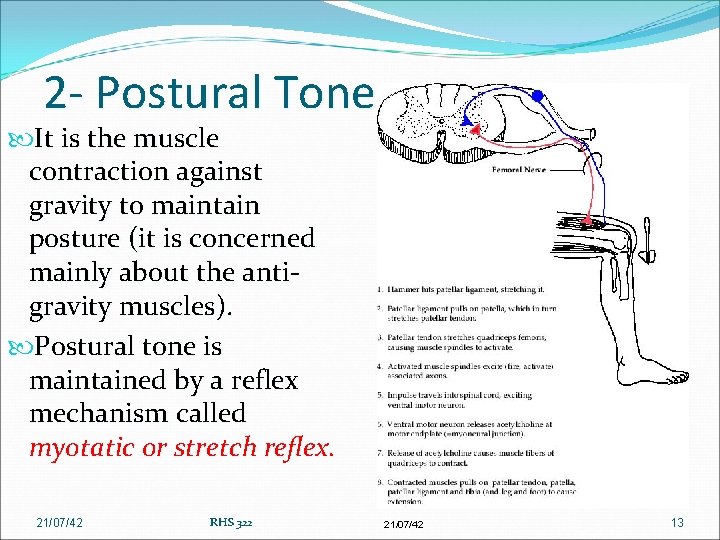
2 - Postural Tone It is the muscle contraction against gravity to maintain posture (it is concerned mainly about the antigravity muscles). Postural tone is maintained by a reflex mechanism called myotatic or stretch reflex. 21/07/42 RHS 322 21/07/42 13
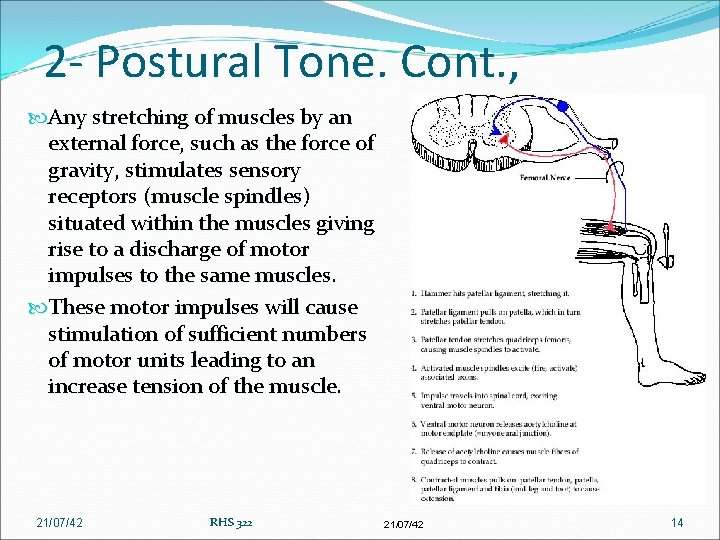
2 - Postural Tone. Cont. , Any stretching of muscles by an external force, such as the force of gravity, stimulates sensory receptors (muscle spindles) situated within the muscles giving rise to a discharge of motor impulses to the same muscles. These motor impulses will cause stimulation of sufficient numbers of motor units leading to an increase tension of the muscle. 21/07/42 RHS 322 21/07/42 14
Postural Tone. Cont. , The degree and location of postural tone varies with any alteration in posture. in upright positions, where the force of gravity tends to stretch muscles more strongly, in recumbent positions, where the effects of the force of gravity is adequately counterbalanced by full support of the body. 21/07/42 RHS 322 21/07/42 15
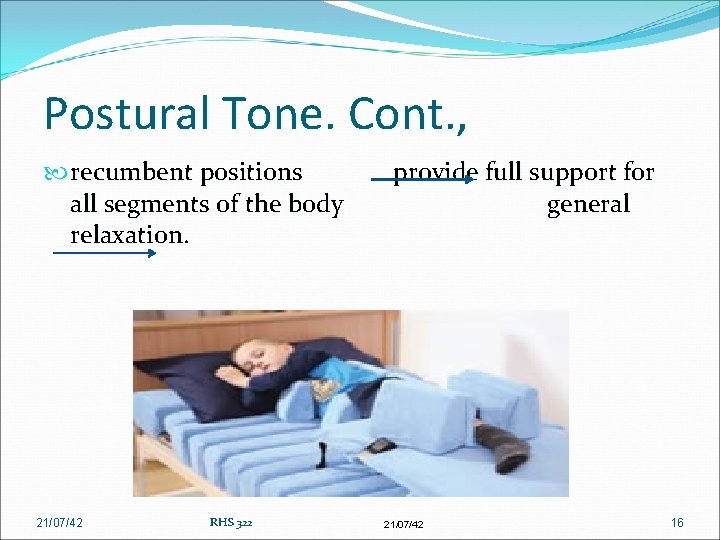
Postural Tone. Cont. , recumbent positions provide full support for all segments of the body general relaxation. 21/07/42 RHS 322 21/07/42 16
3 - Voluntary Movement After any muscle contraction and completion of the movement, the muscles come to rest and relax. There is a recognized biological principle that activity of living cells tends to be followed by inhibition of that activity (contraction=relaxation). 21/07/42 RHS 322 21/07/42 17
Voluntary Movement. Cont. , Contraction in any one group of muscles is accompanied by a reciprocal relaxation of the antagonistic group to allow movement to take place smoothly. These facts are of importance during consideration of methods designed to obtain relaxation of a particular group of muscles (Reciprocal inhibition). 21/07/42 RHS 322 21/07/42 18
4 - Mental Attitude Mental attitudes such as fear, anger and exciting give rise of the muscle tension and preparing the muscle for rapid or forceful action. Normally, this tension is reduced with relaxation, but in some cases it may become habitual and lead to change of normal posture. 21/07/42 RHS 322 21/07/42 19
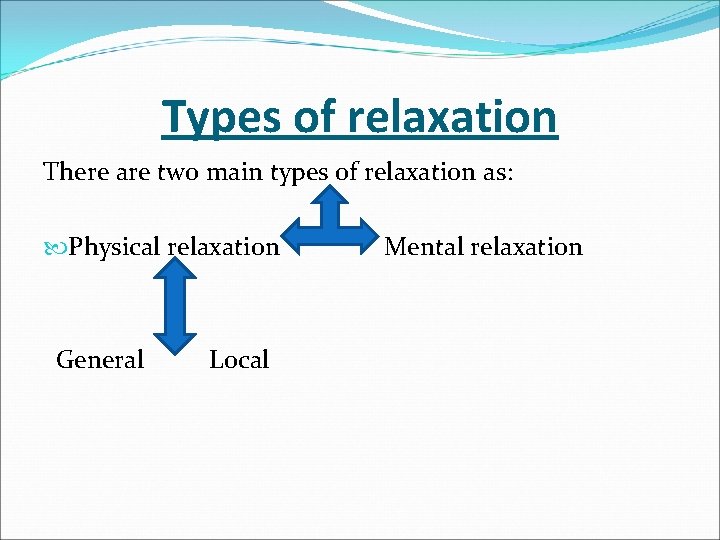
Types of relaxation There are two main types of relaxation as: Physical relaxation Mental relaxation General Local
a-General relaxation It is obtained through positioning of body in fully supported comfortable position which is sitting, half lying, side lying or back lying position. Pillows and cushions are used to accommodate body curves and supported head and limbs. The most common and preferable position is modified side lying position (side lying lateral): because all body parts are rested or firmly supported and no muscles are acting to carry weight.
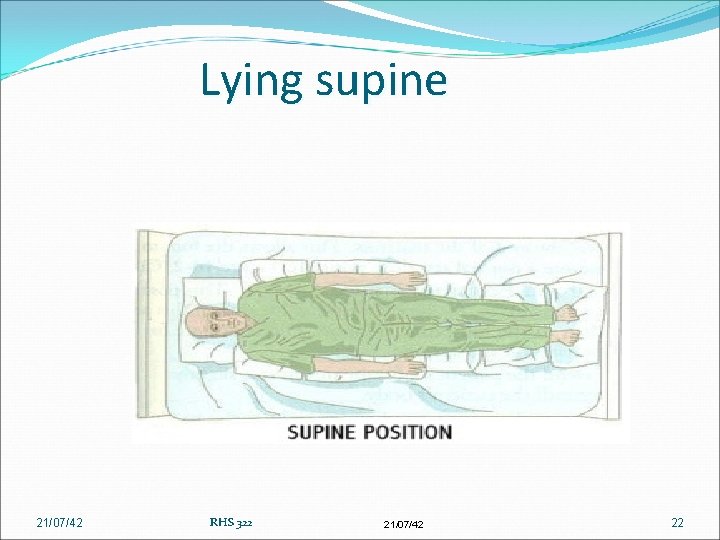
Lying supine 21/07/42 RHS 322 21/07/42 22
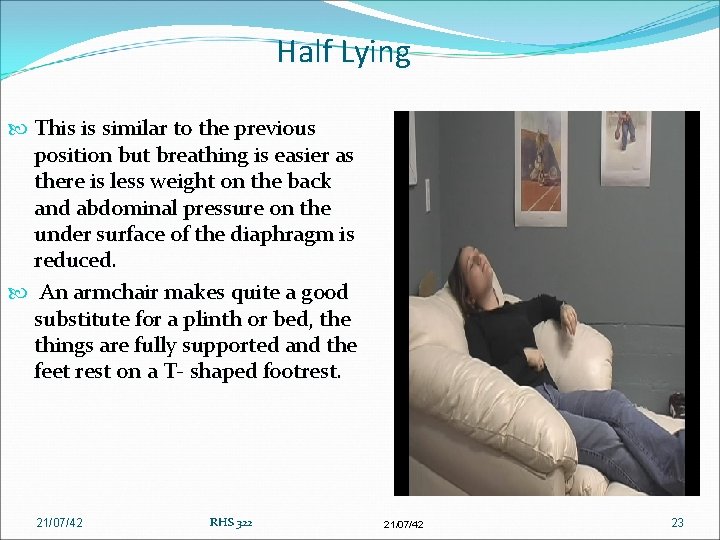
Half Lying This is similar to the previous position but breathing is easier as there is less weight on the back and abdominal pressure on the under surface of the diaphragm is reduced. An armchair makes quite a good substitute for a plinth or bed, the things are fully supported and the feet rest on a T- shaped footrest. 21/07/42 RHS 322 21/07/42 23
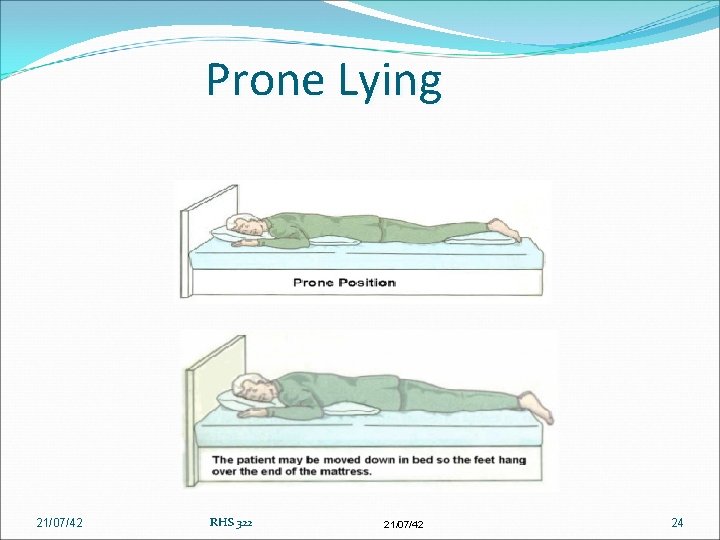
Prone Lying 21/07/42 RHS 322 21/07/42 24
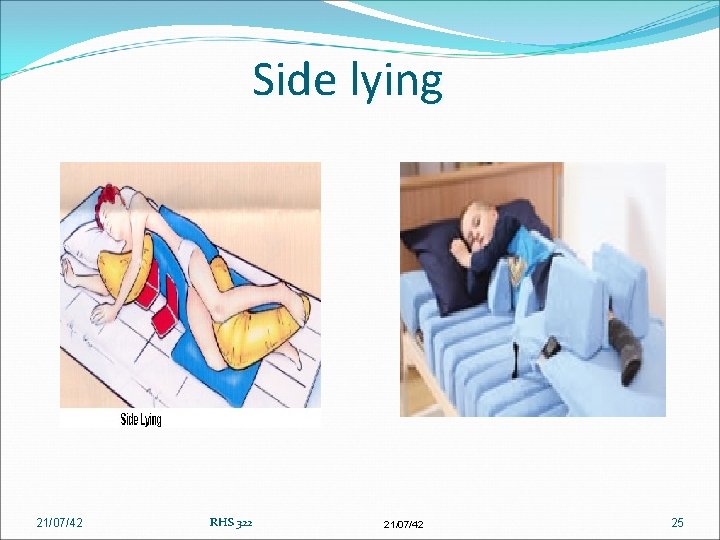
Side lying 21/07/42 RHS 322 21/07/42 25
How can we gain relaxation? 1 -Autogenic training. This approach, involves conscious relaxation through autosuggestion and a progression of exercises as well as meditation. Autogenic Training restores the balance between the activity of the sympathetic (flight or fight) and the parasympathetic (rest and digest) branches of the autonomic nervous system. This has important health benefits, as the parasympathetic activity promotes digestion and bowel movements, lowers the blood pressure, slows the heart rate, and promotes the functions of the immune system.
2 -Awareness through movement The system of therapy combines sensory awareness, movements of the limbs and trunk, deep breathing, conscious relaxation procedures, and self-massage to alter muscle imbalances and abnormal postural alignment to remediate muscle tension and pain.
3 -Progressive relaxation This technique, uses systematic, distal to proximal progression of voluntary contraction and relaxation of muscles. You can combine deep breathing with progressive muscle relaxation for an additional level of stress relief.
Sequence for Progressive Relaxation Techniques Place the patient in a quiet area and in a comfortable position, and be sure that restrictive clothing is loosened. Have the patient breathe in a deep, relaxed manner. Ask the patient to contract the distal musculature in the hands or feet voluntarily for several (5 to 7) seconds and then consciously relax those muscles for 20 to 30 seconds.
Suggest that the patient try to feel a sense of heaviness in the hands or feet and a sense of warmth in the muscles just relaxed. Progress to a more proximal area of the body and have the patient actively contract and actively relax the more proximal musculature. Eventually have the patient isometrically contract and consciously relax the entire extremity. Suggest to the patient that he or she should feel a sense of relaxation and warmth throughout the entire limb and eventually throughout the whole body.
The most popular sequence runs as follows Right foot* Left foot Right calf Left calf Right thigh Left thigh Hips and buttocks Stomach Chest Back Right arm and hand Left arm and hand Neck and shoulders Face
4 -Relaxation with breathing control Contrast method: for small joints (toes, ankle, fingers and hand): With inspiration, subject should feel tension (i. e. bend toes up and down) With expiration, subject should lose tension (i. e. release toes)
Deep Breathing Deep breathing is a simple but very effective method of relaxation. It’s easy to learn, can be practiced almost anywhere, and provides a quick way to get your stress levels in check. Deep breathing is the cornerstone of many other relaxation practices, too, and can be combined with other relaxing elements such as aromatherapy and music.
The key to deep breathing is to breathe deeply from the abdomen, getting as much fresh air as possible in your lungs. When you take deep breaths from the abdomen, rather than shallow breaths from your upper chest, you inhale more oxygen. The more oxygen you get, the less tense
5 -Body scan meditation for stress relief A body scan is similar to progressive muscle relaxation except, instead of tensing and relaxing muscles, you simply focus on the sensations in each part of your body.
6. Rhythmic exercise as a mindfulness relaxation technique Rhythmic exercise—such as running, walking, rowing, or cycling—is most effective at relieving stress when performed with relaxation in mind. It requires being fully engaged in the present moment, focusing your mind on how your body feels right now. For example, If walking or running, focus on each step—the sensation of your feet touching the ground, the rhythm of your breath while moving will gain relaxation.
b-local relaxation 1 -Heat Superficial heat (hot packs, paraffin) or deep-heating modalities (ultrasound, shortwave diathermy) provide different mechanisms to heat tissues. These thermal agents are used primarily to heat small areas such as individual joints, muscle groups, or tendons and may be applied prior to or during the stretching procedure.
2 -Massage self-massage, using light stroking techniques (effleurage), is performed during the relaxation process. In sports and conditioning programs, massage has been used for general relaxation purposes or to enhance recovery after strenuous physical activity. Because massage has been shown to increase circulation to muscles and decrease muscle spasm, it is a useful adjunct to stretching exercises.
3 -Biofeedback is another tool to help a patient learn and practice the process of relaxation. A patient, if properly trained, can electronically monitor and learn to reduce the amount of tension in muscles, as well as heart rate and blood pressure, through biofeedback instrumentation. Through visual or auditory feedback, a patient can begin to sense or feel what muscle relaxation is. By reducing muscle tension, pain can be decreased and flexibility increased.
4 -Joint Traction or Oscillation Slight manual distraction of joint surfaces prior to or in conjunction with joint mobilization or muscletendon stretching techniques can be used to inhibit joint pain and spasm of muscles around a joint
5. Pendular swinging -This is used for relaxation of the limbs. The arm/s or leg/s may be swing back and forward until they feel numb. The sensory receptors have accommodated to the constant movement. This type of swinging may be aided by adding from a 1/2 to 1 kg weight to the limb. -It is the most suitable for the shoulder, hips, knee. (Pendular motions of a joint use the weight of the limb to distract the joint surfaces). 21/07/42 RHS 322 21/07/42 41
2) Mental relaxation a) Rhythm: mind directed to follow given rhythm as sort of lights, music, sound of clock, individual breathing sound or hear a high-pitched rushing sound in your ear for 10 -15 minutes. b) Colors: individual thinking of certain color while body parts should be completely relaxed. c) Numbers: individuals count backward from 100. d) Attention focusing: individual use visual focal point for concentration
e) Guided Imagery In this technique, the goal is to visualize you in a peaceful setting. Lie on your back with your eyes closed. Imagine yourself in a favorite, peaceful place. The place may be on a sunny beach with the ocean breezes caressing you, swinging in a hammock in the mountains or in your own backyard. Any place that you find peaceful and relaxing is OK.
Imagine you are there. See and feel your surroundings, hear the peaceful sounds, smell the flowers, fell the warmth of the sun and any other sensations that you find. Relax and enjoy it. You can return to this place any night you need to. As you use this place more and more you will find it easier to fall asleep as this imagery becomes a sleep conditioner.
How to test relaxation By sight By palpation By passive movement By shacking the limb By raising the limb and sudden fall down By EMG 21/07/42 RHS 322 21/07/42 45
Indicators of Relaxation Decreased muscle tension Lowered heart and respiratory rates and blood pressure Increased skin temperature in the extremities associated with vasodilation Constricted pupils Little to no body movement Eyes closed and flat facial expression Jaw and hands relaxed with palms open
Advices to obtain relaxation in our life If possible, schedule a set time to practice each day. Set aside one or two periods each day. Practice relaxation techniques while you’re doing other things. Avoid practicing when you’re sleepy. Do not practice after eating a heavy meal or while using drugs, tobacco, or alcohol. Expect ups and downs. Don’t be discouraged if you skip a few days or even a few weeks. It happens. Just get started again and slowly build up to your old momentum.
- Slides: 47