
Relativity made simple The Laws of Physics the
- Slides: 29
Relativity made simple?
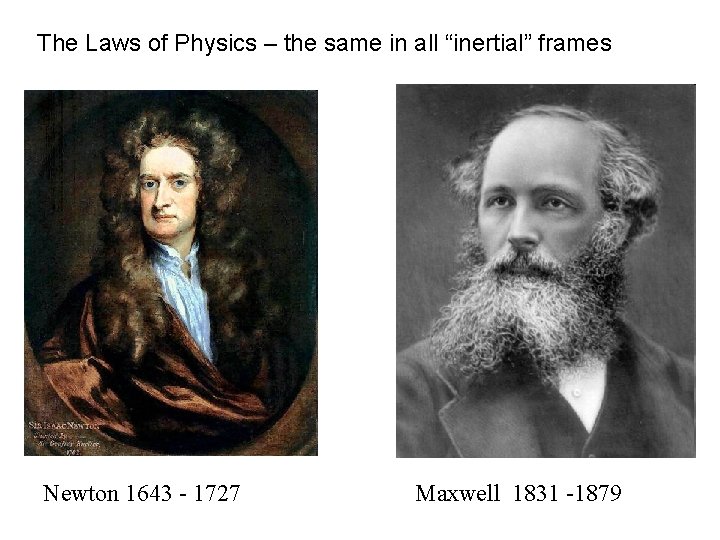
The Laws of Physics – the same in all “inertial” frames Newton 1643 - 1727 Maxwell 1831 -1879
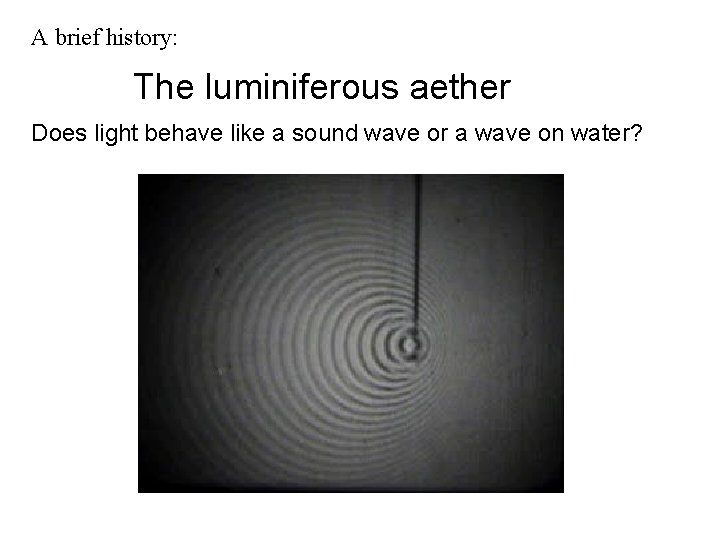
A brief history: The luminiferous aether Does light behave like a sound wave or a wave on water?
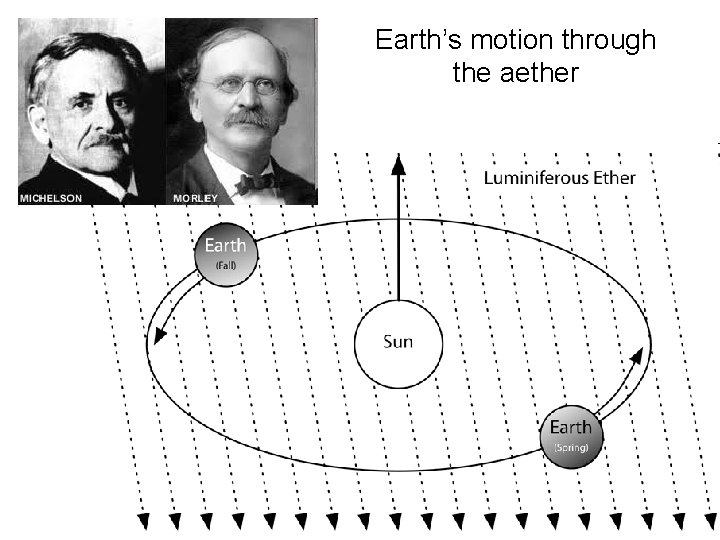
Earth’s motion through the aether
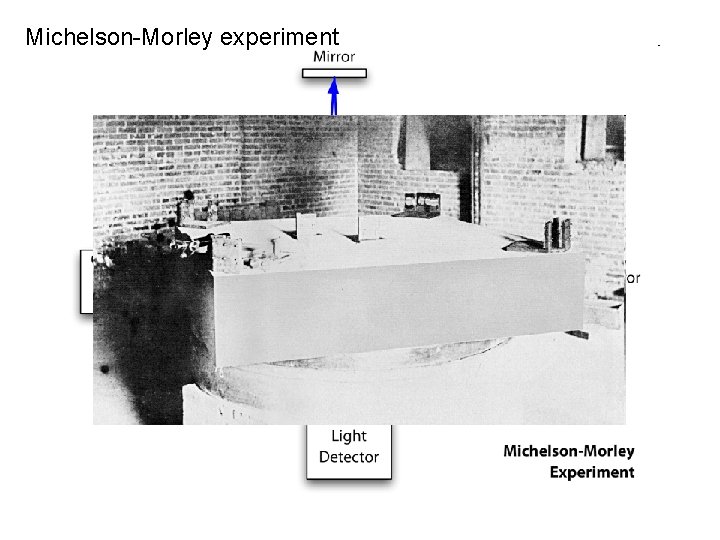
Michelson-Morley experiment
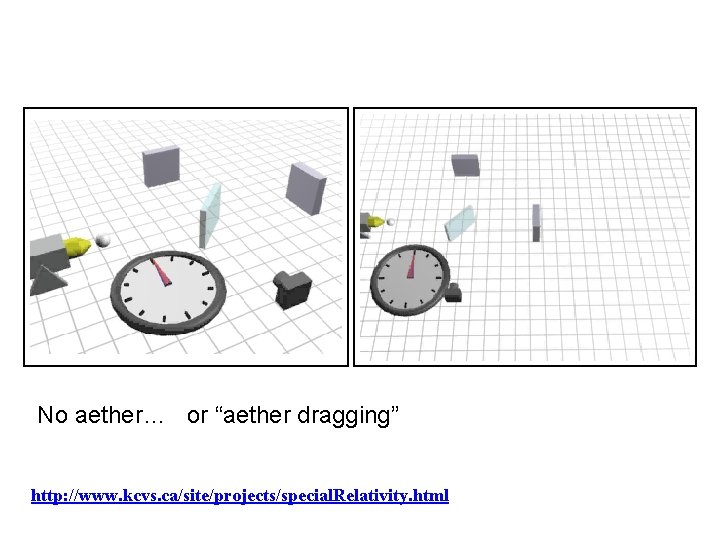
No aether… or “aether dragging” http: //www. kcvs. ca/site/projects/special. Relativity. html
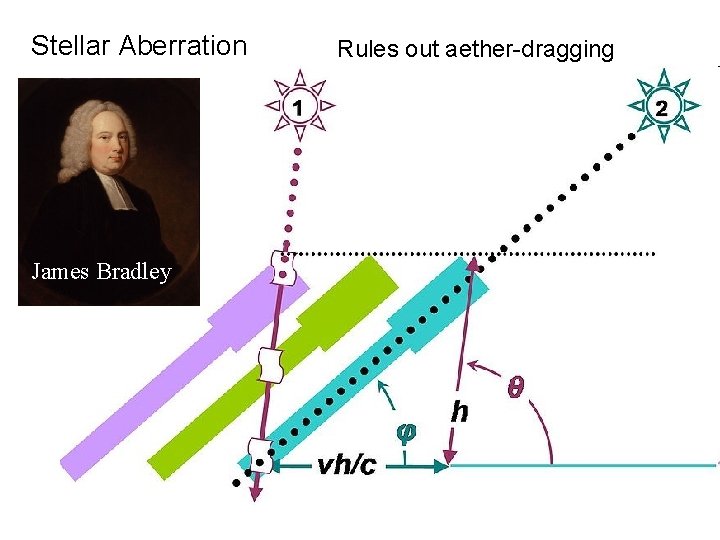
Stellar Aberration James Bradley Rules out aether-dragging
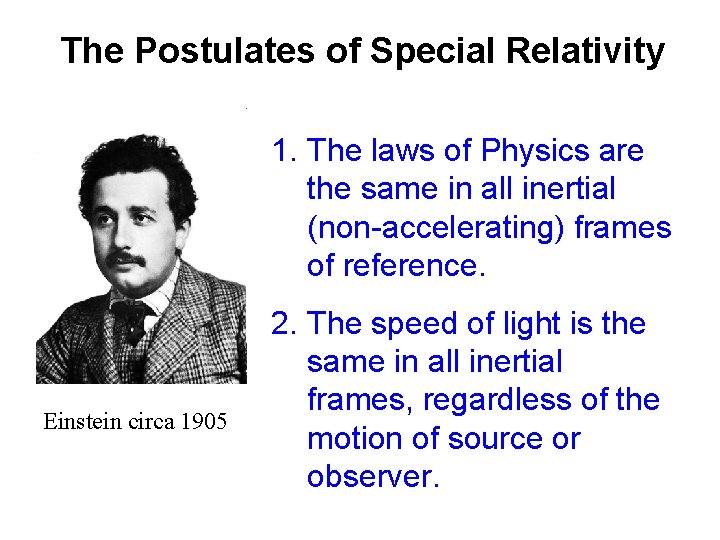
The Postulates of Special Relativity 1. The laws of Physics are the same in all inertial (non-accelerating) frames of reference. Einstein circa 1905 2. The speed of light is the same in all inertial frames, regardless of the motion of source or observer.
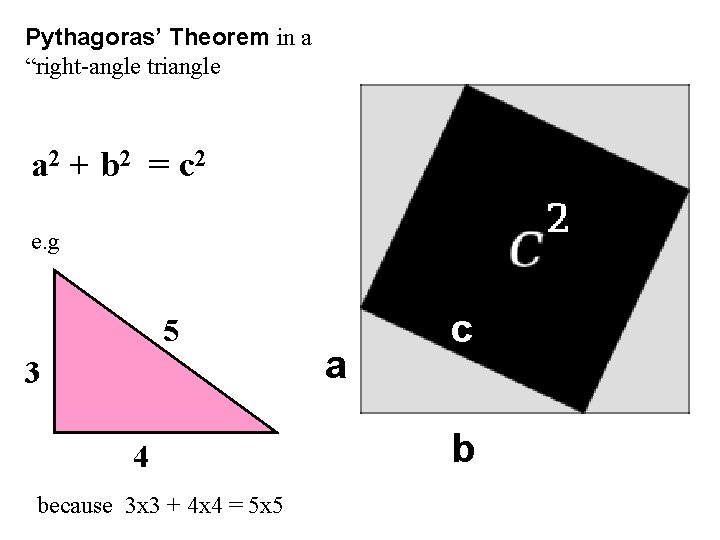
Pythagoras’ Theorem in a “right-angle triangle a 2 + b 2 = c 2 e. g 5 3 4 because 3 x 3 + 4 x 4 = 5 x 5 a c b
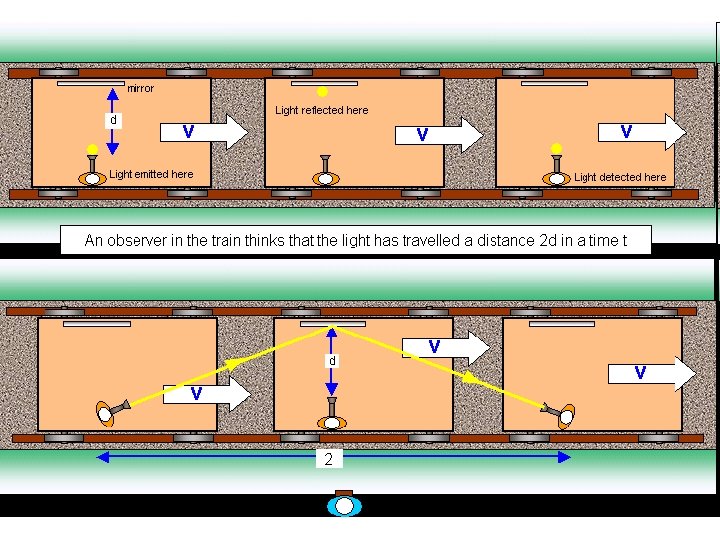
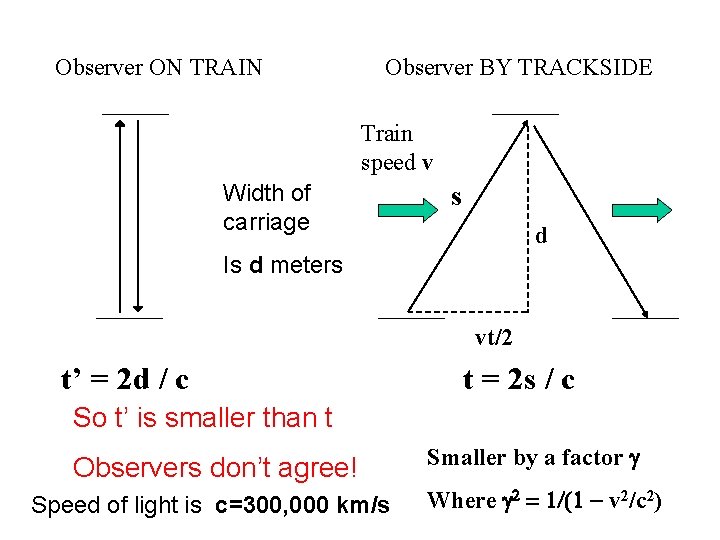
Observer ON TRAIN Observer BY TRACKSIDE Train speed v Width of carriage s d Is d meters vt/2 t’ = 2 d / c t = 2 s / c So t’ is smaller than t Observers don’t agree! Speed of light is c=300, 000 km/s Smaller by a factor g Where g 2 = 1/(1 - v 2/c 2)
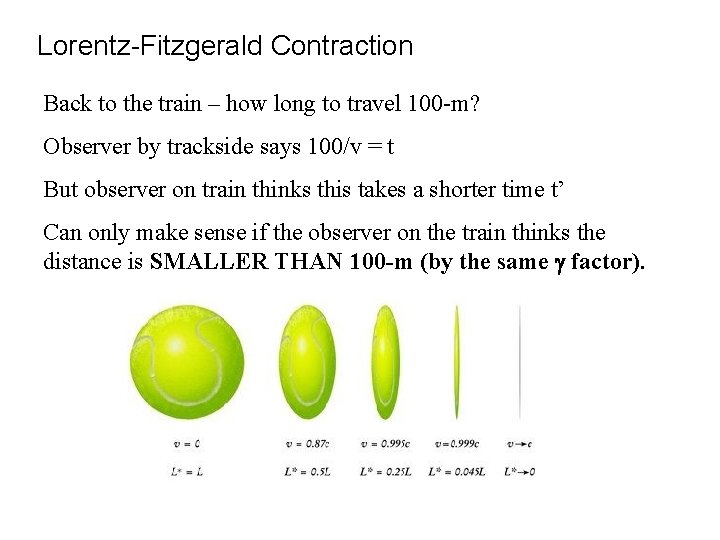
Lorentz-Fitzgerald Contraction Back to the train – how long to travel 100 -m? Observer by trackside says 100/v = t But observer on train thinks this takes a shorter time t’ Can only make sense if the observer on the train thinks the distance is SMALLER THAN 100 -m (by the same g factor).
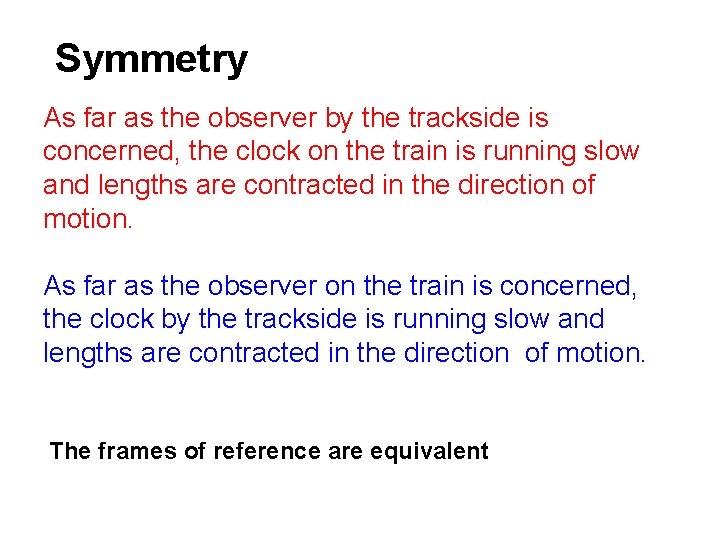
Symmetry As far as the observer by the trackside is concerned, the clock on the train is running slow and lengths are contracted in the direction of motion. As far as the observer on the train is concerned, the clock by the trackside is running slow and lengths are contracted in the direction of motion. The frames of reference are equivalent
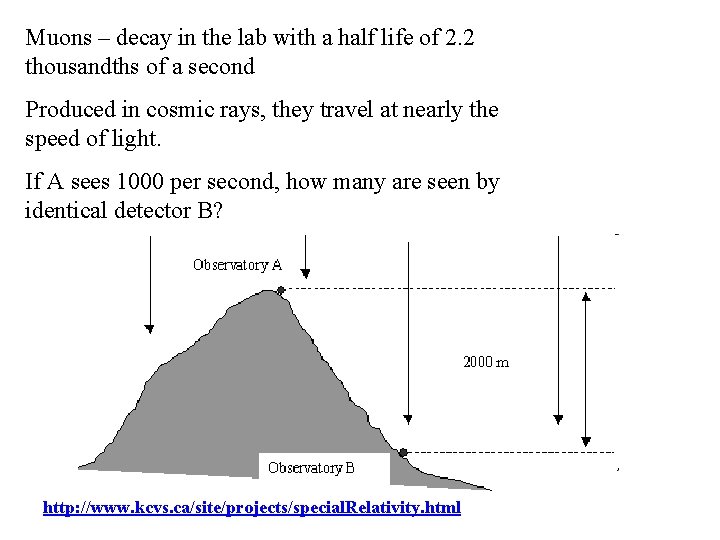
Muons – decay in the lab with a half life of 2. 2 thousandths of a second Produced in cosmic rays, they travel at nearly the speed of light. If A sees 1000 per second, how many are seen by identical detector B? http: //www. kcvs. ca/site/projects/special. Relativity. html
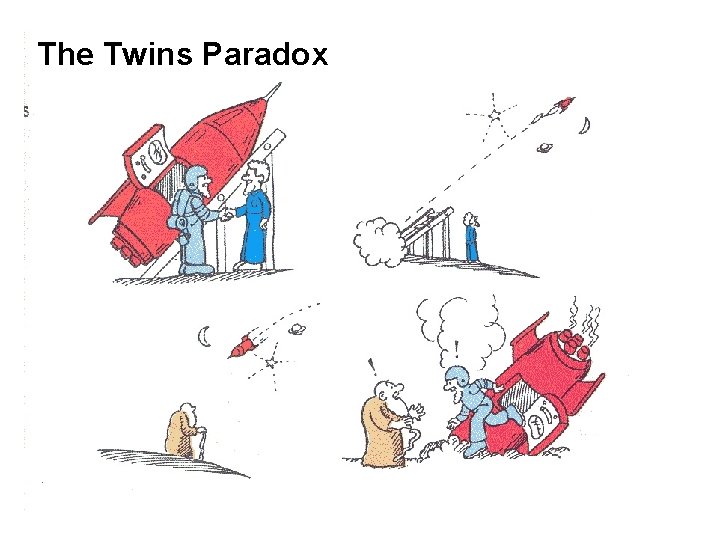
The Twins Paradox
Homework ! Watch this film http: //www/scivee. tv/node/2415
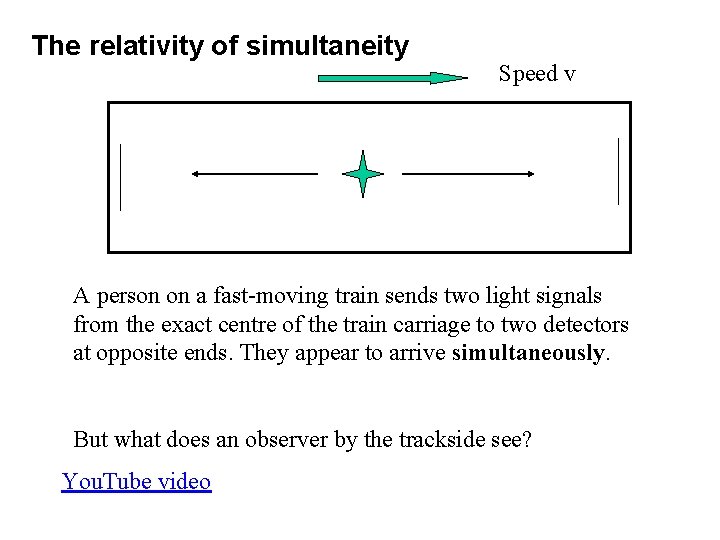
The relativity of simultaneity Speed v A person on a fast-moving train sends two light signals from the exact centre of the train carriage to two detectors at opposite ends. They appear to arrive simultaneously. But what does an observer by the trackside see? You. Tube video
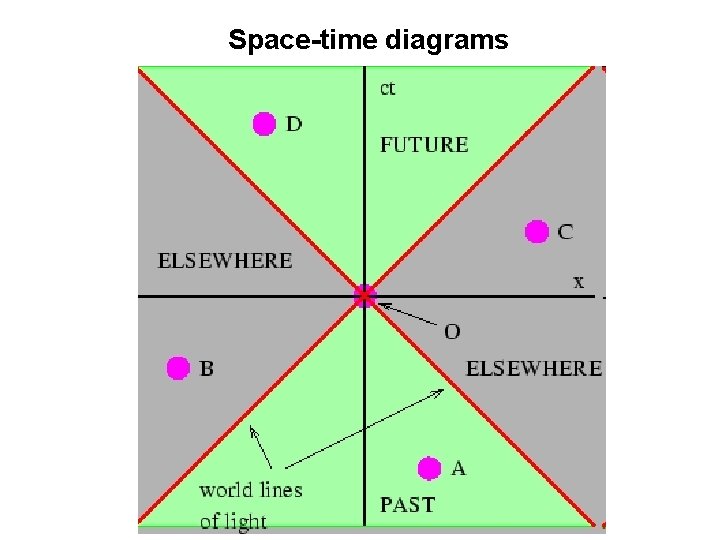
Space-time diagrams
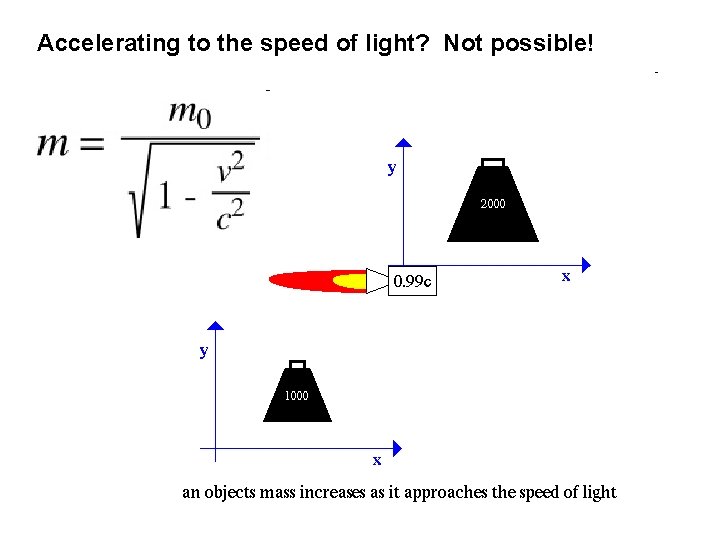
Accelerating to the speed of light? Not possible!
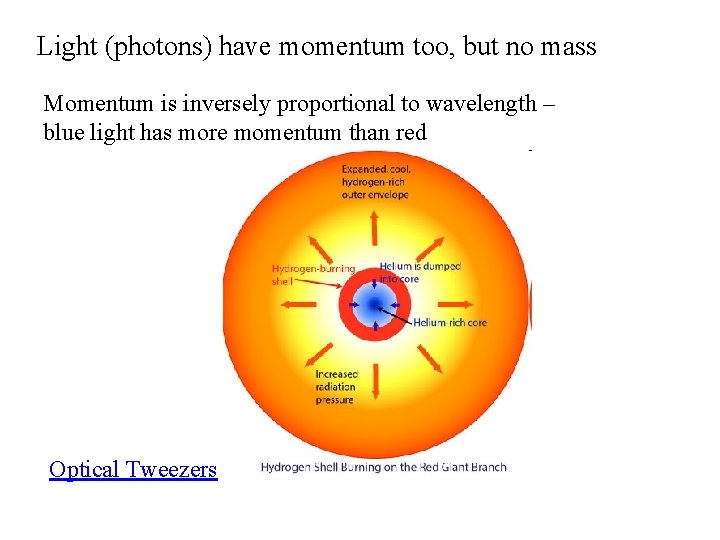
Light (photons) have momentum too, but no mass Momentum is inversely proportional to wavelength – blue light has more momentum than red Optical Tweezers
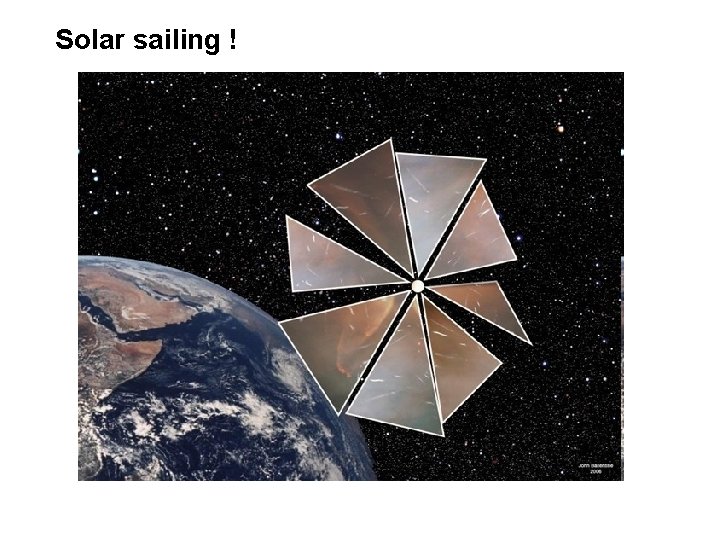
Solar sailing !
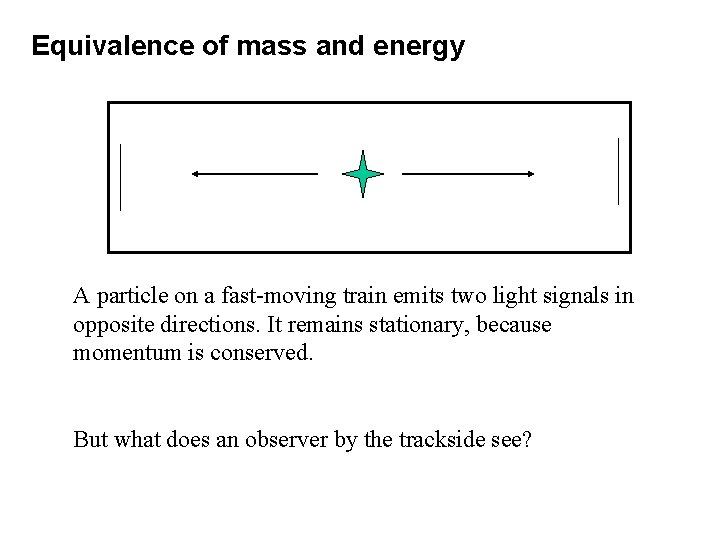
Equivalence of mass and energy A particle on a fast-moving train emits two light signals in opposite directions. It remains stationary, because momentum is conserved. But what does an observer by the trackside see?
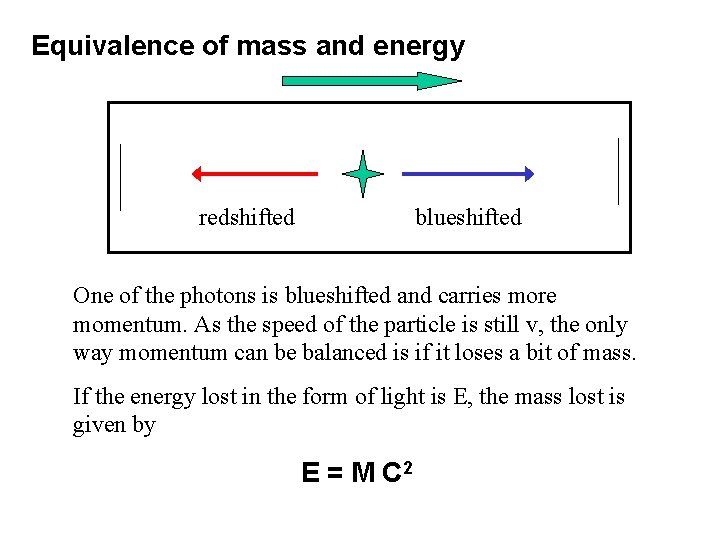
Equivalence of mass and energy redshifted blueshifted One of the photons is blueshifted and carries more momentum. As the speed of the particle is still v, the only way momentum can be balanced is if it loses a bit of mass. If the energy lost in the form of light is E, the mass lost is given by E = M C 2
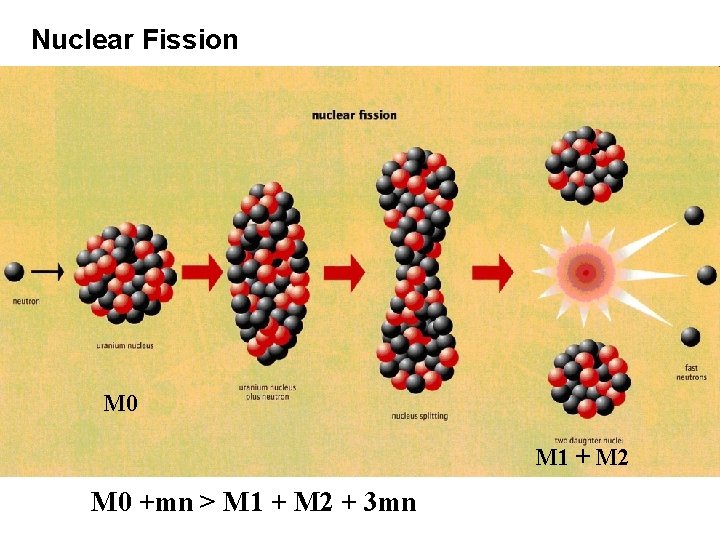
Nuclear Fission M 0 M 1 + M 2 M 0 +mn > M 1 + M 2 + 3 mn
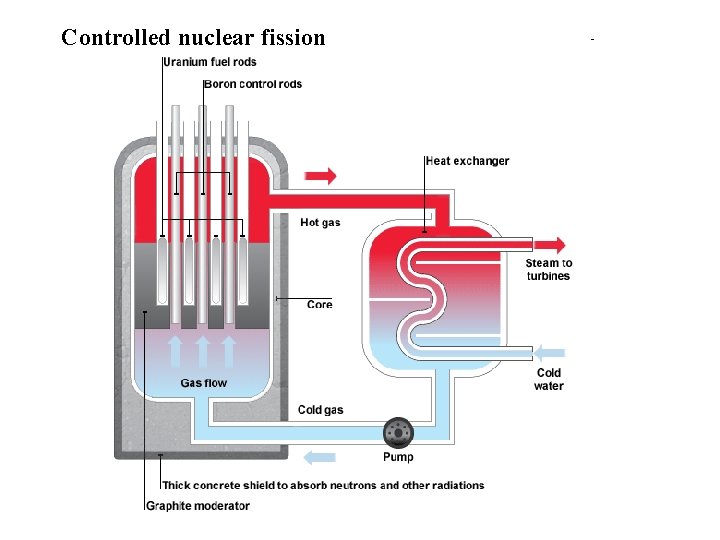
Controlled nuclear fission
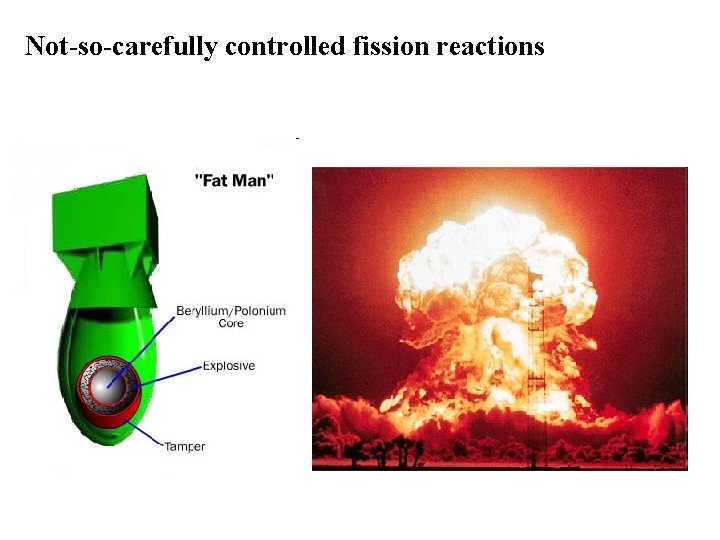
Not-so-carefully controlled fission reactions
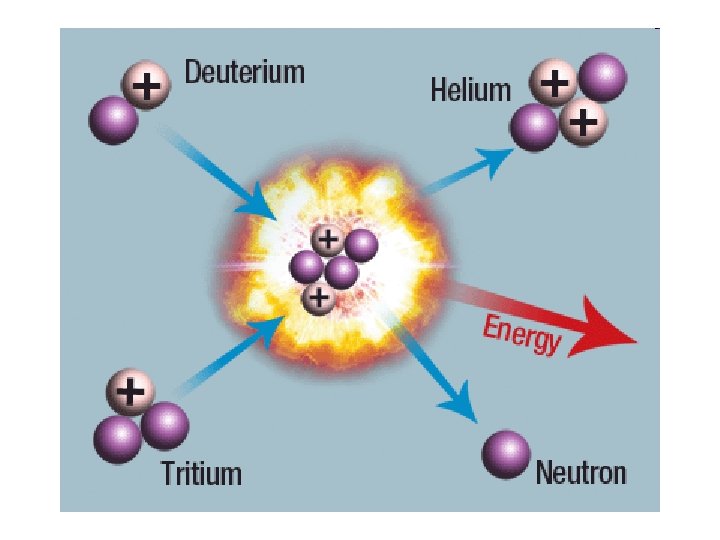
neutron