
Relativistic meanfield model with scaled hadron masses and
![Nuclear optical potential [Feldmeier, Lindner ZPA 341 (1991) 83] Date: Hama, Clark et al.](https://slidetodoc.com/presentation_image/1dbc4cb74d52d2a5d415fa09668d781a/image-8.jpg "Nuclear optical potential [Feldmeier, Lindner ZPA 341 (1991) 83] Date: Hama, Clark et al.")
![Mass-radius constraints BPA: Bayesian probability analysis [Lattimer, Steiner …] msp PSRJ 0437 -4715: 3](https://slidetodoc.com/presentation_image/1dbc4cb74d52d2a5d415fa09668d781a/image-14.jpg "Mass-radius constraints BPA: Bayesian probability analysis [Lattimer, Steiner …] msp PSRJ 0437 -4715: 3")
- Slides: 15
Relativistic mean-field model with scaled hadron masses and coupling constants and the Hyperon Puzzle Evgeni E. Kolomeitsev (University of Matej Bel, Slovakia) work in collaboration with K. Maslov and D. N. Voskresensky Ø RMF model with scaling. Nuclear matter constraints Ø Inclusion of hyperons. Phi meson mass reduction. Ø Maximum mass of neutron star with hyperons and strangeness concentration
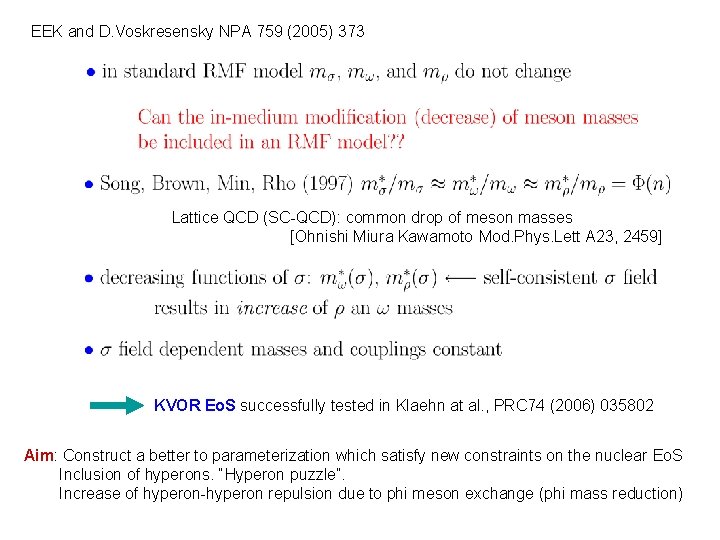
EEK and D. Voskresensky NPA 759 (2005) 373 Lattice QCD (SC-QCD): common drop of meson masses [Ohnishi Miura Kawamoto Mod. Phys. Lett A 23, 2459] KVOR Eo. S successfully tested in Klaehn at al. , PRC 74 (2006) 035802 Aim: Construct a better to parameterization which satisfy new constraints on the nuclear Eo. S Inclusion of hyperons. “Hyperon puzzle”. Increase of hyperon-hyperon repulsion due to phi meson exchange (phi mass reduction)
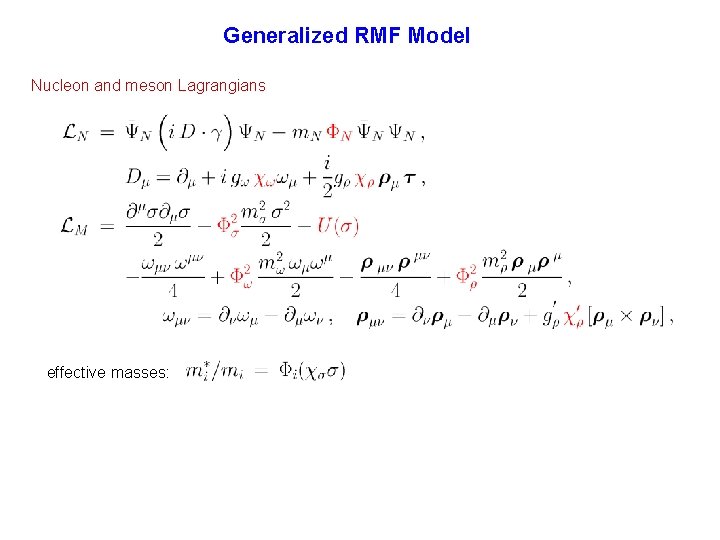
Generalized RMF Model Nucleon and meson Lagrangians effective masses:
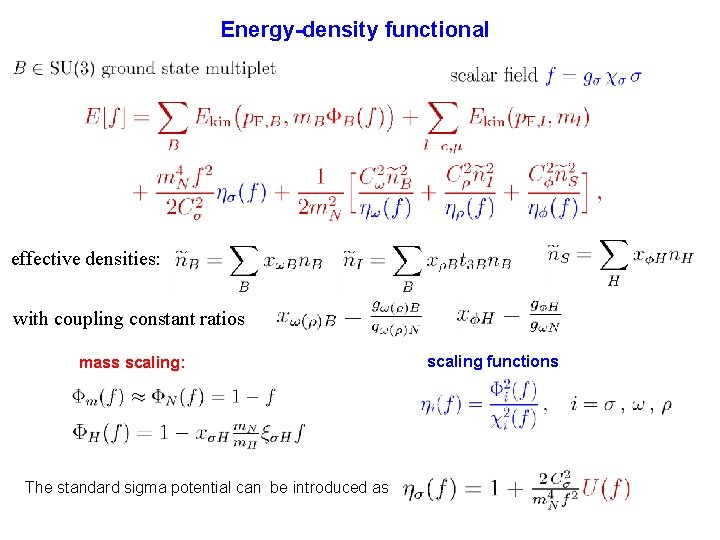
Energy-density functional effective densities: with coupling constant ratios mass scaling: The standard sigma potential can be introduced as scaling functions
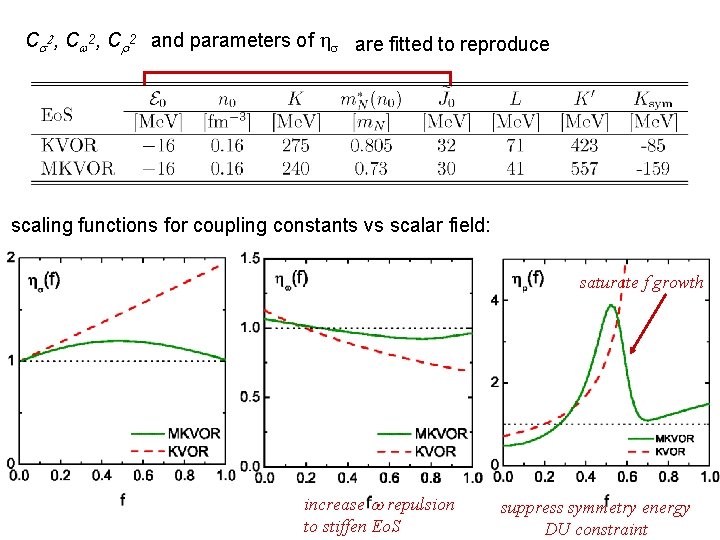
Cs 2, Cw 2, Cr 2 and parameters of hs are fitted to reproduce scaling functions for coupling constants vs scalar field: saturate f growth increase w repulsion to stiffen Eo. S suppress symmetry energy DU constraint
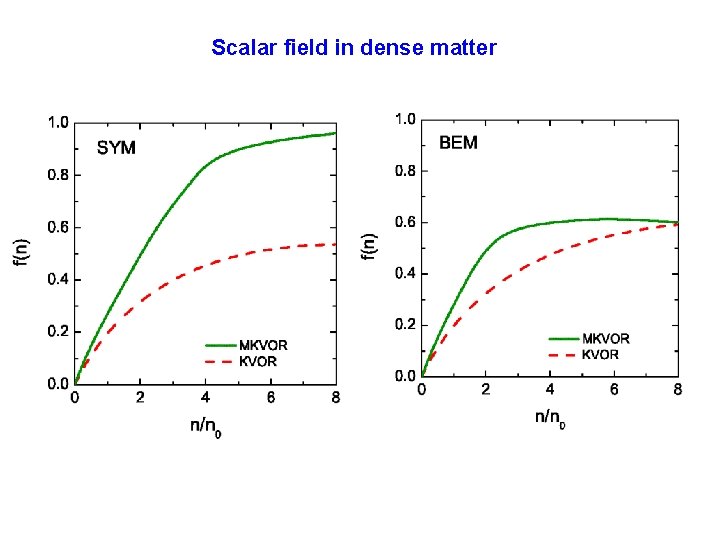
Scalar field in dense matter
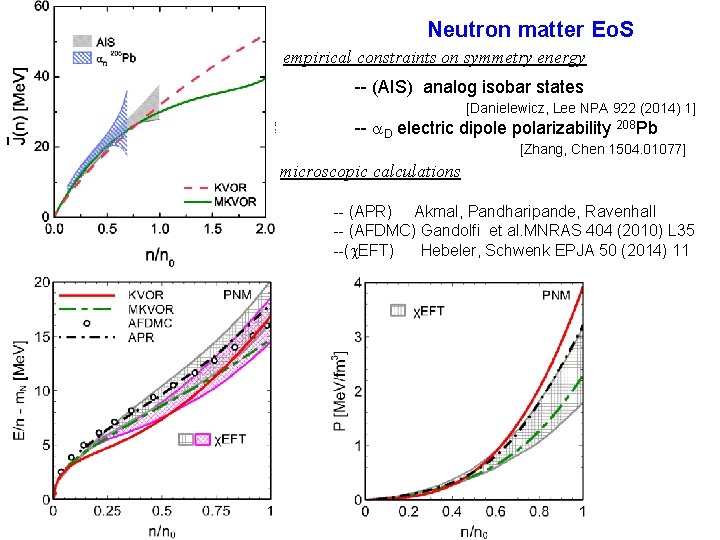
Neutron matter Eo. S empirical constraints on symmetry energy -- (AIS) analog isobar states [Danielewicz, Lee NPA 922 (2014) 1] -- a. D electric dipole polarizability 208 Pb [Zhang, Chen 1504. 01077] microscopic calculations -- (APR) Akmal, Pandharipande, Ravenhall -- (AFDMC) Gandolfi et al. MNRAS 404 (2010) L 35 --(c. EFT) Hebeler, Schwenk EPJA 50 (2014) 11
Nuclear optical potential [Feldmeier, Lindner ZPA 341 (1991) 83] Date: Hama, Clark et al. , Phys. Rev. C 41 (1990) 2737
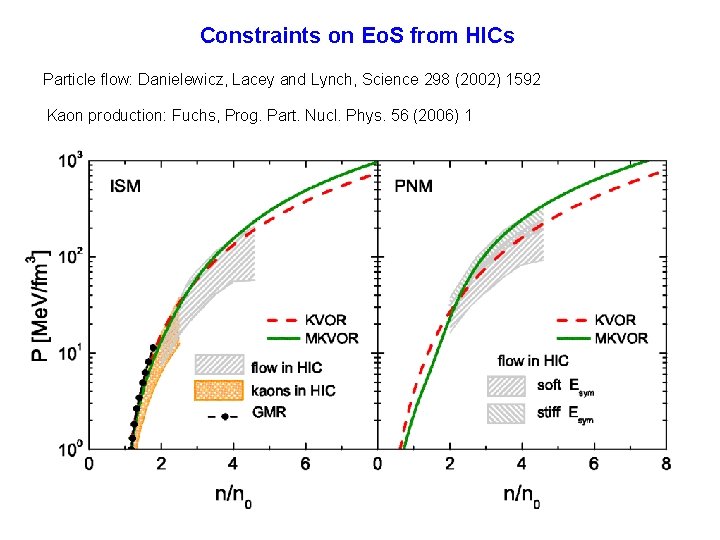
Constraints on Eo. S from HICs Particle flow: Danielewicz, Lacey and Lynch, Science 298 (2002) 1592 Kaon production: Fuchs, Prog. Part. Nucl. Phys. 56 (2006) 1
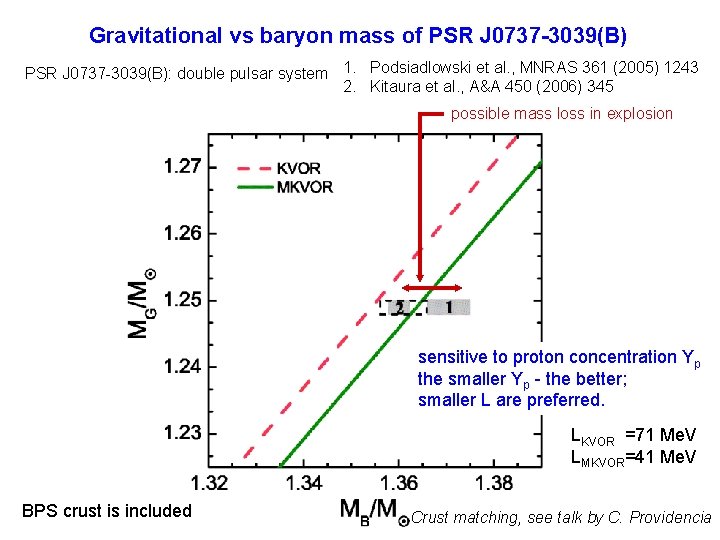
Gravitational vs baryon mass of PSR J 0737 -3039(B): double pulsar system 1. Podsiadlowski et al. , MNRAS 361 (2005) 1243 2. Kitaura et al. , A&A 450 (2006) 345 possible mass loss in explosion sensitive to proton concentration Yp the smaller Yp - the better; smaller L are preferred. LKVOR =71 Me. V LMKVOR=41 Me. V BPS crust is included Crust matching, see talk by C. Providencia
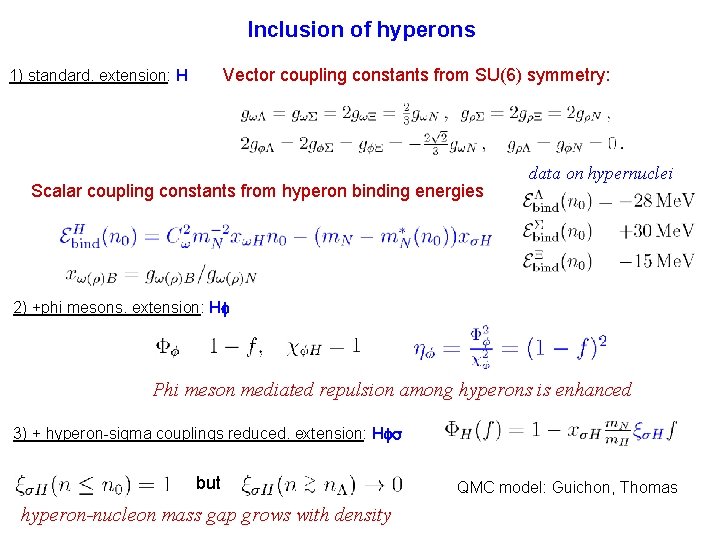
Inclusion of hyperons Vector coupling constants from SU(6) symmetry: 1) standard. extension: H Scalar coupling constants from hyperon binding energies data on hypernuclei 2) +phi mesons. extension: Hf Phi meson mediated repulsion among hyperons is enhanced 3) + hyperon-sigma couplings reduced. extension: Hfs but hyperon-nucleon mass gap grows with density QMC model: Guichon, Thomas
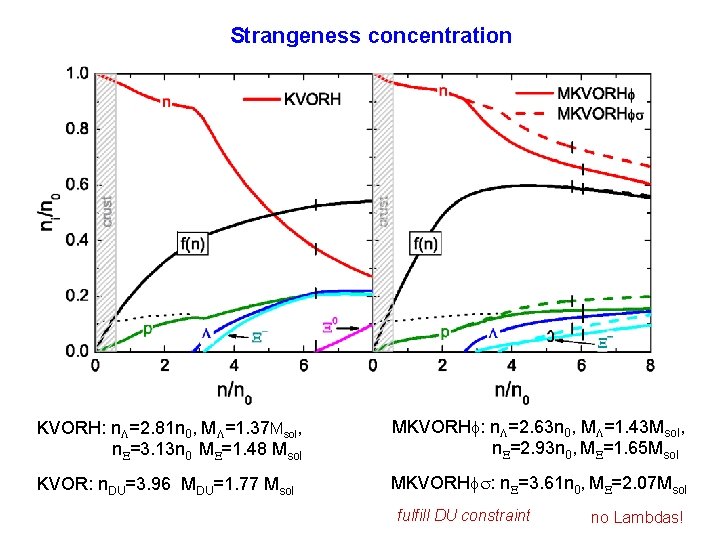
Strangeness concentration KVORH: n. L=2. 81 n 0, ML=1. 37 Msol, n. X=3. 13 n 0 MX=1. 48 Msol MKVORHf: n. L=2. 63 n 0, ML=1. 43 Msol, n. X=2. 93 n 0, MX=1. 65 Msol KVOR: n. DU=3. 96 MDU=1. 77 Msol MKVORHfs: n. X=3. 61 n 0, MX=2. 07 Msol fulfill DU constraint no Lambdas!
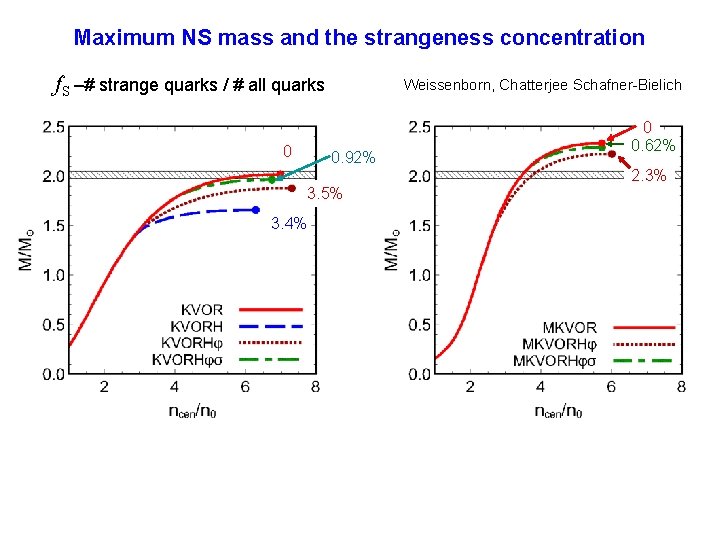
Maximum NS mass and the strangeness concentration f. S –# strange quarks / # all quarks 0 Weissenborn, Chatterjee Schafner-Bielich 0. 92% 0 0. 62% 2. 3% 3. 5% 3. 4%
Mass-radius constraints BPA: Bayesian probability analysis [Lattimer, Steiner …] msp PSRJ 0437 -4715: 3 s confidence Bogdanov Ap. J 762, 96 (2013)
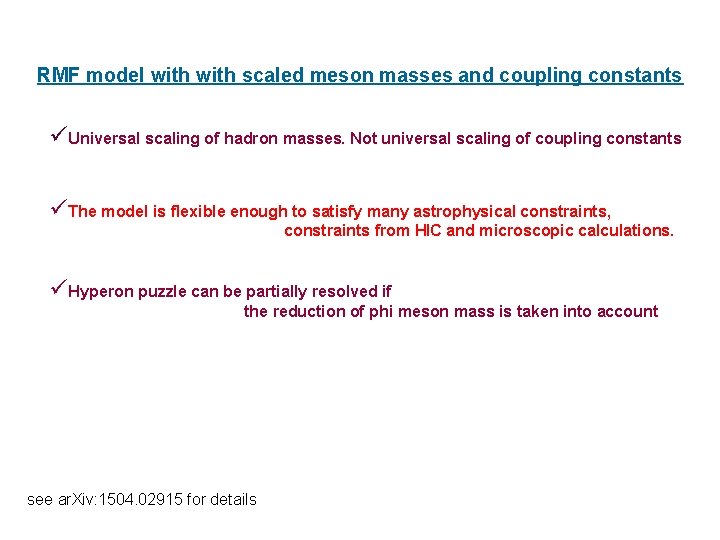
RMF model with scaled meson masses and coupling constants üUniversal scaling of hadron masses. Not universal scaling of coupling constants üThe model is flexible enough to satisfy many astrophysical constraints, constraints from HIC and microscopic calculations. üHyperon puzzle can be partially resolved if the reduction of phi meson mass is taken into account see ar. Xiv: 1504. 02915 for details