
Relatives Identifying Nonidentifying Clause 1 Some relative clause
- Slides: 6
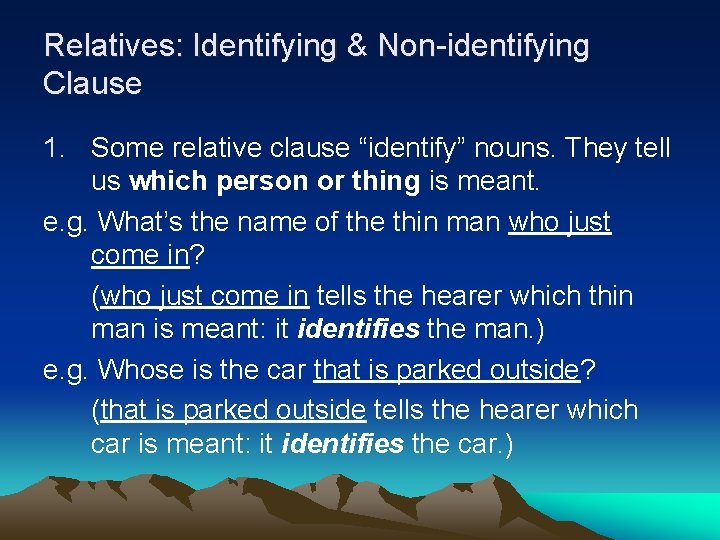
Relatives: Identifying & Non-identifying Clause 1. Some relative clause “identify” nouns. They tell us which person or thing is meant. e. g. What’s the name of the thin man who just come in? (who just come in tells the hearer which thin man is meant: it identifies the man. ) e. g. Whose is the car that is parked outside? (that is parked outside tells the hearer which car is meant: it identifies the car. )
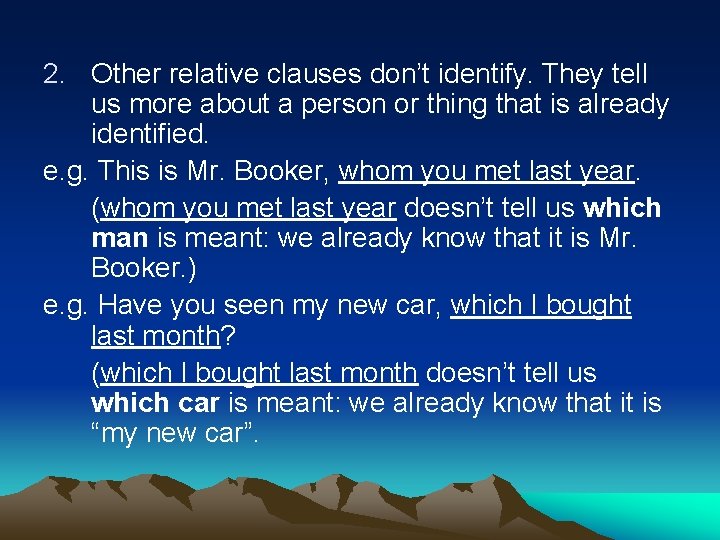
2. Other relative clauses don’t identify. They tell us more about a person or thing that is already identified. e. g. This is Mr. Booker, whom you met last year. (whom you met last year doesn’t tell us which man is meant: we already know that it is Mr. Booker. ) e. g. Have you seen my new car, which I bought last month? (which I bought last month doesn’t tell us which car is meant: we already know that it is “my new car”.
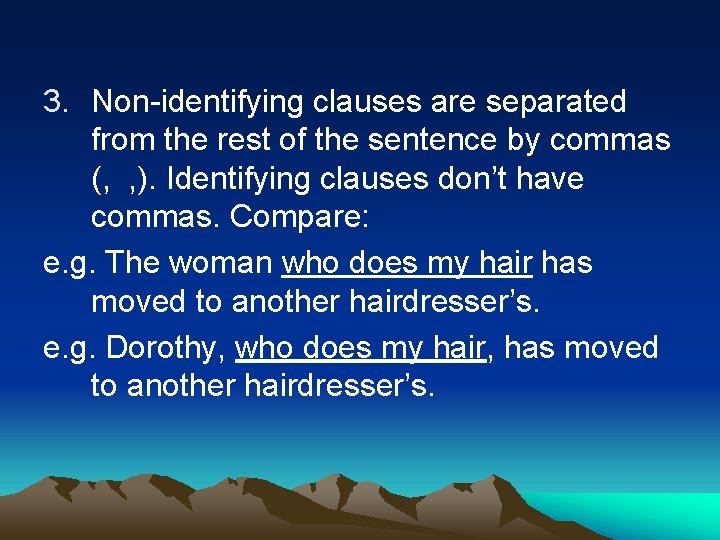
3. Non-identifying clauses are separated from the rest of the sentence by commas (, , ). Identifying clauses don’t have commas. Compare: e. g. The woman who does my hair has moved to another hairdresser’s. e. g. Dorothy, who does my hair, has moved to another hairdresser’s.
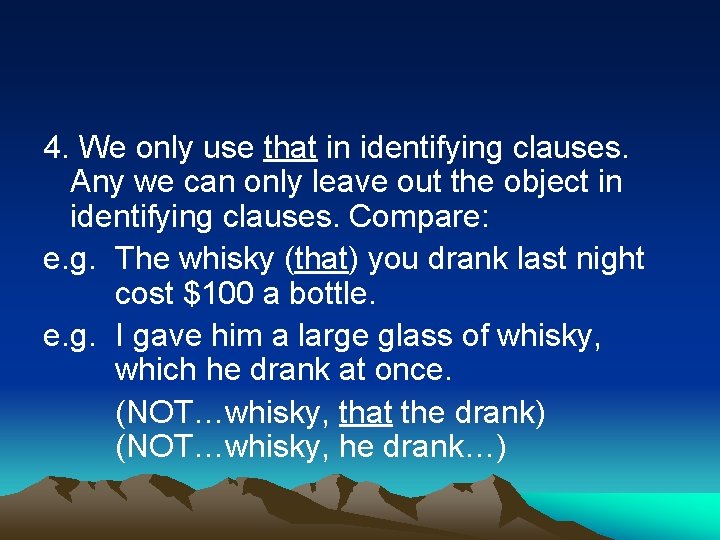
4. We only use that in identifying clauses. Any we can only leave out the object in identifying clauses. Compare: e. g. The whisky (that) you drank last night cost $100 a bottle. e. g. I gave him a large glass of whisky, which he drank at once. (NOT…whisky, that the drank) (NOT…whisky, he drank…)
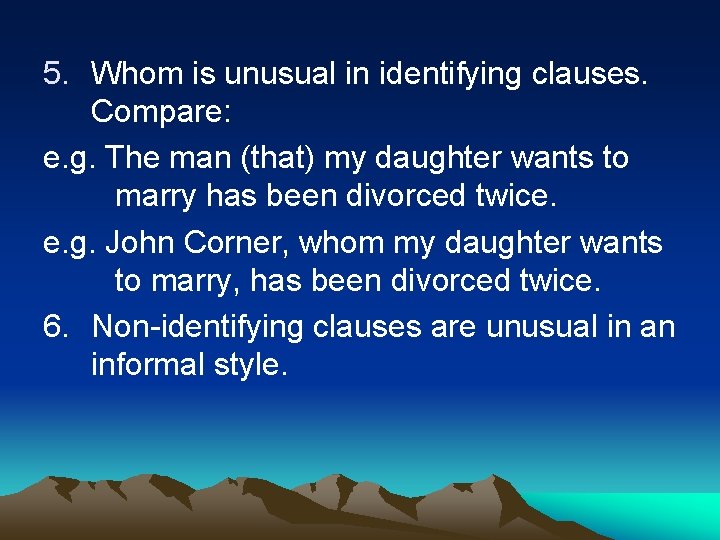
5. Whom is unusual in identifying clauses. Compare: e. g. The man (that) my daughter wants to marry has been divorced twice. e. g. John Corner, whom my daughter wants to marry, has been divorced twice. 6. Non-identifying clauses are unusual in an informal style.
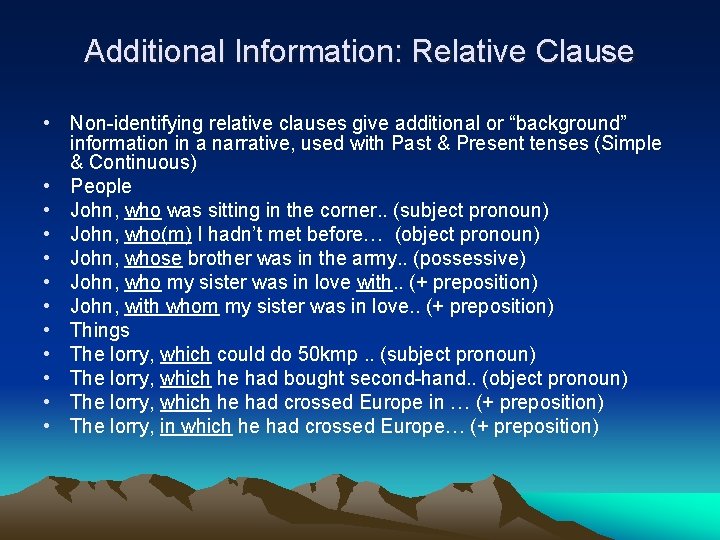
Additional Information: Relative Clause • Non-identifying relative clauses give additional or “background” information in a narrative, used with Past & Present tenses (Simple & Continuous) • People • John, who was sitting in the corner. . (subject pronoun) • John, who(m) I hadn’t met before… (object pronoun) • John, whose brother was in the army. . (possessive) • John, who my sister was in love with. . (+ preposition) • John, with whom my sister was in love. . (+ preposition) • Things • The lorry, which could do 50 kmp. . (subject pronoun) • The lorry, which he had bought second-hand. . (object pronoun) • The lorry, which he had crossed Europe in … (+ preposition) • The lorry, in which he had crossed Europe… (+ preposition)