
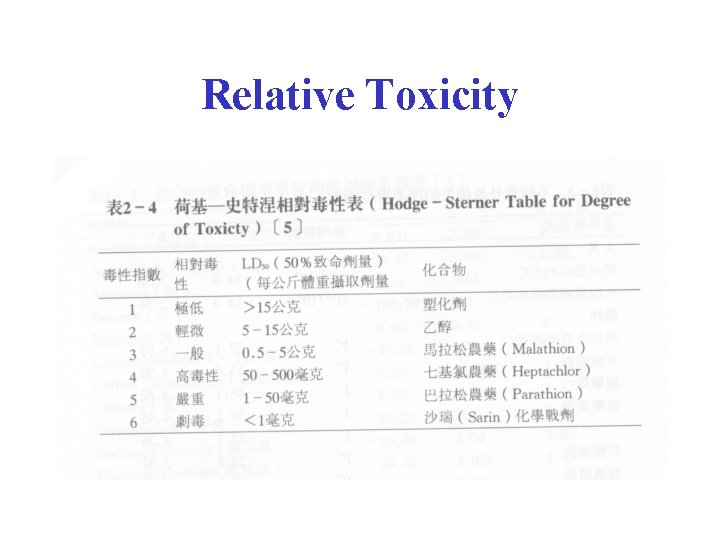
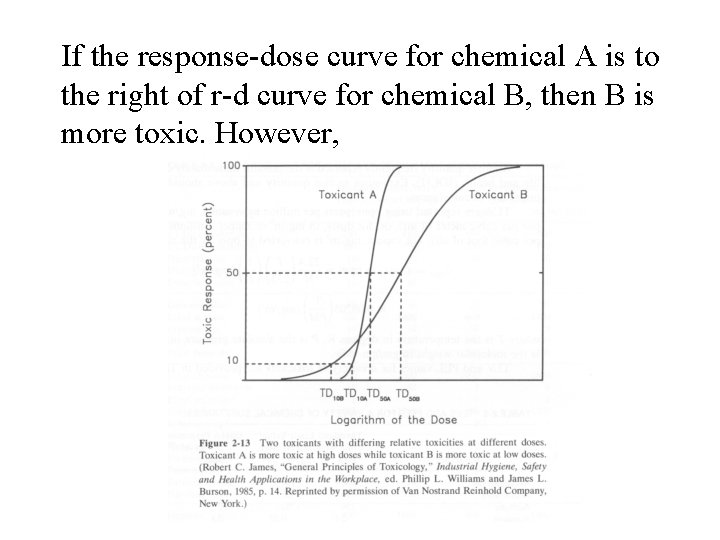
Relative Toxicity If the responsedose curve for chemical
- Slides: 9
Relative Toxicity
If the response-dose curve for chemical A is to the right of r-d curve for chemical B, then B is more toxic. However,
Threshold Dose The lowest value on the response vs. dose curve is called the threshold dose. Below this dose the body is able to detoxify and eliminate the agent without any detectable effects.
Threshold Limit Values (TLV) • Established by the American Conference of Governmental Industrial Hygienists (ACGIH). • The TLV refers to airborne concentrations that correspond to conditions where no adverse effects are normally expected during a worker’s lifetime. • The exposure occurs only during normal working hours, eight hours per day and five days per week.
TLV-TWA Time weighted average for a normal 8 -hour workday or 40 -hour workweek, to which nearly all workers can be exposed, day after day, without adverse effects. Excursions above the limit are allowed if compensated by excursions below the limit.
TLV-STEL Short-term exposure limit. The maximum concentration to which workers can be exposed for a period of up to 15 minutes continuously without suffering (1) intolerable irritation, (2) chronic or irreversible tissue changes, (3) narcosis of sufficient degree to increases accident proneness, or materially reduce worker efficiency, provided that no more than four excursions per day are permitted, and provided that the daily TLV-TWA is not exceed.
TLV-C Ceiling limit. The concentration which should not be exceeded, even instantaneously.
Permissible Exposure Level (PEL) • Defined by the United States Occupational Safety and Health Administration (OSHA). • The PEL values follow the TLV-TWA very closely. However, they are not as numerous and are not updated as frequently. The TLVs are more conservative.
IDLH • Amount immediately dangerous to lif and health. • Established by National Institute of Occupational Safety and Health (NIOSH). • See Appendix 5 for TLV, PEL and IDLH data.