
Relative Pronouns and Relative Clauses in German RELATIVPRONOMEN
![RELATIVPRONOMEN / RELATIVSÄTZE: Krankenpflegerin [= Krankenschwester] ist ein Beruf, für den Kathi sich interessiert.](https://slidetodoc.com/presentation_image_h/0427fd0481efab9cd9e5c2cc26ce4a1b/image-5.jpg "RELATIVPRONOMEN / RELATIVSÄTZE: Krankenpflegerin [= Krankenschwester] ist ein Beruf, für den Kathi sich interessiert.")
- Slides: 24
(Relative Pronouns and Relative Clauses in German) RELATIVPRONOMEN / RELATIVSÄTZE Kontext: Arbeitswelt (Vorbereitet von Prof. Engel-Doyle, Version vom 30. September 200
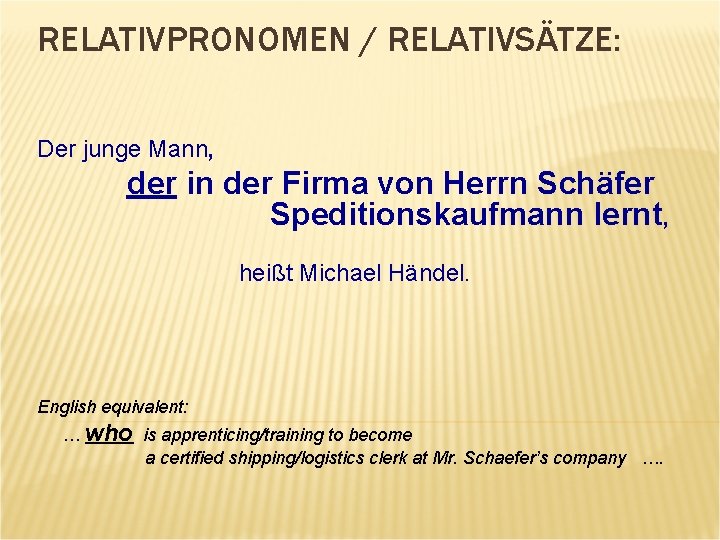
RELATIVPRONOMEN / RELATIVSÄTZE: Der junge Mann, der in der Firma von Herrn Schäfer Speditionskaufmann lernt, heißt Michael Händel. English equivalent: … who is apprenticing/training to become a certified shipping/logistics clerk at Mr. Schaefer’s company ….
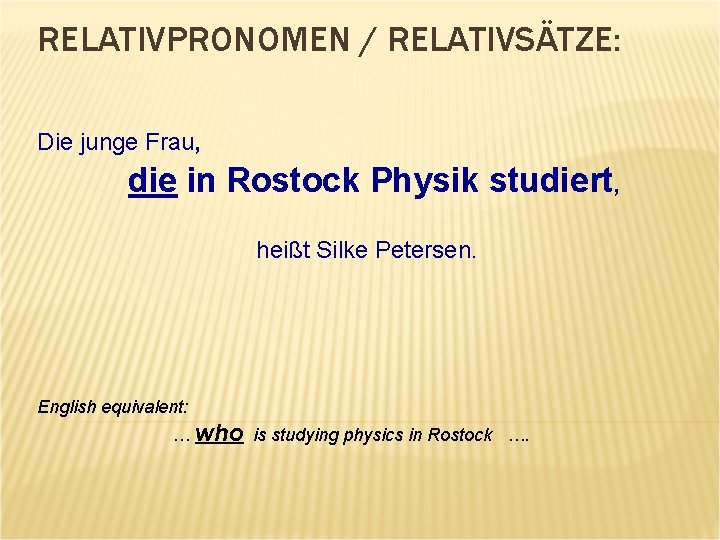
RELATIVPRONOMEN / RELATIVSÄTZE: Die junge Frau, die in Rostock Physik studiert, heißt Silke Petersen. English equivalent: … who is studying physics in Rostock ….
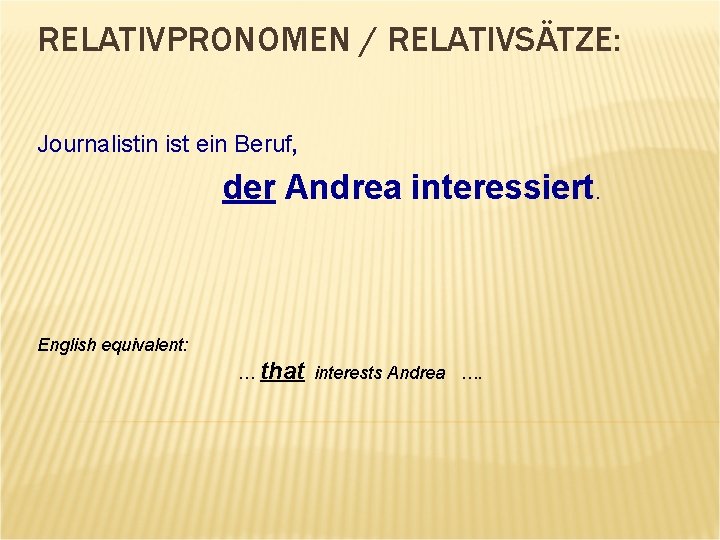
RELATIVPRONOMEN / RELATIVSÄTZE: Journalistin ist ein Beruf, der Andrea interessiert. English equivalent: … that interests Andrea ….
RELATIVPRONOMEN / RELATIVSÄTZE: Krankenpflegerin [= Krankenschwester] ist ein Beruf, für den Kathi sich interessiert. English equivalent: … / … in that which Kathie is interested in Kathie is interested
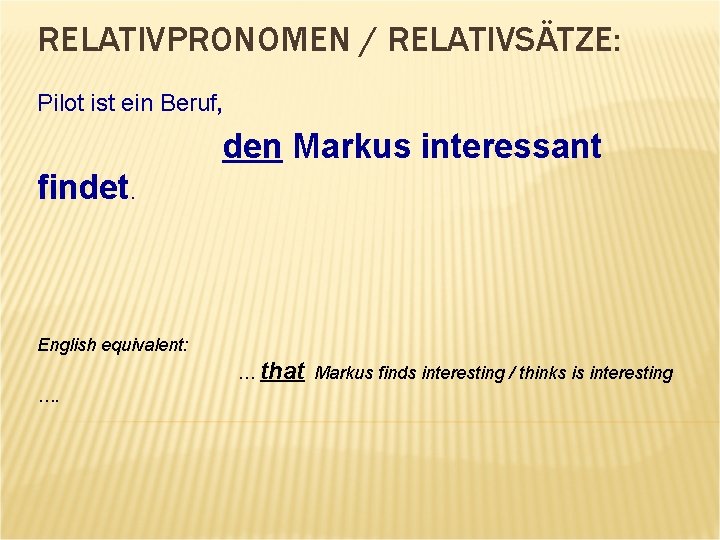
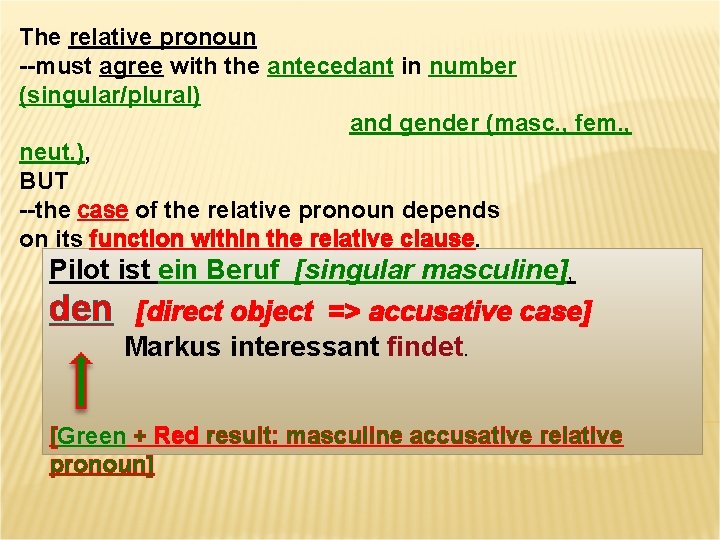
RELATIVPRONOMEN / RELATIVSÄTZE: Pilot ist ein Beruf, den Markus interessant findet. English equivalent: … …. that Markus finds interesting / thinks is interesting
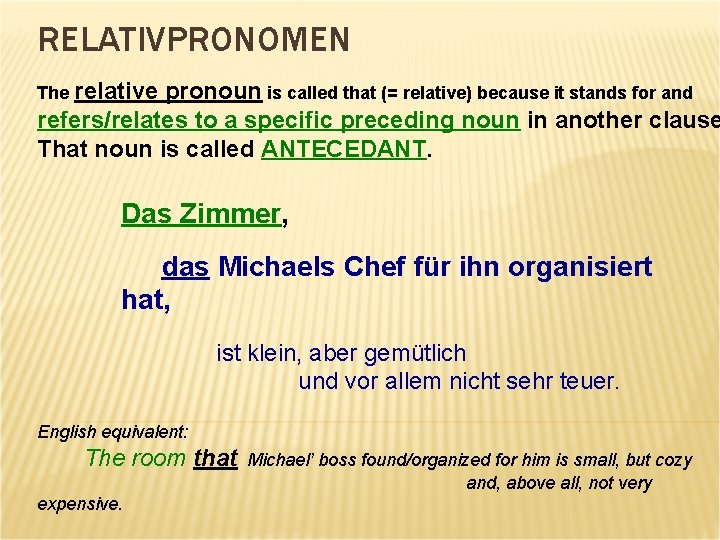
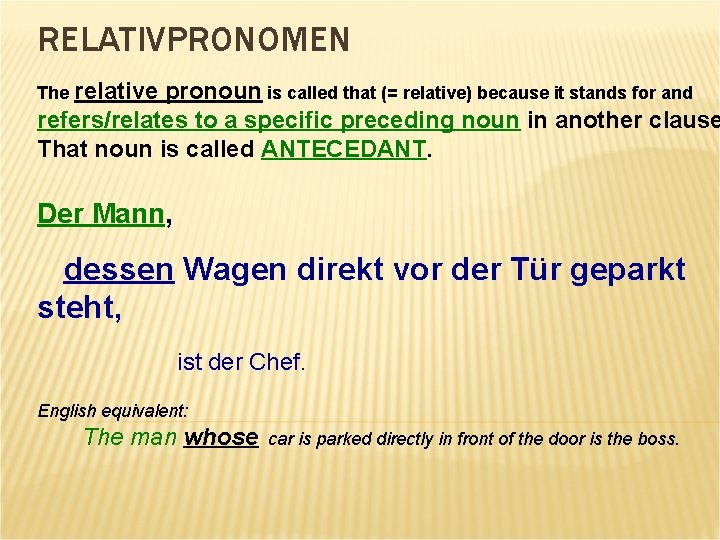
RELATIVPRONOMEN The relative pronoun is called that (= relative) because it stands for and refers/relates to a specific preceding noun in another clause That noun is called ANTECEDANT. Das Zimmer, das Michaels Chef für ihn organisiert hat, ist klein, aber gemütlich und vor allem nicht sehr teuer. English equivalent: The room that expensive. Michael’ boss found/organized for him is small, but cozy and, above all, not very
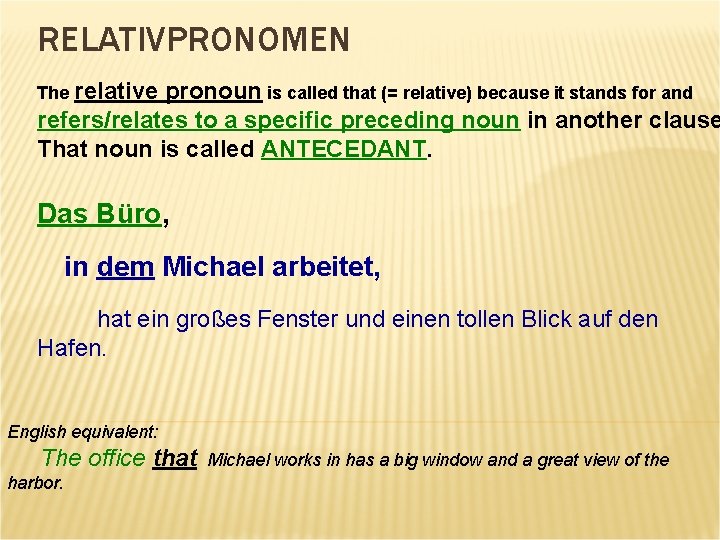
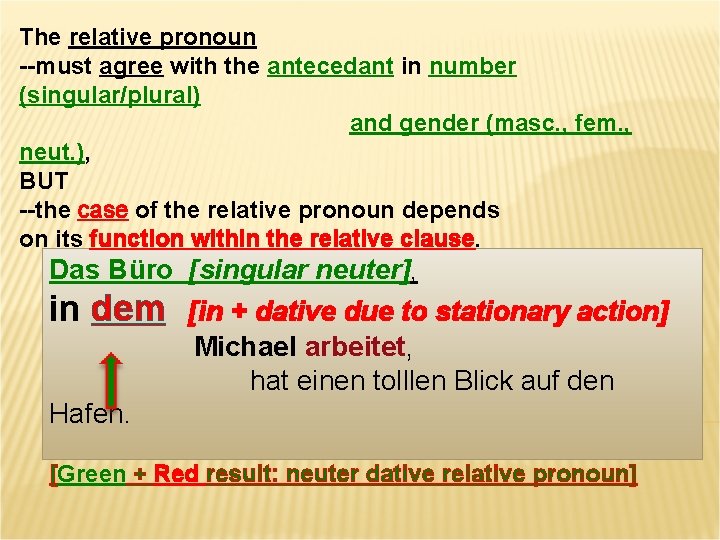
RELATIVPRONOMEN The relative pronoun is called that (= relative) because it stands for and refers/relates to a specific preceding noun in another clause That noun is called ANTECEDANT. Das Büro, in dem Michael arbeitet, hat ein großes Fenster und einen tollen Blick auf den Hafen. English equivalent: The office that harbor. Michael works in has a big window and a great view of the
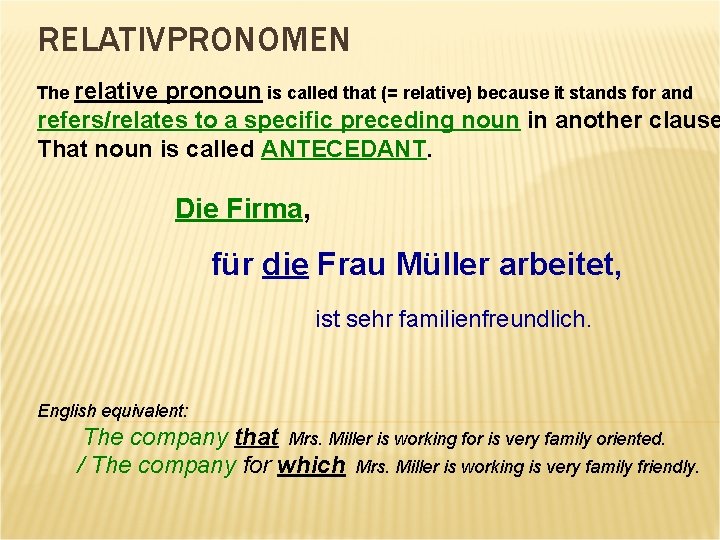
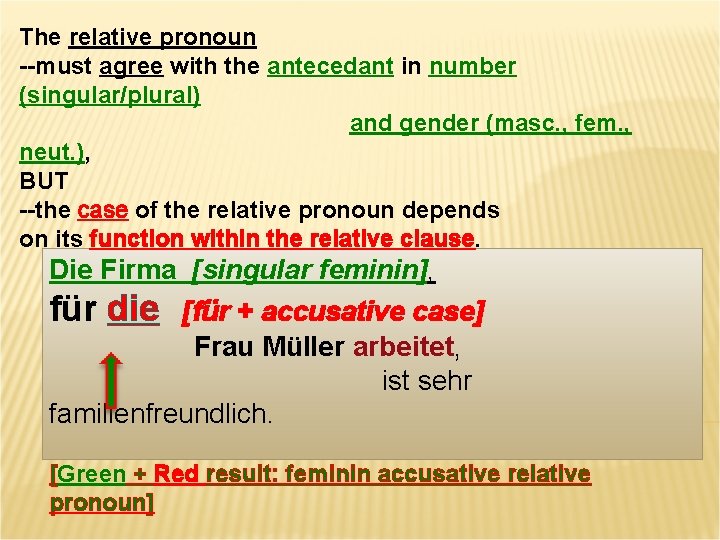
RELATIVPRONOMEN The relative pronoun is called that (= relative) because it stands for and refers/relates to a specific preceding noun in another clause That noun is called ANTECEDANT. Die Firma, für die Frau Müller arbeitet, ist sehr familienfreundlich. English equivalent: The company that Mrs. Miller is working for is very family oriented. / The company for which Mrs. Miller is working is very family friendly.
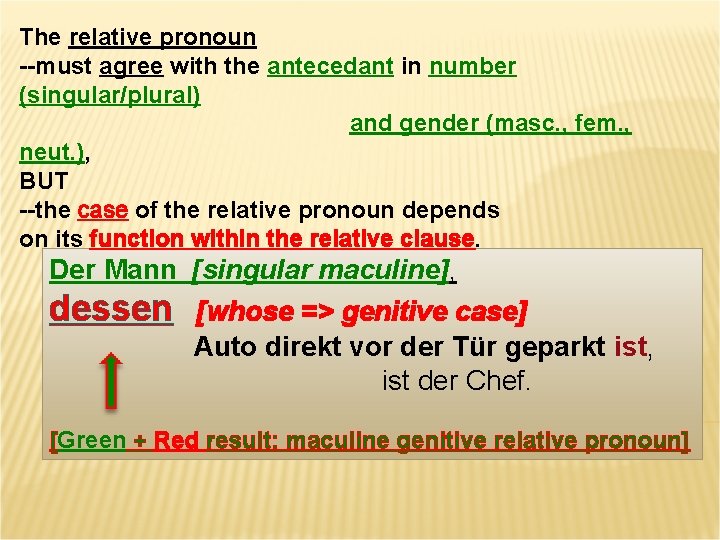
RELATIVPRONOMEN The relative pronoun is called that (= relative) because it stands for and refers/relates to a specific preceding noun in another clause That noun is called ANTECEDANT. Der Mann, dessen Wagen direkt vor der Tür geparkt steht, ist der Chef. English equivalent: The man whose car is parked directly in front of the door is the boss.
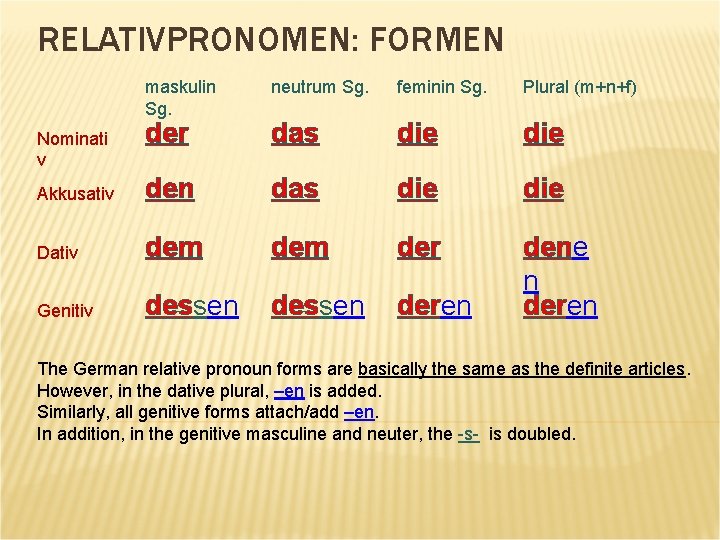
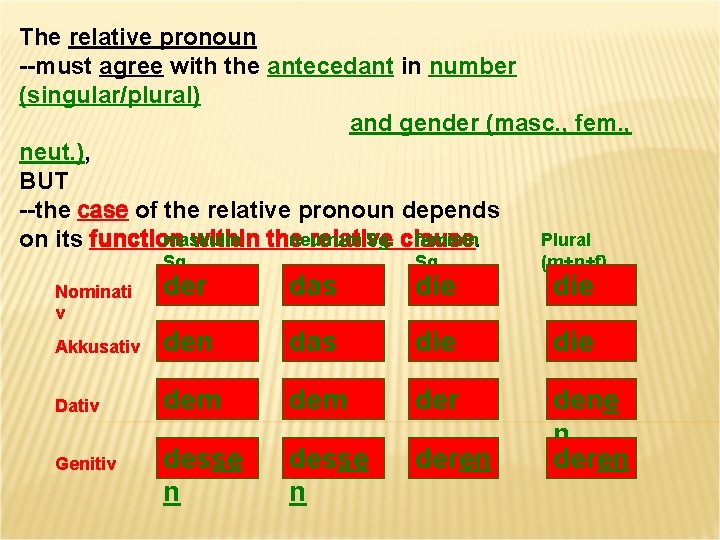
RELATIVPRONOMEN: FORMEN maskulin Sg. neutrum Sg. feminin Sg. Plural (m+n+f) der das die Akkusativ den das die Dativ dem der Genitiv dessen deren dene n deren Nominati v The German relative pronoun forms are basically the same as the definite articles. However, in the dative plural, –en is added. Similarly, all genitive forms attach/add –en. In addition, in the genitive masculine and neuter, the -s- is doubled.
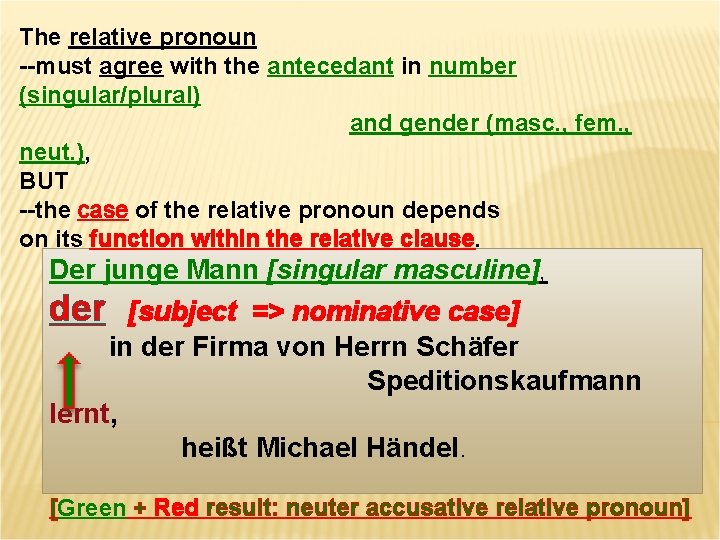
The relative pronoun --must agree with the antecedant in number (singular/plural) and gender (masc. , fem. , neut. ), BUT --the case of the relative pronoun depends on its function within the relative clause. Der junge Mann [singular masculine], der [subject => nominative case] in der Firma von Herrn Schäfer Speditionskaufmann lernt, heißt Michael Händel. [Green + Red result: neuter accusative relative pronoun]
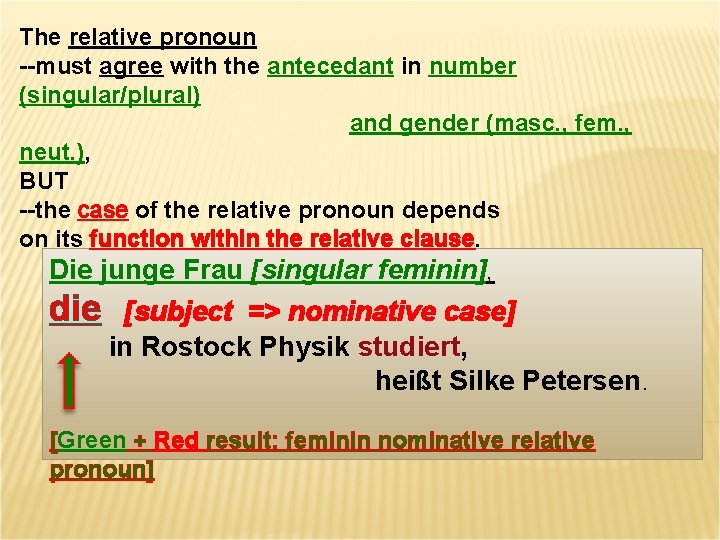
The relative pronoun --must agree with the antecedant in number (singular/plural) and gender (masc. , fem. , neut. ), BUT --the case of the relative pronoun depends on its function within the relative clause. Die junge Frau [singular feminin], die [subject => nominative case] in Rostock Physik studiert, heißt Silke Petersen. [Green + Red result: feminin nominative relative pronoun]
The relative pronoun --must agree with the antecedant in number (singular/plural) and gender (masc. , fem. , neut. ), BUT --the case of the relative pronoun depends on its function within the relative clause. Pilot ist ein Beruf [singular masculine], den [direct object => accusative case] Markus interessant findet. [Green + Red result: masculine accusative relative pronoun]
The relative pronoun --must agree with the antecedant in number (singular/plural) and gender (masc. , fem. , neut. ), BUT --the case of the relative pronoun depends on its function within the relative clause. Das Büro [singular neuter], in dem [in + dative due to stationary action] Michael arbeitet, hat einen tolllen Blick auf den Hafen. [Green + Red result: neuter dative relative pronoun]
The relative pronoun --must agree with the antecedant in number (singular/plural) and gender (masc. , fem. , neut. ), BUT --the case of the relative pronoun depends on its function within the relative clause. Die Firma [singular feminin], für die [für + accusative case] Frau Müller arbeitet, ist sehr familienfreundlich. [Green + Red result: feminin accusative relative pronoun]
The relative pronoun --must agree with the antecedant in number (singular/plural) and gender (masc. , fem. , neut. ), BUT --the case of the relative pronoun depends on its function within the relative clause. Der Mann [singular maculine], dessen [whose => genitive case] Auto direkt vor der Tür geparkt ist, ist der Chef. [Green + Red result: maculine genitive relative pronoun]
The relative pronoun --must agree with the antecedant in number (singular/plural) and gender (masc. , fem. , neut. ), BUT --the case of the relative pronoun depends maskulin neutrum Sg. clause. feminin Plural on its function within the relative Sg. der das Akkusativ den das die Dativ dem der desse n deren dene n deren Nominati v Genitiv die (m+n+f) die
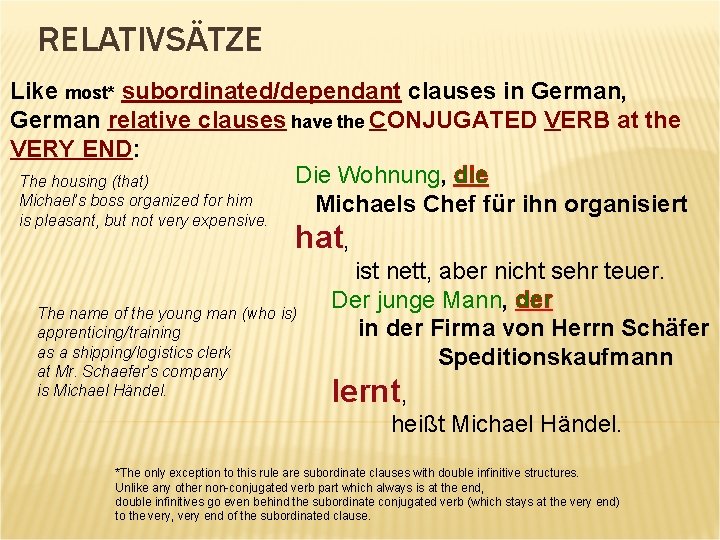
RELATIVSÄTZE Like most* subordinated/dependant clauses in German, German relative clauses have the CONJUGATED VERB at the VERY END: Die Wohnung, die The housing (that) Michael’s boss organized for him Michaels Chef für ihn organisiert is pleasant, but not very expensive. hat, The name of the young man (who is) apprenticing/training as a shipping/logistics clerk at Mr. Schaefer’s company is Michael Händel. ist nett, aber nicht sehr teuer. Der junge Mann, der in der Firma von Herrn Schäfer Speditionskaufmann lernt, heißt Michael Händel. *The only exception to this rule are subordinate clauses with double infinitive structures. Unlike any other non-conjugated verb part which always is at the end, double infinitives go even behind the subordinate conjugated verb (which stays at the very end) to the very, very end of the subordinated clause.
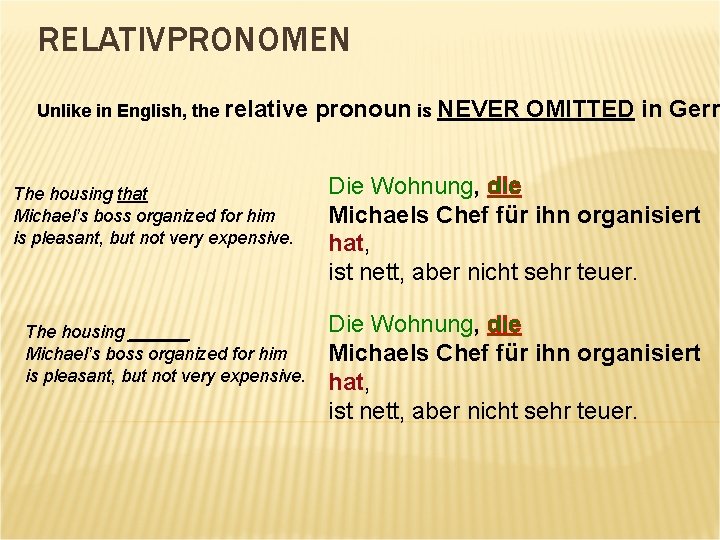
RELATIVPRONOMEN Unlike in English, the relative The housing that Michael’s boss organized for him is pleasant, but not very expensive. The housing ______ Michael’s boss organized for him is pleasant, but not very expensive. pronoun is NEVER OMITTED in Germ Die Wohnung, die Michaels Chef für ihn organisiert hat, ist nett, aber nicht sehr teuer.
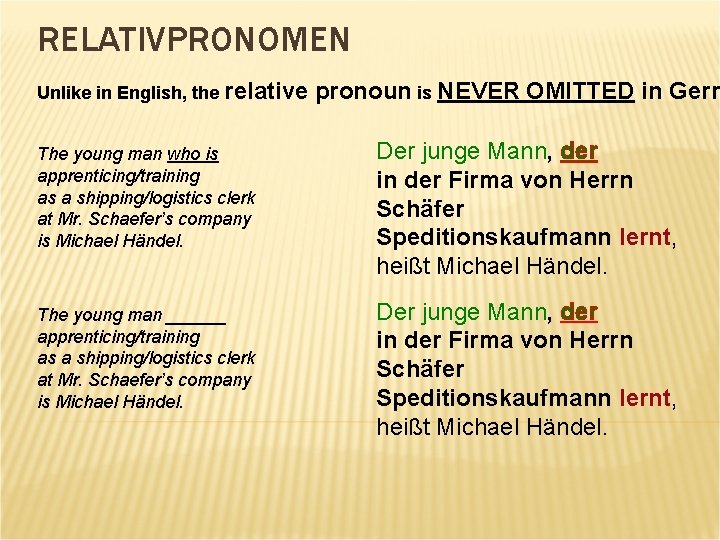
RELATIVPRONOMEN Unlike in English, the relative pronoun is NEVER OMITTED in Germ The young man who is apprenticing/training as a shipping/logistics clerk at Mr. Schaefer’s company is Michael Händel. Der junge Mann, der in der Firma von Herrn Schäfer Speditionskaufmann lernt, heißt Michael Händel. The young man ______ apprenticing/training as a shipping/logistics clerk at Mr. Schaefer’s company is Michael Händel. Der junge Mann, der in der Firma von Herrn Schäfer Speditionskaufmann lernt, heißt Michael Händel.
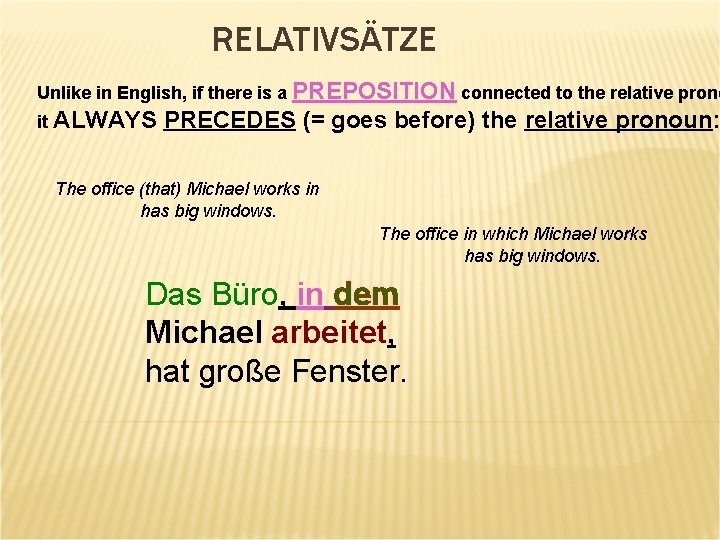
RELATIVSÄTZE Unlike in English, if there is a PREPOSITION connected to the relative prono it ALWAYS PRECEDES (= goes before) the relative pronoun: The office (that) Michael works in has big windows. The office in which Michael works has big windows. Das Büro, in dem Michael arbeitet, hat große Fenster.
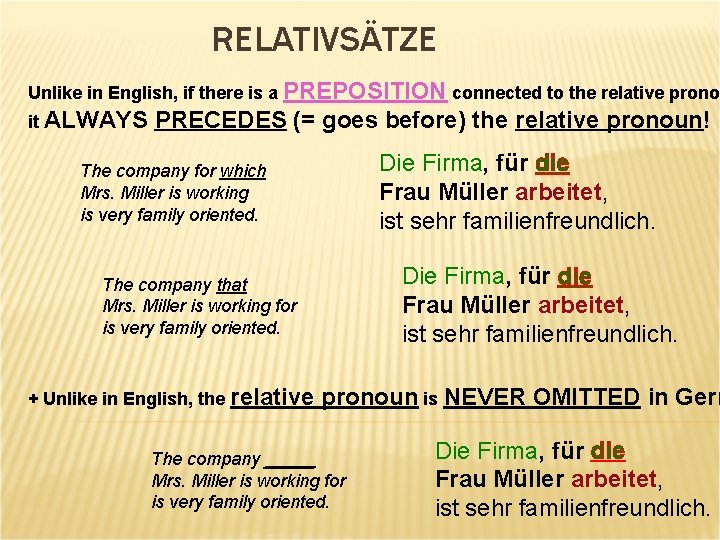
RELATIVSÄTZE Unlike in English, if there is a PREPOSITION connected to the relative pronou it ALWAYS PRECEDES (= goes before) the relative pronoun! Die Firma, für die Frau Müller arbeitet, ist sehr familienfreundlich. The company for which Mrs. Miller is working is very family oriented. Die Firma, für die Frau Müller arbeitet, ist sehr familienfreundlich. The company that Mrs. Miller is working for is very family oriented. + Unlike in English, the relative pronoun is NEVER OMITTED in Germ The company _____ Mrs. Miller is working for is very family oriented. Die Firma, für die Frau Müller arbeitet, ist sehr familienfreundlich.
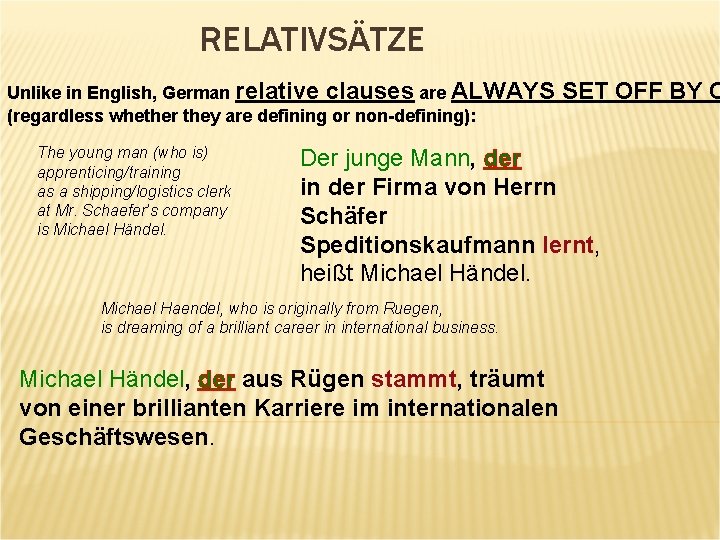
RELATIVSÄTZE Unlike in English, German relative clauses are ALWAYS (regardless whether they are defining or non-defining): The young man (who is) apprenticing/training as a shipping/logistics clerk at Mr. Schaefer’s company is Michael Händel. SET OFF BY C Der junge Mann, der in der Firma von Herrn Schäfer Speditionskaufmann lernt, heißt Michael Händel. Michael Haendel, who is originally from Ruegen, is dreaming of a brilliant career in international business. Michael Händel, der aus Rügen stammt, träumt von einer brillianten Karriere im internationalen Geschäftswesen.