
Relative Motion Relative Velocity A useful example of

- Slides: 8
Relative Motion
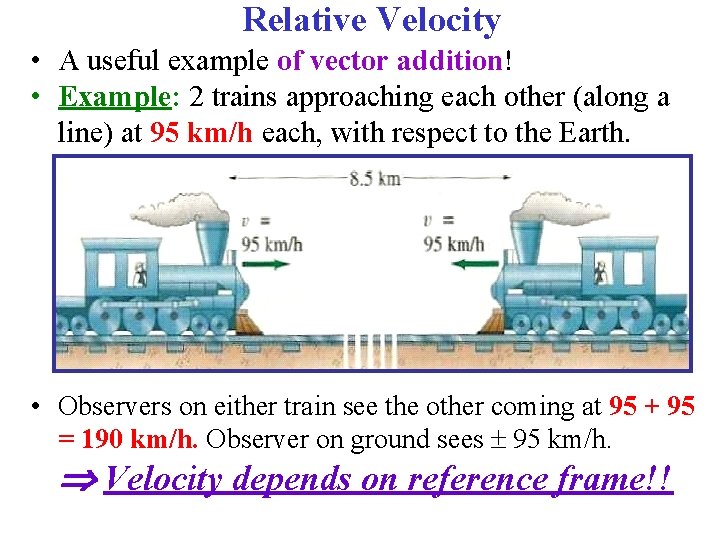
Relative Velocity • A useful example of vector addition! • Example: 2 trains approaching each other (along a line) at 95 km/h each, with respect to the Earth. • Observers on either train see the other coming at 95 + 95 = 190 km/h. Observer on ground sees 95 km/h. Velocity depends on reference frame!!
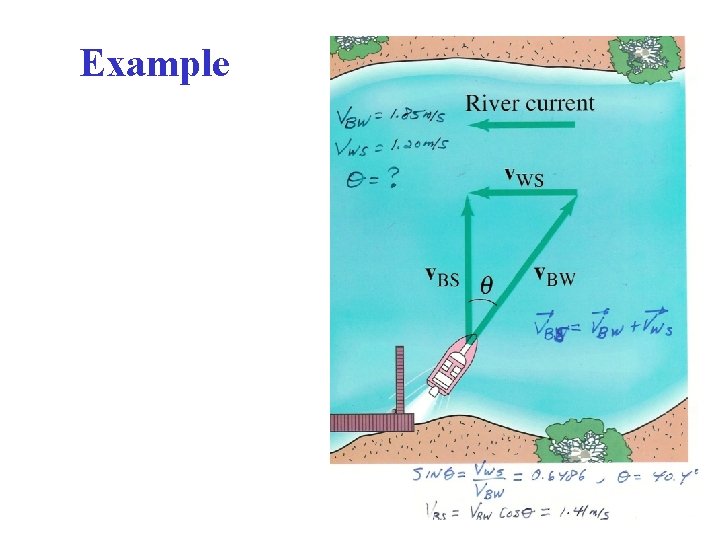
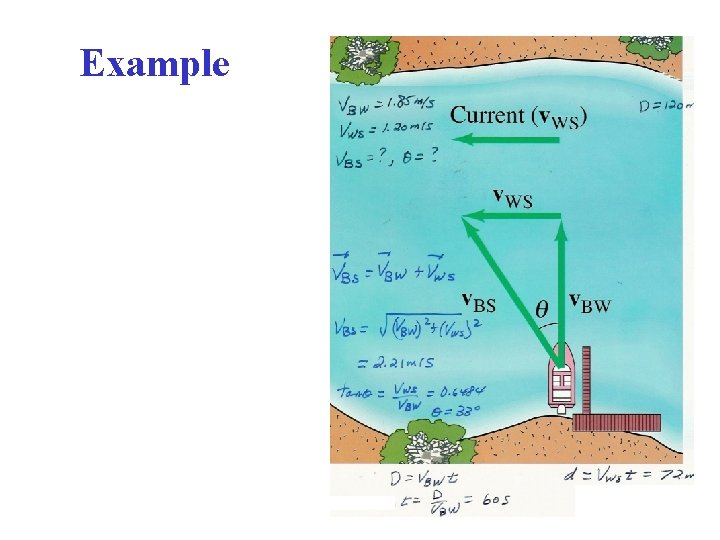
Velocities not along the same line • Need to use full vector addition. – A common error is adding or subtracting wrong velocities – A method to help avoid this is: Proper subscript labeling of velocities • CONVENTION: – Velocities with 2 subscripts. – First = object, O, – Second = reference frame, R. v. OR
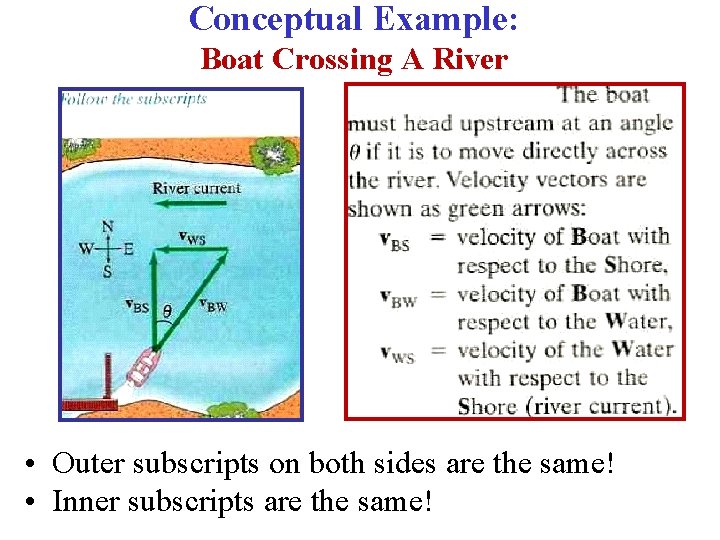
Conceptual Example: Boat Crossing A River • Outer subscripts on both sides are the same! • Inner subscripts are the same!
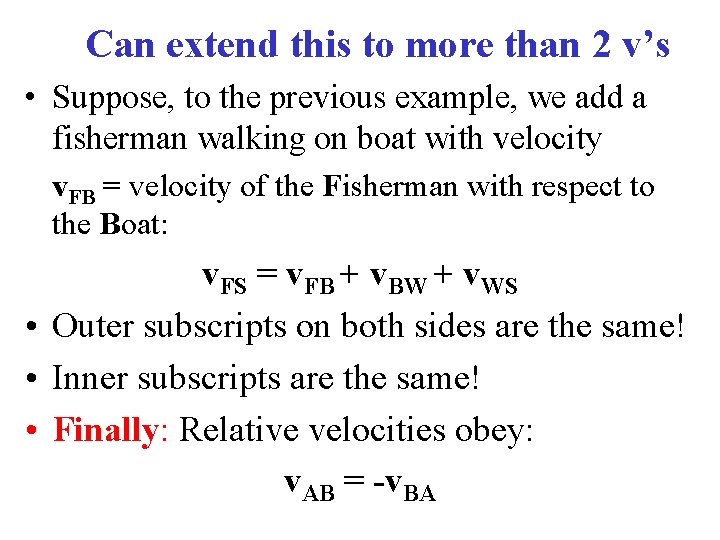
Can extend this to more than 2 v’s • Suppose, to the previous example, we add a fisherman walking on boat with velocity v. FB = velocity of the Fisherman with respect to the Boat: v. FS = v. FB + v. BW + v. WS • Outer subscripts on both sides are the same! • Inner subscripts are the same! • Finally: Relative velocities obey: v. AB = -v. BA
Example
Example
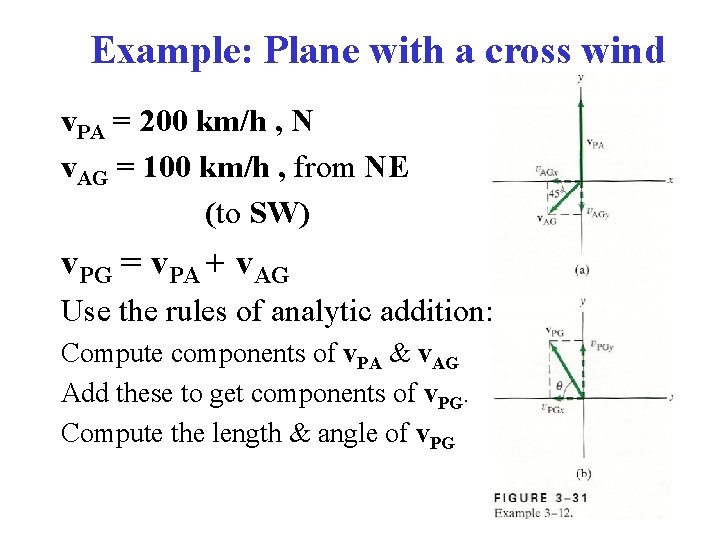
Example: Plane with a cross wind v. PA = 200 km/h , N v. AG = 100 km/h , from NE (to SW) v. PG = v. PA + v. AG Use the rules of analytic addition: Compute components of v. PA & v. AG Add these to get components of v. PG. Compute the length & angle of v. PG