
Relative Humidity What is Humidity Specific Humidity is

- Slides: 18
Relative Humidity
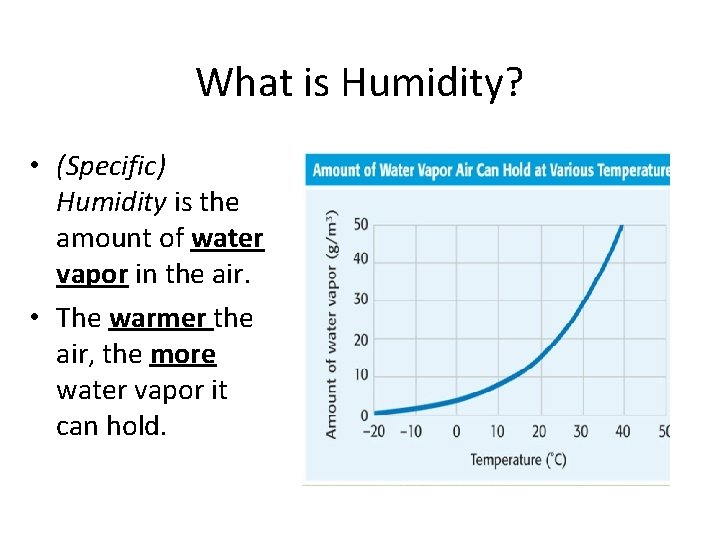
What is Humidity? • (Specific) Humidity is the amount of water vapor in the air. • The warmer the air, the more water vapor it can hold.
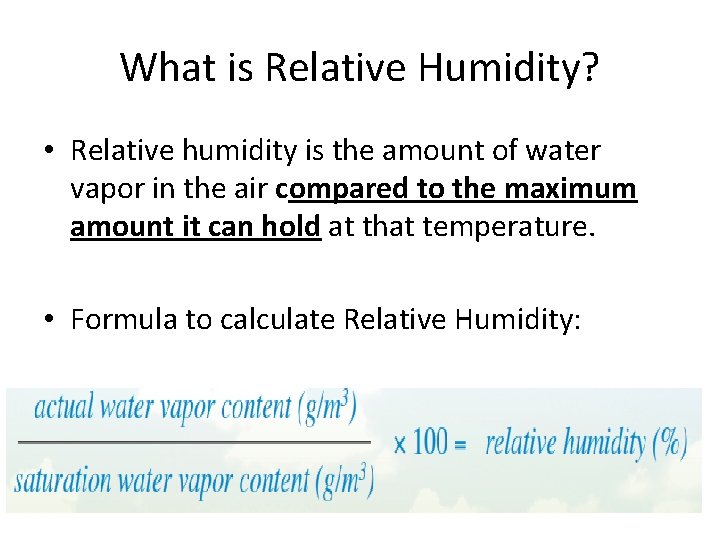
What is Relative Humidity? • Relative humidity is the amount of water vapor in the air compared to the maximum amount it can hold at that temperature. • Formula to calculate Relative Humidity:
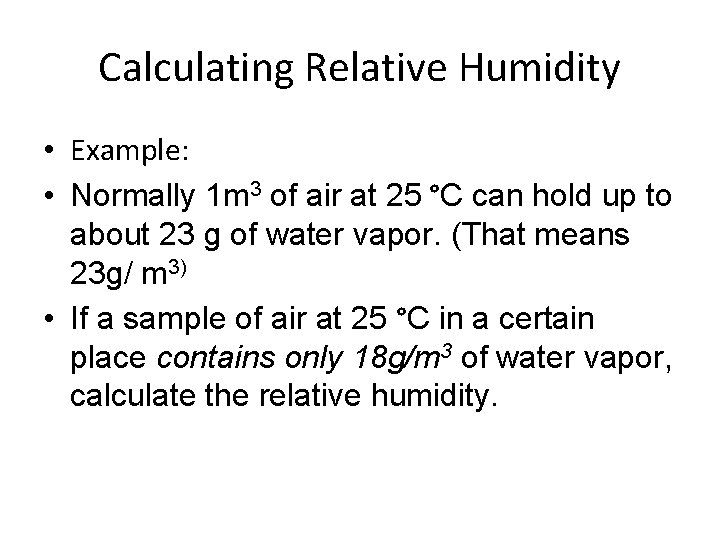
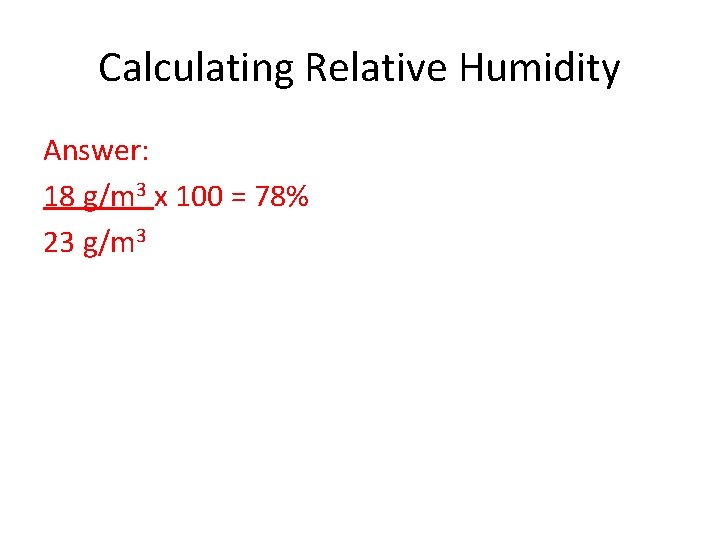
Calculating Relative Humidity • Example: • Normally 1 m 3 of air at 25 °C can hold up to about 23 g of water vapor. (That means 23 g/ m 3) • If a sample of air at 25 °C in a certain place contains only 18 g/m 3 of water vapor, calculate the relative humidity.
Calculating Relative Humidity Answer: 18 g/m 3 x 100 = 78% 23 g/m 3
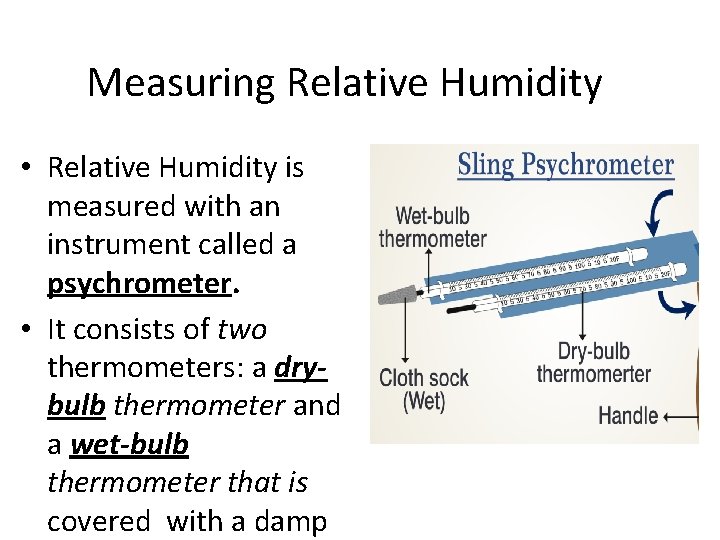
Measuring Relative Humidity • Relative Humidity is measured with an instrument called a psychrometer. • It consists of two thermometers: a drybulb thermometer and a wet-bulb thermometer that is covered with a damp
How a Psychrometer works • https: //www. youtube. com/watch? v=m. B 9 VTm. Q 5 V 4 o • As air passes through the cloth on a wet-bulb thermometer, some of the water in the cloth evaporates, cooling the cloth. • The difference in the two reading is the relative humidity. • When humidity is low, water evaporates more quickly, giving a lower reading. • If humidity is high, less water evaporates, yielding very little change in temp from the dry bulb. • The larger the difference the lower the relative
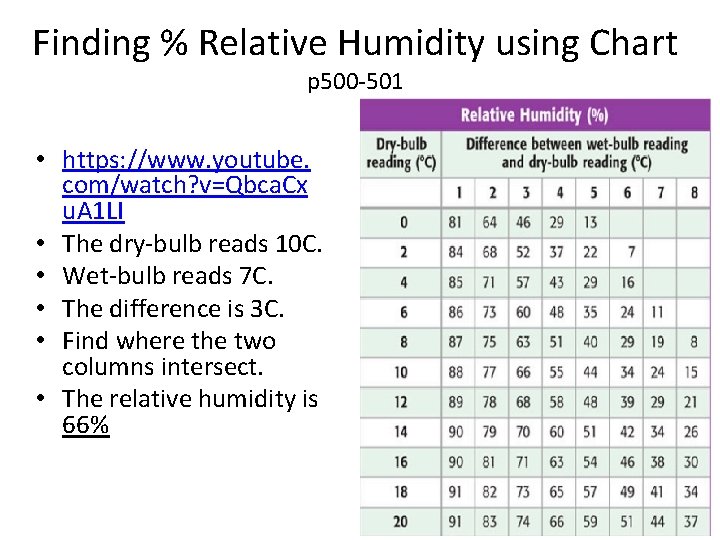
Finding % Relative Humidity using Chart p 500 -501 • https: //www. youtube. com/watch? v=Qbca. Cx u. A 1 LI • The dry-bulb reads 10 C. • Wet-bulb reads 7 C. • The difference is 3 C. • Find where the two columns intersect. • The relative humidity is 66%
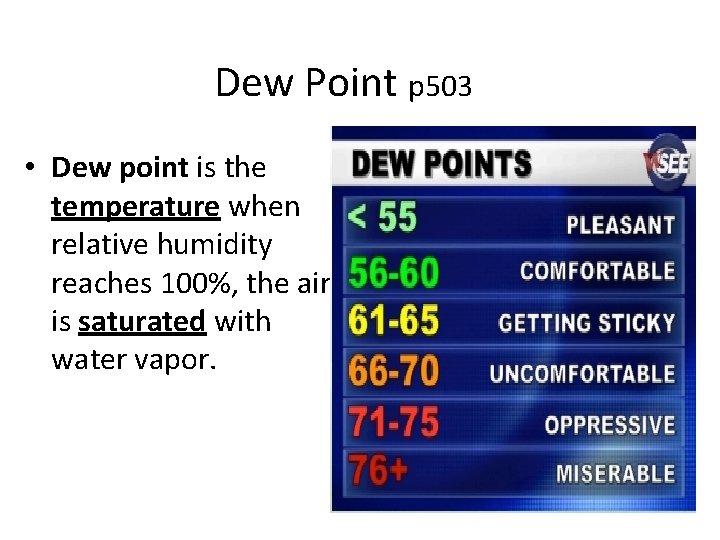
Dew Point p 503 • Dew point is the temperature when relative humidity reaches 100%, the air is saturated with water vapor.
Dew Point • Dew point temperature is the temperature to which the air would have to cool in order to reach saturation. • The higher the dewpoint, the more moisture in the air. • When the dew point temperature and air temperature are equal, the air is said to be saturated.
Dew Point • Dew point temperature is NEVER GREATER than the air temperature. • Therefore, if the air cools, moisture must be removed from the air and this is accomplished through condensation. This process results in the formation of tiny water droplets that can lead to the development of fog, frost, clouds, or even precipitation.
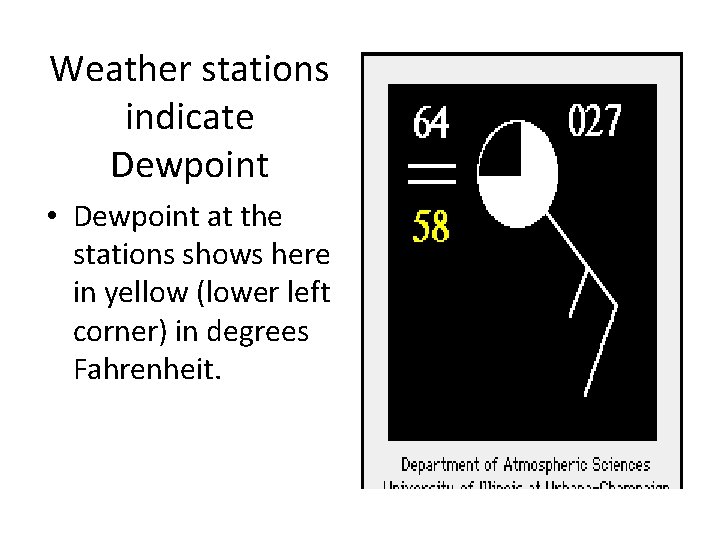
Weather stations indicate Dewpoint • Dewpoint at the stations shows here in yellow (lower left corner) in degrees Fahrenheit.
Condensation p 503 • Condensation happens when air is saturated with water vapor. It is the process by which a gas becomes liquid. • For water vapor to condense, air must be cooled below its dew point. • Water needs to condense onto something (eg, dust particles) called cooling nuclei. • Requires: Cooling and Nuclei
Condensation Requires Cooling and Nuclei p 503 For water vapor to condense, air must be cooled below its dew point. This cooling can happen in four different ways. Air may lose heat by: 1. contacting a colder surface 2. radiating heat 3. Mixing with colder air 4. Expanding when it rises (cloud formation)
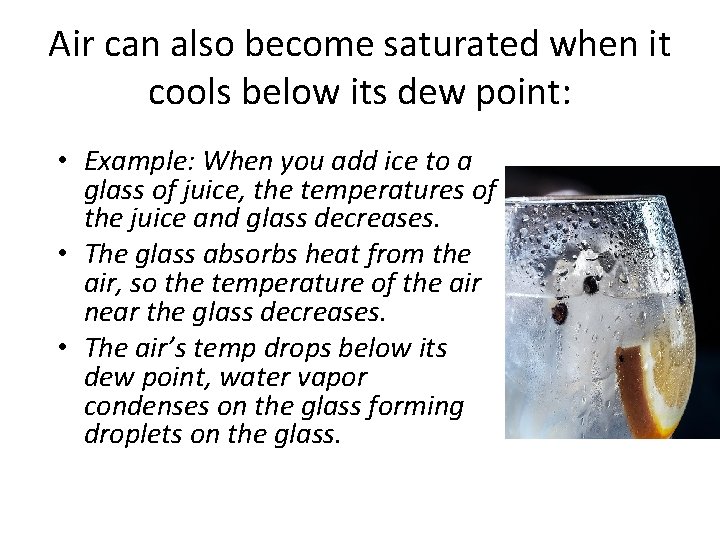
Air can also become saturated when it cools below its dew point: • Example: When you add ice to a glass of juice, the temperatures of the juice and glass decreases. • The glass absorbs heat from the air, so the temperature of the air near the glass decreases. • The air’s temp drops below its dew point, water vapor condenses on the glass forming droplets on the glass.
How does evaporation work? • https: //www. youtube. com/watch? v=Djo 9 qtr. L c 7 Q
Homework Read p 491 for Temperature, Read p 499 -503 for Evaporation, Condensation, Dew Point HW: Calculating Relative Humidity WS HW: Relative Humidity and Dew Point WS Activity: Build a Zeer Pot (Pot-in-pot refrigerator)
Factors determining Weather • • • latitude; elevation or proximity to mountains; large bodies of water and relative temperatures of land water; storms