
Relative Formula Mass Volumes of Gases Aiming for
- Slides: 4
Relative Formula Mass Volumes of Gases • Aiming for 6: Calculate the amount in moles of gas in a given volume at room temperature and pressure, convert units. • Aiming for 8: Predict how temperate and pressure will affect the volume of a gas. Saturday, January 1, 2022
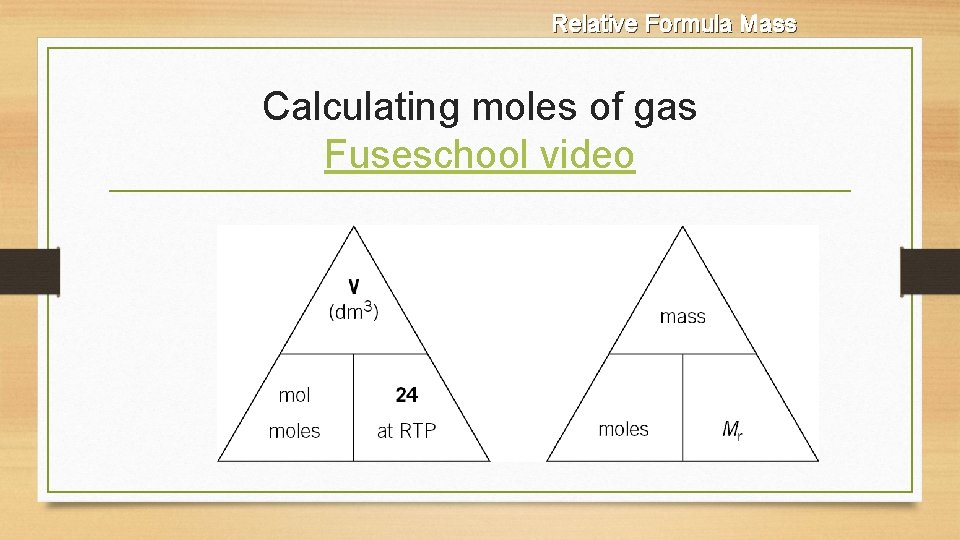
Relative Formula Mass Calculating moles of gas Fuseschool video
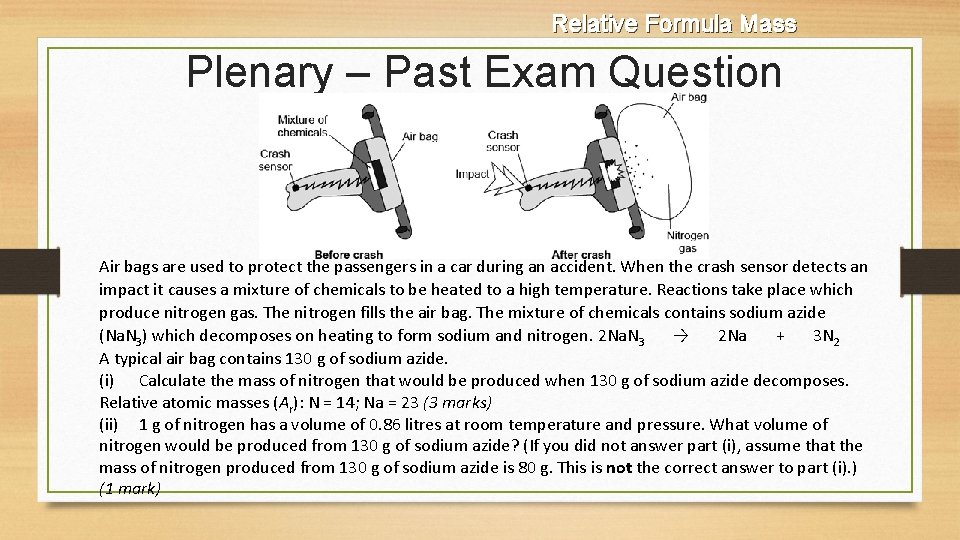
Relative Formula Mass Plenary – Past Exam Question Air bags are used to protect the passengers in a car during an accident. When the crash sensor detects an impact it causes a mixture of chemicals to be heated to a high temperature. Reactions take place which produce nitrogen gas. The nitrogen fills the air bag. The mixture of chemicals contains sodium azide (Na. N 3) which decomposes on heating to form sodium and nitrogen. 2 Na. N 3 → 2 Na + 3 N 2 A typical air bag contains 130 g of sodium azide. (i) Calculate the mass of nitrogen that would be produced when 130 g of sodium azide decomposes. Relative atomic masses (Ar): N = 14; Na = 23 (3 marks) (ii) 1 g of nitrogen has a volume of 0. 86 litres at room temperature and pressure. What volume of nitrogen would be produced from 130 g of sodium azide? (If you did not answer part (i), assume that the mass of nitrogen produced from 130 g of sodium azide is 80 g. This is not the correct answer to part (i). ) (1 mark)
Relative Formula Mass Plenary – Past Exam Mark Scheme (i) 84 / 84. 5 / 83. 98 correct answer with or without working gains 3 marks (moles of Na. N 3 =) 130/65 (1), moles of nitrogen = 3 (1), mass of nitrogen = 3 x 28 = 84 (1) or 2 x (23 + (3 x 14)) (1) 3 x (2 x 14) (1) or 2 Na. N 3 = 130 (1) 3 N 2 = 84 (1) if answer is incorrect then look for evidence of correct working. allow ecf from previous stage 1 mark lost for each mistake in the working if they do not have the correct answer. (ii) 72 / 72. 24 / 72. 2 allow ecf from part (i) × 0. 86 or 69 or 68. 8