
Relative fitness and the growth of complexity in

- Slides: 37
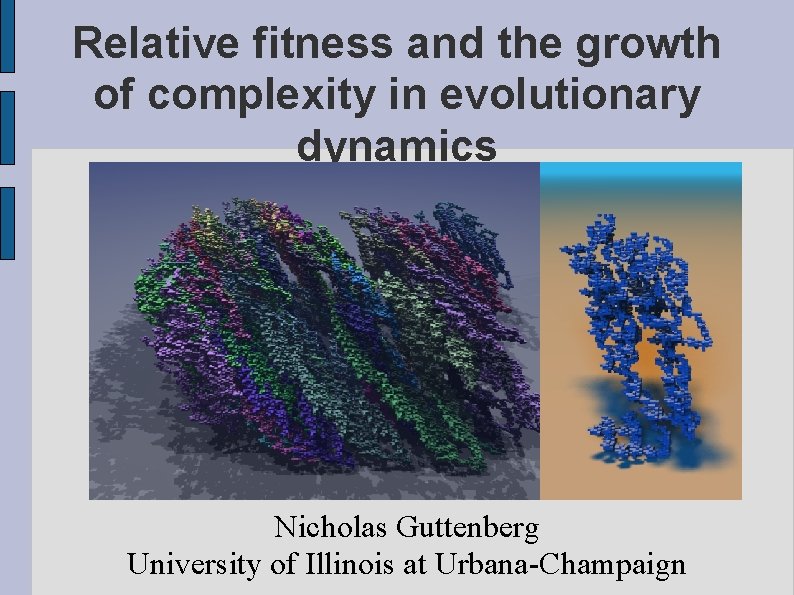
Relative fitness and the growth of complexity in evolutionary dynamics Nicholas Guttenberg University of Illinois at Urbana-Champaign
Simulating Evolutionary Dynamics What can be learned from simulations? Toy models for artificial life von Neumann's replicators Conway's Game of Life Predator-Prey, ecological models Evolutionary dynamics Tierra and AVIDA The effects of 'fitness' Open-ended increase in complexity
What can be learned from simulations? Understand the important factors in behaviors observed in biology Diversity of species Complexity in biological systems Evolutionary effects of mechanisms such as horizontal gene transfer, mutation, crossover, homologous recombination 1, . . . Learn how to build non-biological systems with biological properties - biomimetics Machine learning Self-replicating automata Evolutionary circuit design 2 1: K Vetsigian and N Goldenfeld, “Global divergence of microbial genome sequences mediated by propagating fronts” PNAS 102 p 7332 (2005) K Vetsigian, C Woese, N Goldenfeld, “Collective evolution and the genetic code” PNAS 103 p 10696 (2006) 2: A Thompson, “Exploring beyond the scope of human design: Automatic generation of FPGA configurations through artificial evolution” 8 th annual Advanced PLD and FPGA conference 1998
Toy Models for Artificial Life
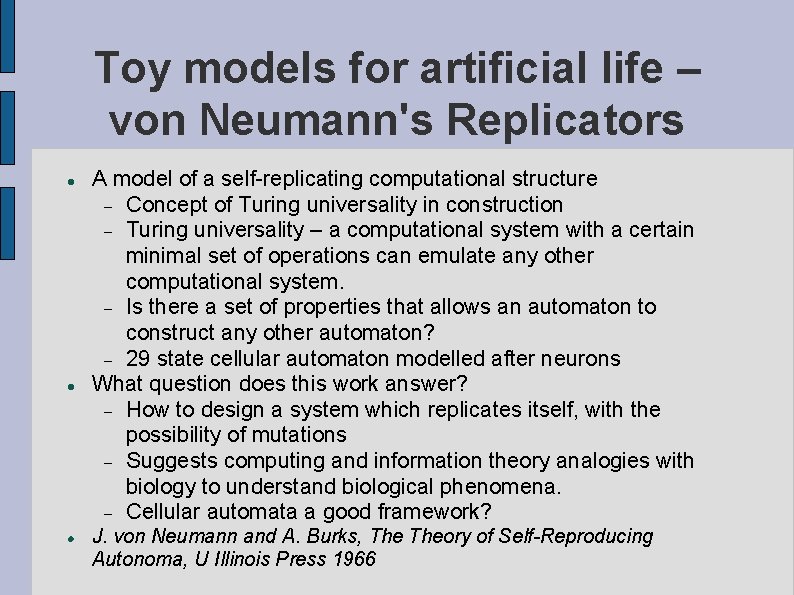
Toy models for artificial life – von Neumann's Replicators A model of a self-replicating computational structure Concept of Turing universality in construction Turing universality – a computational system with a certain minimal set of operations can emulate any other computational system. Is there a set of properties that allows an automaton to construct any other automaton? 29 state cellular automaton modelled after neurons What question does this work answer? How to design a system which replicates itself, with the possibility of mutations Suggests computing and information theory analogies with biology to understand biological phenomena. Cellular automata a good framework? J. von Neumann and A. Burks, Theory of Self-Reproducing Autonoma, U Illinois Press 1966
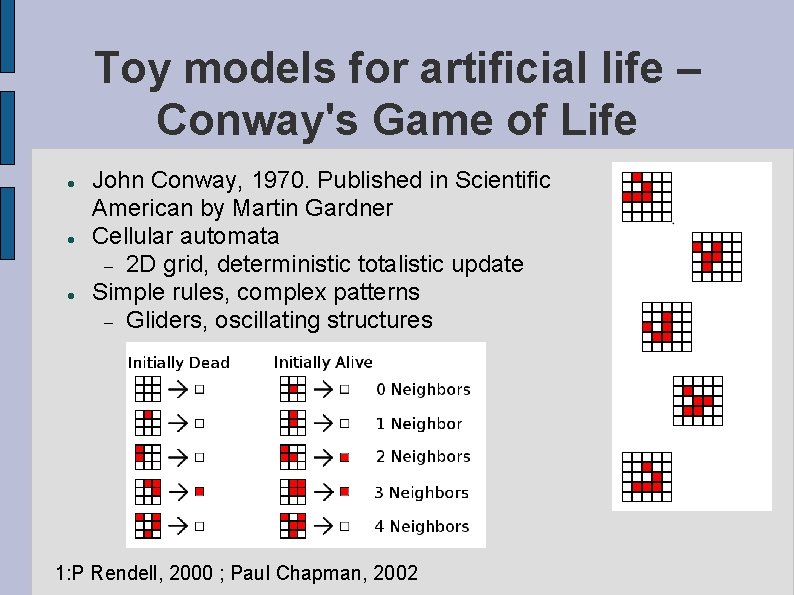
Toy models for artificial life – Conway's Game of Life John Conway, 1970. Published in Scientific American by Martin Gardner Cellular automata 2 D grid, deterministic totalistic update Simple rules, complex patterns Gliders, oscillating structures 1: P Rendell, 2000 ; Paul Chapman, 2002
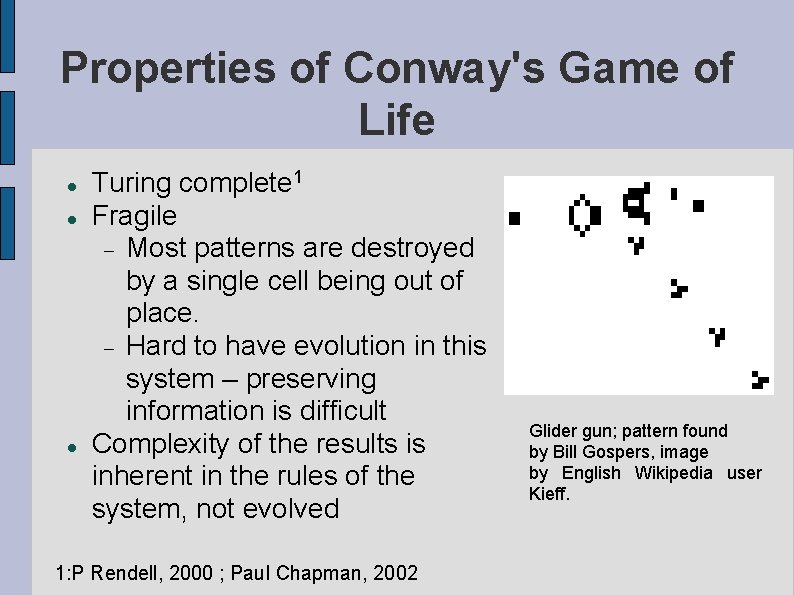
Properties of Conway's Game of Life Turing complete 1 Fragile Most patterns are destroyed by a single cell being out of place. Hard to have evolution in this system – preserving information is difficult Complexity of the results is inherent in the rules of the system, not evolved 1: P Rendell, 2000 ; Paul Chapman, 2002 Glider gun; pattern found by Bill Gospers, image by English Wikipedia user Kieff.
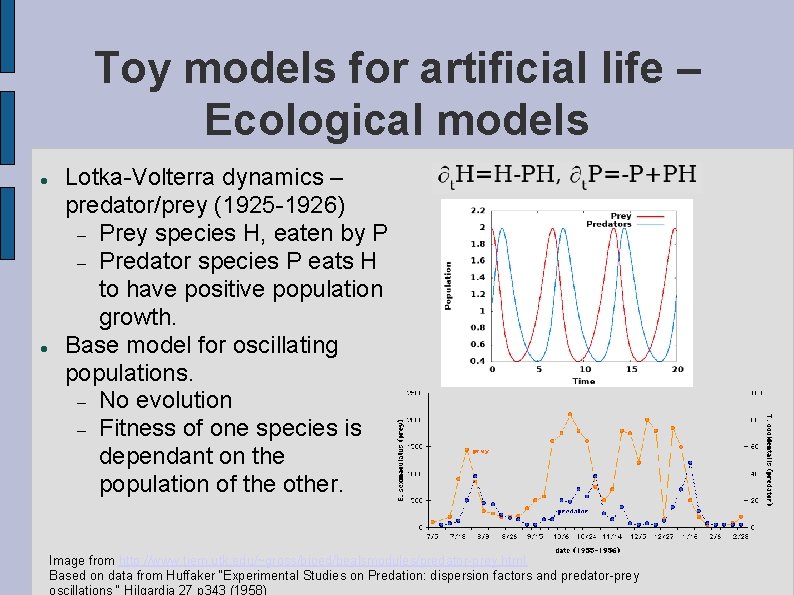
Toy models for artificial life – Ecological models Lotka-Volterra dynamics – predator/prey (1925 -1926) Prey species H, eaten by P Predator species P eats H to have positive population growth. Base model for oscillating populations. No evolution Fitness of one species is dependant on the population of the other. Image from http: //www. tiem. utk. edu/~gross/bioed/bealsmodules/predator-prey. html Based on data from Huffaker “Experimental Studies on Predation: dispersion factors and predator-prey oscillations “ Hilgardia 27 p 343 (1958)
Evolutionary Dynamics
Evolutionary dynamics – Tierra and AVIDA Tierra – Tom Ray, 1992 Organisms are programs written in a simple assembly language The programs are executed by virtual machines in the simulation space and reproduce by copying themselves. Programs are subject to mutation Initialized with a self-replicating sequence Functions can be marked by templates, organisms can call 'external' code and interact AVIDA – Chris Adami, 1994 A fitness criterion is imposed to make programs solve a particular problem Organisms live on a 2 D grid Simulate biodiversity and ecology. Study open-ended evolution
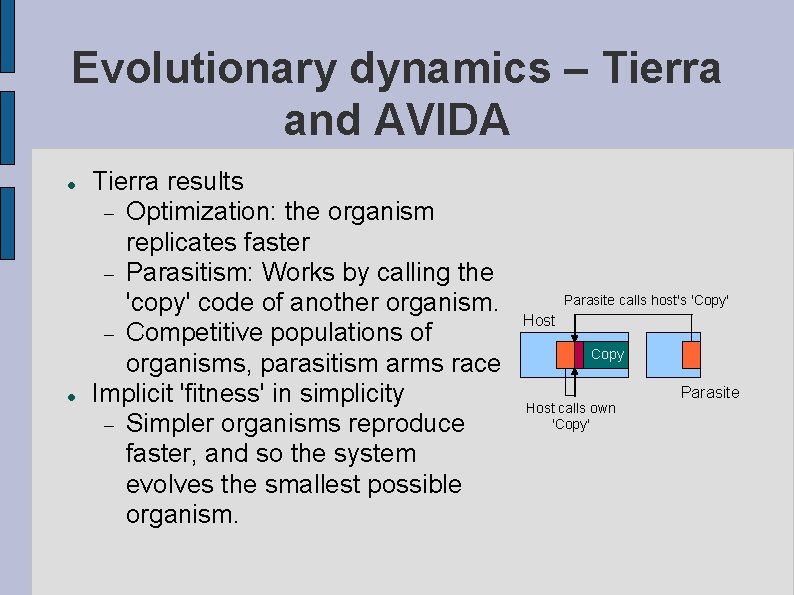
Evolutionary dynamics – Tierra and AVIDA Tierra results Optimization: the organism replicates faster Parasitism: Works by calling the 'copy' code of another organism. Competitive populations of organisms, parasitism arms race Implicit 'fitness' in simplicity Simpler organisms reproduce faster, and so the system evolves the smallest possible organism. Parasite calls host's 'Copy' Host Copy Host calls own 'Copy' Parasite
Evolutionary dynamics – Tierra and AVIDA results 1, 2 Increase in fitness with time Sharp jumps in the fitness which correspond to sharp changes in the complexity of the program Simpler problems to solve result in simpler organisms In more complex problems, simpler functions emerge first and then are combined to solve the complex problem Complexity increases until the problem is solved, then stops. 1: C. Adami, C. Ofria, and T. C. Collier, “Evolution of Biological Complexity” PNAS 97 (2000) 2: R. Lenski, C. Ofria, R. Pennock, C. Adami, “The evolutionary origin of complex features” Nature 423 (2003)
Fitness and Complexity
Effects of Absolute Fitness In most simulations of evolutionary dynamics, there is some externally imposed fitness criterion. In others, there is an implicit absolute fitness criterion (for example, speed of replication in Tierra or AVIDA) Absolute fitness criteria have maxima (global or local). The system will eventually get stuck in some sort of maximum and will stagnate.
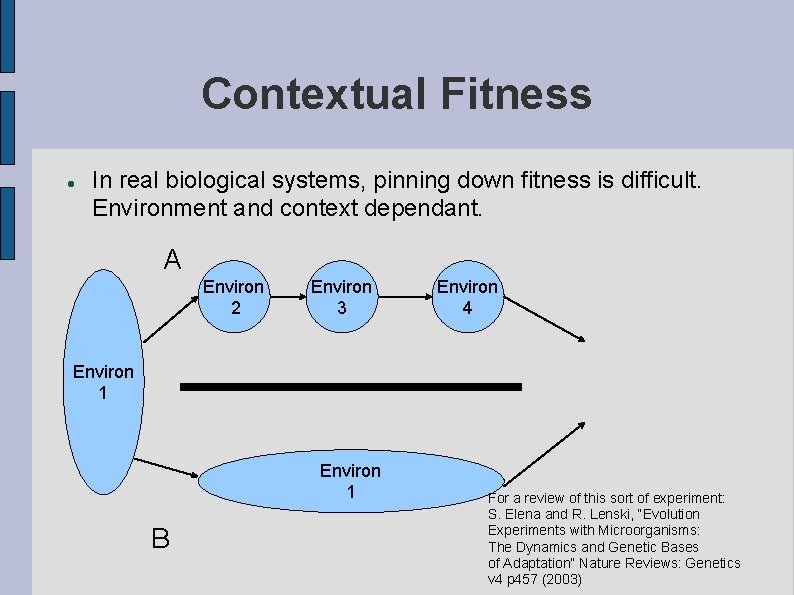
Contextual Fitness In real biological systems, pinning down fitness is difficult. Environment and context dependant. A Environ 2 Environ 3 Environ 4 Environ 1 B For a review of this sort of experiment: S. Elena and R. Lenski, “Evolution Experiments with Microorganisms: The Dynamics and Genetic Bases of Adaptation” Nature Reviews: Genetics v 4 p 457 (2003)
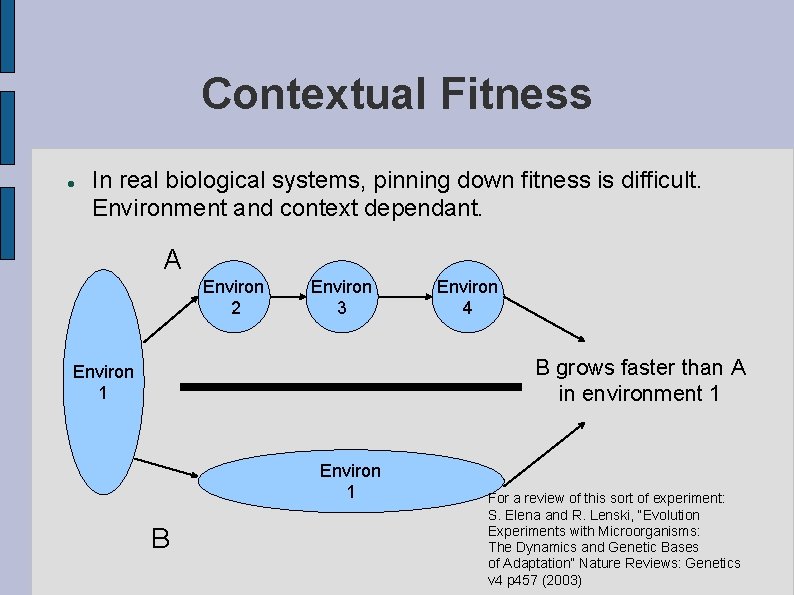
Contextual Fitness In real biological systems, pinning down fitness is difficult. Environment and context dependant. A Environ 2 Environ 3 Environ 4 B grows faster than A in environment 1 Environ 1 B For a review of this sort of experiment: S. Elena and R. Lenski, “Evolution Experiments with Microorganisms: The Dynamics and Genetic Bases of Adaptation” Nature Reviews: Genetics v 4 p 457 (2003)
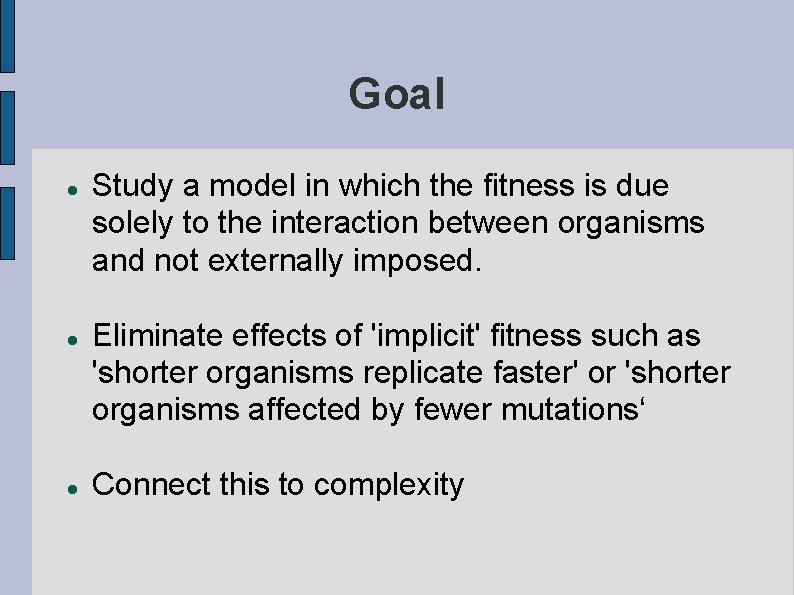
Goal Study a model in which the fitness is due solely to the interaction between organisms and not externally imposed. Eliminate effects of 'implicit' fitness such as 'shorter organisms replicate faster' or 'shorter organisms affected by fewer mutations‘ Connect this to complexity
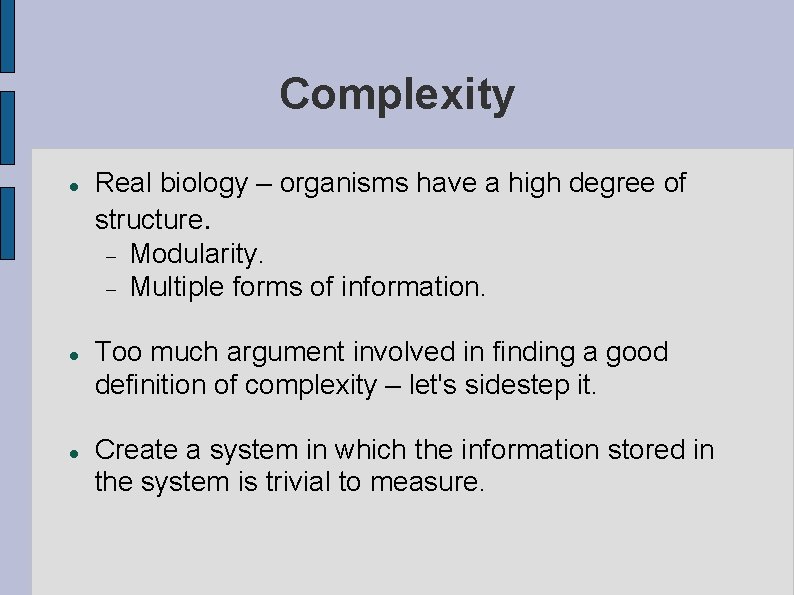
Complexity Real biology – organisms have a high degree of structure. Modularity. Multiple forms of information. Too much argument involved in finding a good definition of complexity – let's sidestep it. Create a system in which the information stored in the system is trivial to measure.
Foodchain and Plant. Net: Models with open-ended complexity
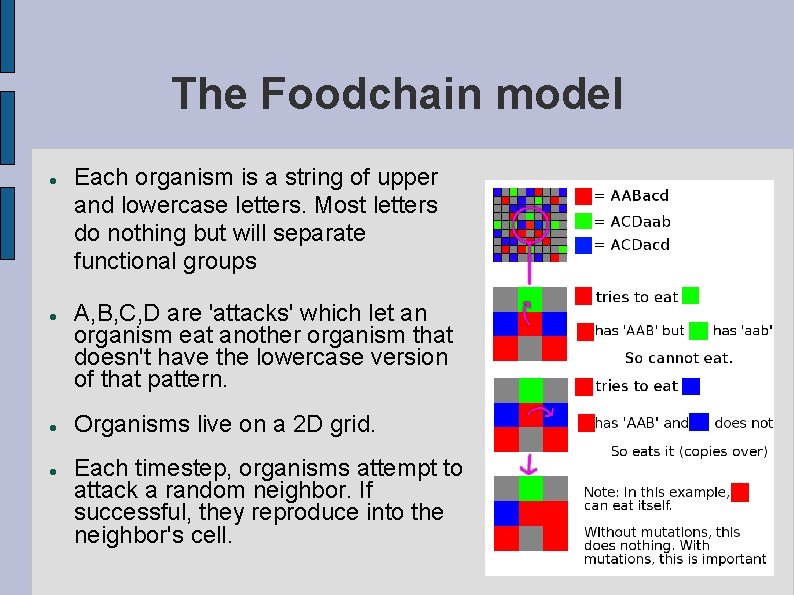
The Foodchain model Each organism is a string of upper and lowercase letters. Most letters do nothing but will separate functional groups A, B, C, D are 'attacks' which let an organism eat another organism that doesn't have the lowercase version of that pattern. Organisms live on a 2 D grid. Each timestep, organisms attempt to attack a random neighbor. If successful, they reproduce into the neighbor's cell.
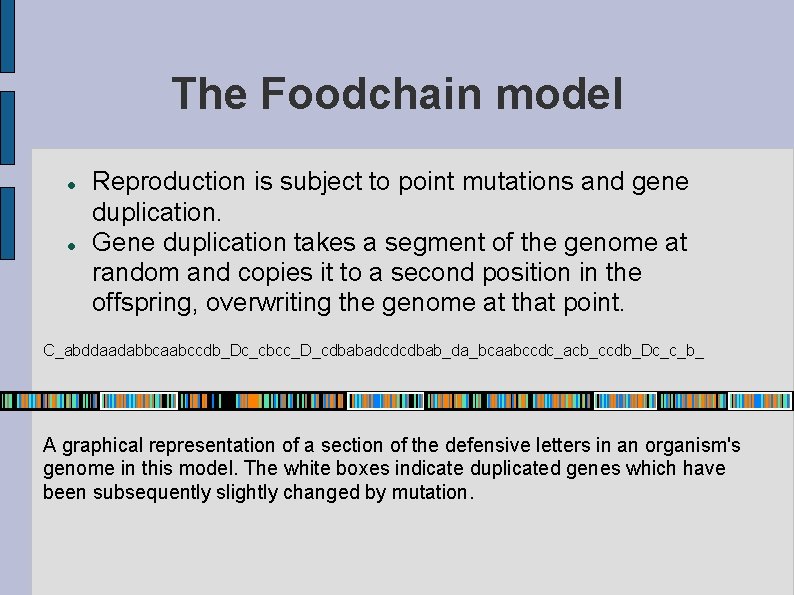
The Foodchain model Reproduction is subject to point mutations and gene duplication. Gene duplication takes a segment of the genome at random and copies it to a second position in the offspring, overwriting the genome at that point. C_abddaadabbcaabccdb_Dc_cbcc_D_cdbabadcdcdbab_da_bcaabccdc_acb_ccdb_Dc_c_b_ A graphical representation of a section of the defensive letters in an organism's genome in this model. The white boxes indicate duplicated genes which have been subsequently slightly changed by mutation.
Gene duplication Why include gene duplication? This is considered to be a way for organisms to diversify without knocking out essential functions. The new copy can be modified by mutation without risking the function of the original.
Mutation vs. Gene duplication Mutation: Probability of destroying a gene increases with gene length. Gene duplication: Probability of destroying a gene independent of gene length.
Foodchain – What to measure? Measured quantity: the length of a, b, c, d and A, B, C, D patterns Having an A, B, C, D pattern of length L requires an a, b, c, d pattern of at least length L to functionally counter it. These pattern lengths are a decent complexity measure as they are directly related to function.
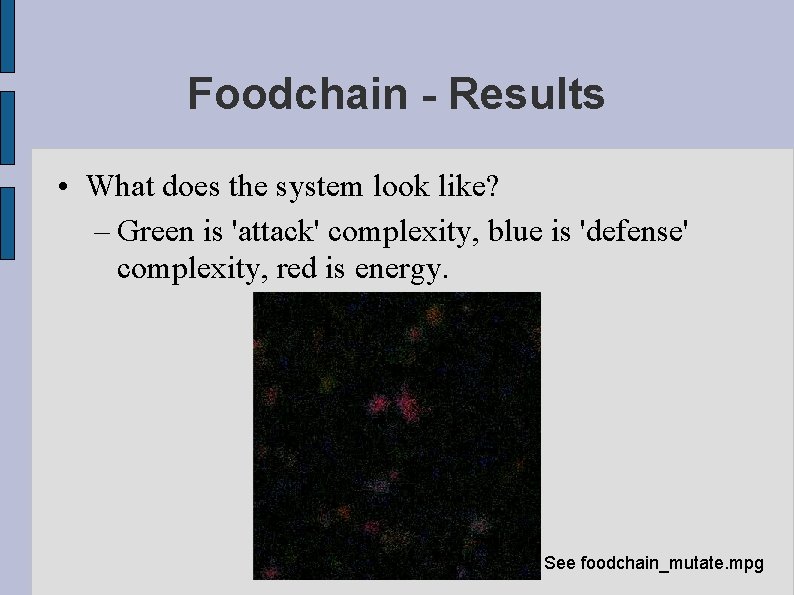
Foodchain - Results • What does the system look like? – Green is 'attack' complexity, blue is 'defense' complexity, red is energy. See foodchain_mutate. mpg
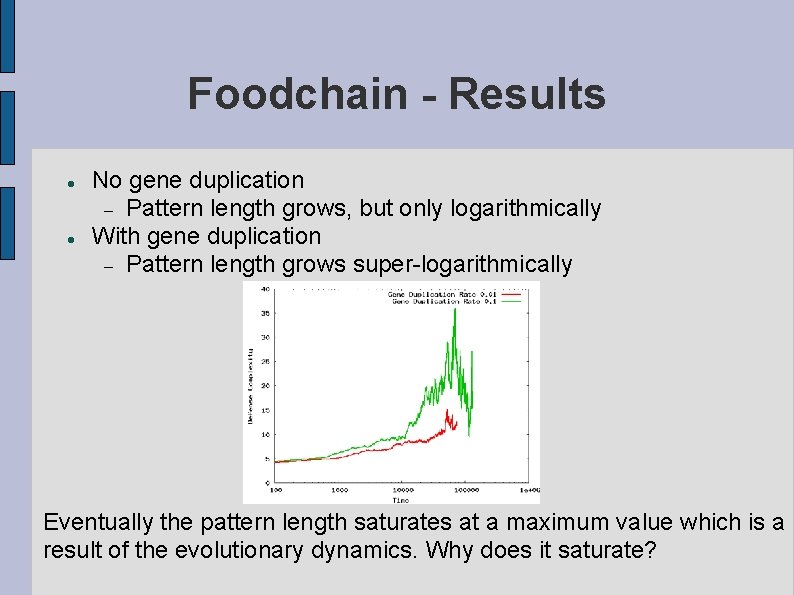
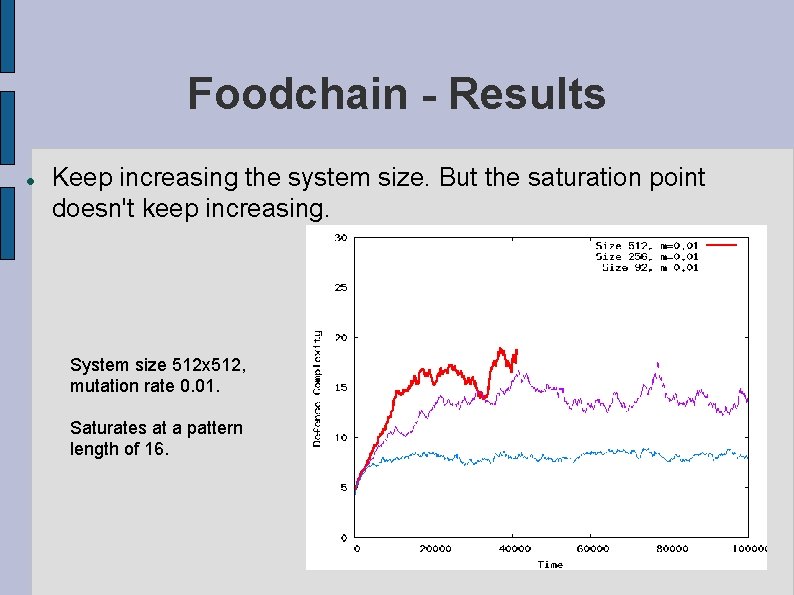
Foodchain - Results No gene duplication Pattern length grows, but only logarithmically With gene duplication Pattern length grows super-logarithmically Eventually the pattern length saturates at a maximum value which is a result of the evolutionary dynamics. Why does it saturate?
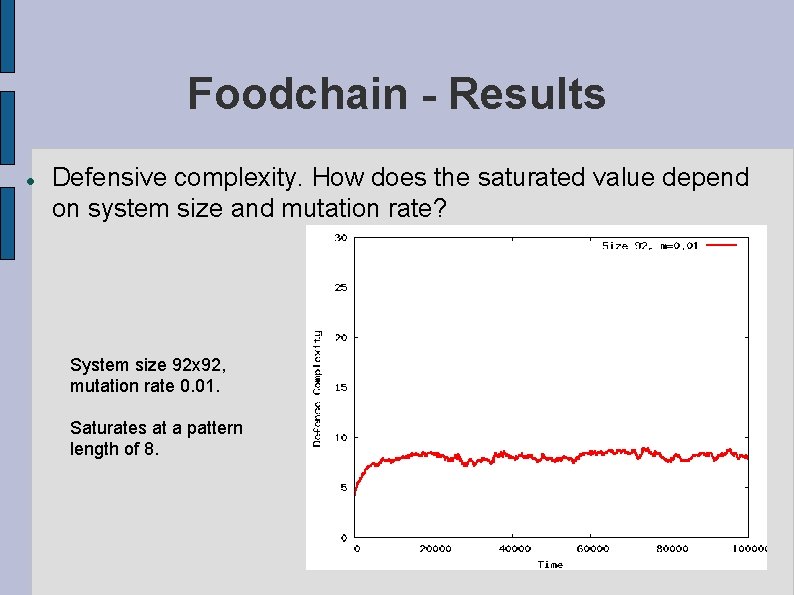
Foodchain - Results Defensive complexity. How does the saturated value depend on system size and mutation rate? System size 92 x 92, mutation rate 0. 01. Saturates at a pattern length of 8.
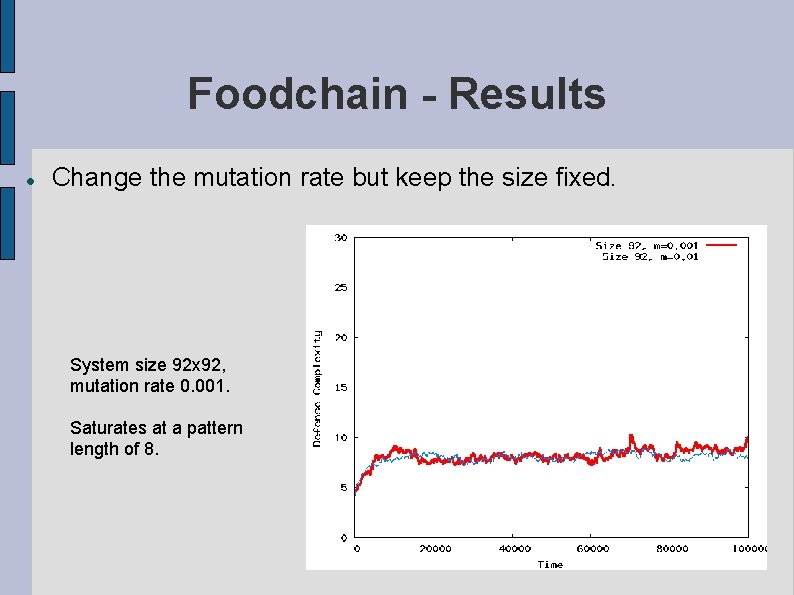
Foodchain - Results Change the mutation rate but keep the size fixed. System size 92 x 92, mutation rate 0. 001. Saturates at a pattern length of 8.
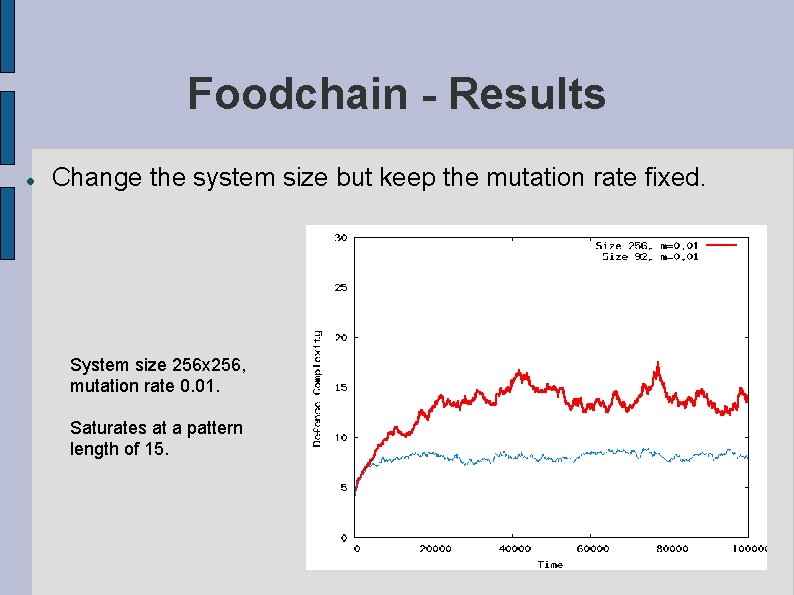
Foodchain - Results Change the system size but keep the mutation rate fixed. System size 256 x 256, mutation rate 0. 01. Saturates at a pattern length of 15.
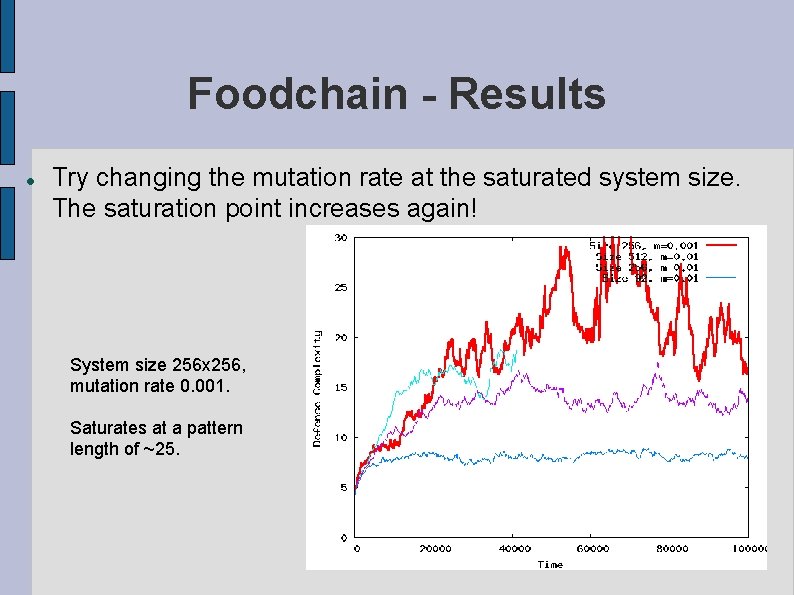
Foodchain - Results Keep increasing the system size. But the saturation point doesn't keep increasing. System size 512 x 512, mutation rate 0. 01. Saturates at a pattern length of 16.
Foodchain - Results Try changing the mutation rate at the saturated system size. The saturation point increases again! System size 256 x 256, mutation rate 0. 001. Saturates at a pattern length of ~25.
Foodchain - Results Saturation of maximum pattern length. The point of saturation depends on various system factors. Mutation rate: the higher the mutation rate, the lower the saturation point System size: the smaller the system, the lower the saturation point When one increases the system size and decreases the mutation rate, the maximum pattern length increases!
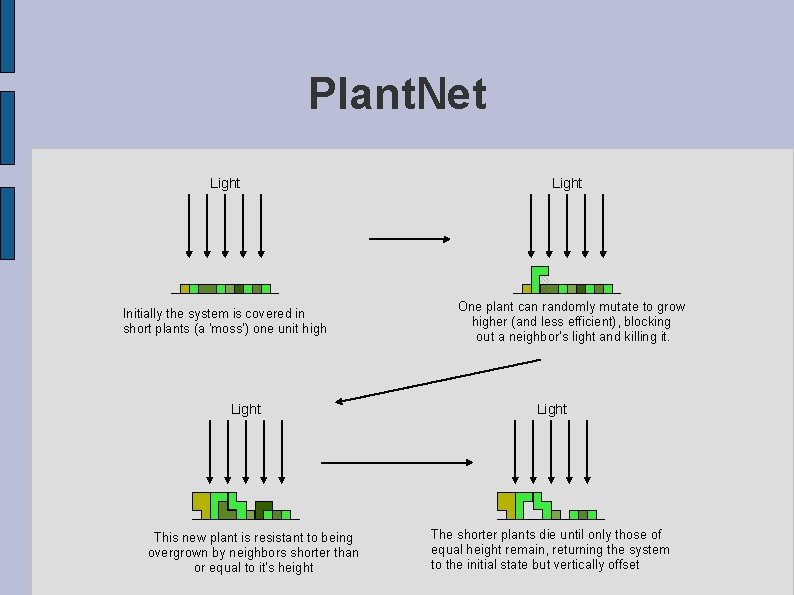
Plant. Net – the effect of fitness Artificial system with complexity growth Point of the exercise: increase in complexity can occur in spite of an externally imposed fitness function. The dynamics can even decrease the total fitness. Plant. Net Build trees which compete for sunlight from a series of building blocks. Trees are penalized for their total mass. Height of a tree corresponds to active information in its genome.
Plant. Net Light Initially the system is covered in short plants (a 'moss') one unit high Light This new plant is resistant to being overgrown by neighbors shorter than or equal to it's height Light One plant can randomly mutate to grow higher (and less efficient), blocking out a neighbor's light and killing it. Light The shorter plants die until only those of equal height remain, returning the system to the initial state but vertically offset
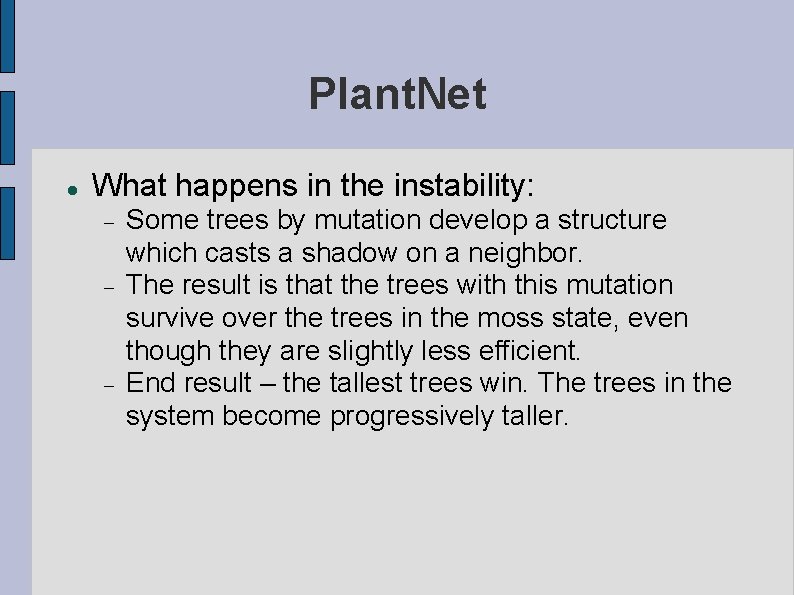
Plant. Net What happens in the instability: Some trees by mutation develop a structure which casts a shadow on a neighbor. The result is that the trees with this mutation survive over the trees in the moss state, even though they are slightly less efficient. End result – the tallest trees win. The trees in the system become progressively taller.
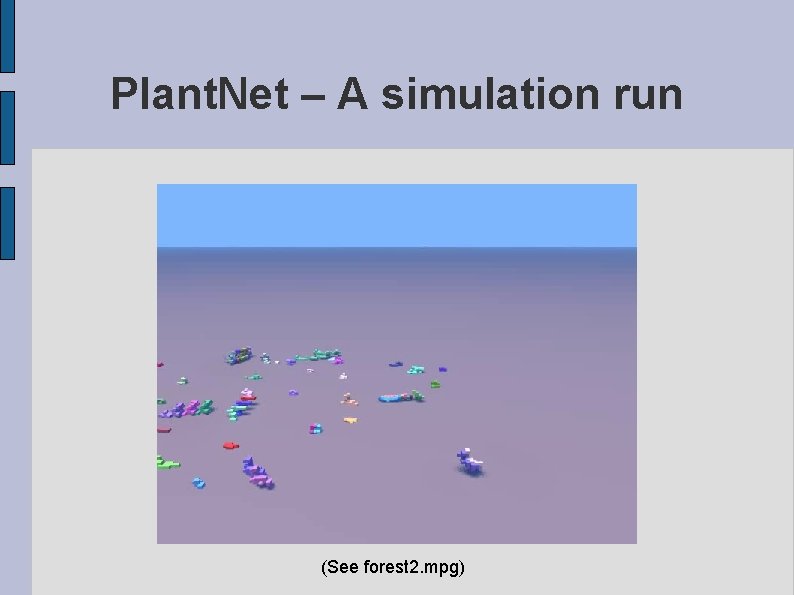
Plant. Net – A simulation run (See forest 2. mpg)
Conclusions Open-ended increase of complexity needs dynamics that are independent of the complexity at any given time. Increase of complexity can occur without imposing global optimality. It can even drive the system to decrease overall fitness. A strong, imposed fitness landscape can prevent openended increase in complexity.