
Relative clauses There are two types of relative
- Slides: 8
Relative clauses There are two types of relative clauses: a) Defining relative clauses b) Non-defining relative clauses. Defining relative clauses give essential information about something, information which is necessary to understand the meaning of the sentence. However, nondefining relative clauses give extra information about something, information we do not need to understand the meaning of the sentence. e. g. The woman who lives next door is English. (defining) e. g. Sylvia, who comes from Paris, speaks Spanish very well. (non-defining)
Relative clauses DEFINING RELATIVE CLAUSES We use defining relative clauses to add essential information to a sentence. The clause goes immediately after the noun it describes. e. g. “This is the man who sold me the car”
Relative clauses We use relative pronouns in defining relative clauses: -who/that for people -which/that for objects e. g. He is the man who/that owns this car. e. g. This is the pencil (which/that) she lost. We can leave out who/which/that when the relative pronoun is the object of the sentence. We can´t leave out who/which/that when the relative pronoun is the subject of the sentence. e. g. The car (which/that) I cleaned last weekend was my brother´s car. (object) e. g. The man (who/that) I saw yesterday in the park was very rude. (object) e. g. That´s the dog which attacked my children (subject)
Relative clauses We can also use relative adverbs in relative clauses, for instance, where, when, why. Where for places (WHEN THE PLACE IS THE ADVERB OF THE SENTENCE, NOT THE OBJECT) e. g. London is the city which I visited yesterday in England. (Here “city” is the object of the sentence > what city did I visit? London. ) e. g. London is the city where I was born (Here “city” is the adverb of the sentence > Where was I born? In London. ) When for time e. g. I will never forget the day when I met you. Why for reason e. g. Her personality was the reason why I broke up our relationship.
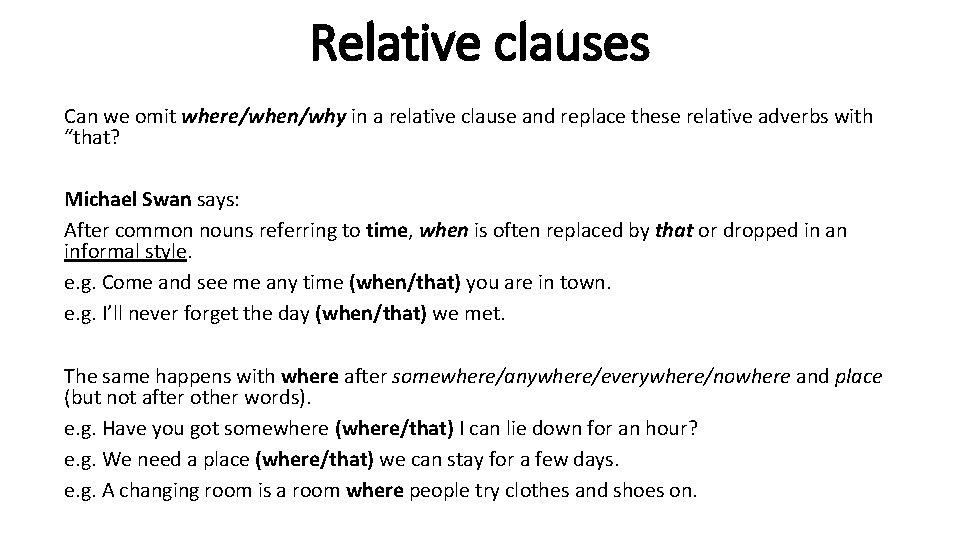
Relative clauses Can we omit where/when/why in a relative clause and replace these relative adverbs with “that? Michael Swan says: After common nouns referring to time, when is often replaced by that or dropped in an informal style. e. g. Come and see me any time (when/that) you are in town. e. g. I’ll never forget the day (when/that) we met. The same happens with where after somewhere/anywhere/everywhere/nowhere and place (but not after other words). e. g. Have you got somewhere (where/that) I can lie down for an hour? e. g. We need a place (where/that) we can stay for a few days. e. g. A changing room is a room where people try clothes and shoes on.
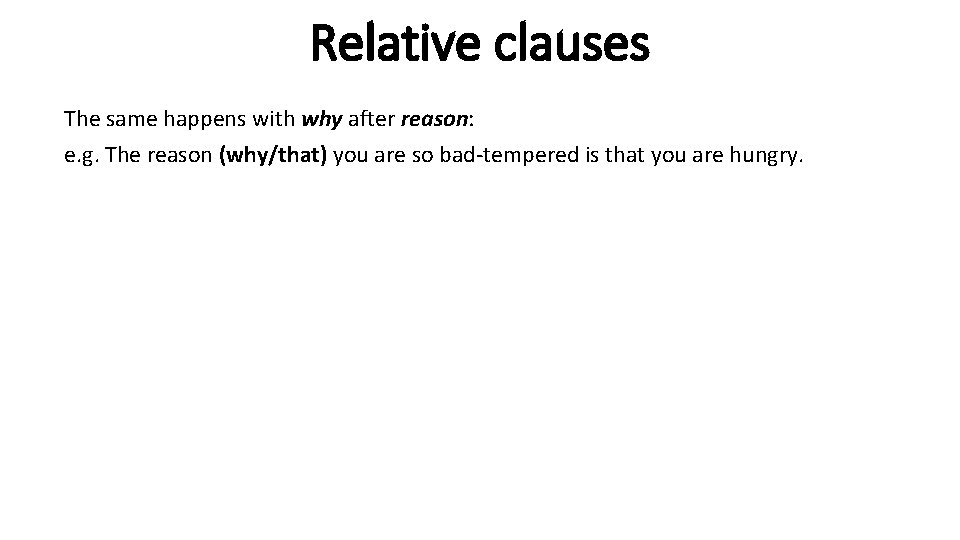
Relative clauses The same happens with why after reason: e. g. The reason (why/that) you are so bad-tempered is that you are hungry.
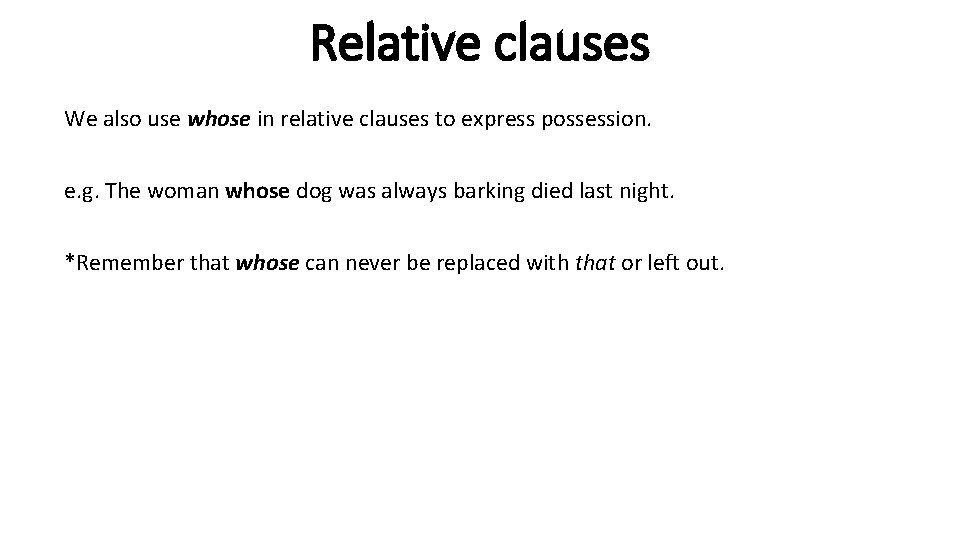
Relative clauses We also use whose in relative clauses to express possession. e. g. The woman whose dog was always barking died last night. *Remember that whose can never be replaced with that or left out.
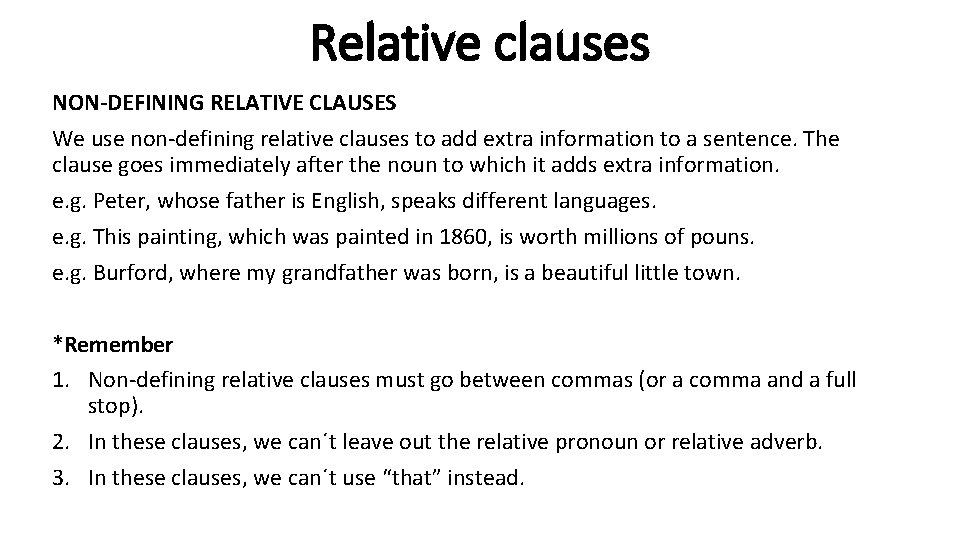
Relative clauses NON-DEFINING RELATIVE CLAUSES We use non-defining relative clauses to add extra information to a sentence. The clause goes immediately after the noun to which it adds extra information. e. g. Peter, whose father is English, speaks different languages. e. g. This painting, which was painted in 1860, is worth millions of pouns. e. g. Burford, where my grandfather was born, is a beautiful little town. *Remember 1. Non-defining relative clauses must go between commas (or a comma and a full stop). 2. In these clauses, we can´t leave out the relative pronoun or relative adverb. 3. In these clauses, we can´t use “that” instead.