
RELATIVE CLAUSES n Complete with the correct relative
- Slides: 15
RELATIVE CLAUSES
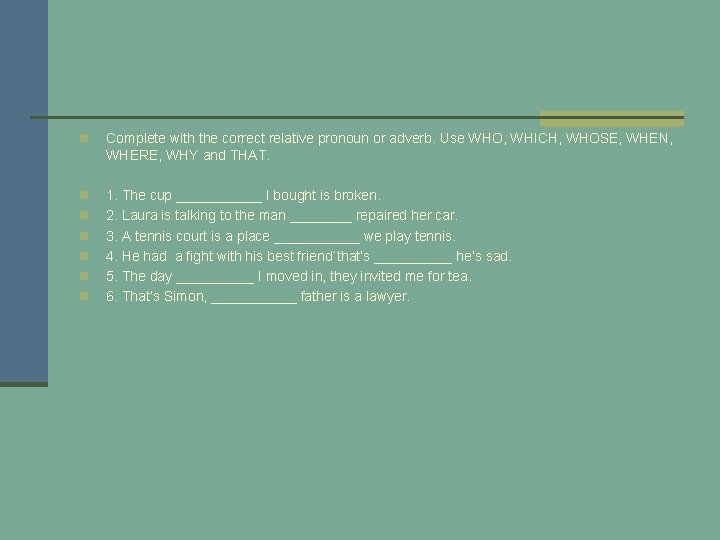
n Complete with the correct relative pronoun or adverb. Use WHO, WHICH, WHOSE, WHEN, WHERE, WHY and THAT. n 1. The cup ______ I bought is broken. 2. Laura is talking to the man ____ repaired her car. 3. A tennis court is a place ______ we play tennis. 4. He had a fight with his best friend´that’s _____ he’s sad. 5. The day _____ I moved in, they invited me for tea. 6. That’s Simon, ______ father is a lawyer. n n n
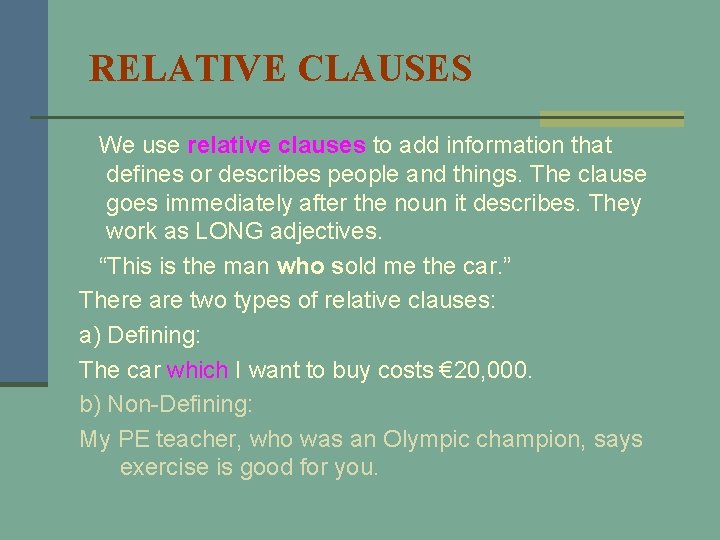
RELATIVE CLAUSES We use relative clauses to add information that defines or describes people and things. The clause goes immediately after the noun it describes. They work as LONG adjectives. “This is the man who sold me the car. ” There are two types of relative clauses: a) Defining: The car which I want to buy costs € 20, 000. b) Non-Defining: My PE teacher, who was an Olympic champion, says exercise is good for you.
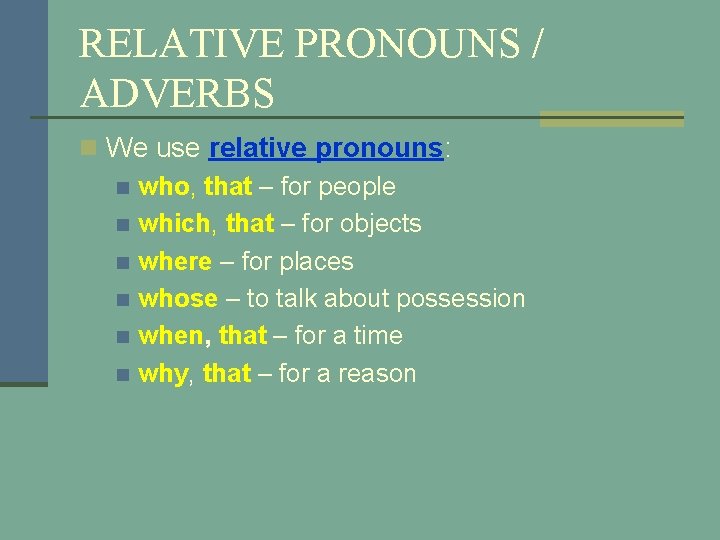
RELATIVE PRONOUNS / ADVERBS n We use relative pronouns: n who, that – for people n which, that – for objects n where – for places n whose – to talk about possession n when, that – for a time n why, that – for a reason
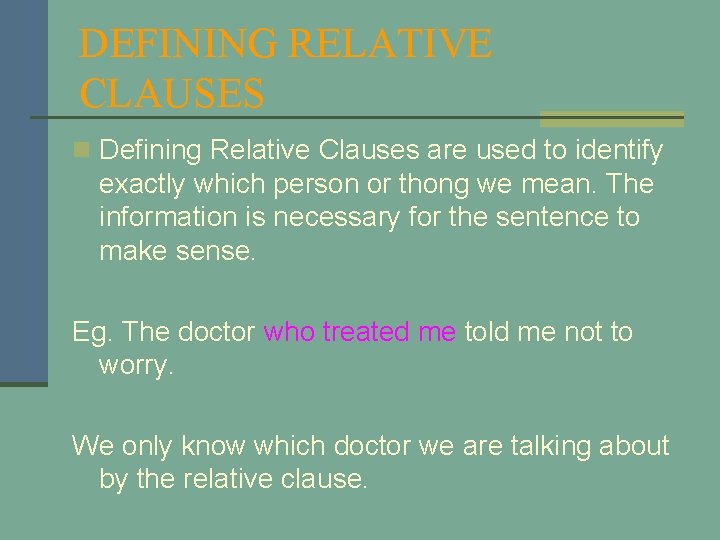
DEFINING RELATIVE CLAUSES n Defining Relative Clauses are used to identify exactly which person or thong we mean. The information is necessary for the sentence to make sense. Eg. The doctor who treated me told me not to worry. We only know which doctor we are talking about by the relative clause.
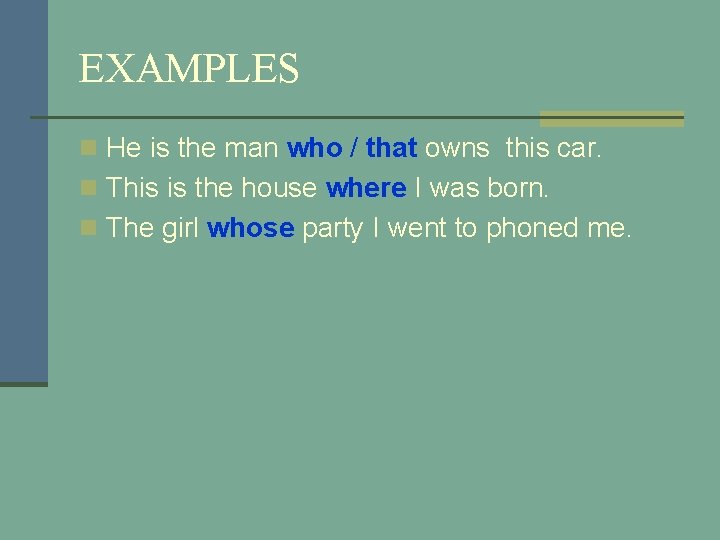
EXAMPLES n He is the man who / that owns this car. n This is the house where I was born. n The girl whose party I went to phoned me.
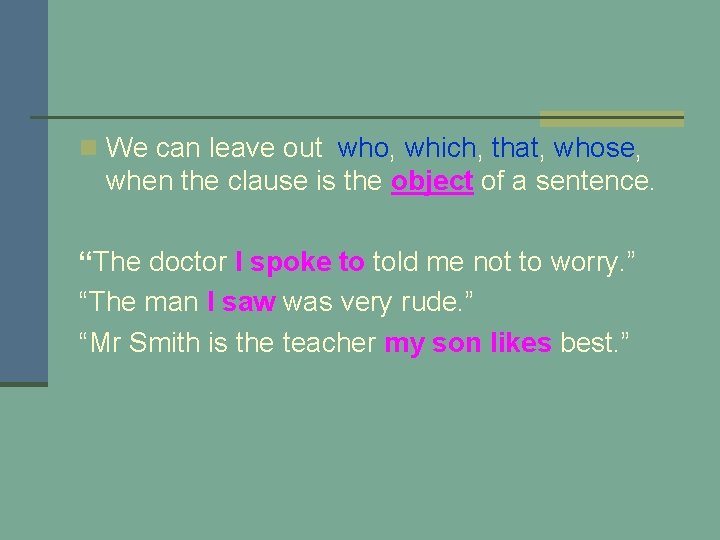
n We can leave out who, which, that, whose, when the clause is the object of a sentence. “The doctor I spoke to told me not to worry. ” “The man I saw was very rude. ” “Mr Smith is the teacher my son likes best. ”
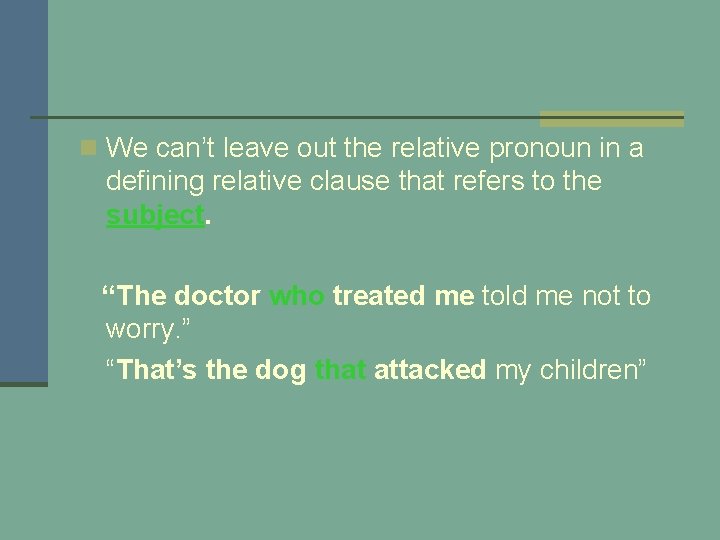
n We can’t leave out the relative pronoun in a defining relative clause that refers to the subject. “The doctor who treated me told me not to worry. ” “That’s the dog that attacked my children”
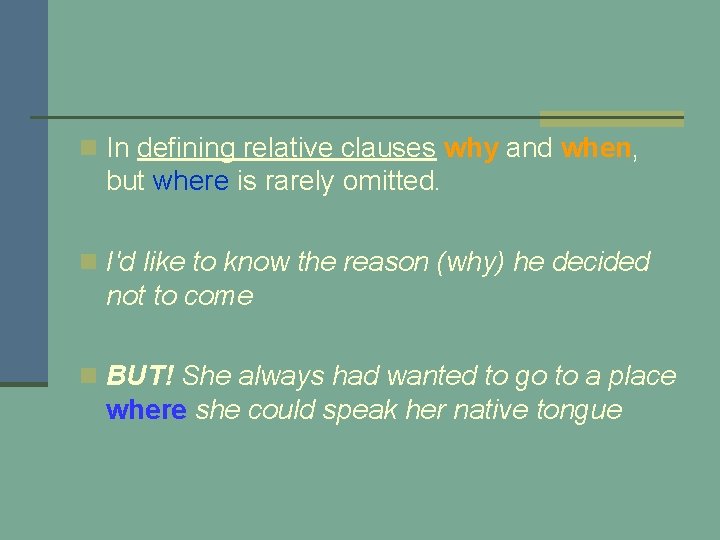
n In defining relative clauses why and when, but where is rarely omitted. n I'd like to know the reason (why) he decided not to come n BUT! She always had wanted to go to a place where she could speak her native tongue
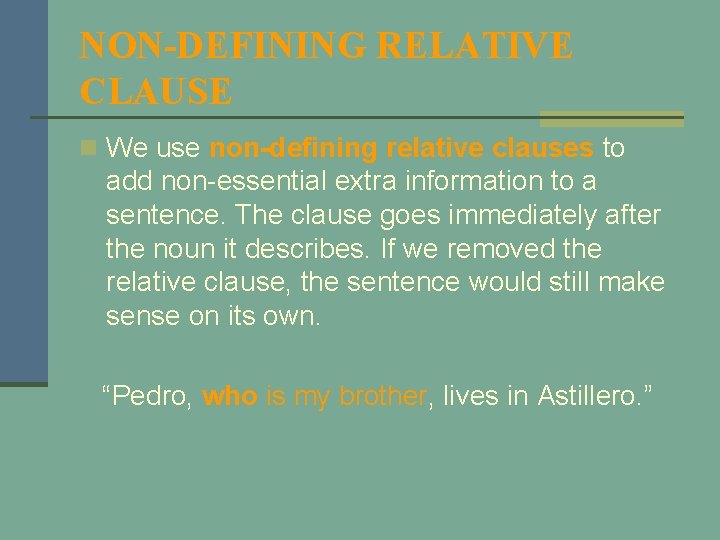
NON-DEFINING RELATIVE CLAUSE n We use non-defining relative clauses to add non-essential extra information to a sentence. The clause goes immediately after the noun it describes. If we removed the relative clause, the sentence would still make sense on its own. “Pedro, who is my brother, lives in Astillero. ”
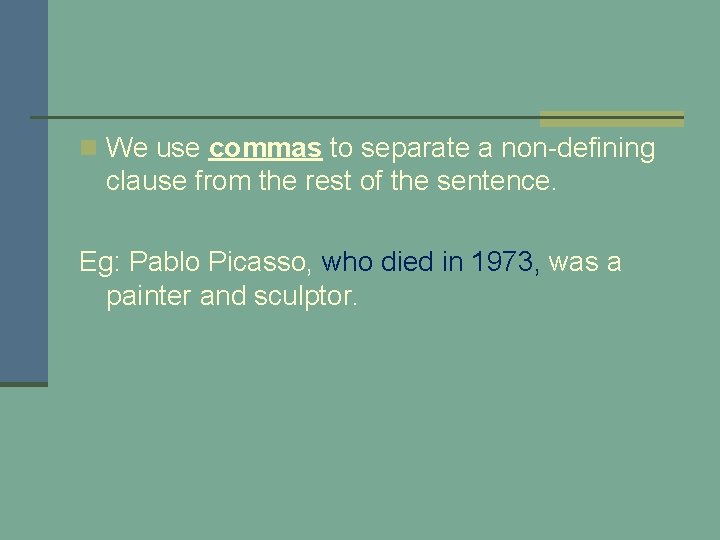
n We use commas to separate a non-defining clause from the rest of the sentence. Eg: Pablo Picasso, who died in 1973, was a painter and sculptor.
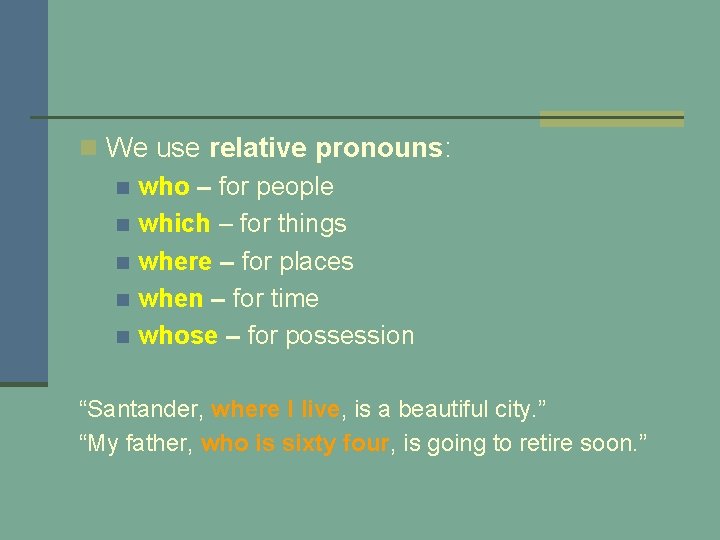
n We use relative pronouns: n who – for people n which – for things n where – for places n when – for time n whose – for possession “Santander, where I live, is a beautiful city. ” “My father, who is sixty four, is going to retire soon. ”
n We can’t leave out the relative pronoun in non-defining relative clauses. “John, who is English, helped me write the essay. ” We can’t use that in non-defining relative clauses.
Complete the sentences with a suitable relative pronoun if necessary. n Is that the book _____ you read last month? n Is this the film _____ won three Oscars? n This is the shop ____ they sell Mexican food. n Last summer I met a girl _____ father is a famous lawyer. n An engineer is a person ____ plans, makes or repairs things like machines, roads or bridges. n My neighbour works for a company _______ builds roads. n This is the town _____ my mother grew up.
Complete the sentences with a suitable relative pronoun if necessary. n n n n A tin opener is a thing ____ you open things with. Palencia is the city _______ my mother was born. This the company ____ my brother works for. The stage on ____ the new play was performed was very small. I didn’t enjoy the film ____ we saw last night. The sofa on _______ we were sitting collapsed. An air hostess is woman ____ job is to look after people on a plane. Here is the book _____ you have been looking for.