
Relative Clauses Kyewon Lee Debora Overview 1 Basic
Relative Clauses Kyewon Lee / Debora
Overview 1) Basic form 2) Different grammatical roles a) Subjective relatives b) Objective relatives c) After-preposition relatives d) Possessive relatives 3) Basic meaning of relative pronouns 4) Semantic & Structural differences 5) End-weight
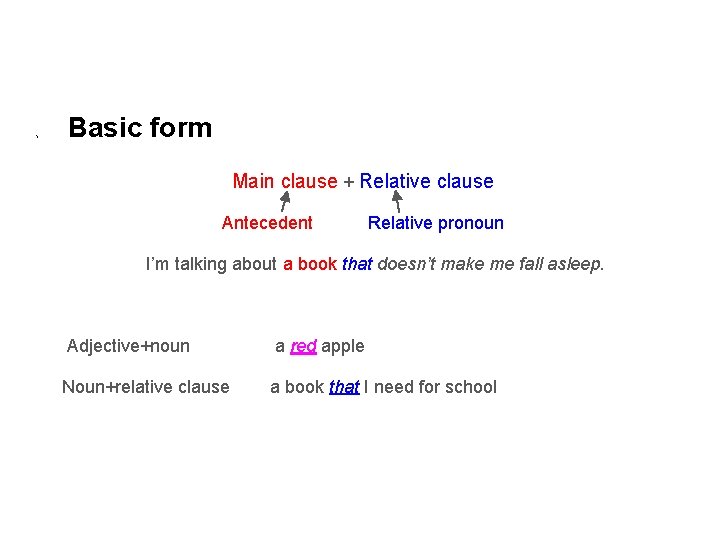
1) Basic form Main clause + Relative clause Antecedent Relative pronoun I’m talking about a book that doesn’t make me fall asleep. Adjective+noun a red apple Noun+relative clause a book that I need for school
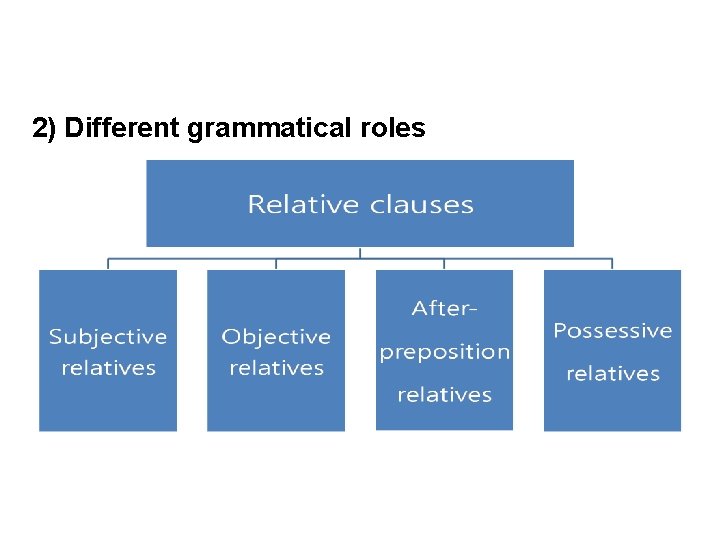
2) Different grammatical roles
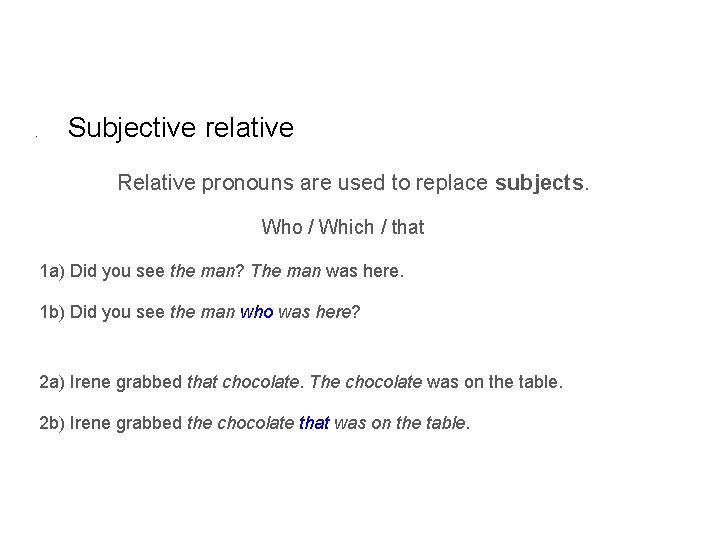
● Subjective relative Relative pronouns are used to replace subjects. Who / Which / that 1 a) Did you see the man? The man was here. 1 b) Did you see the man who was here? 2 a) Irene grabbed that chocolate. The chocolate was on the table. 2 b) Irene grabbed the chocolate that was on the table.
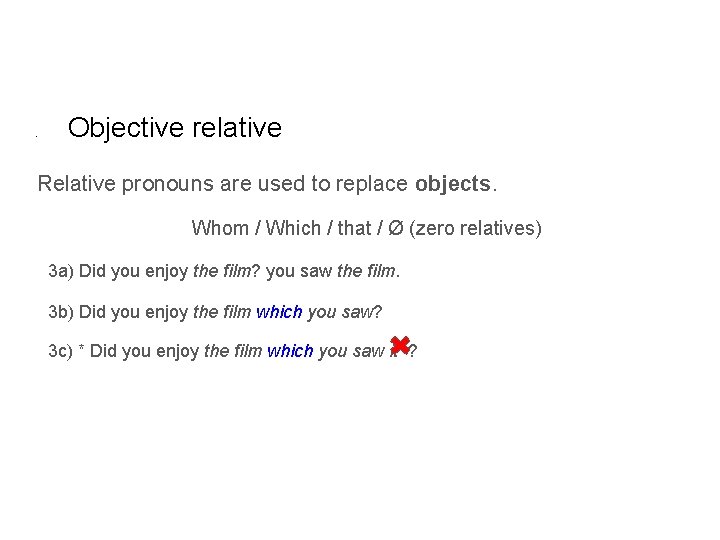
● Objective relative Relative pronouns are used to replace objects. Whom / Which / that / Ø (zero relatives) 3 a) Did you enjoy the film? you saw the film. 3 b) Did you enjoy the film which you saw? 3 c) * Did you enjoy the film which you saw it ?
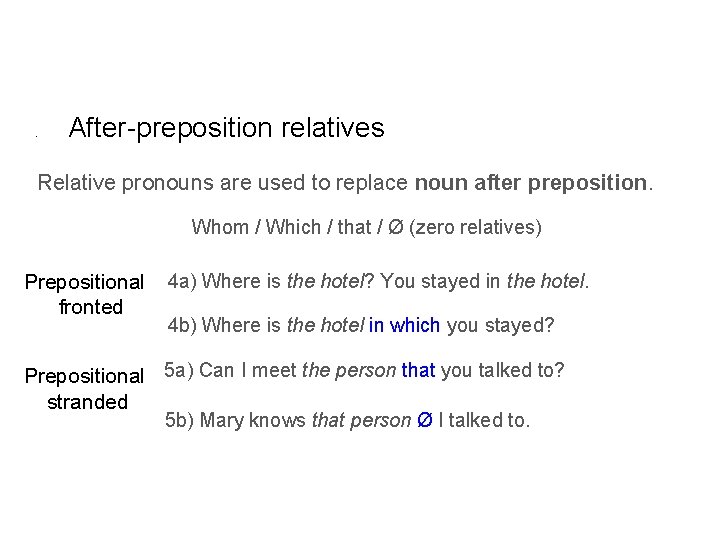
● After-preposition relatives Relative pronouns are used to replace noun after preposition. Whom / Which / that / Ø (zero relatives) Prepositional fronted 4 a) Where is the hotel? You stayed in the hotel. 4 b) Where is the hotel in which you stayed? Prepositional 5 a) Can I meet the person that you talked to? stranded 5 b) Mary knows that person Ø I talked to.
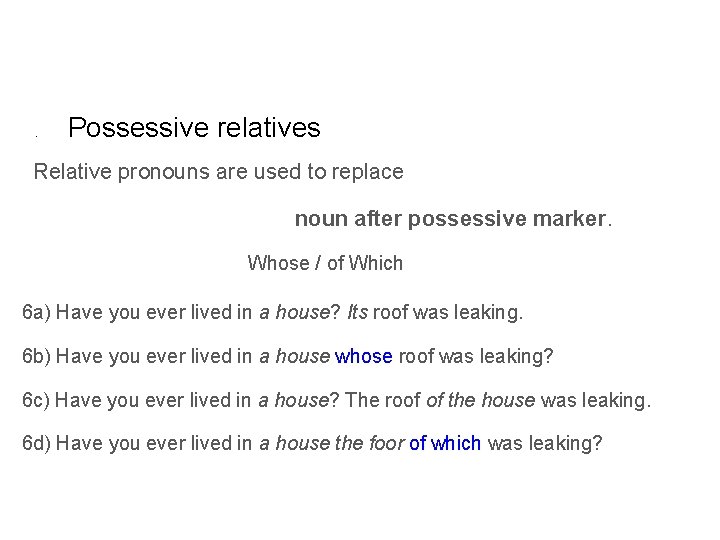
● Possessive relatives Relative pronouns are used to replace noun after possessive marker. Whose / of Which 6 a) Have you ever lived in a house? Its roof was leaking. 6 b) Have you ever lived in a house whose roof was leaking? 6 c) Have you ever lived in a house? The roof of the house was leaking. 6 d) Have you ever lived in a house the foor of which was leaking?
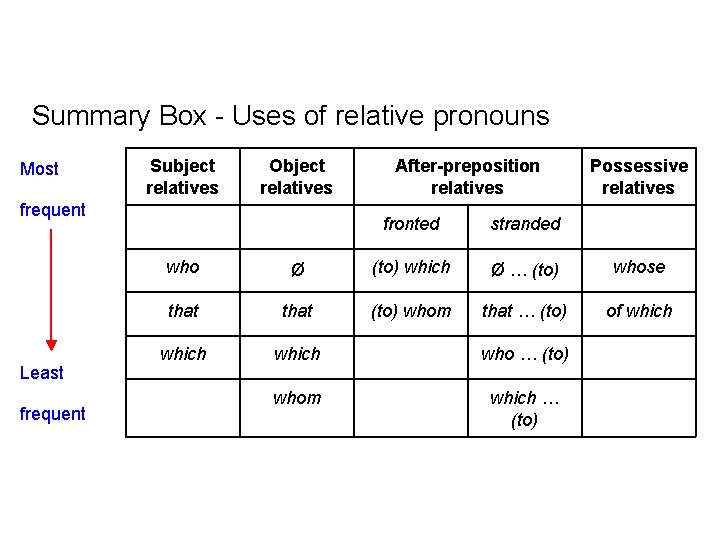
Summary Box - Uses of relative pronouns Most Subject relatives Object relatives frequent Least frequent After-preposition relatives fronted stranded Possessive relatives who Ø (to) which Ø … (to) whose that (to) whom that … (to) of which who … (to) whom which … (to)
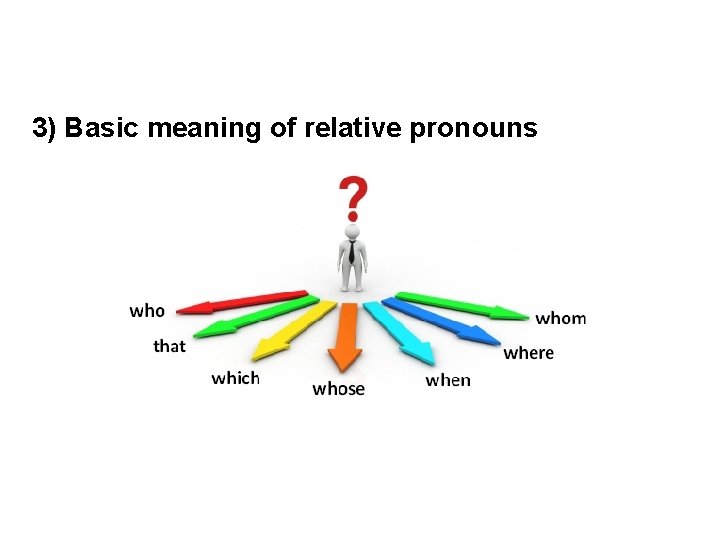
3) Basic meaning of relative pronouns
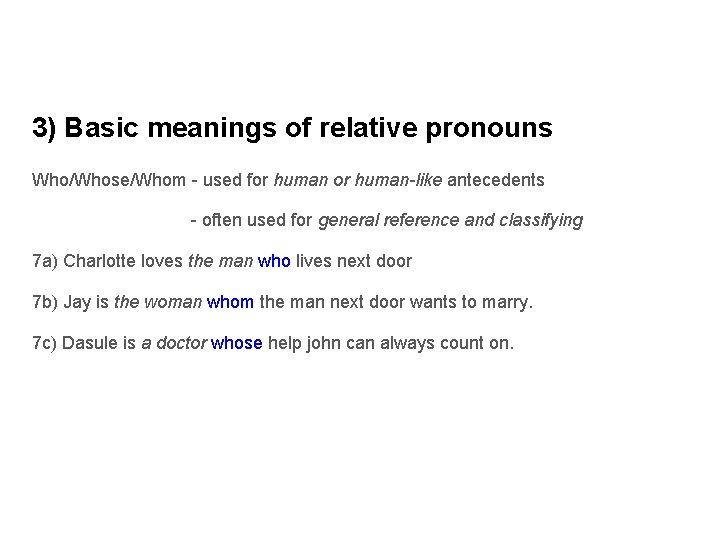
3) Basic meanings of relative pronouns Who/Whose/Whom - used for human-like antecedents - often used for general reference and classifying 7 a) Charlotte loves the man who lives next door 7 b) Jay is the woman whom the man next door wants to marry. 7 c) Dasule is a doctor whose help john can always count on.
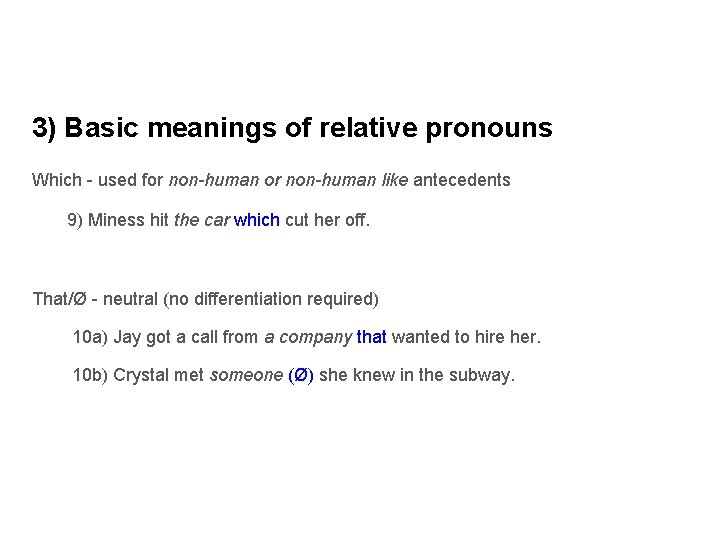
3) Basic meanings of relative pronouns Which - used for non-human like antecedents 9) Miness hit the car which cut her off. That/Ø - neutral (no differentiation required) 10 a) Jay got a call from a company that wanted to hire her. 10 b) Crystal met someone (Ø) she knew in the subway.
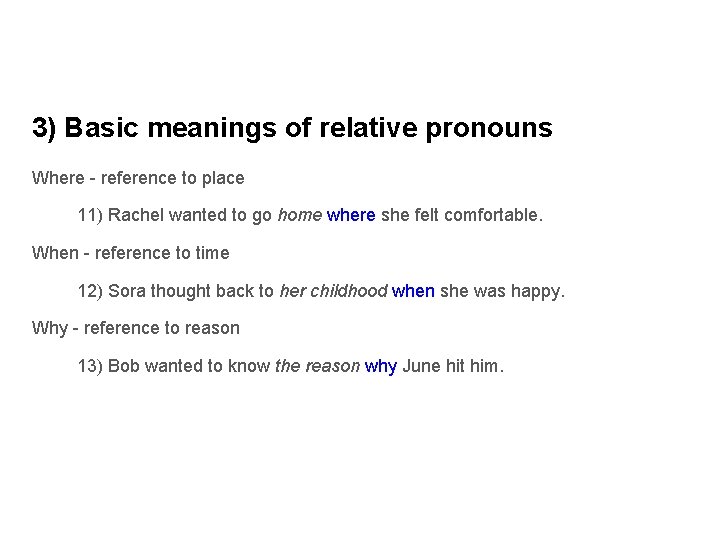
3) Basic meanings of relative pronouns Where - reference to place 11) Rachel wanted to go home where she felt comfortable. When - reference to time 12) Sora thought back to her childhood when she was happy. Why - reference to reason 13) Bob wanted to know the reason why June hit him.
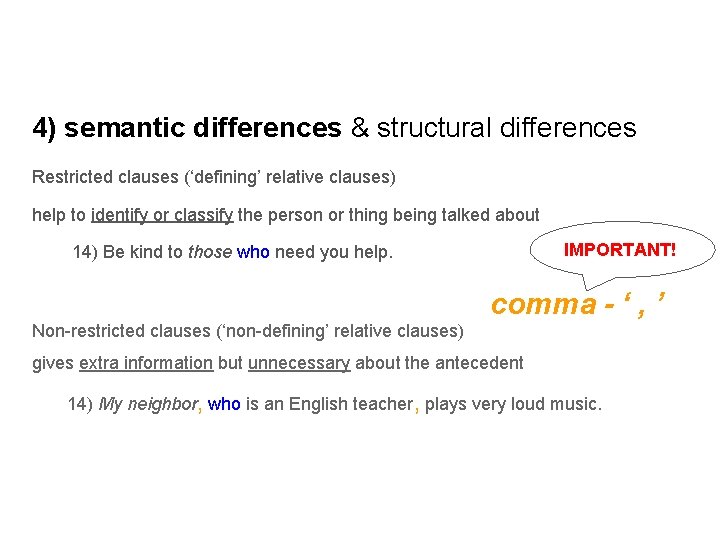
4) semantic differences & structural differences Restricted clauses (‘defining’ relative clauses) help to identify or classify the person or thing being talked about - IMPORTANT! 14) Be kind to those who need you help. comma - ‘ , ’ Non-restricted clauses (‘non-defining’ relative clauses) gives extra information but unnecessary about the antecedent - 14) My neighbor, who is an English teacher, plays very loud music.
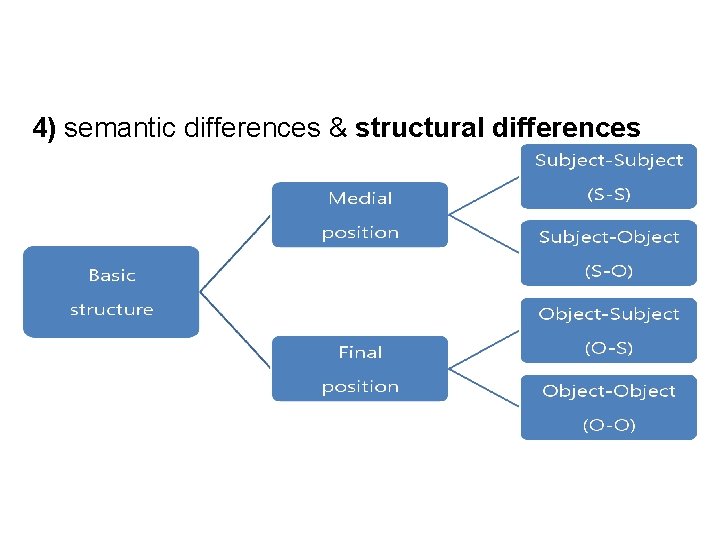
4) semantic differences & structural differences
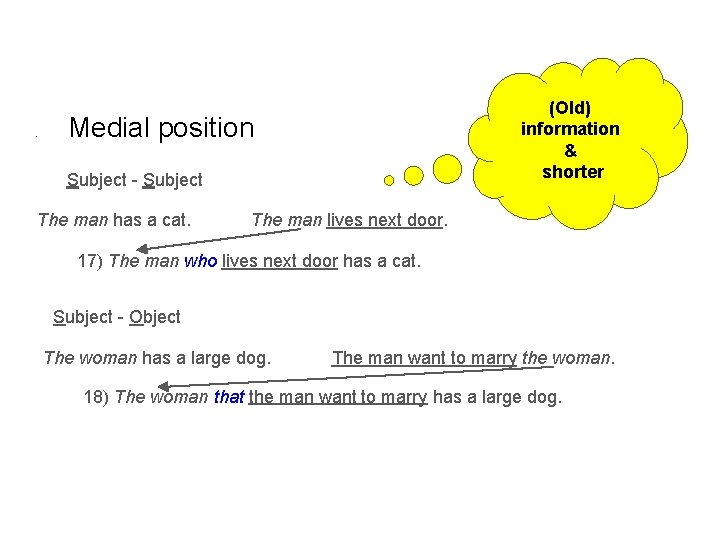
● (Old) information & shorter Medial position Subject - Subject The man has a cat. The man lives next door. 17) The man who lives next door has a cat. Subject - Object The woman has a large dog. The man want to marry the woman. 18) The woman that the man want to marry has a large dog.
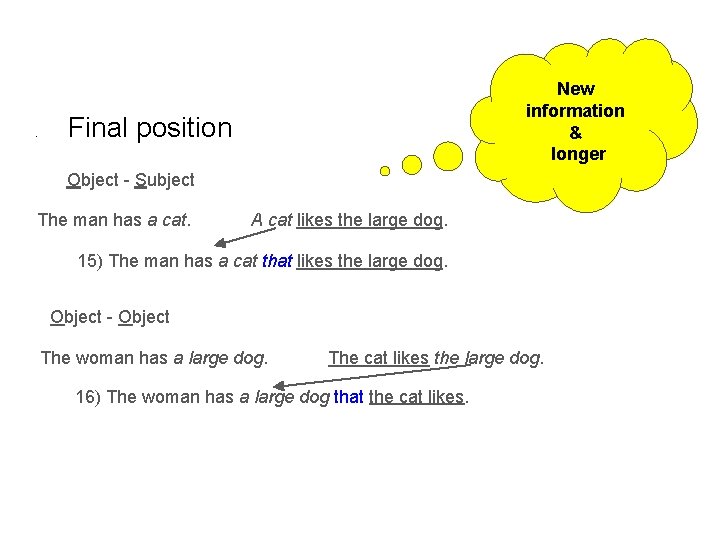
● New information & longer Final position Object - Subject The man has a cat. A cat likes the large dog. 15) The man has a cat that likes the large dog. Object - Object The woman has a large dog. The cat likes the large dog. 16) The woman has a large dog that the cat likes.
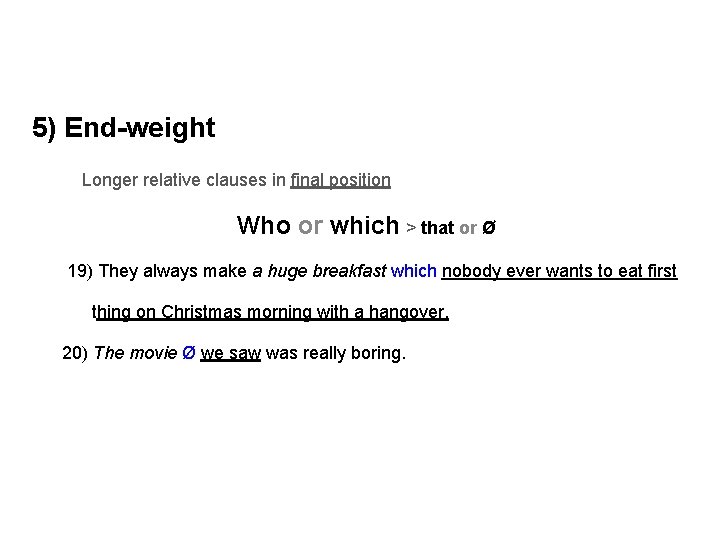
5) End-weight Longer relative clauses in final position Who or which > that or Ø 19) They always make a huge breakfast which nobody ever wants to eat first thing on Christmas morning with a hangover. 20) The movie Ø we saw was really boring.
Relative Clauses Class activities
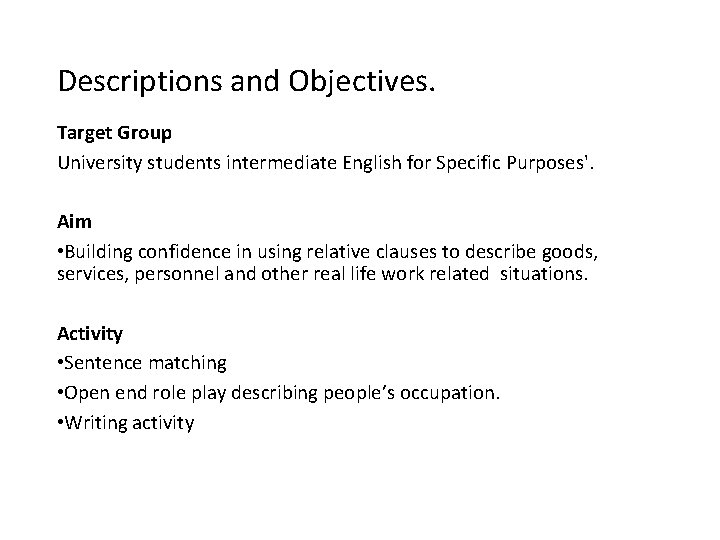
Descriptions and Objectives. Target Group University students intermediate English for Specific Purposes'. Aim • Building confidence in using relative clauses to describe goods, services, personnel and other real life work related situations. Activity • Sentence matching • Open end role play describing people’s occupation. • Writing activity
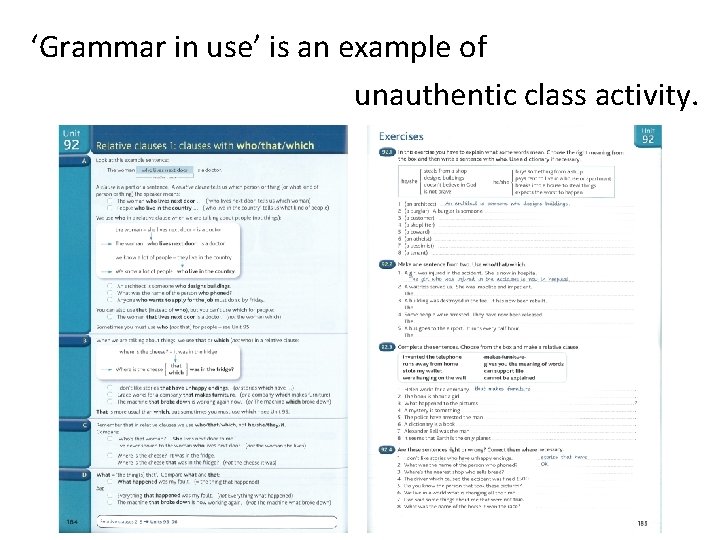
‘Grammar in use’ is an example of unauthentic class activity.
Activity 1. Open Ended role play using role cards - Outline Discuss with students to the topic occupation, using relative clauses by asking a few questions such as: • How would you describe a blue collar worker? What's full time work? Who is a consultant? What is a doctor do? • These questions should elicit a number of responses with competent use of relative clauses. • Make sure to rephrase student answers throughout using relative clauses to help inductively introduce the idea of relative clause use. For example: 1. Oh, full time work is a type of work which takes place for at least 40 hours a week. 2. A consultant is someone who provides services and advice to a company on a contractual basis. etc.
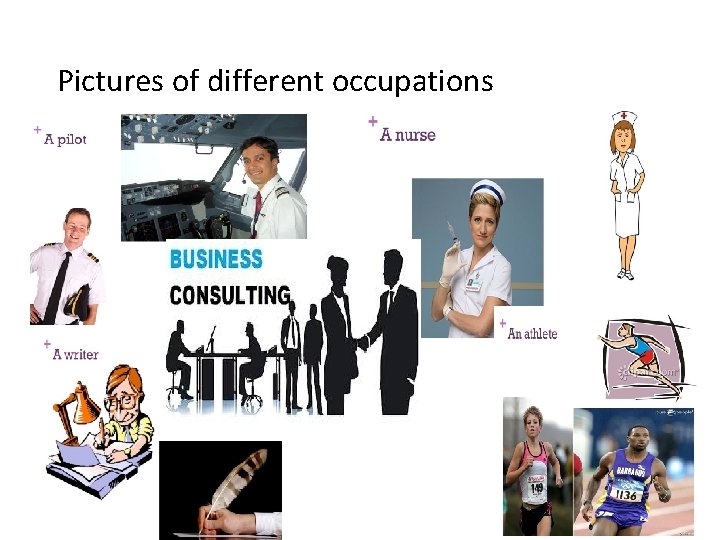
Pictures of different occupations
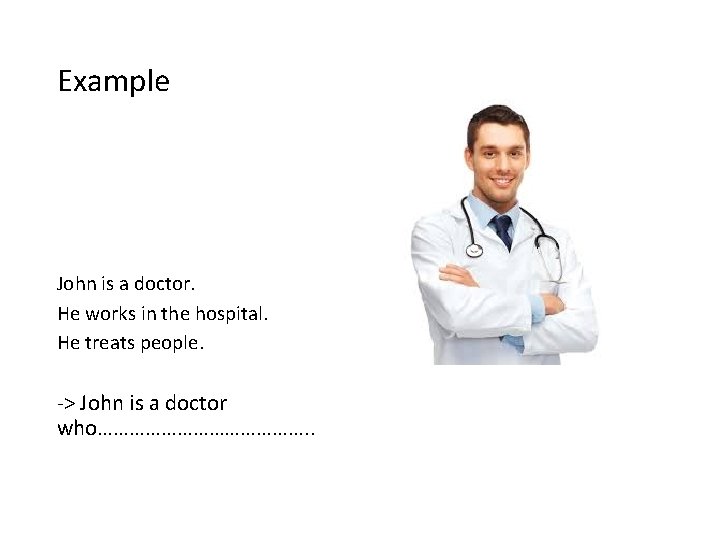
Example John is a doctor. He works in the hospital. He treats people. -> John is a doctor who…………………. .
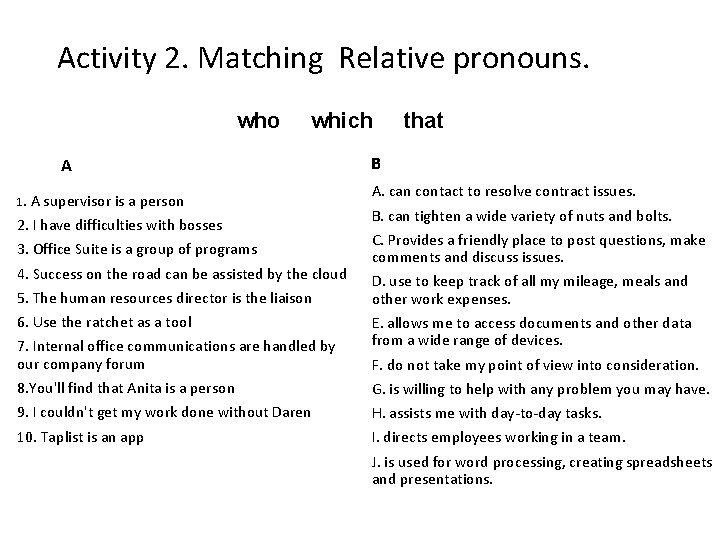
Activity 2. Matching Relative pronouns. who which A 1. A supervisor is a person 2. I have difficulties with bosses 3. Office Suite is a group of programs 4. Success on the road can be assisted by the cloud 5. The human resources director is the liaison 6. Use the ratchet as a tool 7. Internal office communications are handled by our company forum that B A. can contact to resolve contract issues. B. can tighten a wide variety of nuts and bolts. C. Provides a friendly place to post questions, make comments and discuss issues. D. use to keep track of all my mileage, meals and other work expenses. E. allows me to access documents and other data from a wide range of devices. F. do not take my point of view into consideration. 8. You'll find that Anita is a person G. is willing to help with any problem you may have. 9. I couldn't get my work done without Daren H. assists me with day-to-day tasks. 10. Taplist is an app I. directs employees working in a team. J. is used for word processing, creating spreadsheets and presentations.
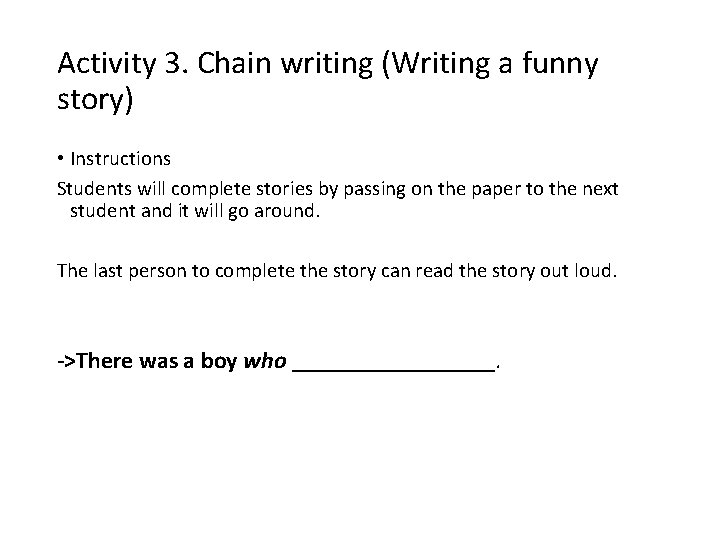
Activity 3. Chain writing (Writing a funny story) • Instructions Students will complete stories by passing on the paper to the next student and it will go around. The last person to complete the story can read the story out loud. ->There was a boy who _________.
- Slides: 26