
Relative Clause Aims Objectives 1 To understand how
Relative Clause 修飾節(しゅうしょくせつ) Aims & Objectives 1) To understand how a relative clause is used in a sentence in Japanese 2) To be able to modify a noun using a relative clause 3) To be able to form a sentence in which a relative clause is used 4) To be able to identify a relative clause in a longer sentence
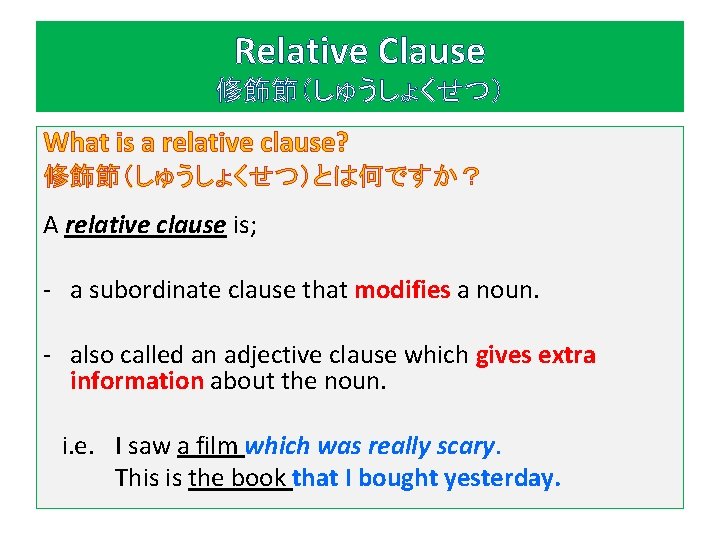
Relative Clause 修飾節(しゅうしょくせつ) What is a relative clause? 修飾節(しゅうしょくせつ)とは何ですか? A relative clause is; - a subordinate clause that modifies a noun. - also called an adjective clause which gives extra information about the noun. i. e. I saw a film which was really scary. This is the book that I bought yesterday.
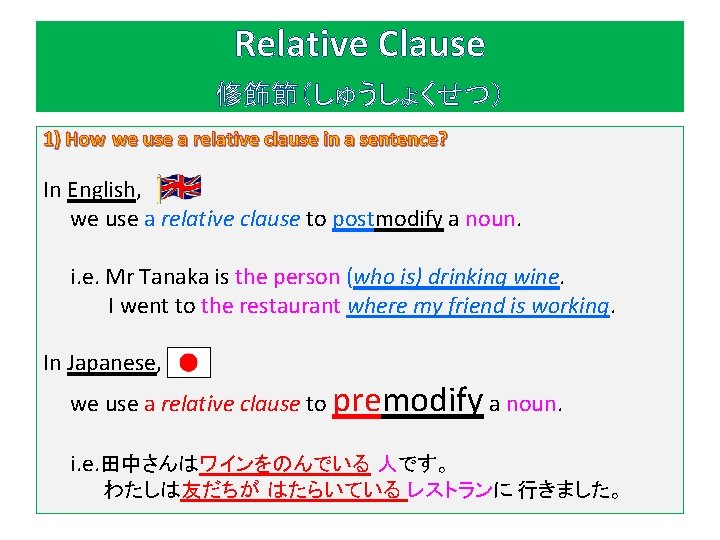
Relative Clause 修飾節(しゅうしょくせつ) 1) How we use a relative clause in a sentence? In English, we use a relative clause to postmodify a noun. i. e. Mr Tanaka is the person (who is) drinking wine. I went to the restaurant where my friend is working. In Japanese, we use a relative clause to premodify a noun. i. e. 田中さんはワインをのんでいる 人です。 わたしは友だちが はたらいている レストランに 行きました。
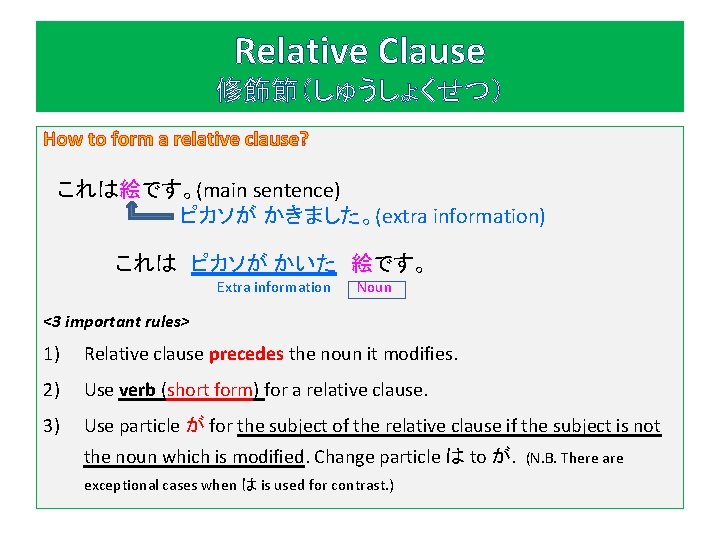
Relative Clause 修飾節(しゅうしょくせつ) How to form a relative clause? これは絵です。(main sentence) ピカソが かきました。(extra information) これは ピカソが かいた 絵です。 Extra information Noun <3 important rules> 1) Relative clause precedes the noun it modifies. 2) Use verb (short form) for a relative clause. 3) Use particle が for the subject of the relative clause if the subject is not the noun which is modified. Change particle は to が. exceptional cases when は is used for contrast. ) (N. B. There are
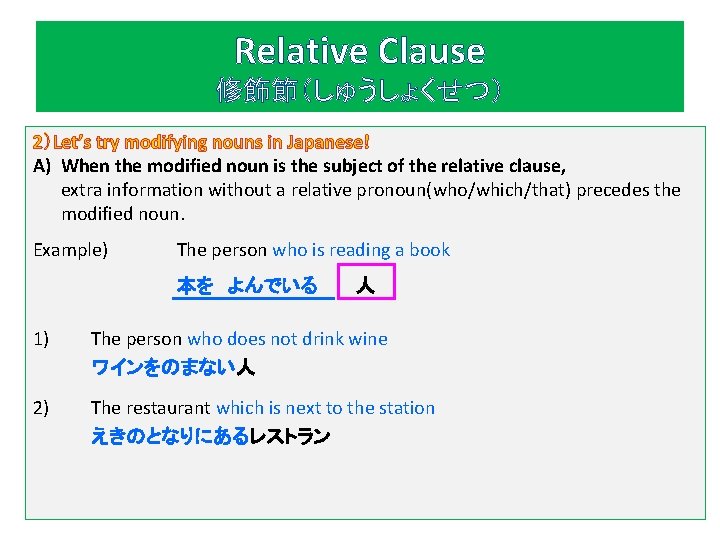
Relative Clause 修飾節(しゅうしょくせつ) 2)Let’s try modifying nouns in Japanese! A) When the modified noun is the subject of the relative clause, extra information without a relative pronoun(who/which/that) precedes the modified noun. Example) The person who is reading a book 本を よんでいる 人 1) The person who does not drink wine ワインをのまない人 2) The restaurant which is next to the station えきのとなりにあるレストラン
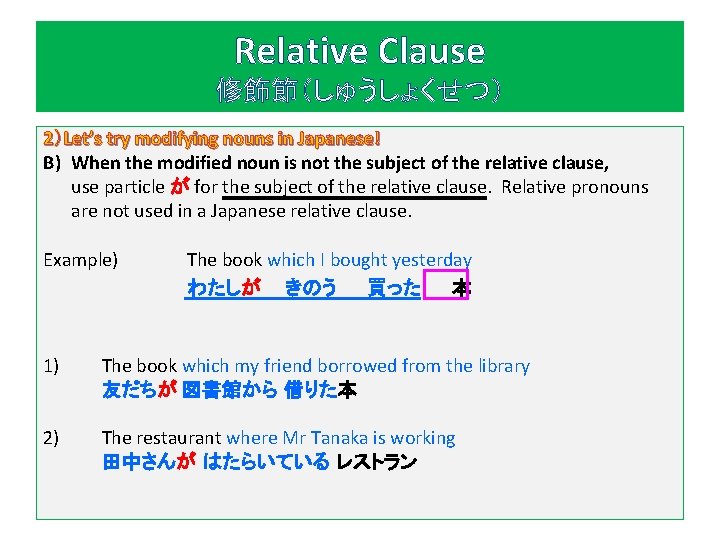
Relative Clause 修飾節(しゅうしょくせつ) 2)Let’s try modifying nouns in Japanese! B) When the modified noun is not the subject of the relative clause, use particle が for the subject of the relative clause. Relative pronouns are not used in a Japanese relative clause. Example) The book which I bought yesterday わたしが きのう 買った 本 1) The book which my friend borrowed from the library 友だちが 図書館から 借りた本 2) The restaurant where Mr Tanaka is working 田中さんが はたらいている レストラン
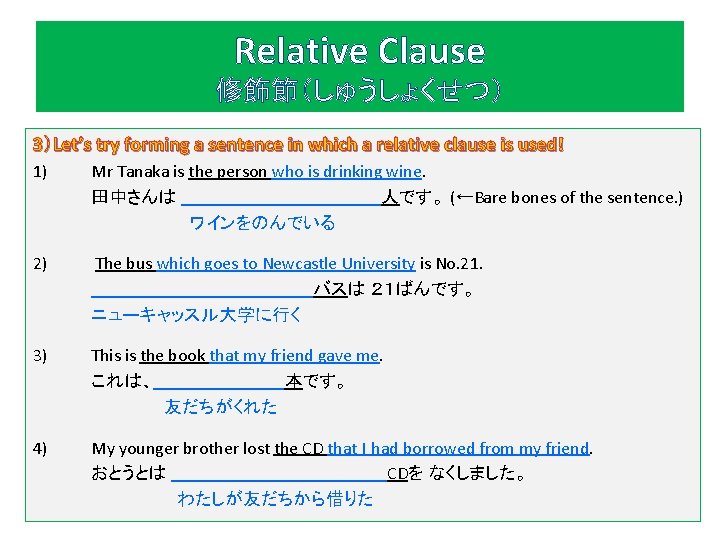
Relative Clause 修飾節(しゅうしょくせつ) 3)Let’s try forming a sentence in which a relative clause is used! 1) Mr Tanaka is the person who is drinking wine. 田中さんは 人です。 (←Bare bones of the sentence. ) ワインをのんでいる 2) The bus which goes to Newcastle University is No. 21. ______ バスは 21ばんです。 ニューキャッスル大学に行く 3) This is the book that my friend gave me. これは、 本です。 友だちがくれた 4) My younger brother lost the CD that I had borrowed from my friend. おとうとは CDを なくしました。 わたしが友だちから借りた
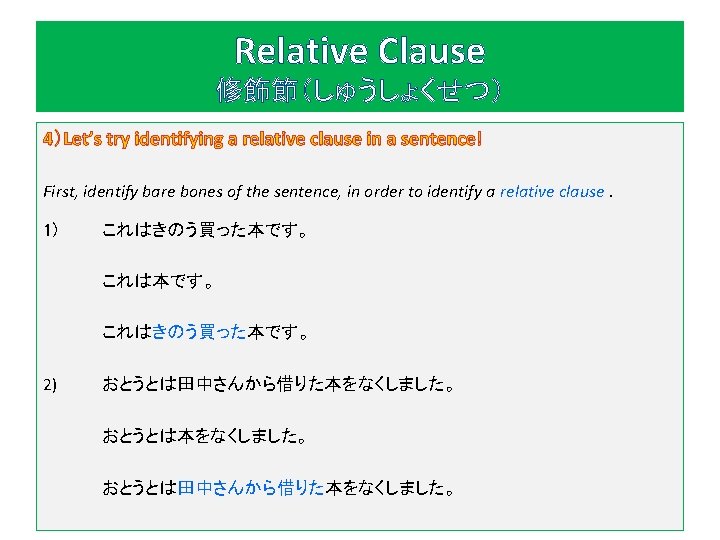
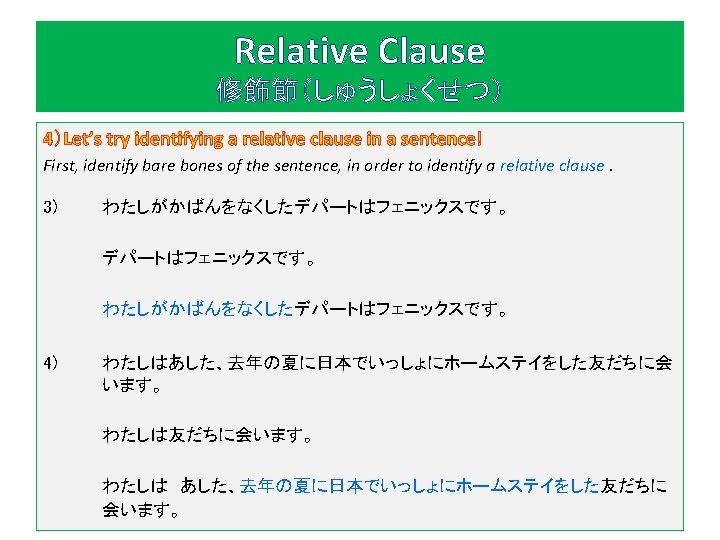
Relative Clause 修飾節(しゅうしょくせつ) 4)Let’s try identifying a relative clause in a sentence! First, identify bare bones of the sentence, in order to identify a relative clause. 1) これはきのう買った本です。 2) おとうとは田中さんから借りた本をなくしました。
- Slides: 9