
Relative charges Compounds Are formed by elements in
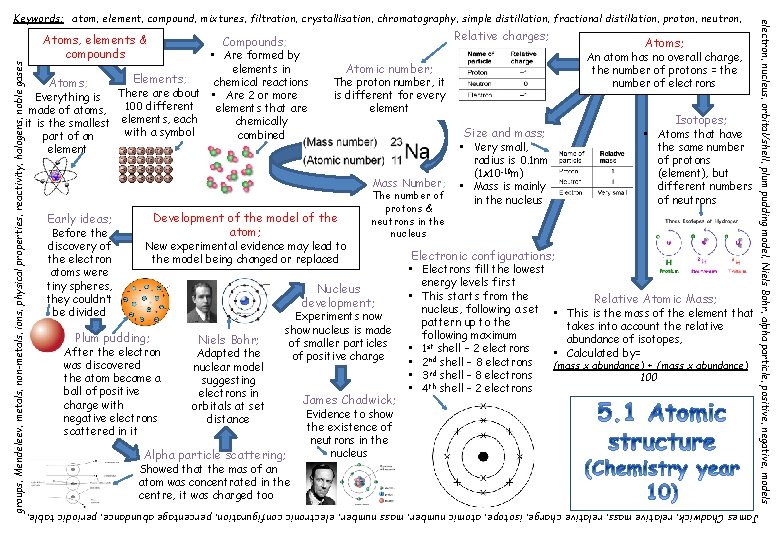
Relative charges; Compounds; • Are formed by elements in Elements; chemical reactions Atoms; Everything is There about • Are 2 or more 100 different elements that are made of atoms, elements, each chemically it is the smallest with a symbol combined part of an element Before the discovery of the electron atoms were tiny spheres, they couldn’t be divided New experimental evidence may lead to the model being changed or replaced Plum pudding; Niels Bohr; Adapted the nuclear model suggesting electrons in orbitals at set distance Mass Number; The number of protons & neutrons in the nucleus Experiments now show nucleus is made of smaller particles of positive charge Alpha particle scattering; Showed that the mas of an atom was concentrated in the centre, it was charged too Isotopes; • Atoms that have the same number of protons (element), but different numbers of neutrons Size and mass; Nucleus development; After the electron was discovered the atom became a ball of positive charge with negative electrons scattered in it An atom has no overall charge, the number of protons = the number of electrons Atomic number; The proton number, it is different for every element Development of the model of the atom; Early ideas; Atoms; James Chadwick; • Very small, radius is 0. 1 nm (1 x 10 -10 m) • Mass is mainly in the nucleus Electronic configurations; • Electrons fill the lowest energy levels first • This starts from the nucleus, following a set pattern up to the following maximum • 1 st shell – 2 electrons • 2 nd shell – 8 electrons • 3 rd shell – 8 electrons • 4 th shell – 2 electrons Relative Atomic Mass; • This is the mass of the element that takes into account the relative abundance of isotopes, • Calculated by= (mass x abundance) + (mass x abundance) 100 Evidence to show the existence of neutrons in the nucleus James Chadwick, relative mass, relative charge, isotope, atomic number, mass number, electronic configuration, percentage abundance, periodic table, groups, Mendeleev, metals, non-metals, ions, physical properties, reactivity, halogens, noble gases Atoms, elements & compounds electron, nucleus, orbital/shell, plum pudding model, Niels Bohr, alpha particle, positive, negative, models Keywords; atom, element, compound, mixtures, filtration, crystallisation, chromatography, simple distillation, fractional distillation, proton, neutron,
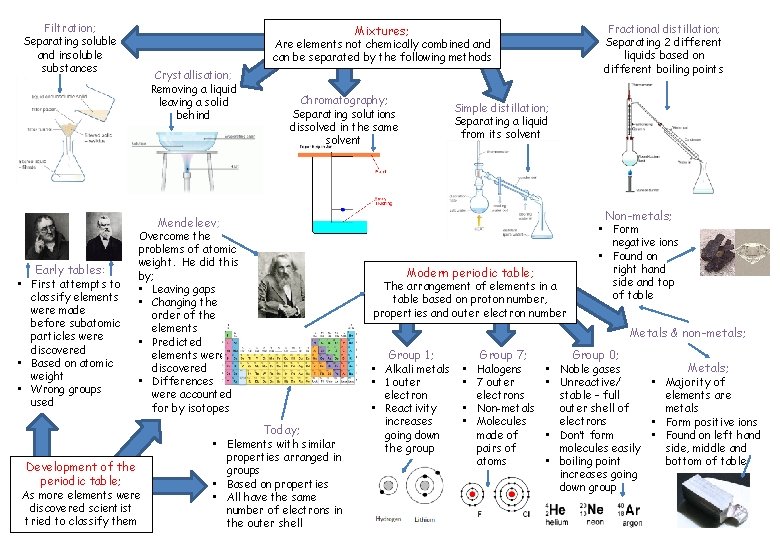
Filtration; Separating soluble and insoluble substances Fractional distillation; Separating 2 different liquids based on different boiling points Mixtures; Are elements not chemically combined and can be separated by the following methods Crystallisation; Removing a liquid leaving a solid behind Chromatography; Separating solutions dissolved in the same solvent Simple distillation; Separating a liquid from its solvent Non-metals; Mendeleev; Early tables: • First attempts to classify elements were made before subatomic particles were discovered • Based on atomic weight • Wrong groups used Development of the periodic table; Overcome the problems of atomic weight. He did this by; • Leaving gaps • Changing the order of the elements • Predicted elements were discovered • Differences were accounted for by isotopes As more elements were discovered scientist tried to classify them Today; • Elements with similar properties arranged in groups • Based on properties • All have the same number of electrons in the outer shell Modern periodic table; The arrangement of elements in a table based on proton number, properties and outer electron number • Form negative ions • Found on right hand side and top of table Metals & non-metals; Group 1; • Alkali metals • 1 outer electron • Reactivity increases going down the group Group 7; • Halogens • 7 outer electrons • Non-metals • Molecules made of pairs of atoms Group 0; Metals; • Noble gases • Unreactive/ • Majority of stable – full elements are outer shell of metals electrons • Form positive ions • Don’t form • Found on left hand molecules easily side, middle and • boiling point bottom of table increases going down group
- Slides: 2