
Relative and Absolute Thinking The Chocolatey Cake Debate

Relative and Absolute Thinking
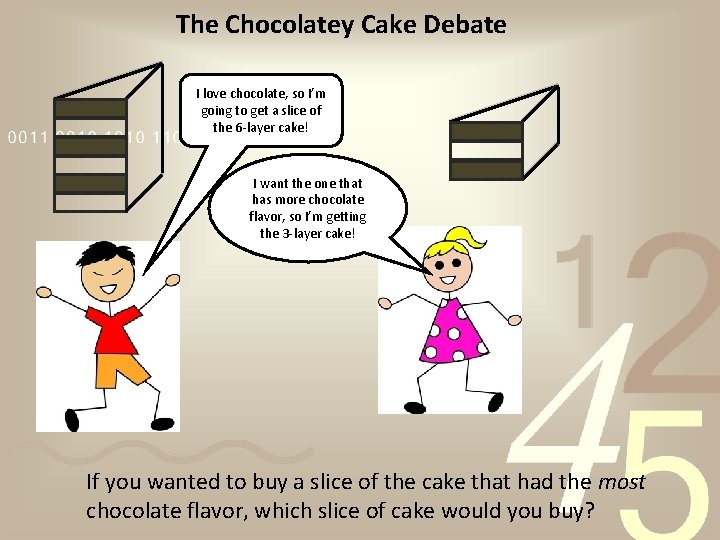
The Chocolatey Cake Debate I love chocolate, so I’m going to get a slice of the 6 -layer cake! I want the one that has more chocolate flavor, so I’m getting the 3 -layer cake! If you wanted to buy a slice of the cake that had the most chocolate flavor, which slice of cake would you buy?
Chocolatey Cake? • Work on your own to decide which cake is more chocolatey • Put your paper aside when you are done so that we know that you have finished • Then work with your group members to decide on an answer • Are you tempted to change your answer that you wrote down?
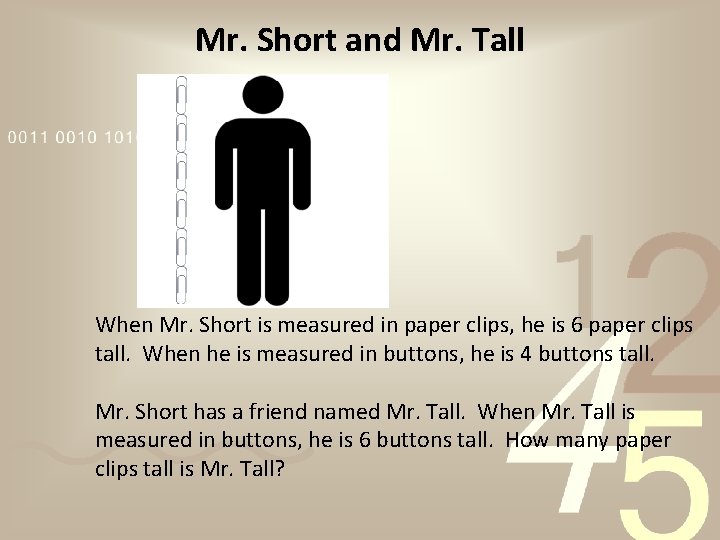
Mr. Short and Mr. Tall When Mr. Short is measured in paper clips, he is 6 paper clips tall. When he is measured in buttons, he is 4 buttons tall. Mr. Short has a friend named Mr. Tall. When Mr. Tall is measured in buttons, he is 6 buttons tall. How many paper clips tall is Mr. Tall?
How many paper clips? • Work on your own to decide the height of Mr. Tall in paper clips • Put your paper aside when you are done so that we know that you have finished • Then work with your group members to decide on an answer • Are you tempted to change your answer that you wrote down?

Student Work
Proportional Reasoning • Proportional Thinkers understand that (Van de Walle): – There is a clear difference between proportional relationships and nonproportional relationships, especially in the real world – There a variety of strategies for solving proportions or comparing ratios (that are not prescribed algorithms) – There are relationships where 2 quantities vary together (covariation)
Proportional Reasoning • It is important to develop proportional reasoning both in ourselves and our students • Develop slowly over middle school years, not just a couple weeks in 6 th grade • Common Core addresses this
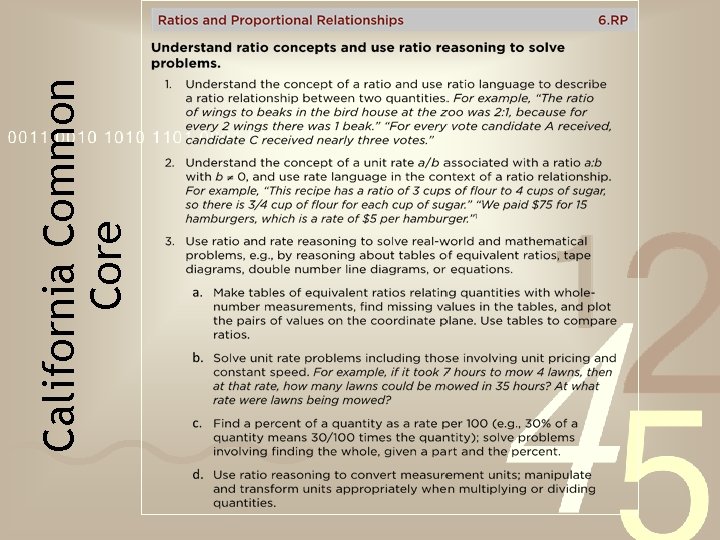
California Common Core
6. RP 3 • Use ratio and rate reasoning to solve real-world and mathematical problems, e. g. , by reasoning about tables of equivalent ratios, tape diagrams, double number line diagrams, or equations.
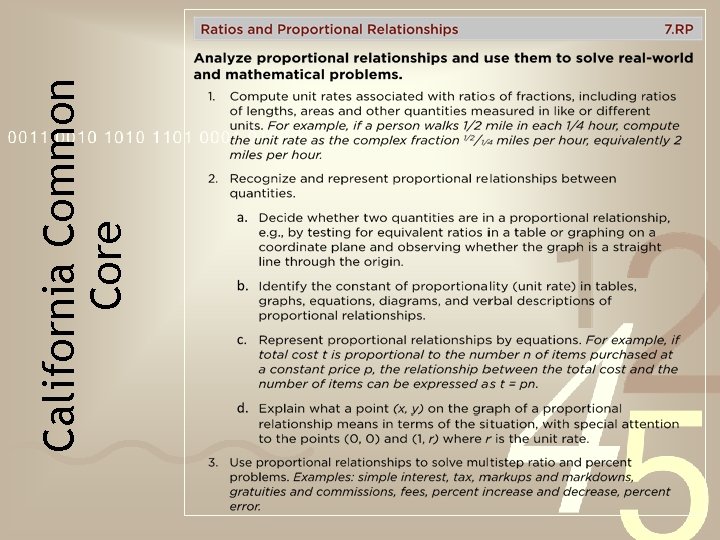
California Common Core
7. RP 2 and 7. RP 3 • Recognize and represent proportional relationships between quantities. – Decide whether two quantities are in a proportional relationship, e. g. , by testing for equivalent ratios in a table or graphing on a coordinate plane and observing whether the graph is a straight line through the origin. • Use proportional relationships to solve multistep ratio and percent problems.
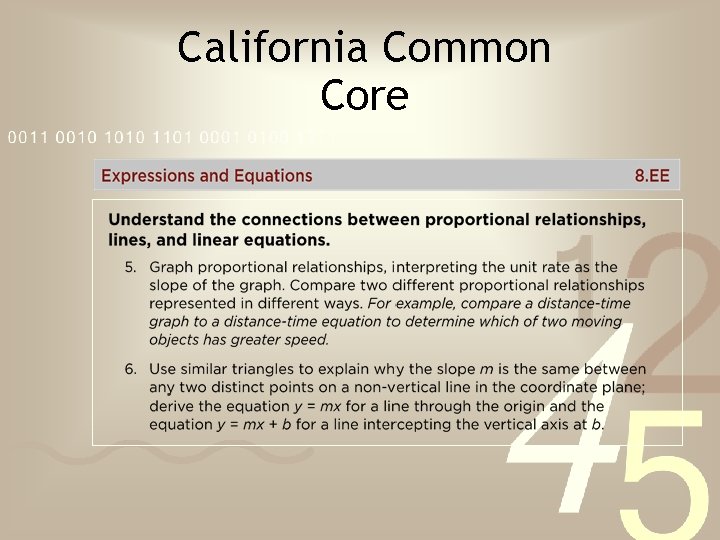
California Common Core
8. EE 5 • Graph proportional relationships, interpreting the unit rate as the slope of the graph. Compare two different proportional relationships represented in different ways.
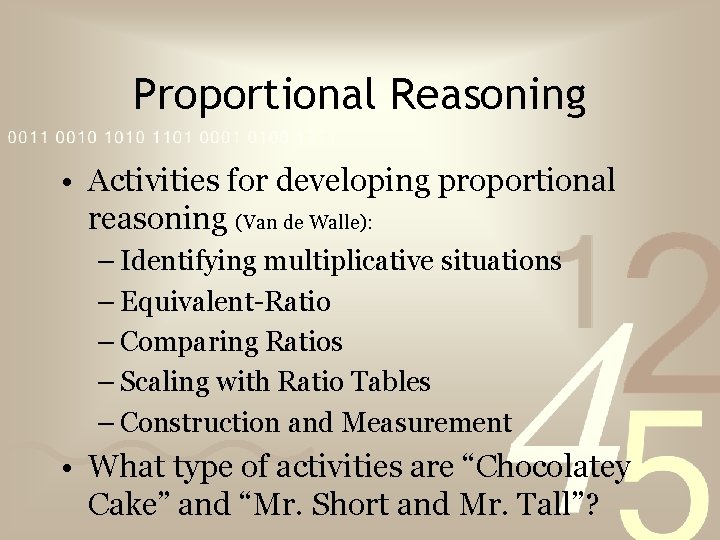
Proportional Reasoning • Activities for developing proportional reasoning (Van de Walle): – Identifying multiplicative situations – Equivalent-Ratio – Comparing Ratios – Scaling with Ratio Tables – Construction and Measurement • What type of activities are “Chocolatey Cake” and “Mr. Short and Mr. Tall”?
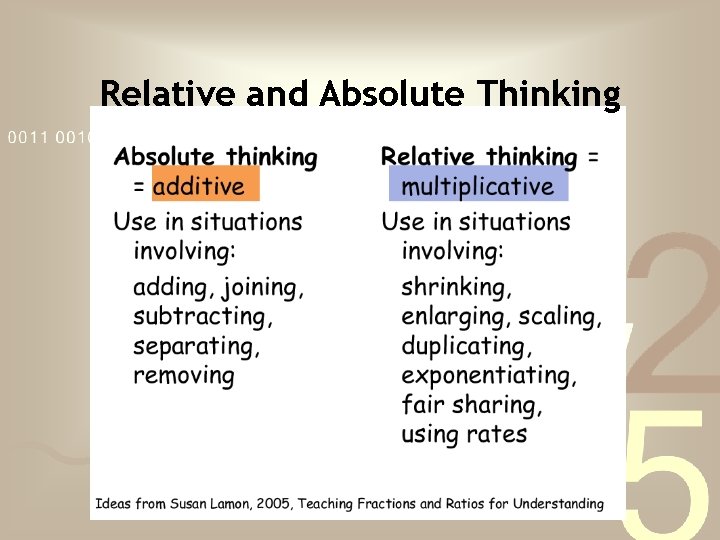
Relative and Absolute Thinking
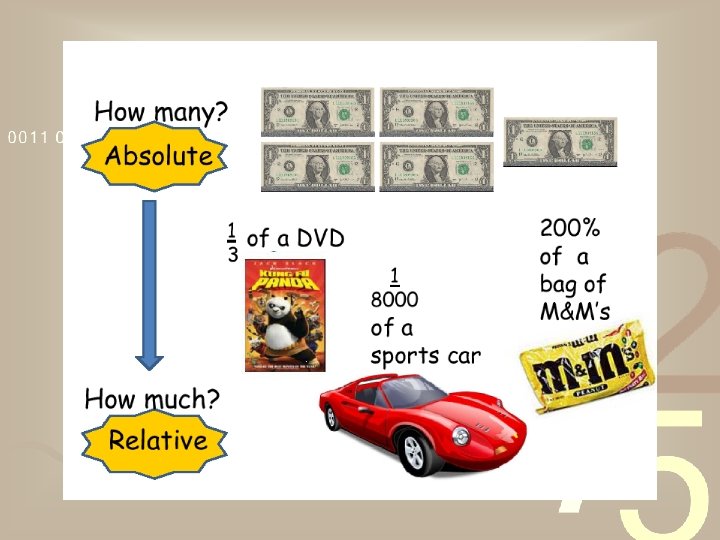
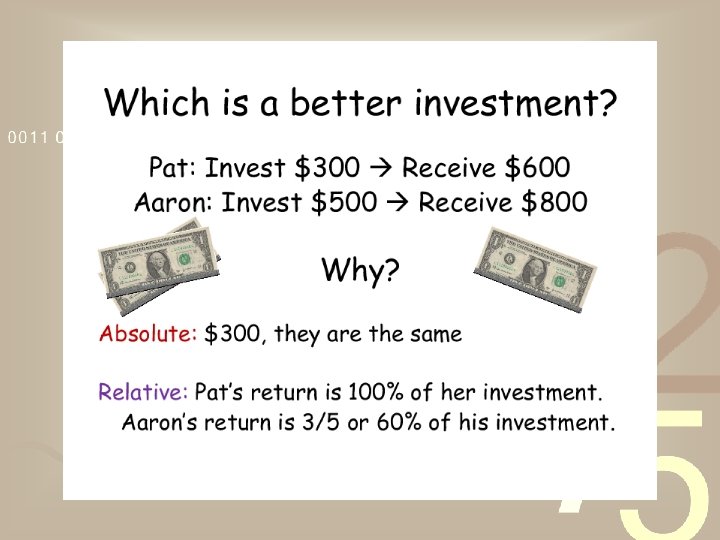
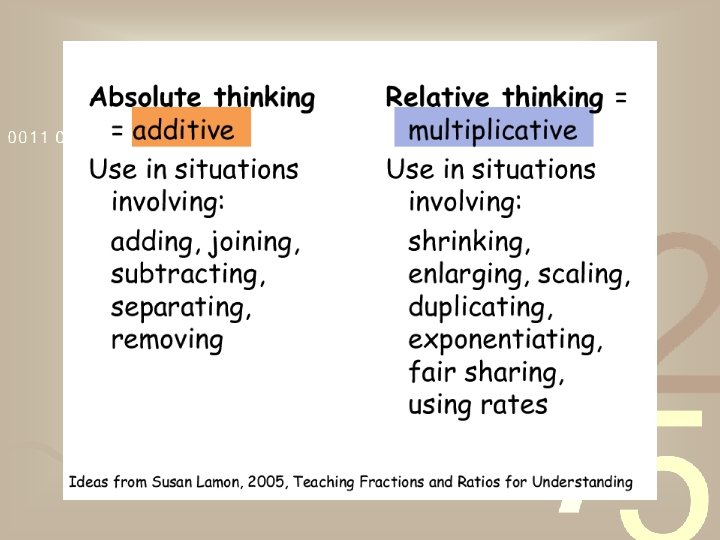
Relative and Absolute Thinking • What are you doing or can you do to distinguish the difference?
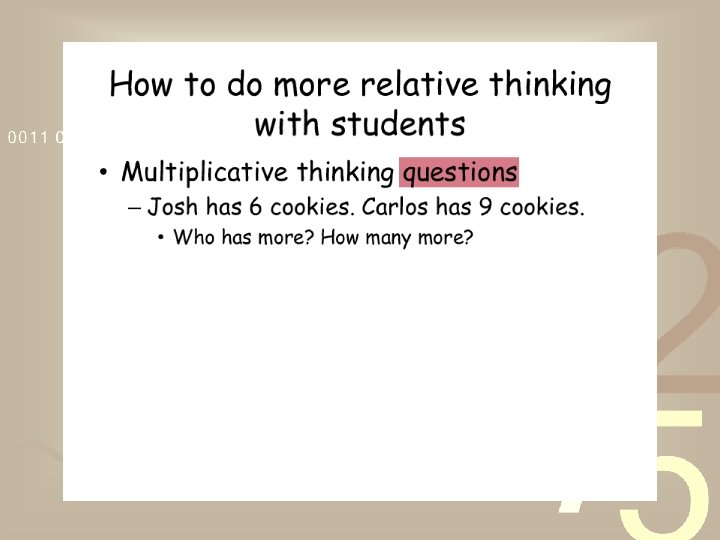
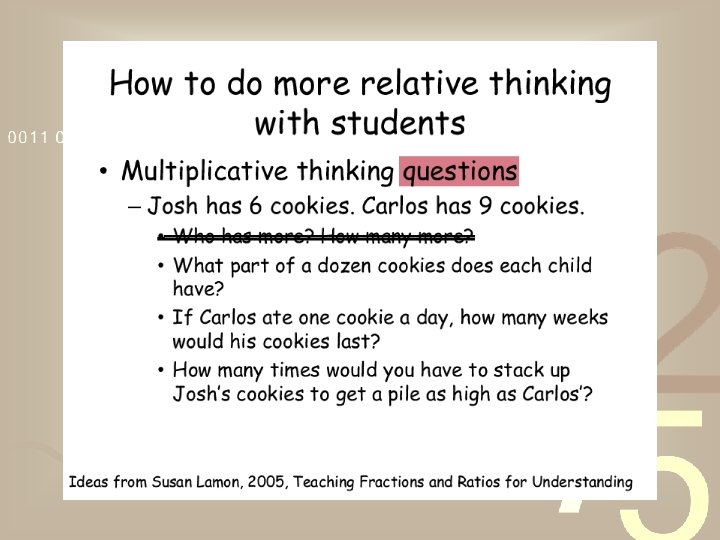
- Slides: 24