
Relationship marketing RM Relation marketing concept n The


- Slides: 28
Relationship marketing (RM) Relation marketing concept n. The influence on Internet on customer relationships n. The difference between marketing paradigm and customer centric approach n e-Commerce 1
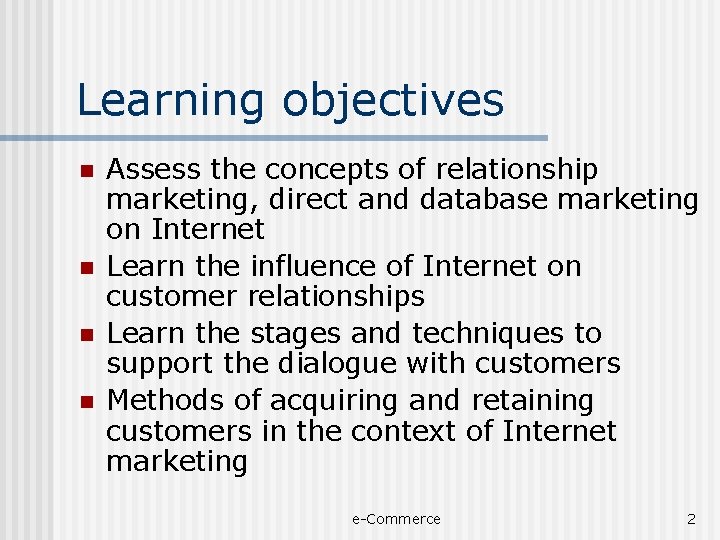
Learning objectives n n Assess the concepts of relationship marketing, direct and database marketing on Internet Learn the influence of Internet on customer relationships Learn the stages and techniques to support the dialogue with customers Methods of acquiring and retaining customers in the context of Internet marketing e-Commerce 2
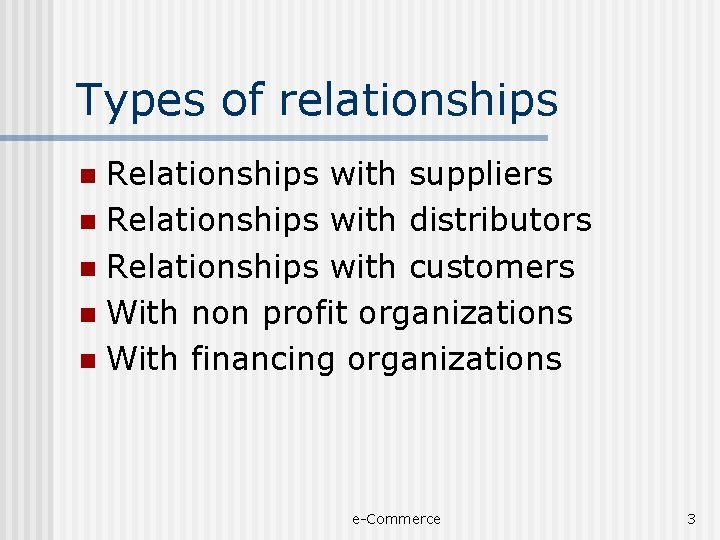
Types of relationships Relationships with suppliers n Relationships with distributors n Relationships with customers n With non profit organizations n With financing organizations n e-Commerce 3
Group task Which relationships from the mentioned above are the most important? n Which are the key relationships, according to the articles? n Give examples for the different types of relationships n e-Commerce 4
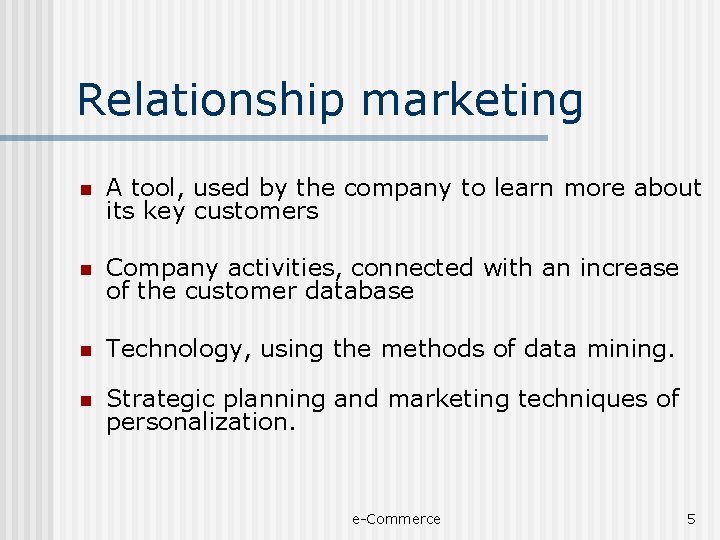
Relationship marketing n A tool, used by the company to learn more about its key customers n Company activities, connected with an increase of the customer database n Technology, using the methods of data mining. n Strategic planning and marketing techniques of personalization. e-Commerce 5
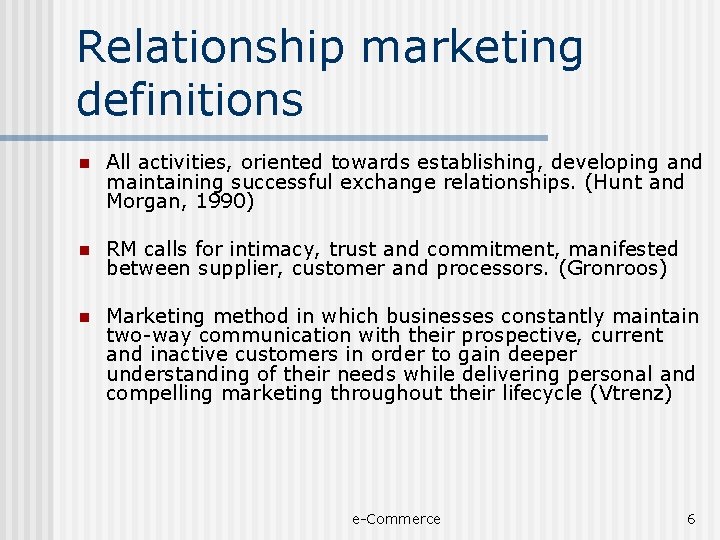
Relationship marketing definitions n All activities, oriented towards establishing, developing and maintaining successful exchange relationships. (Hunt and Morgan, 1990) n RM calls for intimacy, trust and commitment, manifested between supplier, customer and processors. (Gronroos) n Marketing method in which businesses constantly maintain two-way communication with their prospective, current and inactive customers in order to gain deeper understanding of their needs while delivering personal and compelling marketing throughout their lifecycle (Vtrenz) e-Commerce 6
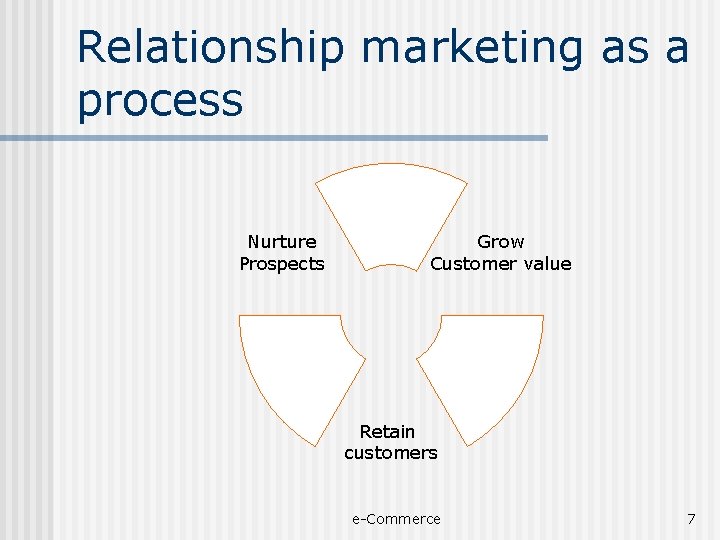
Relationship marketing as a process Nurture Prospects Grow Customer value Retain customers e-Commerce 7
Group task Discuss the difference between the “push” and “pull” approach in marketing. n Give examples of two approaches n Which of the two approaches is more suitable for the Internet marketing. n e-Commerce 8
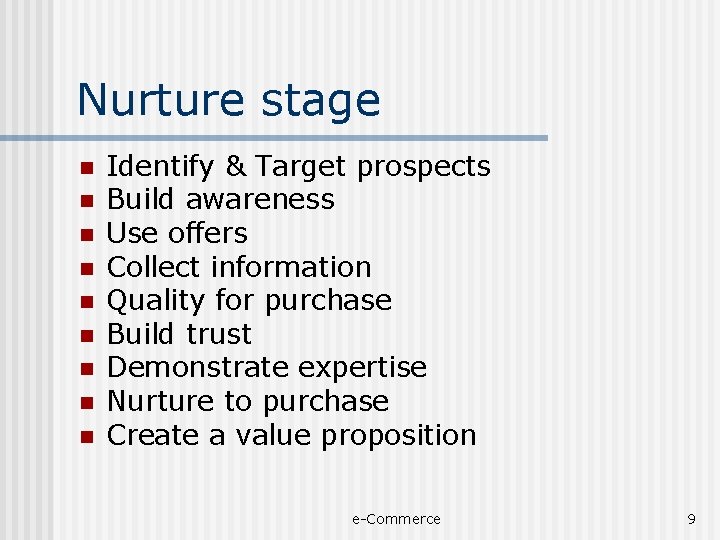
Nurture stage n n n n n Identify & Target prospects Build awareness Use offers Collect information Quality for purchase Build trust Demonstrate expertise Nurture to purchase Create a value proposition e-Commerce 9
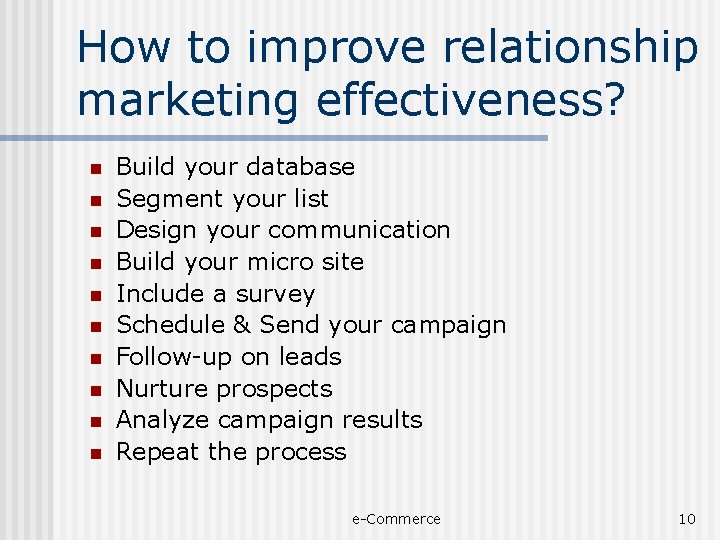
How to improve relationship marketing effectiveness? n n n n n Build your database Segment your list Design your communication Build your micro site Include a survey Schedule & Send your campaign Follow-up on leads Nurture prospects Analyze campaign results Repeat the process e-Commerce 10
Grow stage Customer loyalty means a positive attitude toward a company n Loyalty is a tendency to choose one product or service over another n Customers are loyal when they make repeat purchases or recommend company to others. n e-Commerce 11
Grow stage philosophy n Maximize the value of the existing customer relationships through a set of relationship marketing principals, tactics and metrics. e-Commerce 12
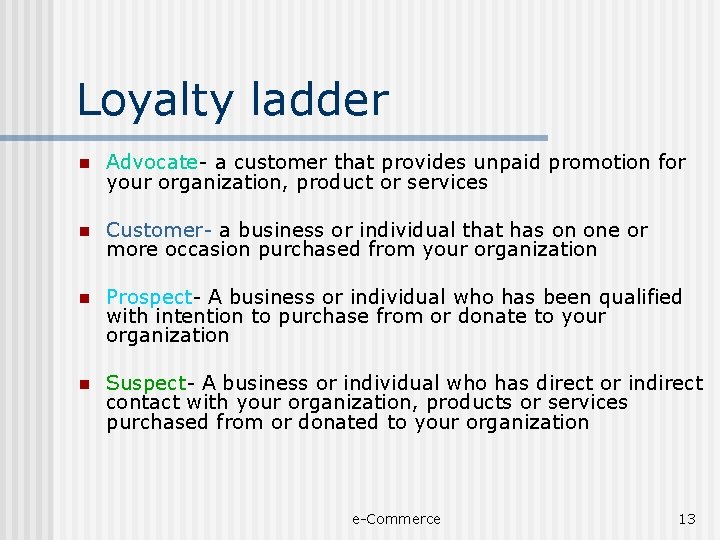
Loyalty ladder n Advocate- a customer that provides unpaid promotion for your organization, product or services n Customer- a business or individual that has on one or more occasion purchased from your organization n Prospect- A business or individual who has been qualified with intention to purchase from or donate to your organization n Suspect- A business or individual who has direct or indirect contact with your organization, products or services purchased from or donated to your organization e-Commerce 13
How to move from customers to advocates? First time buyer n Initial adoption n Repeat buyer n Repeat consumption n Loyal buyer n Supporter n Evangelist n e-Commerce 14
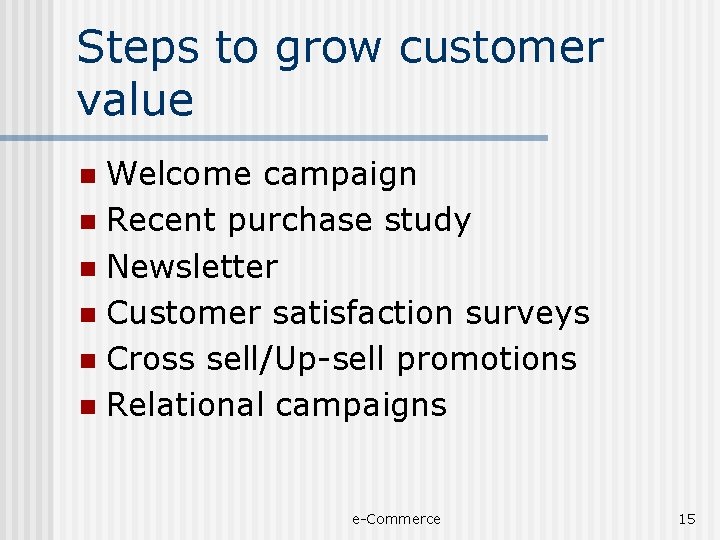
Steps to grow customer value Welcome campaign n Recent purchase study n Newsletter n Customer satisfaction surveys n Cross sell/Up-sell promotions n Relational campaigns n e-Commerce 15
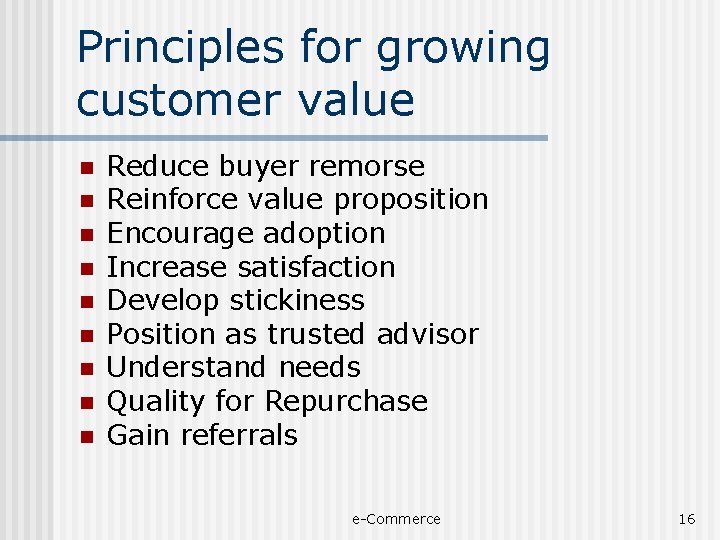
Principles for growing customer value n n n n n Reduce buyer remorse Reinforce value proposition Encourage adoption Increase satisfaction Develop stickiness Position as trusted advisor Understand needs Quality for Repurchase Gain referrals e-Commerce 16
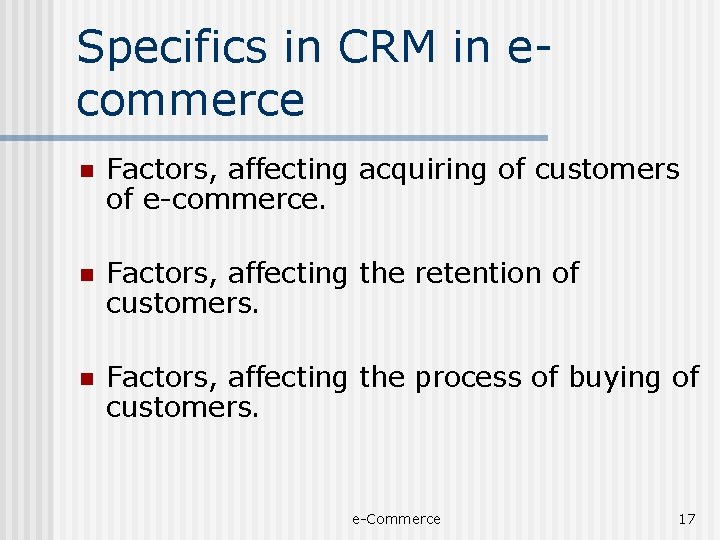
Specifics in CRM in ecommerce n Factors, affecting acquiring of customers of e-commerce. n Factors, affecting the retention of customers. n Factors, affecting the process of buying of customers. e-Commerce 17
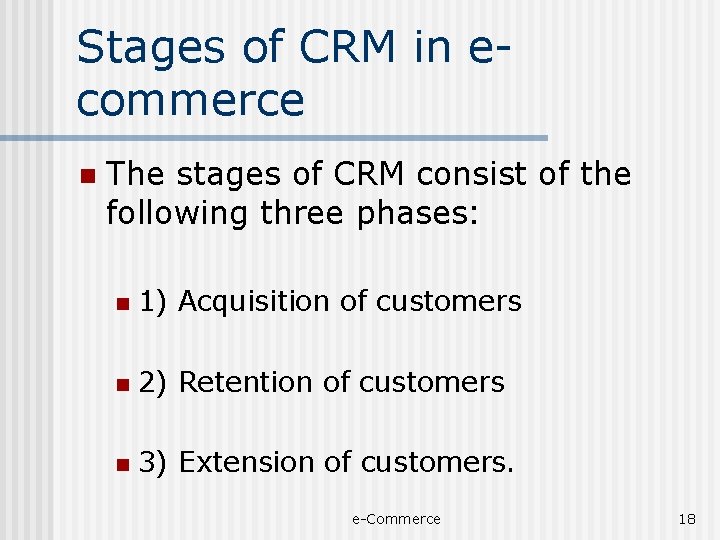
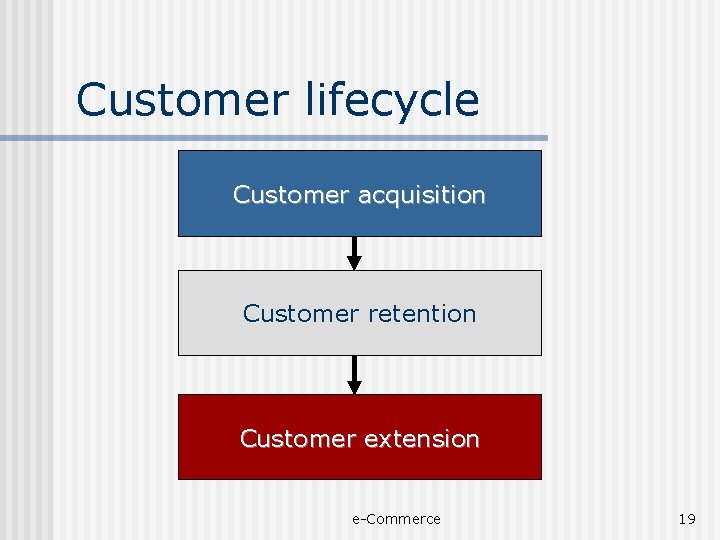
Stages of CRM in ecommerce n The stages of CRM consist of the following three phases: n 1) Acquisition of customers n 2) Retention of customers n 3) Extension of customers. e-Commerce 18
Customer lifecycle Customer acquisition Customer retention Customer extension e-Commerce 19
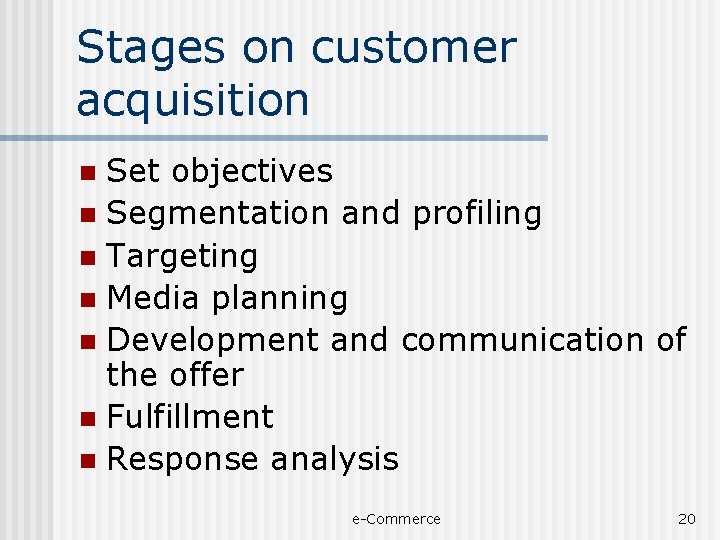
Stages on customer acquisition Set objectives n Segmentation and profiling n Targeting n Media planning n Development and communication of the offer n Fulfillment n Response analysis n e-Commerce 20
Aspects of customer acquisition n Attract new customers to the company’s web-site n Convert the web traffic into buyers (Kotha, 1990) e-Commerce 21
Reasons for retention of customers Acquiring new customer is more costly than keeping a current one n Customers have become more profitable over time n You are more likely to win back a lost customer than attract a new one n e-Commerce 22
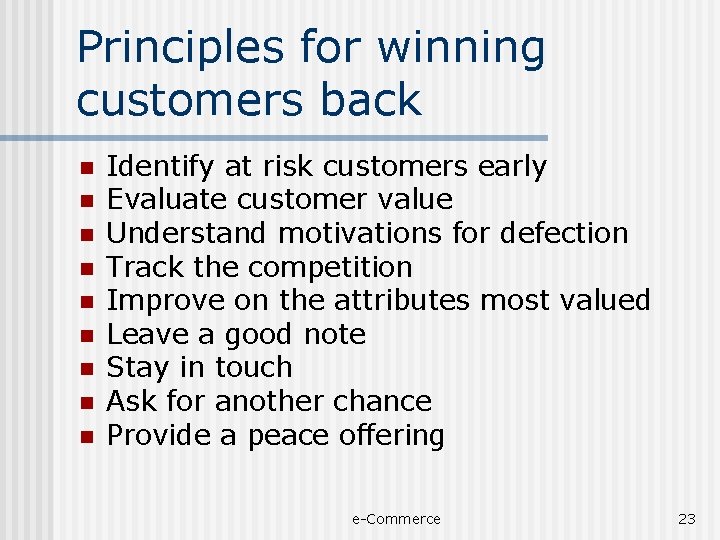
Principles for winning customers back n n n n n Identify at risk customers early Evaluate customer value Understand motivations for defection Track the competition Improve on the attributes most valued Leave a good note Stay in touch Ask for another chance Provide a peace offering e-Commerce 23
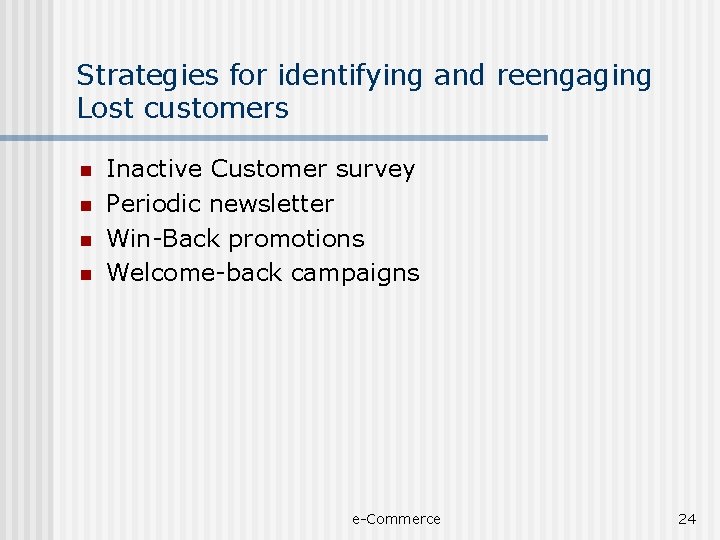
Strategies for identifying and reengaging Lost customers n n Inactive Customer survey Periodic newsletter Win-Back promotions Welcome-back campaigns e-Commerce 24
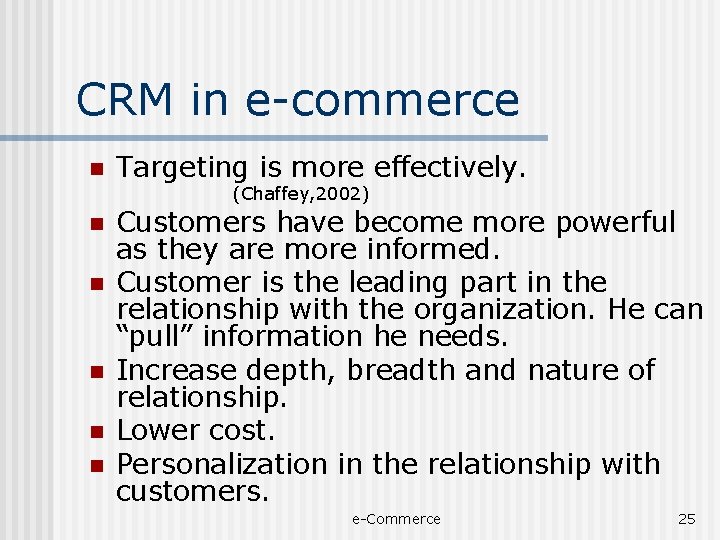
CRM in e-commerce n Targeting is more effectively. (Chaffey, 2002) n n n Customers have become more powerful as they are more informed. Customer is the leading part in the relationship with the organization. He can “pull” information he needs. Increase depth, breadth and nature of relationship. Lower cost. Personalization in the relationship with customers. e-Commerce 25
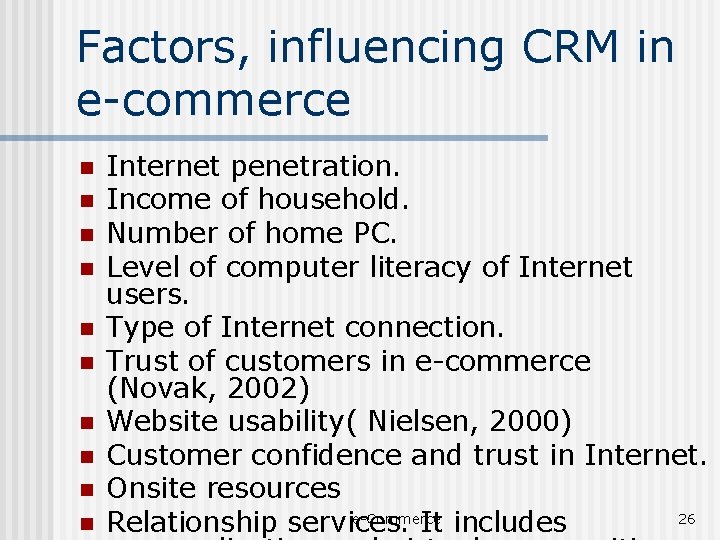
Factors, influencing CRM in e-commerce n n n n n Internet penetration. Income of household. Number of home PC. Level of computer literacy of Internet users. Type of Internet connection. Trust of customers in e-commerce (Novak, 2002) Website usability( Nielsen, 2000) Customer confidence and trust in Internet. Onsite resources e-Commerce 26 Relationship services. It includes
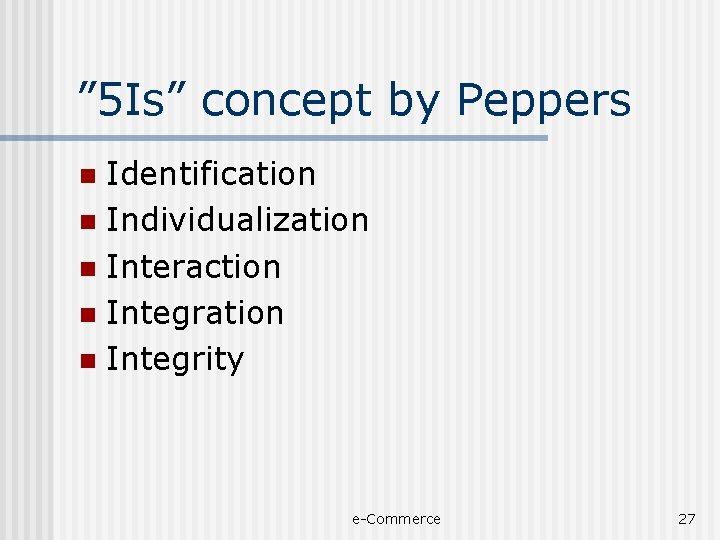
” 5 Is” concept by Peppers Identification n Individualization n Interaction n Integration n Integrity n e-Commerce 27
Group task n Summarize in groups and present the differences between the traditional marketing and Internet n How does the Internet changes the relationship with customers? e-Commerce 28