
Relations Functions and Matrices Mathematical Structures for Computer
- Slides: 16
Relations, Functions, and Matrices Mathematical Structures for Computer Science Chapter 4 Copyright Section 4. 1 © 2006 W. H. Freeman & Co. MSCS Slides Relations, Functions and Matrices
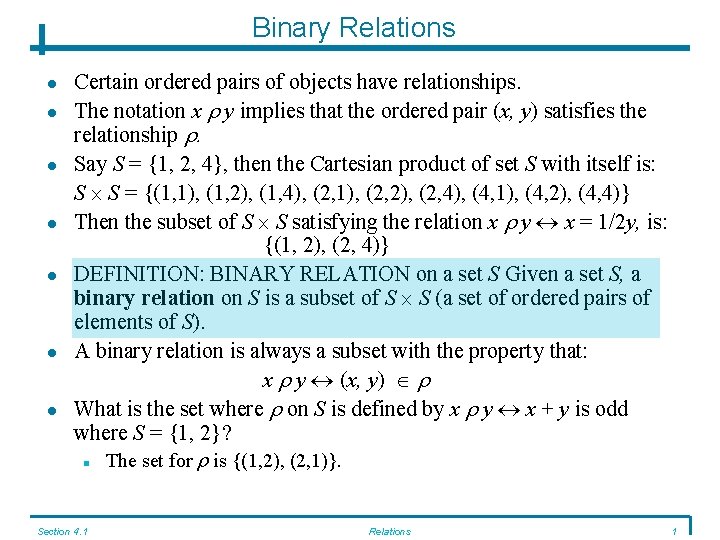
Binary Relations Certain ordered pairs of objects have relationships. The notation x y implies that the ordered pair (x, y) satisfies the relationship Say S = {1, 2, 4}, then the Cartesian product of set S with itself is: S S = {(1, 1), (1, 2), (1, 4), (2, 1), (2, 2), (2, 4), (4, 1), (4, 2), (4, 4)} Then the subset of S S satisfying the relation x y x = 1/2 y, is: {(1, 2), (2, 4)} DEFINITION: BINARY RELATION on a set S Given a set S, a binary relation on S is a subset of S S (a set of ordered pairs of elements of S). A binary relation is always a subset with the property that: x y (x, y) What is the set where on S is defined by x y x + y is odd where S = {1, 2}? The set for is {(1, 2), (2, 1)}. Section 4. 1 Relations 1
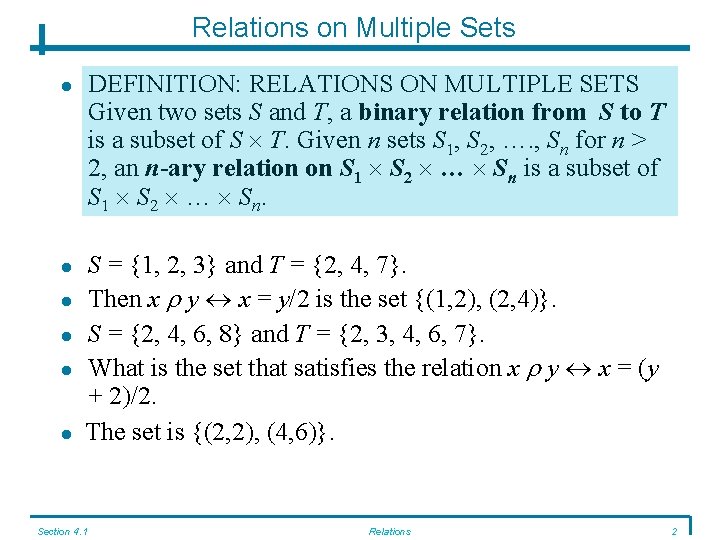
Relations on Multiple Sets DEFINITION: RELATIONS ON MULTIPLE SETS Given two sets S and T, a binary relation from S to T is a subset of S T. Given n sets S 1, S 2, …. , Sn for n > 2, an n-ary relation on S 1 S 2 … Sn is a subset of S 1 S 2 … Sn. S = {1, 2, 3} and T = {2, 4, 7}. Then x y x = y/2 is the set {(1, 2), (2, 4)}. S = {2, 4, 6, 8} and T = {2, 3, 4, 6, 7}. What is the set that satisfies the relation x y x = (y + 2)/2. The set is {(2, 2), (4, 6)}. Section 4. 1 Relations 2
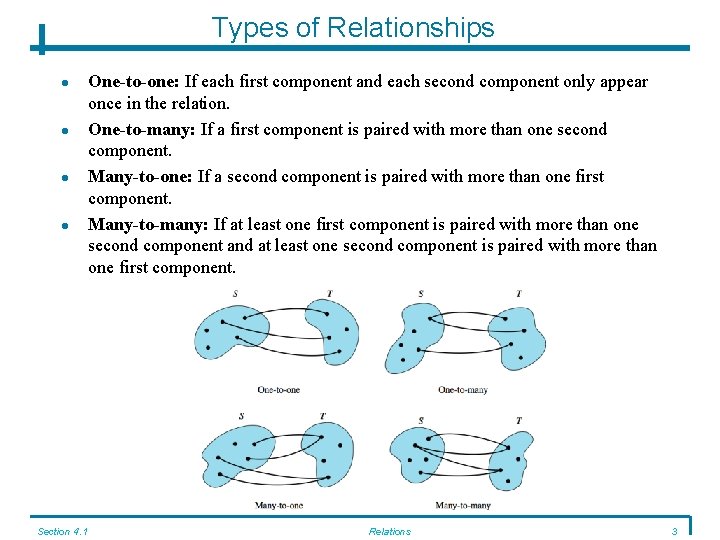
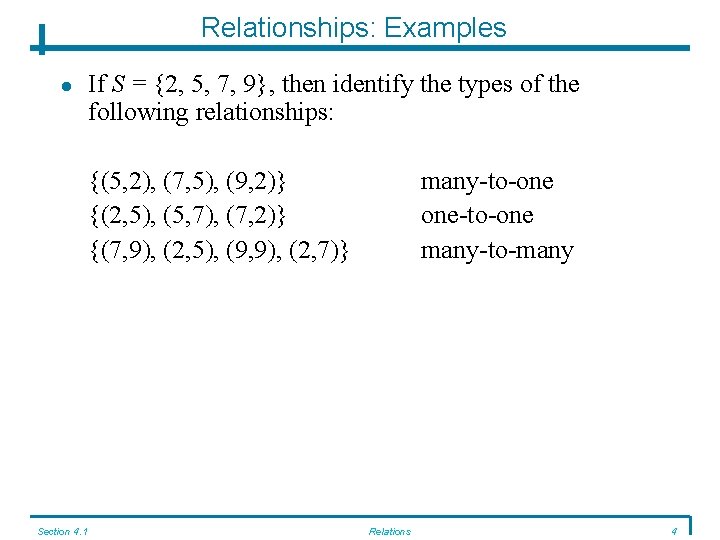
Types of Relationships Section 4. 1 One-to-one: If each first component and each second component only appear once in the relation. One-to-many: If a first component is paired with more than one second component. Many-to-one: If a second component is paired with more than one first component. Many-to-many: If at least one first component is paired with more than one second component and at least one second component is paired with more than one first component. Relations 3
Relationships: Examples If S = {2, 5, 7, 9}, then identify the types of the following relationships: {(5, 2), (7, 5), (9, 2)} {(2, 5), (5, 7), (7, 2)} {(7, 9), (2, 5), (9, 9), (2, 7)} Section 4. 1 many-to-one one-to-one many-to-many Relations 4
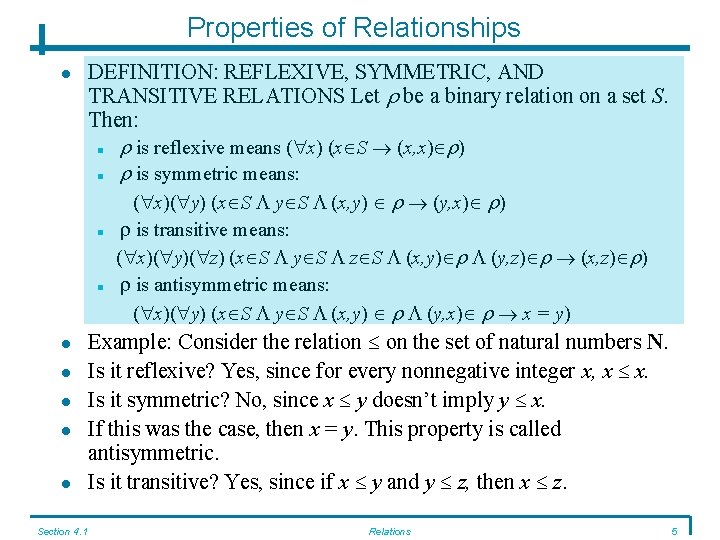
Properties of Relationships DEFINITION: REFLEXIVE, SYMMETRIC, AND TRANSITIVE RELATIONS Let be a binary relation on a set S. Then: is reflexive means ( x) (x S (x, x) ) is symmetric means: ( x)( y) (x S y S (x, y) (y, x) ) Section 4. 1 is transitive means: ( x)( y)( z) (x S y S z S (x, y) (y, z) (x, z) ) is antisymmetric means: ( x)( y) (x S y S (x, y) (y, x) x = y) Example: Consider the relation on the set of natural numbers N. Is it reflexive? Yes, since for every nonnegative integer x, x x. Is it symmetric? No, since x y doesn’t imply y x. If this was the case, then x = y. This property is called antisymmetric. Is it transitive? Yes, since if x y and y z, then x z. Relations 5
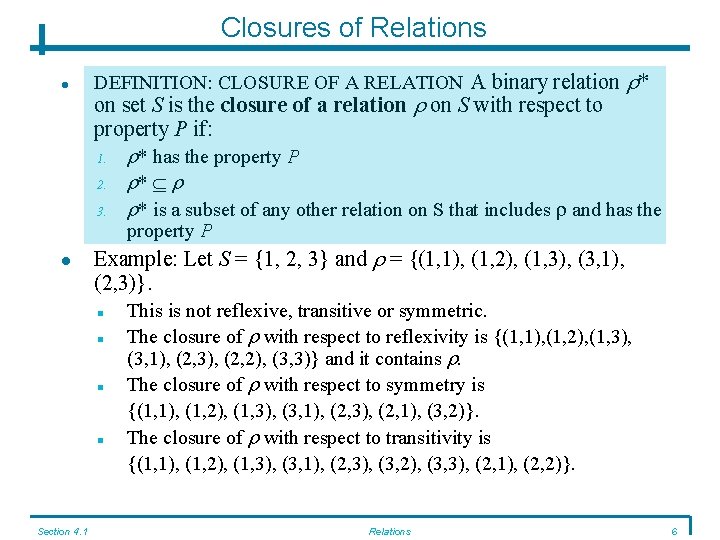
Closures of Relations DEFINITION: CLOSURE OF A RELATION A binary relation * on set S is the closure of a relation on S with respect to property P if: 1. * has the property P 2. * 3. * is a subset of any other relation on S that includes and has the property P Example: Let S = {1, 2, 3} and = {(1, 1), (1, 2), (1, 3), (3, 1), (2, 3)}. Section 4. 1 This is not reflexive, transitive or symmetric. The closure of with respect to reflexivity is {(1, 1), (1, 2), (1, 3), (3, 1), (2, 3), (2, 2), (3, 3)} and it contains . The closure of with respect to symmetry is {(1, 1), (1, 2), (1, 3), (3, 1), (2, 3), (2, 1), (3, 2)}. The closure of with respect to transitivity is {(1, 1), (1, 2), (1, 3), (3, 1), (2, 3), (3, 2), (3, 3), (2, 1), (2, 2)}. Relations 6
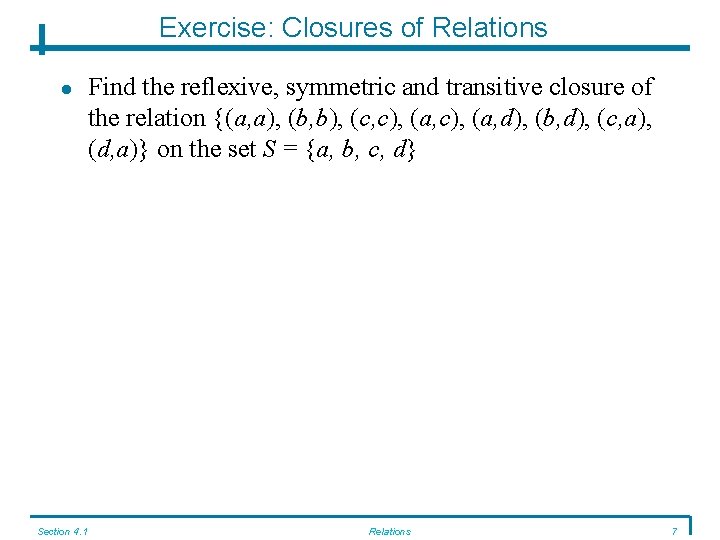
Exercise: Closures of Relations Section 4. 1 Find the reflexive, symmetric and transitive closure of the relation {(a, a), (b, b), (c, c), (a, d), (b, d), (c, a), (d, a)} on the set S = {a, b, c, d} Relations 7
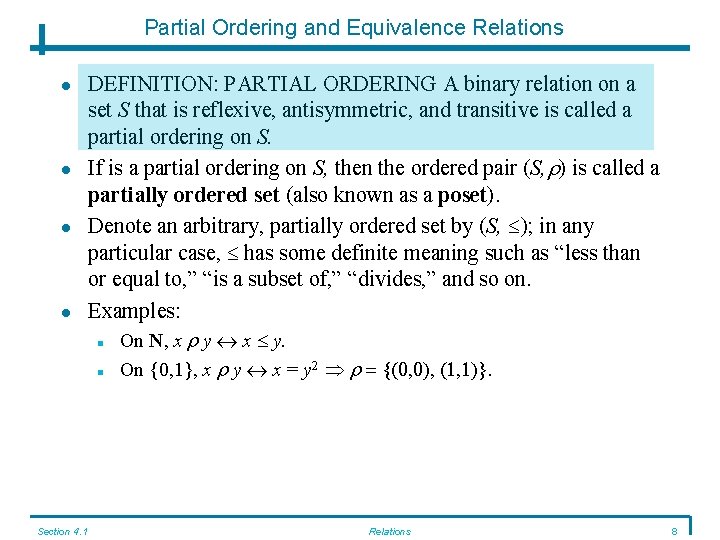
Partial Ordering and Equivalence Relations DEFINITION: PARTIAL ORDERING A binary relation on a set S that is reflexive, antisymmetric, and transitive is called a partial ordering on S. If is a partial ordering on S, then the ordered pair (S, ) is called a partially ordered set (also known as a poset). Denote an arbitrary, partially ordered set by (S, ); in any particular case, has some definite meaning such as “less than or equal to, ” “is a subset of, ” “divides, ” and so on. Examples: On N, x y. On {0, 1}, x y x = y 2 = {(0, 0), (1, 1)} Section 4. 1 Relations 8
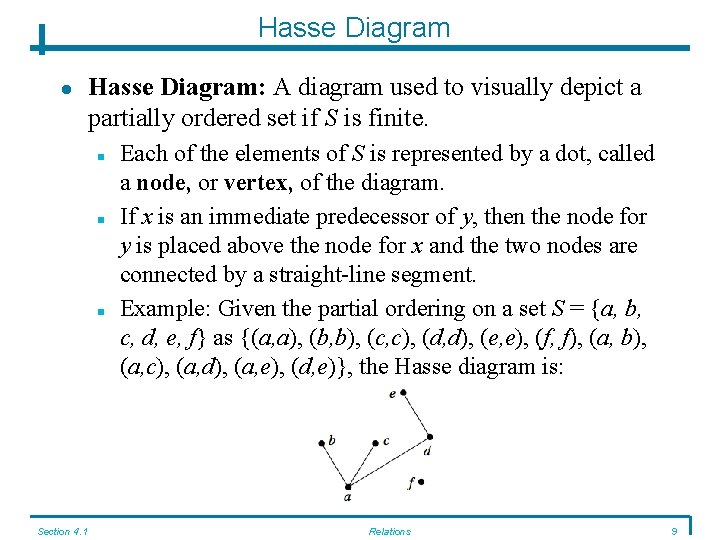
Hasse Diagram Hasse Diagram: A diagram used to visually depict a partially ordered set if S is finite. Section 4. 1 Each of the elements of S is represented by a dot, called a node, or vertex, of the diagram. If x is an immediate predecessor of y, then the node for y is placed above the node for x and the two nodes are connected by a straight-line segment. Example: Given the partial ordering on a set S = {a, b, c, d, e, f} as {(a, a), (b, b), (c, c), (d, d), (e, e), (f, f), (a, b), (a, c), (a, d), (a, e), (d, e)}, the Hasse diagram is: Relations 9
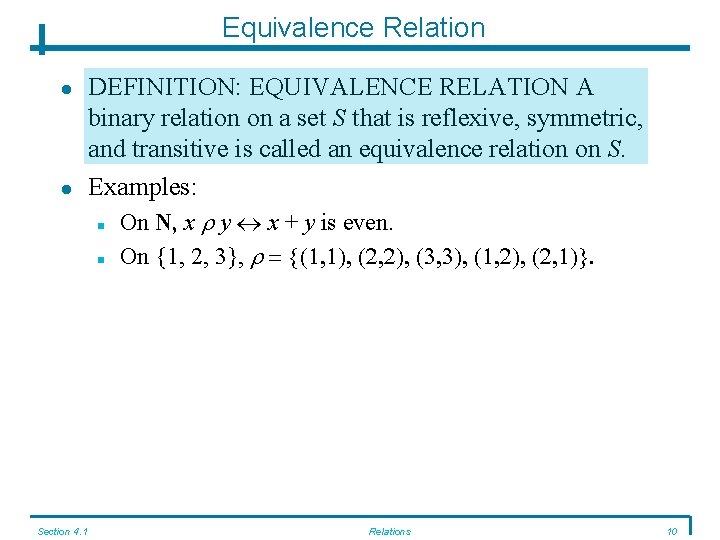
Equivalence Relation DEFINITION: EQUIVALENCE RELATION A binary relation on a set S that is reflexive, symmetric, and transitive is called an equivalence relation on S. Examples: On N, x y x + y is even. On {1, 2, 3}, = {(1, 1), (2, 2), (3, 3), (1, 2), (2, 1)} Section 4. 1 Relations 10
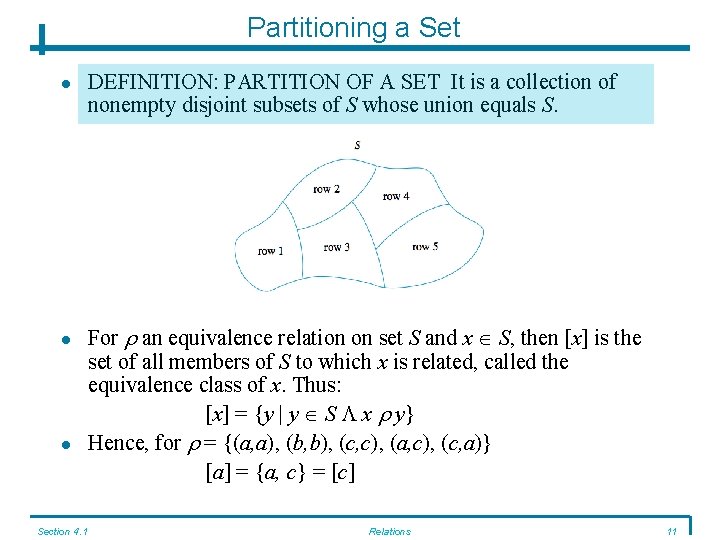
Partitioning a Set Section 4. 1 DEFINITION: PARTITION OF A SET It is a collection of nonempty disjoint subsets of S whose union equals S. For an equivalence relation on set S and x S, then [x] is the set of all members of S to which x is related, called the equivalence class of x. Thus: [x] = {y | y S x y} Hence, for = {(a, a), (b, b), (c, c), (a, c), (c, a)} [a] = {a, c} = [c] Relations 11
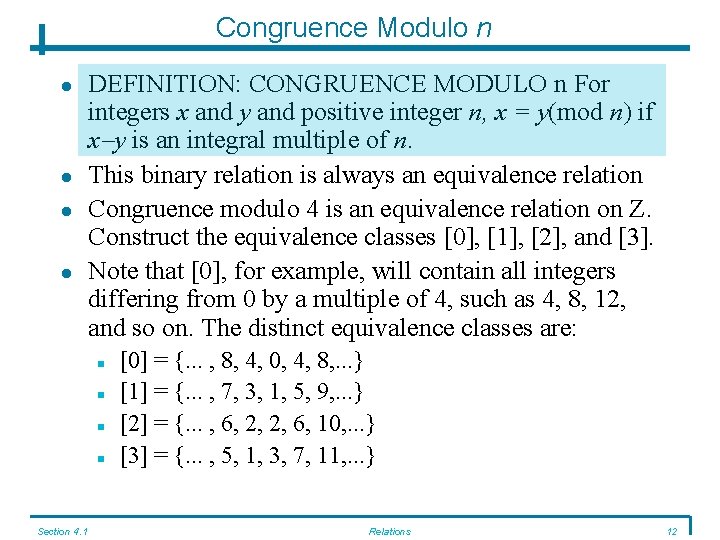
Congruence Modulo n DEFINITION: CONGRUENCE MODULO n For integers x and y and positive integer n, x = y(mod n) if x y is an integral multiple of n. This binary relation is always an equivalence relation Congruence modulo 4 is an equivalence relation on Z. Construct the equivalence classes [0], [1], [2], and [3]. Note that [0], for example, will contain all integers differing from 0 by a multiple of 4, such as 4, 8, 12, and so on. The distinct equivalence classes are: Section 4. 1 [0] = {. . . , 8, 4, 0, 4, 8, . . . } [1] = {. . . , 7, 3, 1, 5, 9, . . . } [2] = {. . . , 6, 2, 2, 6, 10, . . . } [3] = {. . . , 5, 1, 3, 7, 11, . . . } Relations 12
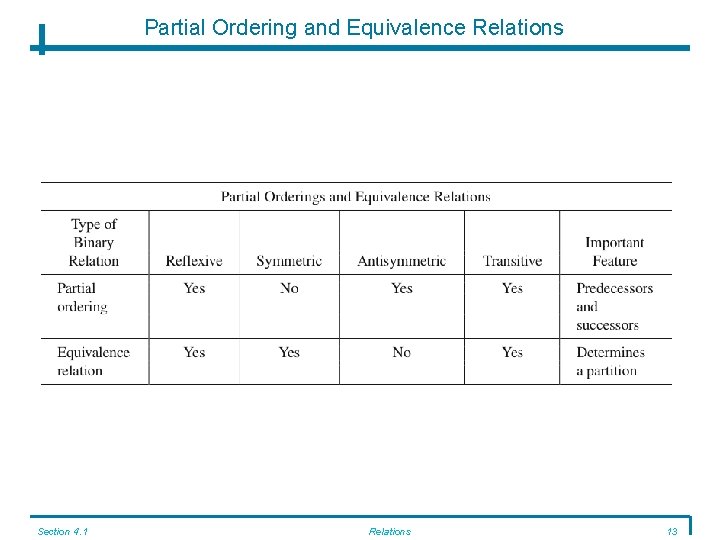
Partial Ordering and Equivalence Relations Section 4. 1 Relations 13
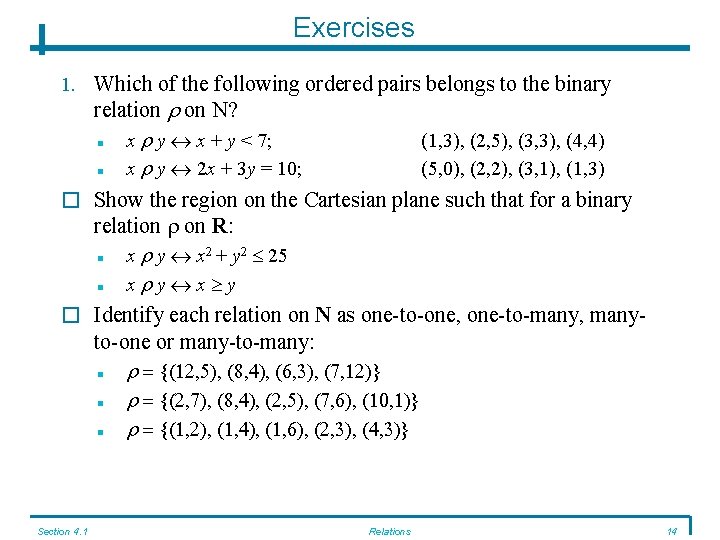
Exercises 1. Which of the following ordered pairs belongs to the binary relation on N? x y x + y < 7; (1, 3), (2, 5), (3, 3), (4, 4) x y 2 x + 3 y = 10; (5, 0), (2, 2), (3, 1), (1, 3) � Show the region on the Cartesian plane such that for a binary relation on R: x y x 2 + y 2 25 x y � Identify each relation on N as one-to-one, one-to-many, manyto-one or many-to-many: = {(12, 5), (8, 4), (6, 3), (7, 12)} = {(2, 7), (8, 4), (2, 5), (7, 6), (10, 1)} = {(1, 2), (1, 4), (1, 6), (2, 3), (4, 3)} Section 4. 1 Relations 14
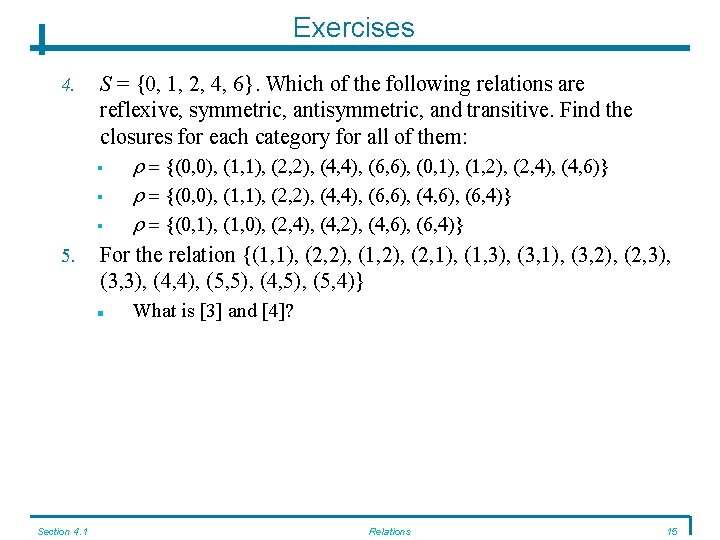
Exercises S = {0, 1, 2, 4, 6}. Which of the following relations are reflexive, symmetric, antisymmetric, and transitive. Find the closures for each category for all of them: § = {(0, 0), (1, 1), (2, 2), (4, 4), (6, 6), (0, 1), (1, 2), (2, 4), (4, 6)} § = {(0, 0), (1, 1), (2, 2), (4, 4), (6, 6), (4, 6), (6, 4)} § = {(0, 1), (1, 0), (2, 4), (4, 2), (4, 6), (6, 4)} 5. For the relation {(1, 1), (2, 2), (1, 2), (2, 1), (1, 3), (3, 1), (3, 2), (2, 3), (3, 3), (4, 4), (5, 5), (4, 5), (5, 4)} 4. Section 4. 1 What is [3] and [4]? Relations 15