
Relations Chapter 9 Copyright Mc GrawHill Education All

- Slides: 37
Relations Chapter 9 Copyright © Mc. Graw-Hill Education. All rights reserved. No reproduction or distribution without the prior written consent of Mc. Graw-Hill Education.
Chapter Summary ● Relations and Their Properties ● Representing Relations ● Equivalence Relations ● Partial Orderings
Relations and Their Properties Section 9. 1
Section Summary ● Relations and Functions ● Properties of Relations ● Reflexive Relations ● Symmetric and Antisymmetric Relations ● Transitive Relations ● Combining Relations
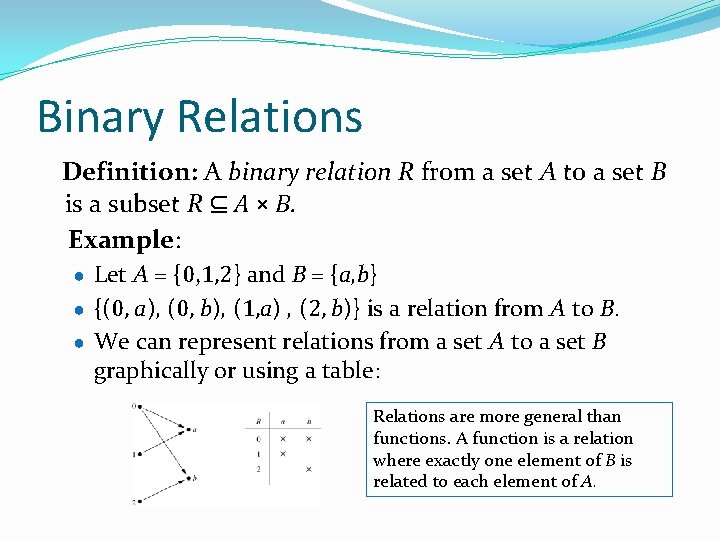
Binary Relations Definition: A binary relation R from a set A to a set B is a subset R ⊆ A × B. Example: ● Let A = {0, 1, 2} and B = {a, b} ● {(0, a), (0, b), (1, a) , (2, b)} is a relation from A to B. ● We can represent relations from a set A to a set B graphically or using a table: Relations are more general than functions. A function is a relation where exactly one element of B is related to each element of A.
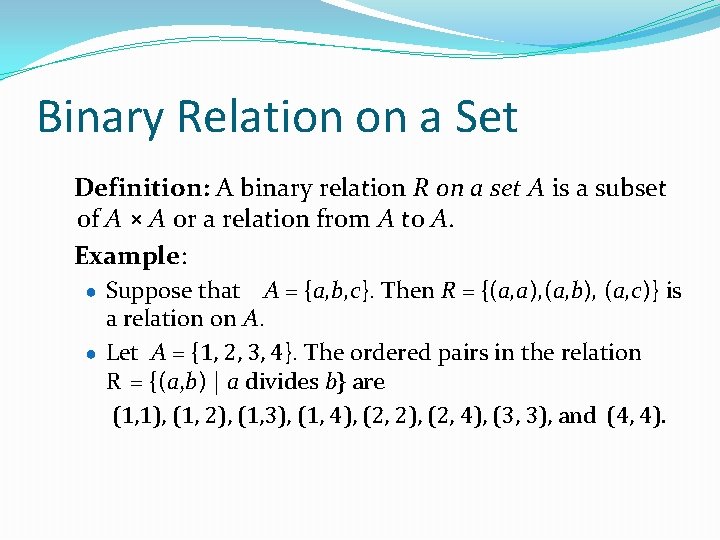
Binary Relation on a Set Definition: A binary relation R on a set A is a subset of A × A or a relation from A to A. Example: ● Suppose that A = {a, b, c}. Then R = {(a, a), (a, b), (a, c)} is a relation on A. ● Let A = {1, 2, 3, 4}. The ordered pairs in the relation R = {(a, b) | a divides b} are (1, 1), (1, 2), (1, 3), (1, 4), (2, 2), (2, 4), (3, 3), and (4, 4).
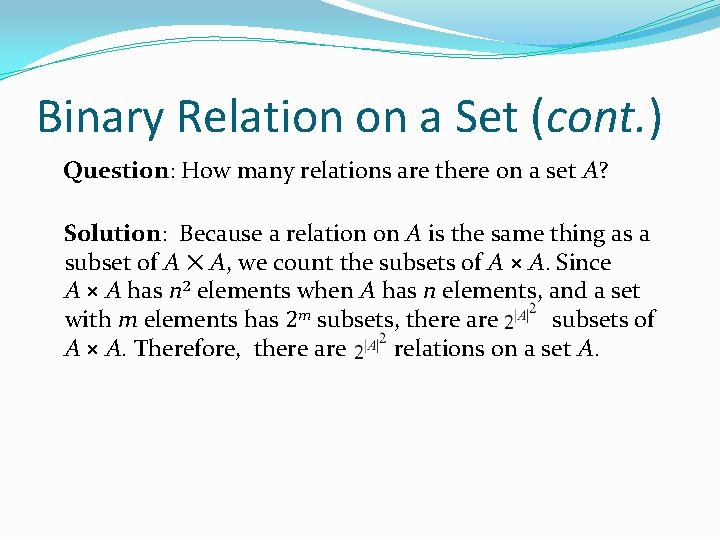
Binary Relation on a Set (cont. ) Question: How many relations are there on a set A? Solution: Because a relation on A is the same thing as a subset of A ⨉ A, we count the subsets of A × A. Since A × A has n 2 elements when A has n elements, and a set with m elements has 2 m subsets, there are subsets of A × A. Therefore, there are relations on a set A.
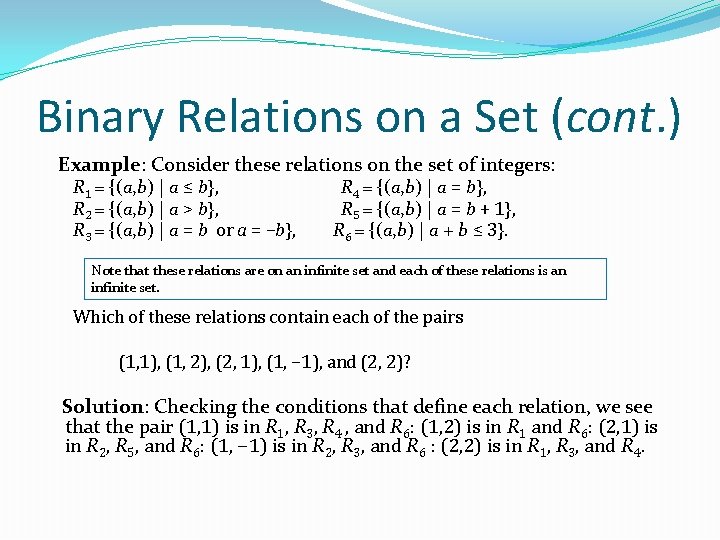
Binary Relations on a Set (cont. ) Example: Consider these relations on the set of integers: R 1 = {(a, b) | a ≤ b}, R 2 = {(a, b) | a > b}, R 3 = {(a, b) | a = b or a = −b}, R 4 = {(a, b) | a = b}, R 5 = {(a, b) | a = b + 1}, R 6 = {(a, b) | a + b ≤ 3}. Note that these relations are on an infinite set and each of these relations is an infinite set. Which of these relations contain each of the pairs (1, 1), (1, 2), (2, 1), (1, − 1), and (2, 2)? Solution: Checking the conditions that define each relation, we see that the pair (1, 1) is in R 1, R 3, R 4 , and R 6: (1, 2) is in R 1 and R 6: (2, 1) is in R 2, R 5, and R 6: (1, − 1) is in R 2, R 3, and R 6 : (2, 2) is in R 1, R 3, and R 4.
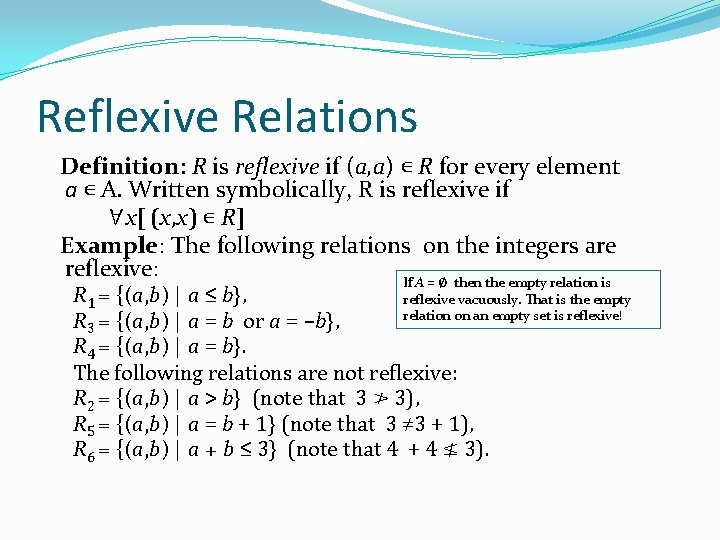
Reflexive Relations Definition: R is reflexive if (a, a) ∊ R for every element a ∊ A. Written symbolically, R is reflexive if ∀x[ (x, x) ∊ R] Example: The following relations on the integers are reflexive: If A = ∅ then the empty relation is R 1 = {(a, b) | a ≤ b}, reflexive vacuously. That is the empty relation on an empty set is reflexive! R 3 = {(a, b) | a = b or a = −b}, R 4 = {(a, b) | a = b}. The following relations are not reflexive: R 2 = {(a, b) | a > b} (note that 3 ≯ 3), R 5 = {(a, b) | a = b + 1} (note that 3 ≠ 3 + 1), R 6 = {(a, b) | a + b ≤ 3} (note that 4 + 4 ≰ 3).
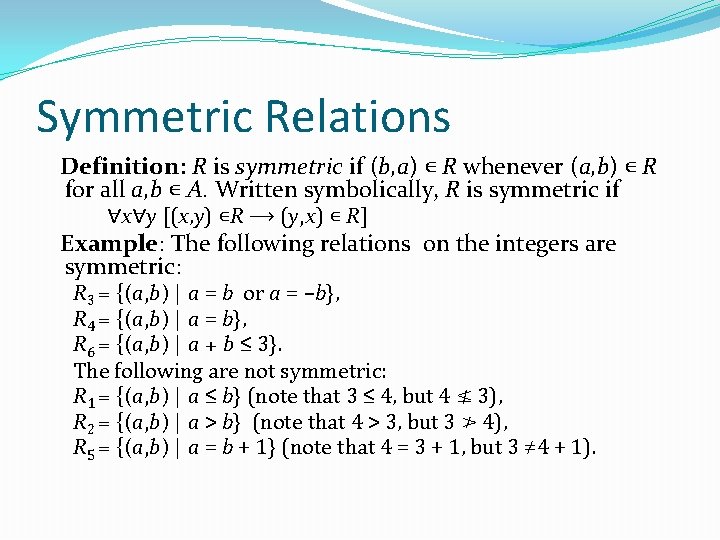
Symmetric Relations Definition: R is symmetric if (b, a) ∊ R whenever (a, b) ∊ R for all a, b ∊ A. Written symbolically, R is symmetric if ∀x∀y [(x, y) ∊R ⟶ (y, x) ∊ R] Example: The following relations on the integers are symmetric: R 3 = {(a, b) | a = b or a = −b}, R 4 = {(a, b) | a = b}, R 6 = {(a, b) | a + b ≤ 3}. The following are not symmetric: R 1 = {(a, b) | a ≤ b} (note that 3 ≤ 4, but 4 ≰ 3), R 2 = {(a, b) | a > b} (note that 4 > 3, but 3 ≯ 4), R 5 = {(a, b) | a = b + 1} (note that 4 = 3 + 1, but 3 ≠ 4 + 1).
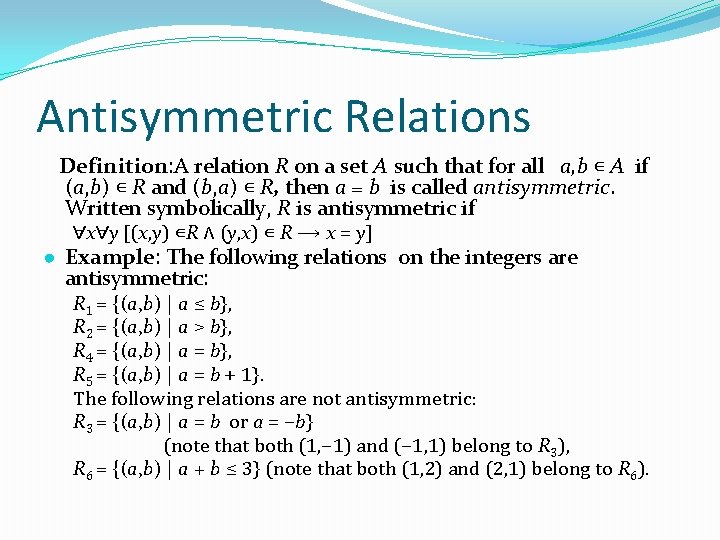
Antisymmetric Relations Definition: A relation R on a set A such that for all a, b ∊ A if (a, b) ∊ R and (b, a) ∊ R, then a = b is called antisymmetric. Written symbolically, R is antisymmetric if ∀x∀y [(x, y) ∊R ∧ (y, x) ∊ R ⟶ x = y] ● Example: The following relations on the integers are antisymmetric: R 1 = {(a, b) | a ≤ b}, R 2 = {(a, b) | a > b}, R 4 = {(a, b) | a = b}, R 5 = {(a, b) | a = b + 1}. The following relations are not antisymmetric: R 3 = {(a, b) | a = b or a = −b} (note that both (1, − 1) and (− 1, 1) belong to R 3), R 6 = {(a, b) | a + b ≤ 3} (note that both (1, 2) and (2, 1) belong to R 6).
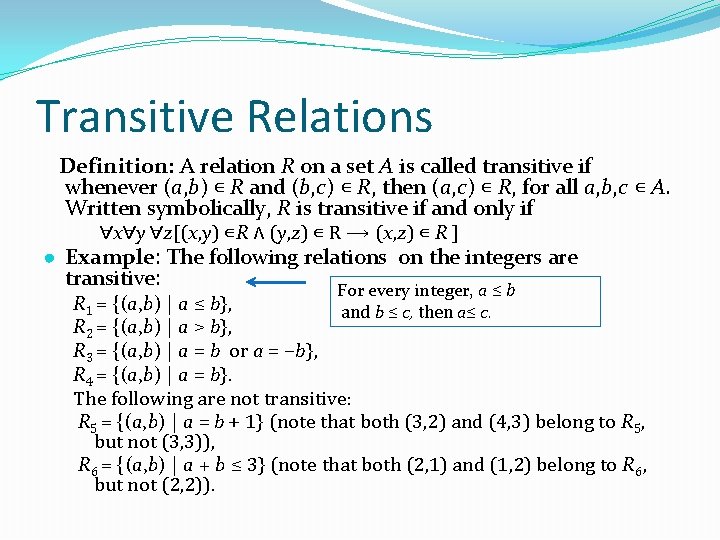
Transitive Relations Definition: A relation R on a set A is called transitive if whenever (a, b) ∊ R and (b, c) ∊ R, then (a, c) ∊ R, for all a, b, c ∊ A. Written symbolically, R is transitive if and only if ∀x∀y ∀z[(x, y) ∊R ∧ (y, z) ∊ R ⟶ (x, z) ∊ R ] ● Example: The following relations on the integers are transitive: For every integer, a ≤ b R 1 = {(a, b) | a ≤ b}, and b ≤ c, then a≤ c. R 2 = {(a, b) | a > b}, R 3 = {(a, b) | a = b or a = −b}, R 4 = {(a, b) | a = b}. The following are not transitive: R 5 = {(a, b) | a = b + 1} (note that both (3, 2) and (4, 3) belong to R 5, but not (3, 3)), R 6 = {(a, b) | a + b ≤ 3} (note that both (2, 1) and (1, 2) belong to R 6, but not (2, 2)).
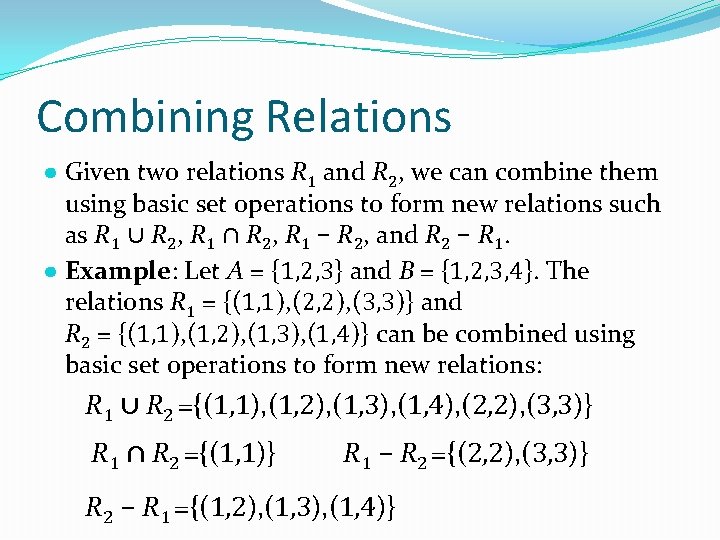
Combining Relations ● Given two relations R 1 and R 2, we can combine them using basic set operations to form new relations such as R 1 ∪ R 2, R 1 ∩ R 2, R 1 − R 2, and R 2 − R 1. ● Example: Let A = {1, 2, 3} and B = {1, 2, 3, 4}. The relations R 1 = {(1, 1), (2, 2), (3, 3)} and R 2 = {(1, 1), (1, 2), (1, 3), (1, 4)} can be combined using basic set operations to form new relations: R 1 ∪ R 2 ={(1, 1), (1, 2), (1, 3), (1, 4), (2, 2), (3, 3)} R 1 ∩ R 2 ={(1, 1)} R 1 − R 2 ={(2, 2), (3, 3)} R 2 − R 1 ={(1, 2), (1, 3), (1, 4)}
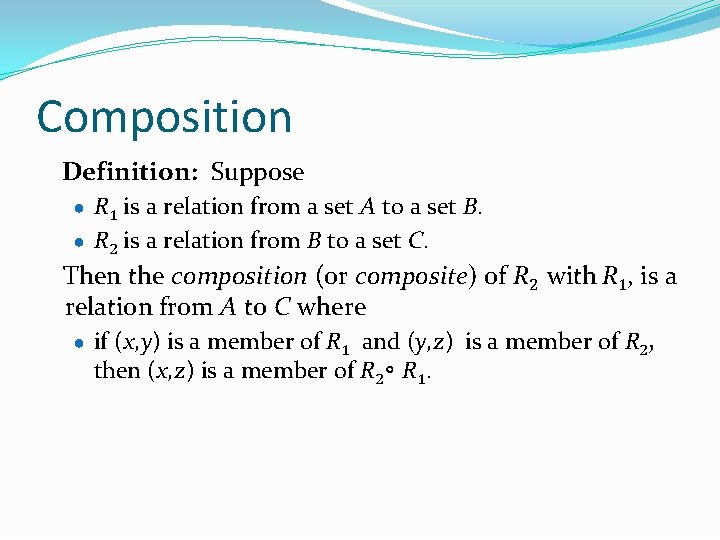
Composition Definition: Suppose ● R 1 is a relation from a set A to a set B. ● R 2 is a relation from B to a set C. Then the composition (or composite) of R 2 with R 1, is a relation from A to C where ● if (x, y) is a member of R 1 and (y, z) is a member of R 2, then (x, z) is a member of R 2∘ R 1.
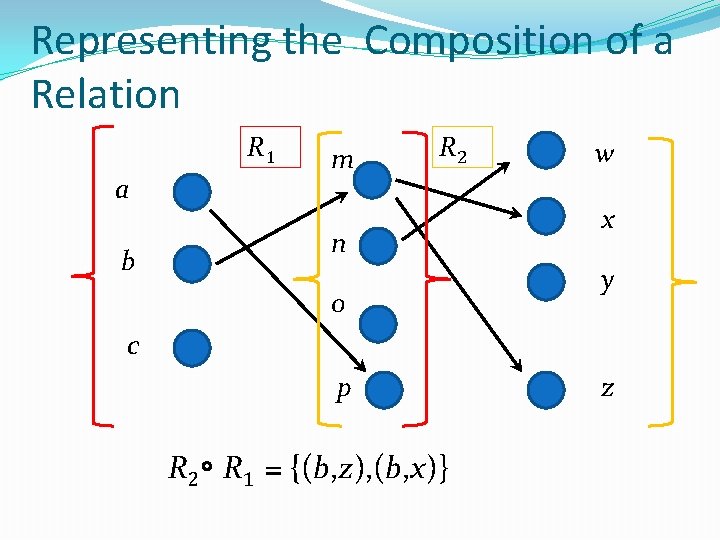
Representing the Composition of a Relation R 1 a b m R 2 n o w x y c p R 2∘ R 1 = {(b, z), (b, x)} z
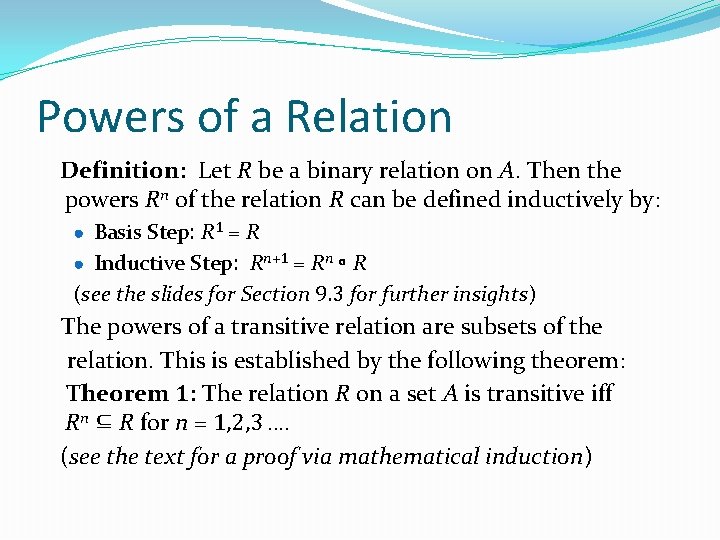
Powers of a Relation Definition: Let R be a binary relation on A. Then the powers Rn of the relation R can be defined inductively by: ● Basis Step: R 1 = R ● Inductive Step: Rn+1 = Rn ∘ R (see the slides for Section 9. 3 for further insights) The powers of a transitive relation are subsets of the relation. This is established by the following theorem: Theorem 1: The relation R on a set A is transitive iff Rn ⊆ R for n = 1, 2, 3 …. (see the text for a proof via mathematical induction)
Representing Relations Section 9. 3
Section Summary ● Representing Relations using Matrices ● Representing Relations using Digraphs
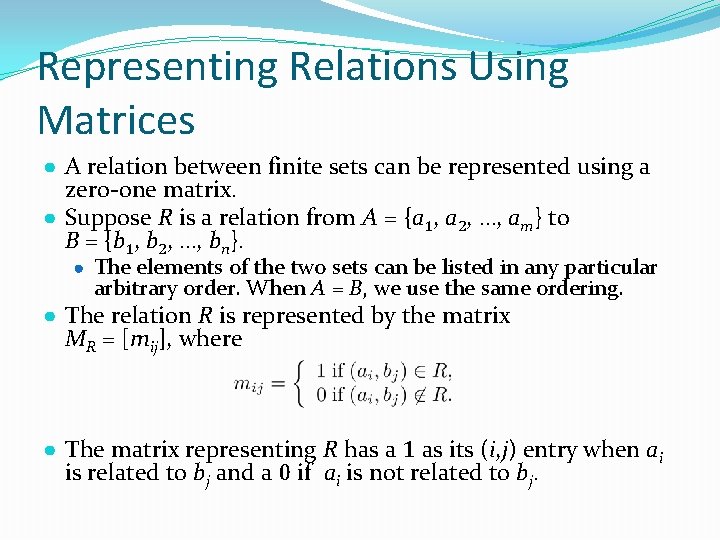
Representing Relations Using Matrices ● A relation between finite sets can be represented using a zero-one matrix. ● Suppose R is a relation from A = {a 1, a 2, …, am} to B = {b 1, b 2, …, bn}. ● The elements of the two sets can be listed in any particular arbitrary order. When A = B, we use the same ordering. ● The relation R is represented by the matrix MR = [mij], where ● The matrix representing R has a 1 as its (i, j) entry when ai is related to bj and a 0 if ai is not related to bj.
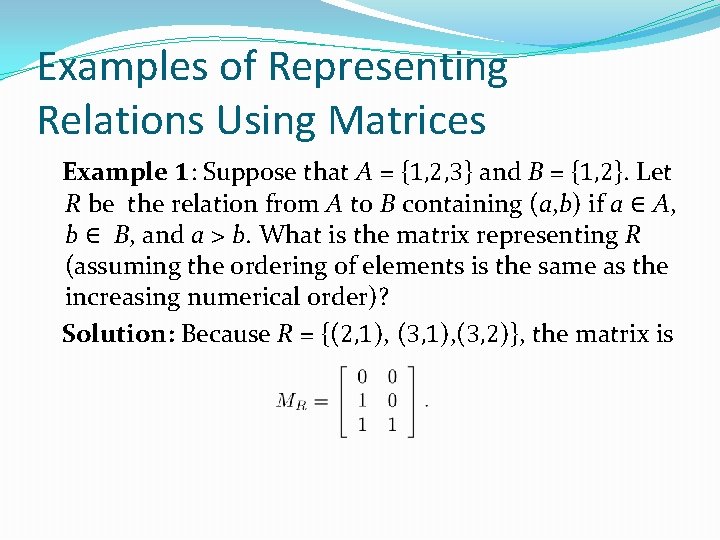
Examples of Representing Relations Using Matrices Example 1: Suppose that A = {1, 2, 3} and B = {1, 2}. Let R be the relation from A to B containing (a, b) if a ∈ A, b ∈ B, and a > b. What is the matrix representing R (assuming the ordering of elements is the same as the increasing numerical order)? Solution: Because R = {(2, 1), (3, 2)}, the matrix is
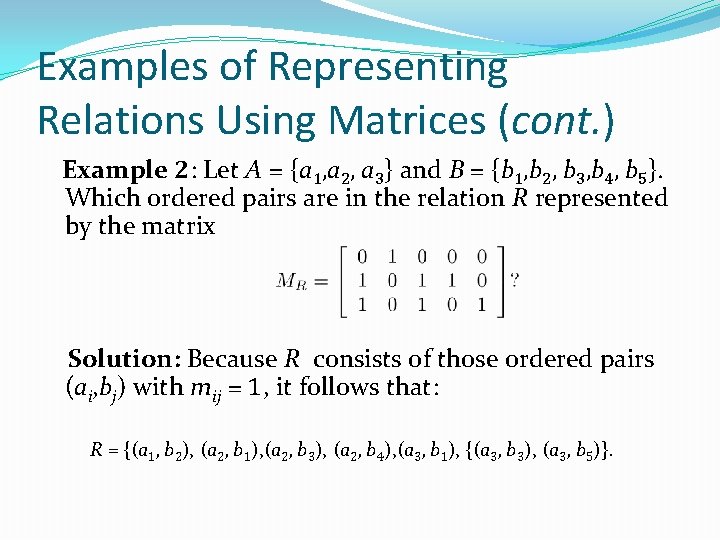
Examples of Representing Relations Using Matrices (cont. ) Example 2: Let A = {a 1, a 2, a 3} and B = {b 1, b 2, b 3, b 4, b 5}. Which ordered pairs are in the relation R represented by the matrix Solution: Because R consists of those ordered pairs (ai, bj) with mij = 1, it follows that: R = {(a 1, b 2), (a 2, b 1), (a 2, b 3), (a 2, b 4), (a 3, b 1), {(a 3, b 3), (a 3, b 5)}.
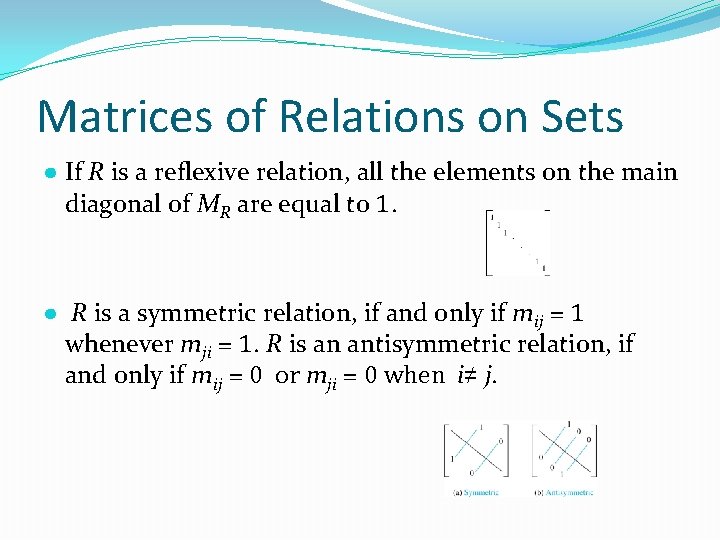
Matrices of Relations on Sets ● If R is a reflexive relation, all the elements on the main diagonal of MR are equal to 1. ● R is a symmetric relation, if and only if mij = 1 whenever mji = 1. R is an antisymmetric relation, if and only if mij = 0 or mji = 0 when i≠ j.
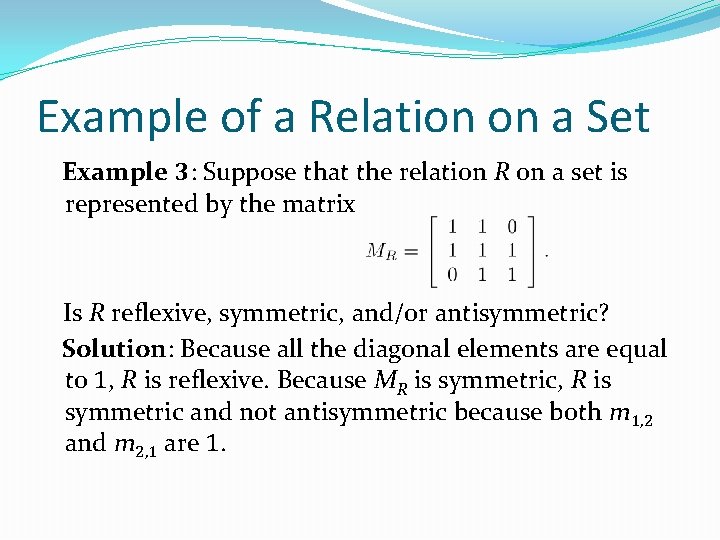
Example of a Relation on a Set Example 3: Suppose that the relation R on a set is represented by the matrix Is R reflexive, symmetric, and/or antisymmetric? Solution: Because all the diagonal elements are equal to 1, R is reflexive. Because MR is symmetric, R is symmetric and not antisymmetric because both m 1, 2 and m 2, 1 are 1.
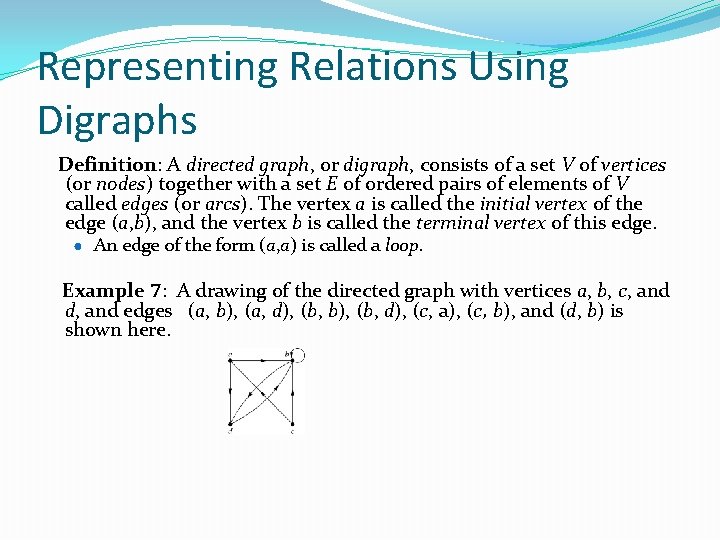
Representing Relations Using Digraphs Definition: A directed graph, or digraph, consists of a set V of vertices (or nodes) together with a set E of ordered pairs of elements of V called edges (or arcs). The vertex a is called the initial vertex of the edge (a, b), and the vertex b is called the terminal vertex of this edge. ● An edge of the form (a, a) is called a loop. Example 7: A drawing of the directed graph with vertices a, b, c, and d, and edges (a, b), (a, d), (b, b), (b, d), (c, a), (c, b), and (d, b) is shown here.
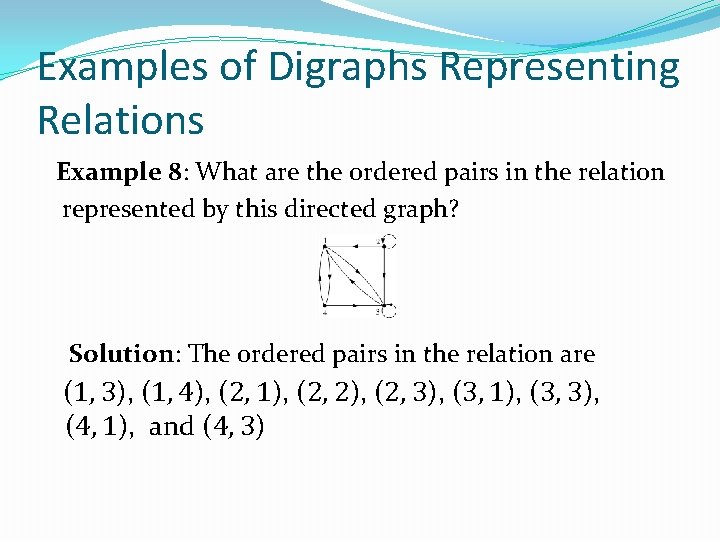
Examples of Digraphs Representing Relations Example 8: What are the ordered pairs in the relation represented by this directed graph? Solution: The ordered pairs in the relation are (1, 3), (1, 4), (2, 1), (2, 2), (2, 3), (3, 1), (3, 3), (4, 1), and (4, 3)
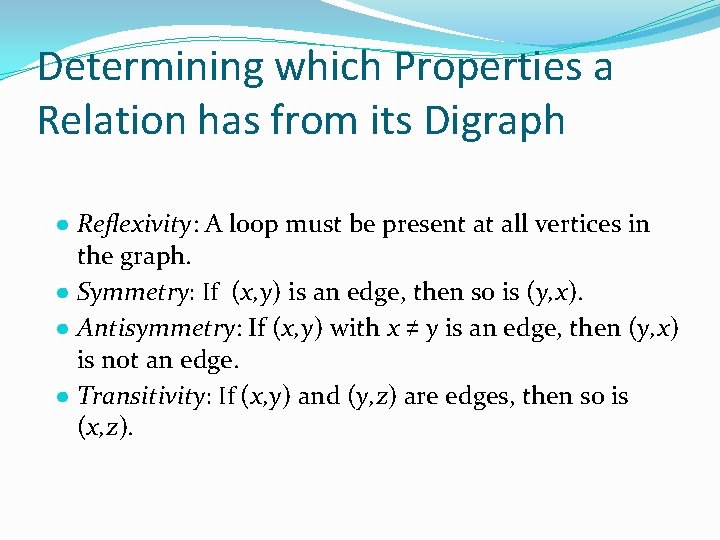
Determining which Properties a Relation has from its Digraph ● Reflexivity: A loop must be present at all vertices in the graph. ● Symmetry: If (x, y) is an edge, then so is (y, x). ● Antisymmetry: If (x, y) with x ≠ y is an edge, then (y, x) is not an edge. ● Transitivity: If (x, y) and (y, z) are edges, then so is (x, z).
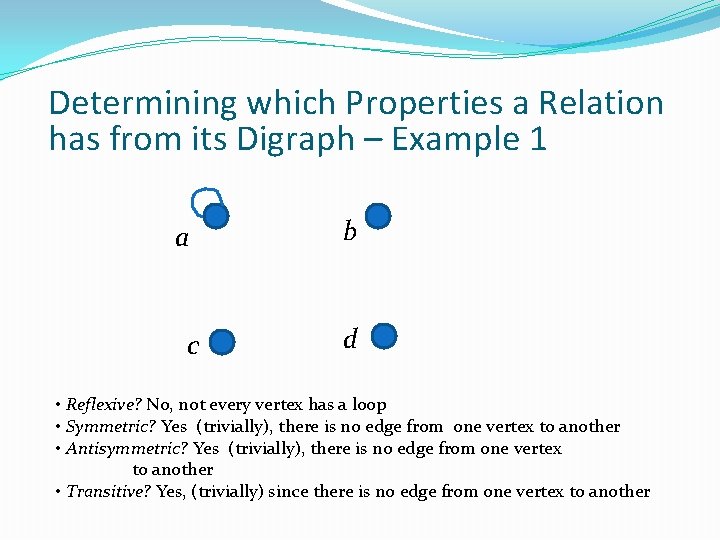
Determining which Properties a Relation has from its Digraph – Example 1 a c b d • Reflexive? No, not every vertex has a loop • Symmetric? Yes (trivially), there is no edge from one vertex to another • Antisymmetric? Yes (trivially), there is no edge from one vertex to another • Transitive? Yes, (trivially) since there is no edge from one vertex to another
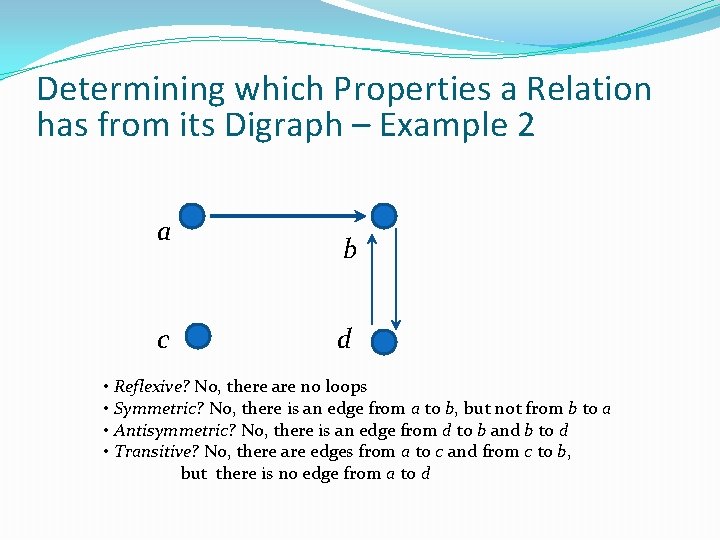
Determining which Properties a Relation has from its Digraph – Example 2 a c b d • Reflexive? No, there are no loops • Symmetric? No, there is an edge from a to b, but not from b to a • Antisymmetric? No, there is an edge from d to b and b to d • Transitive? No, there are edges from a to c and from c to b, but there is no edge from a to d
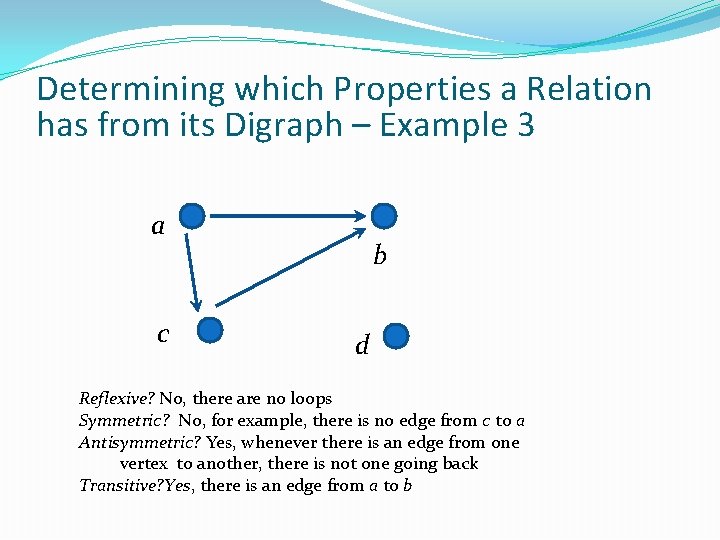
Determining which Properties a Relation has from its Digraph – Example 3 a c b d Reflexive? No, there are no loops Symmetric? No, for example, there is no edge from c to a Antisymmetric? Yes, whenever there is an edge from one vertex to another, there is not one going back Transitive? Yes, there is an edge from a to b
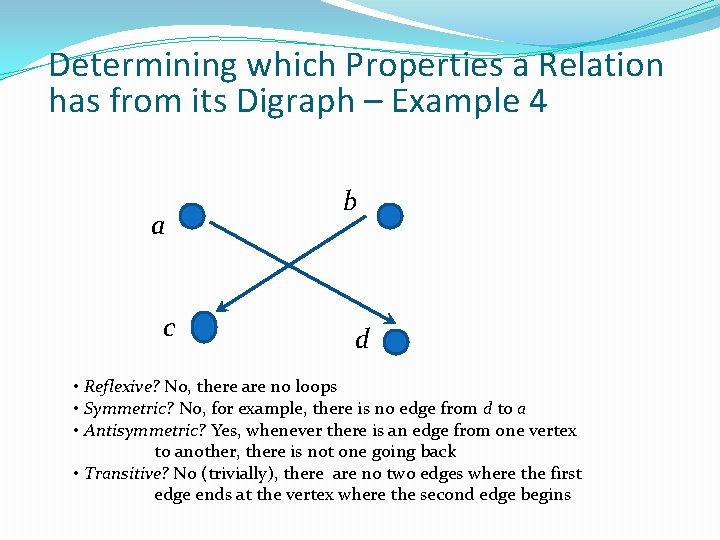
Determining which Properties a Relation has from its Digraph – Example 4 a c b d • Reflexive? No, there are no loops • Symmetric? No, for example, there is no edge from d to a • Antisymmetric? Yes, whenever there is an edge from one vertex to another, there is not one going back • Transitive? No (trivially), there are no two edges where the first edge ends at the vertex where the second edge begins
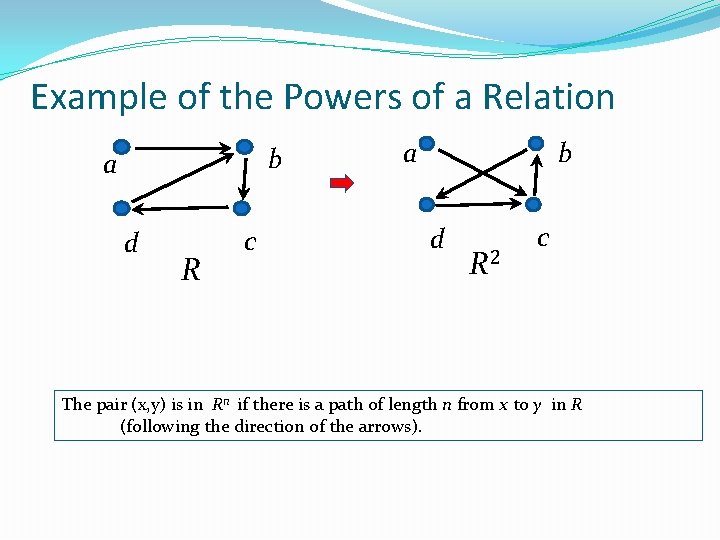
Example of the Powers of a Relation b a d R c a b d R 2 c The pair (x, y) is in Rn if there is a path of length n from x to y in R (following the direction of the arrows).
Equivalence Relations Section 9. 5
Section Summary ● Equivalence Relations
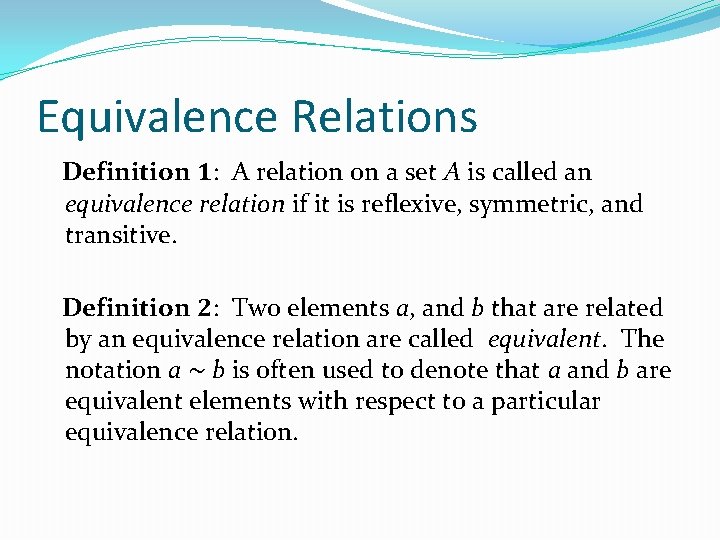
Equivalence Relations Definition 1: A relation on a set A is called an equivalence relation if it is reflexive, symmetric, and transitive. Definition 2: Two elements a, and b that are related by an equivalence relation are called equivalent. The notation a ∼ b is often used to denote that a and b are equivalent elements with respect to a particular equivalence relation.
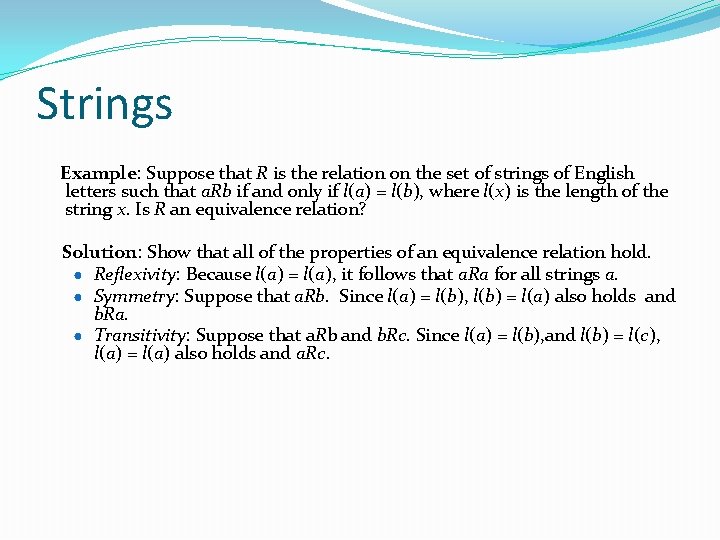
Strings Example: Suppose that R is the relation on the set of strings of English letters such that a. Rb if and only if l(a) = l(b), where l(x) is the length of the string x. Is R an equivalence relation? Solution: Show that all of the properties of an equivalence relation hold. ● Reflexivity: Because l(a) = l(a), it follows that a. Ra for all strings a. ● Symmetry: Suppose that a. Rb. Since l(a) = l(b), l(b) = l(a) also holds and b. Ra. ● Transitivity: Suppose that a. Rb and b. Rc. Since l(a) = l(b), and l(b) = l(c), l(a) = l(a) also holds and a. Rc.
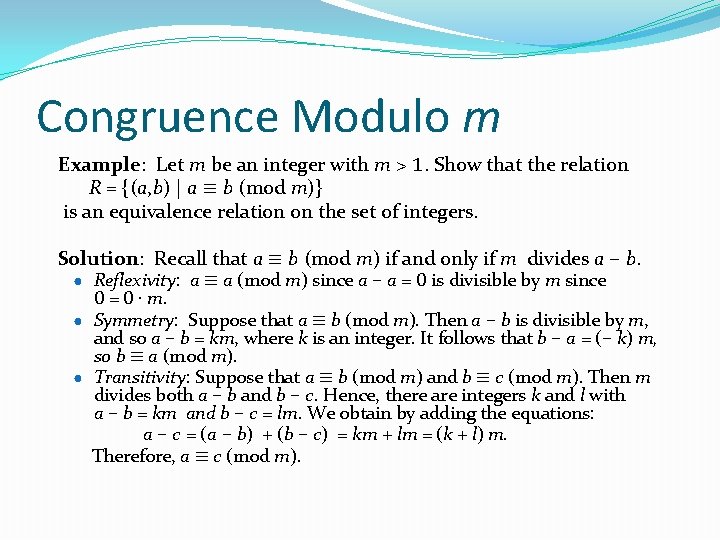
Congruence Modulo m Example: Let m be an integer with m > 1. Show that the relation R = {(a, b) | a ≡ b (mod m)} is an equivalence relation on the set of integers. Solution: Recall that a ≡ b (mod m) if and only if m divides a − b. ● Reflexivity: a ≡ a (mod m) since a − a = 0 is divisible by m since 0 = 0 ∙ m. ● Symmetry: Suppose that a ≡ b (mod m). Then a − b is divisible by m, and so a − b = km, where k is an integer. It follows that b − a = (− k) m, so b ≡ a (mod m). ● Transitivity: Suppose that a ≡ b (mod m) and b ≡ c (mod m). Then m divides both a − b and b − c. Hence, there are integers k and l with a − b = km and b − c = lm. We obtain by adding the equations: a − c = (a − b) + (b − c) = km + lm = (k + l) m. Therefore, a ≡ c (mod m).
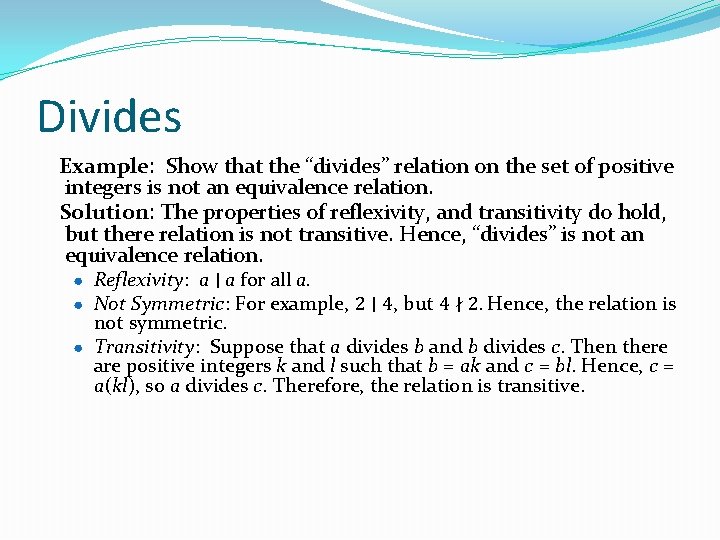
Divides Example: Show that the “divides” relation on the set of positive integers is not an equivalence relation. Solution: The properties of reflexivity, and transitivity do hold, but there relation is not transitive. Hence, “divides” is not an equivalence relation. ● Reflexivity: a ∣ a for all a. ● Not Symmetric: For example, 2 ∣ 4, but 4 ∤ 2. Hence, the relation is not symmetric. ● Transitivity: Suppose that a divides b and b divides c. Then there are positive integers k and l such that b = ak and c = bl. Hence, c = a(kl), so a divides c. Therefore, the relation is transitive.