
Relations between IODEF and IDMEF Based on IDMEF
Relations between IODEF and IDMEF Based on IDMEF XML DTD and Data Model Analysis TERENA ITDWG IODEF Editorial Group Yuri Demchenko <demch@terena. nl> 2001. Yu. Demchenko. TERENA IETF 50: IODEF and IDMEF Slide 2_
Outline · TERENA Incident Taxonomy and Description WG u History and next steps · IODEF Documents · Relation between IDMEF and IODEF © 2001. Yu. Demchenko. TERENA IETF 50: IODEF and IDMEF 2
Incident Taxonomy and Description WG at TERENA TF-CSIRT - History · Incident Taxonomy and Description WG u Webpage and charter - http: //www. terena. nl/task-forces/tf-csirt/i-taxonomy/ u mailing list i-taxonomy@terena. nl and archive http: //hypermail. terena. nl/incident-taxonomy-list/mail-archive/ u Mailing list iodef@terena. nl and archive - http: //hypermail. terena. nl/iodeflist/mail-archive/ u Next meeting – May 31 -June 1, 2001, Ljubljana, Slovenia · Next steps u Pilot implementation among few CSIRTs in Europe – TERENA funded Pilot Project – IHS Platforms: Remedy ARS, Magic TSD, Nortel Clarify u Next Bo. F – at 13 th FIRST Conference in Toulouse, France u Bo. F at IETF 51? ? © 2001. Yu. Demchenko. TERENA IETF 50: IODEF and IDMEF 3
IODEF Documents • Incident Object Description and Exchange Format Requirements · Published as RFC 3067 http: //www. ietf. org/rfc 3067. txt • Incident Object Elements Description and XML Data Type Description (XML DTD) · Pre-project draft is available http: //www. terena. nl/task-forces/tf-csirt/i-taxonomy/docs/iodef-xmldtd-00. dtd · Document (I-draft) to be drafted before May 31, 2001 · Problem with name space sharing with IDMEF • Incident Object Data Model · To be drafted before May 31, 2001 © 2001. Yu. Demchenko. TERENA IETF 50: IODEF and IDMEF 4
Other and external IODEF Documents • Best Current Practice on Incident classification and reporting schemes. · Version 1 http: //www. terena. nl/task-forces/tf-csirt/i-taxonomy/docs/BCPreport 1. rtf • Taxonomy of the Computer Security Incident related terminology http: //www. terena. nl/task-forces/tf-csirt/i-taxonomy/docs/i-taxonomy_terms. html • Other documents/areas of interest · Evidence Collection and Archiving (current i-draft expired) u Cached copy - http: //www. terena. nl/task-forces/tf-csirt/itaxonomy/archive/draft-ietf-grip-prot-evidence-01. txt © 2001. Yu. Demchenko. TERENA IETF 50: IODEF and IDMEF 5

IODEF purposes A uniform incident classification enables applications such as: · uniform internal incident storage · incident handling between teams made easier (only one team needs to classify and analyze the complete incident, the other team can re-use this data) · uniform incident reporting by victims to CSIRTs · uniform statistic generation and exchange, for both domestic use and exchange of data between teams. Over time a distributed incident statistics infrastructure can evolve · trend-analyses for reoccurrence of incidents, victims, attackers, etc. · trend-analyses for relations between scans and attacks and thus begin working on pro-active incident response Main IODEF actors are CSIRTs – not IDS © 2001. Yu. Demchenko. TERENA IETF 50: IODEF and IDMEF 6
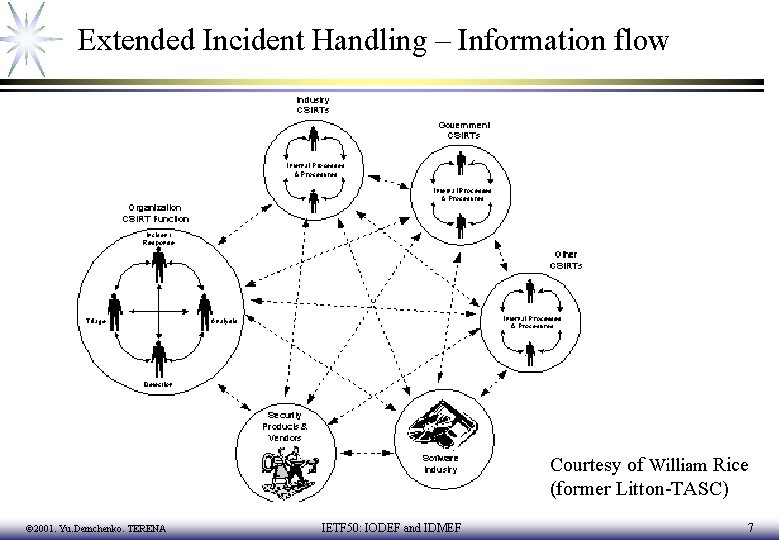
Extended Incident Handling – Information flow Courtesy of William Rice (former Litton-TASC) © 2001. Yu. Demchenko. TERENA IETF 50: IODEF and IDMEF 7
Interaction between IDS, IHS and Vulnerability Reports (Security Alerts) Yet To Be Described (including Attack/Incident History) © 2001. Yu. Demchenko. TERENA IETF 50: IODEF and IDMEF 8
Relation between IDMEF and IODEF Initial requirements/suggestions: 1. IODEF should be compatible with IDMEF and be capable to use/include IDMEF message into IO, e. g. as or inside of Incident. Alert IO class. However, backward compatibility is not required, i. e. it’s not necessary that IODEF message is understood by IDS (or other automatic system? ) 2. If some elements or attributes intersect, options should be considered: · change name in IODEF or · ask IDWG to consider changing name in IDMEF Request for comments to ITDWG and IODEF http: //www. terena. nl/task-forces/tf-csirt/i-taxonomy/docs/iodef-idmef-xmldtd-00 -rfc. html © 2001. Yu. Demchenko. TERENA IETF 50: IODEF and IDMEF 9

IDMEF vs IODEF: (1) 1. Reuse (confirmed) IDMEF to generate in a simplest way Incident. Alert (message)? Possible format for IODEF Incident. Alert: • Some Data • Authority created IO • Additional. Data containing IDMEF To Be Considered. Ask IDWG about lifetime of IDMEF: What happen with confirmed Intrusion? © 2001. Yu. Demchenko. TERENA IETF 50: IODEF and IDMEF 10
IDMEF vs IODEF: (2) 4. Compare (target, source)/IDMEF and (target, source)/IODEF. Does source/IDMEF cover/equal to Attacker/IODEF? The Target class contains information about the possible target(s) of the event(s) that generated an alert. An event may have more than one target (e. g. , in the case of a port sweep). The Target class is composed of four aggregate classes: Node, User, Process, Service The Source class contains information about the possible source(s) of the event(s) that generated an alert. An event may have more than one source (e. g. , in a distributed denial of service attack). The Source class is composed of four aggregate classes: Node, User, Process, Service O. K. to reuse © 2001. Yu. Demchenko. TERENA IETF 50: IODEF and IDMEF 11
IDMEF vs IODEF: (3) 5. Definition of impact/IDMEF Impact (Optional). The evaluated impact of the event(s) leading up to the alert on the target. The permitted values for this attribute are shown below. The default value is "unknown". O. K. to reuse. © 2001. Yu. Demchenko. TERENA IETF 50: IODEF and IDMEF 12
IDMEF vs IODEF: (4) 6. IDMEF uses detect. Time/IDMEF. The Detect. Time class is used to indicate the date and time the event(s) producing an alert was detected by the analyzer. In the case of more than one event, the time the first event was detected. (This may or may not be the same time as Create. Time; analyzers are not required to send alerts immediately upon detection). The Detect. Time class has one attribute: ntpstamp representing the same date and time as the element content. Can be adopted. TBC. Consider including element registration. Time/IODEF © 2001. Yu. Demchenko. TERENA IETF 50: IODEF and IDMEF 13
IDMEF vs IODEF: (5) 7. It seems that name “datetime” is commonly used in XML world but IDMEF use “date-time” with dash. Date-time strings are represented by the DATETIME data type. Each datetime string identifies a particular instant in time; ranges are not supported. Date-time strings are formatted according to a subset of ISO 8601: 2000, as show below. Section references in parentheses refer to sections of the ISO 8601: 2000 standard. O. K. to adopt. Comment to IDWG to change to datetime. © 2001. Yu. Demchenko. TERENA IETF 50: IODEF and IDMEF 14
IDMEF vs IODEF: (6) 8. IDMEF intends to define tool of the attack by element Tool. Alert is subclass of Alert. The Tool. Alert class carries additional information related to the use of attack tools or malevolent programs such as Trojan horses, and can be used by the analyzer when it is able to identify these tools. It is intended to group one or more previously-sent alerts together, to say "these alerts were all the result of someone using this tool. " The Tool. Alert class is composed of three aggregate classes: name, command, alertident. No suggestions (Not applicable for IODEF? ) © 2001. Yu. Demchenko. TERENA IETF 50: IODEF and IDMEF 15
IDMEF vs IODEF: (7) 9. Reuse definition of “Alertident” for extended identification of Incidents. Alert. Ident - the list of alert identifiers that are related to this alert. Because alert identifiers are only unique across the alerts sent by a single analyzer, the optional "analyzerid" attribute of "alertident" should be used to identify the analyzer that a particular alert came from. If the "analyzerid" is not provided, the alert is assumed to have come from the same analyzer that is sending the Tool. Alert. Not applicable for IODEF? © 2001. Yu. Demchenko. TERENA IETF 50: IODEF and IDMEF 16
IDMEF vs IODEF: (8) 10. Check definition of “user” and “user. Id” in IDMEF. The User class is used to describe user that is receiving the event(s). It is primarily used as a "container" class for the User. Id aggregate class. The User. Id class provides specific information about a user. More than one User. Id can be used within the User class to indicate attempts to transition from one user to another, or to provide complete information about a user's (or process') privileges. The User. Id class is composed of two aggregate classes: name, number. User class in IDMEF is not clearly defined. Comment to IDWG. Do we have/need “user*” element in IODEF? © 2001. Yu. Demchenko. TERENA IETF 50: IODEF and IDMEF 17
IDMEF vs IODEF: (9) 11. IDMEF doesn’t contain elements Attack and Vulnerability because • Attack is a confirmed Intrusion that is being handled by CSIRT/humans Vulnerability is covered by Classification element. However, it looks a bit indefinite as sub-element of <!ELEMENT Alert ( Analyzer, Create. Time, Detect. Time? , Analyzer. Time? , Source*, Target*, Classification+, Tool. Alert? , Overflow. Alert? , Correlation. Alert? , Additional. Data*)> The Classification class provides the "name" of an alert, or other information allowing the manager to determine what it is (for example, to decide whether or not to display the alert on-screen, what color to display it in, etc. ). The Classification class is composed of two aggregate classes: name (of vulnerability), url. TBC: What’s the relation between Alert and Attack? © 2001. Yu. Demchenko. TERENA IETF 50: IODEF and IDMEF 18
IDMEF vs IODEF: (10) 13. Check definition of “classification” in IDMEF. Does it mean known/registered vulnerability? <Classification origin="bugtraqid"> <name>629</name> <url>http: //www. securityfocus. com</url> </Classification> Classification class is not clearly defined. Is it related to Vulnerabilities, Exposure or Attacks? If latter, what’s the definition of attack? © 2001. Yu. Demchenko. TERENA IETF 50: IODEF and IDMEF 19
IDMEF vs IODEF: (11) 14. Check definition of method/IDMEF: Service>webservice>method The HTTP method (PUT, GET) used in the request <!ELEMENT Web. Service (url, cgi? , method? , arg*)> Contact IDWG to change method to httpmethod. Using generic term method is not good in general. Otherwise: Consider changing/redefining Method/IODEF and/or moving: · Vulnerability to Attack and · Evidence to Top level elements/classes or to Additional. Data © 2001. Yu. Demchenko. TERENA IETF 50: IODEF and IDMEF 20

IDMEF vs IODEF: (12) 15. Consider reusing the following terms from IDMEF: • size - sub-element of Overflow. Alert - N/A • number - sub-element of user. Id • url - (exactly one string)– used in classification, Web. Service - O. K. • location – sub-element of node (location, name address) - Not clearly defined. • name – has diverse number of definitions: · name of a particular tool in Tool. Alert, name of equipment in node, name of the alert in Classification from one of the known origins, etc. Meaning depends on place in IDMEF hierarchy. - Not clearly defined. © 2001. Yu. Demchenko. TERENA IETF 50: IODEF and IDMEF 21
- Slides: 21