
Relational Query Optimization I Cost Estimation 1 Overview
- Slides: 9
Relational Query Optimization I: Cost Estimation 1
Overview of Query Optimization v Plan: Tree of RA ops, with choice of alg for each op. – Each operator typically implemented using a `pull’ interface: when an operator is `pulled’ for its next output tuple(s), it `pulls’ on its input(s) and computes them. v Two main issues: – For a given query, what plans are considered? u Algorithm to search plan space for cheapest (estimated) plan. – How is the cost of a plan estimated? Ideally: Want to find best plan. Practically: Avoid worst plans! v We will study the System R approach. v 2
Highlights of System R Optimizer v Impact: – Most widely used currently; works well for < 10 joins. v Cost estimation: Approximate art at best. – Statistics, maintained in system catalogs, used to estimate cost of operations and result sizes. – Considers combination of CPU and I/O costs. v Plan Space: Too large, must be pruned. – Only the space of left-deep plans is considered. u Left-deep plans allow output of each operator to be pipelined into the next operator without storing it in a temporary relation. – Cartesian products avoided when possible. 3
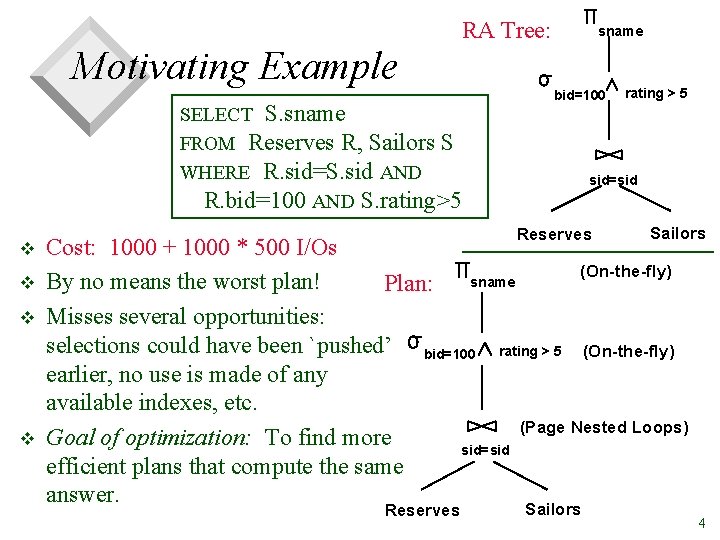
RA Tree: Motivating Example SELECT S. sname FROM Reserves R, Sailors S WHERE R. sid=S. sid AND R. bid=100 AND S. rating>5 v v sname bid=100 rating > 5 sid=sid Reserves Sailors Cost: 1000 + 1000 * 500 I/Os (On-the-fly) sname By no means the worst plan! Plan: Misses several opportunities: selections could have been `pushed’ bid=100 rating > 5 (On-the-fly) earlier, no use is made of any available indexes, etc. (Page Nested Loops) Goal of optimization: To find more sid=sid efficient plans that compute the same answer. Reserves Sailors 4
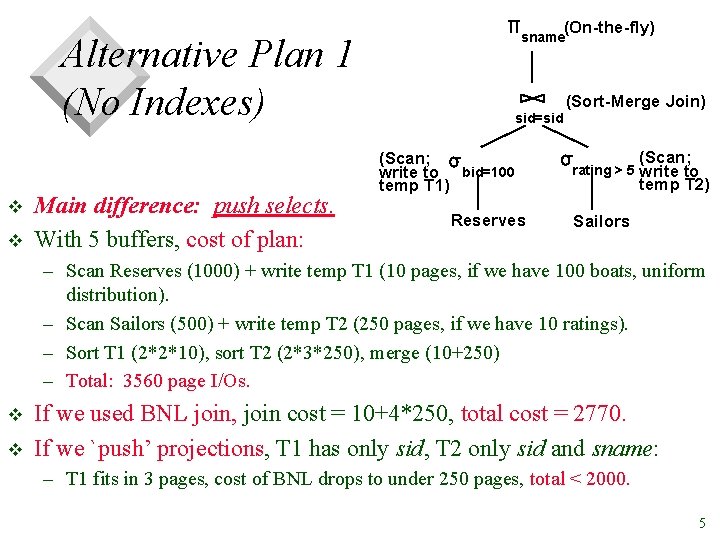
(On-the-fly) sname Alternative Plan 1 (No Indexes) v v Main difference: push selects. With 5 buffers, cost of plan: sid=sid (Scan; write to bid=100 temp T 1) Reserves (Sort-Merge Join) rating > 5 (Scan; write to temp T 2) Sailors – Scan Reserves (1000) + write temp T 1 (10 pages, if we have 100 boats, uniform distribution). – Scan Sailors (500) + write temp T 2 (250 pages, if we have 10 ratings). – Sort T 1 (2*2*10), sort T 2 (2*3*250), merge (10+250) – Total: 3560 page I/Os. v v If we used BNL join, join cost = 10+4*250, total cost = 2770. If we `push’ projections, T 1 has only sid, T 2 only sid and sname: – T 1 fits in 3 pages, cost of BNL drops to under 250 pages, total < 2000. 5
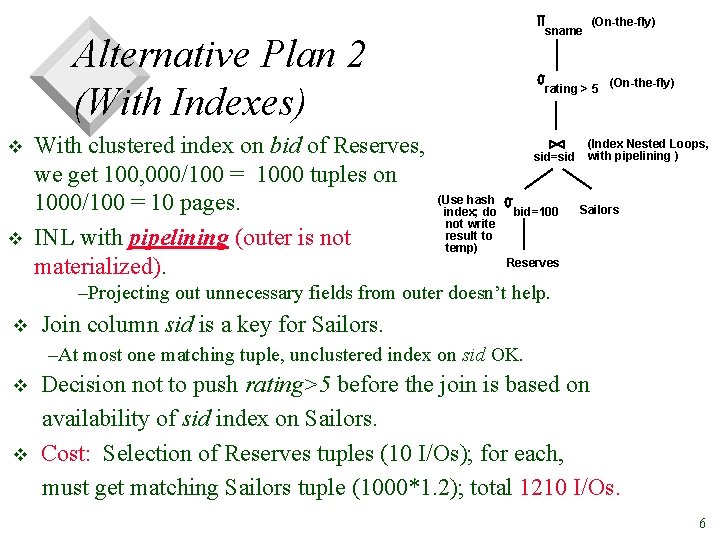
sname Alternative Plan 2 (With Indexes) v v With clustered index on bid of Reserves, we get 100, 000/100 = 1000 tuples on 1000/100 = 10 pages. INL with pipelining (outer is not materialized). (On-the-fly) rating > 5 (On-the-fly) sid=sid (Use hash index; do not write result to temp) bid=100 (Index Nested Loops, with pipelining ) Sailors Reserves –Projecting out unnecessary fields from outer doesn’t help. v Join column sid is a key for Sailors. –At most one matching tuple, unclustered index on sid OK. v v Decision not to push rating>5 before the join is based on availability of sid index on Sailors. Cost: Selection of Reserves tuples (10 I/Os); for each, must get matching Sailors tuple (1000*1. 2); total 1210 I/Os. 6
Cost Estimation v For each plan considered, must estimate cost: – Must estimate cost of each operation in plan tree. Depends on input cardinalities. u We’ve already discussed how to estimate the cost of operations (sequential scan, index scan, joins, etc. ) u – Must estimate size of result for each operation in tree! Use information about the input relations. u For selections and joins, assume independence of predicates. u v We’ll discuss the System R cost estimation approach. – Very inexact, but works ok in practice. – More sophisticated techniques known now. 7
Statistics and Catalogs v Need information about the relations and indexes involved. Catalogs typically contain at least: – # tuples (NTuples) and # pages (NPages) for each relation. – # distinct key values (NKeys) and NPages for each index. – Index height, low/high key values (Low/High) for each tree index. v Catalogs updated periodically. – Updating whenever data changes is too expensive; lots of approximation anyway, so slight inconsistency ok. v More detailed information (e. g. , histograms of the values in some field) are usually stored. 8
Summary v For each operation in a RA Tree, many implementations are possible – Cost (in I/Os) of each operation can be computed using statistics from DB catalog relations and by estimating result sizes (next time) for operations – Pipelining used whenever possible (avoids putting intermediate results to disk) v Many RA Trees exist for a given query (next time: how to generate them) 9