
Relational Logic Propositional Logic Premises If Jack knows








- Slides: 83
Relational Logic
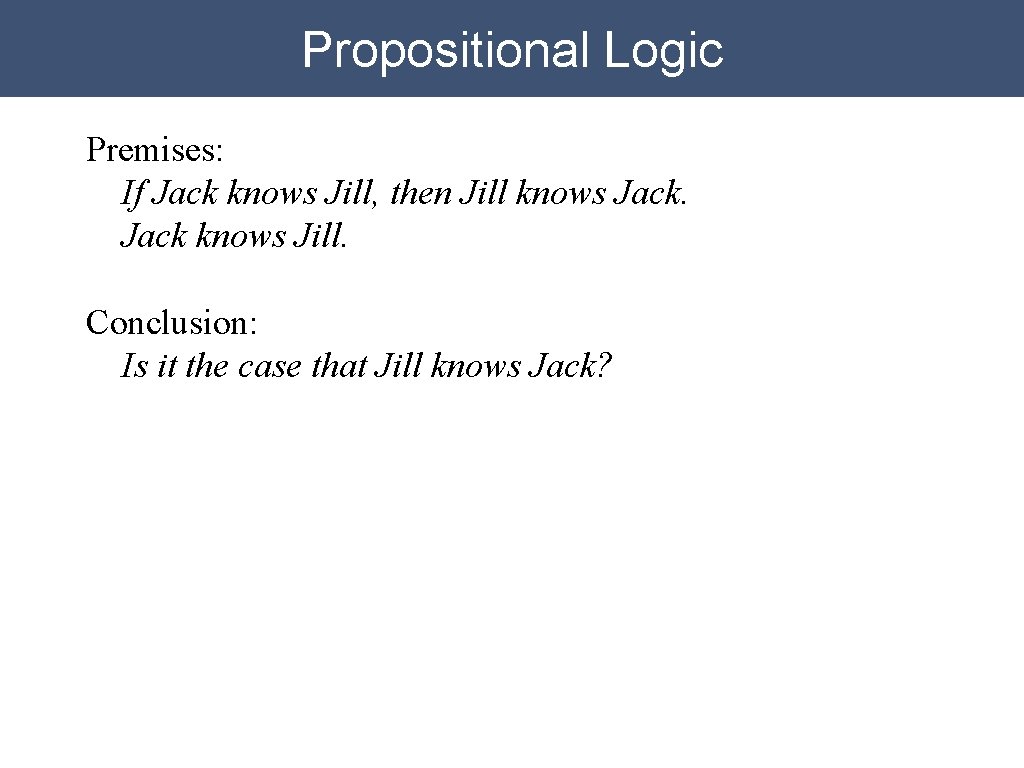
Propositional Logic Premises: If Jack knows Jill, then Jill knows Jack knows Jill. Conclusion: Is it the case that Jill knows Jack?
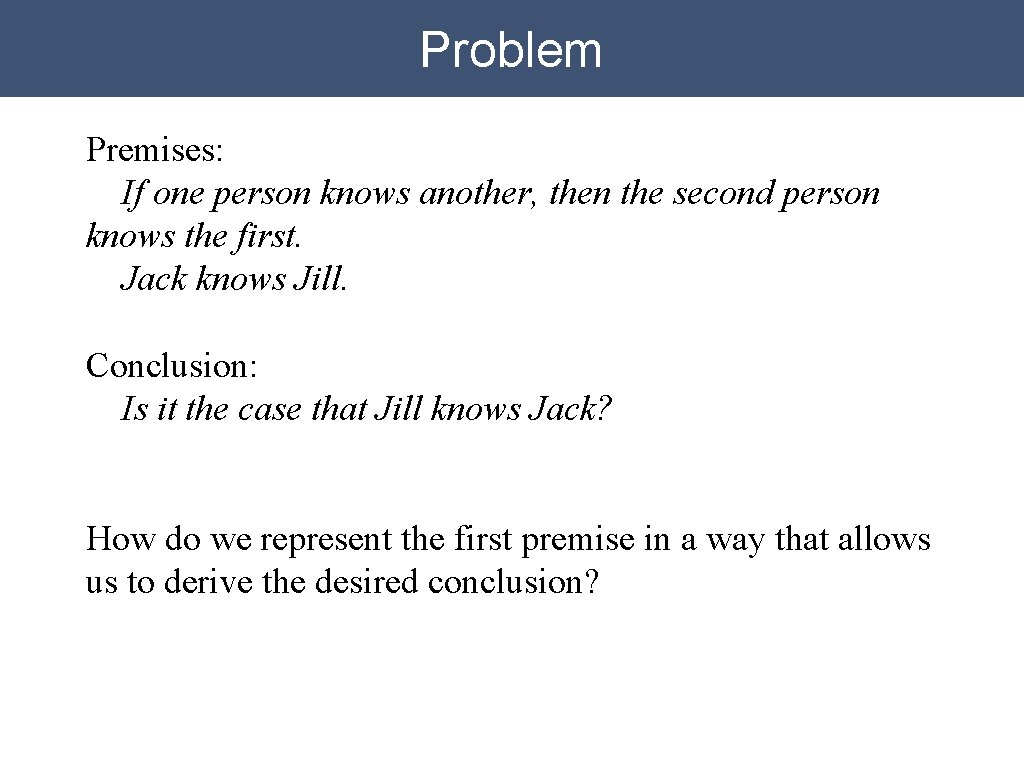
Problem Premises: If one person knows another, then the second person knows the first. Jack knows Jill. Conclusion: Is it the case that Jill knows Jack? How do we represent the first premise in a way that allows us to derive the desired conclusion?
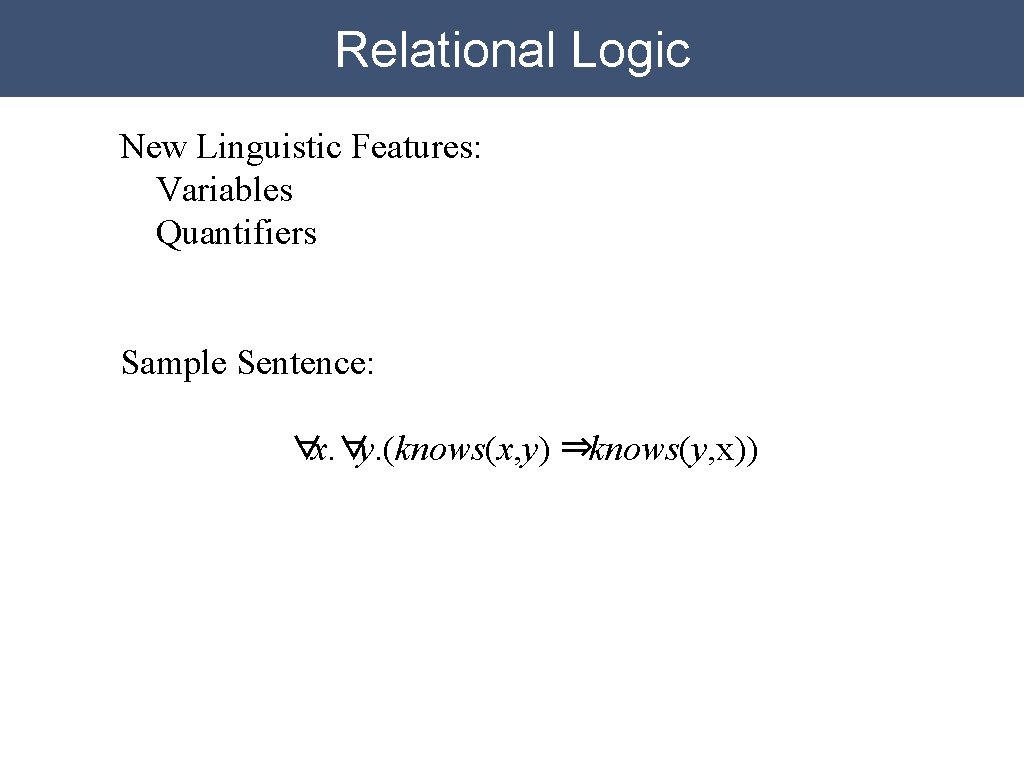
Relational Logic New Linguistic Features: Variables Quantifiers Sample Sentence: ∀x. ∀y. (knows(x, y) ⇒knows(y, x))
Programme Syntax Semantics Examples, Examples Properties of Sentences Logical Entailment Decidability
Syntax
Components of Language Words a, b, g, p Terms g(a, a) Sentences ∀x. (p(x) ⇒p(x, g(x, x)))
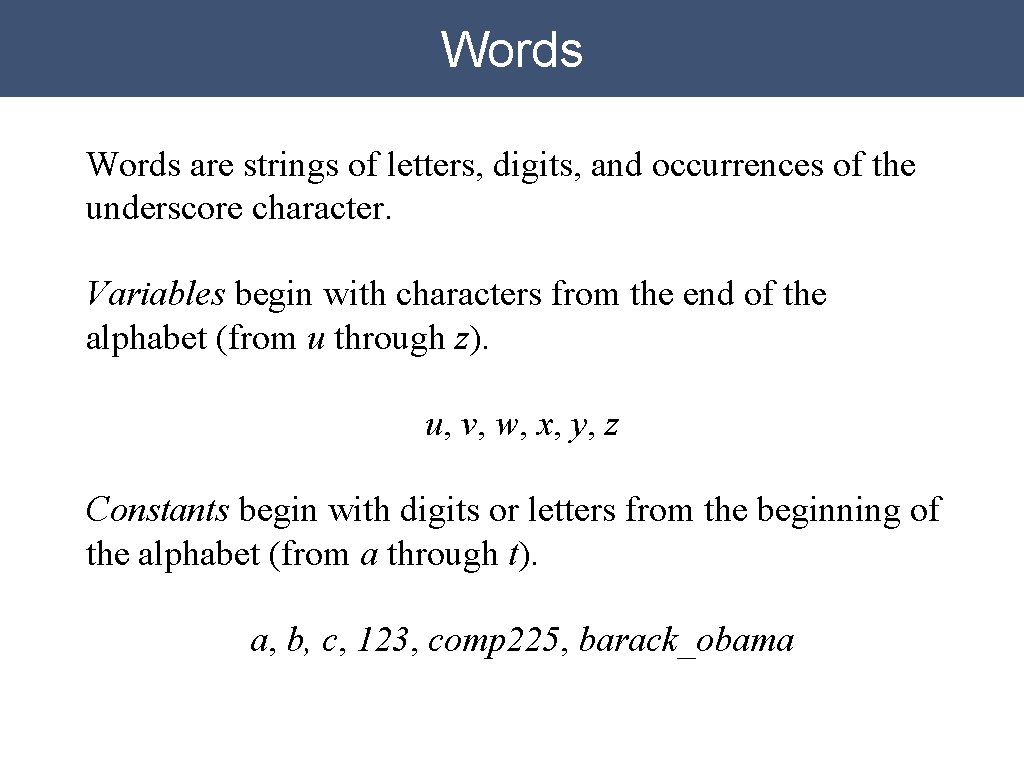
Words are strings of letters, digits, and occurrences of the underscore character. Variables begin with characters from the end of the alphabet (from u through z). u, v, w, x, y, z Constants begin with digits or letters from the beginning of the alphabet (from a through t). a, b, c, 123, comp 225, barack_obama
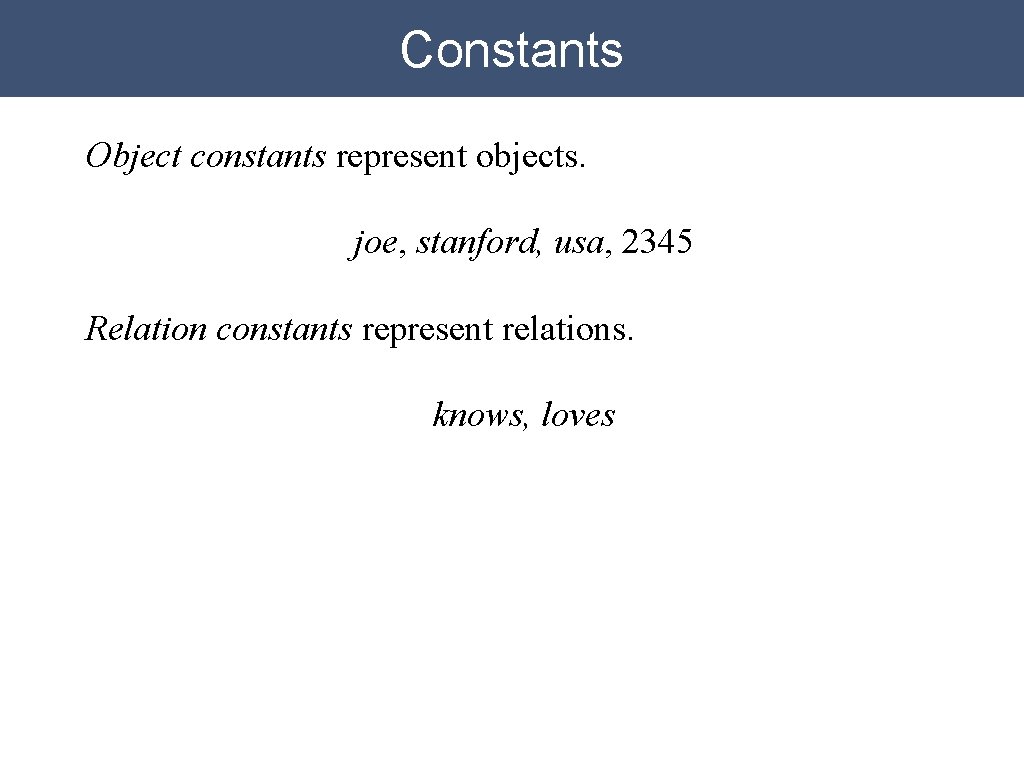
Constants Object constants represent objects. joe, stanford, usa, 2345 Relation constants represent relations. knows, loves
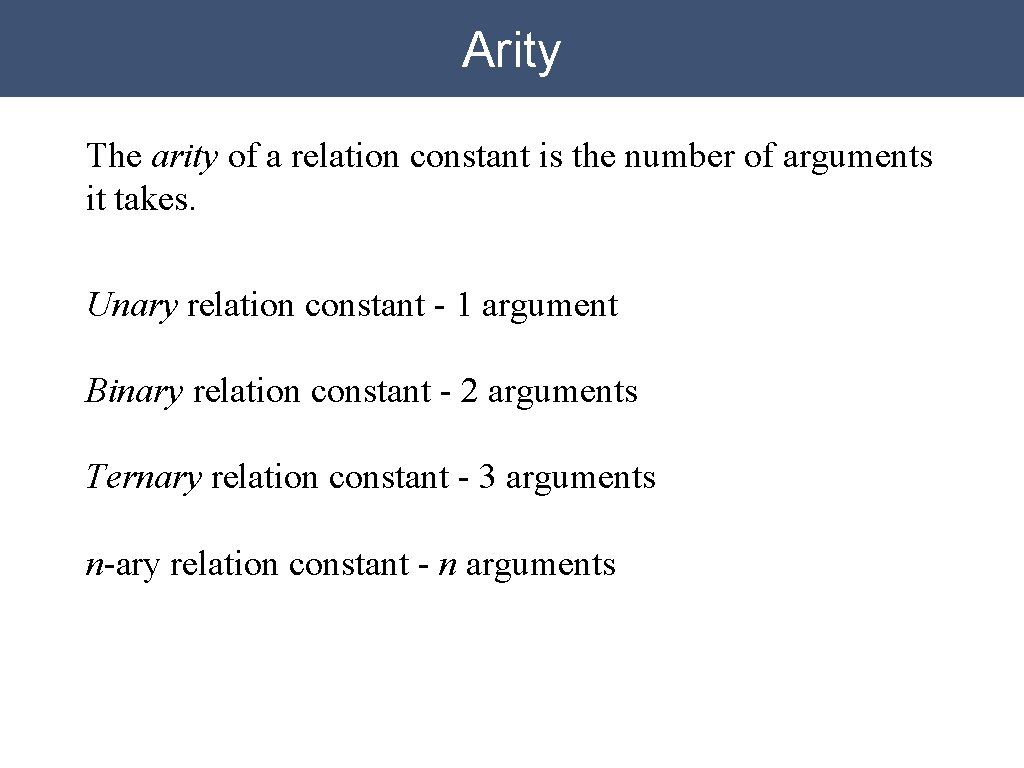
Arity The arity of a relation constant is the number of arguments it takes. Unary relation constant - 1 argument Binary relation constant - 2 arguments Ternary relation constant - 3 arguments n-ary relation constant - n arguments
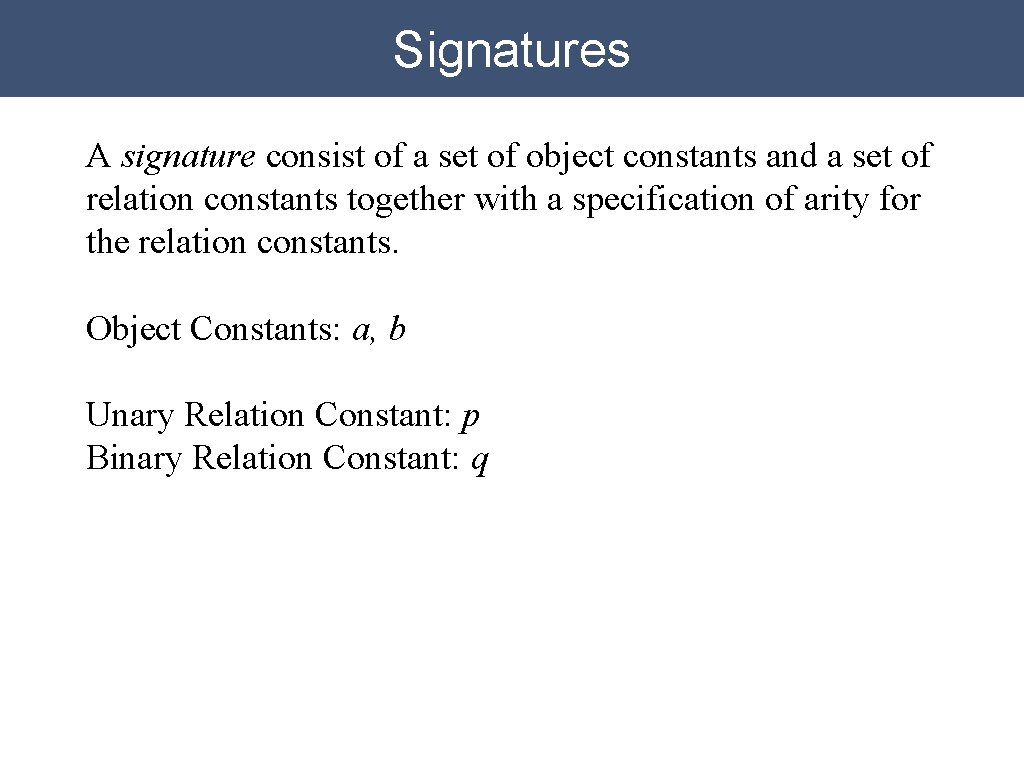
Signatures A signature consist of a set of object constants and a set of relation constants together with a specification of arity for the relation constants. Object Constants: a, b Unary Relation Constant: p Binary Relation Constant: q
Terms A term is either a variable or an object constant, . Terms represent objects. Terms are analogous to noun phrases in natural language.
Sentences Three types of sentences in Relational Logic: Relational sentences - analogous to the simple sentences in natural language Logical sentences - analogous to the logical sentences in natural language Quantified sentences - sentences that express the significance of variables
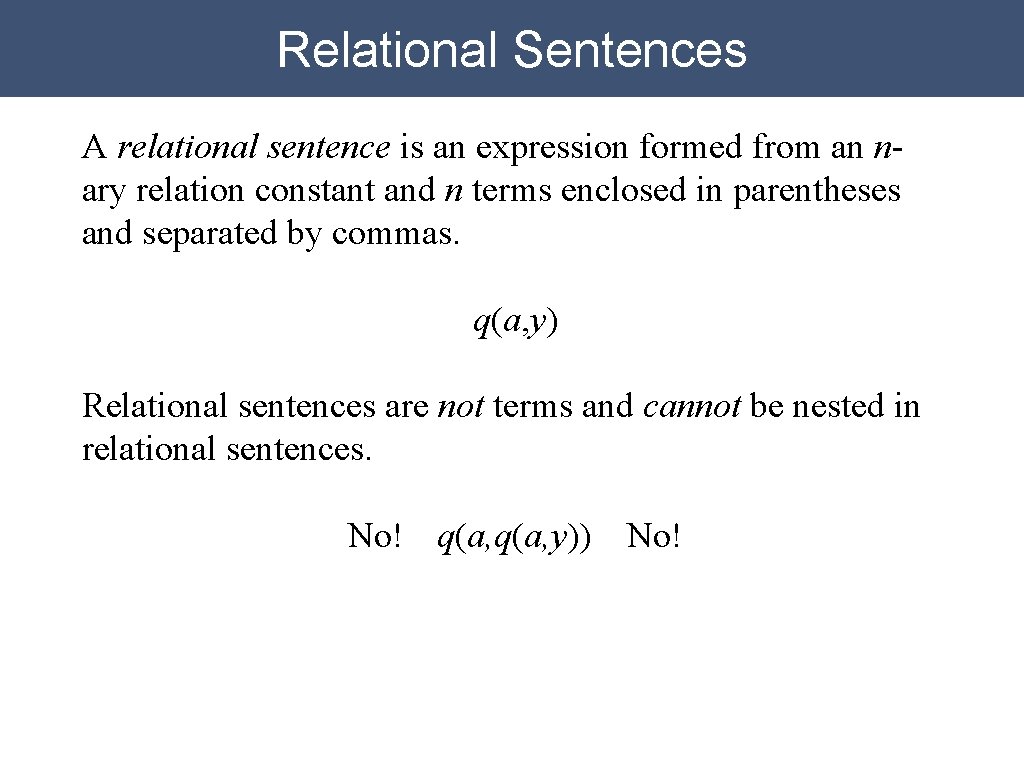
Relational Sentences A relational sentence is an expression formed from an nary relation constant and n terms enclosed in parentheses and separated by commas. q(a, y) Relational sentences are not terms and cannot be nested in relational sentences. No! q(a, y)) No!
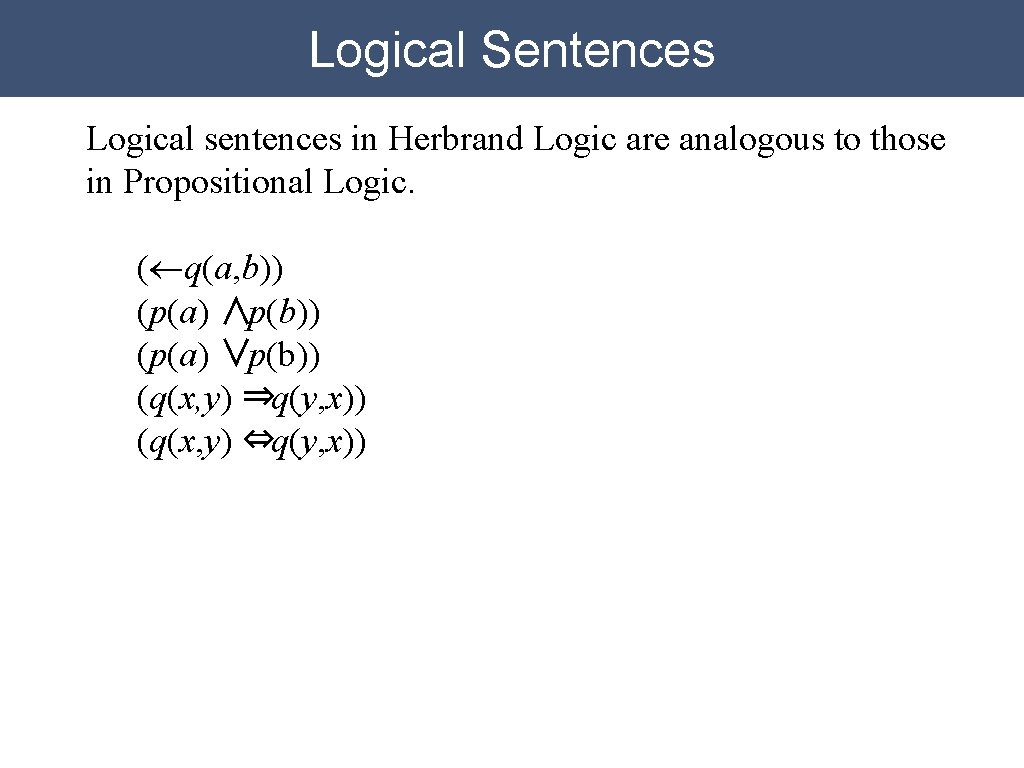
Logical Sentences Logical sentences in Herbrand Logic are analogous to those in Propositional Logic. (¬q(a, b)) (p(a) ∧p(b)) (p(a) ∨p(b)) (q(x, y) ⇒q(y, x)) (q(x, y) ⇔q(y, x))
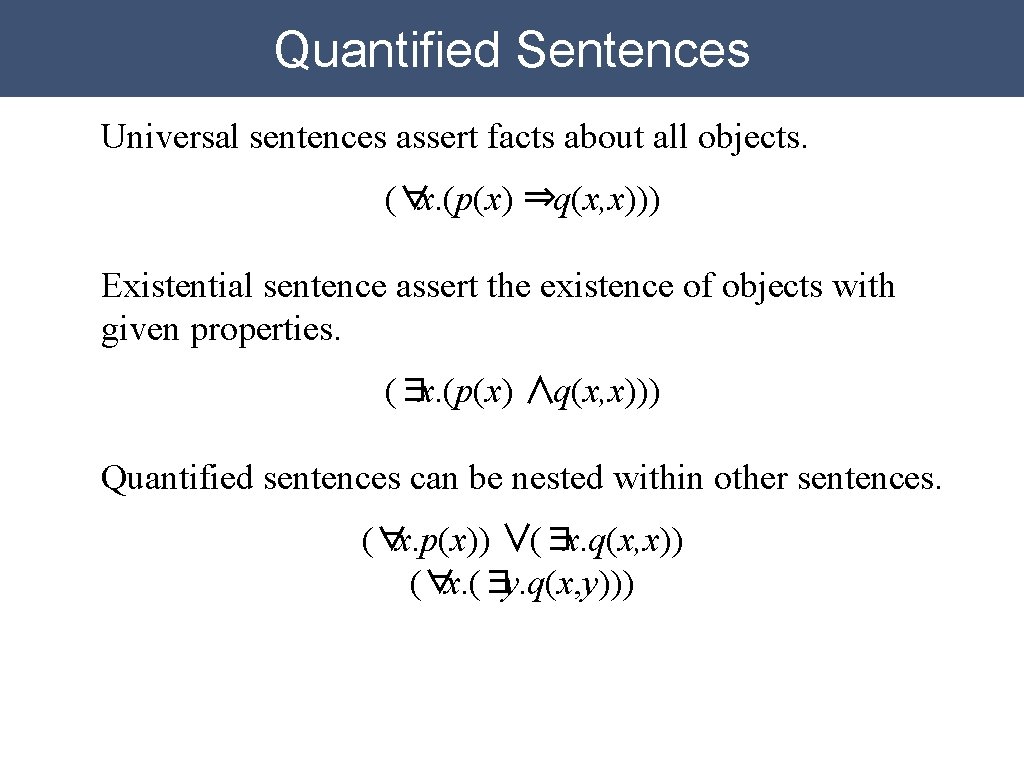
Quantified Sentences Universal sentences assert facts about all objects. (∀x. (p(x) ⇒q(x, x))) Existential sentence assert the existence of objects with given properties. (∃x. (p(x) ∧q(x, x))) Quantified sentences can be nested within other sentences. (∀x. p(x)) ∨(∃x. q(x, x)) (∀x. (∃y. q(x, y)))
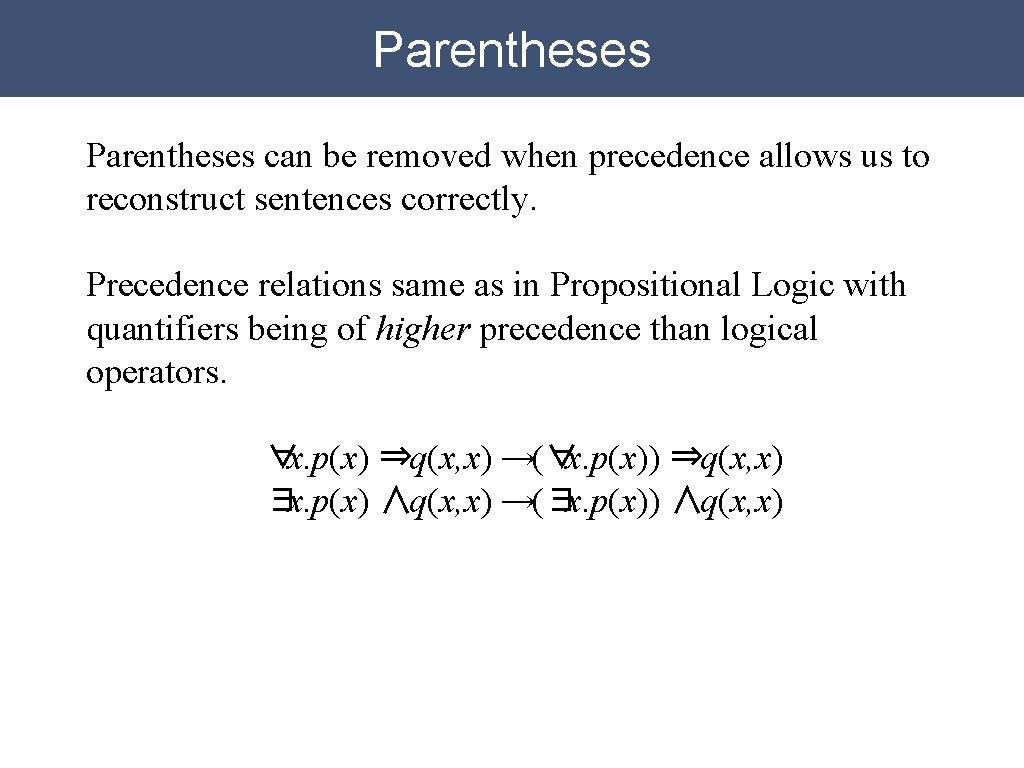
Parentheses can be removed when precedence allows us to reconstruct sentences correctly. Precedence relations same as in Propositional Logic with quantifiers being of higher precedence than logical operators. ∀x. p(x) ⇒q(x, x) →(∀x. p(x)) ⇒q(x, x) ∃x. p(x) ∧q(x, x) →(∃x. p(x)) ∧q(x, x)
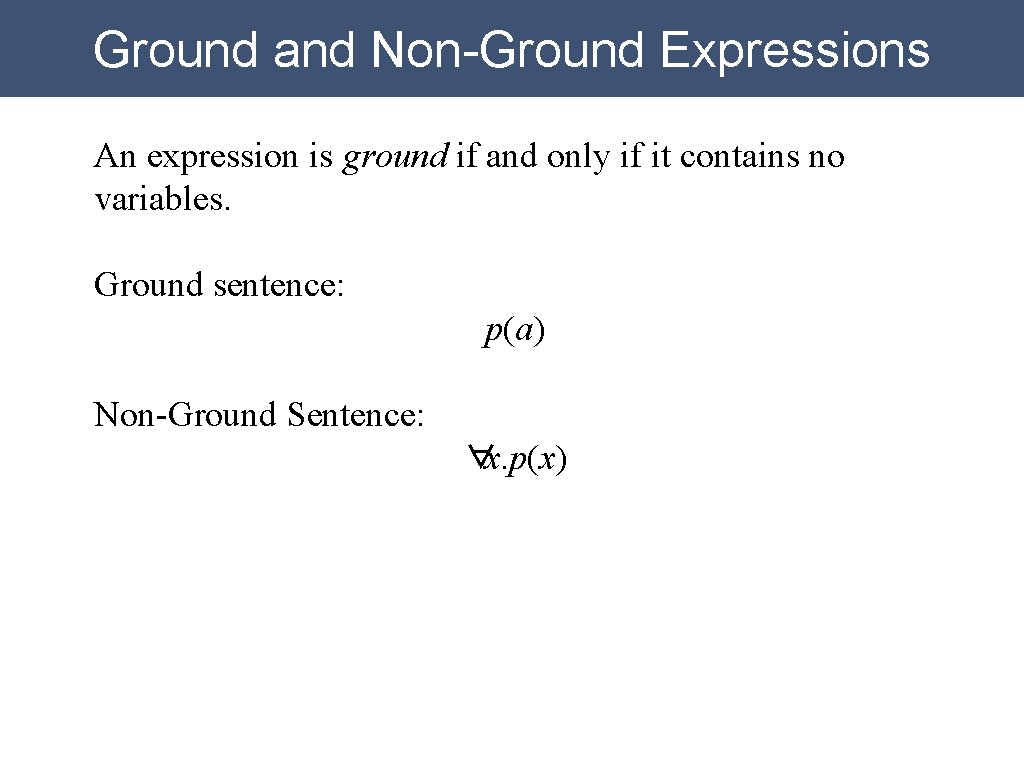
Ground and Non-Ground Expressions An expression is ground if and only if it contains no variables. Ground sentence: p(a) Non-Ground Sentence: ∀x. p(x)
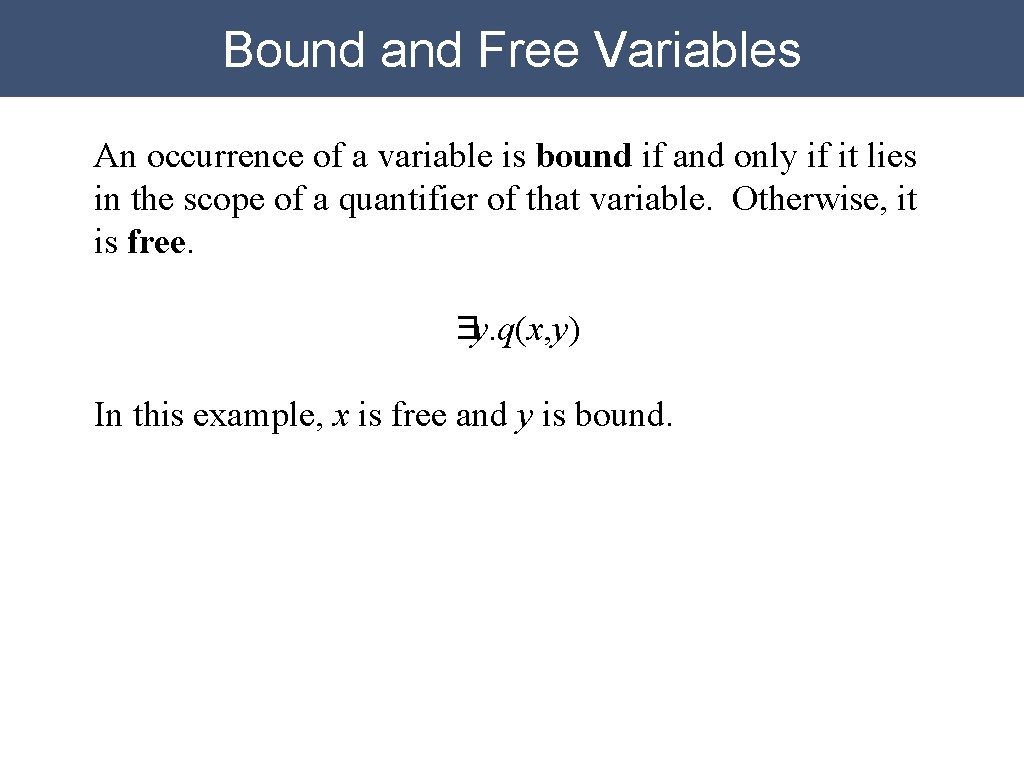
Bound and Free Variables An occurrence of a variable is bound if and only if it lies in the scope of a quantifier of that variable. Otherwise, it is free. ∃y. q(x, y) In this example, x is free and y is bound.
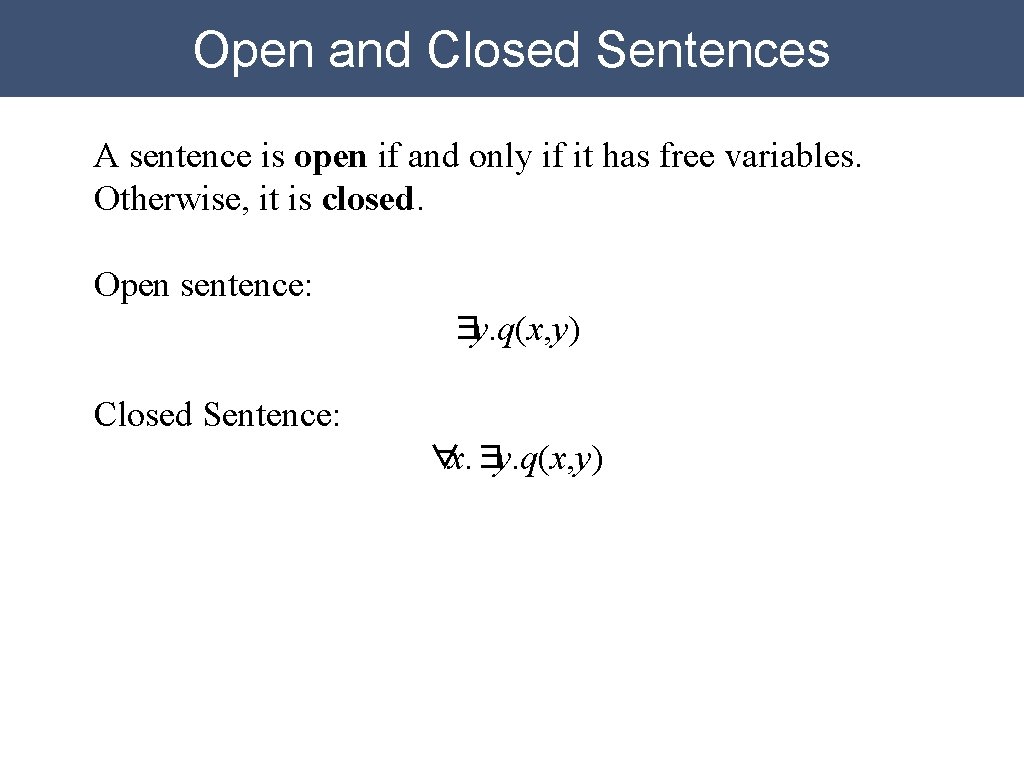
Open and Closed Sentences A sentence is open if and only if it has free variables. Otherwise, it is closed. Open sentence: ∃y. q(x, y) Closed Sentence: ∀x. ∃y. q(x, y)
Semantics
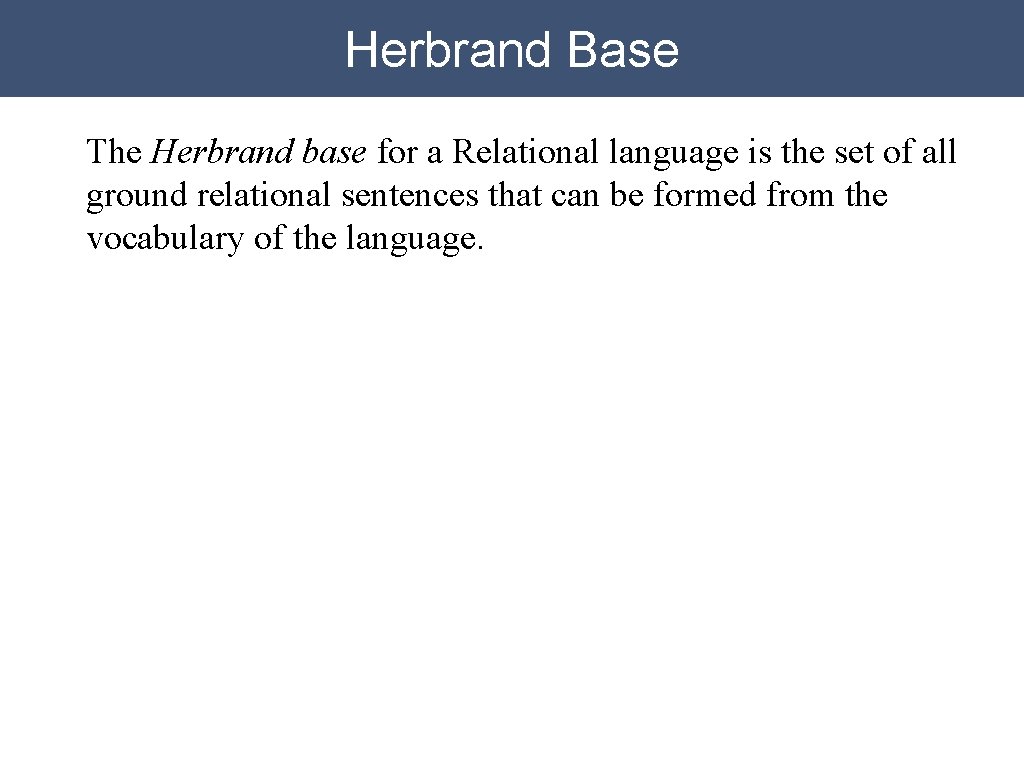
Herbrand Base The Herbrand base for a Relational language is the set of all ground relational sentences that can be formed from the vocabulary of the language.
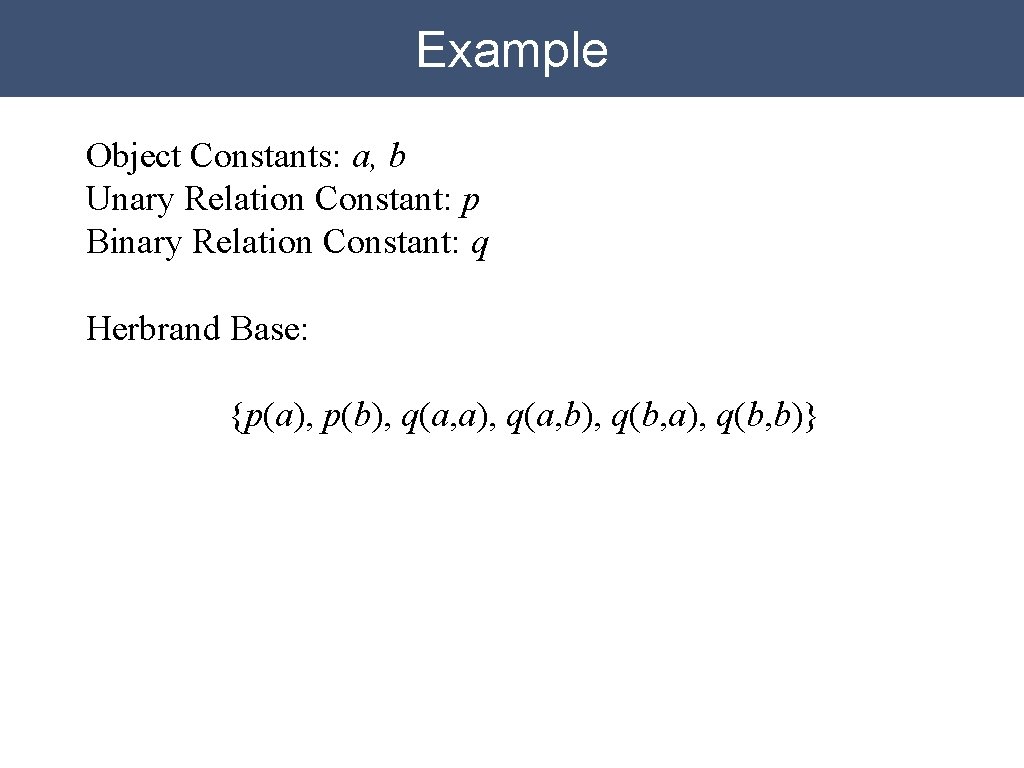
Example Object Constants: a, b Unary Relation Constant: p Binary Relation Constant: q Herbrand Base: {p(a), p(b), q(a, a), q(a, b), q(b, a), q(b, b)}
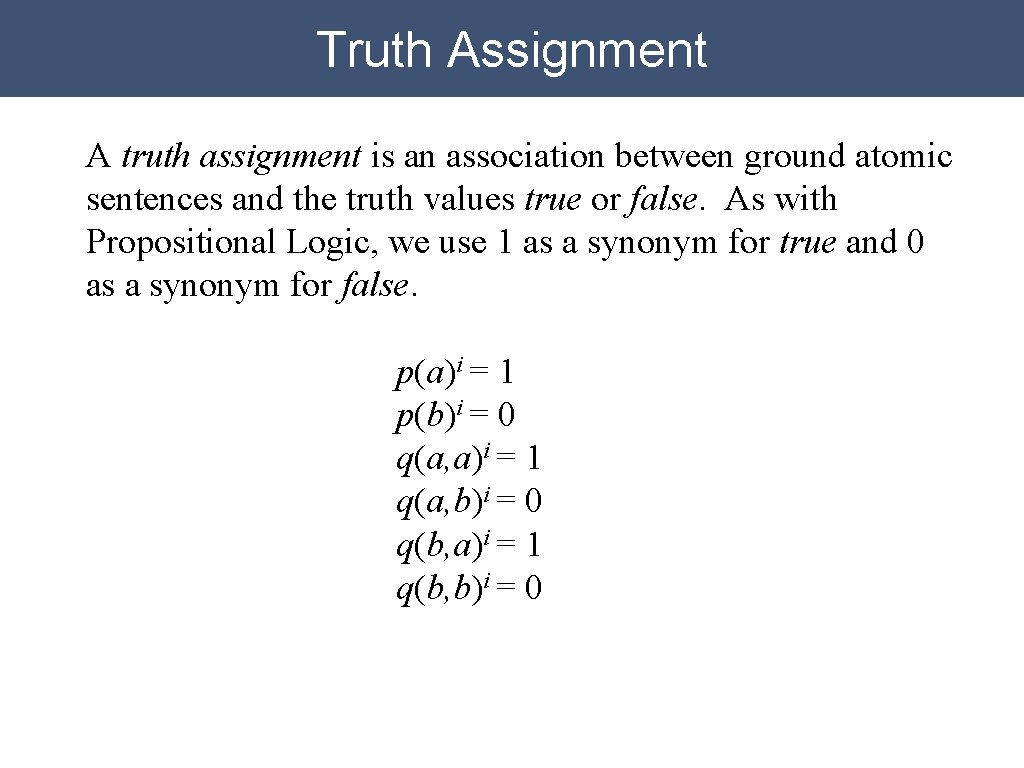
Truth Assignment A truth assignment is an association between ground atomic sentences and the truth values true or false. As with Propositional Logic, we use 1 as a synonym for true and 0 as a synonym for false. p(a)i = 1 p(b)i = 0 q(a, a)i = 1 q(a, b)i = 0 q(b, a)i = 1 q(b, b)i = 0
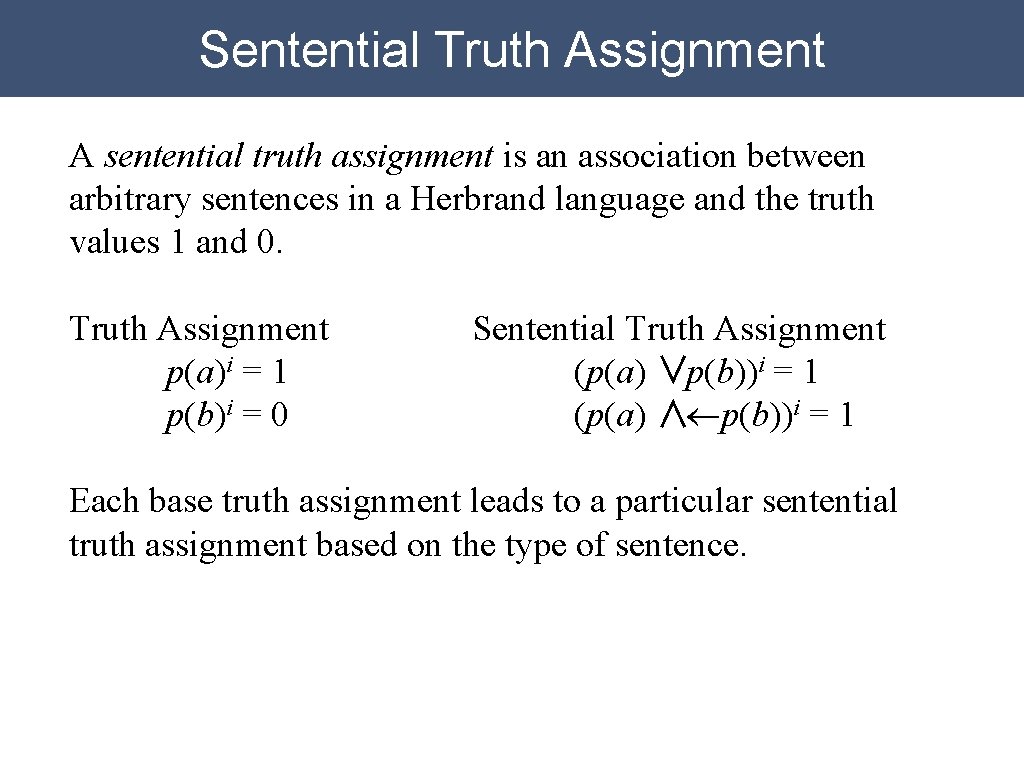
Sentential Truth Assignment A sentential truth assignment is an association between arbitrary sentences in a Herbrand language and the truth values 1 and 0. Truth Assignment p(a)i = 1 p(b)i = 0 Sentential Truth Assignment (p(a) ∨p(b))i = 1 (p(a) ∧¬p(b))i = 1 Each base truth assignment leads to a particular sentential truth assignment based on the type of sentence.
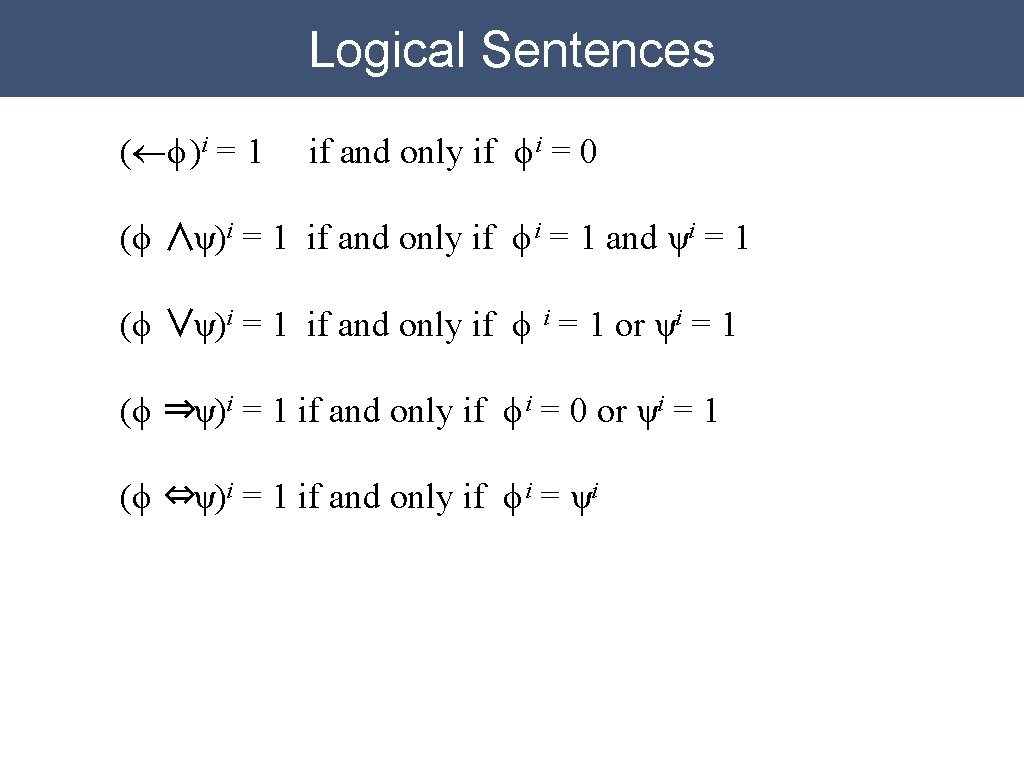
Logical Sentences (¬ϕ)i = 1 if and only if ϕ i = 0 (ϕ ∧ψ)i = 1 if and only if ϕ i = 1 and ψi = 1 (ϕ ∨ψ)i = 1 if and only if ϕ i = 1 or ψi = 1 (ϕ ⇒ψ)i = 1 if and only if ϕ i = 0 or ψi = 1 (ϕ ⇔ψ)i = 1 if and only if ϕ i = ψi
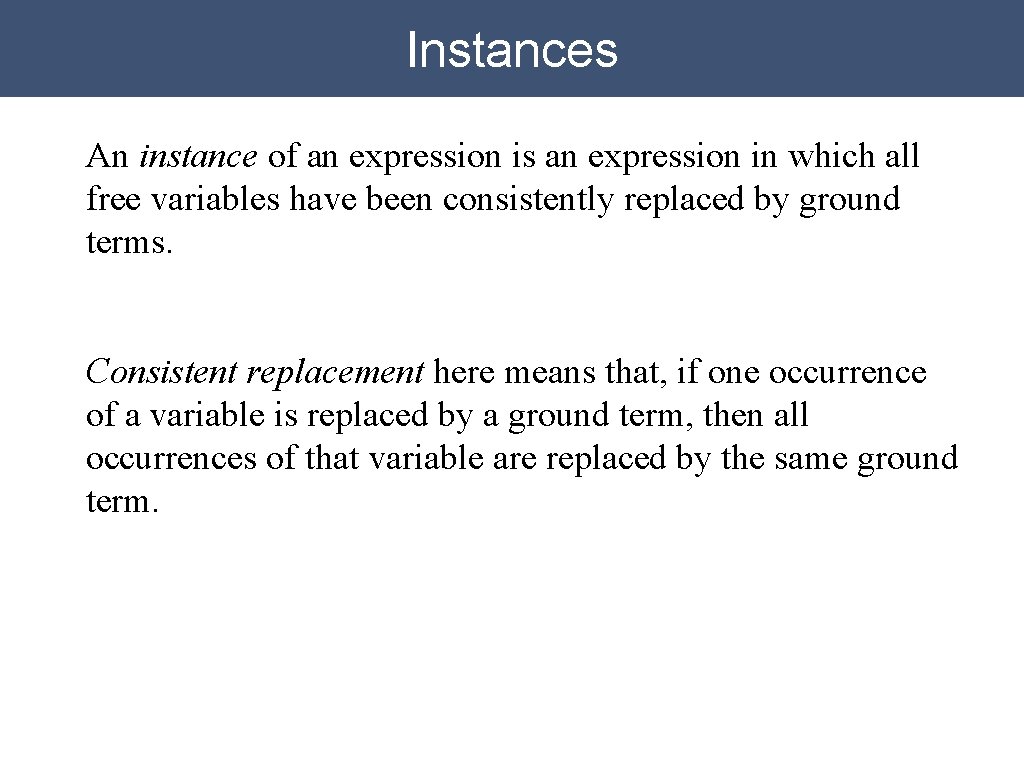
Instances An instance of an expression is an expression in which all free variables have been consistently replaced by ground terms. Consistent replacement here means that, if one occurrence of a variable is replaced by a ground term, then all occurrences of that variable are replaced by the same ground term.
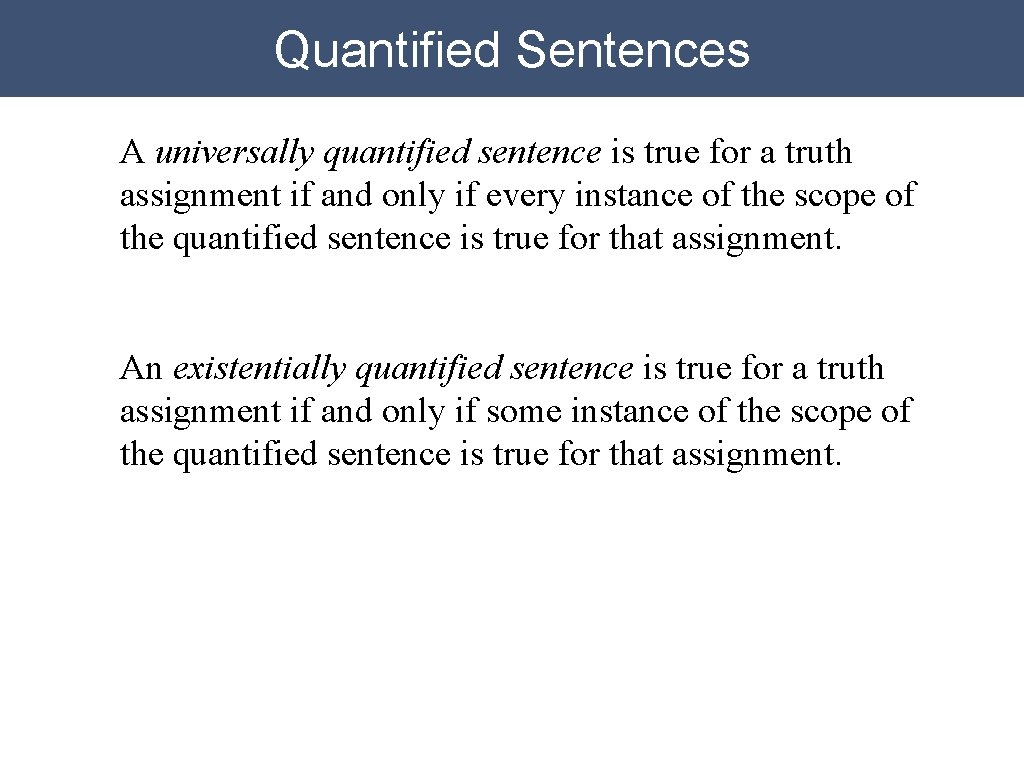
Quantified Sentences A universally quantified sentence is true for a truth assignment if and only if every instance of the scope of the quantified sentence is true for that assignment. An existentially quantified sentence is true for a truth assignment if and only if some instance of the scope of the quantified sentence is true for that assignment.
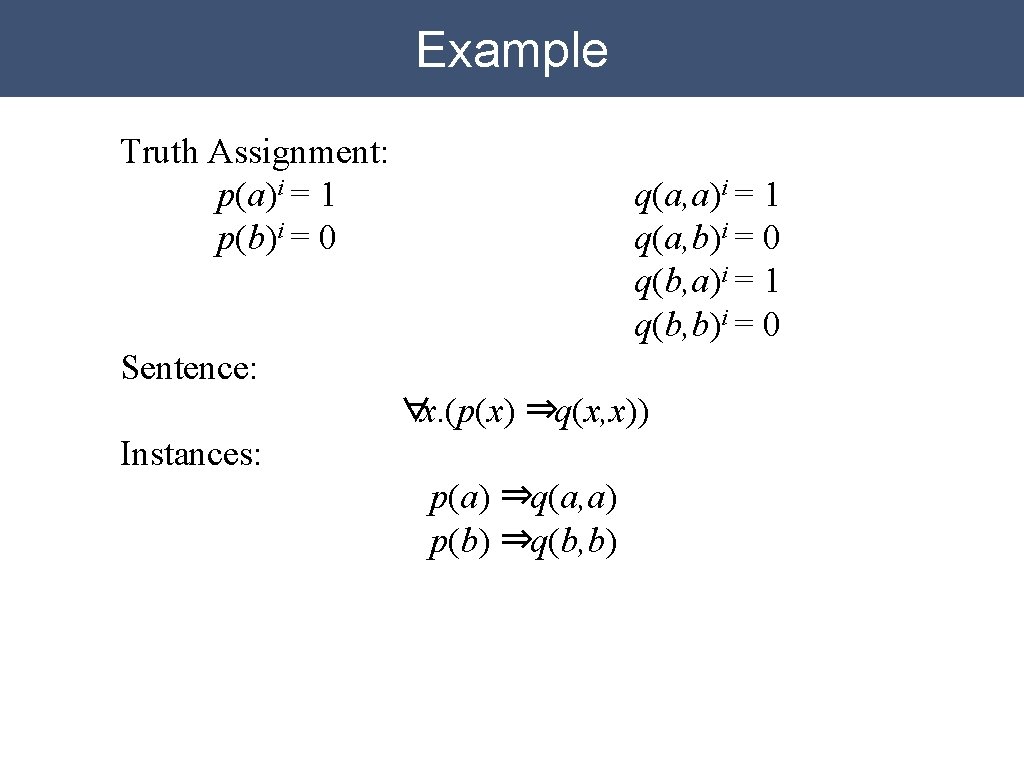
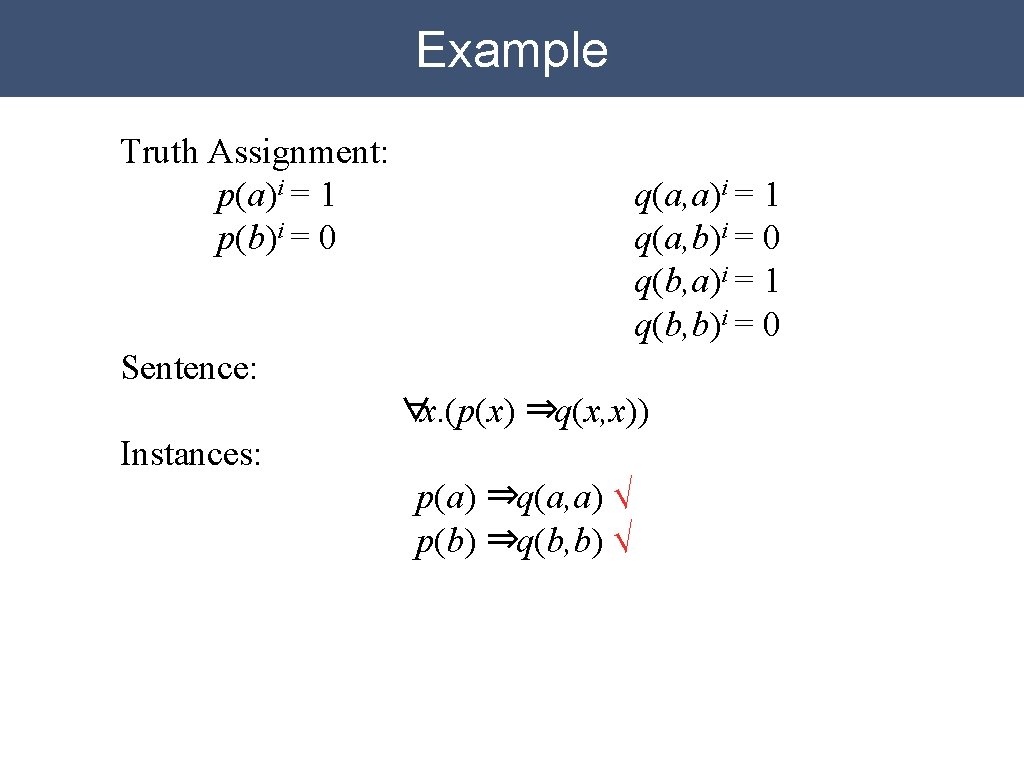
Example Truth Assignment: p(a)i = 1 p(b)i = 0 q(a, a)i = 1 q(a, b)i = 0 q(b, a)i = 1 q(b, b)i = 0 Sentence: ∀x. (p(x) ⇒q(x, x)) Instances: p(a) ⇒q(a, a) p(b) ⇒q(b, b)
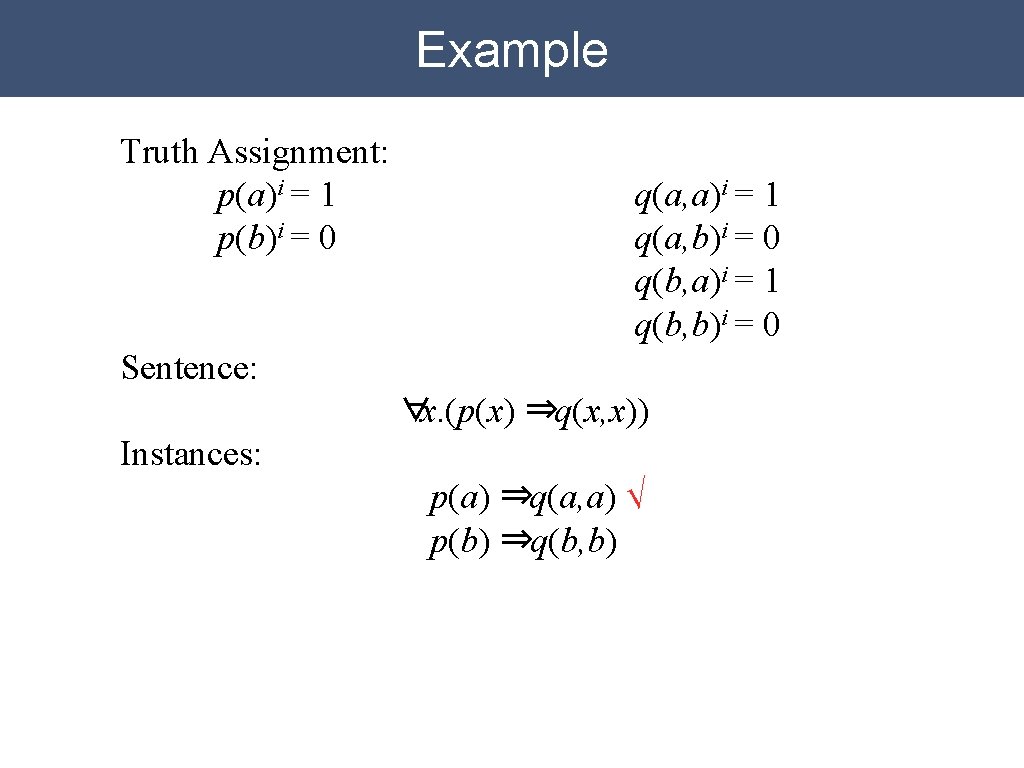
Example Truth Assignment: p(a)i = 1 p(b)i = 0 q(a, a)i = 1 q(a, b)i = 0 q(b, a)i = 1 q(b, b)i = 0 Sentence: ∀x. (p(x) ⇒q(x, x)) Instances: p(a) ⇒q(a, a) √ p(b) ⇒q(b, b)
Example Truth Assignment: p(a)i = 1 p(b)i = 0 q(a, a)i = 1 q(a, b)i = 0 q(b, a)i = 1 q(b, b)i = 0 Sentence: ∀x. (p(x) ⇒q(x, x)) Instances: p(a) ⇒q(a, a) √ p(b) ⇒q(b, b) √
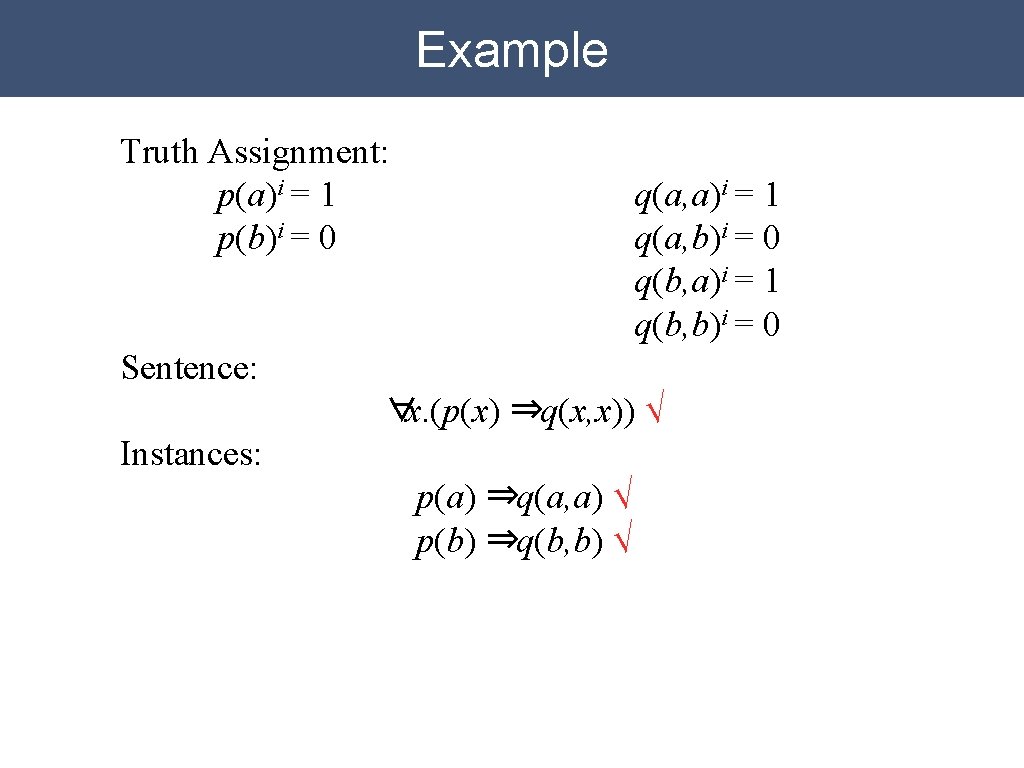
Example Truth Assignment: p(a)i = 1 p(b)i = 0 q(a, a)i = 1 q(a, b)i = 0 q(b, a)i = 1 q(b, b)i = 0 Sentence: ∀x. (p(x) ⇒q(x, x)) √ Instances: p(a) ⇒q(a, a) √ p(b) ⇒q(b, b) √
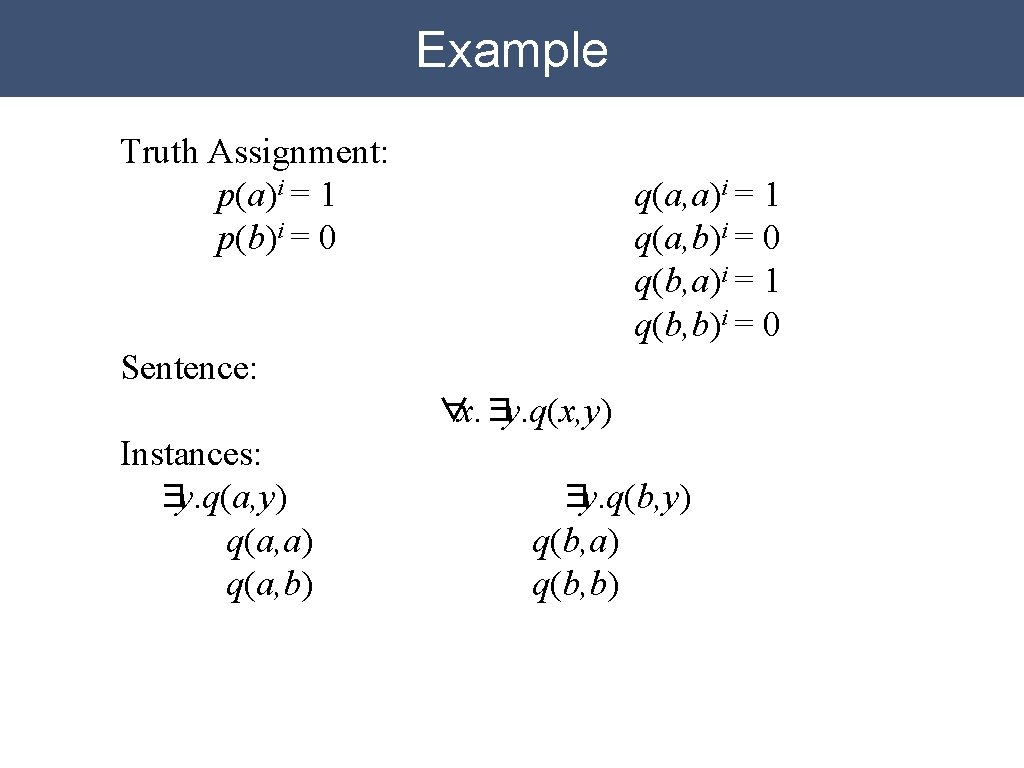
Example Truth Assignment: p(a)i = 1 p(b)i = 0 q(a, a)i = 1 q(a, b)i = 0 q(b, a)i = 1 q(b, b)i = 0 Sentence: ∀x. ∃y. q(x, y) Instances: ∃y. q(a, y) q(a, a) q(a, b) ∃y. q(b, y) q(b, a) q(b, b)
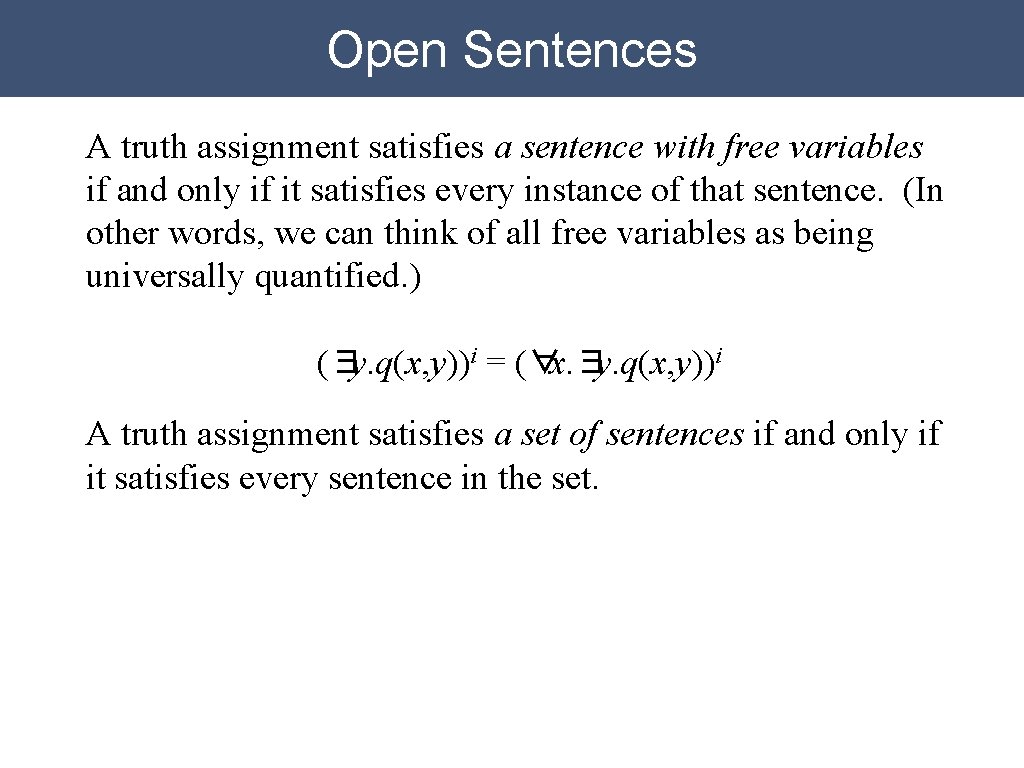
Open Sentences A truth assignment satisfies a sentence with free variables if and only if it satisfies every instance of that sentence. (In other words, we can think of all free variables as being universally quantified. ) (∃y. q(x, y))i = (∀x. ∃y. q(x, y))i A truth assignment satisfies a set of sentences if and only if it satisfies every sentence in the set.
Example - Sorority World
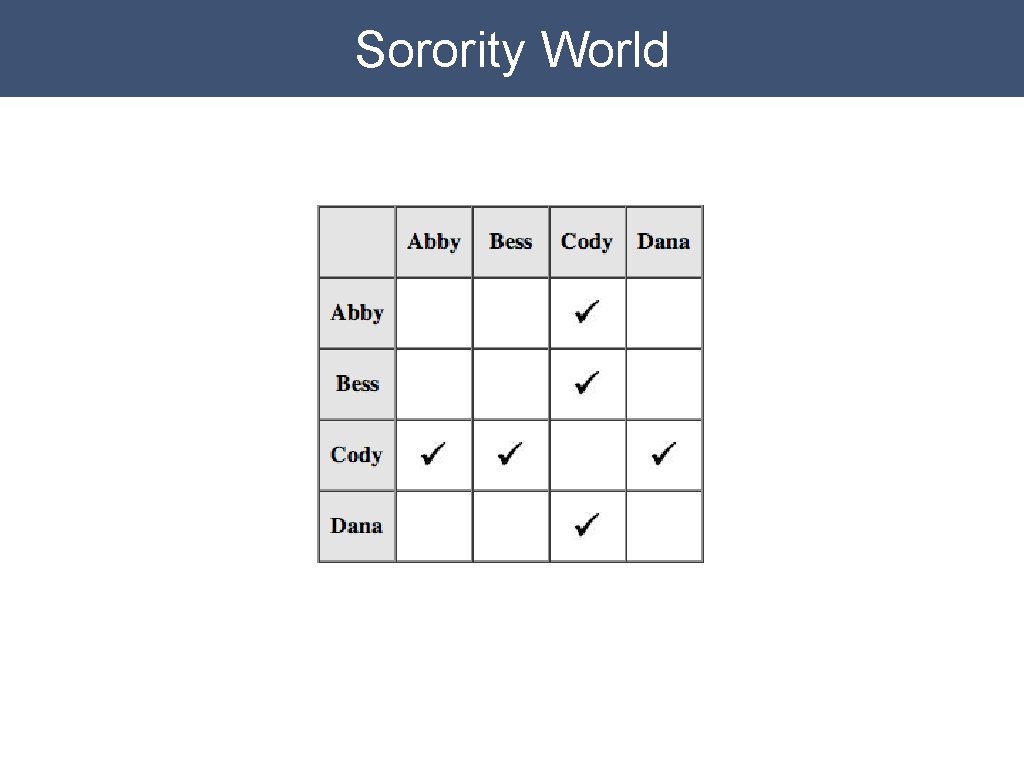
Sorority World
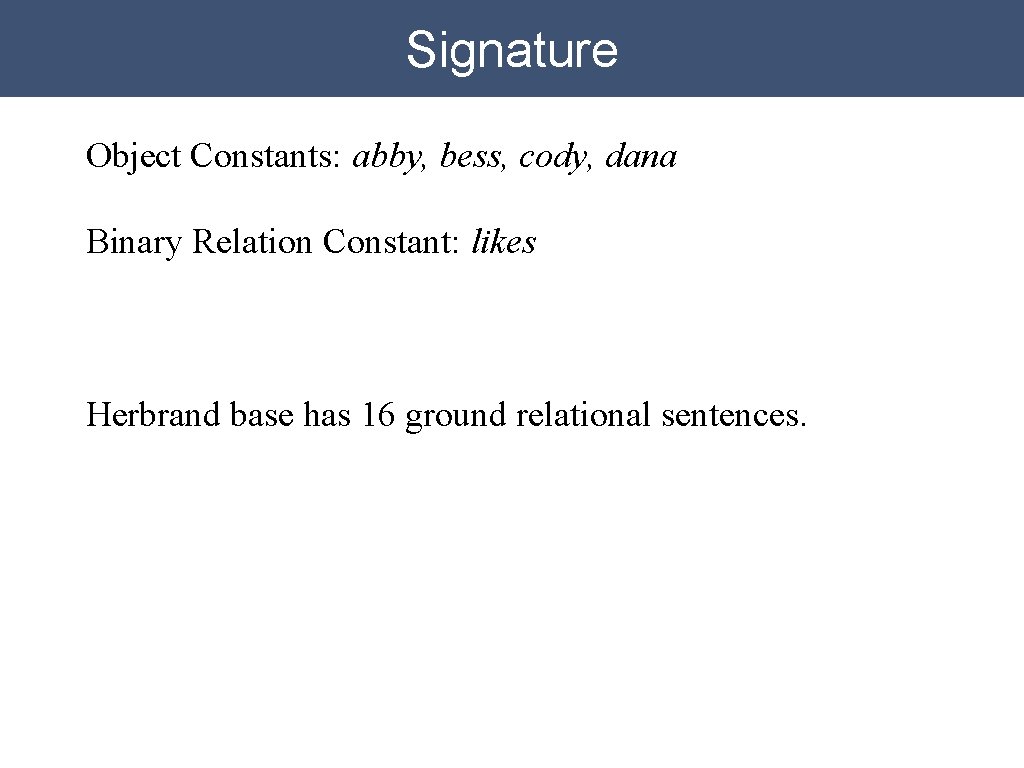
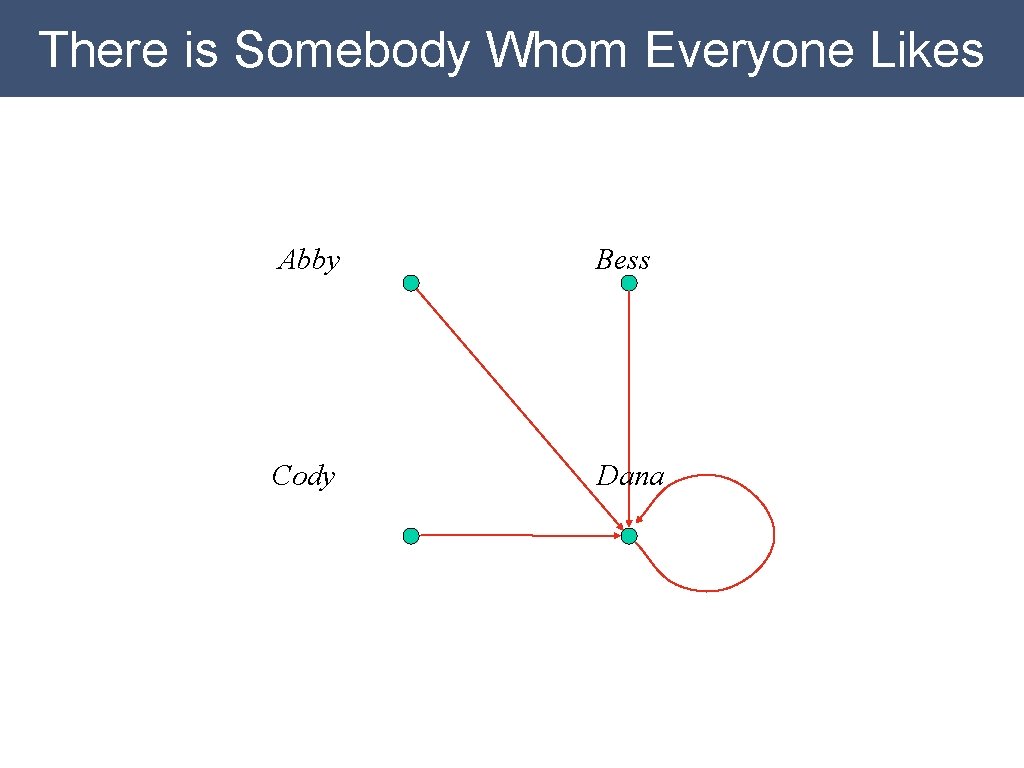
Signature Object Constants: abby, bess, cody, dana Binary Relation Constant: likes Herbrand base has 16 ground relational sentences.
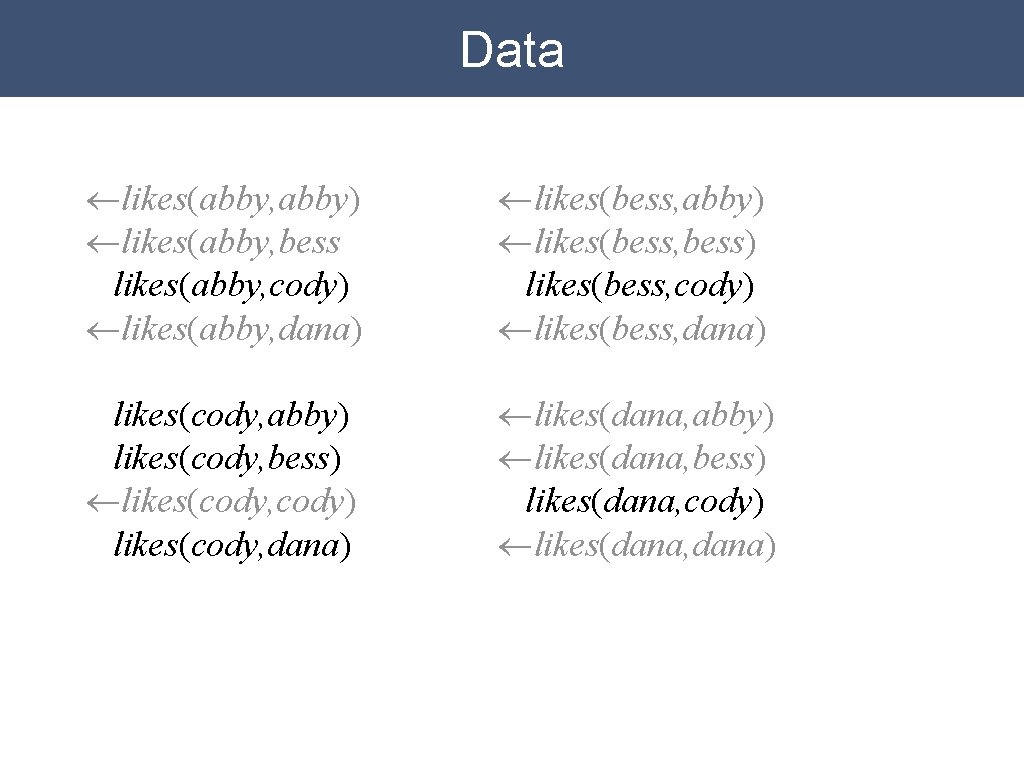
Data ¬likes(abby, abby) ¬likes(abby, bess likes(abby, cody) ¬likes(abby, dana) ¬likes(bess, abby) ¬likes(bess, bess) likes(bess, cody) ¬likes(bess, dana) likes(cody, abby) likes(cody, bess) ¬likes(cody, cody) likes(cody, dana) ¬likes(dana, abby) ¬likes(dana, bess) likes(dana, cody) ¬likes(dana, dana)
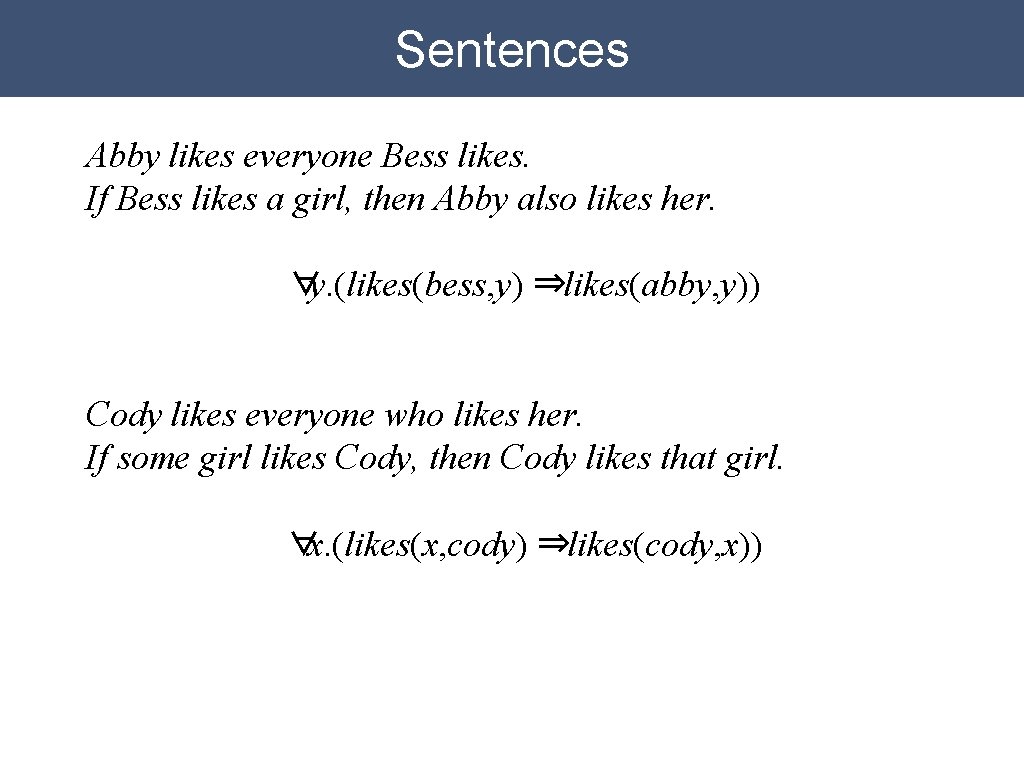
Sentences Abby likes everyone Bess likes. If Bess likes a girl, then Abby also likes her. ∀y. (likes(bess, y) ⇒likes(abby, y)) Cody likes everyone who likes her. If some girl likes Cody, then Cody likes that girl. ∀x. (likes(x, cody) ⇒likes(cody, x))
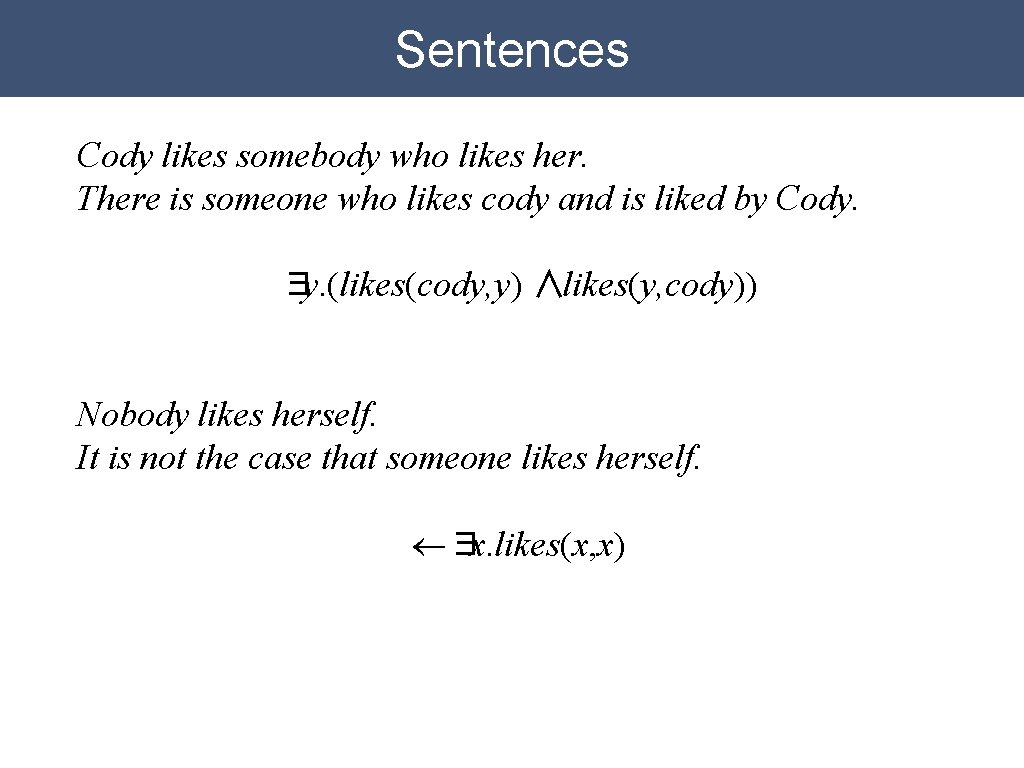
Sentences Cody likes somebody who likes her. There is someone who likes cody and is liked by Cody. ∃y. (likes(cody, y) ∧likes(y, cody)) Nobody likes herself. It is not the case that someone likes herself. ¬∃x. likes(x, x)
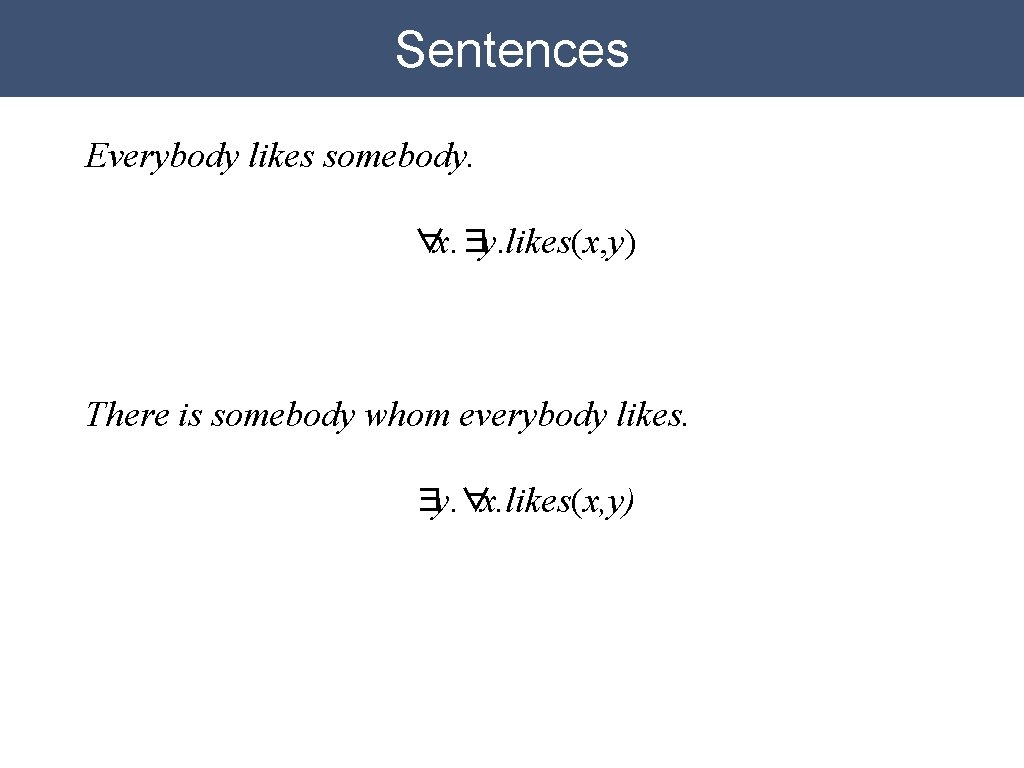
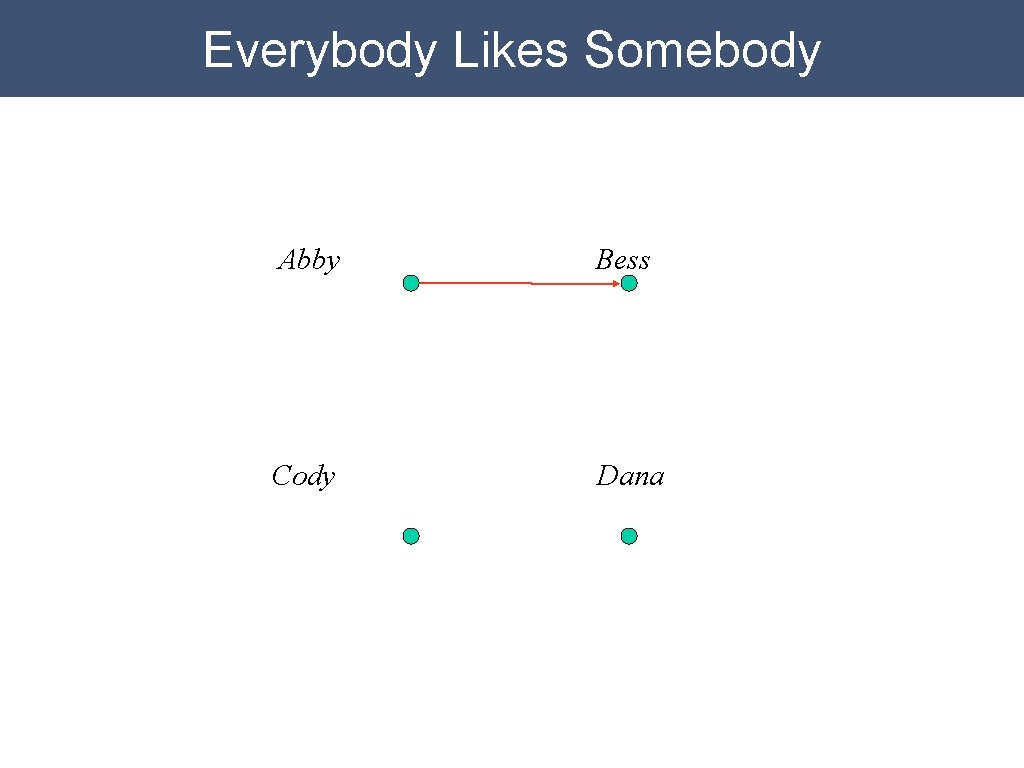
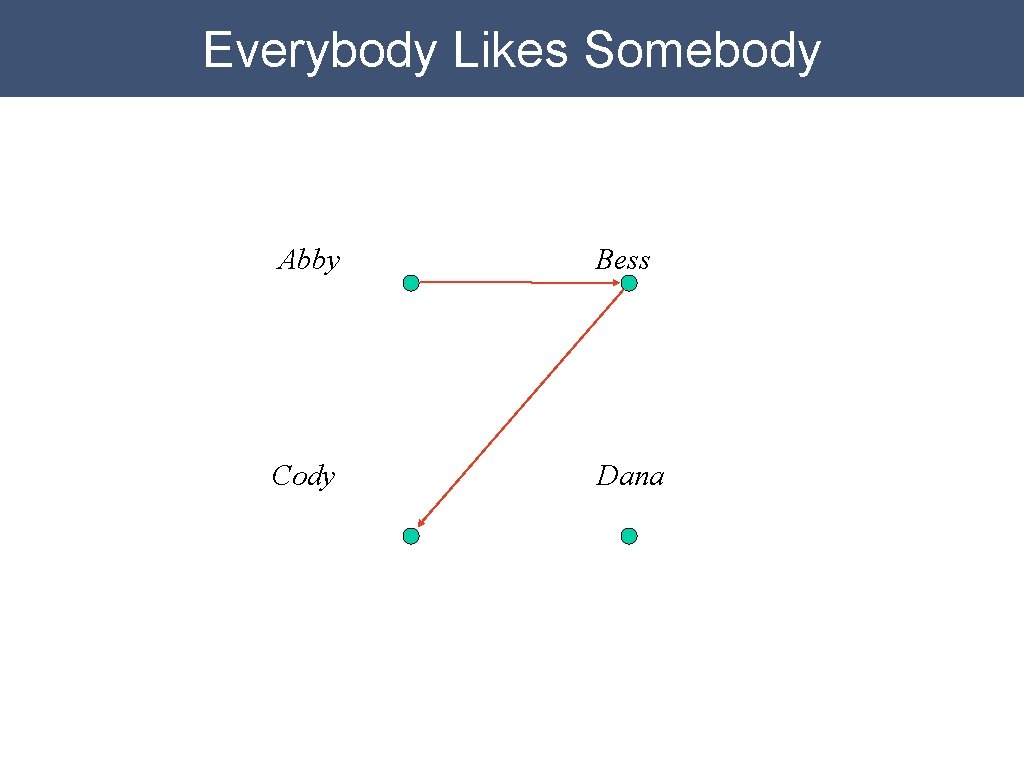
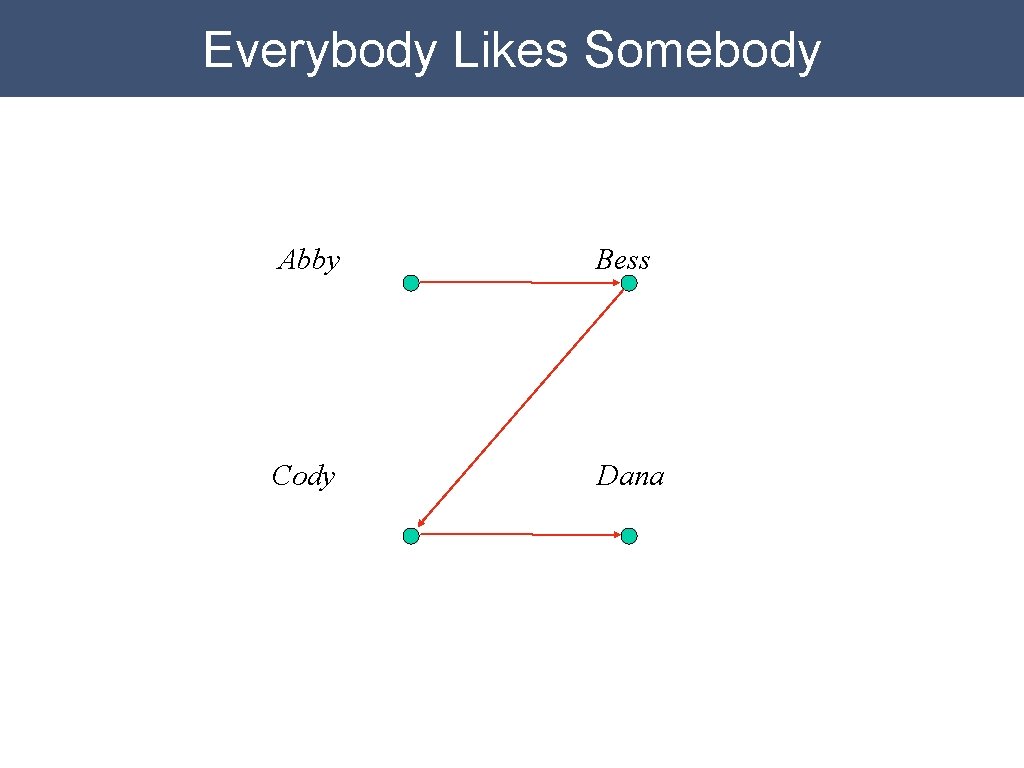
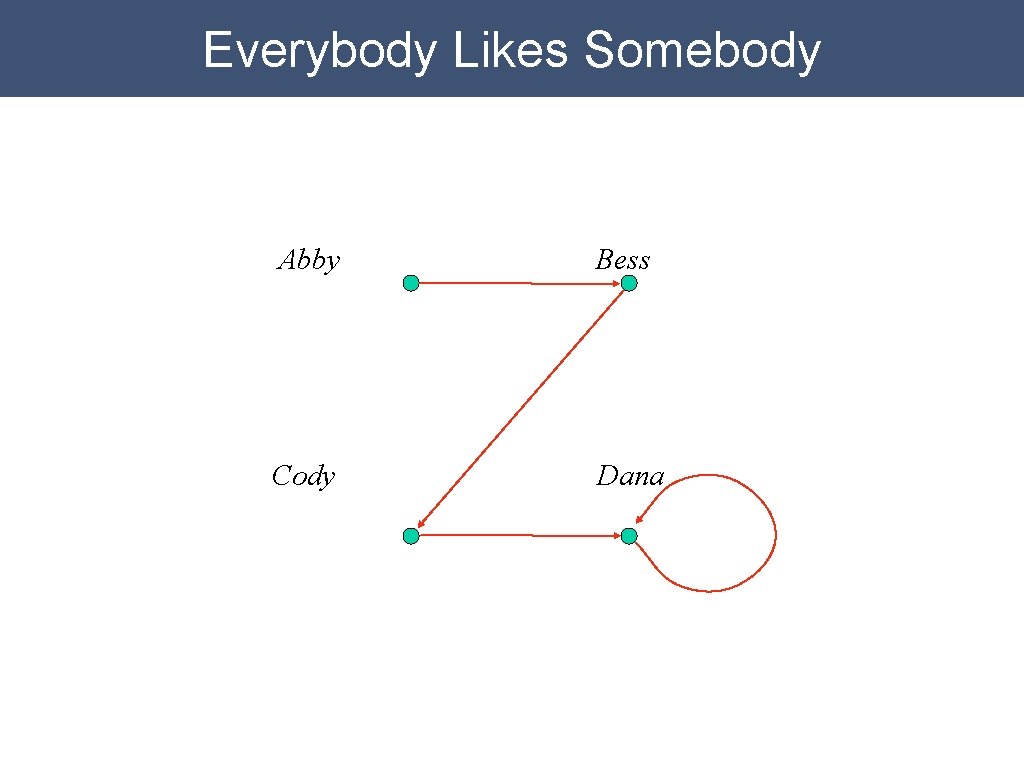
Sentences Everybody likes somebody. ∀x. ∃y. likes(x, y) There is somebody whom everybody likes. ∃y. ∀x. likes(x, y)
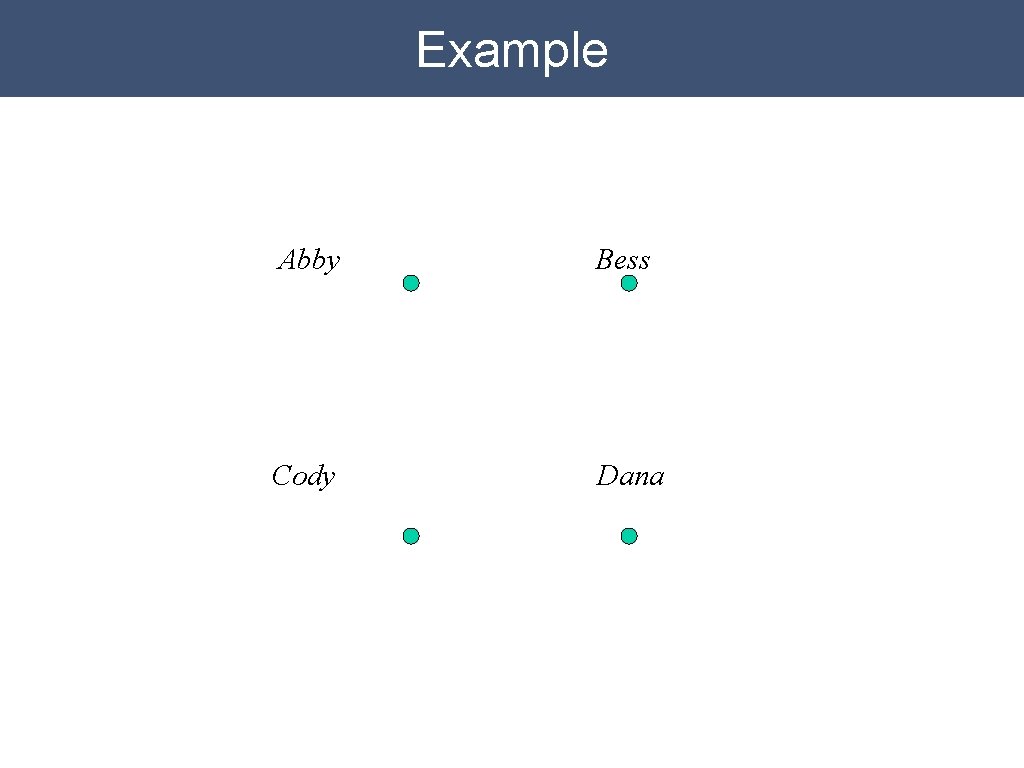
Example Abby Bess Cody Dana
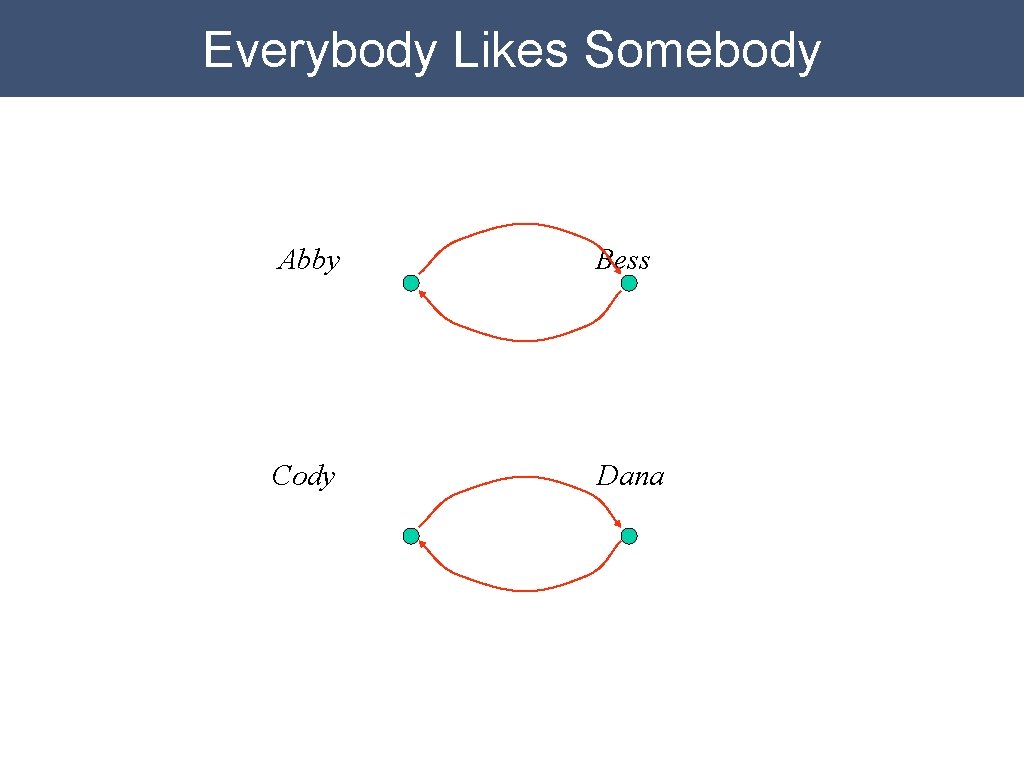
Everybody Likes Somebody Abby Bess Cody Dana
Everybody Likes Somebody Abby Bess Cody Dana
Everybody Likes Somebody Abby Bess Cody Dana
Everybody Likes Somebody Abby Bess Cody Dana
Everybody Likes Somebody Abby Bess Cody Dana
There is Somebody Whom Everyone Likes Abby Bess Cody Dana
Example - Blocks World
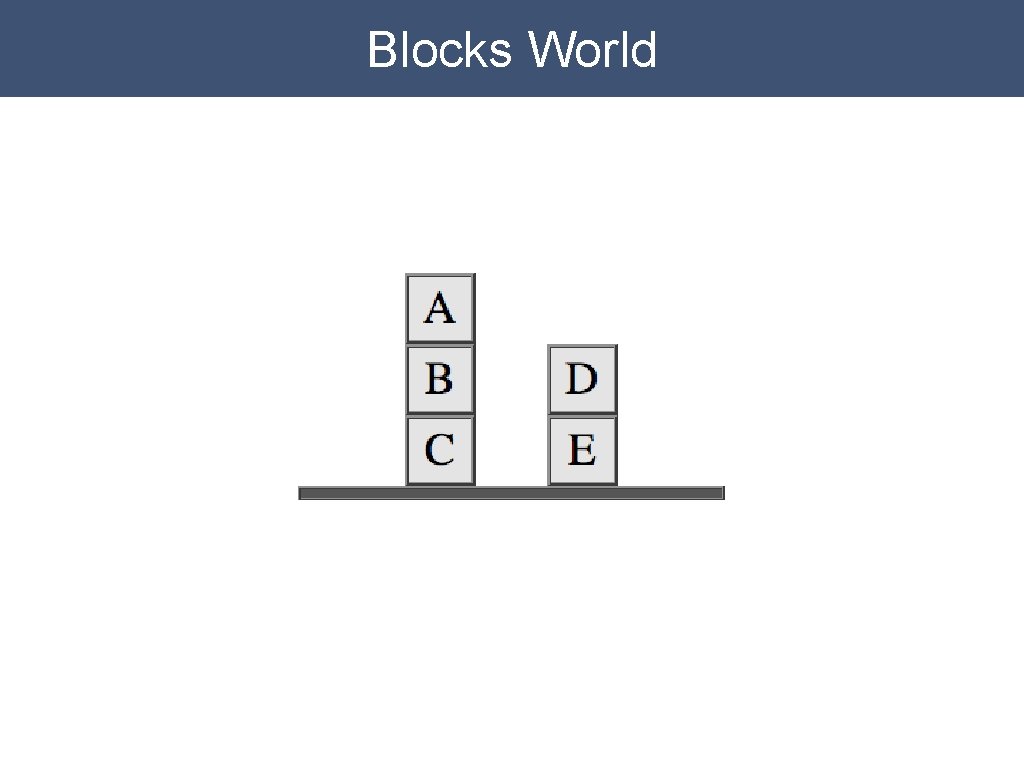
Blocks World
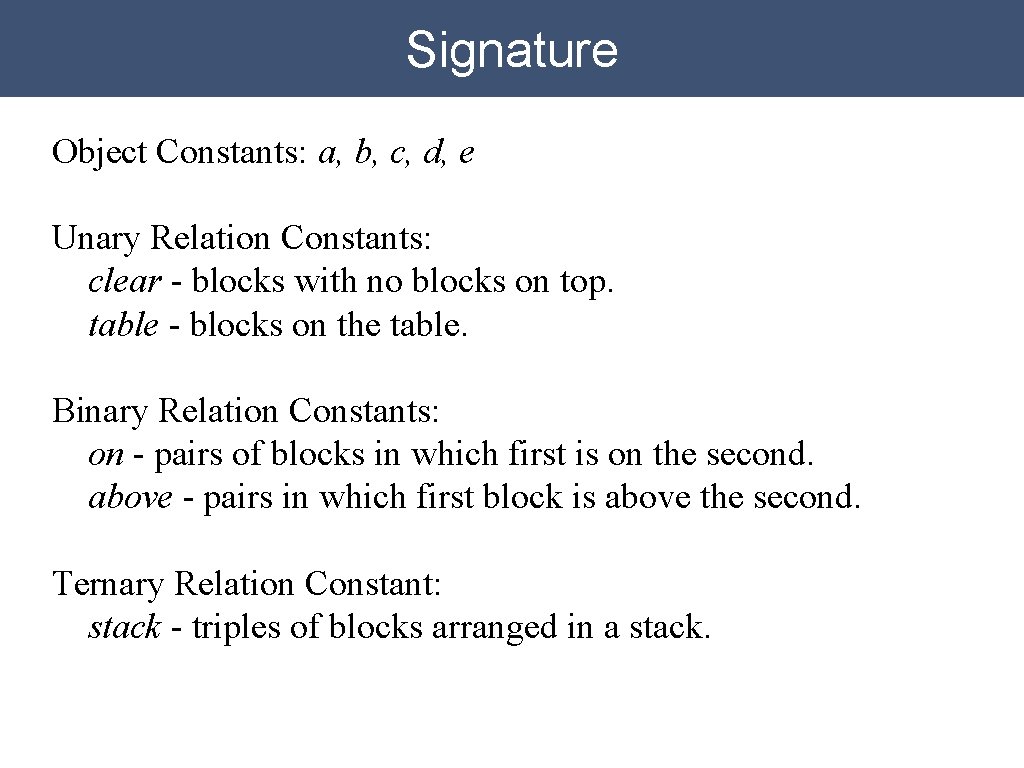
Signature Object Constants: a, b, c, d, e Unary Relation Constants: clear - blocks with no blocks on top. table - blocks on the table. Binary Relation Constants: on - pairs of blocks in which first is on the second. above - pairs in which first block is above the second. Ternary Relation Constant: stack - triples of blocks arranged in a stack.
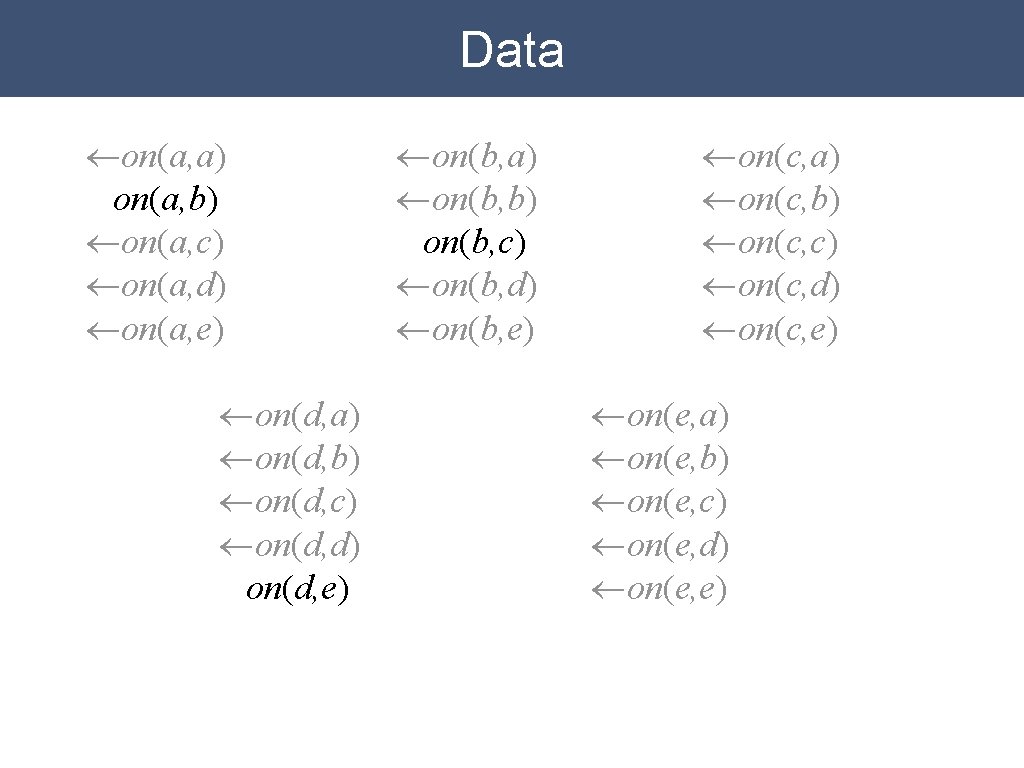
Data ¬on(a, a) on(a, b) ¬on(a, c) ¬on(a, d) ¬on(a, e) ¬on(d, a) ¬on(d, b) ¬on(d, c) ¬on(d, d) on(d, e) ¬on(b, a) ¬on(b, b) on(b, c) ¬on(b, d) ¬on(b, e) ¬on(c, a) ¬on(c, b) ¬on(c, c) ¬on(c, d) ¬on(c, e) ¬on(e, a) ¬on(e, b) ¬on(e, c) ¬on(e, d) ¬on(e, e)
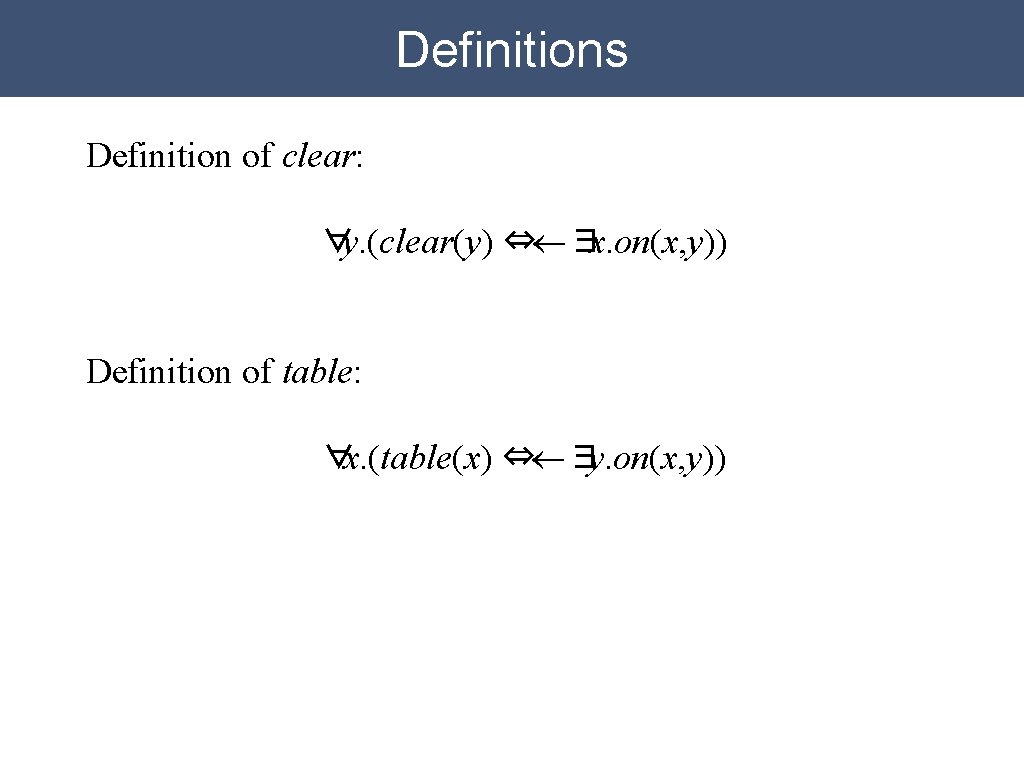
Definitions Definition of clear: ∀y. (clear(y) ⇔¬∃x. on(x, y)) Definition of table: ∀x. (table(x) ⇔¬∃y. on(x, y))
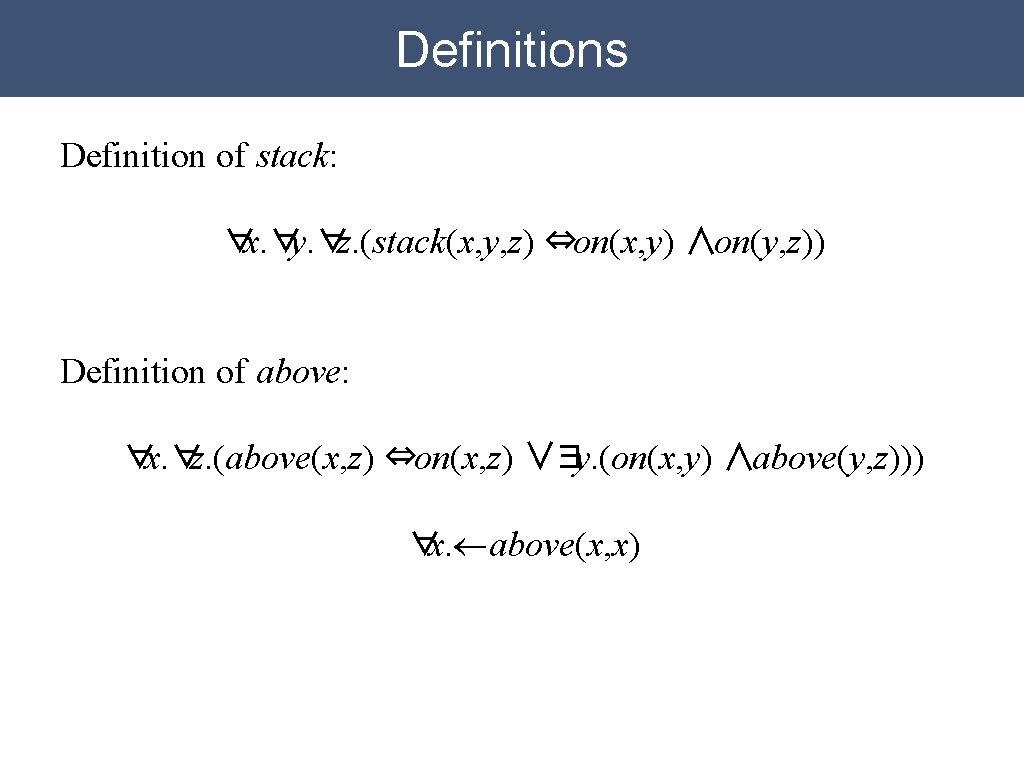
Definitions Definition of stack: ∀x. ∀y. ∀z. (stack(x, y, z) ⇔on(x, y) ∧on(y, z)) Definition of above: ∀x. ∀z. (above(x, z) ⇔on(x, z) ∨∃y. (on(x, y) ∧above(y, z))) ∀x. ¬above(x, x)
Example - Modular Arithmetic
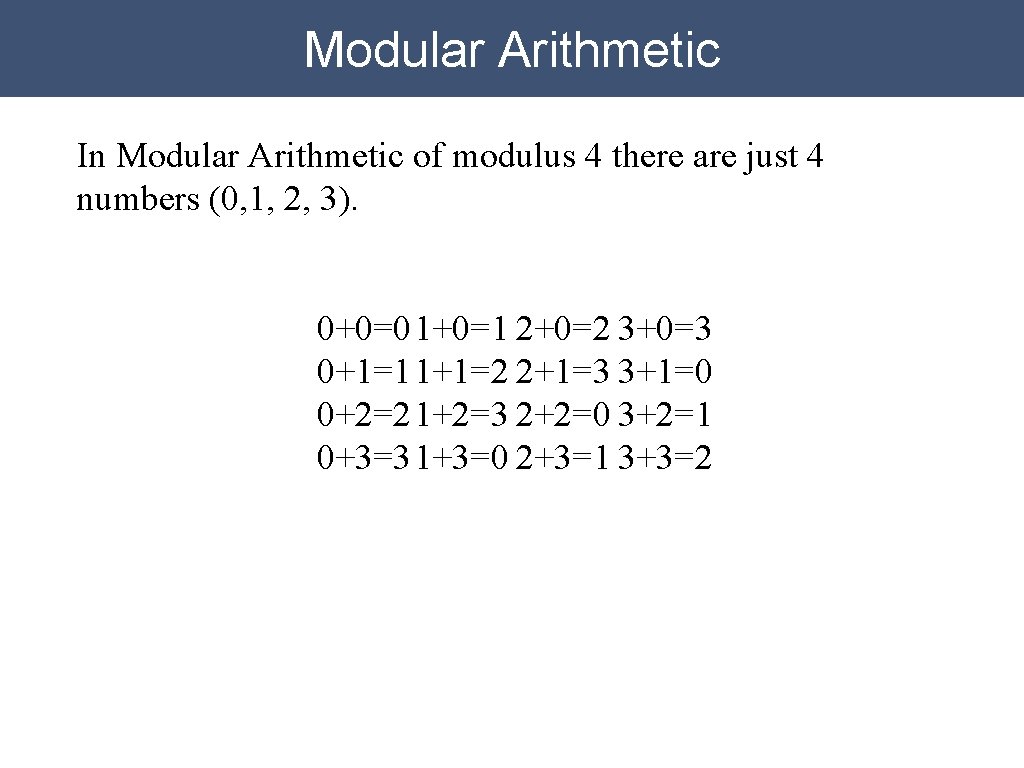
Modular Arithmetic In Modular Arithmetic of modulus 4 there are just 4 numbers (0, 1, 2, 3). 0+0=01+0=1 2+0=2 3+0=3 0+1=11+1=2 2+1=3 3+1=0 0+2=21+2=3 2+2=0 3+2=1 0+3=31+3=0 2+3=1 3+3=2
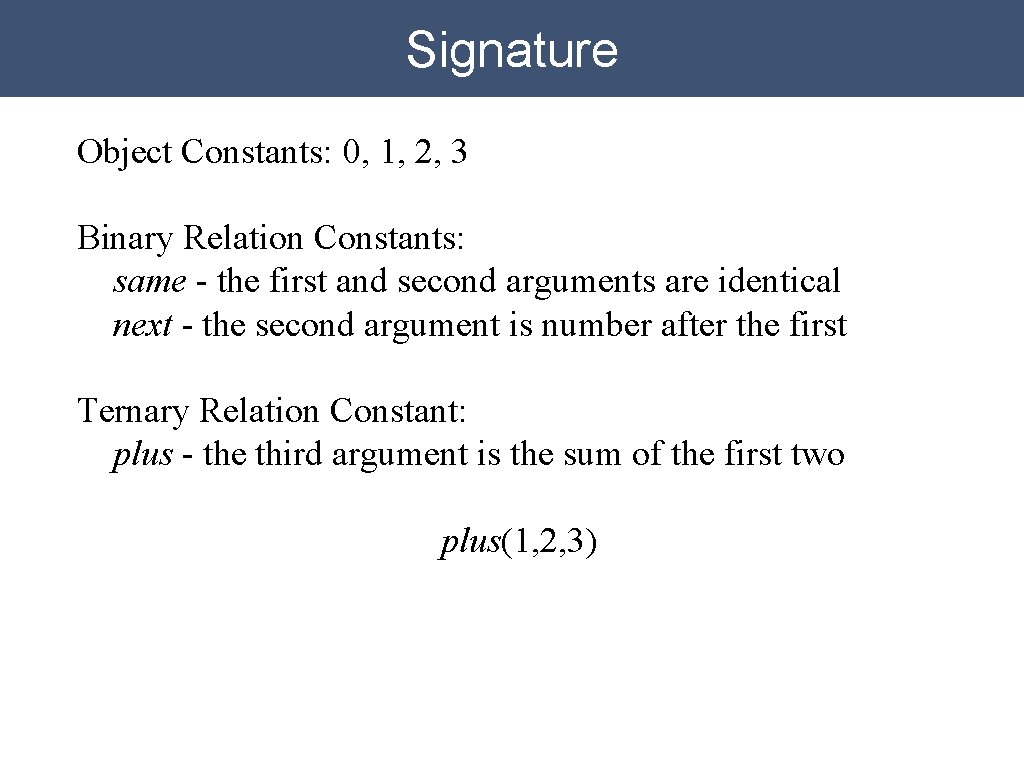
Signature Object Constants: 0, 1, 2, 3 Binary Relation Constants: same - the first and second arguments are identical next - the second argument is number after the first Ternary Relation Constant: plus - the third argument is the sum of the first two plus(1, 2, 3)
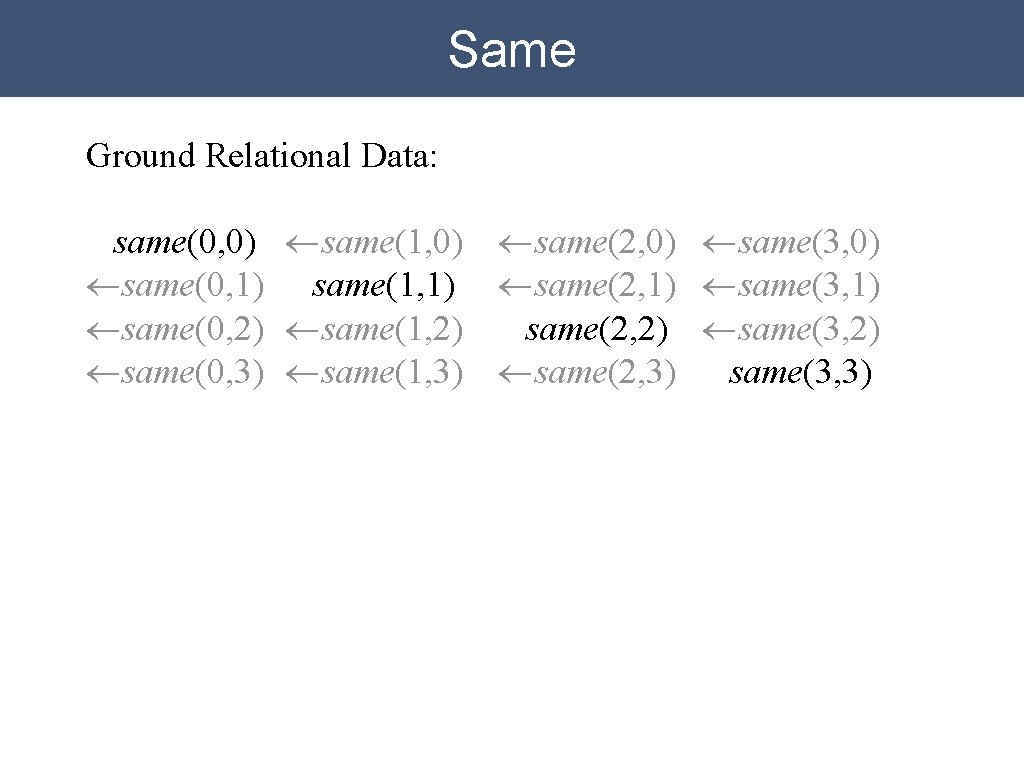
Same Ground Relational Data: same(0, 0) ¬same(1, 0) ¬same(2, 0) ¬same(3, 0) ¬same(0, 1) same(1, 1) ¬same(2, 1) ¬same(3, 1) ¬same(0, 2) ¬same(1, 2) same(2, 2) ¬same(3, 2) ¬same(0, 3) ¬same(1, 3) ¬same(2, 3) same(3, 3)
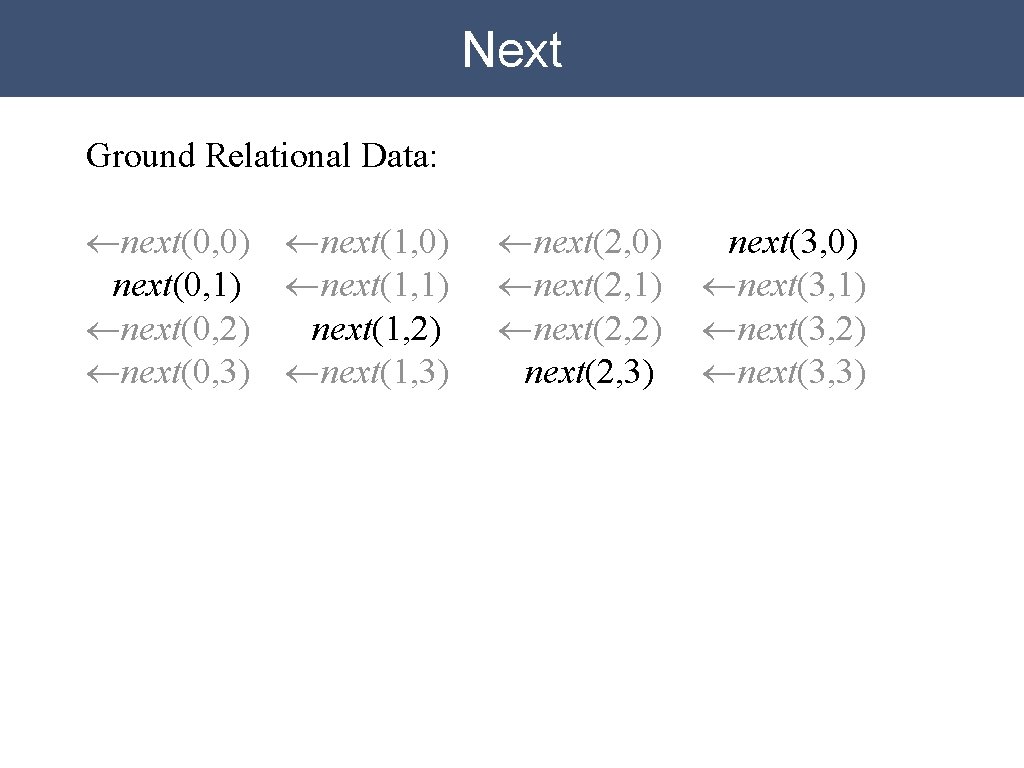
Next Ground Relational Data: ¬next(0, 0) ¬next(1, 0) next(0, 1) ¬next(1, 1) ¬next(0, 2) next(1, 2) ¬next(0, 3) ¬next(1, 3) ¬next(2, 0) ¬next(2, 1) ¬next(2, 2) next(2, 3) next(3, 0) ¬next(3, 1) ¬next(3, 2) ¬next(3, 3)
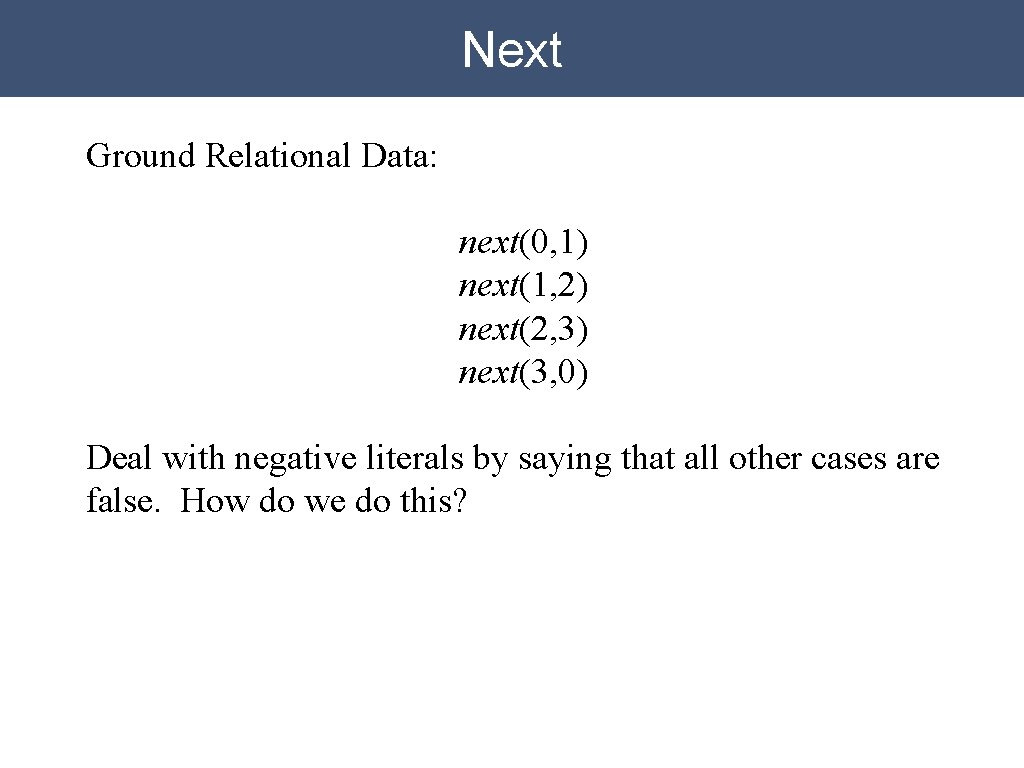
Next Ground Relational Data: next(0, 1) next(1, 2) next(2, 3) next(3, 0) Deal with negative literals by saying that all other cases are false. How do we do this?
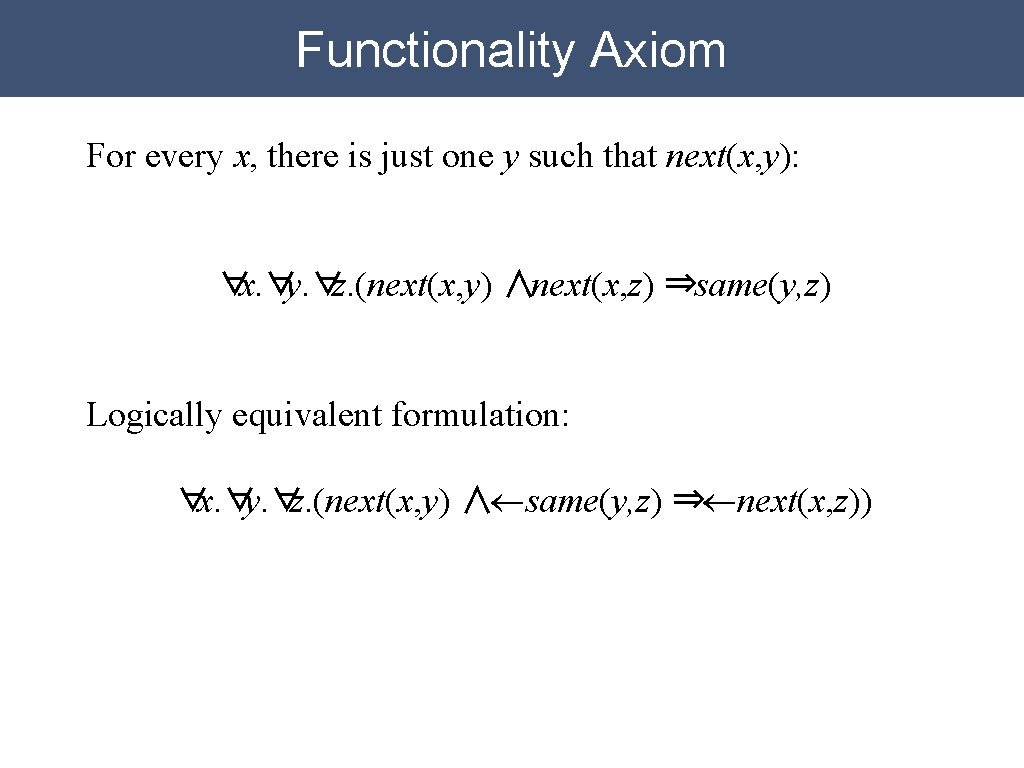
Functionality Axiom For every x, there is just one y such that next(x, y): ∀x. ∀y. ∀z. (next(x, y) ∧next(x, z) ⇒same(y, z) Logically equivalent formulation: ∀x. ∀y. ∀z. (next(x, y) ∧¬same(y, z) ⇒¬next(x, z))
Addition Ground Relational Data: plus(0, 0, 0) plus(0, 1, 1) plus(0, 2, 2) plus(0, 3, 3) plus(1, 0, 1) plus(1, 1, 2) plus(1, 2, 3) plus(1, 3, 0) plus(2, 0, 2) plus(2, 1, 3) plus(2, 2, 0) plus(2, 3, 1) plus(3, 0, 3) plus(3, 1, 0) plus(3, 2, 1) plus(3, 3, 2) Functionality Axiom: ∀x. ∀y. ∀z. ∀w. (plus(x, y, z) ∧plus(x, y, w) ⇒same(z, w)
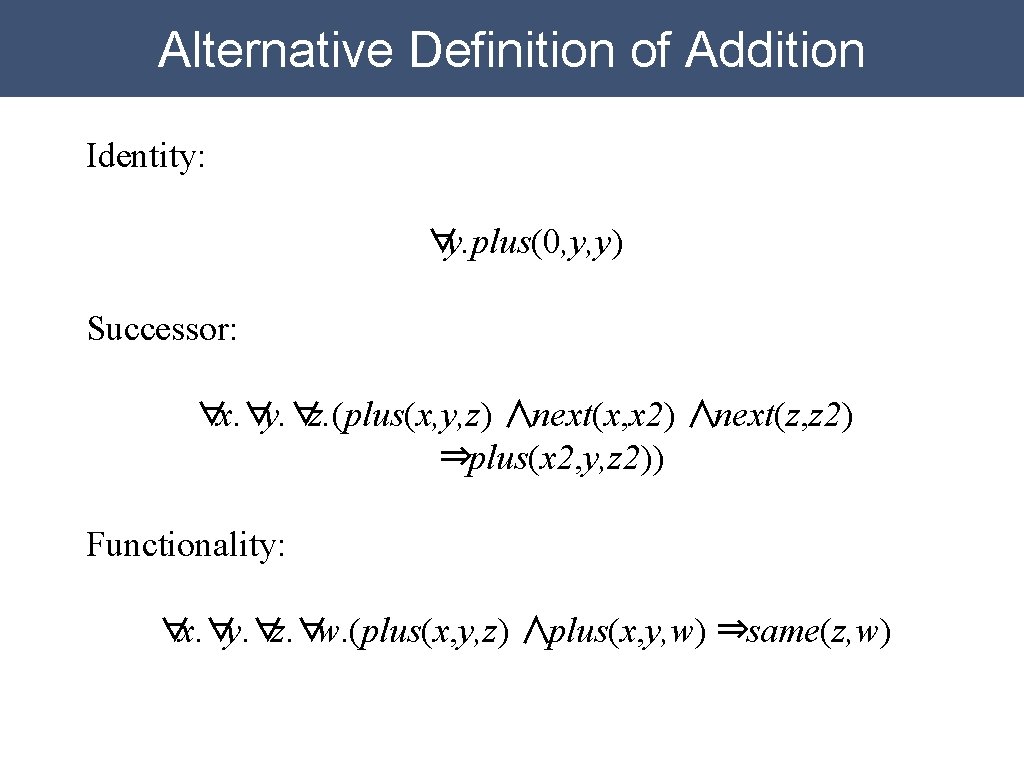
Alternative Definition of Addition Identity: ∀y. plus(0, y, y) Successor: ∀x. ∀y. ∀z. (plus(x, y, z) ∧next(x, x 2) ∧next(z, z 2) ⇒plus(x 2, y, z 2)) Functionality: ∀x. ∀y. ∀z. ∀w. (plus(x, y, z) ∧plus(x, y, w) ⇒same(z, w)
Properties of Sentences
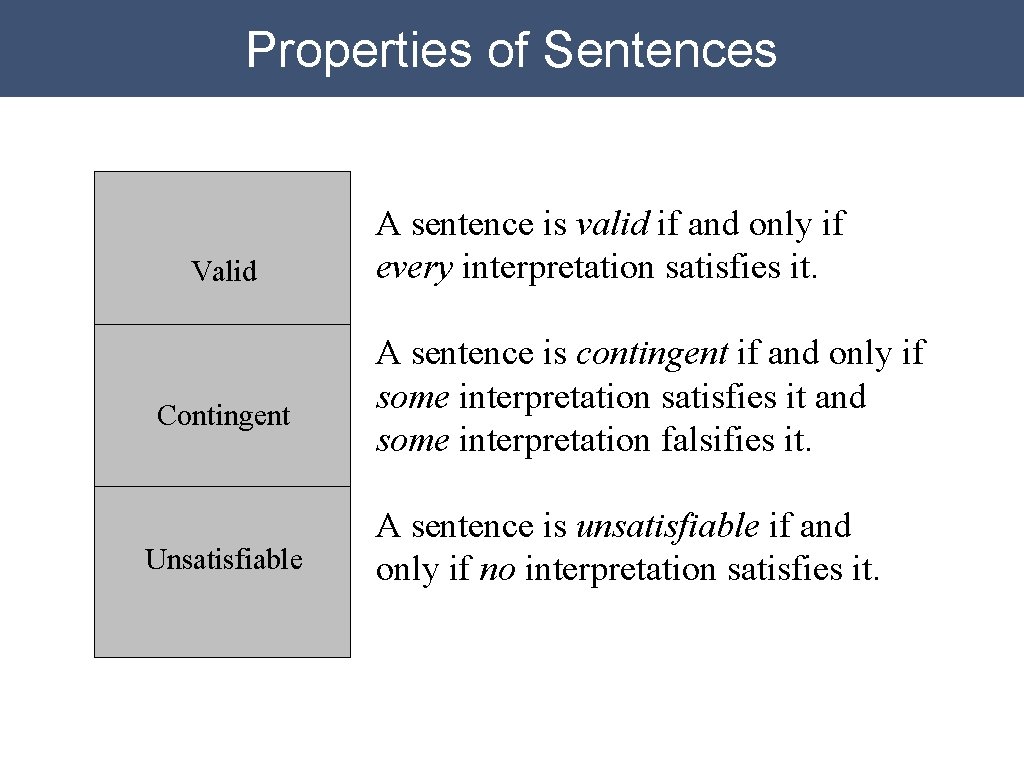
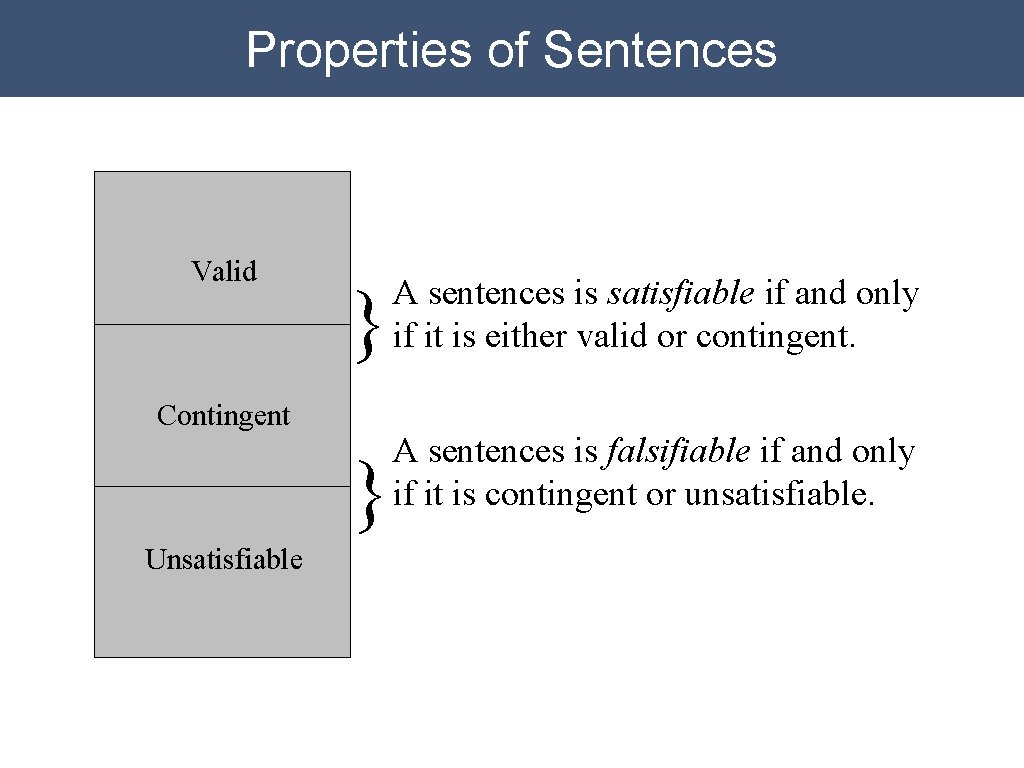
Properties of Sentences Valid Contingent Unsatisfiable A sentence is valid if and only if every interpretation satisfies it. A sentence is contingent if and only if some interpretation satisfies it and some interpretation falsifies it. A sentence is unsatisfiable if and only if no interpretation satisfies it.
Properties of Sentences Valid } A sentences is satisfiable if and only if it is either valid or contingent. } A sentences is falsifiable if and only if it is contingent or unsatisfiable. Contingent Unsatisfiable
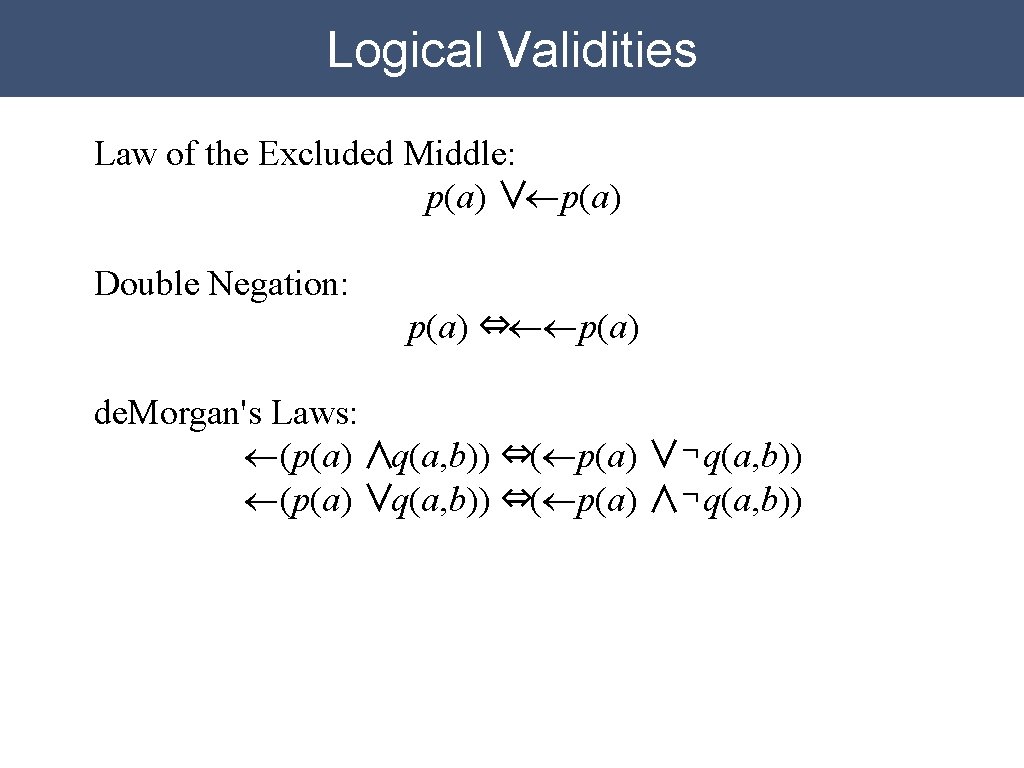
Logical Validities Law of the Excluded Middle: p(a) ∨¬p(a) Double Negation: p(a) ⇔¬¬p(a) de. Morgan's Laws: ¬(p(a) ∧q(a, b)) ⇔(¬p(a) ∨¬q(a, b)) ¬(p(a) ∨q(a, b)) ⇔(¬p(a) ∧¬q(a, b))
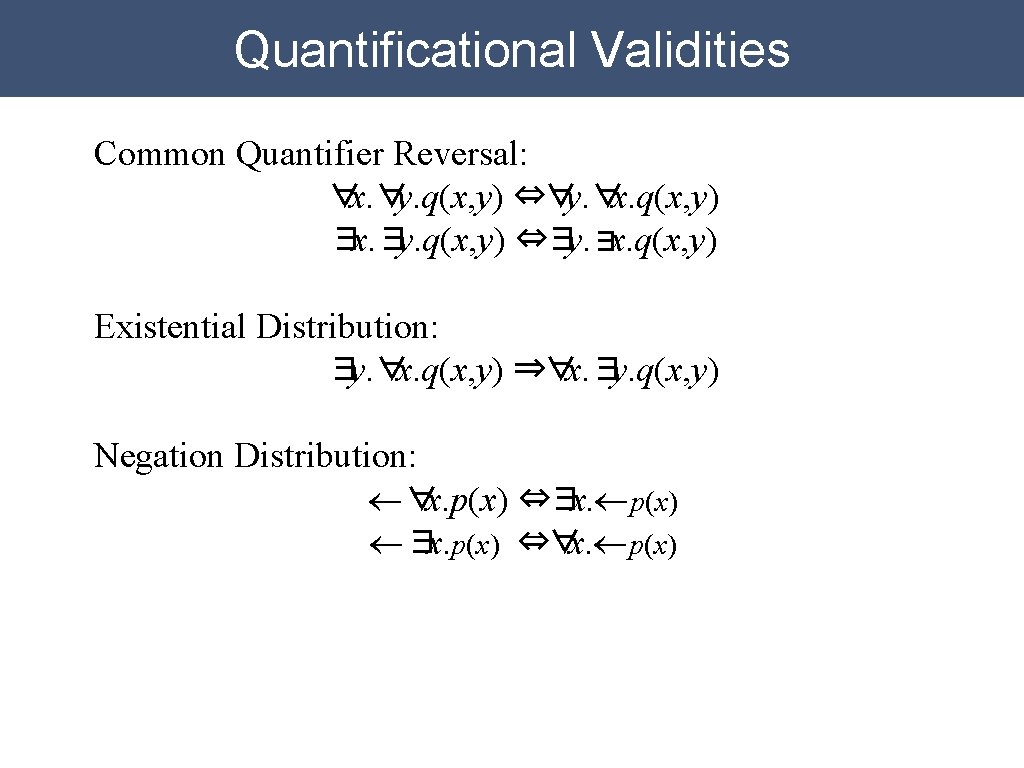
Quantificational Validities Common Quantifier Reversal: ∀x. ∀y. q(x, y) ⇔∀y. ∀x. q(x, y) ∃x. ∃y. q(x, y) ⇔∃y. ∃x. q(x, y) Existential Distribution: ∃y. ∀x. q(x, y) ⇒∀x. ∃y. q(x, y) Negation Distribution: ¬∀x. p(x) ⇔∃x. ¬p(x) ¬∃x. p(x) ⇔∀x. ¬p(x)
Logical Entailment
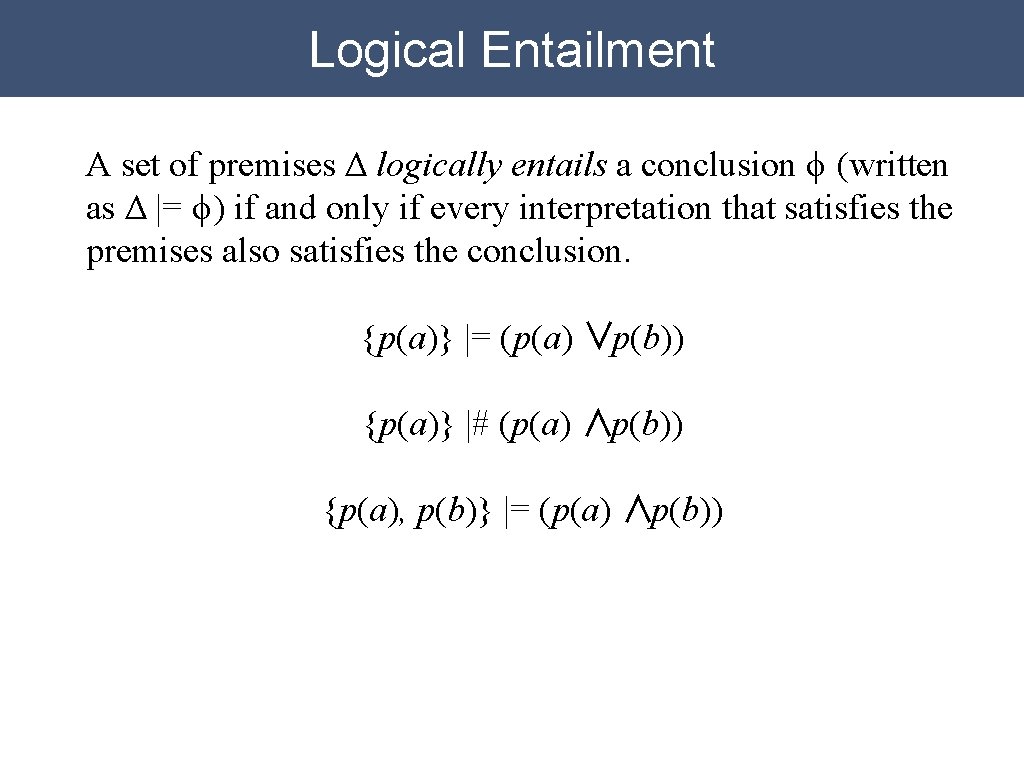
Logical Entailment A set of premises Δ logically entails a conclusion ϕ (written as Δ |= ϕ) if and only if every interpretation that satisfies the premises also satisfies the conclusion. {p(a)} |= (p(a) ∨p(b)) {p(a)} |# (p(a) ∧p(b)) {p(a), p(b)} |= (p(a) ∧p(b))
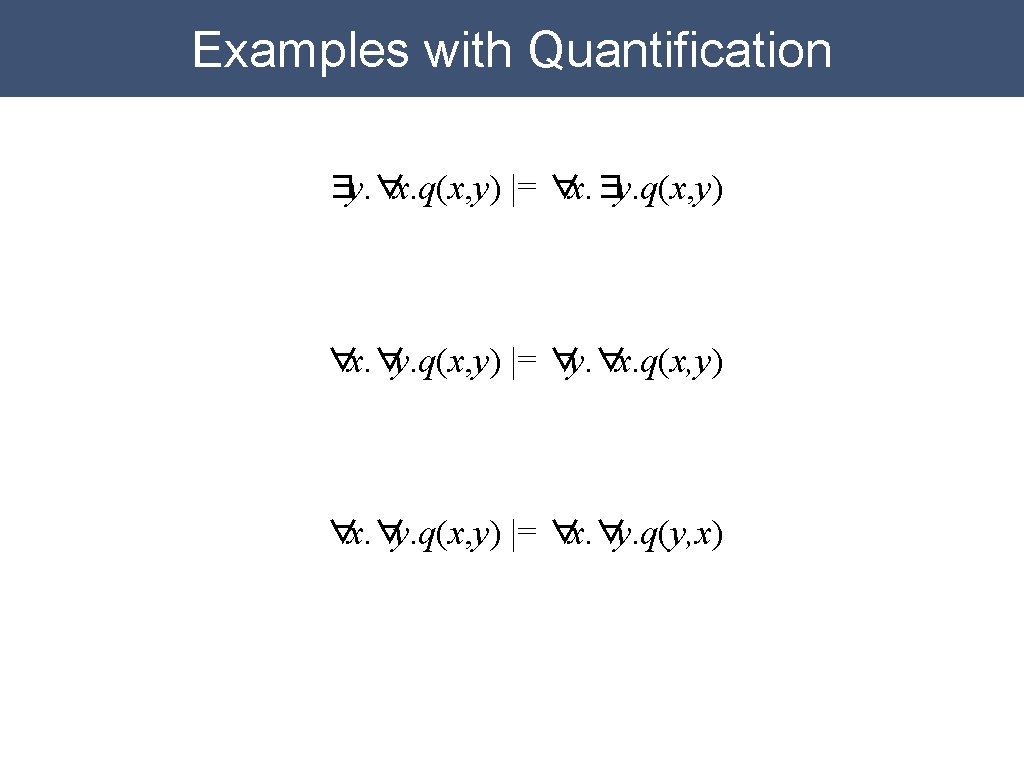
Examples with Quantification ∃y. ∀x. q(x, y) |= ∀x. ∃y. q(x, y) ∀x. ∀y. q(x, y) |= ∀y. ∀x. q(x, y) ∀x. ∀y. q(x, y) |= ∀x. ∀y. q(y, x)
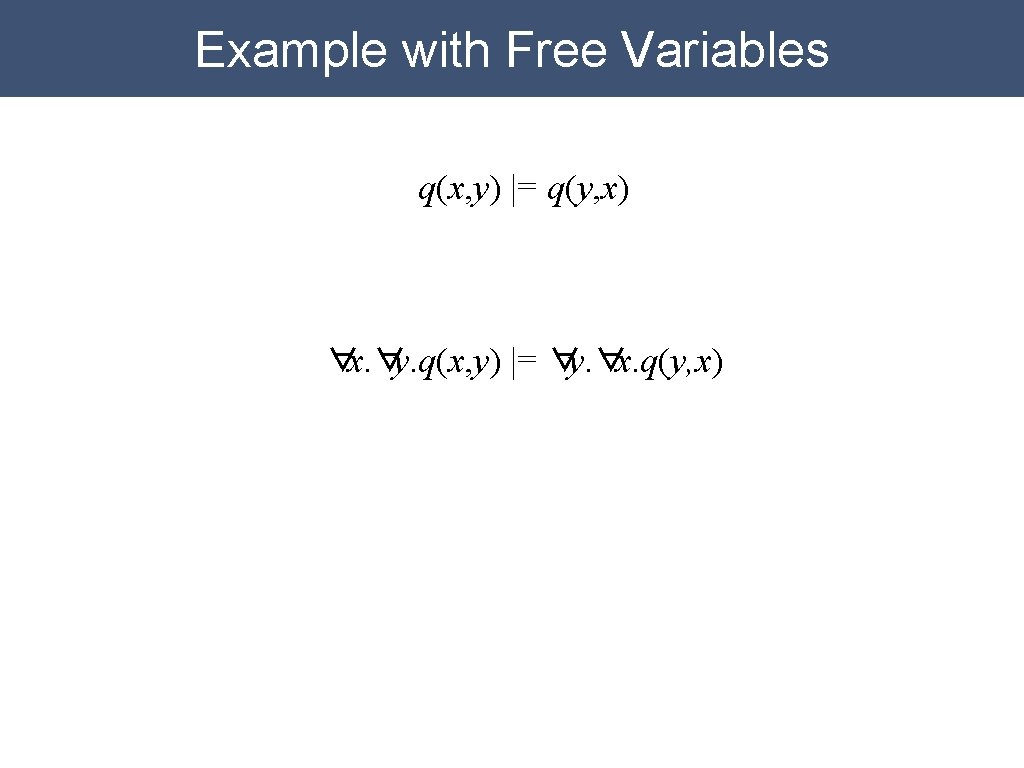
Example with Free Variables q(x, y) |= q(y, x) ∀x. ∀y. q(x, y) |= ∀y. ∀x. q(y, x)
Relational Logic and Propositional Logic
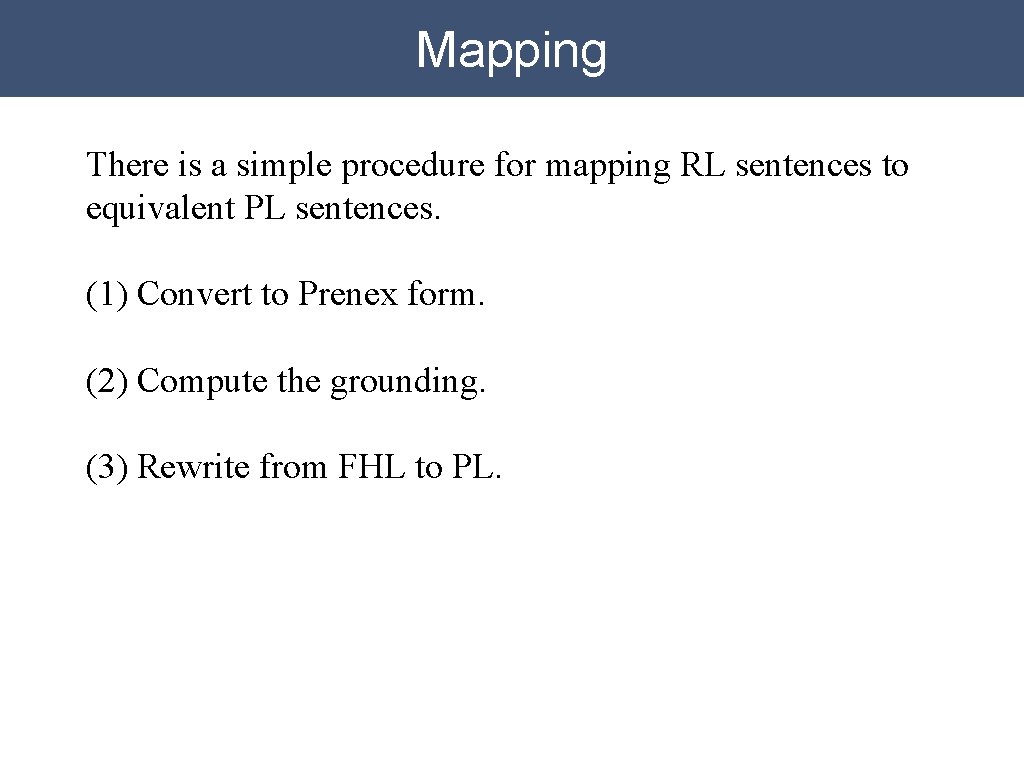
Mapping There is a simple procedure for mapping RL sentences to equivalent PL sentences. (1) Convert to Prenex form. (2) Compute the grounding. (3) Rewrite from FHL to PL.
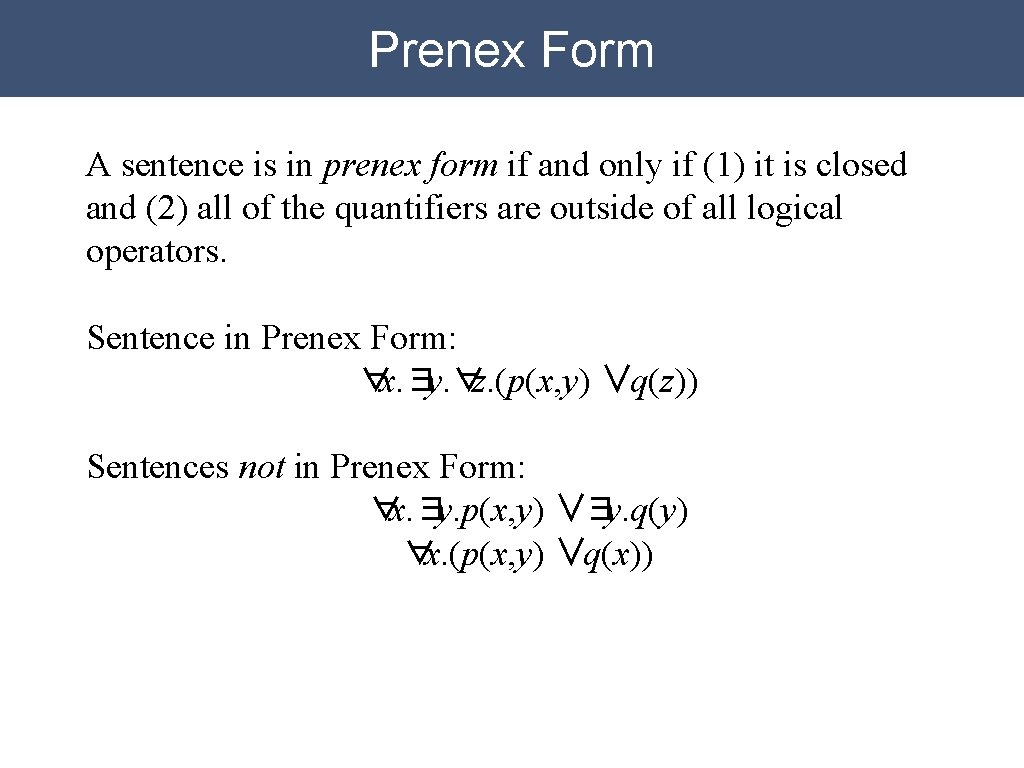
Prenex Form A sentence is in prenex form if and only if (1) it is closed and (2) all of the quantifiers are outside of all logical operators. Sentence in Prenex Form: ∀x. ∃y. ∀z. (p(x, y) ∨q(z)) Sentences not in Prenex Form: ∀x. ∃y. p(x, y) ∨∃y. q(y) ∀x. (p(x, y) ∨q(x))
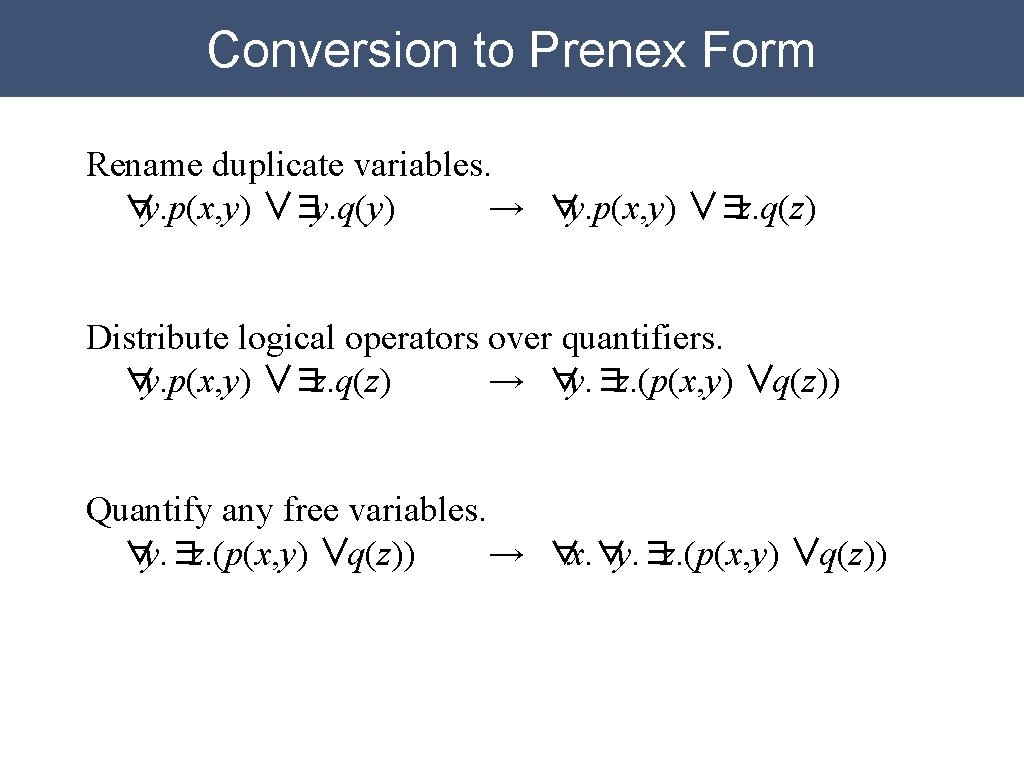
Conversion to Prenex Form Rename duplicate variables. ∀y. p(x, y) ∨∃y. q(y) → ∀y. p(x, y) ∨∃z. q(z) Distribute logical operators over quantifiers. ∀y. p(x, y) ∨∃z. q(z) → ∀y. ∃z. (p(x, y) ∨q(z)) Quantify any free variables. ∀y. ∃z. (p(x, y) ∨q(z)) → ∀x. ∀y. ∃z. (p(x, y) ∨q(z))
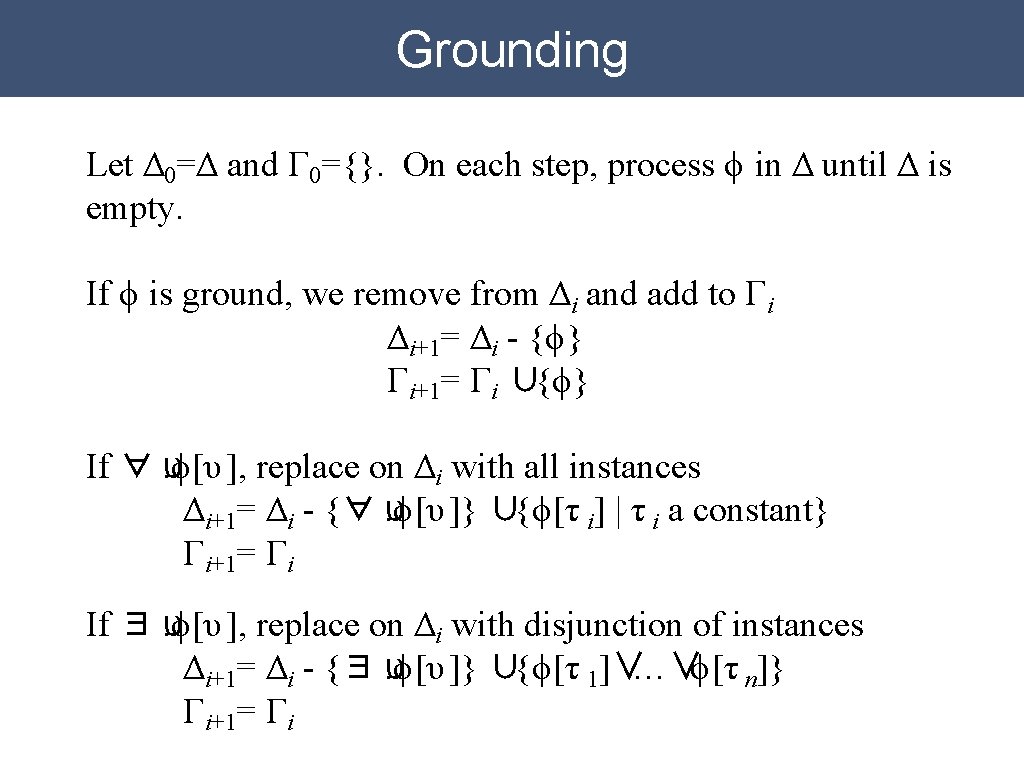
Grounding Let Δ 0=Δ and Γ 0={}. On each step, process ϕ in Δ until Δ is empty. If ϕ is ground, we remove from Δi and add to Γi Δi+1= Δi - {ϕ} Γi+1= Γi ∪{ϕ} If ∀υ. ϕ[υ ], replace on Δi with all instances Δi+1= Δi - {∀υ. ϕ[υ ]} ∪{ϕ[τ i] | τ i a constant} Γi+1= Γi If ∃υ. ϕ[υ ], replace on Δi with disjunction of instances Δi+1= Δi - {∃υ. ϕ[υ ]} ∪{ϕ[τ 1]∨…∨ϕ[τ n]} Γi+1= Γi
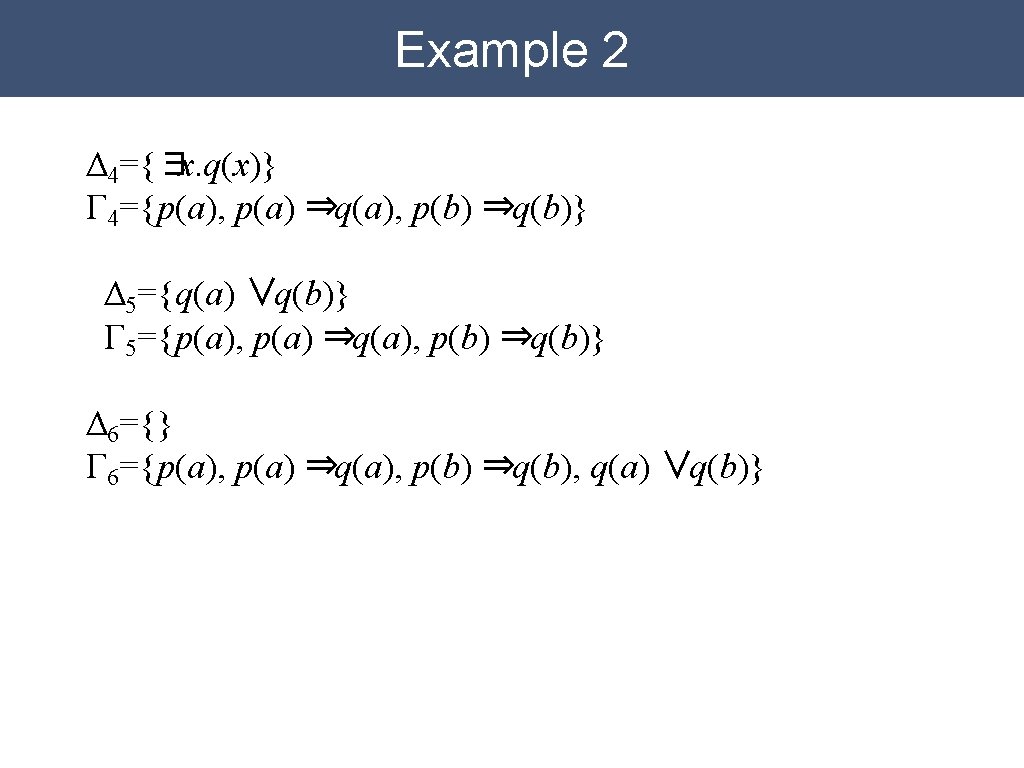
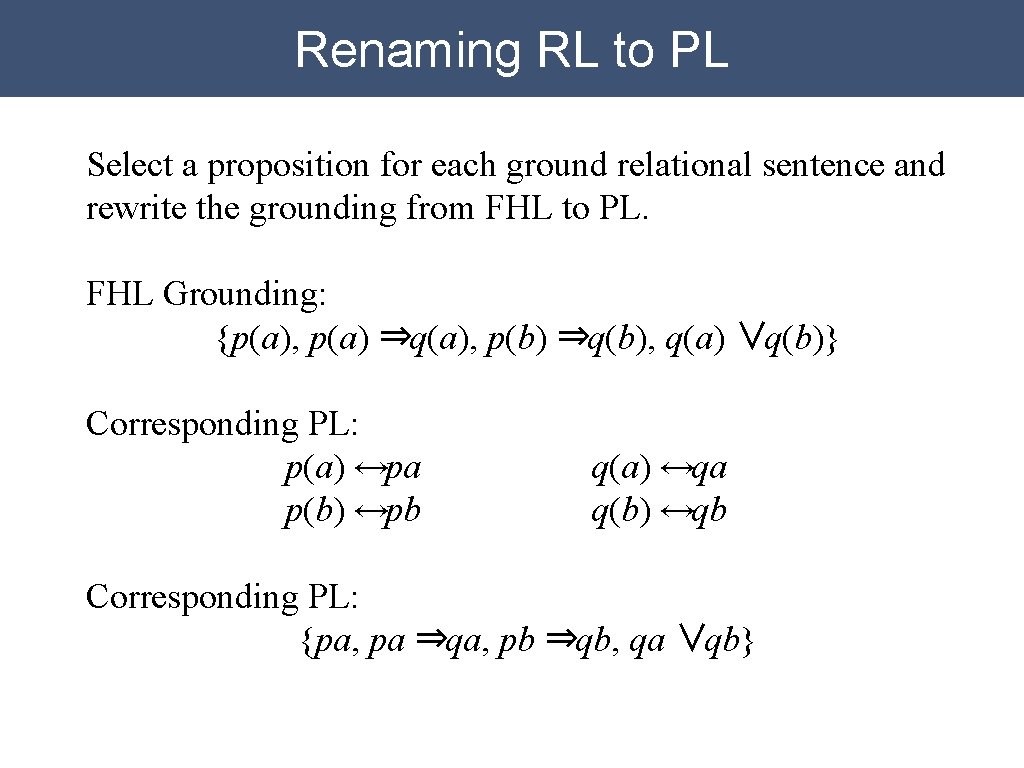
Renaming RL to PL Select a proposition for each ground relational sentence and rewrite the grounding from FHL to PL. FHL Grounding: {p(a), p(a) ⇒q(a), p(b) ⇒q(b), q(a) ∨q(b)} Corresponding PL: p(a) ↔pa p(b) ↔pb q(a) ↔qa q(b) ↔qb Corresponding PL: {pa, pa ⇒qa, pb ⇒qb, qa ∨qb}
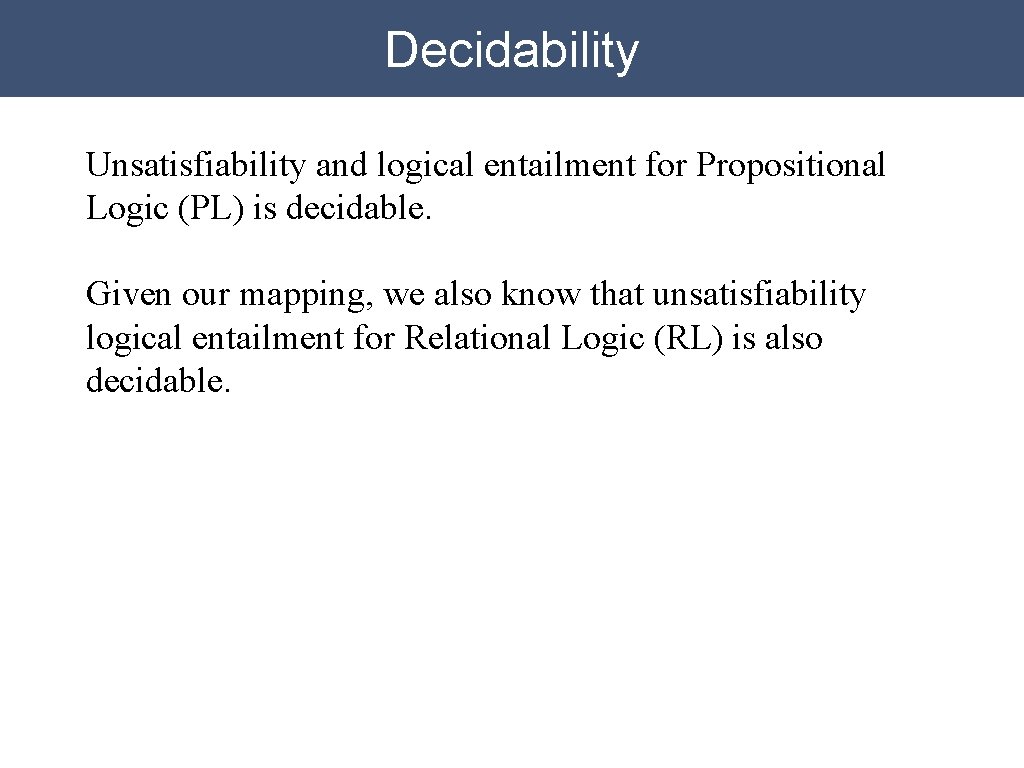
Decidability Unsatisfiability and logical entailment for Propositional Logic (PL) is decidable. Given our mapping, we also know that unsatisfiability logical entailment for Relational Logic (RL) is also decidable.
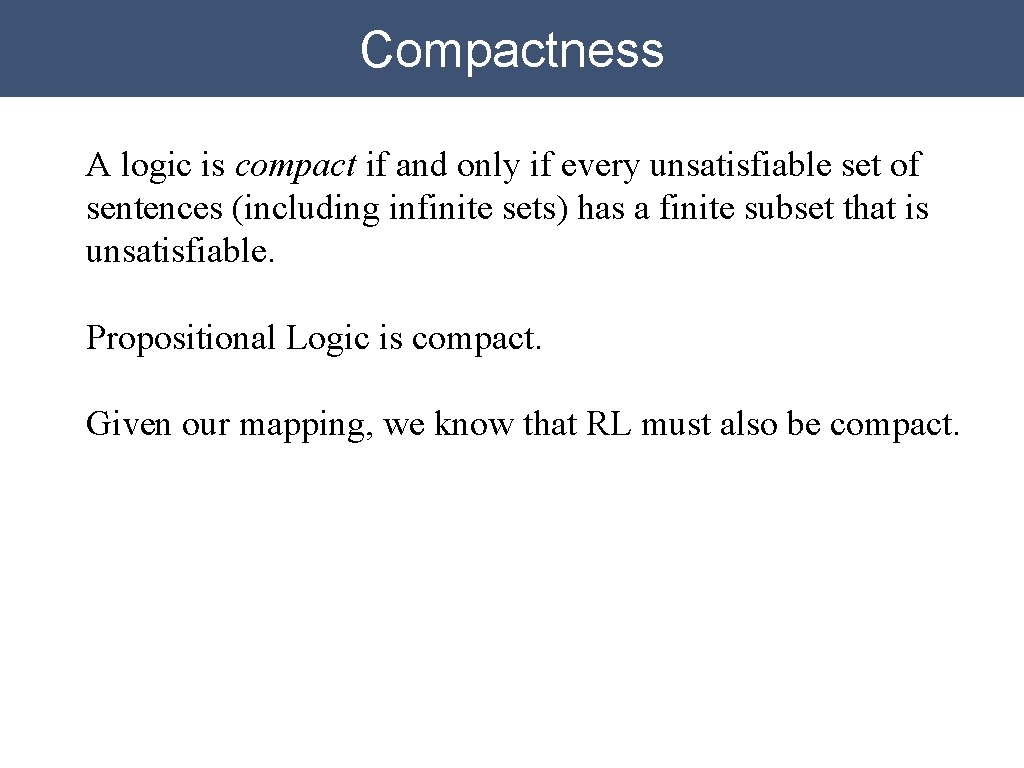
Compactness A logic is compact if and only if every unsatisfiable set of sentences (including infinite sets) has a finite subset that is unsatisfiable. Propositional Logic is compact. Given our mapping, we know that RL must also be compact.