
Relational Collaborative Filtering Modeling Multiple Item Relations for

Relational Collaborative Filtering: Modeling Multiple Item Relations for Recommendation 1 2 2 3 Xin, Xiangnan He, Yongfeng Zhang, Yongdong Zhang, 1 Joemon Jose 1 School of Computing Science, University of Glasgow 2 School of Data Science, University of Science and Technology of China 3 Department of Computer Science, Rutgers University Presented by Xin@SIGIR 19, July 22, 2019 1
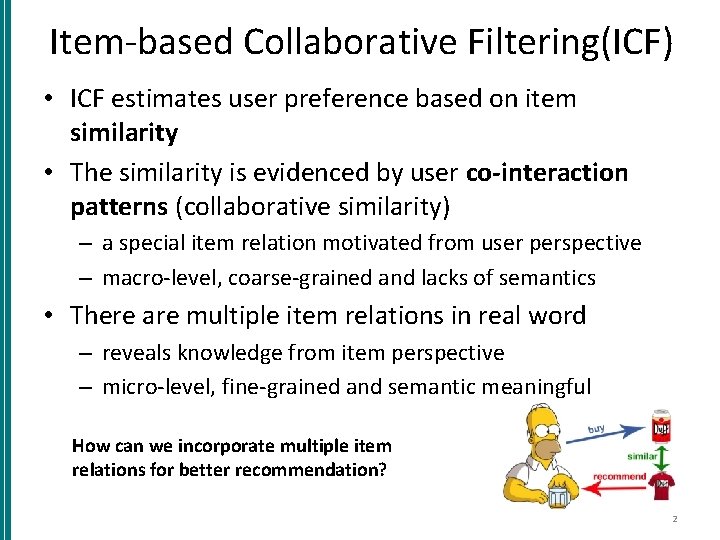
Item-based Collaborative Filtering(ICF) • ICF estimates user preference based on item similarity • The similarity is evidenced by user co-interaction patterns (collaborative similarity) – a special item relation motivated from user perspective – macro-level, coarse-grained and lacks of semantics • There are multiple item relations in real word – reveals knowledge from item perspective – micro-level, fine-grained and semantic meaningful How can we incorporate multiple item relations for better recommendation? 2
Incorporating Item Relations • Motivation – There are multiple item relations in the real world – Users tend to pay different attentions to the relations when making choices – Item relations improve the interpretability of recommendation • Contribution – From ICF to RCF (relational collaborative filtering) – We develop a hierarchy attention mechanism to capture user-item preference – Extensive experiments on movie and music recommendation 3
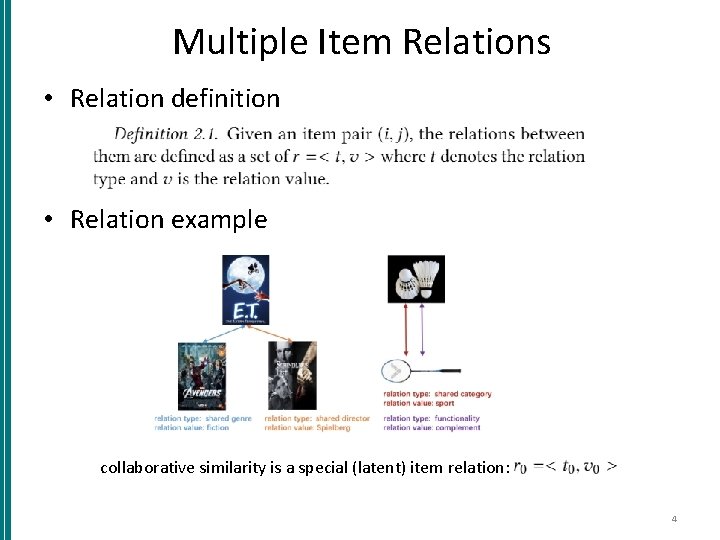
Multiple Item Relations • Relation definition • Relation example collaborative similarity is a special (latent) item relation: 4
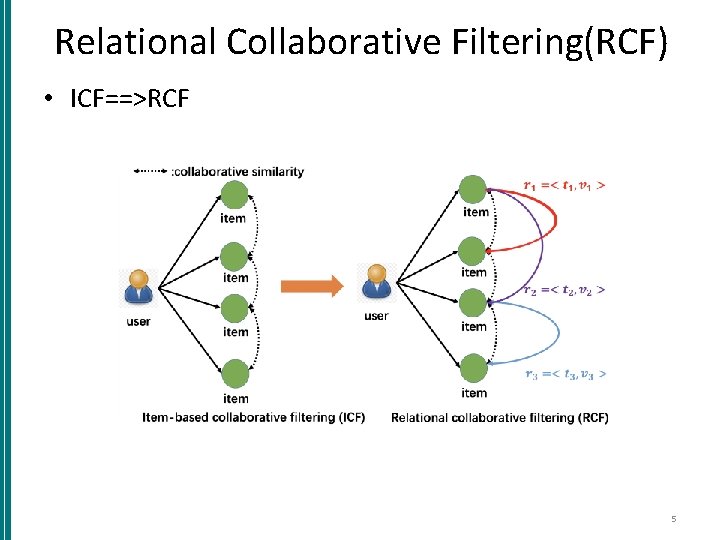
Relational Collaborative Filtering(RCF) • ICF==>RCF 5

User-Item Preference Modeling Users tend to pay different attentions to different relation types … 6
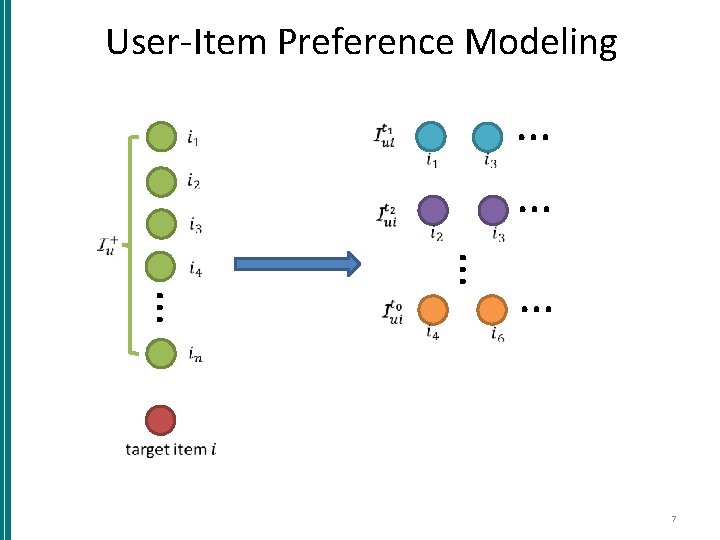
User-Item Preference Modeling … … … 7
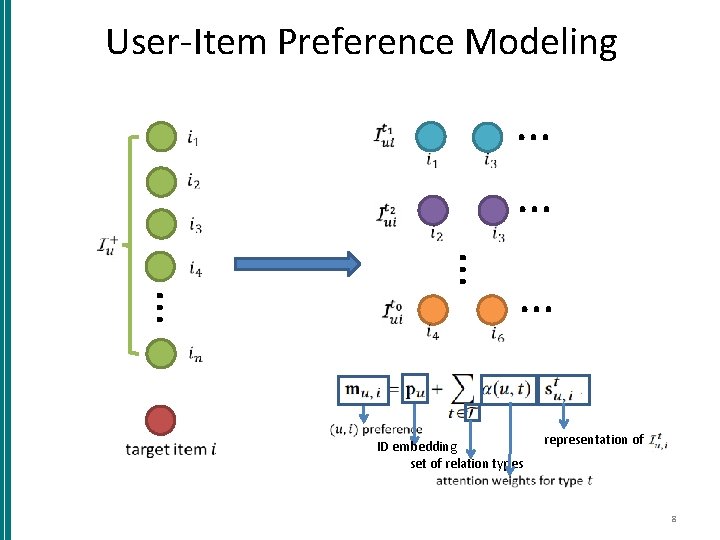
User-Item Preference Modeling … … … ID embedding set of relation types representation of 8
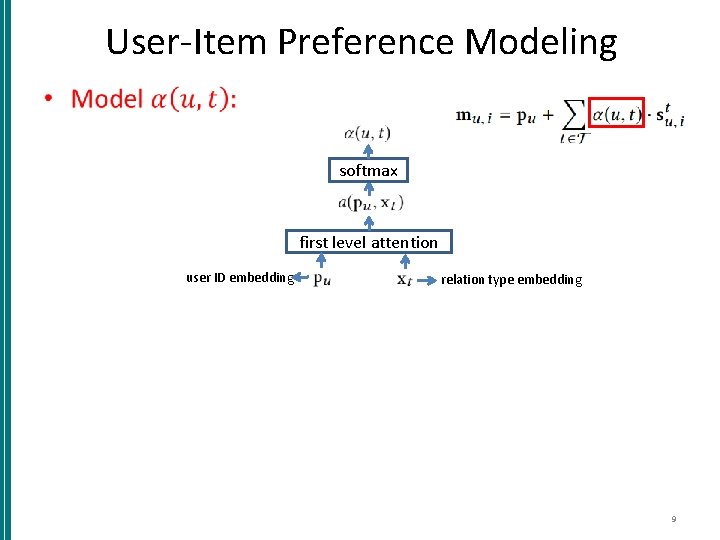
User-Item Preference Modeling • softmax first level attention user ID embedding relation type embedding 9
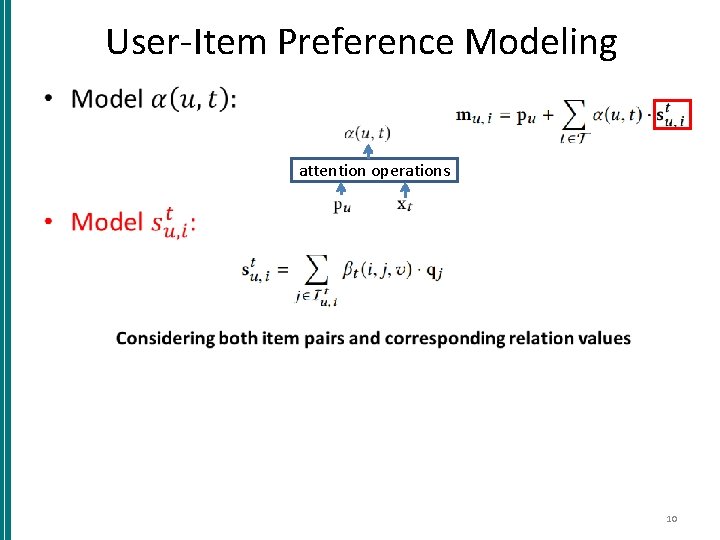
User-Item Preference Modeling • attention operations 10
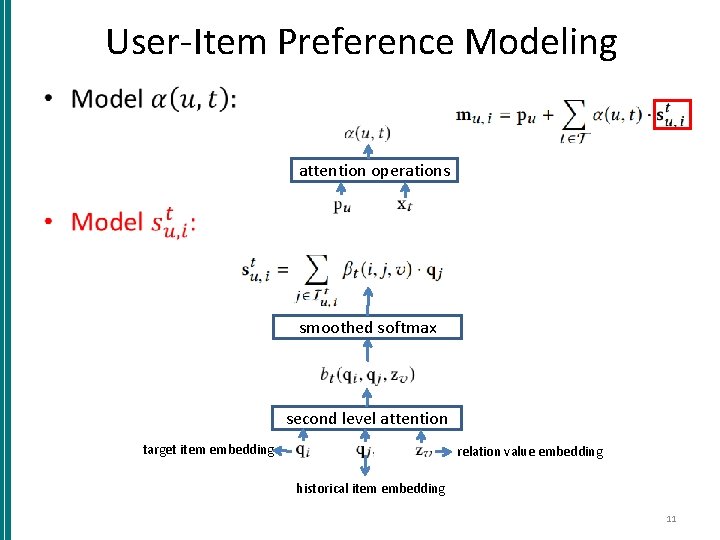
User-Item Preference Modeling • attention operations smoothed softmax second level attention target item embedding relation value embedding historical item embedding 11
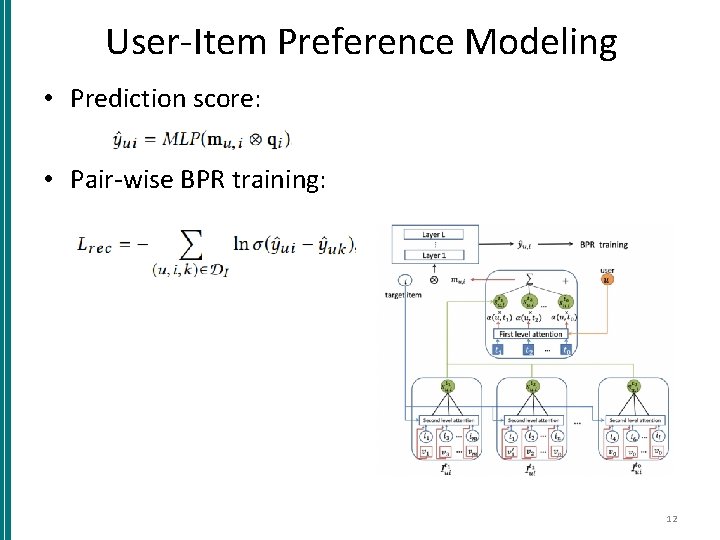
User-Item Preference Modeling • Prediction score: • Pair-wise BPR training: 12
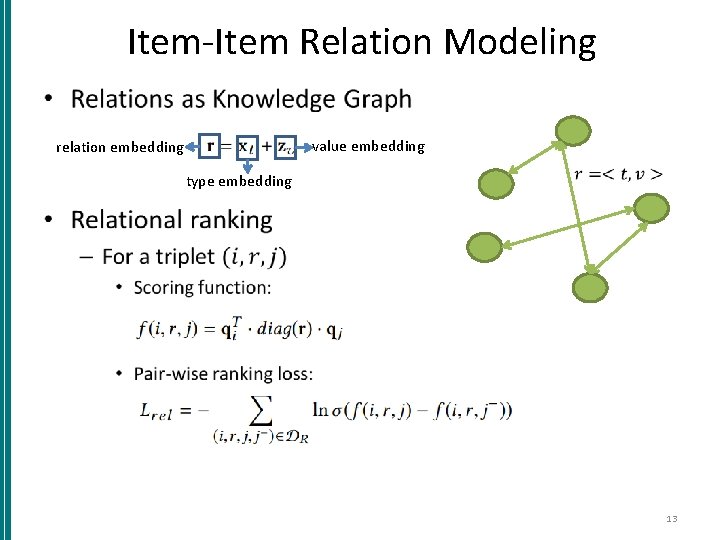
Item-Item Relation Modeling • value embedding relation embedding type embedding 13
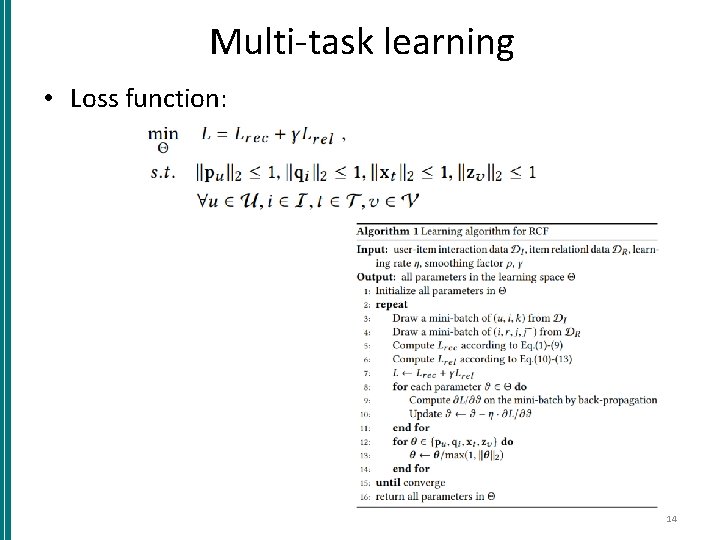
Multi-task learning • Loss function: 14

Experiments • 15
![Experiments • Baselines: – ICF • MF [Koren et al, 2009] • FISM [Kabbur](http://slidetodoc.com/presentation_image_h/309472367c7e859155932554a941ea14/image-16.jpg "Experiments • Baselines: – ICF • MF [Koren et al, 2009] • FISM [Kabbur")
Experiments • Baselines: – ICF • MF [Koren et al, 2009] • FISM [Kabbur S et al, KDD 13] • NAIS [He et al, TKDE 18] – Feature based • FM [Rendle, et al, ICDM 2010] • NFM [He et al, SIGIR 17] – KG-based • CKE [Zhang et al, KDD 16] • MOHR[Kang et al, CIKM 18] 16
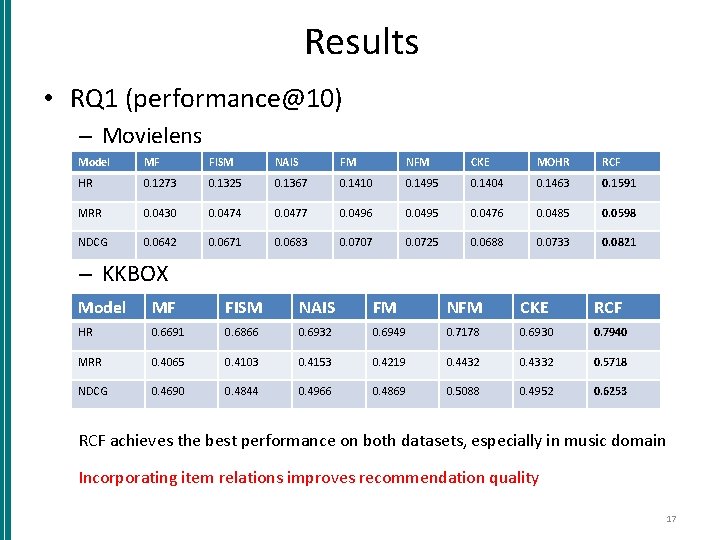
Results • RQ 1 (performance@10) – Movielens Model MF FISM NAIS FM NFM CKE MOHR RCF HR 0. 1273 0. 1325 0. 1367 0. 1410 0. 1495 0. 1404 0. 1463 0. 1591 MRR 0. 0430 0. 0474 0. 0477 0. 0496 0. 0495 0. 0476 0. 0485 0. 0598 NDCG 0. 0642 0. 0671 0. 0683 0. 0707 0. 0725 0. 0688 0. 0733 0. 0821 – KKBOX Model MF FISM NAIS FM NFM CKE RCF HR 0. 6691 0. 6866 0. 6932 0. 6949 0. 7178 0. 6930 0. 7940 MRR 0. 4065 0. 4103 0. 4153 0. 4219 0. 4432 0. 4332 0. 5718 NDCG 0. 4690 0. 4844 0. 4966 0. 4869 0. 5088 0. 4952 0. 6253 RCF achieves the best performance on both datasets, especially in music domain Incorporating item relations improves recommendation quality 17
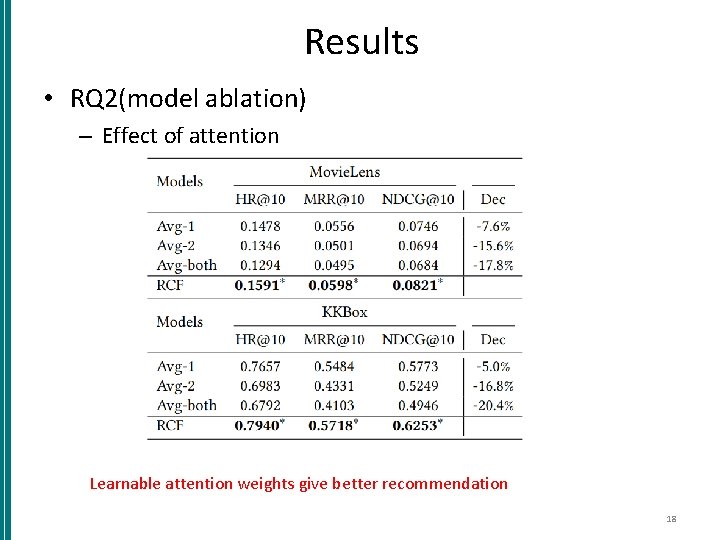
Results • RQ 2(model ablation) – Effect of attention Learnable attention weights give better recommendation 18
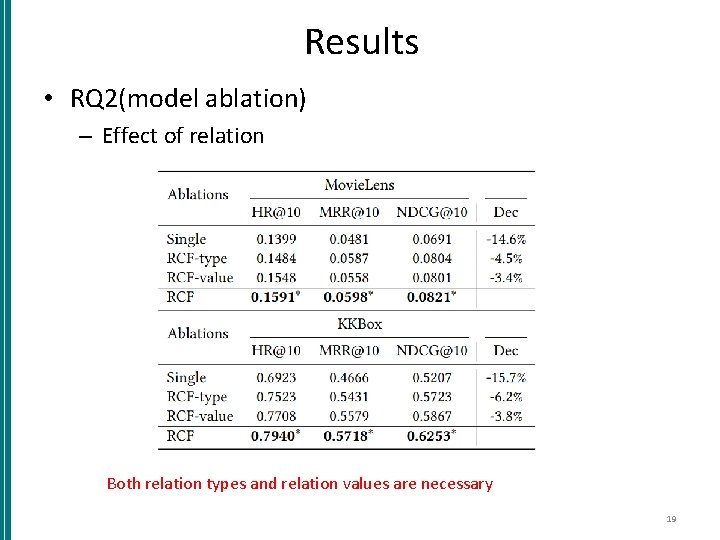
Results • RQ 2(model ablation) – Effect of relation Both relation types and relation values are necessary 19
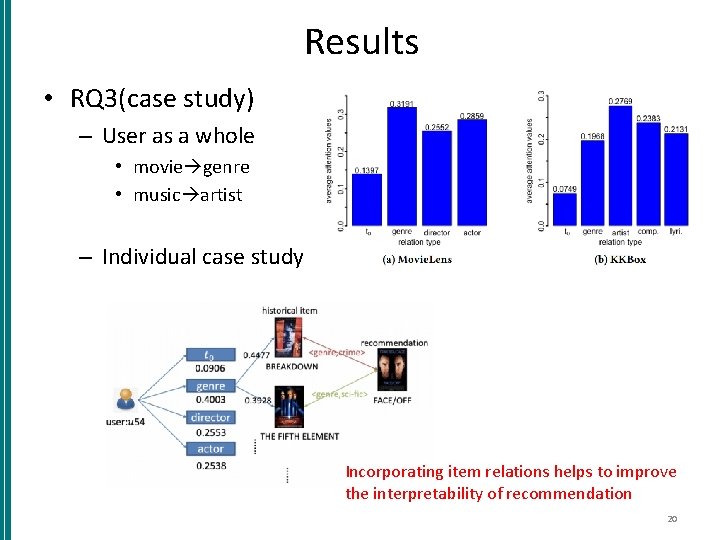
Results • RQ 3(case study) – User as a whole • movie genre • music artist – Individual case study Incorporating item relations helps to improve the interpretability of recommendation 20
Conclusion & Future Work • Take-home messages: – Incorporating item relations helps to improve both quality & interpretability of recommendation – Both relation types and relation values are important to depict item relations – Users pay different attentions when making decisions • for movie: genre, for music: artist • user behavior in music domain has more explicit patterns • Future work – user-user relations – graph computing (e. g. , GCN) 21
![Reference • [Sarwar et al. , 2001]. Item-based collaborative filtering recommendation algorithms. In WWW](http://slidetodoc.com/presentation_image_h/309472367c7e859155932554a941ea14/image-22.jpg "Reference • [Sarwar et al. , 2001]. Item-based collaborative filtering recommendation algorithms. In WWW")
Reference • [Sarwar et al. , 2001]. Item-based collaborative filtering recommendation algorithms. In WWW • [Kabbur et al. , 2013]. Fism: factored item similarity models for top-n recommender systems. In KDD • [He et al. , 2018]. NAIS: Neural attentive item similarity model for recommendation. In TKDE • [Koren et al. , 2009] Matrix factorization techniques for recommender systems. In Computer. • [Rendel et al. , 2010] Factorization machines. In ICDM • [He et al. , 2017] Neural factorization machines for sparse predictive analytics. In SIGIR • [Zhang et al. , 2016] Collaborative knowledge base embedding for recommender systems. In KDD • [Kang et al. , 2018] Recommendation through mixtures of heterogeneous item relationships. In CIKM 22

Thank you Q&A 23
- Slides: 23