
Relational and Logical Operators Topics p p p
- Slides: 27
Relational and Logical Operators Topics p p p Relational Operators and Expressions The if Statement The if-else Statement Nesting of if-else Statements Logical Operators and Expressions Truth Tables Reading p Sections 2. 6, 4. 10, 4. 11
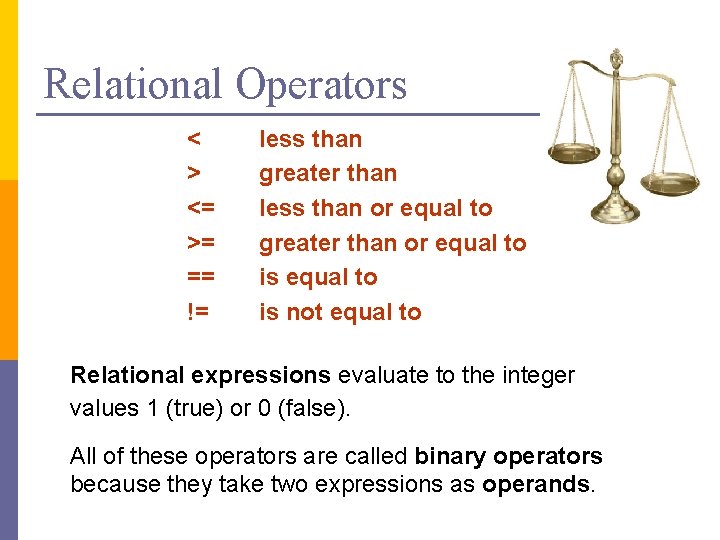
Relational Operators < > <= >= == != less than greater than less than or equal to greater than or equal to is not equal to Relational expressions evaluate to the integer values 1 (true) or 0 (false). All of these operators are called binary operators because they take two expressions as operands.
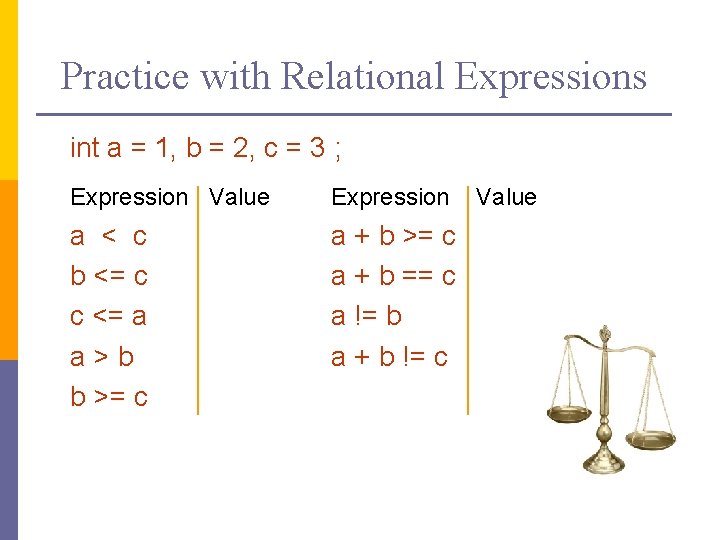
Practice with Relational Expressions int a = 1, b = 2, c = 3 ; Expression Value Expression a < c b <= c c <= a a>b b >= c a + b == c a != b a + b != c Value
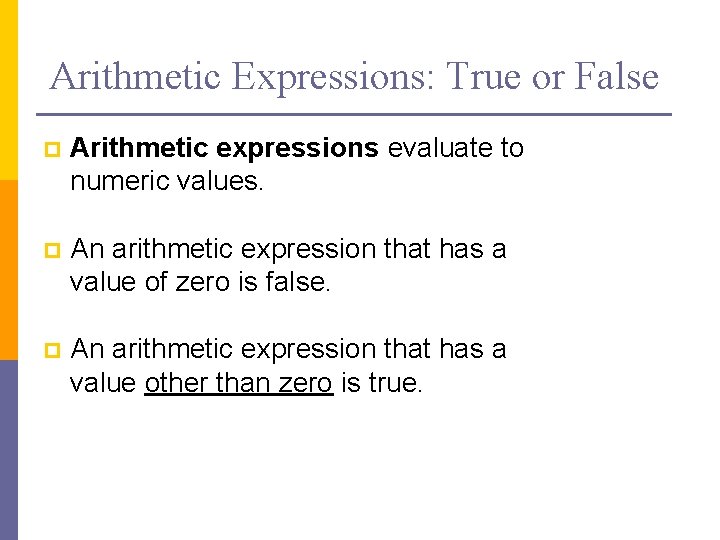
Arithmetic Expressions: True or False p Arithmetic expressions evaluate to numeric values. p An arithmetic expression that has a value of zero is false. p An arithmetic expression that has a value other than zero is true.
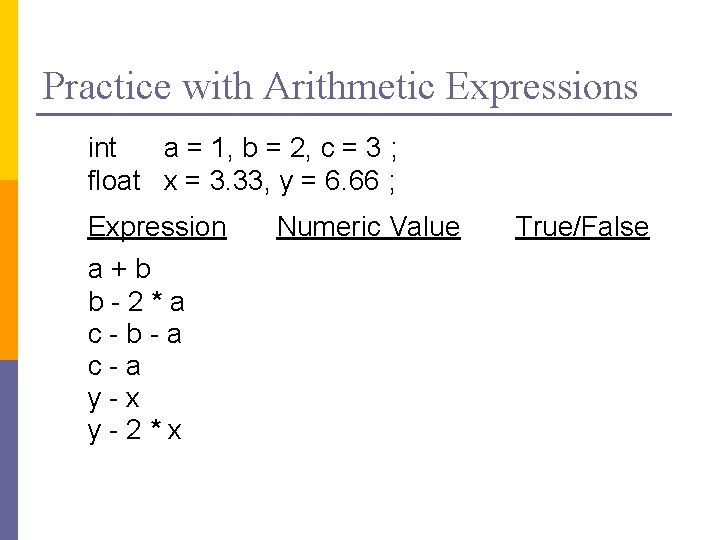
Practice with Arithmetic Expressions int a = 1, b = 2, c = 3 ; float x = 3. 33, y = 6. 66 ; Expression a+b b-2*a c-b-a c-a y-x y-2*x Numeric Value True/False
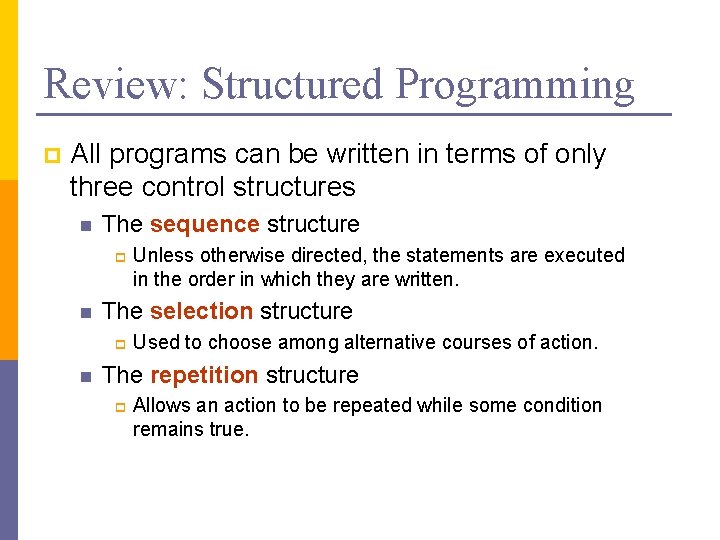
Review: Structured Programming p All programs can be written in terms of only three control structures n The sequence structure p n The selection structure p n Unless otherwise directed, the statements are executed in the order in which they are written. Used to choose among alternative courses of action. The repetition structure p Allows an action to be repeated while some condition remains true.
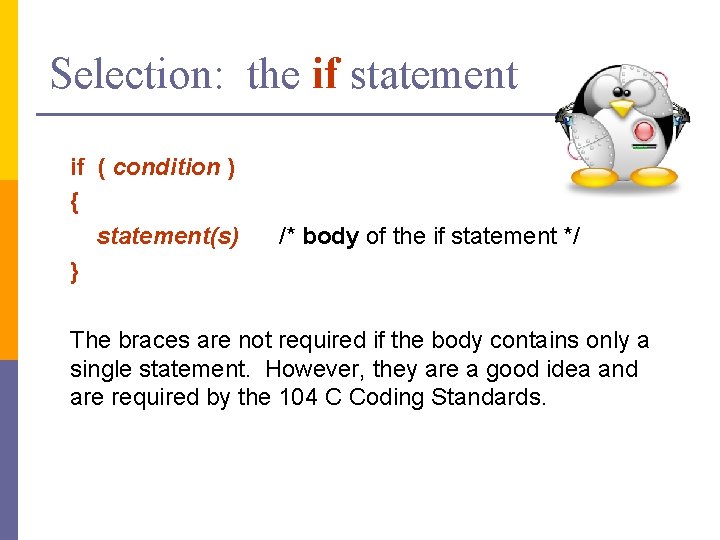
Selection: the if statement if ( condition ) { statement(s) } /* body of the if statement */ The braces are not required if the body contains only a single statement. However, they are a good idea and are required by the 104 C Coding Standards.
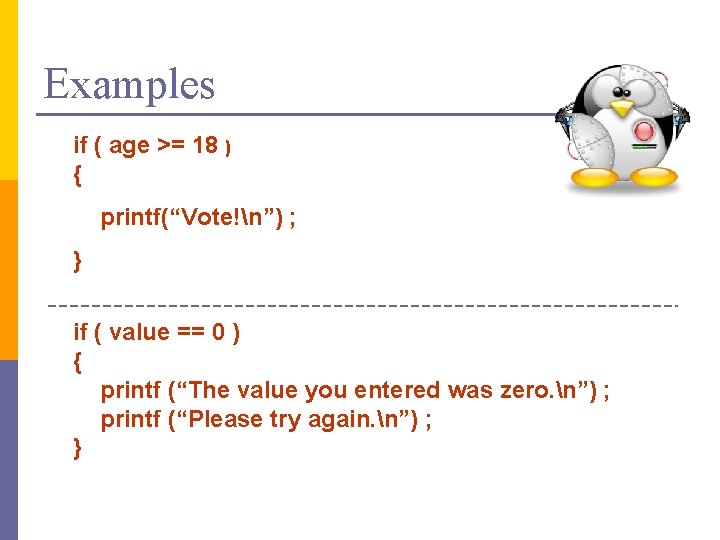
Examples if ( age >= 18 ) { printf(“Vote!n”) ; } if ( value == 0 ) { printf (“The value you entered was zero. n”) ; printf (“Please try again. n”) ; }
Good Programming Practice Always place braces around the body of an if statement. p Advantages: p n n n p Easier to read Will not forget to add the braces if you go back and add a second statement to the body Less likely to make a semantic error Indent the body of the if statement 3 to 5 spaces -- be consistent!
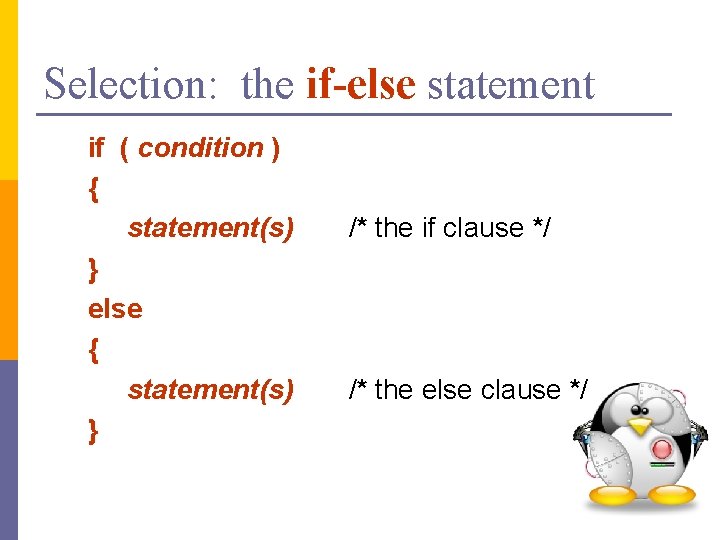
Selection: the if-else statement if ( condition ) { statement(s) } else { statement(s) } /* the if clause */ /* the else clause */
Example if ( age >= 18 ) { printf(“Vote!n”) ; } else { printf(“Maybe next time!n”) ; }
Example if ( value == 0 ) { printf (“The value you entered was zero. n”) ; printf(“Please try again. n”) ; } else { printf (“Value = %d. n”, value) ; }
Good Programming Practice Always place braces around the bodies of the if and else clauses of an if-else statement. p Advantages: p n n n p Easier to read Will not forget to add the braces if you go back and add a second statement to the clause Less likely to make a semantic error Indent the bodies of the if and else clauses 3 to 5 spaces -- be consistent!
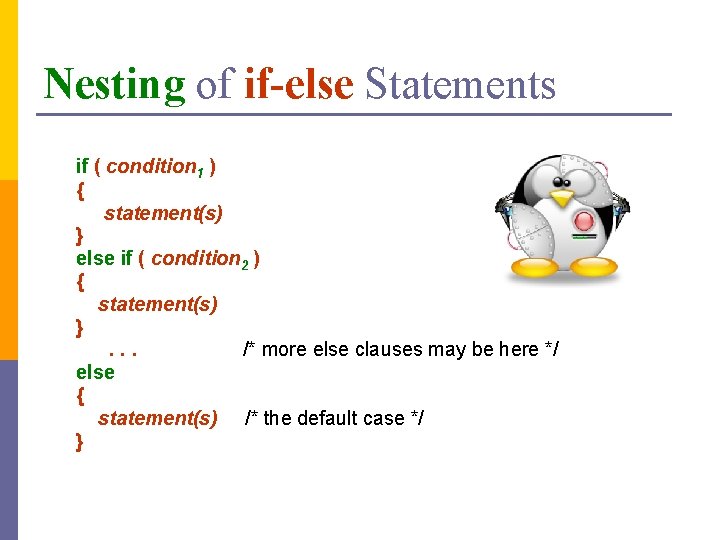
Nesting of if-else Statements if ( condition 1 ) { statement(s) } else if ( condition 2 ) { statement(s) }. . . /* more else clauses may be here */ else { statement(s) /* the default case */ }
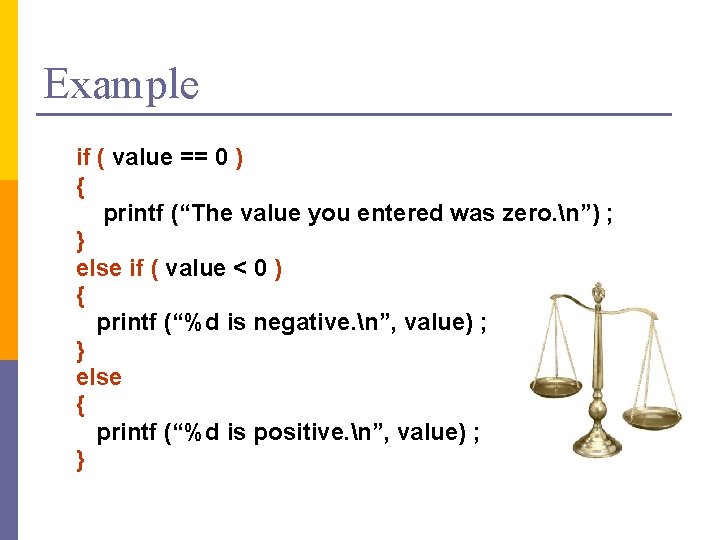
Example if ( value == 0 ) { printf (“The value you entered was zero. n”) ; } else if ( value < 0 ) { printf (“%d is negative. n”, value) ; } else { printf (“%d is positive. n”, value) ; }
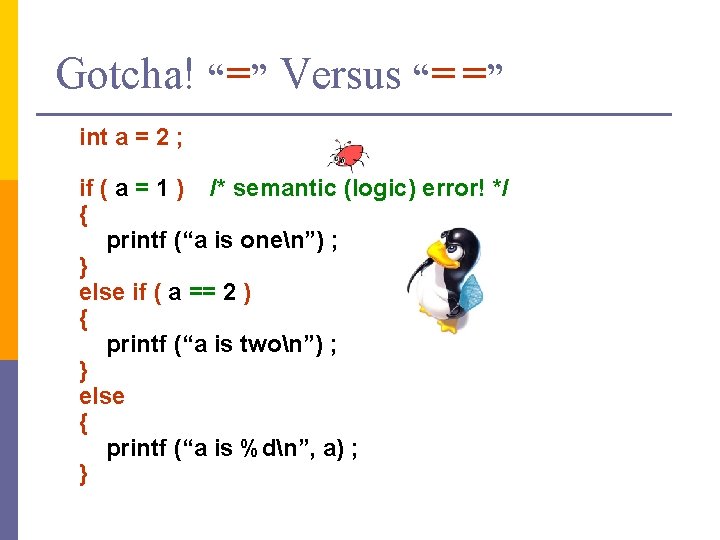
Gotcha! “=” Versus “= =” int a = 2 ; if ( a = 1 ) /* semantic (logic) error! */ { printf (“a is onen”) ; } else if ( a == 2 ) { printf (“a is twon”) ; } else { printf (“a is %dn”, a) ; }
Gotcha (con’t) p p The statement if (a = 1) is syntactically correct, so no error message will be produced. (Some compilers will produce a warning. ) However, a semantic (logic) error will occur. An assignment expression has a value -- the value being assigned. In this case the value being assigned is 1, which is true. If the value being assigned was 0, then the expression would evaluate to 0, which is false. This is a VERY common error. So, if your if-else structure always executes the same, look for this typographical error.
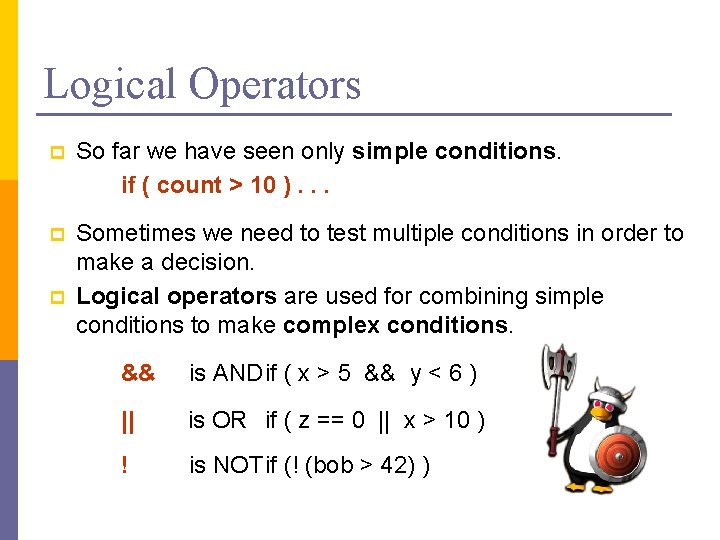
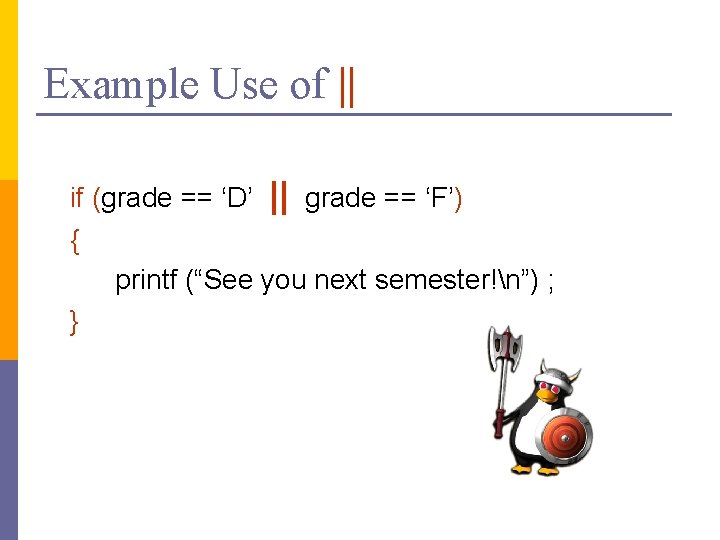
Logical Operators p So far we have seen only simple conditions. if ( count > 10 ). . . p Sometimes we need to test multiple conditions in order to make a decision. Logical operators are used for combining simple conditions to make complex conditions. p && is ANDif ( x > 5 && y < 6 ) || is OR if ( z == 0 || x > 10 ) ! is NOTif (! (bob > 42) )
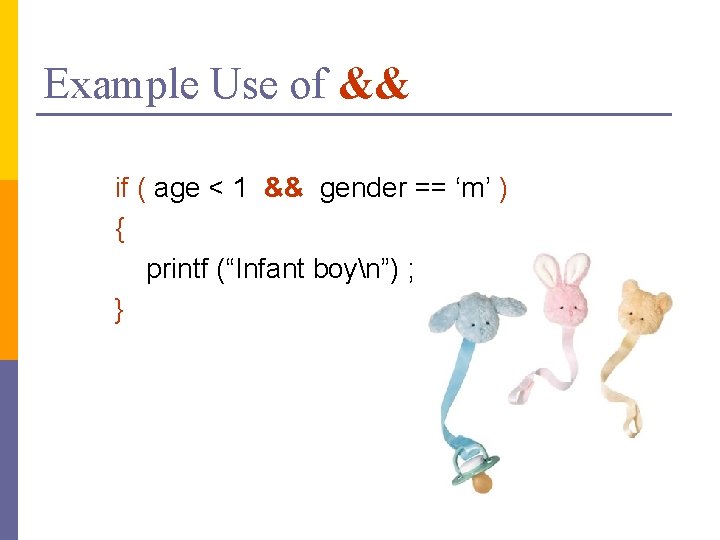
Example Use of && if ( age < 1 && gender == ‘m’ ) { printf (“Infant boyn”) ; }
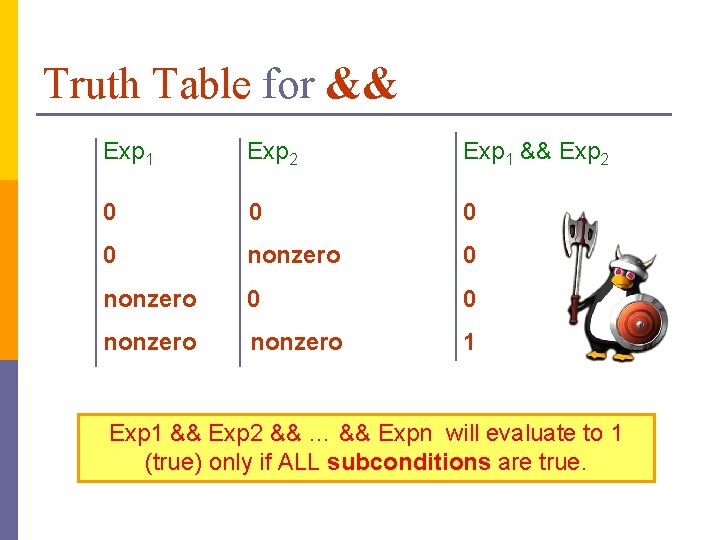
Truth Table for && Exp 1 Exp 2 Exp 1 && Exp 2 0 0 nonzero 1 Exp 1 && Exp 2 && … && Expn will evaluate to 1 (true) only if ALL subconditions are true.
Example Use of || if (grade == ‘D’ || grade == ‘F’) { printf (“See you next semester!n”) ; }
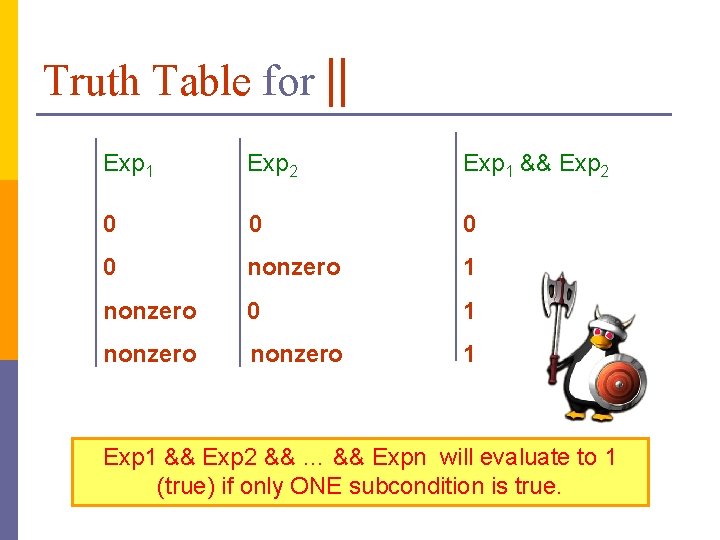
Truth Table for || Exp 1 Exp 2 Exp 1 && Exp 2 0 0 nonzero 1 nonzero 0 1 nonzero 1 Exp 1 && Exp 2 && … && Expn will evaluate to 1 (true) if only ONE subcondition is true.
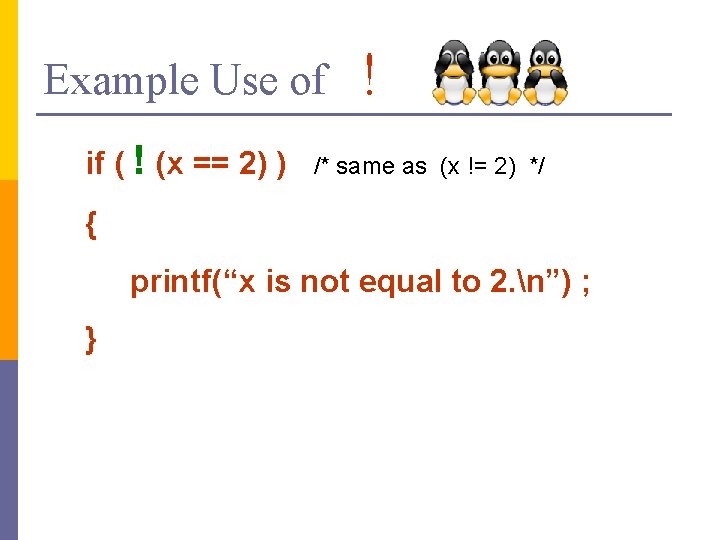
Example Use of if ( ! (x == 2) ) ! /* same as (x != 2) */ { printf(“x is not equal to 2. n”) ; }
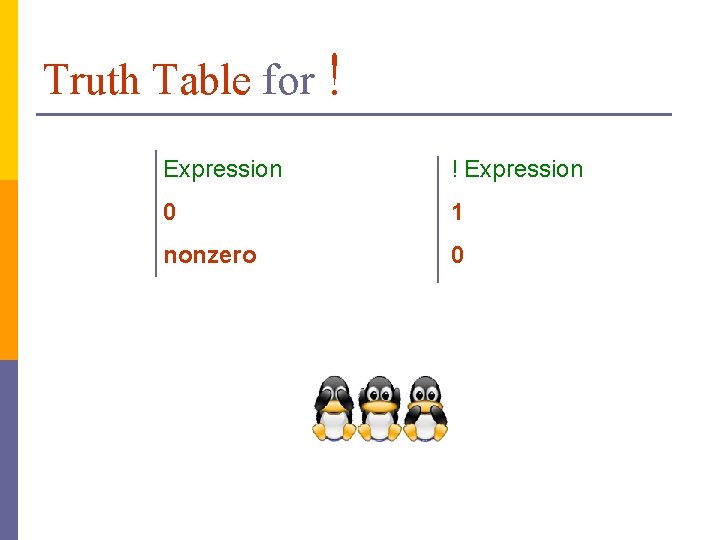
Truth Table for ! Expression 0 1 nonzero 0
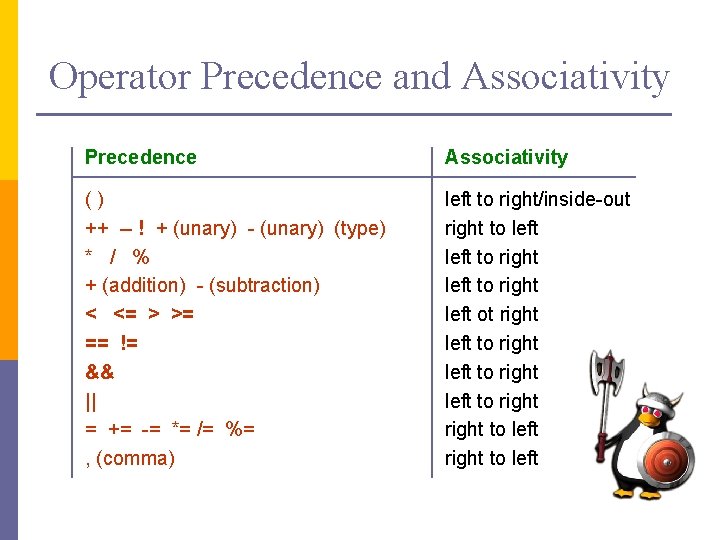
Operator Precedence and Associativity Precedence Associativity () ++ -- ! + (unary) - (unary) (type) * / % + (addition) - (subtraction) < <= > >= == != && || = += -= *= /= %= , (comma) left to right/inside-out right to left to right left ot right left to right to left
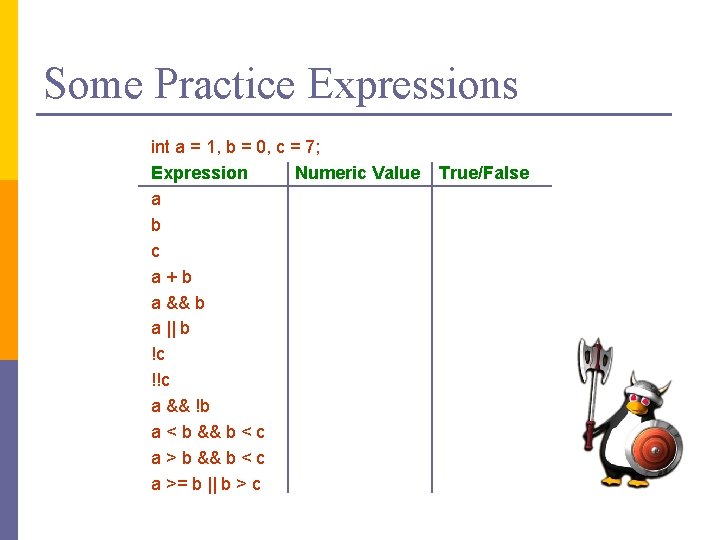
Some Practice Expressions int a = 1, b = 0, c = 7; Expression Numeric Value a b c a+b a && b a || b !c !!c a && !b a < b && b < c a >= b || b > c True/False
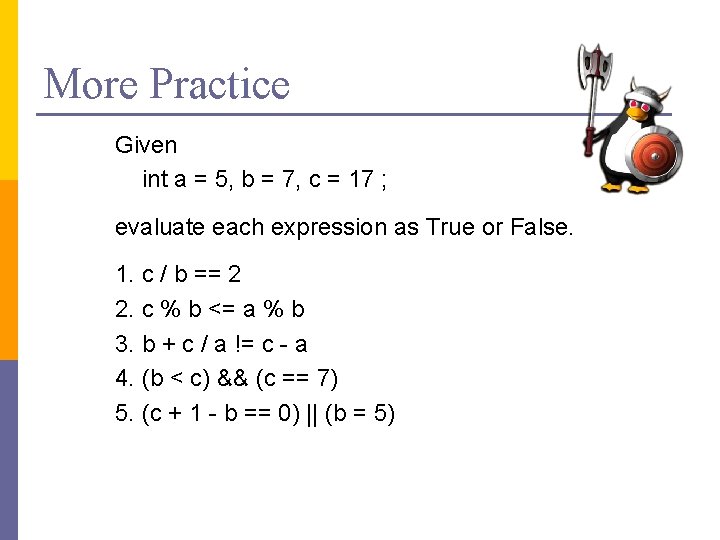
More Practice Given int a = 5, b = 7, c = 17 ; evaluate each expression as True or False. 1. c / b == 2 2. c % b <= a % b 3. b + c / a != c - a 4. (b < c) && (c == 7) 5. (c + 1 - b == 0) || (b = 5)