
Relation Extraction with Matrix Factorization and Universal Schemas
- Slides: 24
Relation Extraction with Matrix Factorization and Universal Schemas Sebastian Riedel, Limin Yao, Andrew Mc. Callum, Benjamin M. Marlin NAACL 2013 Rachit Saluja (rsaluja@seas. upenn. edu) 03/20/2019
Problem & Motivation • This paper tries to tackle the problem of Relation Extraction. • Relation extraction involves determining relations between predicates. Text: Mark works in the history department at Harvard. Relation extraction: [Mark, Relation: is a historian, Harvard] • More Traditional Techniques use Supervised Learning which is very time consuming to annotate. – Multiclassification on a closed set of relations. 2
Problem and Motivation (cont. ) • Why do the algorithms not perform well? 1. The dataset used to train the supervised learning algorithm may not even have that context. (works in history dept. -- > professor) 2. Even if people did figure out a way to find all these relations, it would be impossible to annotate all of them. • This paper tries to solve these problems! 3
Contents: • • • Previous approaches and how did we get there? Matrix Factorization and Universal Schemas Contributions of this work How does the Matrix look like? Objective Function and Matrix Factorization Data Used Evaluation Shortcomings Conclusions and Future Work 4
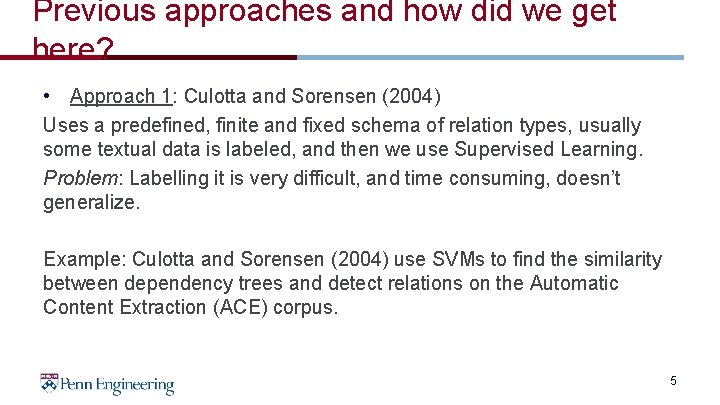
Previous approaches and how did we get here? • Approach 1: Culotta and Sorensen (2004) Uses a predefined, finite and fixed schema of relation types, usually some textual data is labeled, and then we use Supervised Learning. Problem: Labelling it is very difficult, and time consuming, doesn’t generalize. Example: Culotta and Sorensen (2004) use SVMs to find the similarity between dependency trees and detect relations on the Automatic Content Extraction (ACE) corpus. 5
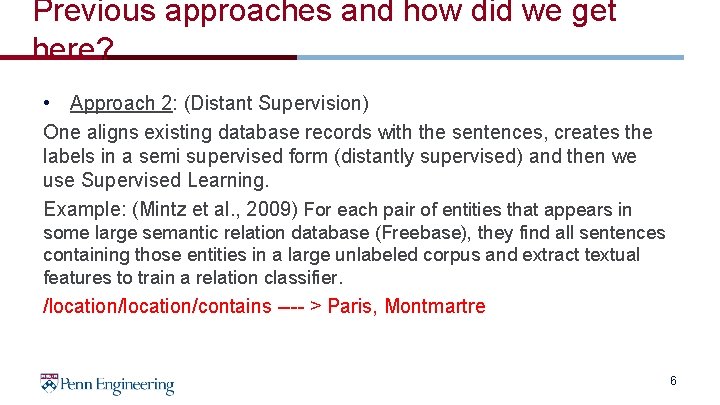
Previous approaches and how did we get here? • Approach 2: (Distant Supervision) One aligns existing database records with the sentences, creates the labels in a semi supervised form (distantly supervised) and then we use Supervised Learning. Example: (Mintz et al. , 2009) For each pair of entities that appears in some large semantic relation database (Freebase), they find all sentences containing those entities in a large unlabeled corpus and extract textual features to train a relation classifier. /location/contains ---- > Paris, Montmartre 6
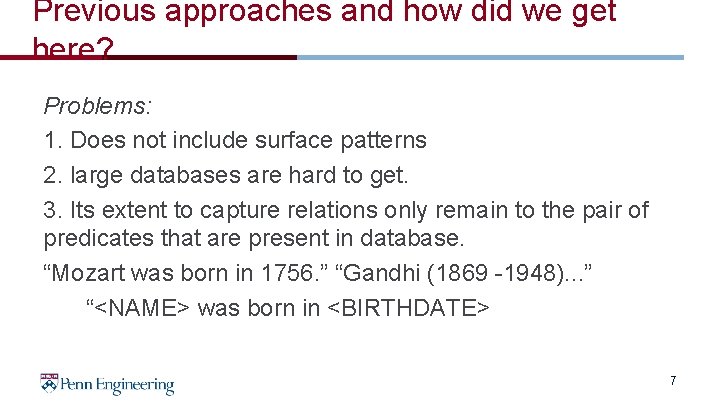
Previous approaches and how did we get here? Problems: 1. Does not include surface patterns 2. large databases are hard to get. 3. Its extent to capture relations only remain to the pair of predicates that are present in database. “Mozart was born in 1756. ” “Gandhi (1869 -1948). . . ” “<NAME> was born in <BIRTHDATE> 7
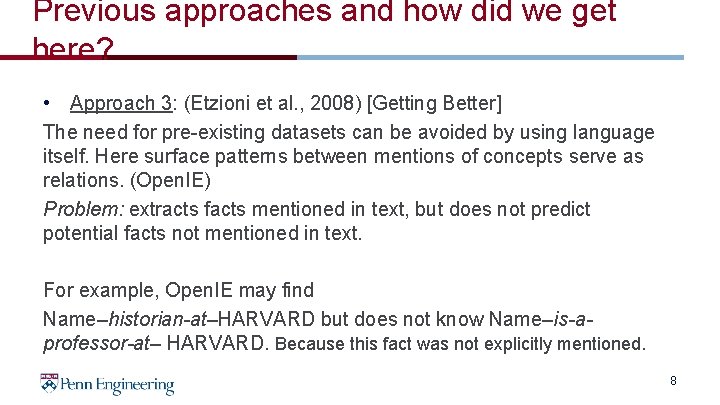
Previous approaches and how did we get here? • Approach 3: (Etzioni et al. , 2008) [Getting Better] The need for pre-existing datasets can be avoided by using language itself. Here surface patterns between mentions of concepts serve as relations. (Open. IE) Problem: extracts facts mentioned in text, but does not predict potential facts not mentioned in text. For example, Open. IE may find Name–historian-at–HARVARD but does not know Name–is-aprofessor-at– HARVARD. Because this fact was not explicitly mentioned. 8
Previous approaches and how did we get here? • Approach 4: (Yao et al. , 2011) Way to improvement is to cluster textual surface forms that have similar meaning based on given database. Example: Cluster could have (historian-at, professor-at, scientist- at, worked-at) But that scientist-at does not necessarily imply professorat and worked-at certainly does not imply scientist-at. 9
Matrix Factorization and Universal Schemas • Step 1: Defining the schema to be the union of all source schemas: original input forms, e. g. variants of surface pat- terns similarly to Open. IE, as well as relations in the schemas of many available pre-existing structured databases. Schema is defined as the database + corpus that the system uses to extract relations. 10
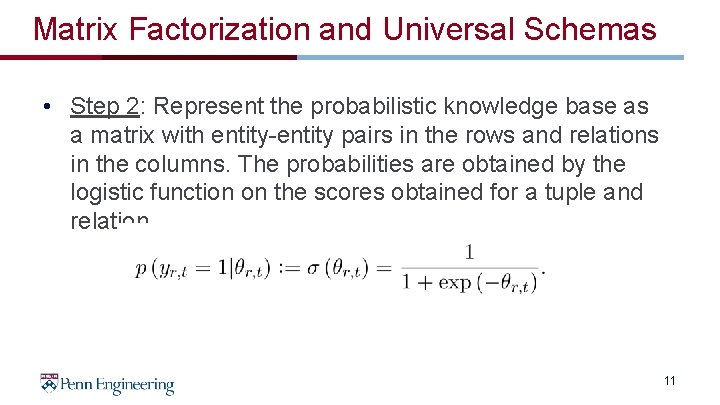
Matrix Factorization and Universal Schemas • Step 2: Represent the probabilistic knowledge base as a matrix with entity-entity pairs in the rows and relations in the columns. The probabilities are obtained by the logistic function on the scores obtained for a tuple and relation. 11
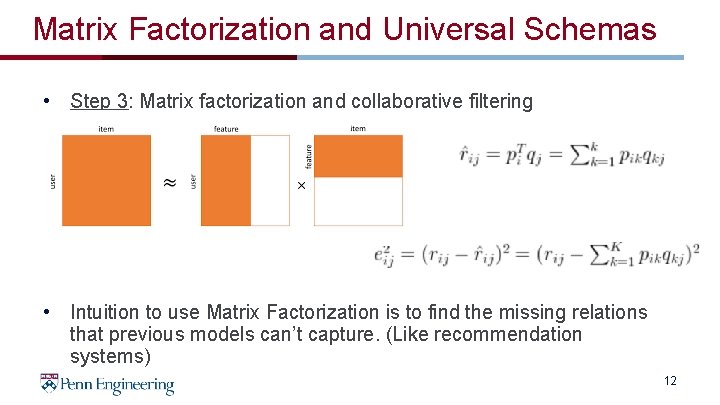
Matrix Factorization and Universal Schemas • Step 3: Matrix factorization and collaborative filtering • Intuition to use Matrix Factorization is to find the missing relations that previous models can’t capture. (Like recommendation systems) 12
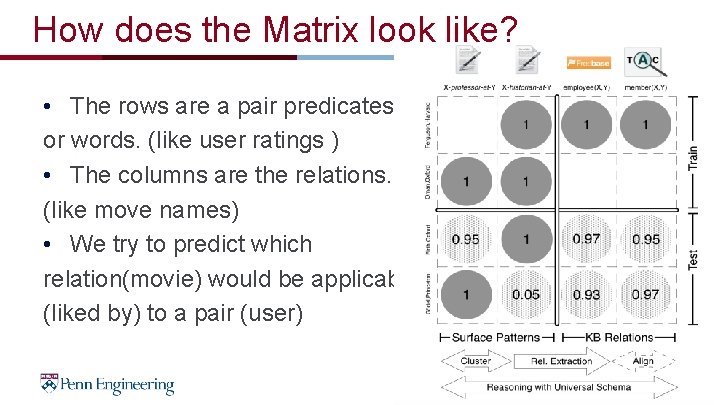
How does the Matrix look like? • The rows are a pair predicates or words. (like user ratings ) • The columns are the relations. (like move names) • We try to predict which relation(movie) would be applicable (liked by) to a pair (user) 13
Contributions of this work • Latent Features in Matrix Factorization. – Captures missing relationships (like missing values in Rec. Sys) • Neighborhood approach. – Captures features that are analogous to genre. – (historian-at, professor-at, scientist- at, worked-at) 14
Contributions of this work • Entity Model – Captures understanding that (p 1 – relation – p 2), can only have a small set of (p 1 and p 2) which helps in learning. – [(Name) – scientist – Penn] and we know that it can never be [(Place) – scientist – Penn ] 15
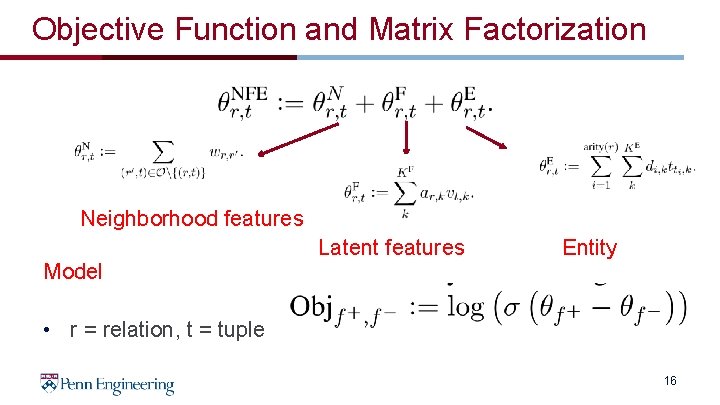
Objective Function and Matrix Factorization Neighborhood features Latent features Entity Model • r = relation, t = tuple 16
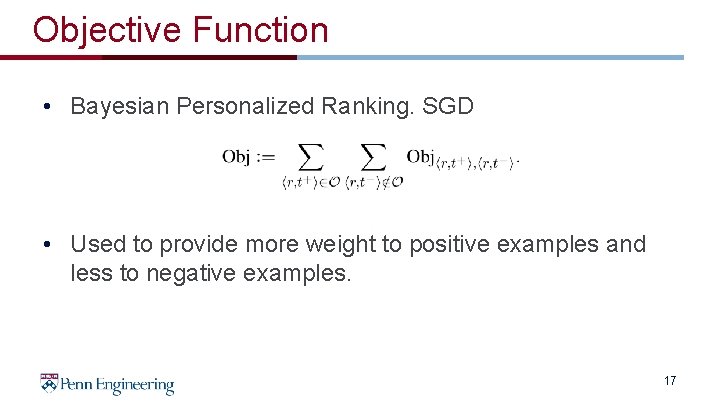
Objective Function • Bayesian Personalized Ranking. SGD • Used to provide more weight to positive examples and less to negative examples. 17
Data • They use Freebase here, with NYT corpus. • Freebase helps to capture the relations and predicate pairs easily. Easier to make the Matrix in Matrix Factorization. • NYT corpus, has a lot text, which helps to build a very big dataset. 18
Data and Preprocessing • Freebase Evaluation: Articles from NYT after 2000 are used as training corpus, articles from 1990 to 1999 as test corpus. Freebase facts 50/50 into train and test facts, and their corresponding tuples into train and test tuples. Coupled together. 200 k Training set, 200 k Test set (10 k For evaluation) • Surface patterns: Extract lexicalized dependency paths between predicates to produce 4 k more examples. • They take the union of both. 19
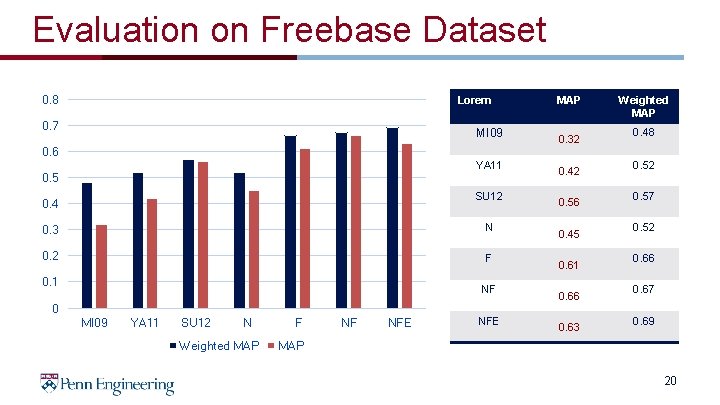
Evaluation on Freebase Dataset 0. 8 Lorem 0. 7 MI 09 0. 6 YA 11 0. 5 SU 12 0. 4 0. 3 N 0. 2 F 0. 1 NF 0 MI 09 YA 11 SU 12 N Weighted MAP F NF NFE MAP 0. 32 0. 42 0. 56 0. 45 0. 61 0. 66 0. 63 Weighted MAP 0. 48 0. 52 0. 57 0. 52 0. 66 0. 67 0. 69 MAP 20
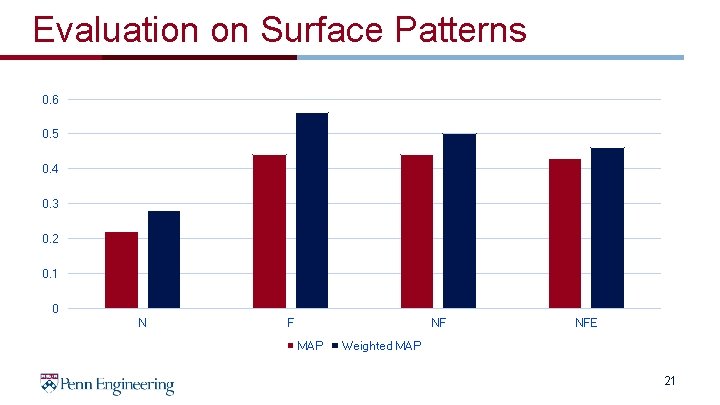
Evaluation on Surface Patterns 0. 6 0. 5 0. 4 0. 3 0. 2 0. 1 0 N F NF MAP NFE Weighted MAP 21
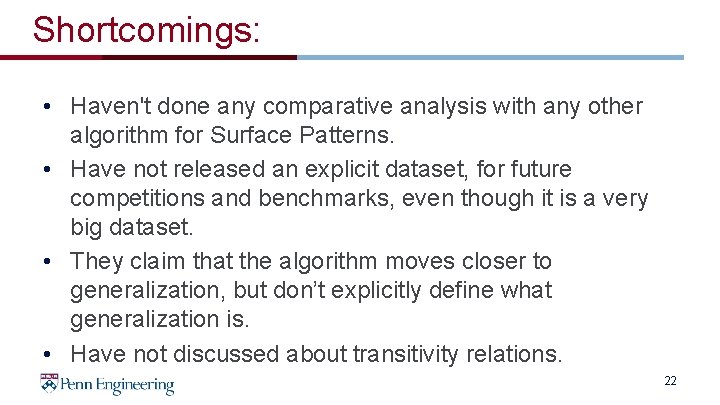
Shortcomings: • Haven't done any comparative analysis with any other algorithm for Surface Patterns. • Have not released an explicit dataset, for future competitions and benchmarks, even though it is a very big dataset. • They claim that the algorithm moves closer to generalization, but don’t explicitly define what generalization is. • Have not discussed about transitivity relations. 22
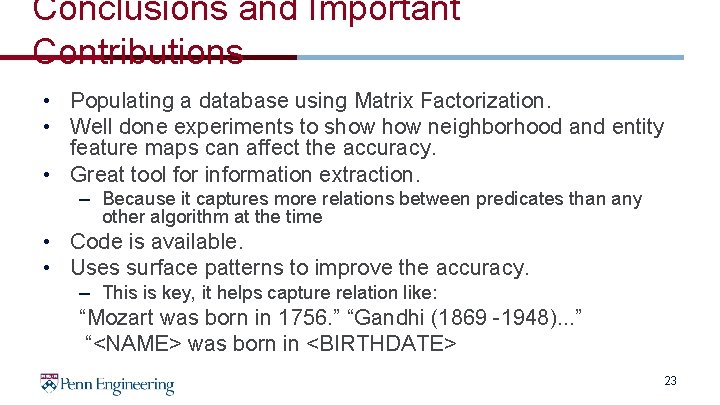
Conclusions and Important Contributions • Populating a database using Matrix Factorization. • Well done experiments to show neighborhood and entity feature maps can affect the accuracy. • Great tool for information extraction. – Because it captures more relations between predicates than any other algorithm at the time • Code is available. • Uses surface patterns to improve the accuracy. – This is key, it helps capture relation like: “Mozart was born in 1756. ” “Gandhi (1869 -1948). . . ” “<NAME> was born in <BIRTHDATE> 23
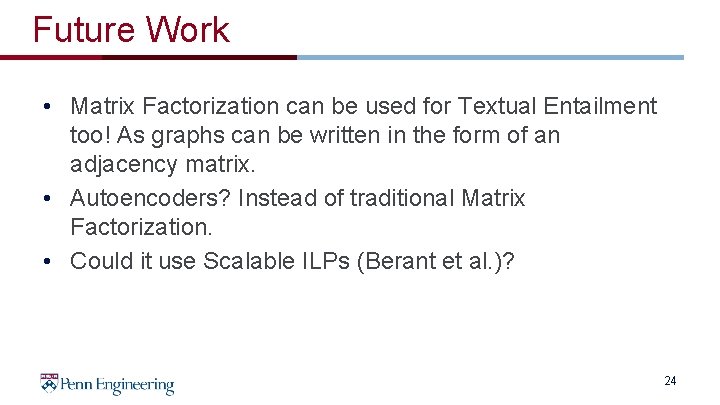
Future Work • Matrix Factorization can be used for Textual Entailment too! As graphs can be written in the form of an adjacency matrix. • Autoencoders? Instead of traditional Matrix Factorization. • Could it use Scalable ILPs (Berant et al. )? 24