
Relation between P D q Dual of dual
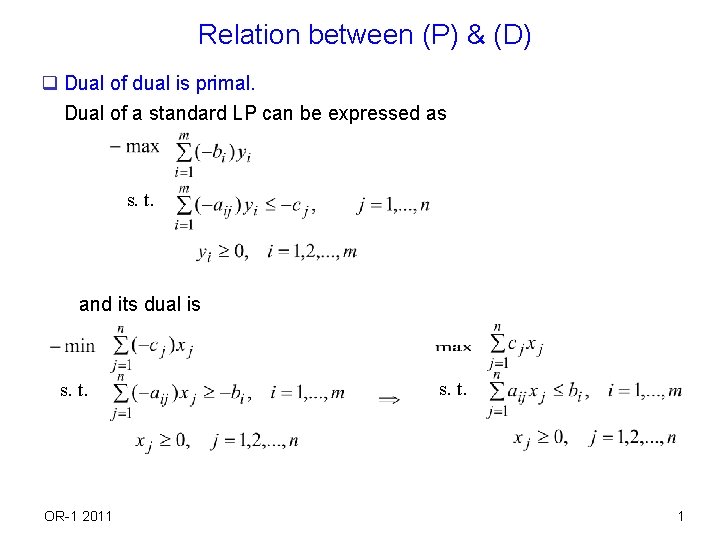
Relation between (P) & (D) q Dual of dual is primal. Dual of a standard LP can be expressed as s. t. and its dual is s. t. OR-1 2011 s. t. 1
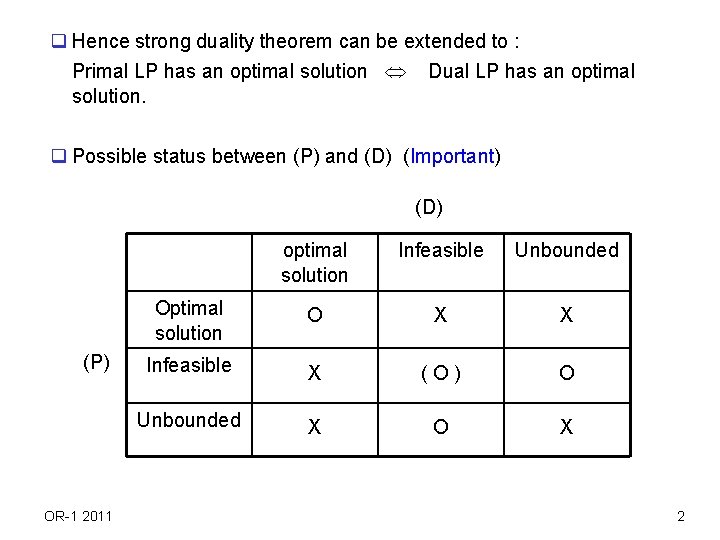
q Hence strong duality theorem can be extended to : Primal LP has an optimal solution Dual LP has an optimal solution. q Possible status between (P) and (D) (Important) (D) (P) OR-1 2011 optimal solution Infeasible Unbounded Optimal solution O X X Infeasible X (O) O Unbounded X O X 2
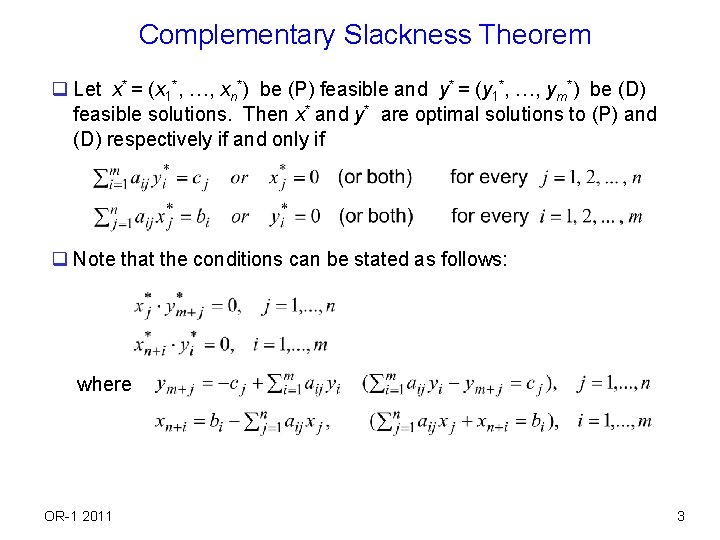
Complementary Slackness Theorem q Let x* = (x 1*, …, xn*) be (P) feasible and y* = (y 1*, …, ym*) be (D) feasible solutions. Then x* and y* are optimal solutions to (P) and (D) respectively if and only if q Note that the conditions can be stated as follows: where OR-1 2011 3
q The conditions say that if one of the primal (dual) variable is positive, then the other corresponding dual (primal) variable must be 0, i. e. at least one of the corresponding pair of primal, dual variables must be 0 in an optimal solution. (primal, dual variables must be feasible, respectively) OR-1 2011 4
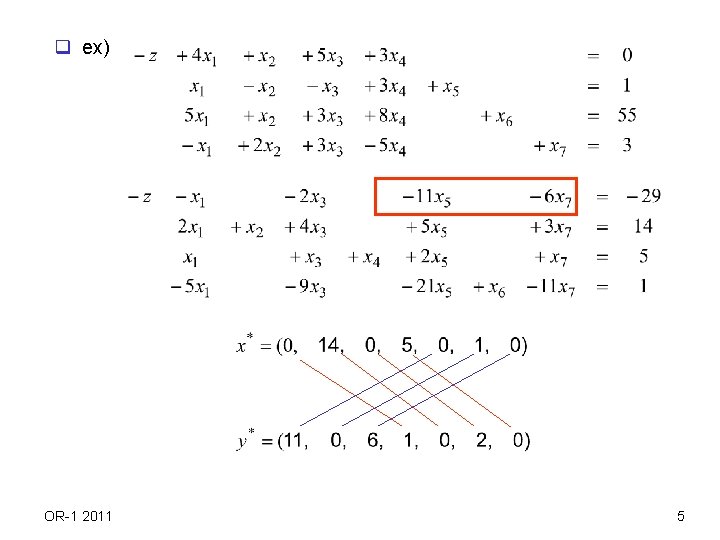
q ex) OR-1 2011 5
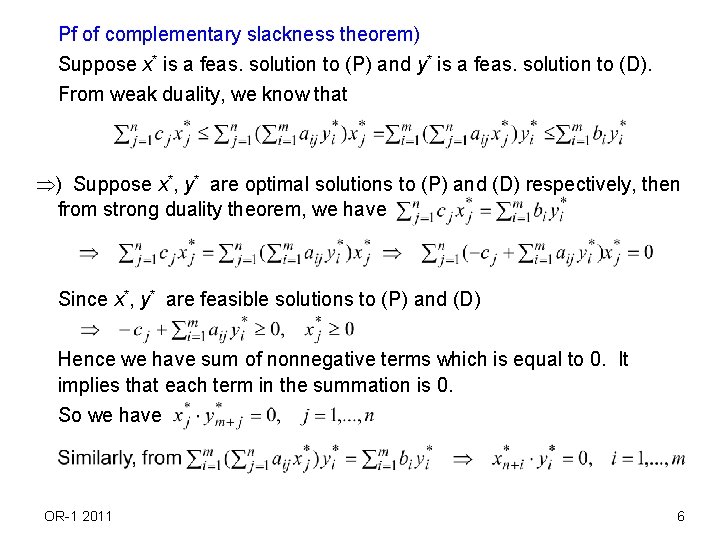
Pf of complementary slackness theorem) Suppose x* is a feas. solution to (P) and y* is a feas. solution to (D). From weak duality, we know that ) Suppose x*, y* are optimal solutions to (P) and (D) respectively, then from strong duality theorem, we have Since x*, y* are feasible solutions to (P) and (D) Hence we have sum of nonnegative terms which is equal to 0. It implies that each term in the summation is 0. So we have OR-1 2011 6
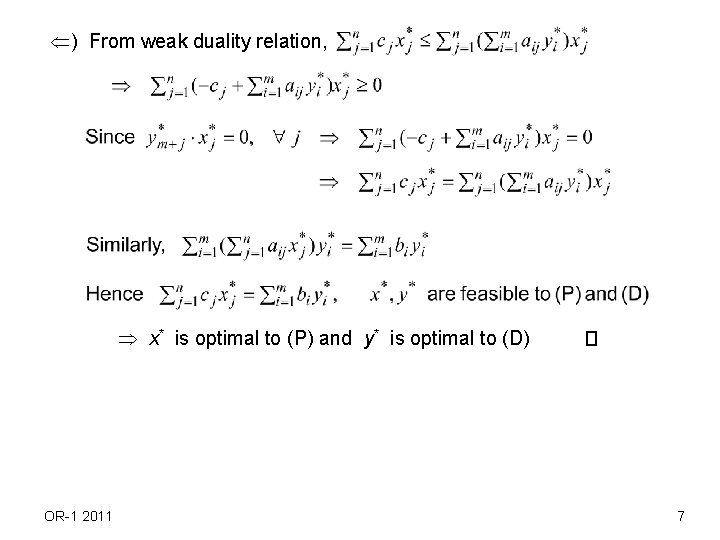
) From weak duality relation, x* is optimal to (P) and y* is optimal to (D) OR-1 2011 � 7
Remarks q CS conditions are necessary and sufficient conditions for optimality. But the condition that the coefficients in the z-row are nonpositive in the simplex tableau is only a sufficient condition for optimality, but not necessary. q CS optimality conditions also hold for more general forms of primal, dual pair of problems if dual is defined appropriately. (more on this later in Chap. 9) q In the CS theorem, the solutions x* and y* need not be basic solutions (in equality form LP). Any primal and dual feasible solutions that satisfy the CS conditions are optimal. CS conditions can be used to design algorithms for LP or network problems. q Most powerful form of interior point method tries to find solutions that satisfy the CS conditions with some modifications. (Logic to derive the conditions is different though) OR-1 2011 8
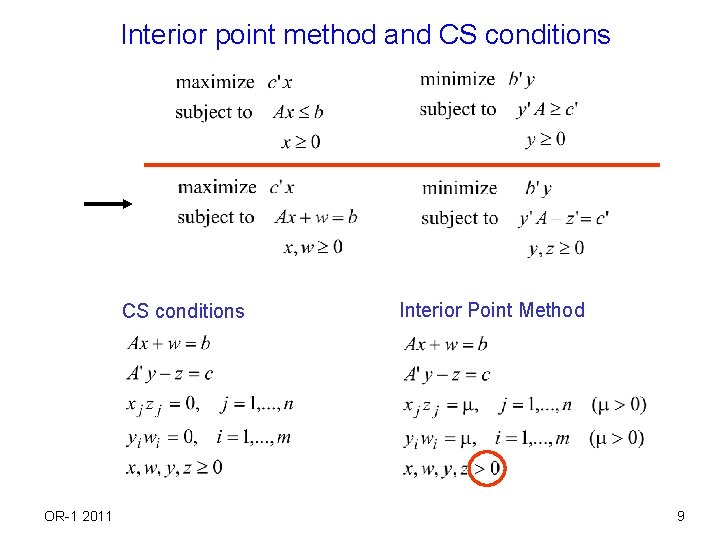
Interior point method and CS conditions OR-1 2011 Interior Point Method 9
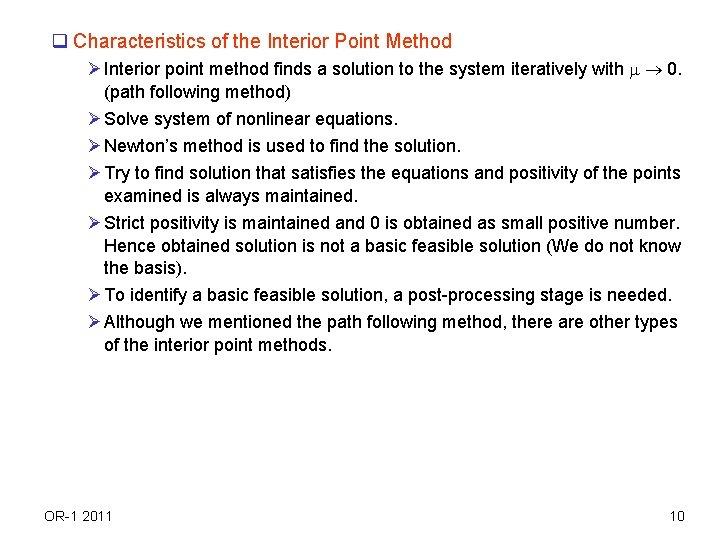
q Characteristics of the Interior Point Method Ø Interior point method finds a solution to the system iteratively with 0. (path following method) Ø Solve system of nonlinear equations. Ø Newton’s method is used to find the solution. Ø Try to find solution that satisfies the equations and positivity of the points examined is always maintained. Ø Strict positivity is maintained and 0 is obtained as small positive number. Hence obtained solution is not a basic feasible solution (We do not know the basis). Ø To identify a basic feasible solution, a post-processing stage is needed. Ø Although we mentioned the path following method, there are other types of the interior point methods. OR-1 2011 10
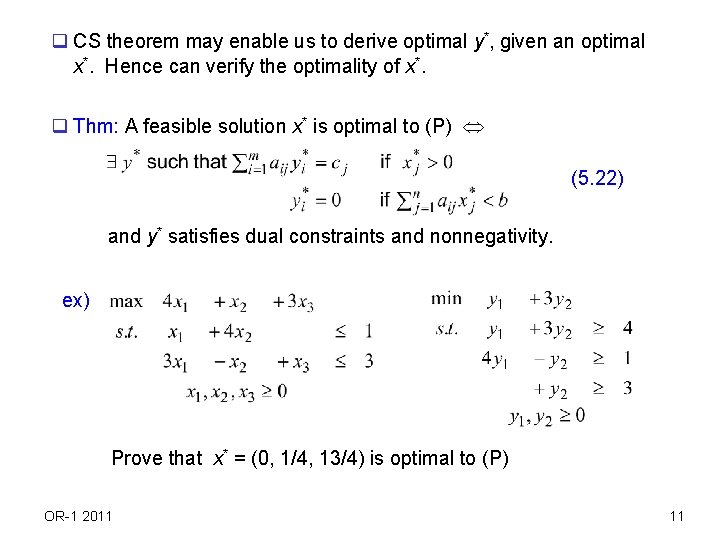
q CS theorem may enable us to derive optimal y*, given an optimal x*. Hence can verify the optimality of x*. q Thm: A feasible solution x* is optimal to (P) (5. 22) and y* satisfies dual constraints and nonnegativity. ex) Prove that x* = (0, 1/4, 13/4) is optimal to (P) OR-1 2011 11
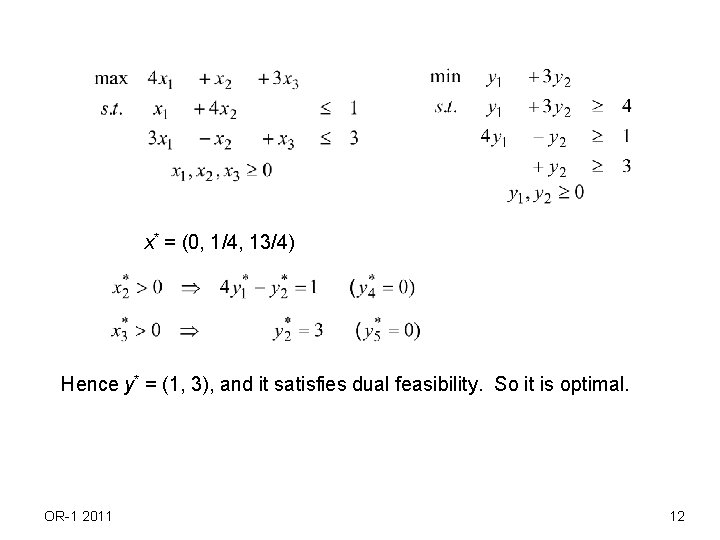
x* = (0, 1/4, 13/4) Hence y* = (1, 3), and it satisfies dual feasibility. So it is optimal. OR-1 2011 12
q Does the system we obtained always have unique solution? q Thm: (sufficient condition for unique solution) If x* is a nondegenerate basic feasible solution (5. 22) has a unique solution y*. pf) homework later. OR-1 2011 13
Economic significance of dual variables q Can interpret optimal dual variable as marginal value of adding one unit of resource to the r. h. s of constraint i (interpret the constraint as limiting the availability of resource i ). q Thm: If (P) has at least one nondegenerate basic optimal solution, then s. t. pf) homework later. OR-1 2011 14
q yi* called the marginal value of the i-th resource, shadow price of the i-th resource. q Ex) Forester’s Problem : Forester has 100 acres of hardwood timber and $4, 000. (1) Fell the hardwood and let the area regenerate: cost $10/acre, subsequent return $50/acre, net profit $40/acre (2) Fell the hardwood and plant the area with pine: cost $50/acre, subsequent return $120/acre, net profit $70/acre. maximize subject to OR-1 2011 40 x 1 + 70 x 2 x 1 + x 2 100 10 x 1 + 50 X 2 4, 000 x 1, x 2 0 15
maximize subject to 40 x 1 + 70 x 2 x 1 + x 2 100 10 x 1 + 50 X 2 4, 000 x 1, x 2 0 Optimal solution is x 1* = 25, x 2* = 75, value = $6, 250 Optimal dual solution is y 1* = 32. 5, y 2* = 0. 75 If interest is lower than 75 cents per dollar, it is better to borrow money and invest it to the forestry. If interest is greater than 75 cents per dollar, it is better to deposit money in the bank rather than invest it in forestry. Note that if we invest too much money, the value of money may not remain 75 cents per dollar. Above analysis only holds for small changes of t, and the value of t such that the value of money remains 75 cents per dollar need to be examined (sensitivity analysis) OR-1 2011 16
- Slides: 16