
Relation between field and potential 2 E V
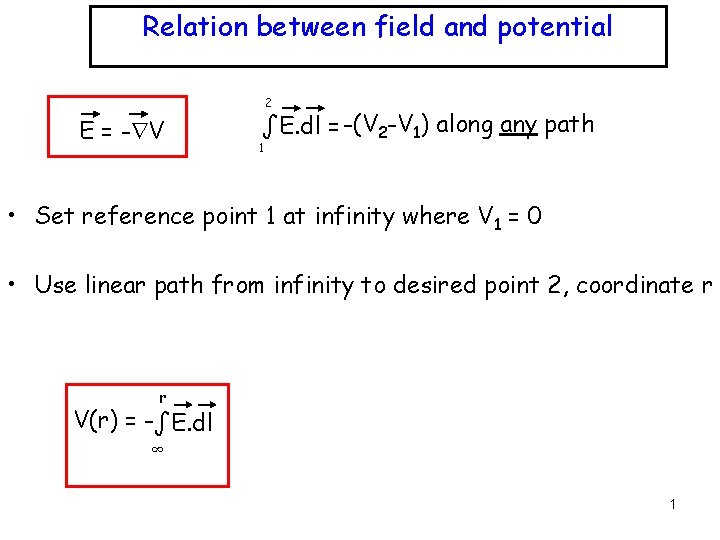
Relation between field and potential 2 E = - V ∫E. dl = -(V 2 -V 1) along any path 1 • Set reference point 1 at infinity where V 1 = 0 • Use linear path from infinity to desired point 2, coordinate r r V(r) = -∫E. dl ∞ 1
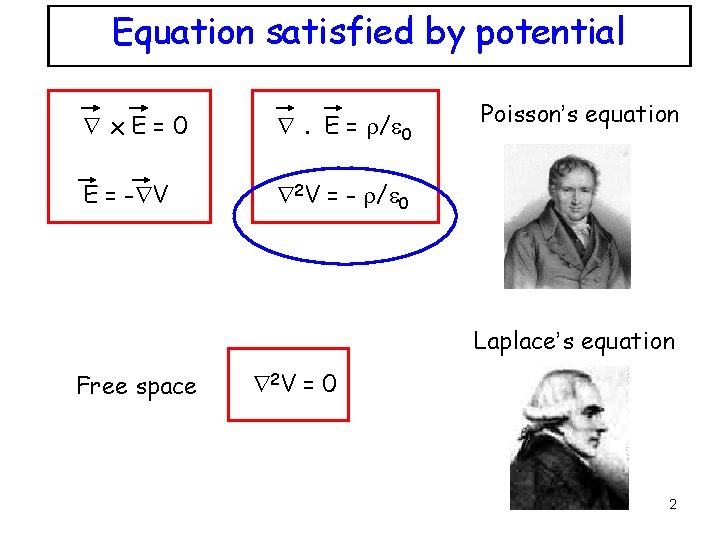
Equation satisfied by potential x. E=0 . E = r/e 0 E = - V 2 V = - r/e 0 Poisson’s equation Laplace’s equation Free space 2 V = 0 2
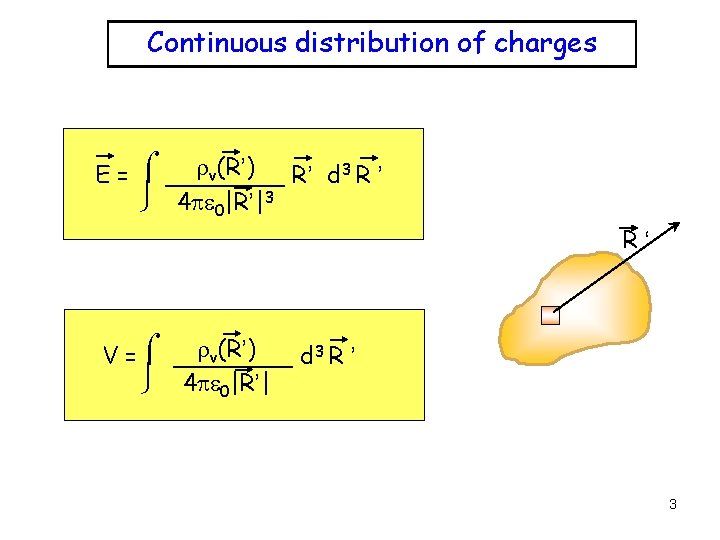
Continuous distribution of charges rv(R’) E = ____ R’ d 3 R ’ 4 pe 0|R’|3 R‘ rv(R’) V = ____ d 3 R ’ 4 pe 0|R’| 3
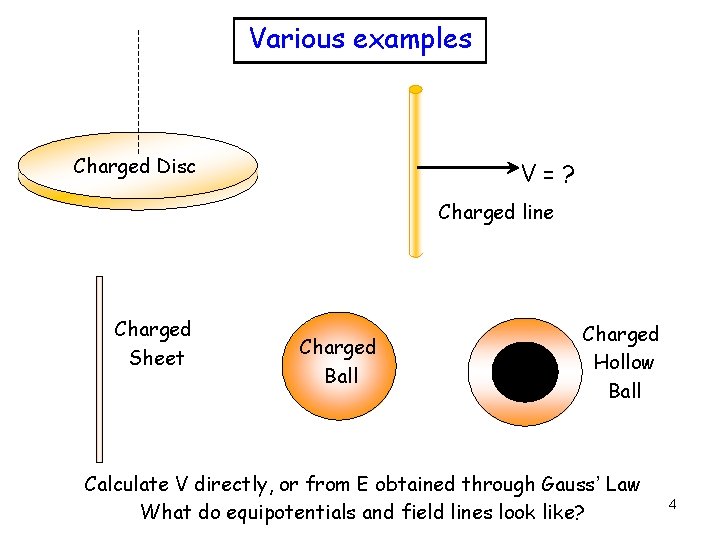
Various examples Charged Disc V=? Charged line Charged Sheet Charged Ball Charged Hollow Ball Calculate V directly, or from E obtained through Gauss’ Law What do equipotentials and field lines look like? 4
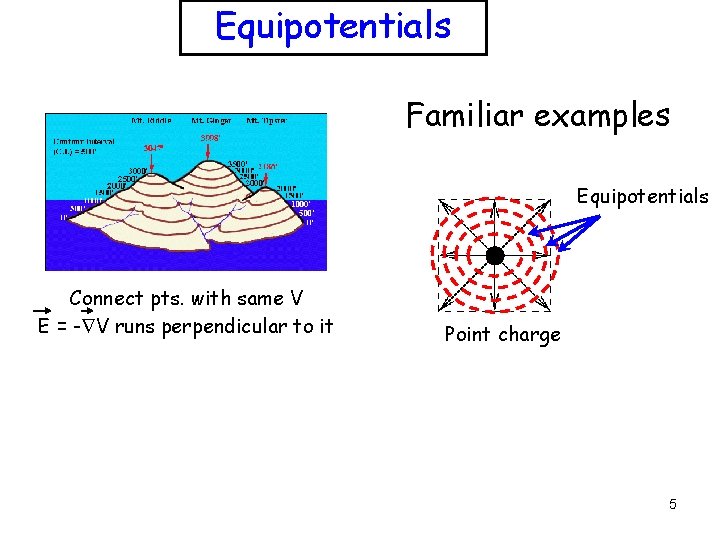
Equipotentials Familiar examples Equipotentials Connect pts. with same V E = - V runs perpendicular to it Point charge 5
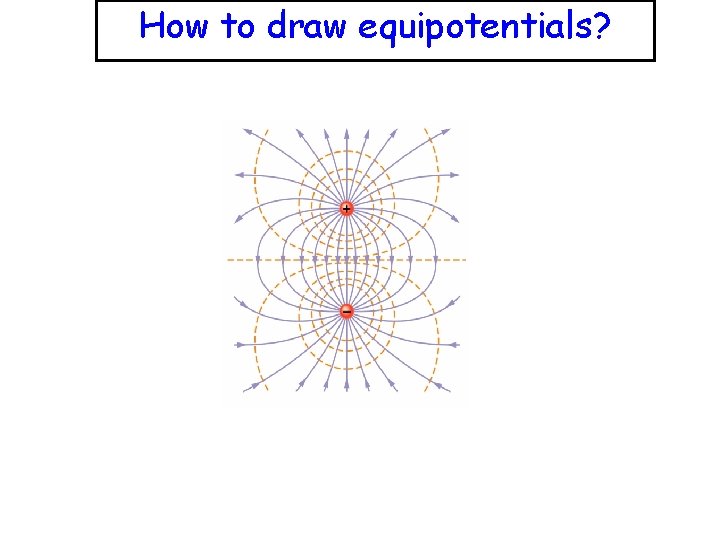
How to draw equipotentials?
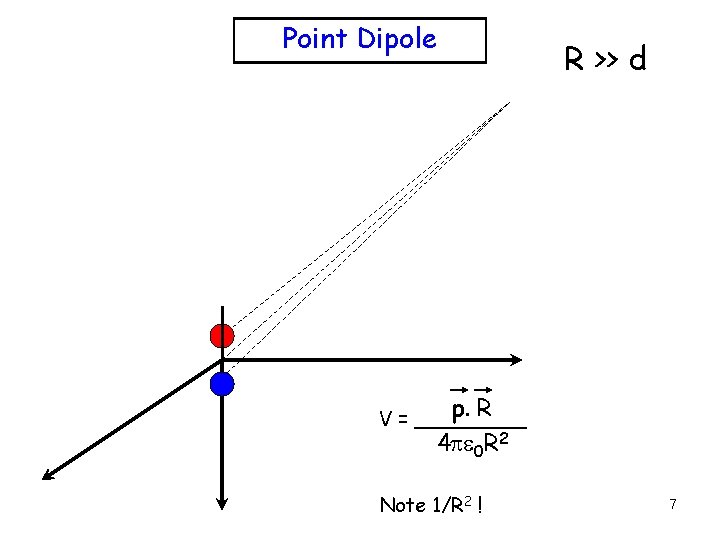
Point Dipole R >> d p. R V = _____ 4 pe 0 R 2 Note 1/R 2 ! 7
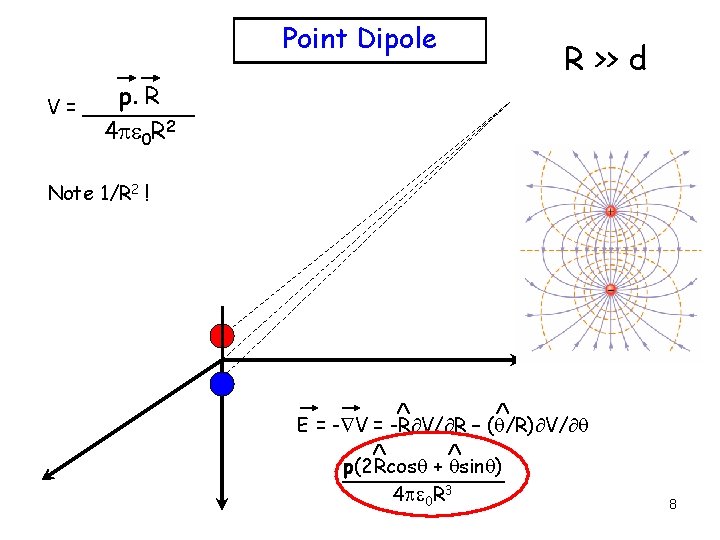
Point Dipole p. R V = _____ R >> d 4 pe 0 R 2 Note 1/R 2 ! E = - V = -R V/ R – (q/R) V/ q p(2 Rcosq + qsinq) _______ 4 pe 0 R 3 8

So dipoles annihilate each other, thereby countering the field that separated and created them in the first place. In other words, they conspire to produce a polarizing field. 9

http: //www. cco. caltech. edu/~phys 1/java/phys 1/EField. html 10

http: //www. cco. caltech. edu/~phys 1/java/phys 1/EField. html 11
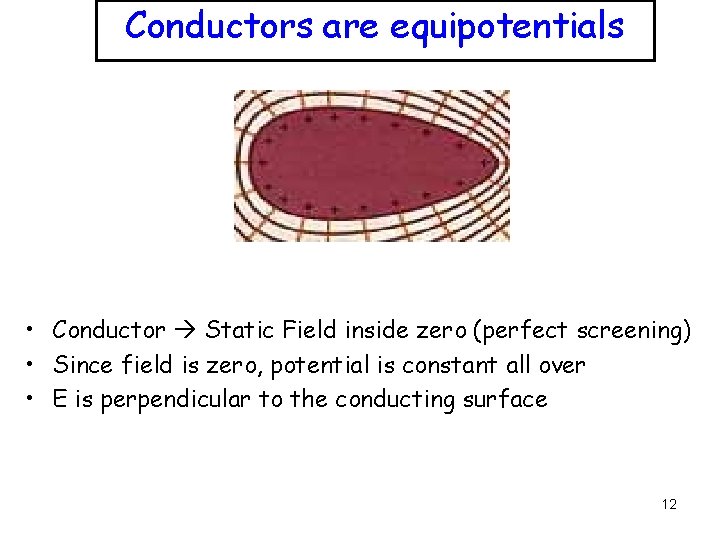
Conductors are equipotentials • Conductor Static Field inside zero (perfect screening) • Since field is zero, potential is constant all over • E is perpendicular to the conducting surface 12
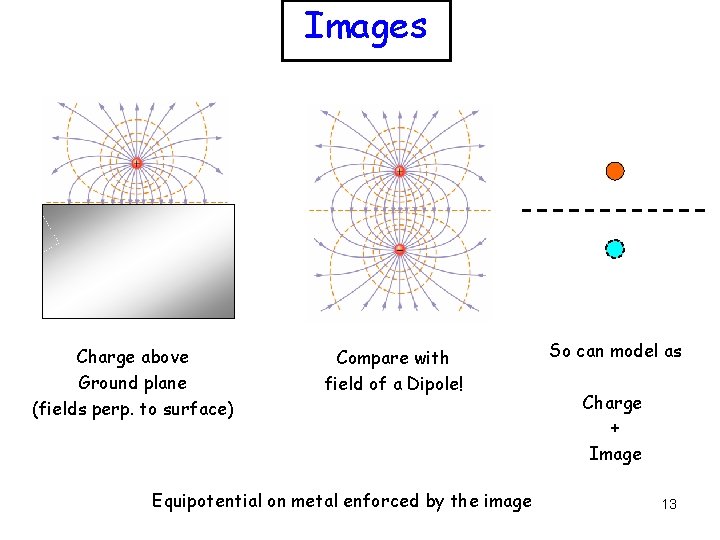
Images Charge above Ground plane (fields perp. to surface) Compare with field of a Dipole! Equipotential on metal enforced by the image So can model as Charge + Image 13
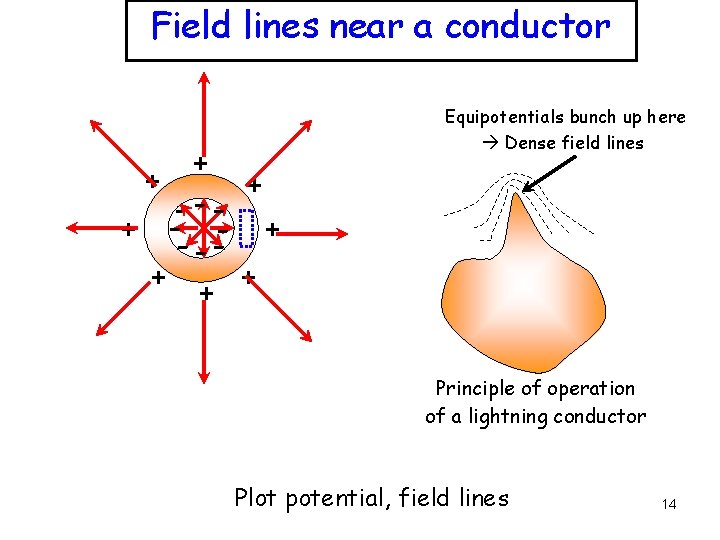
Field lines near a conductor + + + -- -- + + Equipotentials bunch up here Dense field lines Principle of operation of a lightning conductor Plot potential, field lines 14
How much charge can we store on a metal? We can calculate the voltage on a metal for a given charge. Conversely, we can calculate the charge we need to store to create a given voltage on a metal. How would we quantify the charge that is needed to create 1 volt on a metal? The ‘Capacitance’ 15
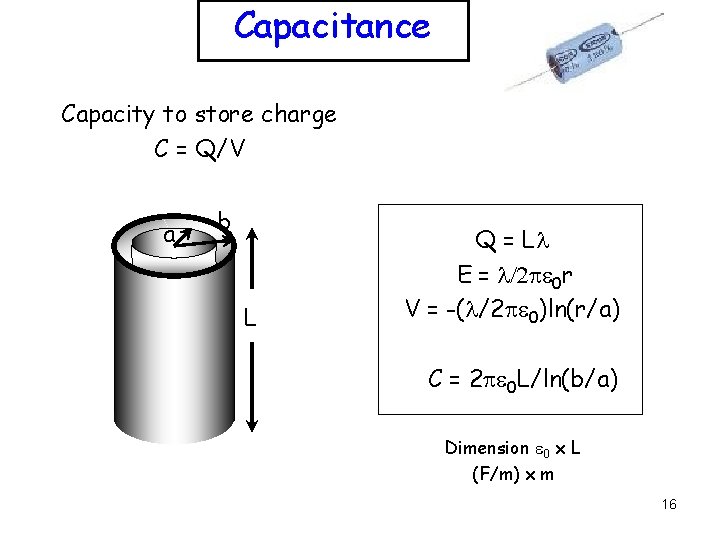
Capacitance Capacity to store charge C = Q/V a b L Q = Ll E = l/2 pe 0 r V = -(l/2 pe 0)ln(r/a) C = 2 pe 0 L/ln(b/a) Dimension e 0 x L (F/m) x m 16
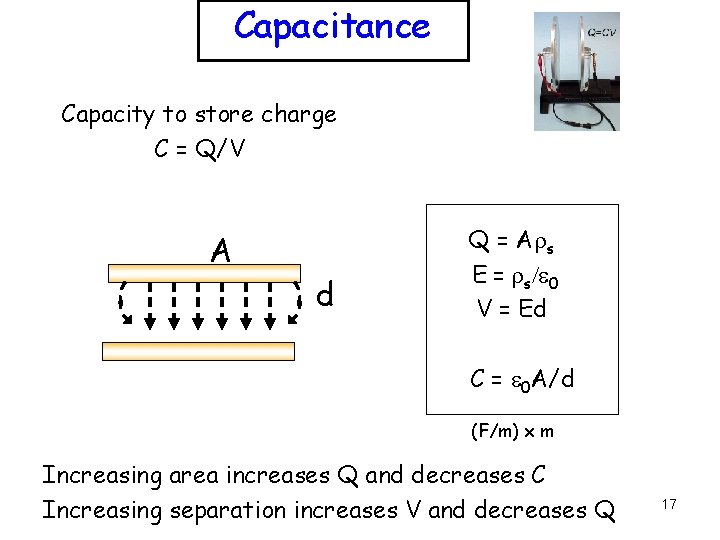
Capacitance Capacity to store charge C = Q/V A d Q = Ars E = rs/e 0 V = Ed C = e 0 A/d (F/m) x m Increasing area increases Q and decreases C Increasing separation increases V and decreases Q 17
Capacitance Capacitor microphone – sound vibrations move a diaphragm relative to a fixed plate and change C Tuning rotate two cylinders and vary degree of overlap with dielectric change C Changing C changes resonant frequency of RL circuit Increasing area increases Q and decreases C Increasing separation increases V and decreases Q 18
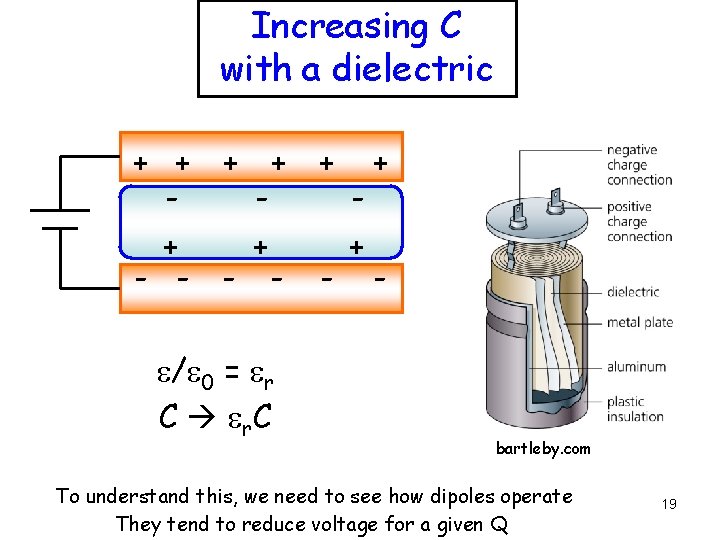
Increasing C with a dielectric + + + - - + + - e/e 0 = er C e r. C + - + + - bartleby. com To understand this, we need to see how dipoles operate They tend to reduce voltage for a given Q 19
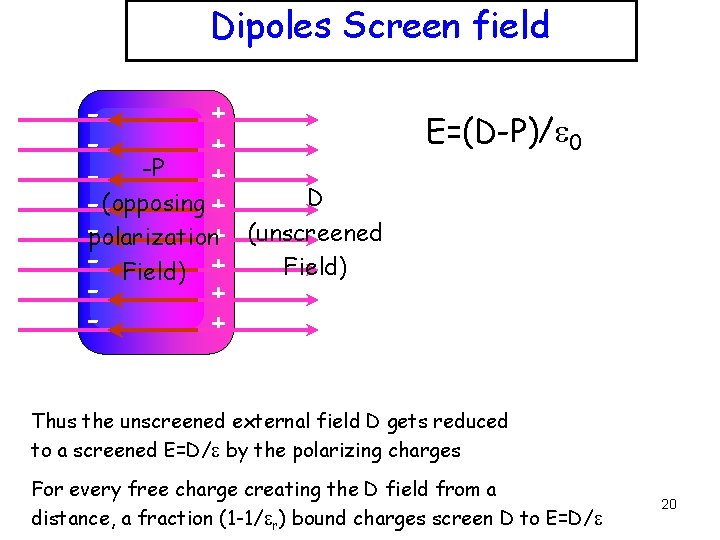
Dipoles Screen field + + - -P + - (opposing + -polarization+ - Field) + + + E=(D-P)/e 0 D (unscreened Field) Thus the unscreened external field D gets reduced to a screened E=D/e by the polarizing charges For every free charge creating the D field from a distance, a fraction (1 -1/er) bound charges screen D to E=D/e 20
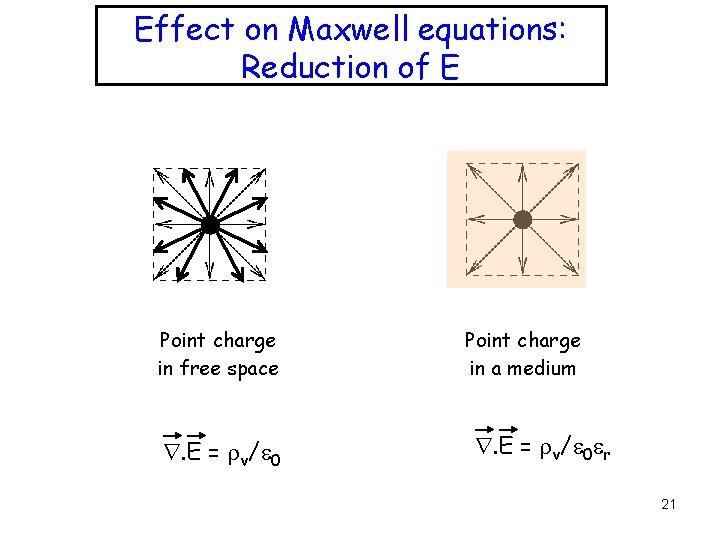
Effect on Maxwell equations: Reduction of E Point charge in free space . E = rv/e 0 Point charge in a medium . E = rv/e 0 er 21
- Slides: 21