
Relating to Other People Unit 2 The Communication
- Slides: 29
Relating to Other People Unit 2
The Communication Process An exchange between two or more people. n Got to listen and speak for it to be successful, aka the sender and receiver. n Learned as children by watching others, especially parents and family. n We grow and improve on our skills throughout life. n
Nonverbal Communication Skills All of these can be interepreted differently by different cultures and backgrounds. n Body language n n n Facial Expressions n n Eye contact, looks, eyebrow movement. Gestures n n Express through thoughts, feelings and emotions. Using your hands to speak Body Motions- The way you sit, stand, cross your legs, etc.
Verbal Communication Skills The way you use words to express what you want to say and the way to listen. n I-statements n n n Avoid you-statements n n n Descriptive, thought, feeling, intention, actions. Like “you are dumb” – not good Like “I see or I think”- good Important to be self aware when expressing. (fig. 5 -8).
Receiving Messages Listen and interpret. n Passive listening n n Hearing words but not listening well. Not even trying to understand the message. Active listening skills (5 -10) n Three ways to show you are: n n n Give feedback Checking out- questions back to person Reflecting- repeat what you heard
Factors Affecting Communication Your self-esteem- good- positive messages, bad-negative messages. (p. 118). n Emotional State- happy or sad at the time. n Environment- time of day, where you are at. n Communication barriers- closed mind, mixed messages, prejudice, poor listening skills, language barriers. n
Skills for Conflict Resolution Identify the problem n Identify who owns the problem n Accept ownership of the problem n Solve the problem n Fig 5 -15 page 121. n
Activity n Mediation: case scenerio
Active Groups Everyone must work as a team. n Group goals- can accomplish more in less amount of time than one person. n Involvement- Each person has something to do: set rules, ideas, needs, etc. n Cohesiveness- feel of belonging n Setting- environment where goals can be met. n Group Structure- Expectations of each n
Effective Leadership Strongly influences the group, but listens to others ideas and expectations. n Must be confident, committed, and motivated. n Identify groups goal n Develop a plan n Carry out the plan n Help the group evaluate- discussion techniques (page 139). n
Being an Effective Member of Society Clearly communicate n Cooperate n Participate n Control emotions n Support the group n
How to Plan, Organize, and Evaluate a Group n Plan n n Organize n n Common interest or goal Elect leader, identify rules are procedures, prepare meetings Evaluate n n n Listen to everyone’s input Ask questions What worked and what didn’t
Freindships Who are your friends? n Similar interests, goals, etc. n Casual acquaintances- people you know but not much interaction. n Frequent acquaintances- People you talk to in class, ask how they are, more conversation. n Mutual friends- call them friends, hang out, some trust. n
What is a Friend? Activity What qualities do you look for? n Similarities are needed n Common interests are needed. n Trust n What you need in a friend? n Fig. 7 -3 page 152 n
Developing a Close Freindship Be friendly n Develop rapport- comfortable n Share yourself n They share themselves with you n Build Trust n Respond with empathy- confide, honest, there for them. n Open to growth- learn from one another n
Peer Relationships People in the same stage of life as you n Changes a little as you get older n Peer pressure n n n Strong influence on each other Want to be a part of something Can be negative- don’t agree with Need to believe in who you are and not give in.
Relationships in the Family Know each other by living together n Ups and downs n How well do you know your family? n How much time you spend together? n Common interests? n What kind of communication? n Acceptance and support? n Love and concern? n
Relating to your parents/siblings Understand their point of view n Conflicts as you are teens n Negotiating? n With siblings- close at times and distant at other times. n
Relationships with Significant Adults Parents, relatives, teachers, coaches, bosses. n People who take time to know you and care. n Sometimes there is conflict and damage, share this with them so they understand hopefully relationship is fixable. n
Work Relationships Being a good communicator is key at work. n Customer relations- friendly service n Relating to co-workers- people like working with you. Team player? n Relating with your boss- friendly, show interest, contribute ideas, negotiate issues, know that you are not going to agree on everything. n
Relationships with People from Different Cultures n We are a nation of different cultures n n Most of our families immigrated here. Accept the differences n n n Languages Traditions Racial background Values believes
Styles of Dating n Formal n n n One invites another one out for a planned evening. More casual these days than 50 years ago Ask your grandparents Boys do not always pay for all the dates. Informal n Two or more people agree to meet and spend time together.
Functions of Dating Understanding others n Understanding yourself n Providing companionship n Communication n Learn to negotiate n Learn to be responsible n Evaluate personality traits n
Stages of the Dating Process Group dating- mix genders spend time together. n Pair dating- just one boy and one girl n Random dating- dating around not just with one person. n Steady dating- dating for a while, build a long-term relationship n
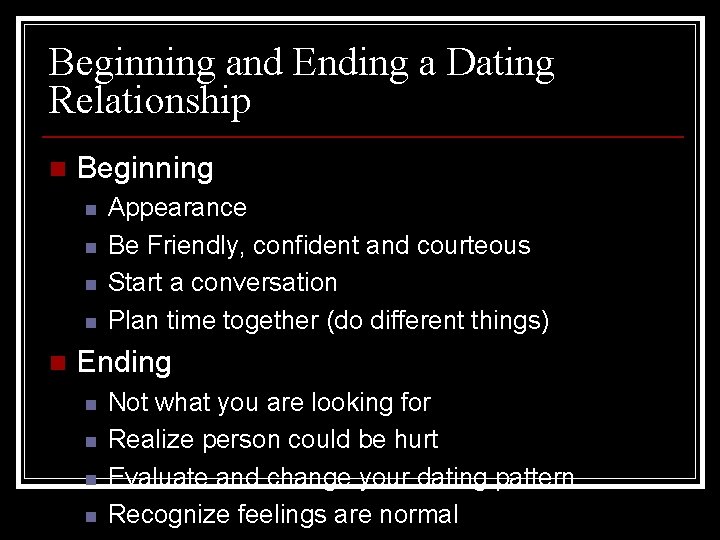
Beginning and Ending a Dating Relationship n Beginning n n n Appearance Be Friendly, confident and courteous Start a conversation Plan time together (do different things) Ending n n Not what you are looking for Realize person could be hurt Evaluate and change your dating pattern Recognize feelings are normal
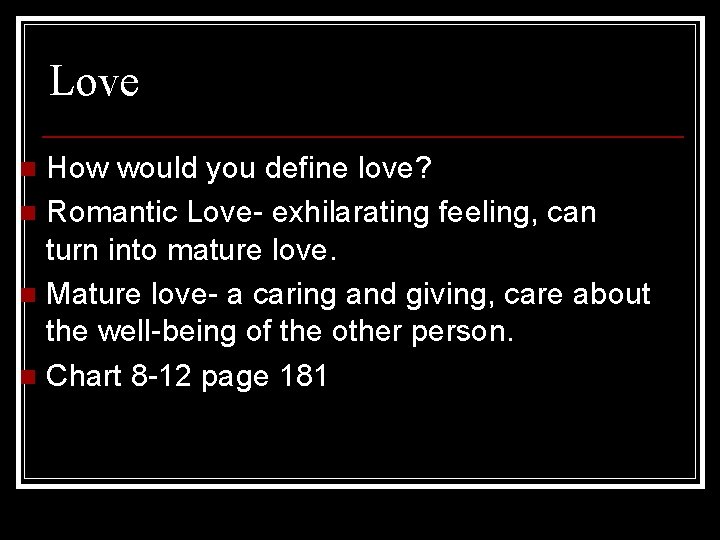
Love How would you define love? n Romantic Love- exhilarating feeling, can turn into mature love. n Mature love- a caring and giving, care about the well-being of the other person. n Chart 8 -12 page 181 n
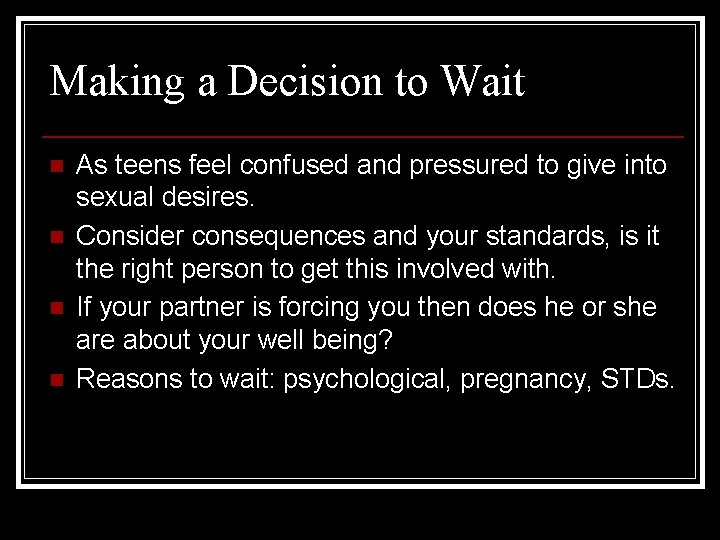
Making a Decision to Wait n n As teens feel confused and pressured to give into sexual desires. Consider consequences and your standards, is it the right person to get this involved with. If your partner is forcing you then does he or she are about your well being? Reasons to wait: psychological, pregnancy, STDs.
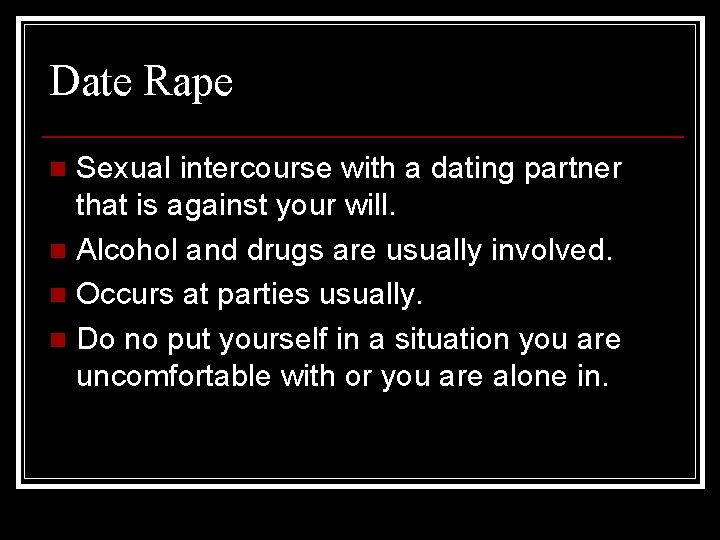
Date Rape Sexual intercourse with a dating partner that is against your will. n Alcohol and drugs are usually involved. n Occurs at parties usually. n Do no put yourself in a situation you are uncomfortable with or you are alone in. n
Activity n Research an STD: share with class the facts about this STD n n In Groups Explain, how you get it, how common it is, symptoms, is sit long term? In girls and guys. Is there meds to clean it up? Etc. Include a picture. Present to class Speak movie