
Relating Graph Thickness to Planar Layers and Bend
Relating Graph Thickness to Planar Layers and Bend Complexity Stephane Durocher Debajyoti Mondal Department of Computer Science University of Manitoba, Canada ICALP 2016 July 12, 2016
Relating Graph Thickness to Planar Layers and Bend Complexity Thickness: The smallest integer k such that G can be decomposed into k planar graphs. ICALP 2016 2 July 12, 2016
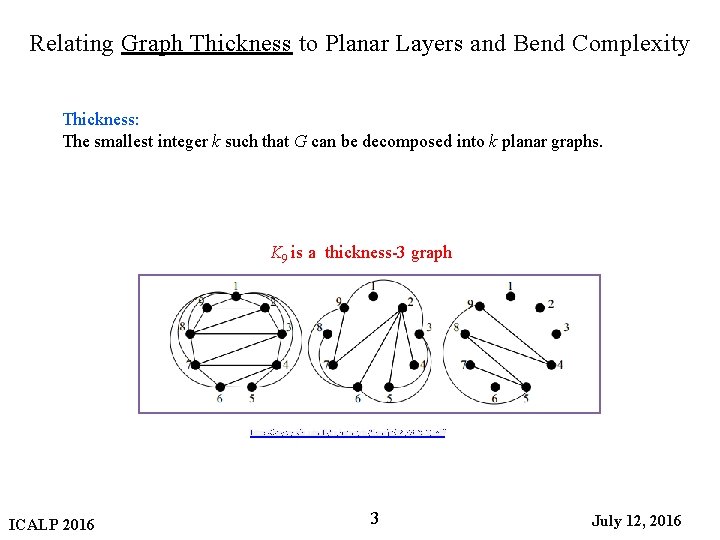
Relating Graph Thickness to Planar Layers and Bend Complexity Thickness: The smallest integer k such that G can be decomposed into k planar graphs. K 9 is a thickness-3 graph http: //www. sis. uta. fi/cs/reports/dsarja/D-2009 -3. pdf ICALP 2016 3 July 12, 2016
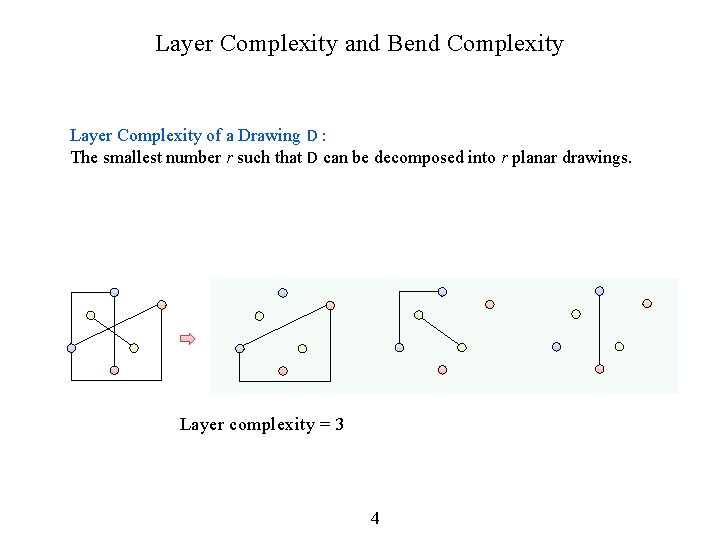
Layer Complexity and Bend Complexity Layer Complexity of a Drawing D : The smallest number r such that D can be decomposed into r planar drawings. Layer complexity = 3 4
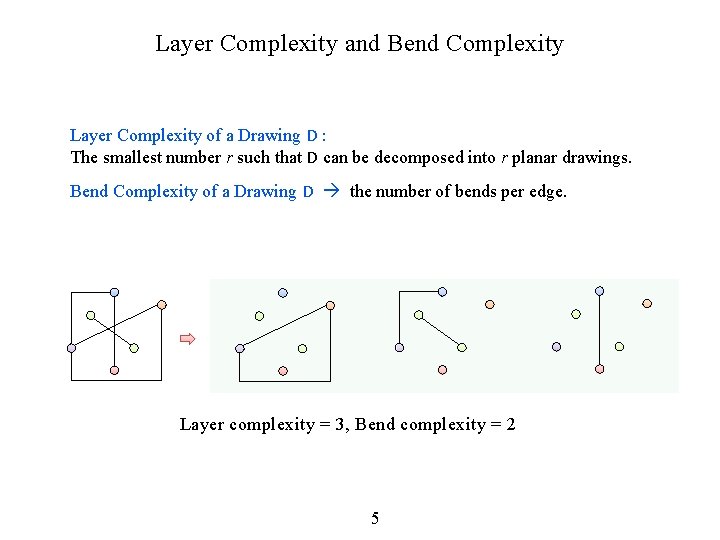
Layer Complexity and Bend Complexity Layer Complexity of a Drawing D : The smallest number r such that D can be decomposed into r planar drawings. Bend Complexity of a Drawing D the number of bends per edge. Layer complexity = 3, Bend complexity = 2 5
Graph Thickness, Layer Complexity and Bend Complexity ICALP 2016 6 July 12, 2016
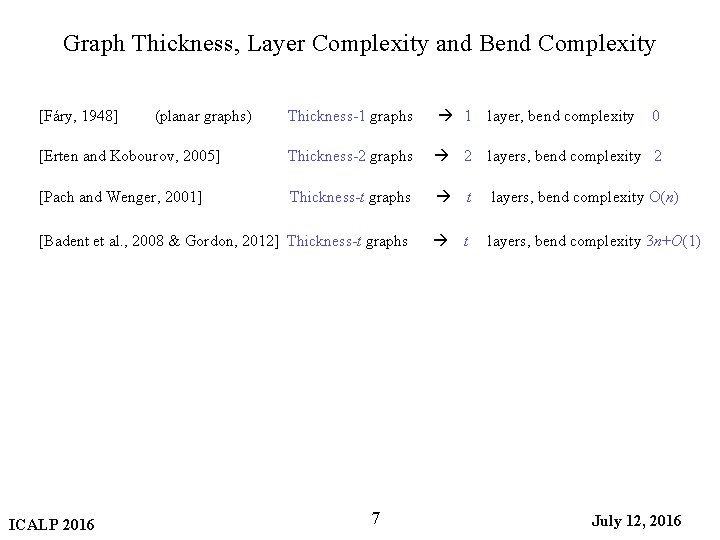
Graph Thickness, Layer Complexity and Bend Complexity Thickness-1 graphs 1 layer, bend complexity [Erten and Kobourov, 2005] Thickness-2 graphs 2 layers, bend complexity 2 [Pach and Wenger, 2001] Thickness-t graphs t layers, bend complexity O(n) [Badent et al. , 2008 & Gordon, 2012] Thickness-t graphs t layers, bend complexity 3 n+O(1) [Fáry, 1948] ICALP 2016 (planar graphs) 7 0 July 12, 2016
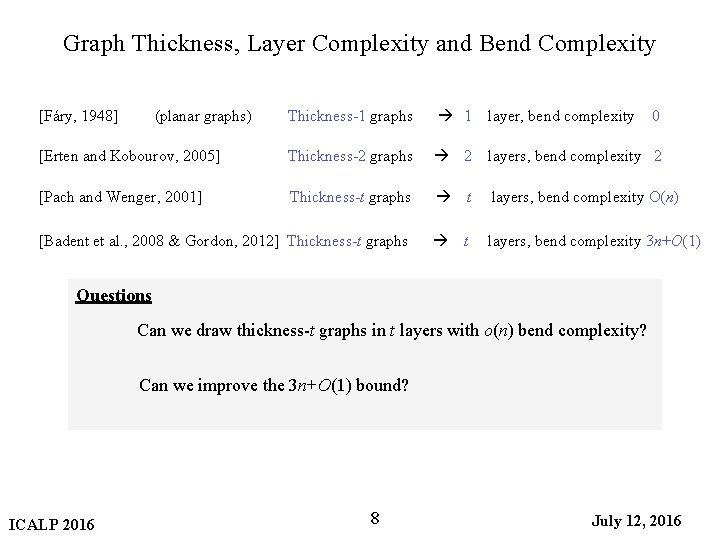
Graph Thickness, Layer Complexity and Bend Complexity Thickness-1 graphs 1 layer, bend complexity [Erten and Kobourov, 2005] Thickness-2 graphs 2 layers, bend complexity 2 [Pach and Wenger, 2001] Thickness-t graphs t layers, bend complexity O(n) [Badent et al. , 2008 & Gordon, 2012] Thickness-t graphs t layers, bend complexity 3 n+O(1) [Fáry, 1948] (planar graphs) 0 Questions Can we draw thickness-t graphs in t layers with o(n) bend complexity? Can we improve the 3 n+O(1) bound? ICALP 2016 8 July 12, 2016
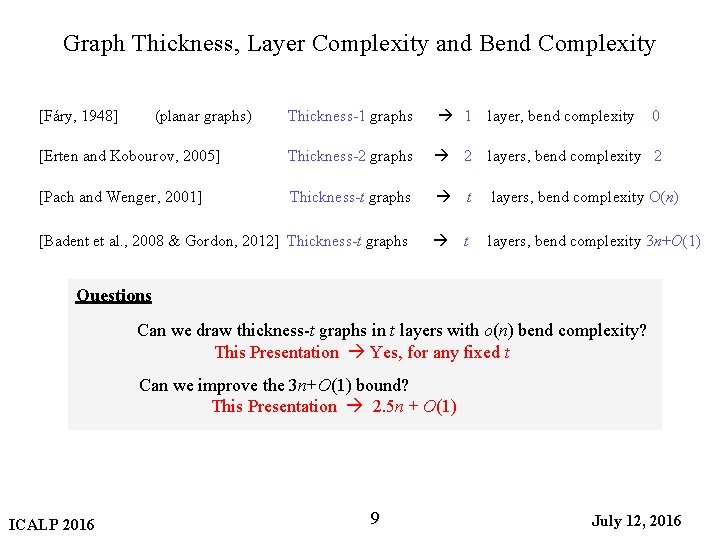
Graph Thickness, Layer Complexity and Bend Complexity Thickness-1 graphs 1 layer, bend complexity [Erten and Kobourov, 2005] Thickness-2 graphs 2 layers, bend complexity 2 [Pach and Wenger, 2001] Thickness-t graphs t layers, bend complexity O(n) [Badent et al. , 2008 & Gordon, 2012] Thickness-t graphs t layers, bend complexity 3 n+O(1) [Fáry, 1948] (planar graphs) 0 Questions Can we draw thickness-t graphs in t layers with o(n) bend complexity? This Presentation Yes, for any fixed t Can we improve the 3 n+O(1) bound? This Presentation 2. 5 n + O(1) ICALP 2016 9 July 12, 2016
![[Erten and Kobourov, 2005] Thickness-2 graphs, 2 layers, bend complexity 2 Every planar graph](http://slidetodoc.com/presentation_image_h2/8410db44ccb0418b56342832884ebd0b/image-10.jpg "[Erten and Kobourov, 2005] Thickness-2 graphs, 2 layers, bend complexity 2 Every planar graph")
[Erten and Kobourov, 2005] Thickness-2 graphs, 2 layers, bend complexity 2 Every planar graph has a monotone topological book embedding. ICALP 2016 10 July 12, 2016
![[Erten and Kobourov, 2005] Thickness-2 graphs, 2 layers, bend complexity 2 Take the monotone](http://slidetodoc.com/presentation_image_h2/8410db44ccb0418b56342832884ebd0b/image-11.jpg "[Erten and Kobourov, 2005] Thickness-2 graphs, 2 layers, bend complexity 2 Take the monotone")
[Erten and Kobourov, 2005] Thickness-2 graphs, 2 layers, bend complexity 2 Take the monotone topological book embeddings of the planar layers. ICALP 2016 11 July 12, 2016
![[Erten and Kobourov, 2005] Thickness-2 graphs, 2 layers, bend complexity 2 Take the monotone](http://slidetodoc.com/presentation_image_h2/8410db44ccb0418b56342832884ebd0b/image-12.jpg "[Erten and Kobourov, 2005] Thickness-2 graphs, 2 layers, bend complexity 2 Take the monotone")
[Erten and Kobourov, 2005] Thickness-2 graphs, 2 layers, bend complexity 2 Take the monotone topological book embeddings of the planar layers. Create corresponding Hamiltonian paths, insert dummy vertices at the crossing. e c a x 1 d b a b c x 1 d e ICALP 2016 12 July 12, 2016
![[Erten and Kobourov, 2005] Thickness-2 graphs, 2 layers, bend complexity 2 Take the monotone](http://slidetodoc.com/presentation_image_h2/8410db44ccb0418b56342832884ebd0b/image-13.jpg "[Erten and Kobourov, 2005] Thickness-2 graphs, 2 layers, bend complexity 2 Take the monotone")
[Erten and Kobourov, 2005] Thickness-2 graphs, 2 layers, bend complexity 2 Take the monotone topological book embeddings of the planar layers. Create corresponding Hamiltonian paths, insert dummy vertices at the crossing. a b x 1 c d e Create vertex positions. Draw the edges. e c a x 1 d b a b c x 1 d e ICALP 2016 13 July 12, 2016
![[Erten and Kobourov, 2005] Thickness-2 graphs, 2 layers, bend complexity 2 Take the monotone](http://slidetodoc.com/presentation_image_h2/8410db44ccb0418b56342832884ebd0b/image-14.jpg "[Erten and Kobourov, 2005] Thickness-2 graphs, 2 layers, bend complexity 2 Take the monotone")
[Erten and Kobourov, 2005] Thickness-2 graphs, 2 layers, bend complexity 2 Take the monotone topological book embeddings of the planar layers. Create corresponding Hamiltonian paths, insert dummy vertices at the crossing. a b x 1 c d e Create vertex positions. Draw the edges. e c a x 1 d b a b c x 1 d e ICALP 2016 14 July 12, 2016
![[Erten and Kobourov, 2005] Thickness-2 graphs, 2 layers, bend complexity 2 Take the monotone](http://slidetodoc.com/presentation_image_h2/8410db44ccb0418b56342832884ebd0b/image-15.jpg "[Erten and Kobourov, 2005] Thickness-2 graphs, 2 layers, bend complexity 2 Take the monotone")
[Erten and Kobourov, 2005] Thickness-2 graphs, 2 layers, bend complexity 2 Take the monotone topological book embeddings of the planar layers. Create corresponding Hamiltonian paths, insert dummy vertices at the crossing. a b x 1 c d e Create vertex positions. Draw the edges. e c a x 1 d b a b c x 1 d e ICALP 2016 15 July 12, 2016
![[Erten and Kobourov, 2005] Thickness-2 graphs, 2 layers, bend complexity 2 Take the monotone](http://slidetodoc.com/presentation_image_h2/8410db44ccb0418b56342832884ebd0b/image-16.jpg "[Erten and Kobourov, 2005] Thickness-2 graphs, 2 layers, bend complexity 2 Take the monotone")
[Erten and Kobourov, 2005] Thickness-2 graphs, 2 layers, bend complexity 2 Take the monotone topological book embeddings of the planar layers. Create corresponding Hamiltonian paths, insert dummy vertices at the crossing. a b x 1 c d e Create vertex positions. Draw the edges. e c a x 1 d b a b c x 1 d e ICALP 2016 16 July 12, 2016
![[Erten and Kobourov, 2005] Thickness-2 graphs, 2 layers, bend complexity 2 Take the monotone](http://slidetodoc.com/presentation_image_h2/8410db44ccb0418b56342832884ebd0b/image-17.jpg "[Erten and Kobourov, 2005] Thickness-2 graphs, 2 layers, bend complexity 2 Take the monotone")
[Erten and Kobourov, 2005] Thickness-2 graphs, 2 layers, bend complexity 2 Take the monotone topological book embeddings of the planar layers. Create corresponding Hamiltonian paths, insert dummy vertices at the crossing. Create vertex positions. Draw the edges. ICALP 2016 17 July 12, 2016
![[Erten and Kobourov, 2005] Thickness-2 graphs, 2 layers, bend complexity 2 Take the monotone](http://slidetodoc.com/presentation_image_h2/8410db44ccb0418b56342832884ebd0b/image-18.jpg "[Erten and Kobourov, 2005] Thickness-2 graphs, 2 layers, bend complexity 2 Take the monotone")
[Erten and Kobourov, 2005] Thickness-2 graphs, 2 layers, bend complexity 2 Take the monotone topological book embeddings of the planar layers. Create corresponding Hamiltonian paths, insert dummy vertices at the crossing. Create vertex positions. Draw the edges. No extension to three or more paths was known! ICALP 2016 18 July 12, 2016
Thickness-4 graphs, 4 layers, bend complexity O(√n) ICALP 2016 19 July 12, 2016
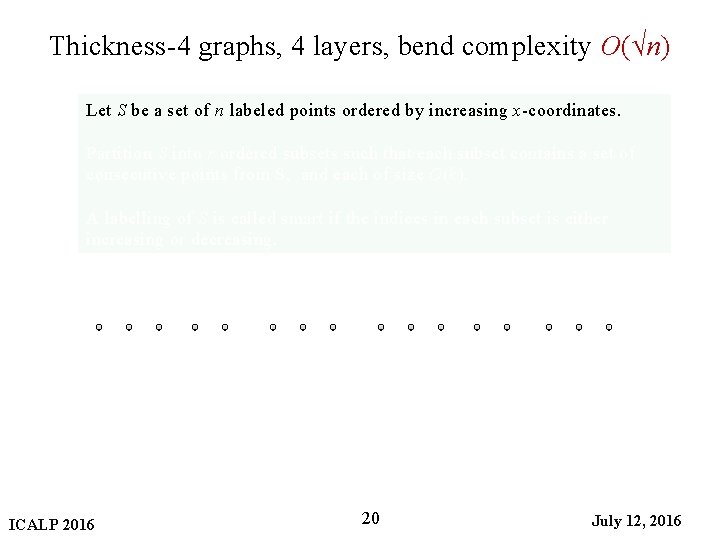
Thickness-4 graphs, 4 layers, bend complexity O(√n) Let S be a set of n labeled points ordered by increasing x-coordinates. Partition S into r ordered subsets such that each subset contains a set of consecutive points from S, and each of size O(k). A labelling of S is called smart if the indices in each subset is either increasing or decreasing. ICALP 2016 20 July 12, 2016
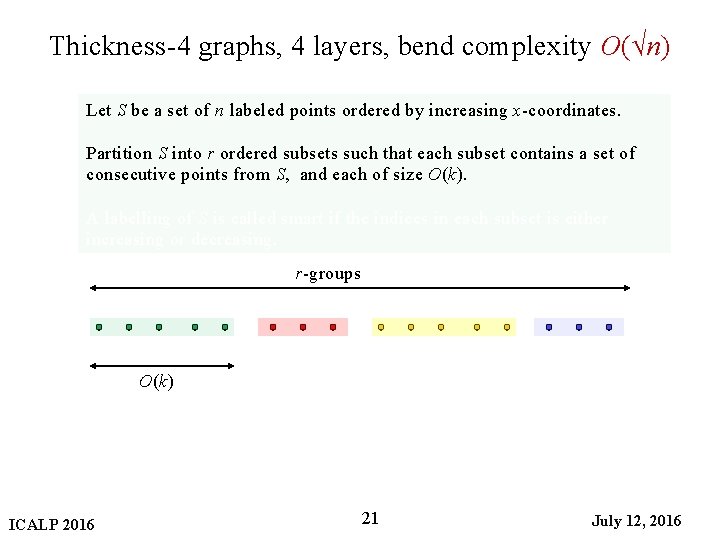
Thickness-4 graphs, 4 layers, bend complexity O(√n) Let S be a set of n labeled points ordered by increasing x-coordinates. Partition S into r ordered subsets such that each subset contains a set of consecutive points from S, and each of size O(k). A labelling of S is called smart if the indices in each subset is either increasing or decreasing. r-groups O(k) ICALP 2016 21 July 12, 2016
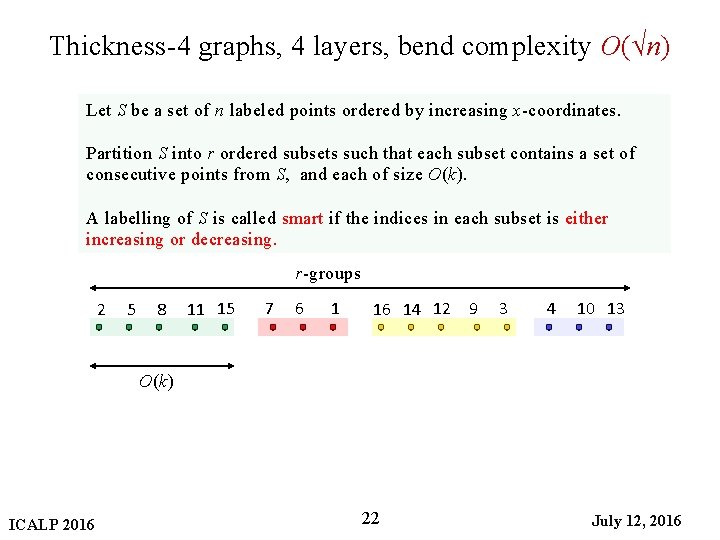
Thickness-4 graphs, 4 layers, bend complexity O(√n) Let S be a set of n labeled points ordered by increasing x-coordinates. Partition S into r ordered subsets such that each subset contains a set of consecutive points from S, and each of size O(k). A labelling of S is called smart if the indices in each subset is either increasing or decreasing. r-groups 2 5 8 11 15 7 6 1 16 14 12 9 3 4 10 13 O(k) ICALP 2016 22 July 12, 2016
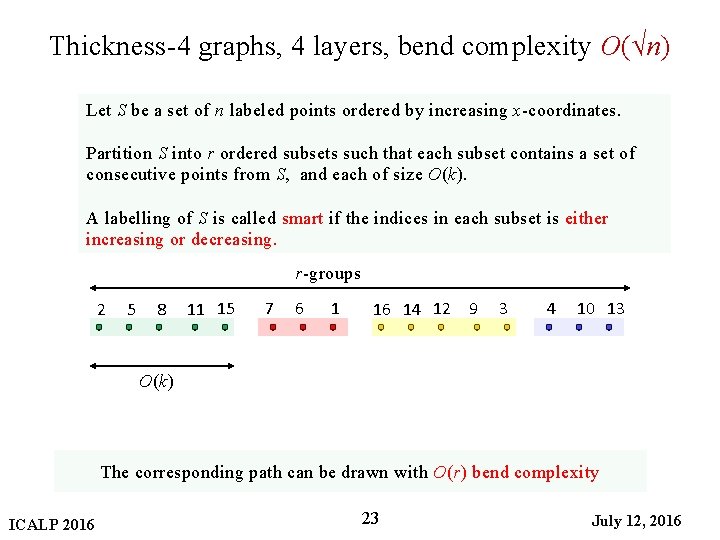
Thickness-4 graphs, 4 layers, bend complexity O(√n) Let S be a set of n labeled points ordered by increasing x-coordinates. Partition S into r ordered subsets such that each subset contains a set of consecutive points from S, and each of size O(k). A labelling of S is called smart if the indices in each subset is either increasing or decreasing. r-groups 2 5 8 11 15 7 6 1 16 14 12 9 3 4 10 13 O(k) The corresponding path can be drawn with O(r) bend complexity ICALP 2016 23 July 12, 2016
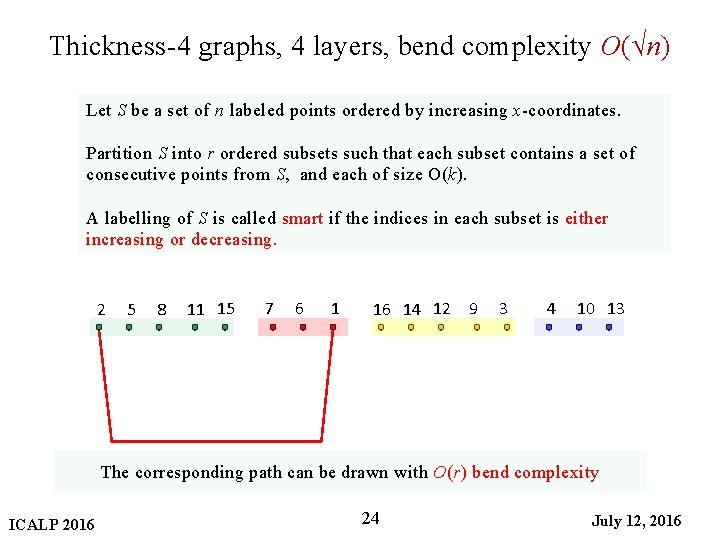
Thickness-4 graphs, 4 layers, bend complexity O(√n) Let S be a set of n labeled points ordered by increasing x-coordinates. Partition S into r ordered subsets such that each subset contains a set of consecutive points from S, and each of size O(k). A labelling of S is called smart if the indices in each subset is either increasing or decreasing. 2 5 8 11 15 7 6 1 16 14 12 9 3 4 10 13 The corresponding path can be drawn with O(r) bend complexity ICALP 2016 24 July 12, 2016
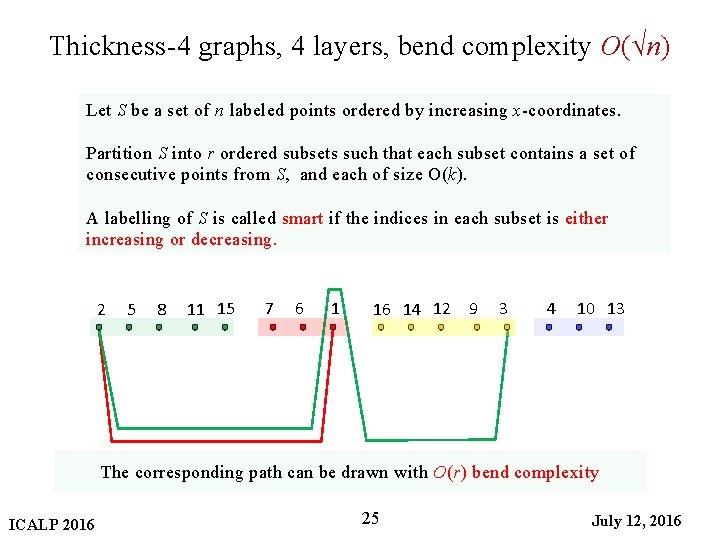
Thickness-4 graphs, 4 layers, bend complexity O(√n) Let S be a set of n labeled points ordered by increasing x-coordinates. Partition S into r ordered subsets such that each subset contains a set of consecutive points from S, and each of size O(k). A labelling of S is called smart if the indices in each subset is either increasing or decreasing. 2 5 8 11 15 7 6 1 16 14 12 9 3 4 10 13 The corresponding path can be drawn with O(r) bend complexity ICALP 2016 25 July 12, 2016
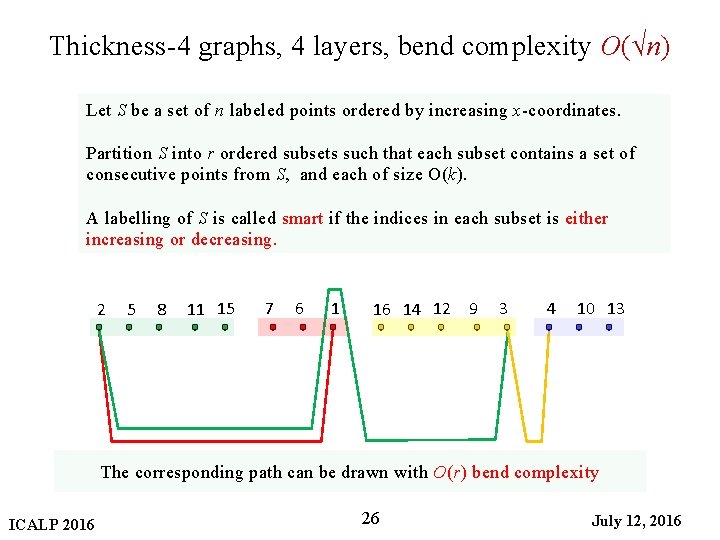
Thickness-4 graphs, 4 layers, bend complexity O(√n) Let S be a set of n labeled points ordered by increasing x-coordinates. Partition S into r ordered subsets such that each subset contains a set of consecutive points from S, and each of size O(k). A labelling of S is called smart if the indices in each subset is either increasing or decreasing. 2 5 8 11 15 7 6 1 16 14 12 9 3 4 10 13 The corresponding path can be drawn with O(r) bend complexity ICALP 2016 26 July 12, 2016
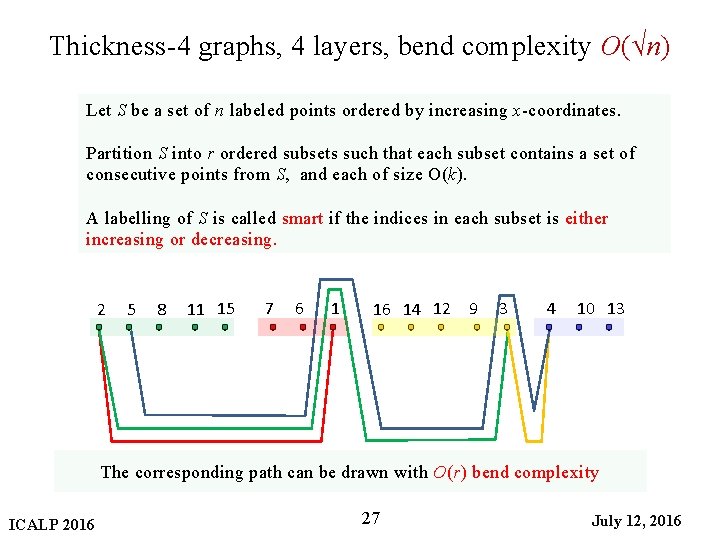
Thickness-4 graphs, 4 layers, bend complexity O(√n) Let S be a set of n labeled points ordered by increasing x-coordinates. Partition S into r ordered subsets such that each subset contains a set of consecutive points from S, and each of size O(k). A labelling of S is called smart if the indices in each subset is either increasing or decreasing. 2 5 8 11 15 7 6 1 16 14 12 9 3 4 10 13 The corresponding path can be drawn with O(r) bend complexity ICALP 2016 27 July 12, 2016
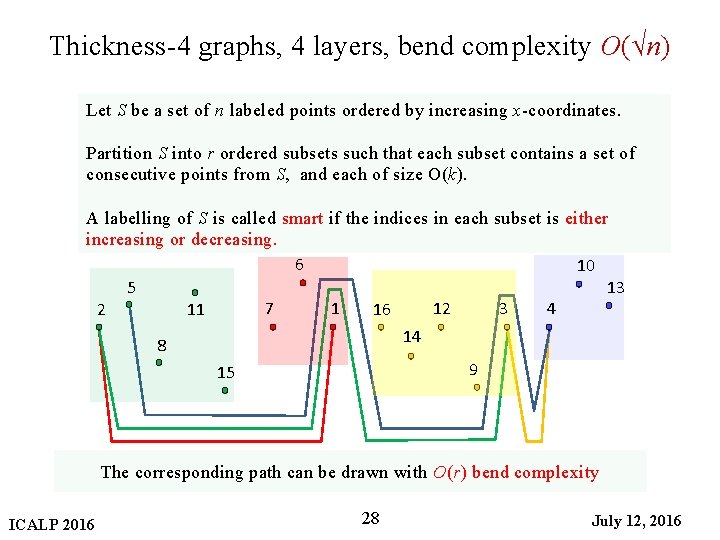
Thickness-4 graphs, 4 layers, bend complexity O(√n) Let S be a set of n labeled points ordered by increasing x-coordinates. Partition S into r ordered subsets such that each subset contains a set of consecutive points from S, and each of size O(k). A labelling of S is called smart if the indices in each subset is either increasing or decreasing. 6 10 5 13 7 1 12 3 4 2 11 16 14 8 9 15 The corresponding path can be drawn with O(r) bend complexity ICALP 2016 28 July 12, 2016
![Thickness-4 graphs, 4 layers, bend complexity O(√n) [Erdӧs-Szekeres, 1935] Every point set of n](http://slidetodoc.com/presentation_image_h2/8410db44ccb0418b56342832884ebd0b/image-29.jpg "Thickness-4 graphs, 4 layers, bend complexity O(√n) [Erdӧs-Szekeres, 1935] Every point set of n")
Thickness-4 graphs, 4 layers, bend complexity O(√n) [Erdӧs-Szekeres, 1935] Every point set of n points can be partitioned into O(√n) monotone chains. ICALP 2016 29 July 12, 2016
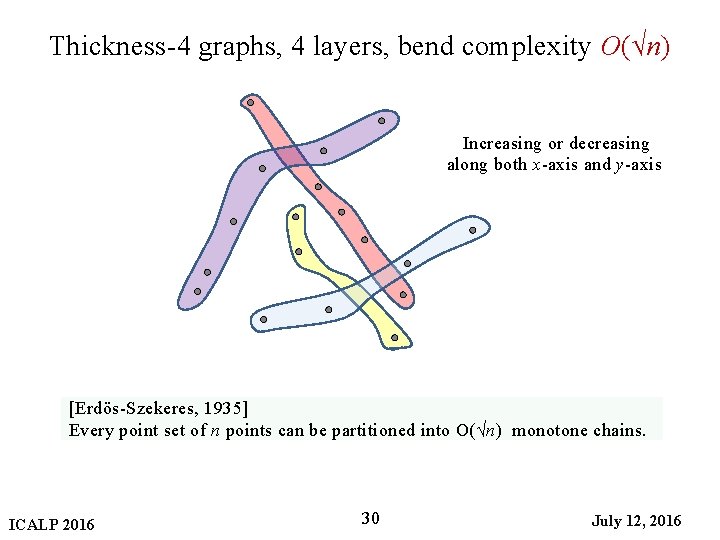
Thickness-4 graphs, 4 layers, bend complexity O(√n) Increasing or decreasing along both x-axis and y-axis [Erdӧs-Szekeres, 1935] Every point set of n points can be partitioned into O(√n) monotone chains. ICALP 2016 30 July 12, 2016
Thickness-4 graphs, 4 layers, bend complexity O(√n) P 3 P 4 P 1 P 2 ICALP 2016 31 July 12, 2016
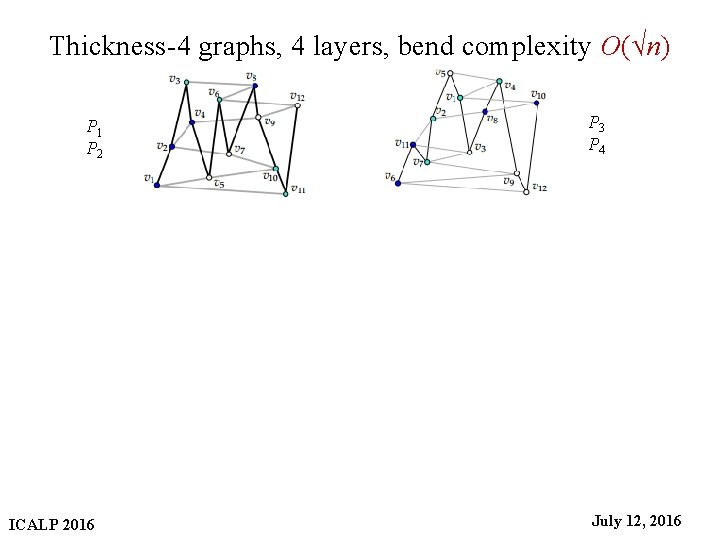
Thickness-4 graphs, 4 layers, bend complexity O(√n) P 3 P 4 P 1 P 2 ICALP 2016 32 July 12, 2016
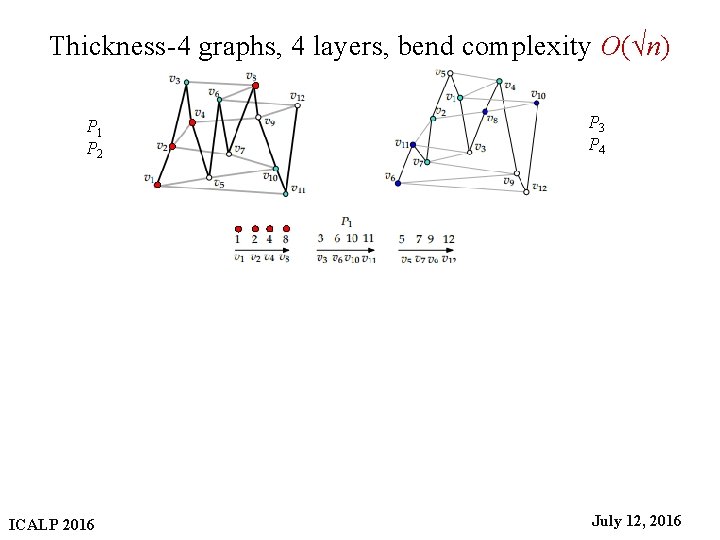
Thickness-4 graphs, 4 layers, bend complexity O(√n) P 3 P 4 P 1 P 2 ICALP 2016 33 July 12, 2016
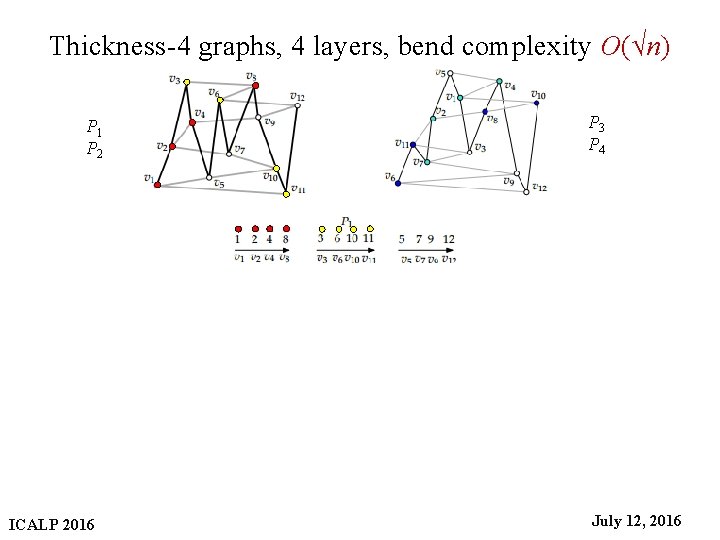
Thickness-4 graphs, 4 layers, bend complexity O(√n) P 3 P 4 P 1 P 2 ICALP 2016 34 July 12, 2016
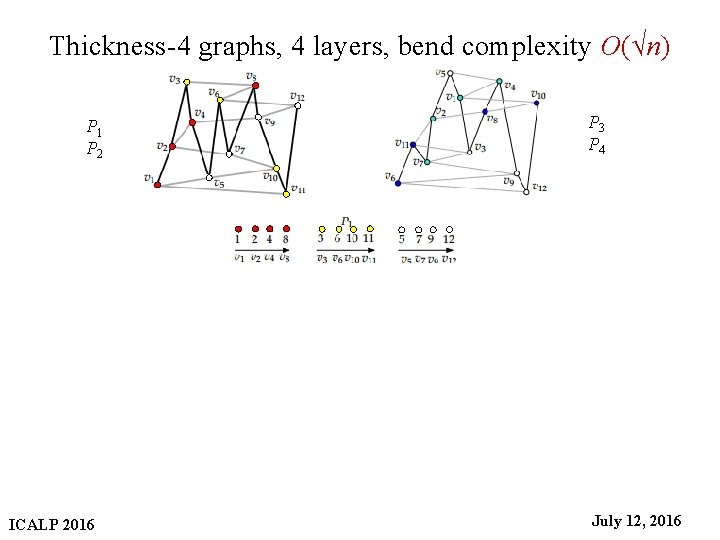
Thickness-4 graphs, 4 layers, bend complexity O(√n) P 3 P 4 P 1 P 2 ICALP 2016 35 July 12, 2016
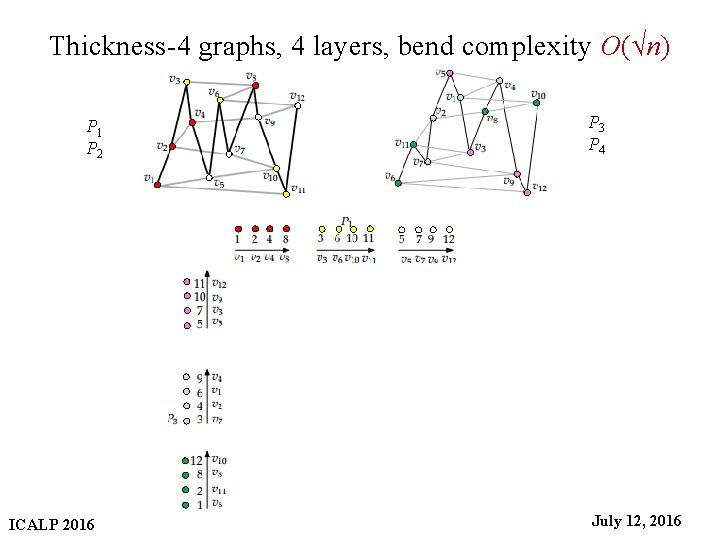
Thickness-4 graphs, 4 layers, bend complexity O(√n) P 3 P 4 P 1 P 2 ICALP 2016 36 July 12, 2016
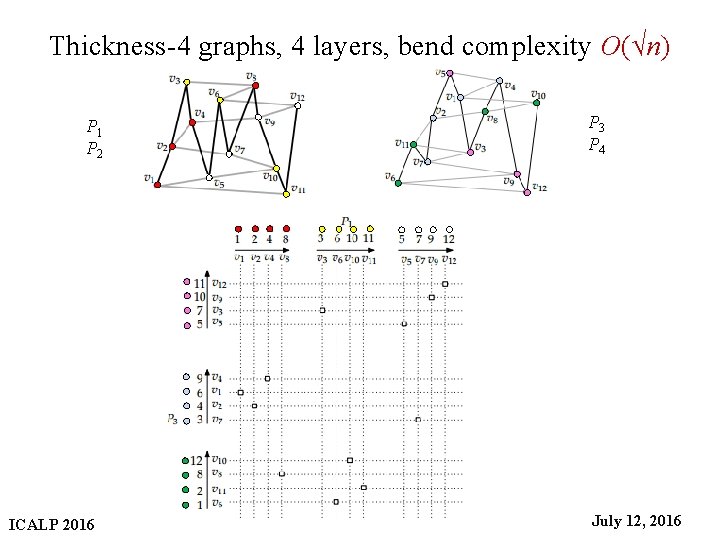
Thickness-4 graphs, 4 layers, bend complexity O(√n) P 3 P 4 P 1 P 2 ICALP 2016 37 July 12, 2016
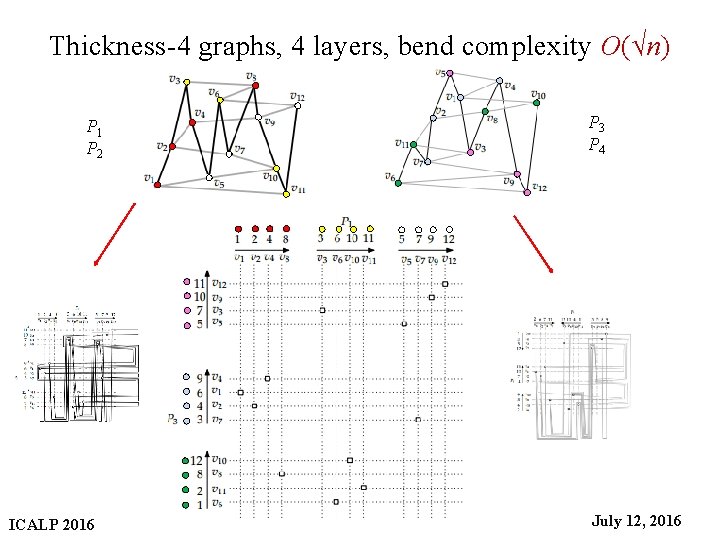
Thickness-4 graphs, 4 layers, bend complexity O(√n) P 3 P 4 P 1 P 2 ICALP 2016 38 July 12, 2016
Thickness-t, t layers, Bend Complexity ? ICALP 2016 39 July 12, 2016
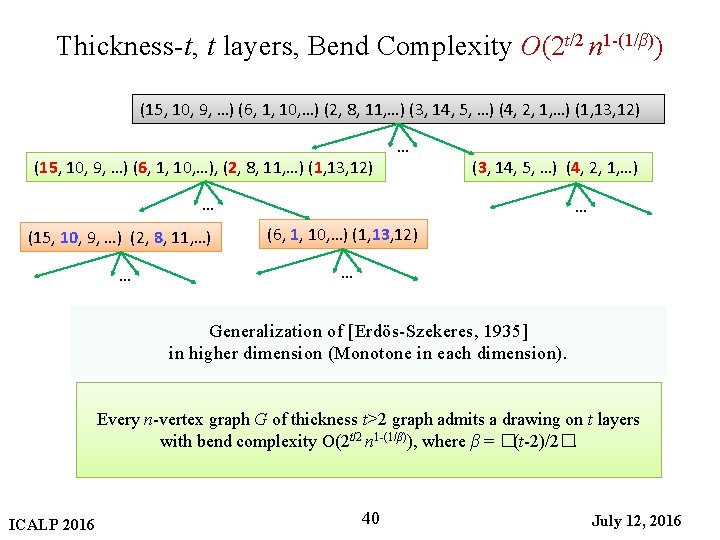
Thickness-t, t layers, Bend Complexity O(2 t/2 n 1 -(1/β)) (15, 10, 9, …) (6, 1, 10, …) (2, 8, 11, …) (3, 14, 5, …) (4, 2, 1, …) (1, 13, 12) (15, 10, 9, …) (6, 1, 10, …), (2, 8, 11, …) (1, 13, 12) … (3, 14, 5, …) (4, 2, 1, …) … … (15, 10, 9, …) (2, 8, 11, …) (6, 1, 10, …) (1, 13, 12) … … Generalization of [Erdӧs-Szekeres, 1935] in higher dimension (Monotone in each dimension). Every n-vertex graph G of thickness t>2 graph admits a drawing on t layers with bend complexity O(2 t/2 n 1 -(1/β)), where β = �(t-2)/2�. ICALP 2016 40 July 12, 2016
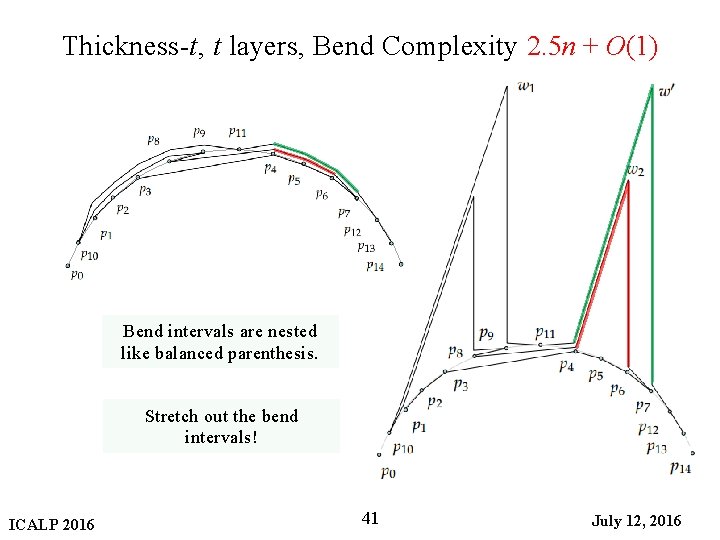
Thickness-t, t layers, Bend Complexity 2. 5 n + O(1) Bend intervals are nested like balanced parenthesis. Stretch out the bend intervals! ICALP 2016 41 July 12, 2016
Future Research Thickness-2: Can we draw every thickness-2 graph on 2 planar layers with bend complexity 1? Thickness-t: Can we draw every thickness-t graph, where t > 2, on t planar layers with bend complexity o(√n)? Is there an Ω(√n) lower bound on the bend complexity? Trade-offs: How the bend complexity varies if we allow more than t planar layers to draw a thickness-t graph? ICALP 2016 42 July 12, 2016
Thank You. .
Appendix
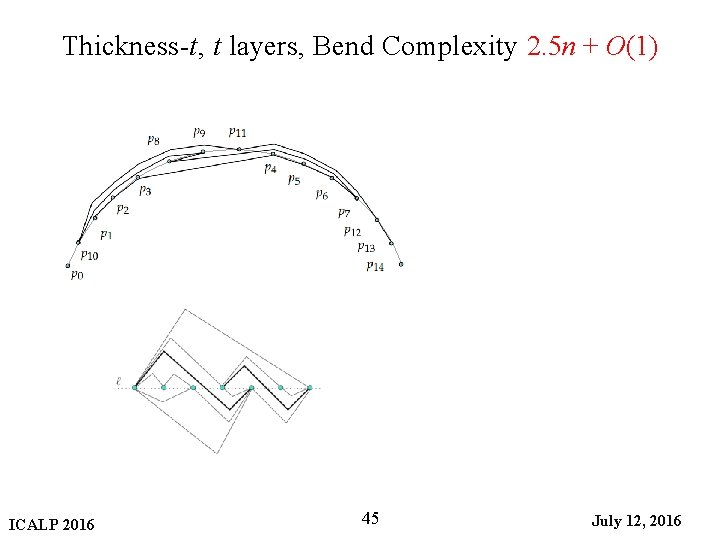
Thickness-t, t layers, Bend Complexity 2. 5 n + O(1) ICALP 2016 45 July 12, 2016
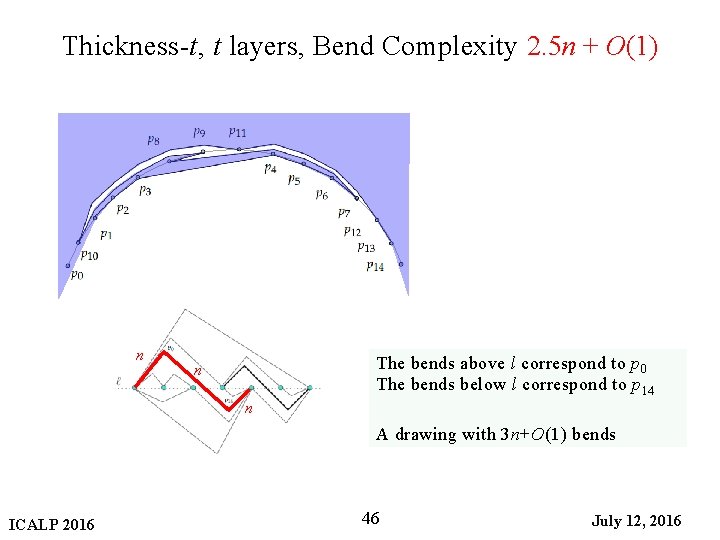
Thickness-t, t layers, Bend Complexity 2. 5 n + O(1) n The bends above l correspond to p 0 The bends below l correspond to p 14 n n A drawing with 3 n+O(1) bends ICALP 2016 46 July 12, 2016
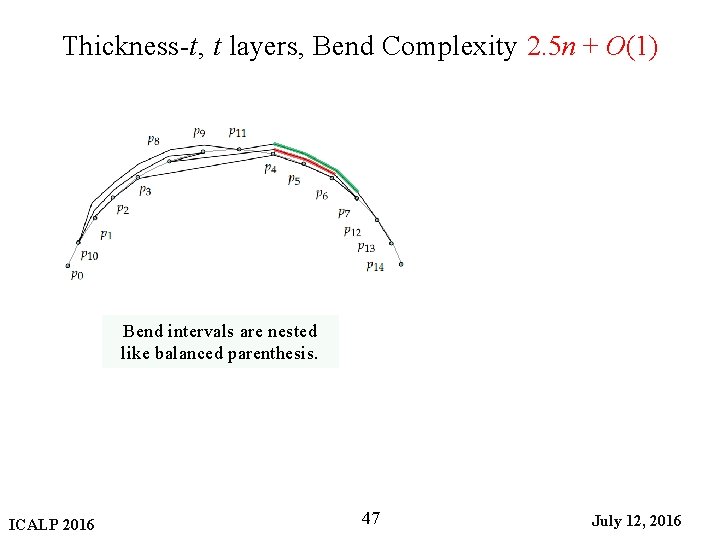
Thickness-t, t layers, Bend Complexity 2. 5 n + O(1) Bend intervals are nested like balanced parenthesis. ICALP 2016 47 July 12, 2016
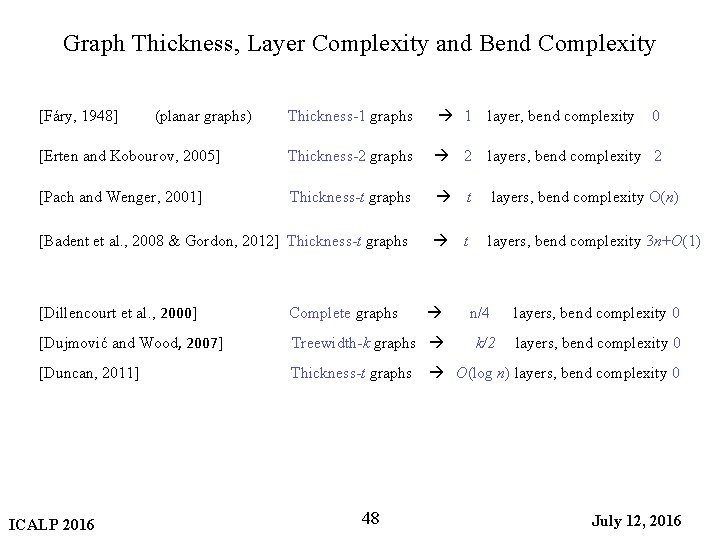
Graph Thickness, Layer Complexity and Bend Complexity Thickness-1 graphs 1 layer, bend complexity [Erten and Kobourov, 2005] Thickness-2 graphs 2 layers, bend complexity 2 [Pach and Wenger, 2001] Thickness-t graphs t layers, bend complexity O(n) [Badent et al. , 2008 & Gordon, 2012] Thickness-t graphs t layers, bend complexity 3 n+O(1) [Fáry, 1948] (planar graphs) [Dillencourt et al. , 2000] Complete graphs [Dujmović and Wood, 2007] Treewidth-k graphs [Duncan, 2011] Thickness-t graphs ICALP 2016 48 n/4 k/2 0 layers, bend complexity 0 O(log n) layers, bend complexity 0 July 12, 2016
- Slides: 48