
Relateive response Spectral sensitivity of cones Blue cones
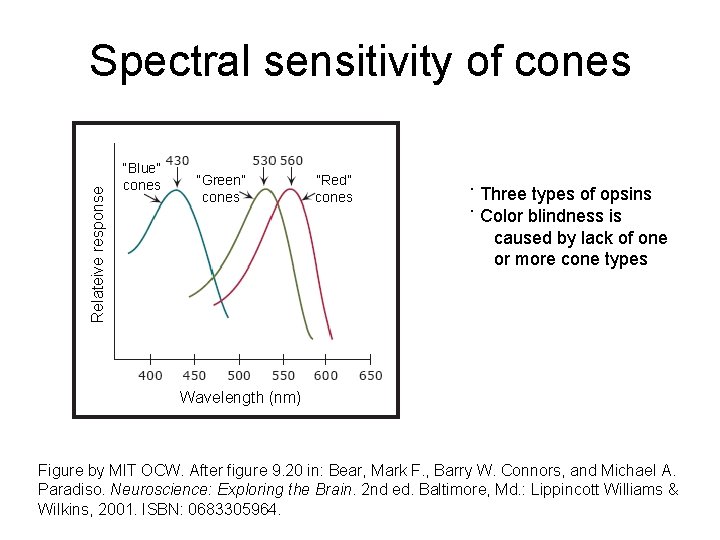
Relateive response Spectral sensitivity of cones “Blue” cones “Green” cones “Red” cones ˙ Three types of opsins ˙ Color blindness is caused by lack of one or more cone types Wavelength (nm) Figure by MIT OCW. After figure 9. 20 in: Bear, Mark F. , Barry W. Connors, and Michael A. Paradiso. Neuroscience: Exploring the Brain. 2 nd ed. Baltimore, Md. : Lippincott Williams & Wilkins, 2001. ISBN: 0683305964.
Color space is 3 d ˙ Any color can be synthesized by mixing three primary colors. ˙ Young-Helmholtz trichromacy theory Image removed due to copyright reasons. Please see figure 9 -21 in: Bear, Mark F. , Barry W. Connors, and Michael A. Paradiso. Neuroscience: Exploring Brain. 2 nd ed. Baltimore, Md. : Lippincott Williams & Wilkins, 2001. ISBN: 0683305964.
Retinal ganglion cells • • Output cells of the retina Send a million axons in the optic nerve Background rate of spiking Rate of spiking is modulated up or down by visual stimulation
Visual neurophysiology • Anesthetized cat • Video: visual stimulus seen by cat • Audio: extracellular recording
Receptive field • The area of retina (or of visual space) in which a stimulus can cause changes in the activity of a neuron. • The “preferred stimulus” is that which causes the most increase in rate of action potential firing.
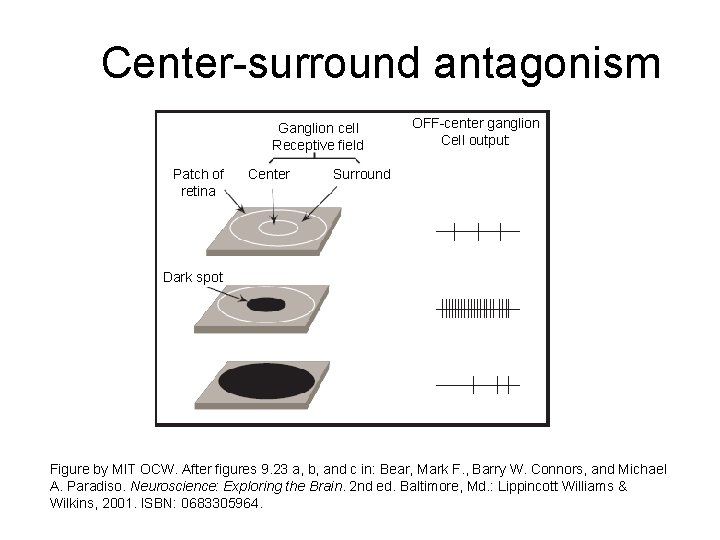
Center-surround antagonism Ganglion cell Receptive field Patch of retina Center OFF-center ganglion Cell output: Surround Dark spot Figure by MIT OCW. After figures 9. 23 a, b, and c in: Bear, Mark F. , Barry W. Connors, and Michael A. Paradiso. Neuroscience: Exploring the Brain. 2 nd ed. Baltimore, Md. : Lippincott Williams & Wilkins, 2001. ISBN: 0683305964.
Visual stimuli • • • Moving spot Flashed spot Annulus Spot with changing ciameter Moving bar
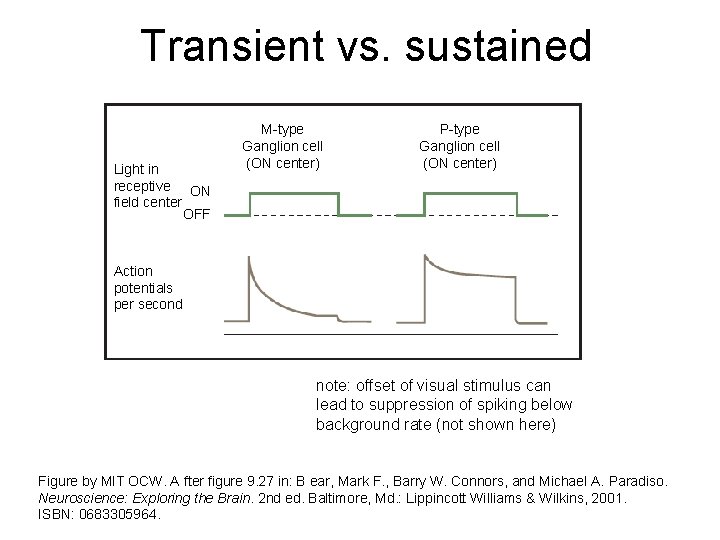
Transient vs. sustained Light in receptive ON field center OFF M-type Ganglion cell (ON center) P-type Ganglion cell (ON center) Action potentials per second note: offset of visual stimulus can lead to suppression of spiking below background rate (not shown here) Figure by MIT OCW. A fter figure 9. 27 in: B ear, Mark F. , Barry W. Connors, and Michael A. Paradiso. Neuroscience: Exploring the Brain. 2 nd ed. Baltimore, Md. : Lippincott Williams & Wilkins, 2001. ISBN: 0683305964.
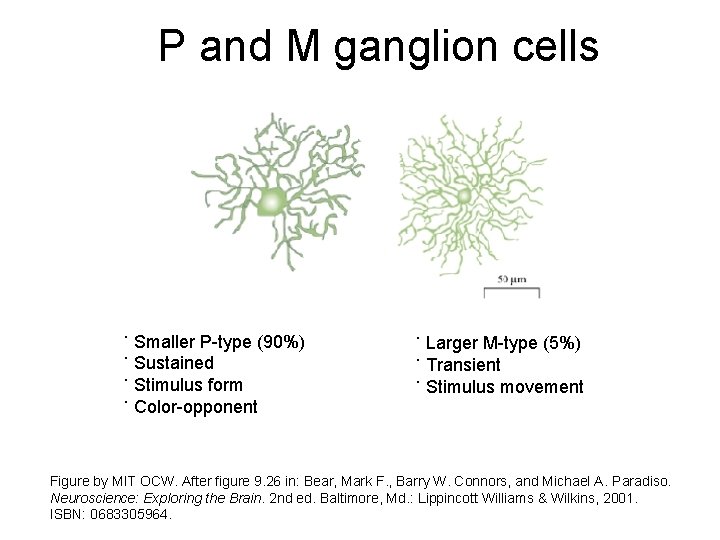
P and M ganglion cells ˙ Smaller P-type (90%) ˙ Sustained ˙ Stimulus form ˙ Color-opponent ˙ Larger M-type (5%) ˙ Transient ˙ Stimulus movement Figure by MIT OCW. After figure 9. 26 in: Bear, Mark F. , Barry W. Connors, and Michael A. Paradiso. Neuroscience: Exploring the Brain. 2 nd ed. Baltimore, Md. : Lippincott Williams & Wilkins, 2001. ISBN: 0683305964.
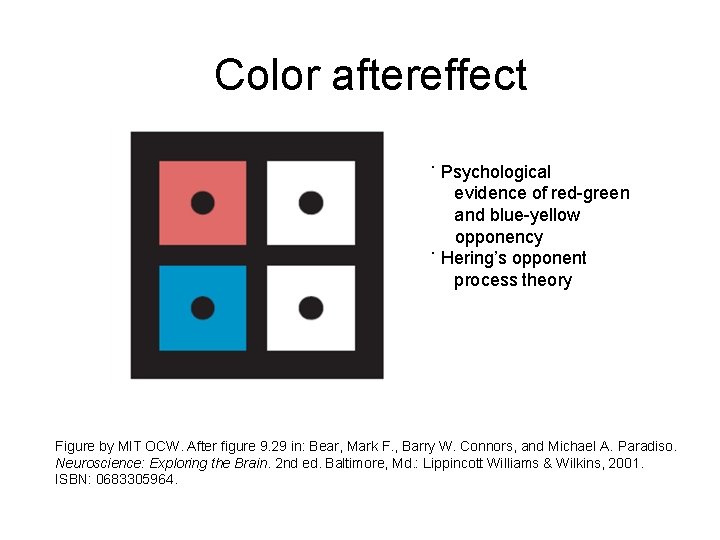
Color aftereffect ˙ Psychological evidence of red-green and blue-yellow opponency ˙ Hering’s opponent process theory Figure by MIT OCW. After figure 9. 29 in: Bear, Mark F. , Barry W. Connors, and Michael A. Paradiso. Neuroscience: Exploring the Brain. 2 nd ed. Baltimore, Md. : Lippincott Williams & Wilkins, 2001. ISBN: 0683305964.
Neural basis of color opponency Images removed due to copyright reasons. Please see figure 9. 28 in: Bear, Mark F. , Barry W. Connors, and Michael A. Paradiso. Neuroscience: Exploring the Brain. 2 nd ed. Baltimore, Md. : Lippincott Williams & Wilkins, 2001. ISBN: 0683305964.
Dual process theory • Resolution of the debate with a hybrid theory • Photoreceptors - Young-Helmholtz trichromacy • Ganglion cells - Hering color opponency Further reading: S. E. Palmer, Vision Science, MIT Press (1999).
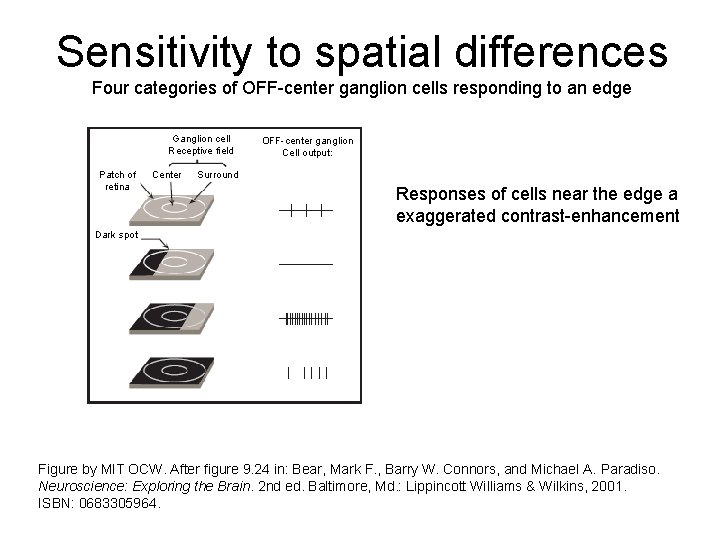
Sensitivity to spatial differences Four categories of OFF-center ganglion cells responding to an edge Ganglion cell Receptive field Patch of retina Center OFF-center ganglion Cell output: Surround Responses of cells near the edge a exaggerated contrast-enhancement Dark spot Figure by MIT OCW. After figure 9. 24 in: Bear, Mark F. , Barry W. Connors, and Michael A. Paradiso. Neuroscience: Exploring the Brain. 2 nd ed. Baltimore, Md. : Lippincott Williams & Wilkins, 2001. ISBN: 0683305964.
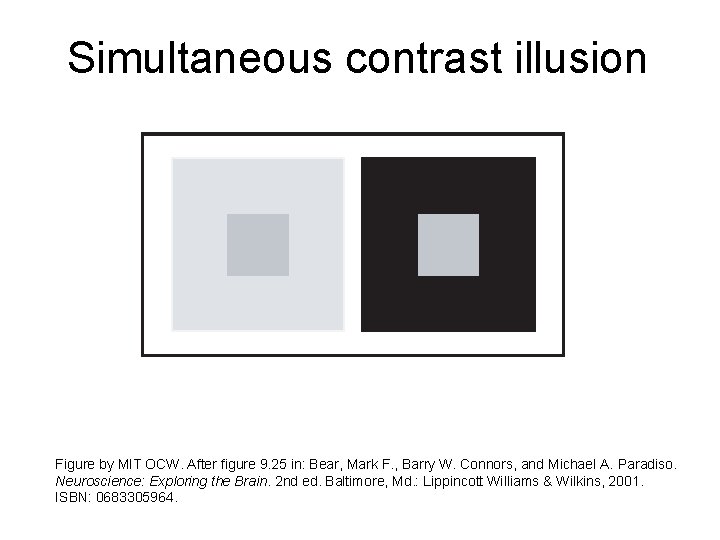
Simultaneous contrast illusion Figure by MIT OCW. After figure 9. 25 in: Bear, Mark F. , Barry W. Connors, and Michael A. Paradiso. Neuroscience: Exploring the Brain. 2 nd ed. Baltimore, Md. : Lippincott Williams & Wilkins, 2001. ISBN: 0683305964.
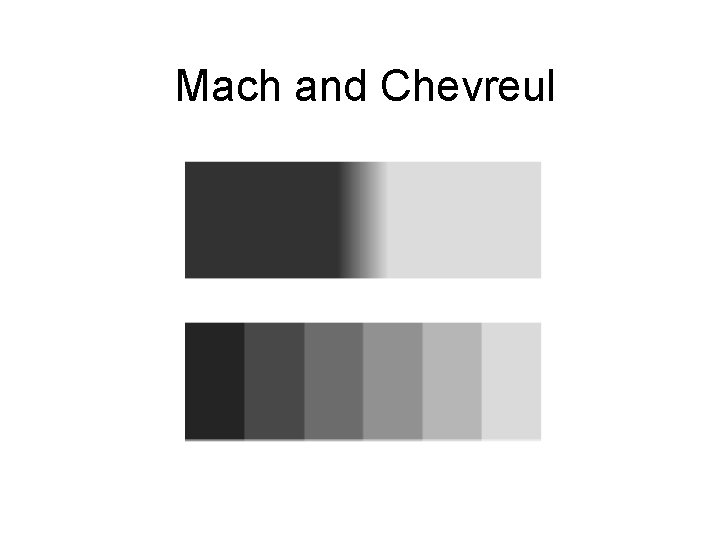
Mach and Chevreul
Lateral inhibition • Horizontal cells • Amacrine cells Images removed due to copyright reasons. Please see figures 9. 22 a, b, and c in: Bear, Mark F. , Barry W. Connors, and Michael A. Paradiso. Neuroscience: Exploring the Brain. 2 nd ed. Baltimore, Md. : Lippincott Williams & Wilkins, 2001. ISBN: 0683305964.
Convolution • Mathematical idealization of retinal computation Image removed due to copyright reasons.
Engineering applications • Silicon retinas - Kwabena Boahen (U penn) • Retinal prosthetics - John Wyatt (MIT)
Central visual system
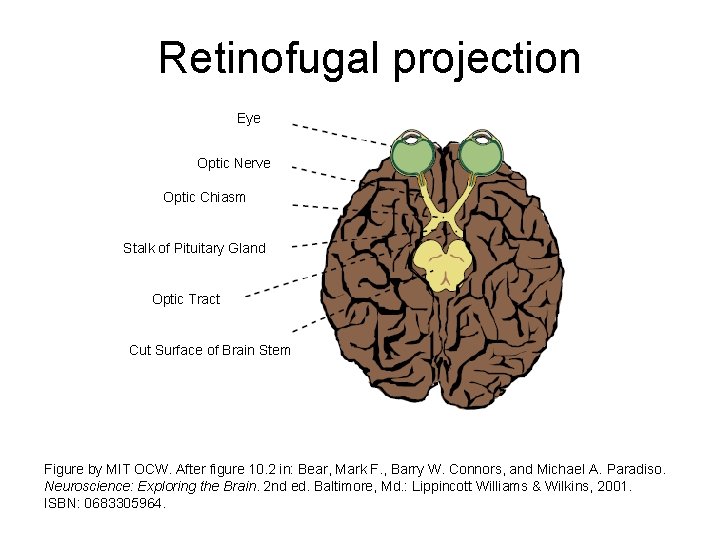
Retinofugal projection Eye Optic Nerve Optic Chiasm Stalk of Pituitary Gland Optic Tract Cut Surface of Brain Stem Figure by MIT OCW. After figure 10. 2 in: Bear, Mark F. , Barry W. Connors, and Michael A. Paradiso. Neuroscience: Exploring the Brain. 2 nd ed. Baltimore, Md. : Lippincott Williams & Wilkins, 2001. ISBN: 0683305964.
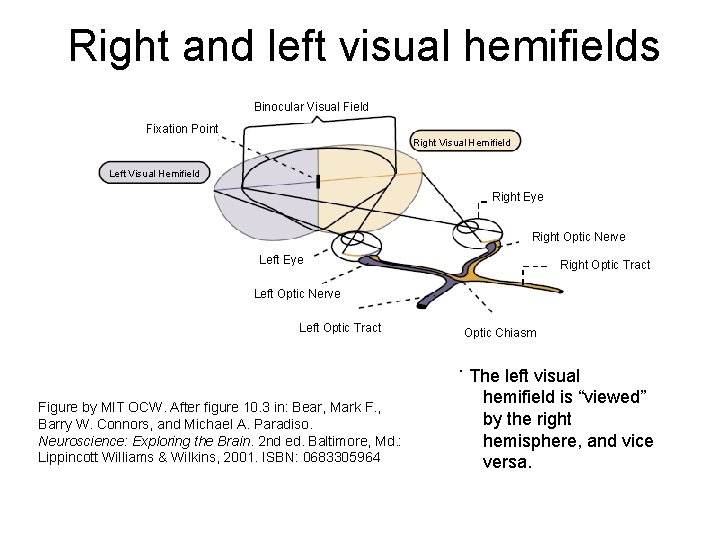
Right and left visual hemifields Binocular Visual Field Fixation Point Right Visual Hemifield Left Visual Hemifield Right Eye Right Optic Nerve Left Eye Right Optic Tract Left Optic Nerve Left Optic Tract Figure by MIT OCW. After figure 10. 3 in: Bear, Mark F. , Barry W. Connors, and Michael A. Paradiso. Neuroscience: Exploring the Brain. 2 nd ed. Baltimore, Md. : Lippincott Williams & Wilkins, 2001. ISBN: 0683305964 Optic Chiasm ˙ The left visual hemifield is “viewed” by the right hemisphere, and vice versa.
Retinogeniculocortical pathway Retina LGN V 1 pathway for conscious visual perception Images removed due to copyright reasons. Please see figures 10. 4 a and b in: Bear, Mark F. , Barry W. Connors, and Michael A. Paradiso. Neuroscience: Exploring the Brain. 2 nd ed. Baltimore, Md. : Lippincott Williams & Wilkins, 2001. ISBN: 0683305964.
Lateral geniculate nucleus ˙ dorsal thalamus ˙ major targets of optic tracts Images removed due to copyright reasons. Please see figure 10. 8 in: Bear, Mark F. , Barry W. Connors, and Michael A. Paradiso. Neuroscience: Exploring the Brain. 2 nd ed. Baltimore, Md. : Lippincott Williams & Wilkins, 2001. ISBN: 0683305964.
Retinotopy • Neighboring retinal cells project to neighboring LGN cells. • There are maps of visual space in the LGN. • Magnification of map for central vision.
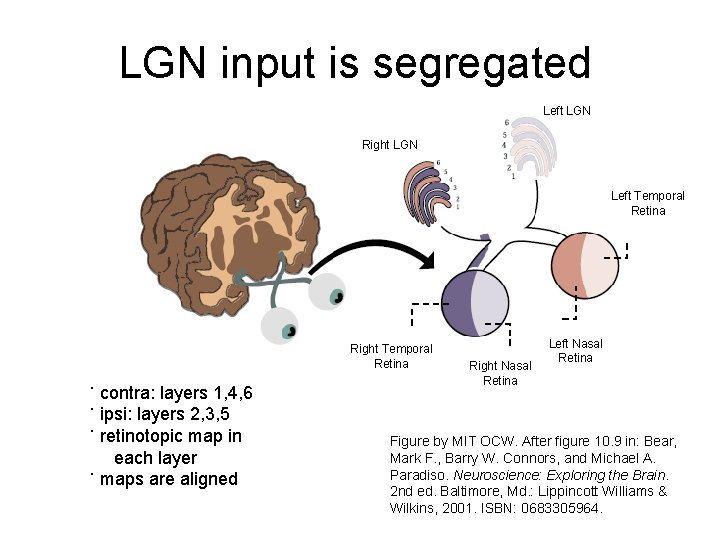
LGN input is segregated Left LGN Right LGN Left Temporal Retina Right Temporal Retina ˙ contra: layers 1, 4, 6 ˙ ipsi: layers 2, 3, 5 ˙ retinotopic map in each layer ˙ maps are aligned Right Nasal Retina Left Nasal Retina Figure by MIT OCW. After figure 10. 9 in: Bear, Mark F. , Barry W. Connors, and Michael A. Paradiso. Neuroscience: Exploring the Brain. 2 nd ed. Baltimore, Md. : Lippincott Williams & Wilkins, 2001. ISBN: 0683305964.
LGN function? ? • Receptive fields like retinal ganglion cells • 80% of excitatory synapses from conrtex • Neuromodulatory input - alertness - attention - sleep
- Slides: 26