
RELATED READING PAUL DUNCUM 7 PRINCIPLES FOR VISUAL
- Slides: 23
RELATED READING: PAUL DUNCUM, “ 7 PRINCIPLES FOR VISUAL CULTURE EDUCATION” (IN JANUARY 2010 ART EDUCATION) Ashley Cardamone, Fall 2015
7 Principles Developed in contrast to formal Elements of Art/Principles of Design, for a contemporary curriculum Contrast to Gude’s Principles because these relate more to examining images Duncum’s Principles: � Power � Ideology � Representation � Seduction � Gaze � Intertextuality
Power “Power is exercised as a struggle to control and oppose, influence and resist. ” Imagery has power that works in two ways � Images have the power to assert ideas for the viewers � Viewers have the power to interpret the image Advertising-intentions and interpretations � Video 1: https: //www. youtube. com/watch? v=5 Bod 1 c. LFvj. Y � Video 2: https: //www. youtube. com/watch? v=ou 5 Ensq. NRc
Ideology Images communicate “assumptions about the way of the world” and may spread ideologies that are: � Racist � Sexist � Ageist Ideology of images may also: � Support family � Condemn violence � Promote conservation of the environment Ideologies are historically and culturally
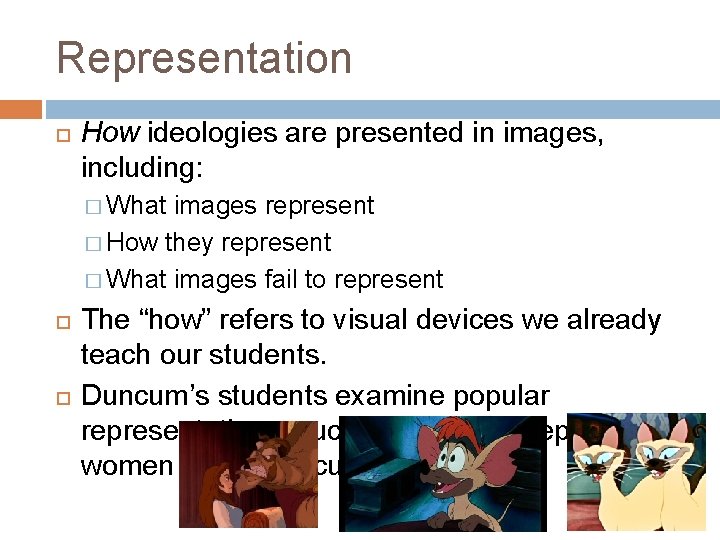
Representation How ideologies are presented in images, including: � What images represent � How they represent � What images fail to represent The “how” refers to visual devices we already teach our students. Duncum’s students examine popular representations, such as Disney’s depiction of women and other cultures
Seduction The “pleasurable form” of images that makes it easy to accept ideologies � Beauty, grotesque, kitsch, cute, romantic, repulsive Dumcum’s finding: “Students report that sometimes they are conflicted over enjoying the sensory qualities of a cultural form and objecting to its ideology. ”
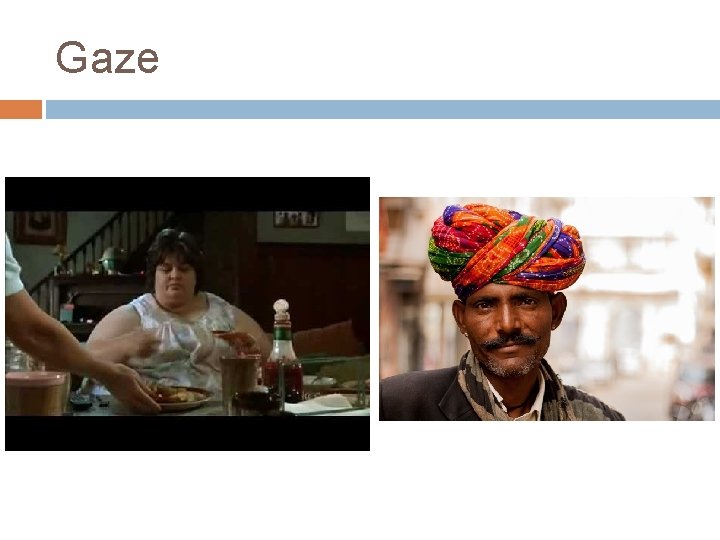
Gaze What we bring to images, the way we interpret them based on our predisposition With visual culture imagery, it is more common that we glance quickly than take time to gaze Has two components: � The image invites us to see something specific � Our predisposition determines what we see
Gaze
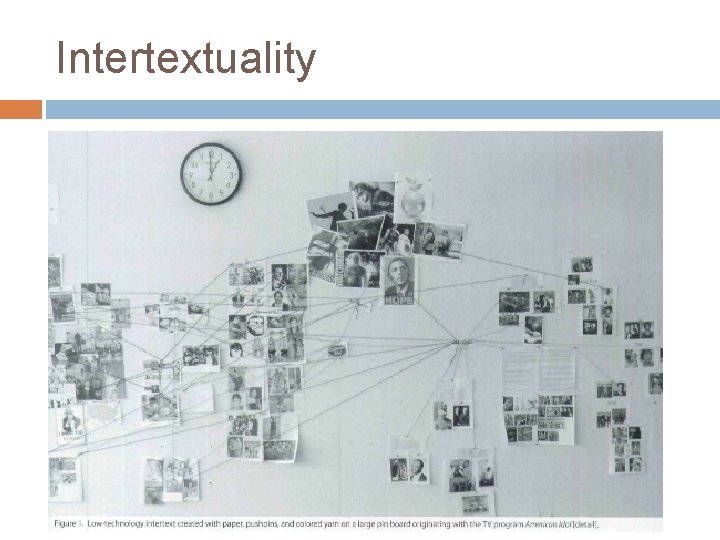
Intertextuality Every image relates to something else Visual culture images have a rhyzomatic structure Images can be connected regardless of � Historical category � Time � Geography Intertexts can connect student interest with project requirements by allowing more content to relate
Intertextuality
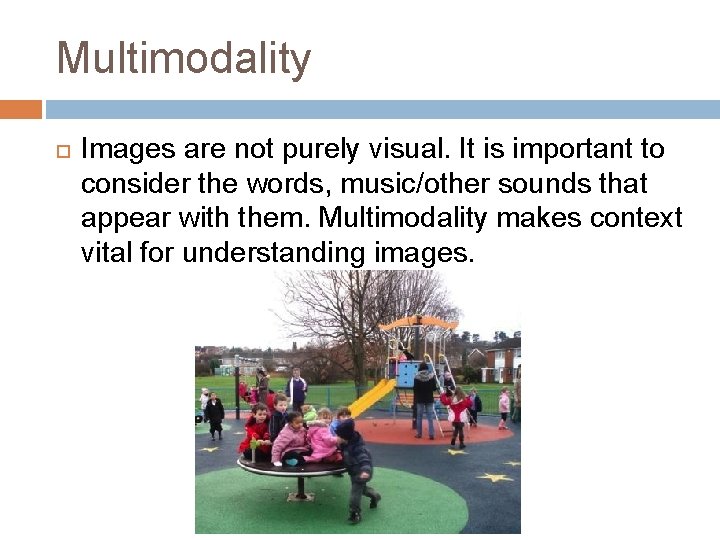
Multimodality Images are not purely visual. It is important to consider the words, music/other sounds that appear with them. Multimodality makes context vital for understanding images.
IRIT ROGOFF, “STUDYING VISUAL CULTURE” Ashley Cardamone, Fall 2015
Discussion Questions What are some benefits of responding to visual culture objectively? How can we teach our students to do this?
Discussion Questions “Can we actually participate in the pleasure and identify with the images produced by culturally specific groups to which we do not belong? ” “…who is allowed to speak about what? ” � How do these statements relate to teaching about diverse cultures and media in the classroom? � How do you discuss multicultural art with students? � Have you ever been uncomfortable discussing multicultural art with students, or not gotten the
Discussion Questions How is our “critical culture” positive or negative for our students? What can we do in the art room to prepare our students as members of this “critical culture”both criticizing and being critiqued?
Breakout Group Discussion/Activity What are the “thorniest problems” among your students? � Share within your group � Choose one, then come up with a lesson idea that would push students to address that problem through art
Discussion Questions My favorite example of having a “good eye”! https: //www. youtube. com/watch? v=r. VUg 8 a 1 Tlf 0 How might having a traditional “good eye” help students digest visual culture? What can we do to encourage students to achieve a “curious eye”? (being open to learning something completely new by looking)
Discussion Questions HISTORICAL CONTEXT MATERIAL TECHNIQUES NOTIONS OF QUALITY/EXCELLENCE
Favorite Quotes “In visual culture the history becomes that of the viewer…rather than that of the object. ” � How does that relate to relevance in teaching? � What are some specific images that students might have a history with in this way? q “(Visual culture) might lead towards a new object of study which would be determined around issues. ” q What “big ideas” have you centered projects around that have been most successful?
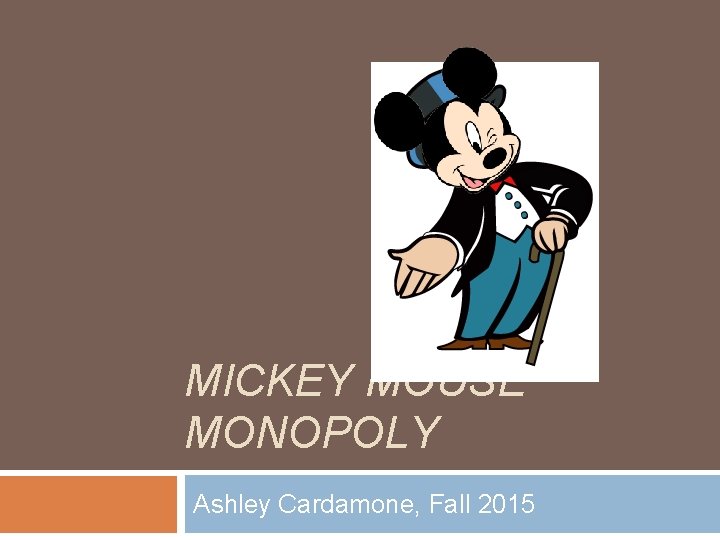
MICKEY MOUSE MONOPOLY Ashley Cardamone, Fall 2015
Discussion Questions First of all, let’s survey. Agree or disagree? Whose responsibility is it to filter Disney images (if that is what should be done) for children? Parents? Teachers? How should we address Disney as teachers? � Full access/encourage it � Conversations � Avoid completely
Discussion Questions Disney is concerned about “policing” its image. � How is that different from when other corporations do the same thing? Why does it upset us so much when Disney does it? Female Disney characters are accused of showing girls what they should look like, that they must be rescued, how to be feminine, etc? � Is anyone other than Disney responsible for this? � Do male Disney characters have a similar affect
Discussion Questions How do accurate-to-screen character toys affect how children play? � Elementary teachers…have you seen any of these effects?