
Related Parties IAS 24 Management Level Paper F


- Slides: 44
Related Parties – IAS 24 Management Level – Paper F 2 Advanced Financial Reporting Lecture - 018 Vidya Rajawasam ACMA CGMA MBA
Related Parties We have discussed the subject area related ØFurther aspects of Construction contracts (IAS 11) in our previous lecture.
Related Parties v. In this lecture we will discuss the Related parties
Related Parties Introduction Related party relationships are a normal part of everyday business. Often groups of companies are formed based on their trading relationship. This relationship can have a direct impact on the financial performance of an individual company.
Related Parties Introduction This is mainly due to the special terms and arrangements that could arise between related parties e. g. an entity sells its products to a subsidiary in the same group at a smaller mark-up than it would to an entity that wasn’t a related party. Obviously this would have a direct impact on profit margins.
Related Parties Introduction When it comes to balances outstanding the same could be true e. g. an entity allows an extended credit period to its related parties so distorting is debt collection figures. If the users of the financial statements are aware of these relationships, transactions and balances then they can take them into account when assessing the performance and position of the entity.
Related Parties § § Definitions Related party – A party is related to an entity if the party either: controls, is controlled by, or is under common control with, the entity has an interest in the entity that gives a significant influence over the entity has joint control over the entity is an associate (IAS 28 Investment in Associates).
Related Parties Definitions Related party – A party is related to an entity if the party either: § is a joint venture in which the entity is a venturer (IAS 31 Interests in joint ventures) § is a member of the key management personnel of the entity or its parent
Related Parties Definitions Related party – A party is related to an entity if the party either: § is a close family member of any of the above § is a post-employment benefit plan for the employees of the entity or of any entity that is a related party of the entity.
Related Parties Definitions Related party transaction – The transfer of resources, services or obligations between related parties, regardless of whether a price is charged. Example A parent company may provide some of its key staff to a subsidiary without cost. The subsidiary is being subsidized at the expense of the parent.
Related Parties Definitions Control – Is the power to govern the financial and operating policies of an entity so as to obtain benefits from its activities. Joint control is the contractually-agreed sharing of control over an economic activity.
Related Parties Definitions Example You have a joint-venture agreement with a foreign sales agent. You provide the goods, which your agent sells in a foreign territory. The agreement identifies the product range, promotional material, management support, limit of the sales area, and transfer price. You share the profits, with 40% coming you, 60% to the agent. This is an example of joint control.
Related Parties Definitions Key management personnel – Those persons having authority and responsibility for planning, directing and controlling the activities of the entity, directly or indirectly, including any director of that entity.
Related Parties Definitions Example Executives from your parent company may give instructions to your staff in important matters, such as strategic planning and treasury functions. For your company, these are key management personnel.
Related Parties Definitions Significant influence – The power to participate in the financial and operating policy decisions of an entity but is not control over those policies. Significant influence may be gained by share ownership, statute or agreement.
Related Parties Definitions Example Significant influence may be reflected in board membership, and/or a substantial shareholding of between 20% and 50%. A majority shareholding is more than a significant influence, as at would yield control, in most circumstances.
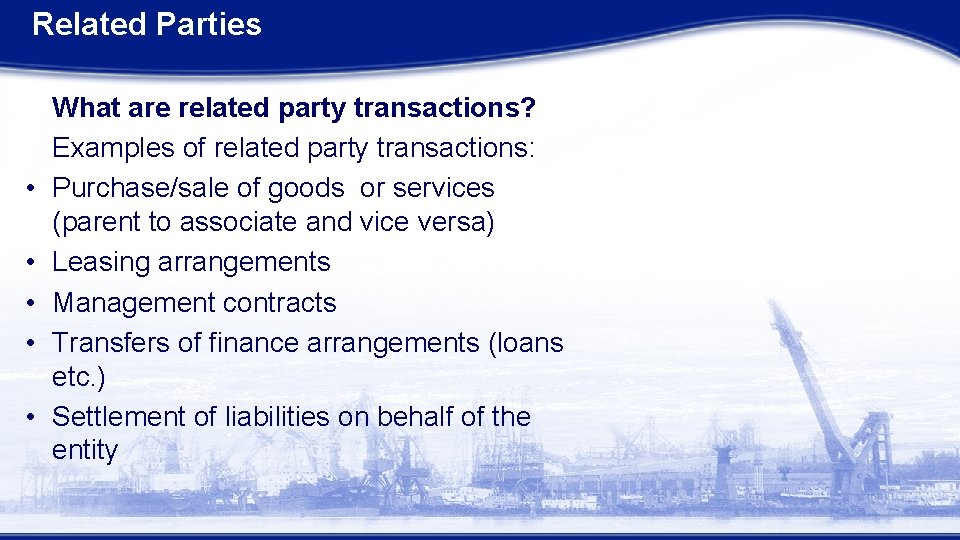
Related Parties What are related party transactions? Quite simply put, it is the transfer of resources or obligations between related parties regardless whether a fee has been charged or not. The key point here being the fact that money doesn’t have to change hands for it to be considered a related party transaction. .
Related Parties • • • What are related party transactions? Examples of related party transactions: Purchase/sale of goods or services (parent to associate and vice versa) Leasing arrangements Management contracts Transfers of finance arrangements (loans etc. ) Settlement of liabilities on behalf of the entity
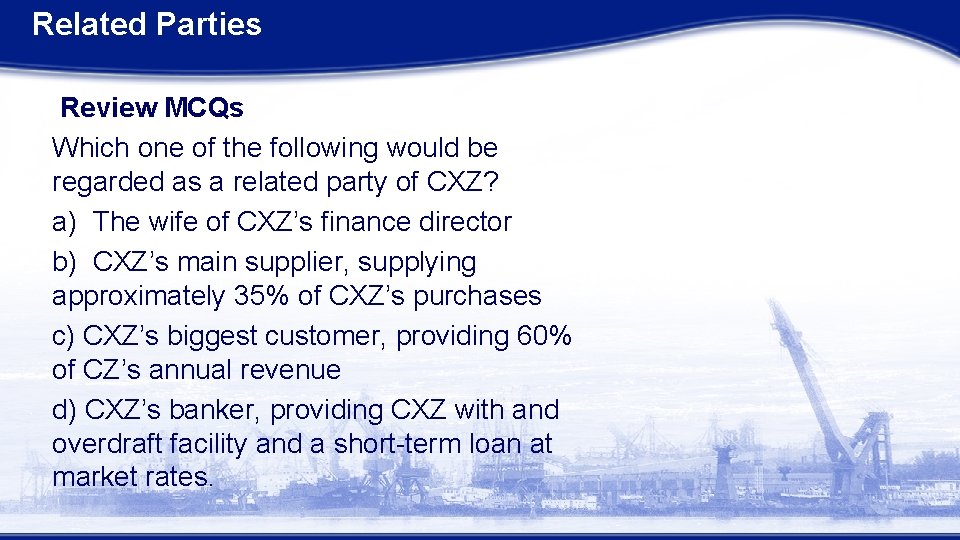
Related Parties Review MCQs Which one of the following would be regarded as a related party of CXZ? a) The wife of CXZ’s finance director b) CXZ’s main supplier, supplying approximately 35% of CXZ’s purchases c) CXZ’s biggest customer, providing 60% of CZ’s annual revenue d) CXZ’s banker, providing CXZ with and overdraft facility and a short-term loan at market rates.
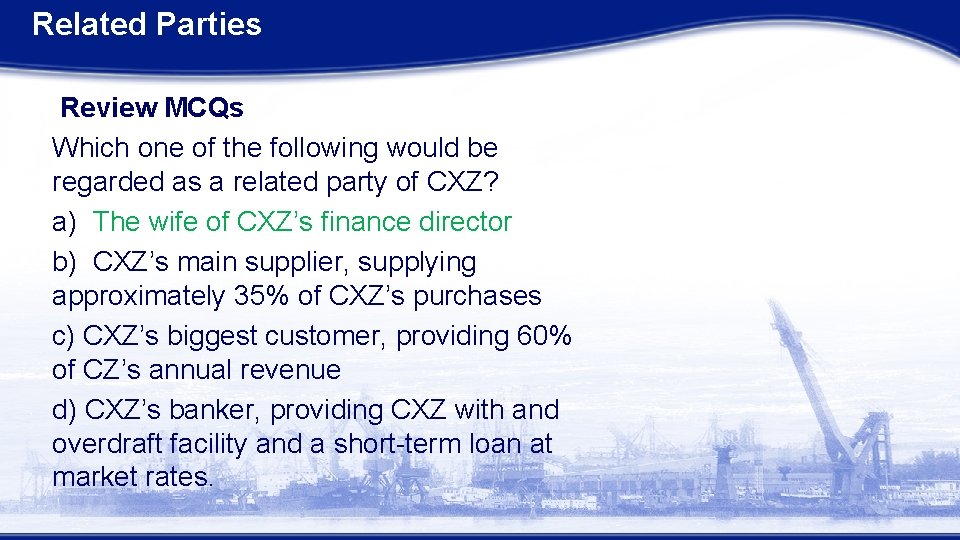
Related Parties Review MCQs Which one of the following would be regarded as a related party of CXZ? a) The wife of CXZ’s finance director b) CXZ’s main supplier, supplying approximately 35% of CXZ’s purchases c) CXZ’s biggest customer, providing 60% of CZ’s annual revenue d) CXZ’s banker, providing CXZ with and overdraft facility and a short-term loan at market rates.
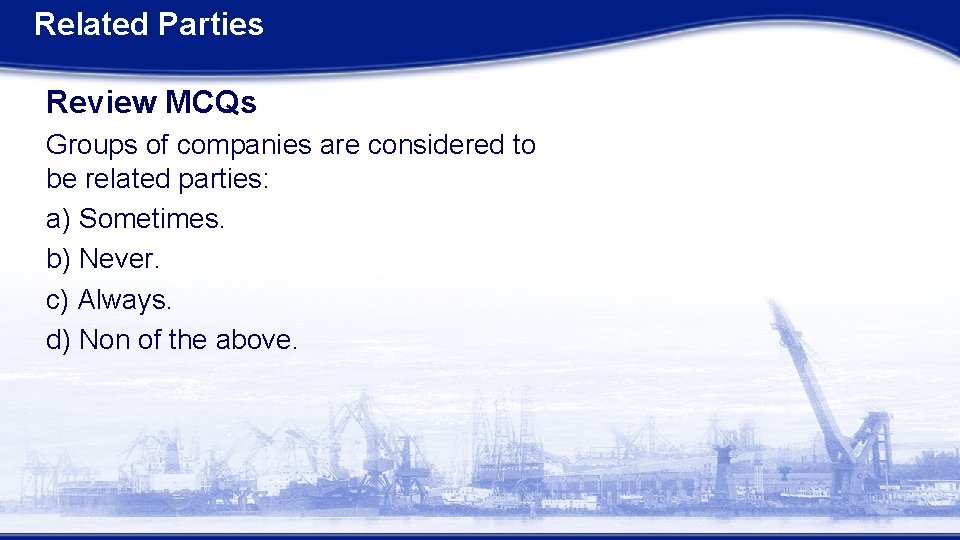
Related Parties Review MCQs Groups of companies are considered to be related parties: a) Sometimes. b) Never. c) Always. d) Non of the above.
Related Parties Review MCQs Groups of companies are considered to be related parties: a) Sometimes. b) Never. c) Always. d) Non of the above.
Related Parties Disclosures Relationships between parents and subsidiaries shall be disclosed irrespective of whethere have been transactions between those related parties. § Name of entity’s parent and; § If different the ultimate controlling party
Related Parties § § Disclosures Disclosure of key management personnel compensation Key management personnel compensation in total and for each of the following; Short-term employee benefits Post-employment benefits Other long term benefits Share based payments
Related Parties Disclosure of transactions and balances generally If there have been transactions between related parties, an entity should disclose the nature of the related party relationships as well as information about the types of transactions and the outstanding balances necessary for an understanding of the financial statements.
Related Parties Disclosure of transactions and balances generally Disclosure should be made irrespective of whether a price is charged. At a minimum the disclosure should include: § The amount of the transactions § The amount of outstanding balances, including terms and conditions, whether they are secured and the nature of the consideration to be provided.
Related Parties § § Disclosure of transactions and balances generally The above should be made separately for each of the following, The parent Entities with joint control or significant influence over the entity Subsidiaries Associates
Related Parties Disclosure of transactions and balances generally The above should be made separately for each of the following, § Joint ventures in which the entity is a venture § Key management personnel § Other related parties
Related Parties Example Entity X is a manufacturer of automobile spare parts. It transacts business through a business model that has worked for several years and has made the entity a successful enterprise that is rated in the top 10 businesses in its field by a trade journal.
Related Parties Example Entity X believes in working with reliable and dependable vendors and also sells only to entities that it can either control or exercise significant influence over. The business model works in this way:
Related Parties Example (a) Entity X purchases everything it needs from Entity Z, a well-known supplier. Due to the high quality of the material that Entity Z has provided over the last 10 years, Entity X. has never purchased from any other supplier. Thus it may be considered economically dependent on Entity Z
Related Parties Example (b) Entity X sells 70% of its output to a company owned by a director and the balance to an entity that is its “associate” by virtue of Entity X owning 35% of the share capital of that company. (c) Entity X stores inventory in a warehouse that is leased from the wife of its director. The lease rentals are at arm`s length.
Related Parties Example (d) Entity X has provided an interestfree loan to a company owned by the chief executive officer (CEO) of Entity X for the purposes of financing the purchase of delivery vans which the company owned by the CEO is using for transporting goods from the warehouse of the supplier to the warehouse used by Entity X for storing inventory.
Related Parties Analysis Let us examine each of the transactions in order to determine whether they would warrant disclosure as related party transaction under IAS 24.
Related Parties Analysis (a) Notwithstanding the fact that Entity X purchases all its raw materials from Entity Z and is economically dependent on it, Entity Z does not automatically become a related party. Thus for the purpose of IAS 24, purchases made from Entity Z are not considered related party transactions.
Related Parties Analysis (b) Seventy percent of the sales are to an entity owned by a “director” (i. e. , an entity controlled by a key management person), and 30% of the sales are made to an entity that Entity X has “significant influence” over. Thus both sales are to related parties as defined in IAS 24 and would need to be disclosed as such.
Related Parties Analysis (c) The lease of the warehouse, although at arm`s length, has been entered into with the wife (a “close member of the family”) of a “director” (a key management person) and thus needs to be disclosed as a related party transaction.
Related Parties Analysis (d) The interest-free loan to an entity owned by a director needs to be disclosed as a related party transaction. The fact that it is interest-free may warrant disclosure because it may not be construed as an “arm`s-length transaction” since Entity X would not normally provide unrelated parties with interest-free loans.
Related Parties Review MCQs A parent company can control, or influence its subsidiary’s: a) Financial policies. b) Operating policies. c) Both. d) Non of the above
Related Parties Review MCQs A parent company can control, or influence its subsidiary’s: a) Financial policies. b) Operating policies. c) Both. d) Non of the above.
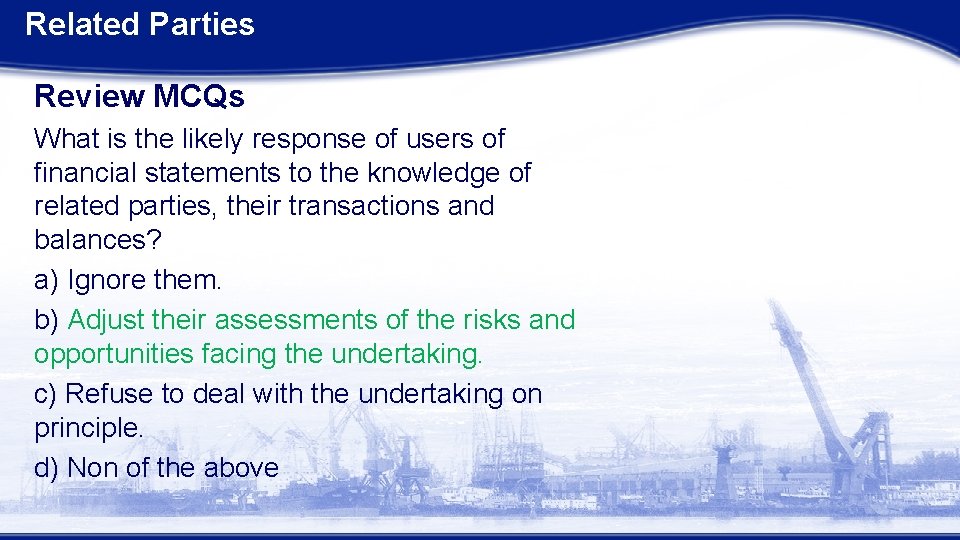
Related Parties Review MCQs What is the likely response of users of financial statements to the knowledge of related parties, their transactions and balances? a) Ignore them. b) Adjust their assessments of the risks and opportunities facing the undertaking. c) Refuse to deal with the undertaking on principle. d) Non of the above
Related Parties Review MCQs What is the likely response of users of financial statements to the knowledge of related parties, their transactions and balances? a) Ignore them. b) Adjust their assessments of the risks and opportunities facing the undertaking. c) Refuse to deal with the undertaking on principle. d) Non of the above
Related Parties Lecture Summary Ø Related Parties
Related Parties Management Level – Paper F 2 Advanced Financial Reporting Lecture - 018 Vidya Rajawasam ACMA CGMA MBA