
Reinventing the Telephone System The Third Generation Henning
- Slides: 45
Re-inventing the Telephone System: The Third Generation Henning Schulzrinne Dept. of Computer Science Columbia University CAT Forum -- October 12, 2004
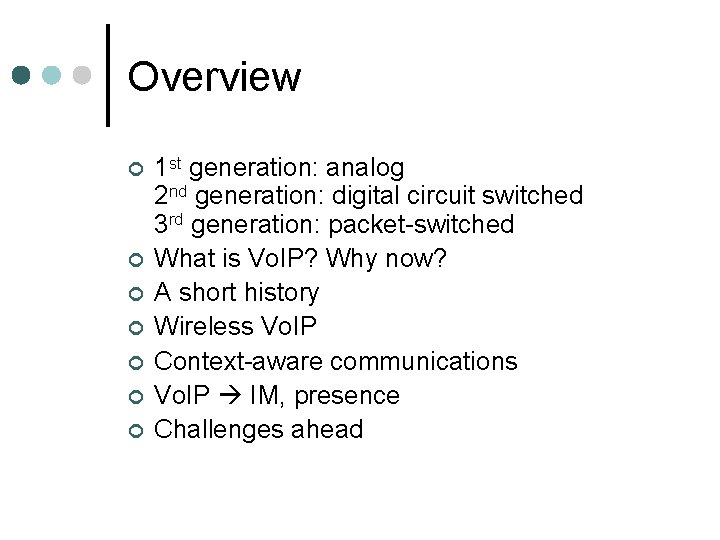
Overview ¢ ¢ ¢ ¢ 1 st generation: analog 2 nd generation: digital circuit switched 3 rd generation: packet-switched What is Vo. IP? Why now? A short history Wireless Vo. IP Context-aware communications Vo. IP IM, presence Challenges ahead
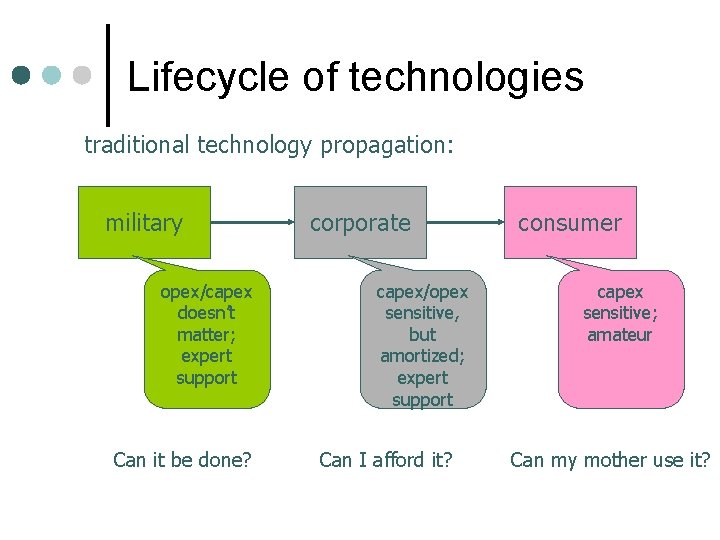
Lifecycle of technologies traditional technology propagation: military opex/capex doesn’t matter; expert support Can it be done? corporate capex/opex sensitive, but amortized; expert support Can I afford it? consumer capex sensitive; amateur Can my mother use it?
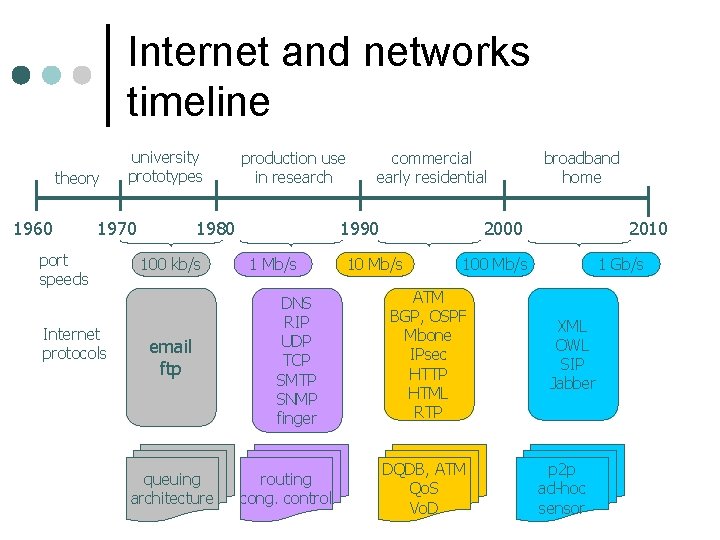
Internet and networks timeline theory 1960 university prototypes 1970 port speeds Internet protocols production use in research 1980 100 kb/s email ftp queuing architecture commercial early residential 1990 1 Mb/s DNS RIP UDP TCP SMTP SNMP finger routing cong. control broadband home 2000 10 Mb/s 2010 100 Mb/s ATM BGP, OSPF Mbone IPsec HTTP HTML RTP DQDB, ATM Qo. S Vo. D 1 Gb/s XML OWL SIP Jabber p 2 p ad-hoc sensor
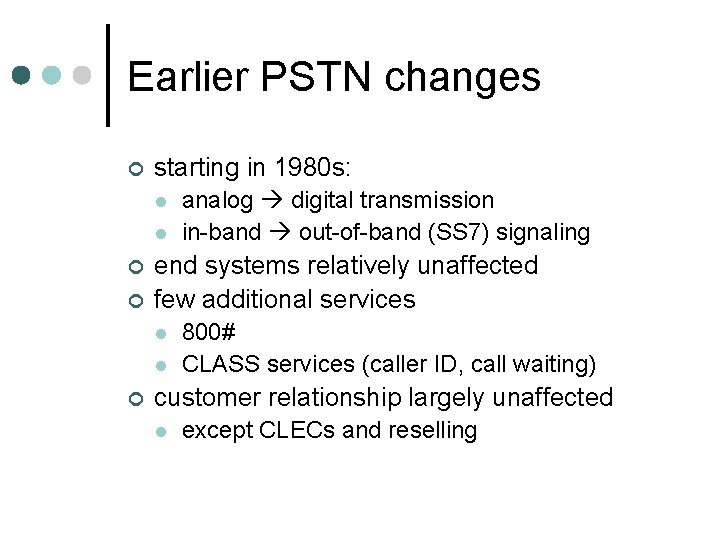
Earlier PSTN changes ¢ starting in 1980 s: l l ¢ ¢ end systems relatively unaffected few additional services l l ¢ analog digital transmission in-band out-of-band (SS 7) signaling 800# CLASS services (caller ID, call waiting) customer relationship largely unaffected l except CLECs and reselling
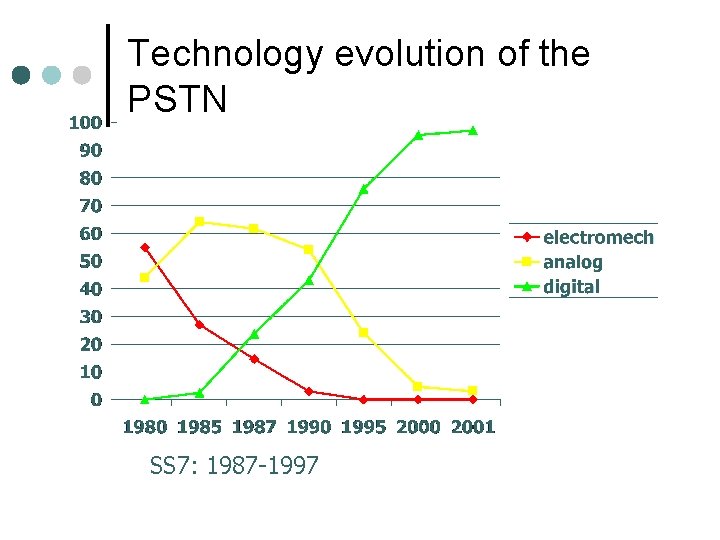
Technology evolution of the PSTN SS 7: 1987 -1997
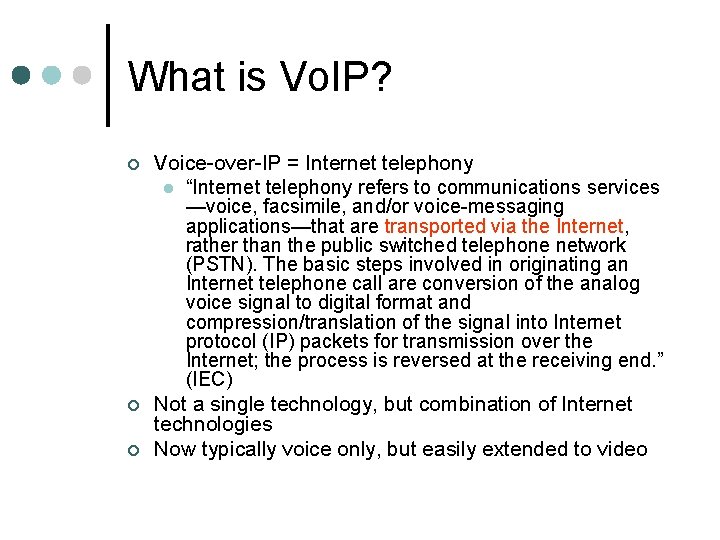
What is Vo. IP? ¢ ¢ ¢ Voice-over-IP = Internet telephony l “Internet telephony refers to communications services —voice, facsimile, and/or voice-messaging applications—that are transported via the Internet, rather than the public switched telephone network (PSTN). The basic steps involved in originating an Internet telephone call are conversion of the analog voice signal to digital format and compression/translation of the signal into Internet protocol (IP) packets for transmission over the Internet; the process is reversed at the receiving end. ” (IEC) Not a single technology, but combination of Internet technologies Now typically voice only, but easily extended to video
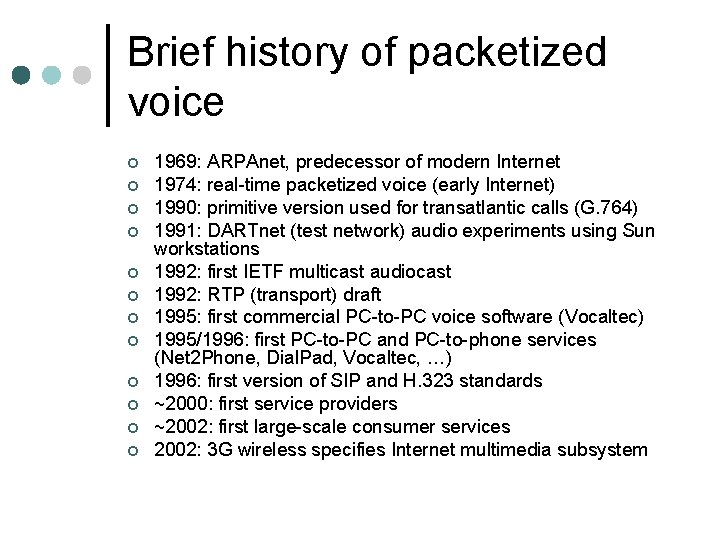
Brief history of packetized voice ¢ ¢ ¢ 1969: ARPAnet, predecessor of modern Internet 1974: real-time packetized voice (early Internet) 1990: primitive version used for transatlantic calls (G. 764) 1991: DARTnet (test network) audio experiments using Sun workstations 1992: first IETF multicast audiocast 1992: RTP (transport) draft 1995: first commercial PC-to-PC voice software (Vocaltec) 1995/1996: first PC-to-PC and PC-to-phone services (Net 2 Phone, Dial. Pad, Vocaltec, …) 1996: first version of SIP and H. 323 standards ~2000: first service providers ~2002: first large-scale consumer services 2002: 3 G wireless specifies Internet multimedia subsystem
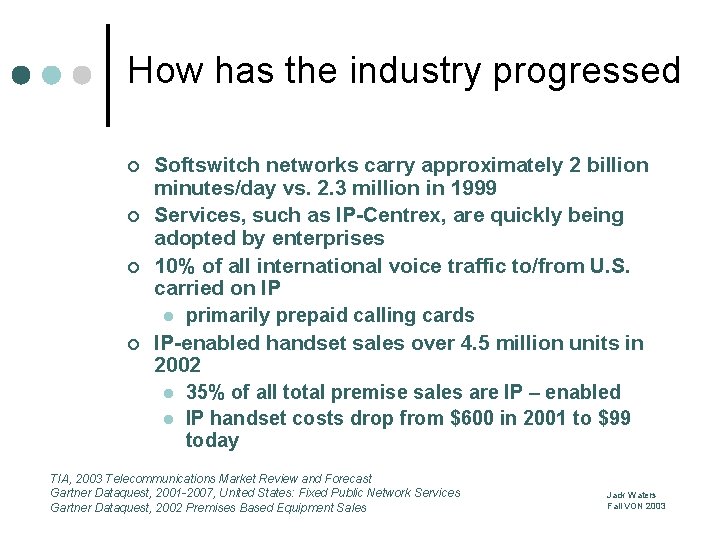
How has the industry progressed ¢ ¢ Softswitch networks carry approximately 2 billion minutes/day vs. 2. 3 million in 1999 Services, such as IP-Centrex, are quickly being adopted by enterprises 10% of all international voice traffic to/from U. S. carried on IP l primarily prepaid calling cards IP-enabled handset sales over 4. 5 million units in 2002 l 35% of all total premise sales are IP – enabled l IP handset costs drop from $600 in 2001 to $99 today TIA, 2003 Telecommunications Market Review and Forecast Gartner Dataquest, 2001 -2007, United States: Fixed Public Network Services Gartner Dataquest, 2002 Premises Based Equipment Sales Jack Waters Fall VON 2003
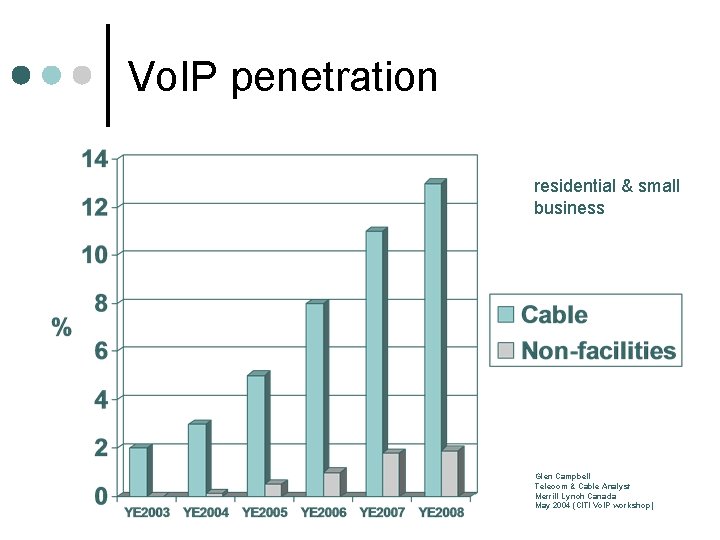
Vo. IP penetration residential & small business Glen Campbell Telecom & Cable Analyst Merrill Lynch Canada May 2004 (CITI Vo. IP workshop)
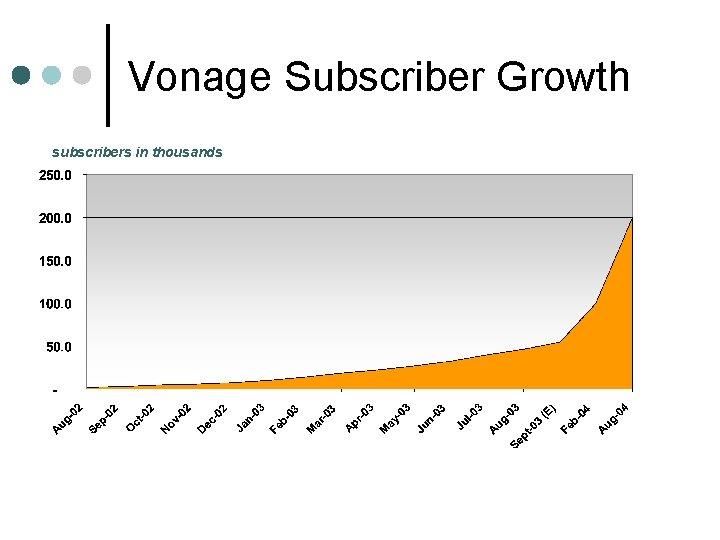
Vonage Subscriber Growth subscribers in thousands *Cable Datacom News Round Up, September 1, 2003
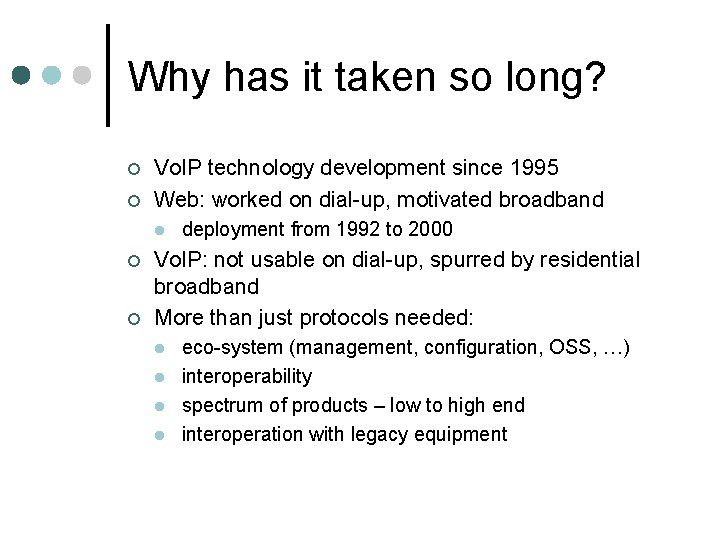
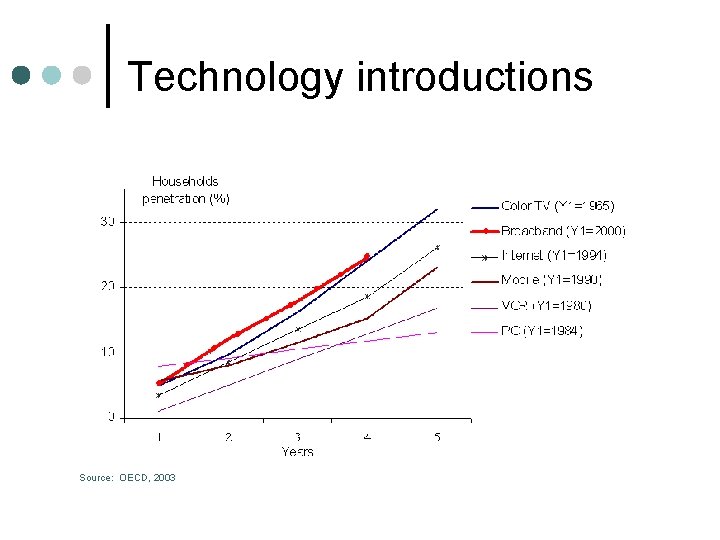
Why has it taken so long? ¢ ¢ Vo. IP technology development since 1995 Web: worked on dial-up, motivated broadband l ¢ ¢ deployment from 1992 to 2000 Vo. IP: not usable on dial-up, spurred by residential broadband More than just protocols needed: l l eco-system (management, configuration, OSS, …) interoperability spectrum of products – low to high end interoperation with legacy equipment
Technology introductions Source: OECD, 2003
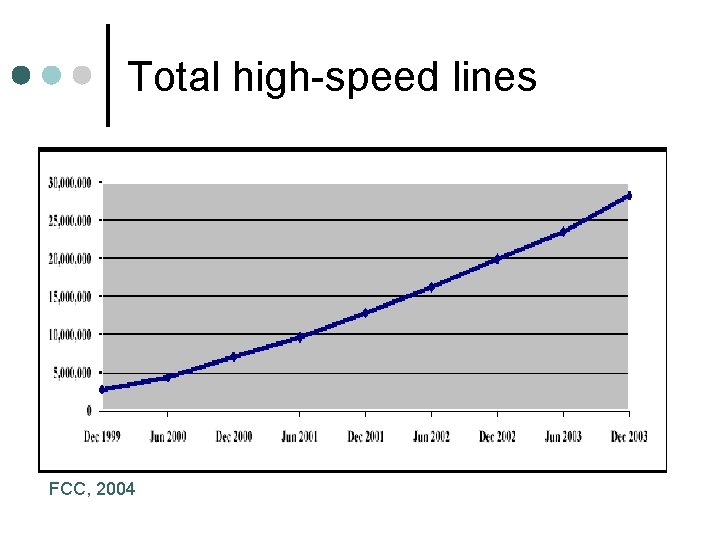
Conditions for Vo. IP ¢ Multimedia PC with low-latency OS l ¢ earlier Windows versions not suitable Broadband access for residence l modem adds significant delay High-speed switched LANs for businesses ¢ only feasible since mid-1990’s ¢
Total high-speed lines FCC, 2004
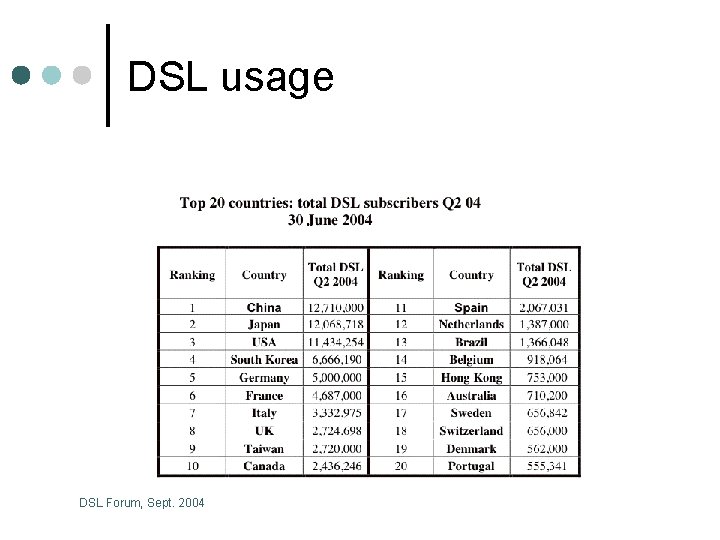
DSL usage DSL Forum, Sept. 2004
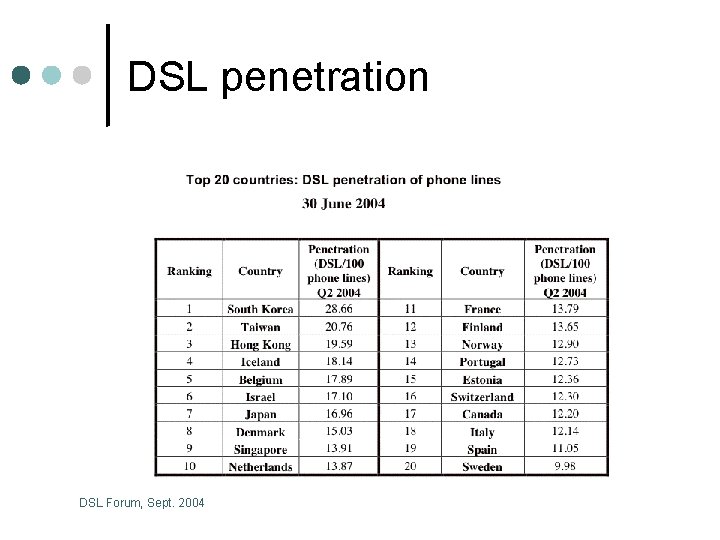
DSL penetration DSL Forum, Sept. 2004
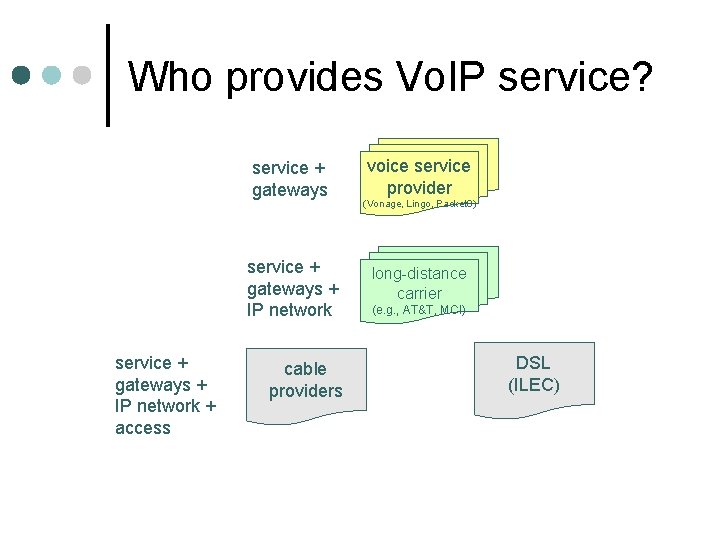
Who provides Vo. IP service? service + gateways + IP network + access cable providers voice service provider (Vonage, Lingo, Packet 8) long-distance carrier (e. g. , AT&T, MCI) DSL (ILEC)
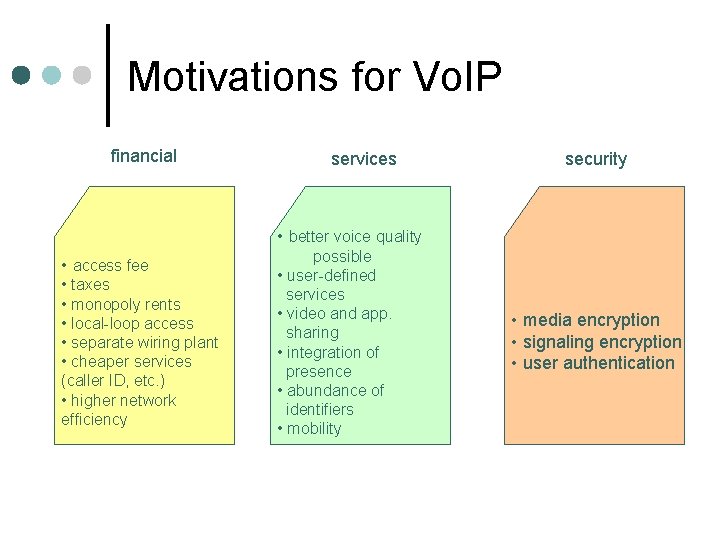
Motivations for Vo. IP financial services security • better voice quality • access fee • taxes • monopoly rents • local-loop access • separate wiring plant • cheaper services (caller ID, etc. ) • higher network efficiency possible • user-defined services • video and app. sharing • integration of presence • abundance of identifiers • mobility • media encryption • signaling encryption • user authentication
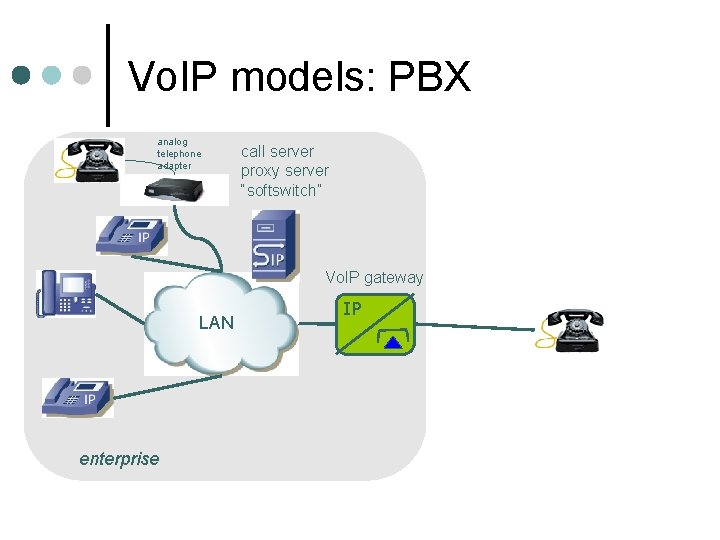
Vo. IP models: PBX analog telephone adapter call server proxy server “softswitch” Vo. IP gateway LAN enterprise IP
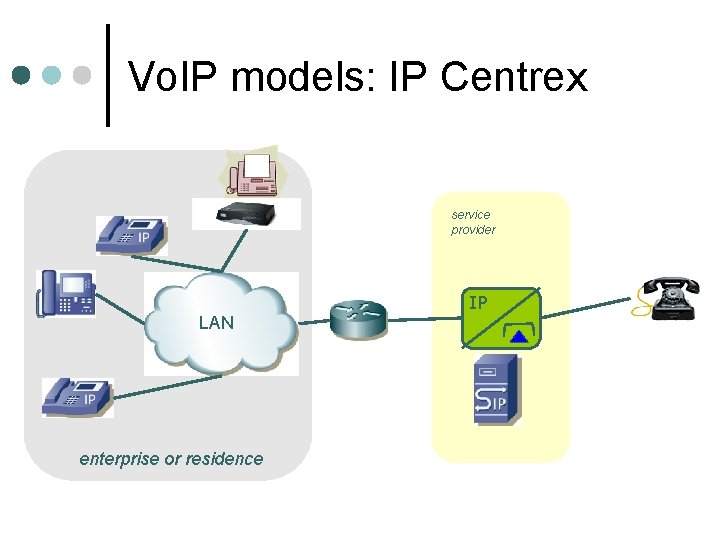
Vo. IP models: IP Centrex service provider LAN enterprise or residence IP
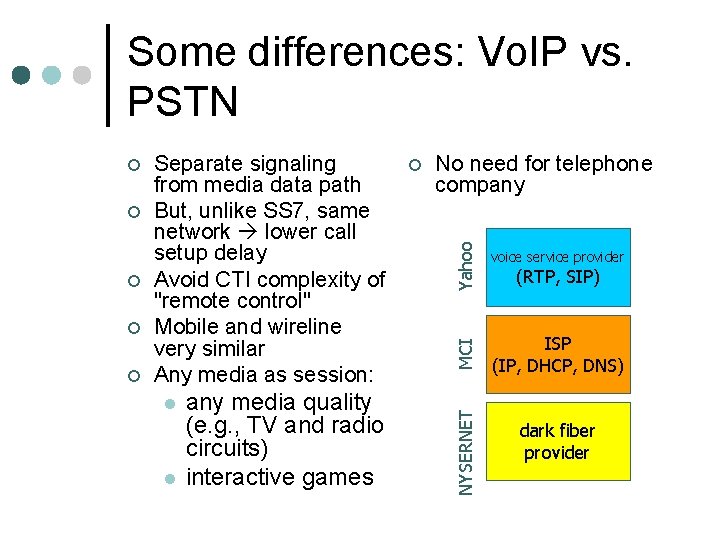
Some differences: Vo. IP vs. PSTN ¢ ¢ l l any media quality (e. g. , TV and radio circuits) interactive games No need for telephone company Yahoo ¢ ¢ voice service provider MCI ¢ Separate signaling from media data path But, unlike SS 7, same network lower call setup delay Avoid CTI complexity of "remote control" Mobile and wireline very similar Any media as session: ISP (IP, DHCP, DNS) NYSERNET ¢ (RTP, SIP) dark fiber provider
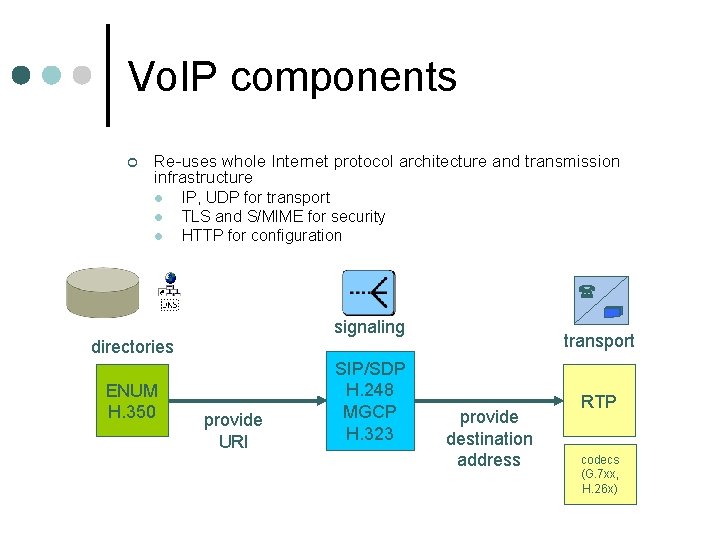
Vo. IP components ¢ Re-uses whole Internet protocol architecture and transmission infrastructure l l l IP, UDP for transport TLS and S/MIME for security HTTP for configuration signaling directories ENUM H. 350 provide URI SIP/SDP H. 248 MGCP H. 323 transport provide destination address RTP codecs (G. 7 xx, H. 26 x)
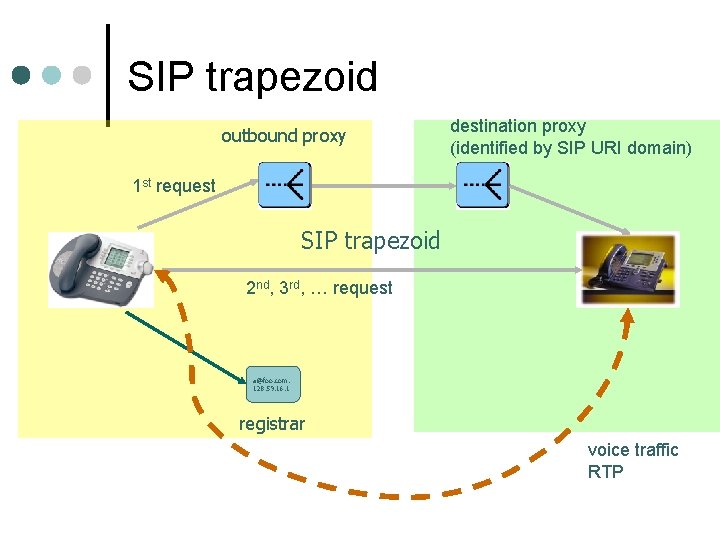
SIP trapezoid outbound proxy destination proxy (identified by SIP URI domain) 1 st request SIP trapezoid 2 nd, 3 rd, … request a@foo. com: 128. 59. 16. 1 registrar voice traffic RTP
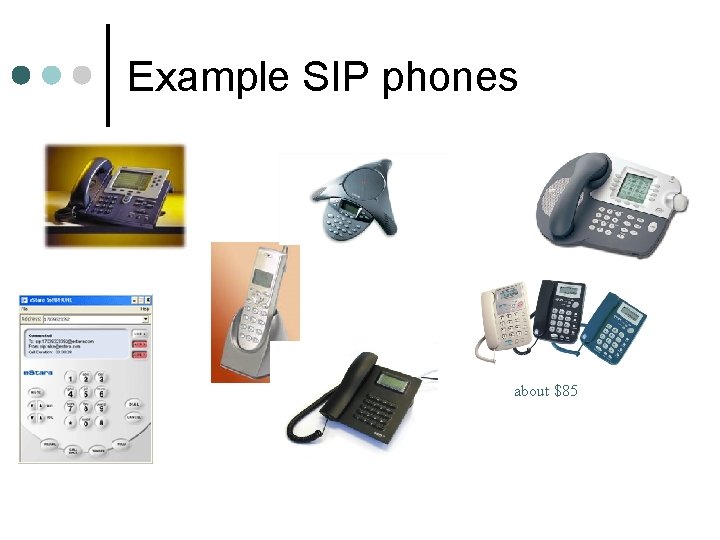
Example SIP phones about $85
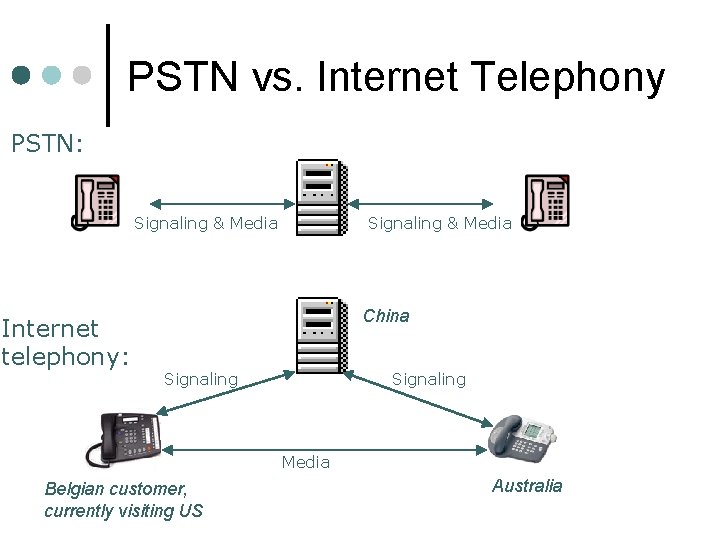
PSTN vs. Internet Telephony PSTN: Signaling & Media Internet telephony: Signaling & Media China Signaling Media Belgian customer, currently visiting US Australia
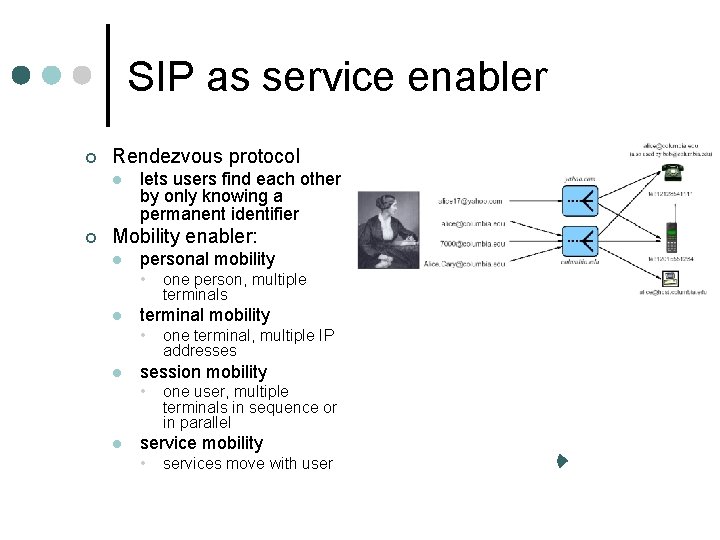
SIP as service enabler ¢ Rendezvous protocol l ¢ lets users find each other by only knowing a permanent identifier Mobility enabler: l personal mobility • l terminal mobility • l one terminal, multiple IP addresses session mobility • l one person, multiple terminals one user, multiple terminals in sequence or in parallel service mobility • services move with user
Changes caused by Vo. IP ¢ Access independence: single-function network to voice-over-any-network l separation of transport and services Transition from “polling” service (try until user happens to be available) to “presence” service ¢ Voice special voice just one media among many ¢
(Early) Adulthood ¢ “fully developed and mature” Not quite yet, but no longer a teenager l probably need another 6 years to be grown up… l ¢ Responsibilities: Dealing with elderly relatives POTS l Financial issues payments, RADIUS l Family emergencies 911 l
Emerging technologies ¢ Core Vo. IP technology largely finished l l ¢ Presence from “polling” to “status report” l l l ¢ deployment largely due to cost savings, not new services toll and fee bypass integrated infrastructure (LAN & WAN) extend “PBX” reach to home and branch offices special case of event notification events as common infrastructure for services location-based services Integration of IM and Vo. IP l l often used in same conference (side channel) IM as initiator of real-time voice/video
Near future: Location-based services ¢ Finding services based on location l l l ¢ physical services (stores, restaurants, ATMs, …) electronic services (media I/O, printer, display, …) not covered here Using location to improve (network) services l communication • incoming communications changes based on where I am l configuration • devices in room adapt to their current users l awareness • others are (selectively) made aware of my location l security • proximity grants temporary access to local resources
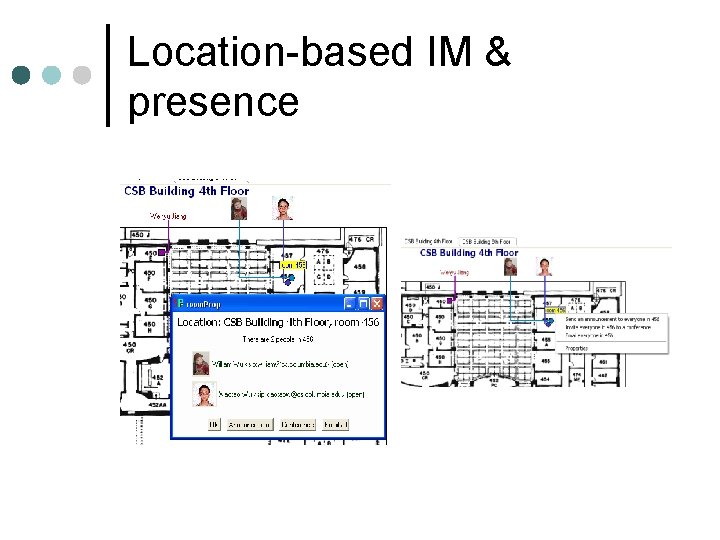
Location-based IM & presence
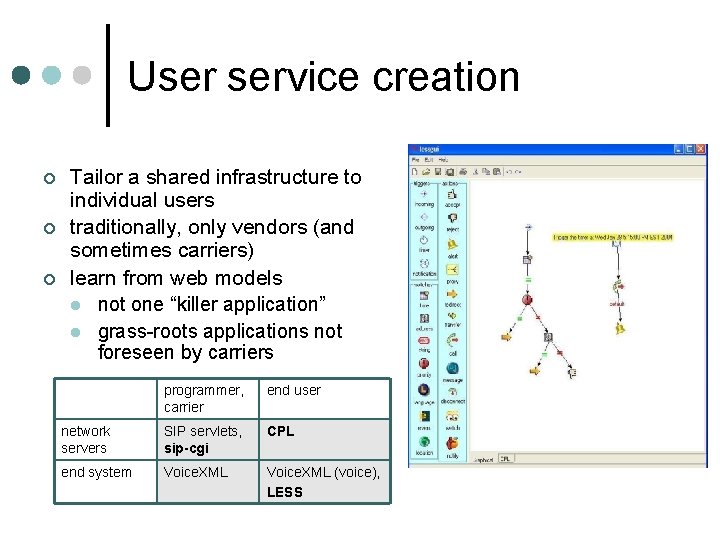
User service creation ¢ ¢ ¢ Tailor a shared infrastructure to individual users traditionally, only vendors (and sometimes carriers) learn from web models l not one “killer application” l grass-roots applications not foreseen by carriers programmer, carrier end user network servers SIP servlets, sip-cgi CPL end system Voice. XML (voice), LESS
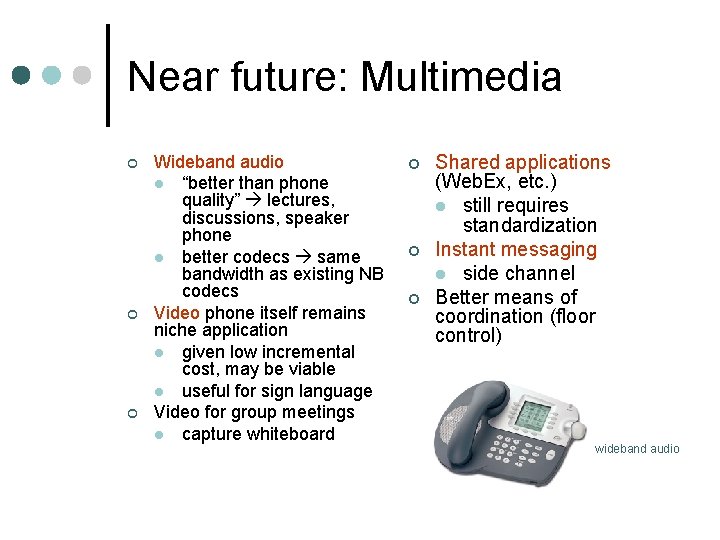
Near future: Multimedia ¢ ¢ ¢ Wideband audio l “better than phone quality” lectures, discussions, speaker phone l better codecs same bandwidth as existing NB codecs Video phone itself remains niche application l given low incremental cost, may be viable l useful for sign language Video for group meetings l capture whiteboard ¢ ¢ ¢ Shared applications (Web. Ex, etc. ) l still requires standardization Instant messaging l side channel Better means of coordination (floor control) wideband audio
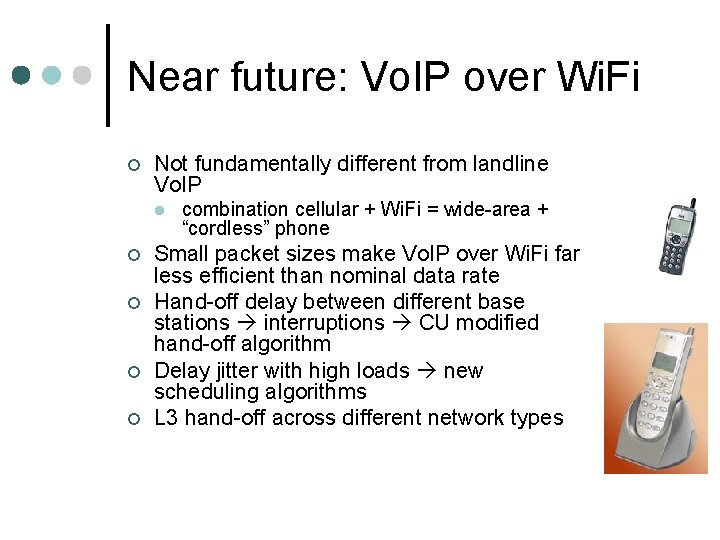
Near future: Vo. IP over Wi. Fi ¢ Not fundamentally different from landline Vo. IP l ¢ ¢ combination cellular + Wi. Fi = wide-area + “cordless” phone Small packet sizes make Vo. IP over Wi. Fi far less efficient than nominal data rate Hand-off delay between different base stations interruptions CU modified hand-off algorithm Delay jitter with high loads new scheduling algorithms L 3 hand-off across different network types
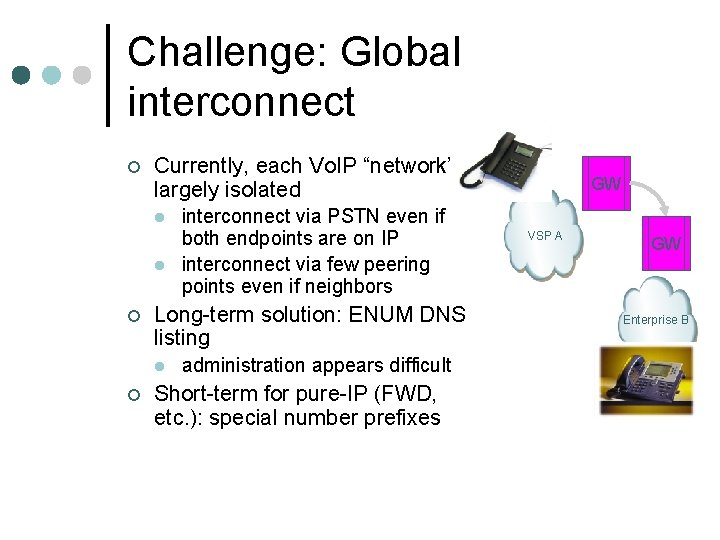
Challenge: Global interconnect ¢ Currently, each Vo. IP “network” largely isolated l l ¢ Long-term solution: ENUM DNS listing l ¢ interconnect via PSTN even if both endpoints are on IP interconnect via few peering points even if neighbors administration appears difficult Short-term for pure-IP (FWD, etc. ): special number prefixes GW VSP A GW Enterprise B
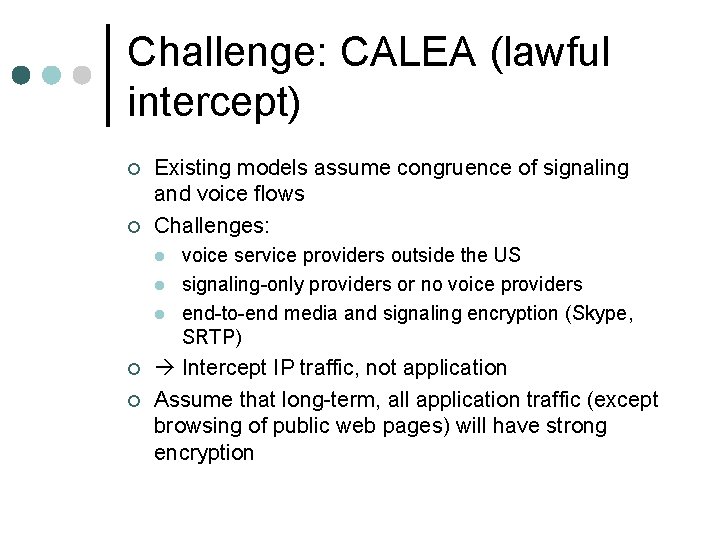
Challenge: CALEA (lawful intercept) ¢ ¢ Existing models assume congruence of signaling and voice flows Challenges: l l l ¢ ¢ voice service providers outside the US signaling-only providers or no voice providers end-to-end media and signaling encryption (Skype, SRTP) Intercept IP traffic, not application Assume that long-term, all application traffic (except browsing of public web pages) will have strong encryption
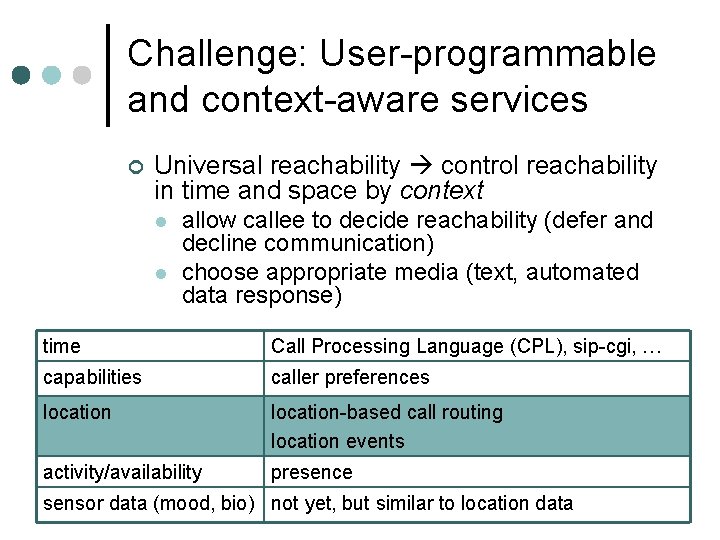
Challenge: User-programmable and context-aware services ¢ Universal reachability control reachability in time and space by context l l allow callee to decide reachability (defer and decline communication) choose appropriate media (text, automated data response) time Call Processing Language (CPL), sip-cgi, … capabilities caller preferences location-based call routing location events activity/availability presence sensor data (mood, bio) not yet, but similar to location data
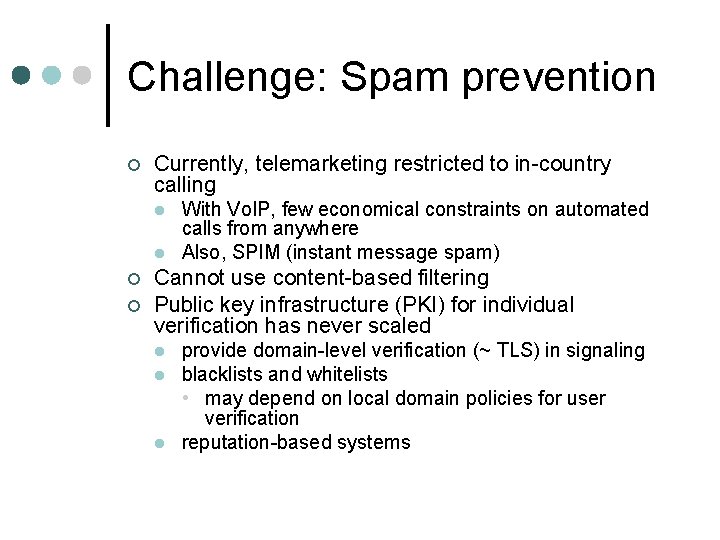
Challenge: Spam prevention ¢ Currently, telemarketing restricted to in-country calling l l ¢ ¢ With Vo. IP, few economical constraints on automated calls from anywhere Also, SPIM (instant message spam) Cannot use content-based filtering Public key infrastructure (PKI) for individual verification has never scaled l l l provide domain-level verification (~ TLS) in signaling blacklists and whitelists • may depend on local domain policies for user verification reputation-based systems
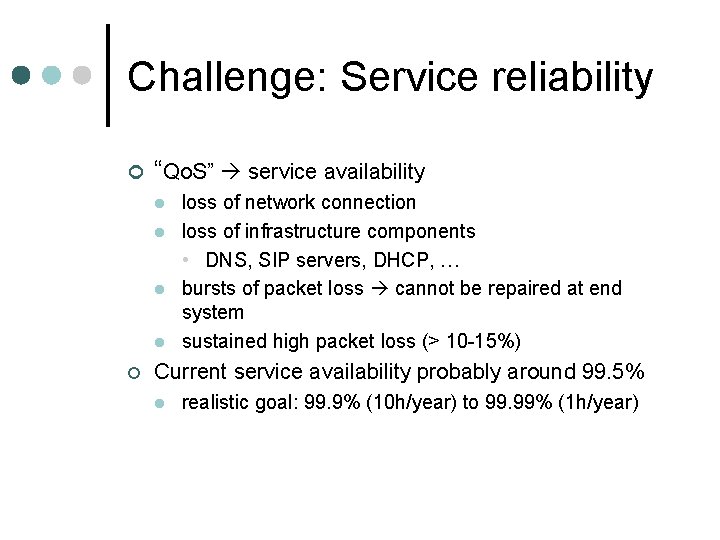
Challenge: Service reliability ¢ “Qo. S” service availability l l ¢ loss of network connection loss of infrastructure components • DNS, SIP servers, DHCP, … bursts of packet loss cannot be repaired at end system sustained high packet loss (> 10 -15%) Current service availability probably around 99. 5% l realistic goal: 99. 9% (10 h/year) to 99. 99% (1 h/year)
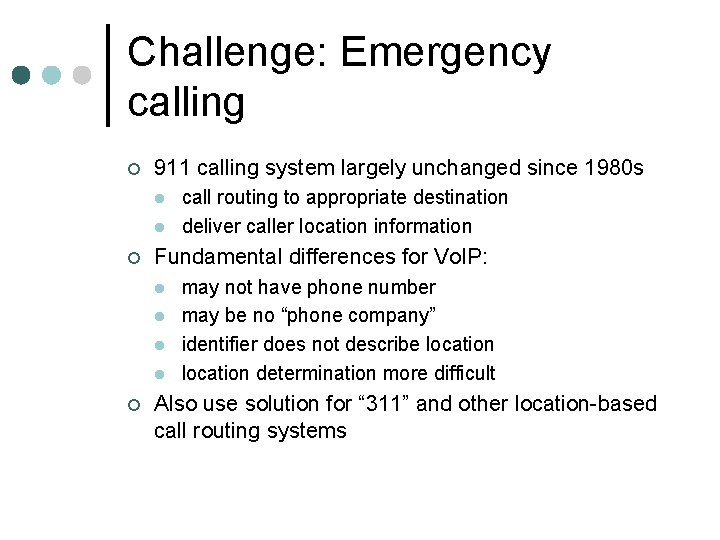
Challenge: Emergency calling ¢ 911 calling system largely unchanged since 1980 s l l ¢ Fundamental differences for Vo. IP: l l ¢ call routing to appropriate destination deliver caller location information may not have phone number may be no “phone company” identifier does not describe location determination more difficult Also use solution for “ 311” and other location-based call routing systems
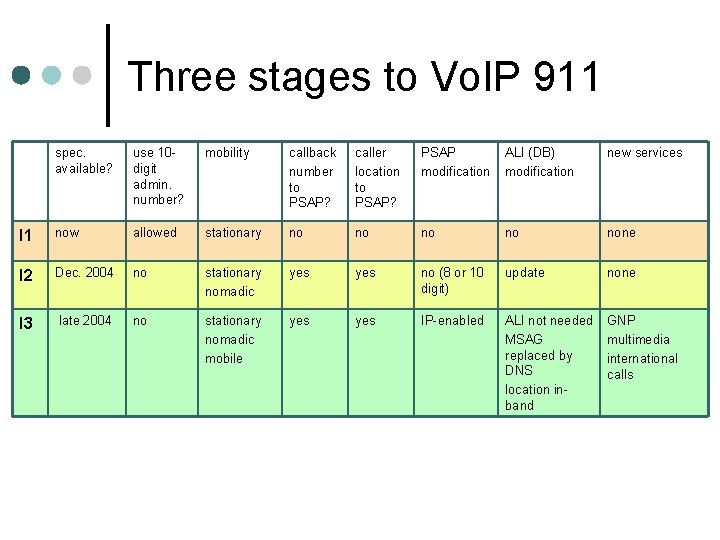
Three stages to Vo. IP 911 spec. available? use 10 digit admin. number? mobility callback number to PSAP? caller location to PSAP? PSAP modification ALI (DB) modification new services I 1 now allowed stationary no no none I 2 Dec. 2004 no stationary nomadic yes no (8 or 10 digit) update none I 3 late 2004 no stationary nomadic mobile yes IP-enabled ALI not needed MSAG replaced by DNS location inband GNP multimedia international calls
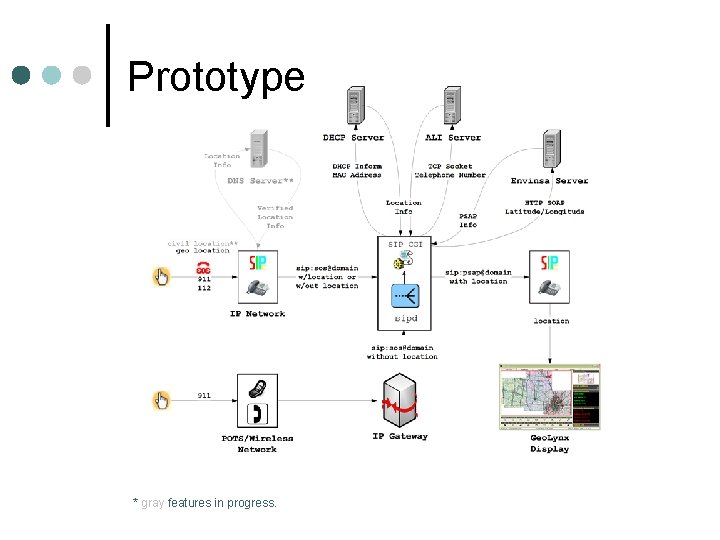
Prototype * gray features in progress.
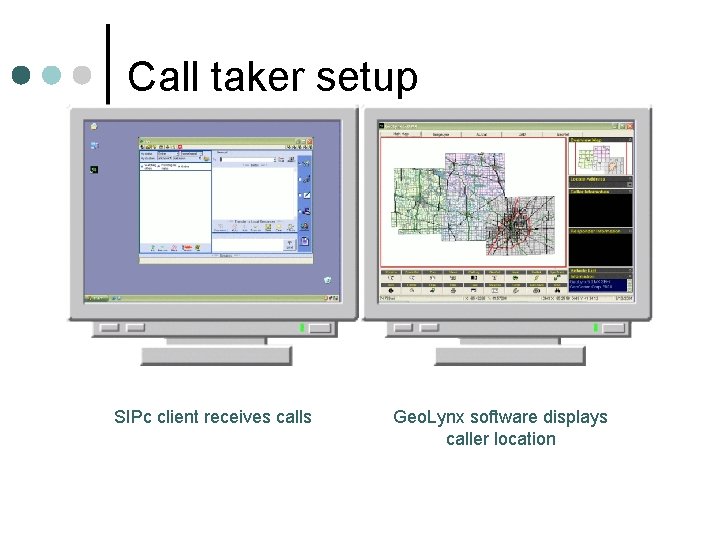
Call taker setup SIPc client receives calls Geo. Lynx software displays caller location
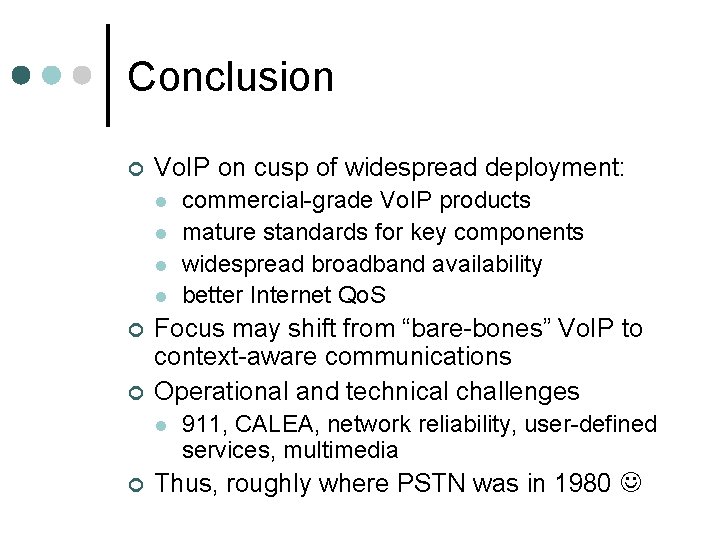
Conclusion ¢ Vo. IP on cusp of widespread deployment: l l ¢ ¢ Focus may shift from “bare-bones” Vo. IP to context-aware communications Operational and technical challenges l ¢ commercial-grade Vo. IP products mature standards for key components widespread broadband availability better Internet Qo. S 911, CALEA, network reliability, user-defined services, multimedia Thus, roughly where PSTN was in 1980