
Reinsurance Reserving Methods Casualty Loss Reserve Seminar September

Reinsurance Reserving Methods Casualty Loss Reserve Seminar September 23, 2002 Michael E. Angelina, ACAS, MAAA Tillinghast – Towers Perrin

Reserving Methods - Bornhuetter-Ferguson n Essentially a blend of LDF method and Expected Loss method n begins with an a-priori estimate of expected losses - IELR (Initial Expected Loss Ratio) x Earned Premium n splits a-priori estimate into two pieces - expected reported losses = (IEL x % reported) - expected unreported losses(IBNR) = (IEL x % unreported) n replaces expected reported losses with actual reported (case incurred) losses n Restated ultimate loss estimate equals n expected unreported(IBNR) plus actual reported (case incurred) 2

Bornhuetter-Ferguson Method - an Example 3

Bornhuetter-Ferguson Method - an Example (Con’t) 4

Bornhuetter-Ferguson Method - Advantages n Allows for smoothing of results n LDF method understates when case incurred losses are small - overstates if losses large (ELR may understate in this instance) n Incorporates changes in the environment n attachment point, coverage changes, layer restructuring, price strengthening/deterioration n Balances stability and actual loss emergence n Estimates IBNR when loss activity is sparse n ideal for long tailed lines (umbrella, xs casualty) n redundant for short tailed lines (approximates LDF method) n Reflects potential information found in underwriting files n underlying limits profile 5
Bornhuetter-Ferguson Method - Disadvantages n Reporting pattern n expected percentage reported = 1 / LDF n difficulty in estimating pattern for LDF method also applies here n Initial expected losses n IBNR is directly related to a-priori estimate - double the expected losses ----> double the IBNR n importance of IELR may be lost in the analysis - need to step back and determine % of total IBNR that is loss ratio driven n Ultimate Premium n most recent year may be difficult to estimate - booked premium is probably under-reported due to timing lags - seek underwriting estimate 6

Bornhuetter-Ferguson Method Alternative Sources of Initial Expected Losses n Loss Ratio Method (incorporates pricing indices) n Underwriting estimate from pricing study n by definition it is the a-priori estimate - verify that parameters for pricing and reserving are consistent n Increased limits factors and direct premium n may be used if you feel primary company’s higher limits pricing is inadequate - should have been incorporated in pricing study n may also be used for changes in layer and/or attachment point n Stanard-Buhlman estimates n Frequency/Severity estimates 7

Example of change in layer structuring Effect on IELR 8

Stanard-Buhlman Estimate n Essentially the Bornhuetter-Ferguson estimate with “on average” perfect information n Uses actual loss ratio indices multiplied by average loss ratio n incorporating loss trend and pricing changes n Balances the expected average loss ratio so that: n expected reported losses = actual reported losses 9
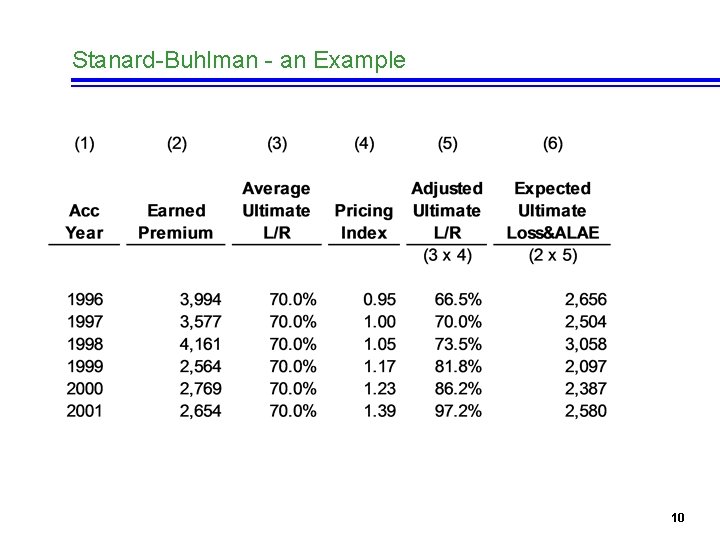
Stanard-Buhlman - an Example 10
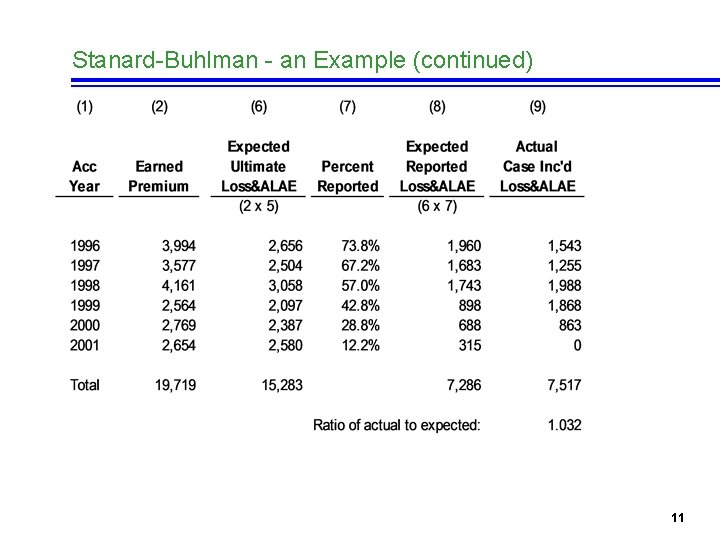
Stanard-Buhlman - an Example (continued) 11
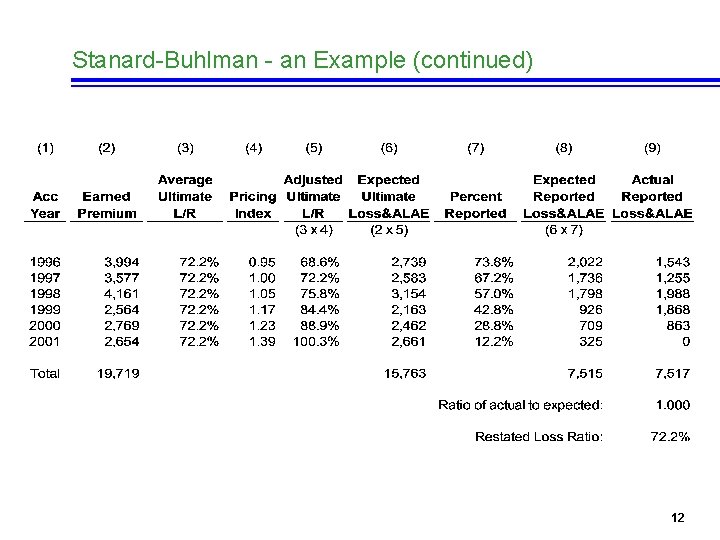
Stanard-Buhlman - an Example (continued) 12
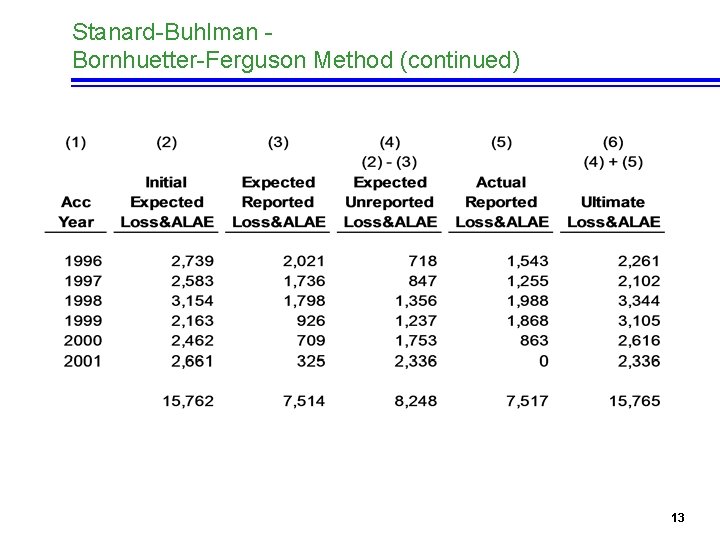
Stanard-Buhlman Bornhuetter-Ferguson Method (continued) 13
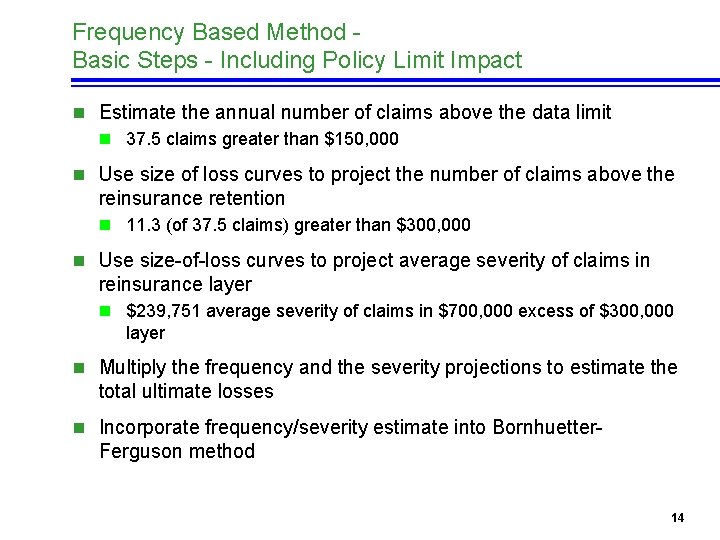
Frequency Based Method Basic Steps - Including Policy Limit Impact n Estimate the annual number of claims above the data limit n 37. 5 claims greater than $150, 000 n Use size of loss curves to project the number of claims above the reinsurance retention n 11. 3 (of 37. 5 claims) greater than $300, 000 n Use size-of-loss curves to project average severity of claims in reinsurance layer n $239, 751 average severity of claims in $700, 000 excess of $300, 000 layer n Multiply the frequency and the severity projections to estimate the total ultimate losses n Incorporate frequency/severity estimate into Bornhuetter- Ferguson method 14
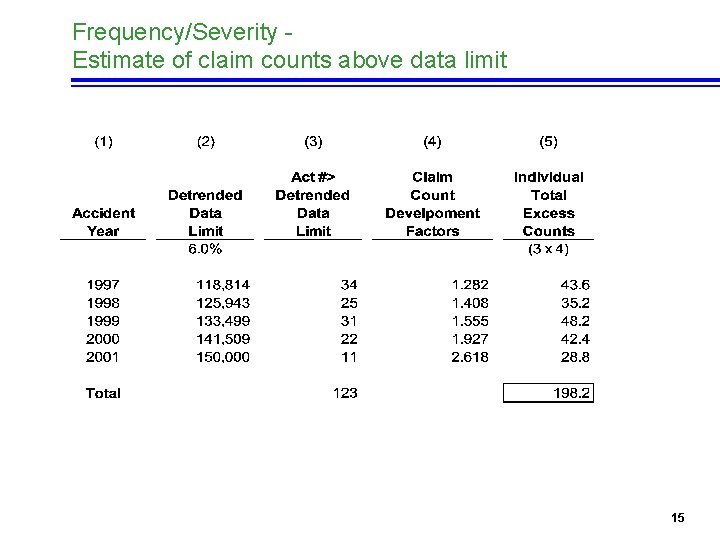
Frequency/Severity Estimate of claim counts above data limit 15
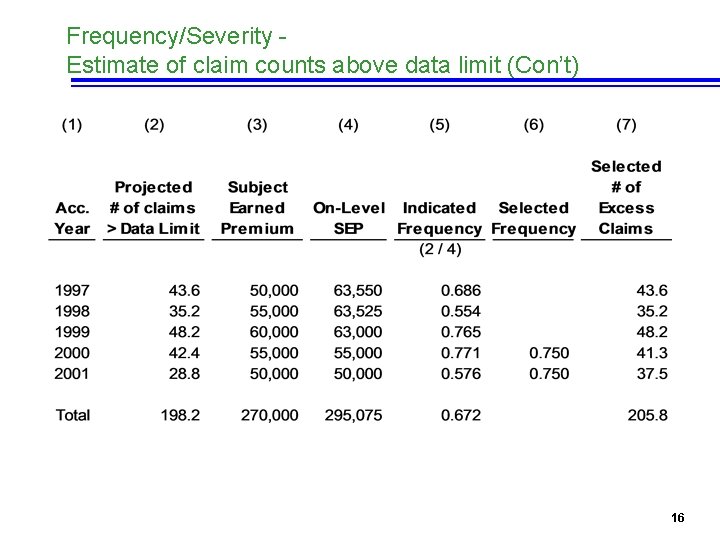
Frequency/Severity Estimate of claim counts above data limit (Con’t) 16
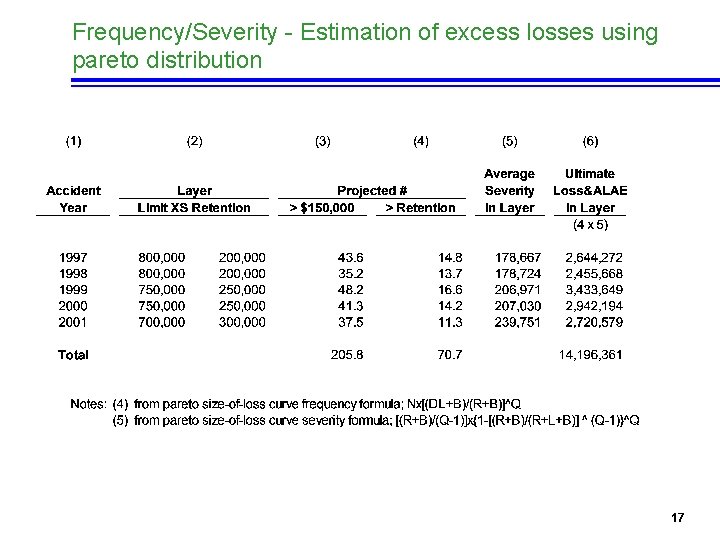
Frequency/Severity - Estimation of excess losses using pareto distribution 17
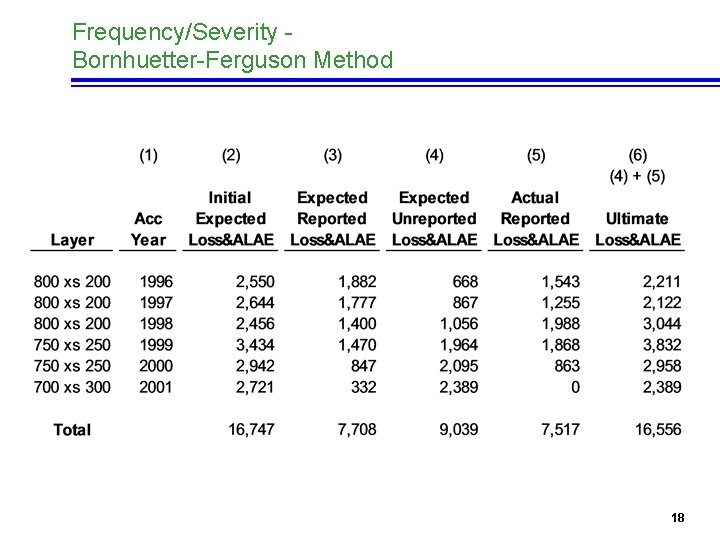
Frequency/Severity Bornhuetter-Ferguson Method 18
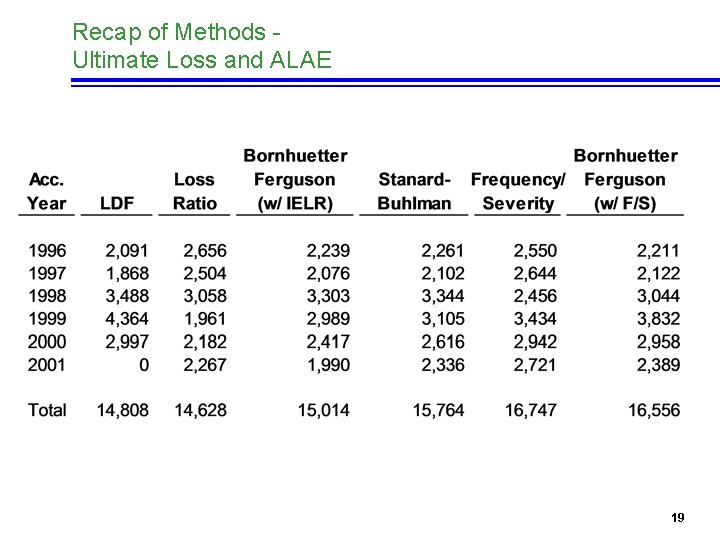
Recap of Methods Ultimate Loss and ALAE 19
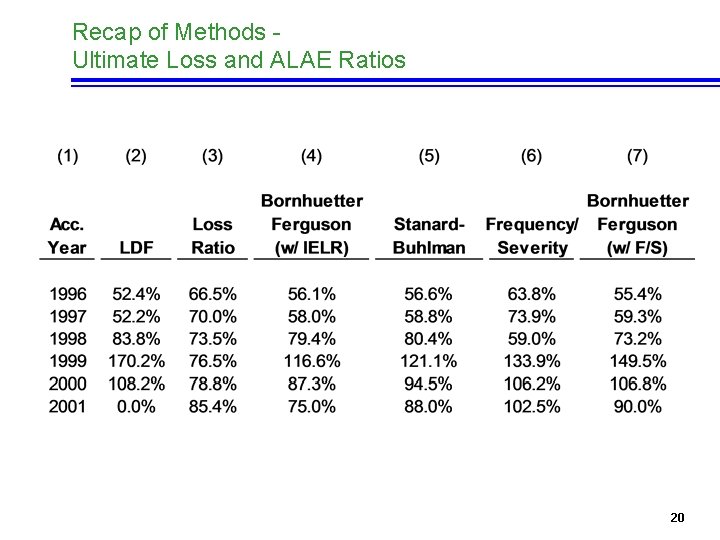
Recap of Methods Ultimate Loss and ALAE Ratios 20
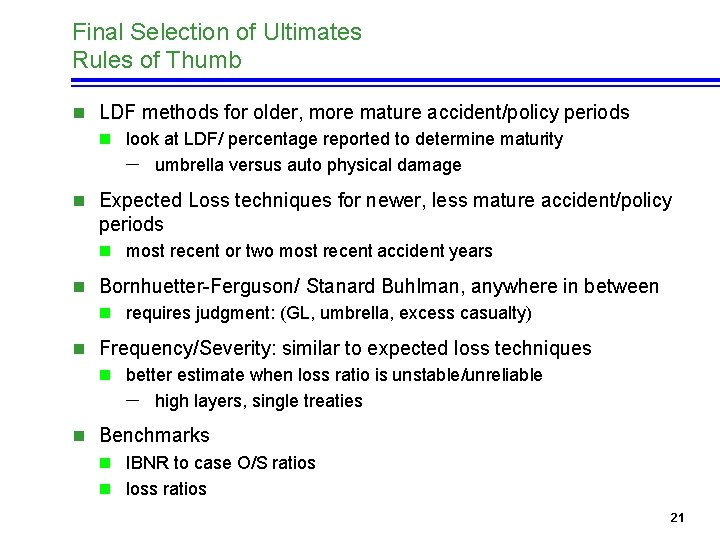
Final Selection of Ultimates Rules of Thumb n LDF methods for older, more mature accident/policy periods n look at LDF/ percentage reported to determine maturity - umbrella versus auto physical damage n Expected Loss techniques for newer, less mature accident/policy periods n most recent or two most recent accident years n Bornhuetter-Ferguson/ Stanard Buhlman, anywhere in between n requires judgment: (GL, umbrella, excess casualty) n Frequency/Severity: similar to expected loss techniques n better estimate when loss ratio is unstable/unreliable - high layers, single treaties n Benchmarks n IBNR to case O/S ratios n loss ratios 21
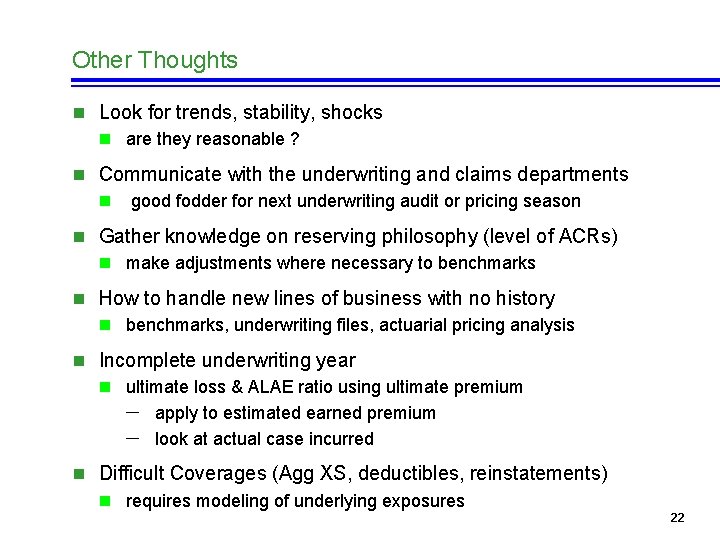
Other Thoughts n Look for trends, stability, shocks n are they reasonable ? n Communicate with the underwriting and claims departments n good fodder for next underwriting audit or pricing season n Gather knowledge on reserving philosophy (level of ACRs) n make adjustments where necessary to benchmarks n How to handle new lines of business with no history n benchmarks, underwriting files, actuarial pricing analysis n Incomplete underwriting year n ultimate loss & ALAE ratio using ultimate premium - apply to estimated earned premium - look at actual case incurred n Difficult Coverages (Agg XS, deductibles, reinstatements) n requires modeling of underlying exposures 22
- Slides: 22