
Reinsurance assignment and setoff Johan Senekal Simmonds Reinsurance
![New contract n NC premium = 1 / (1+rf)*[E(s) – lamda*cov(s, rm)] Lambda =](https://slidetodoc.com/presentation_image_h/e77c652d585cf8a6aa50360bb9ccc571/image-9.jpg "New contract n NC premium = 1 / (1+rf)*[E(s) – lamda*cov(s, rm)] Lambda =")
- Slides: 10
Reinsurance assignment and setoff Johan Senekal Simmonds
Reinsurance pricing conditions High order losses measured in spread loss years n Spread loss period vs corporate bond amort. n Longitudinal price differential and shape of loss distribution n NPV of reinsurance n
Reinsurer credit risk VAR for reinsurance companies n Costing default risk into the programme n Protective mechanisms n Credit spread n Illusionary value adjustments n
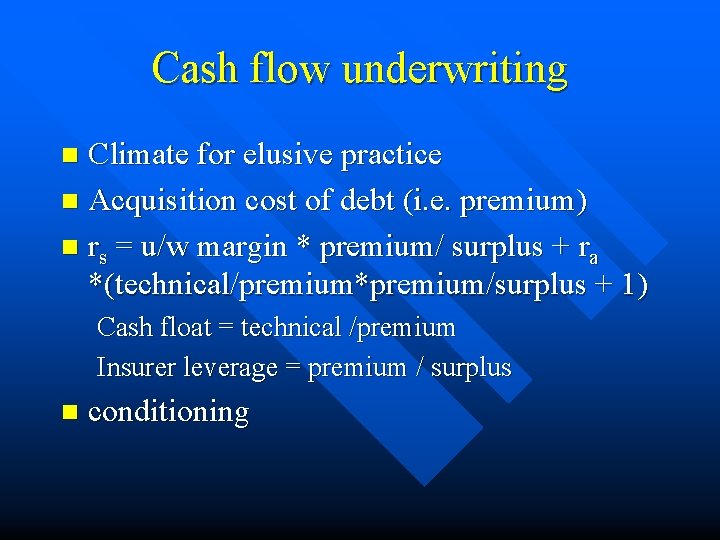
Cash flow underwriting Climate for elusive practice n Acquisition cost of debt (i. e. premium) n rs = u/w margin * premium/ surplus + ra *(technical/premium*premium/surplus + 1) n Cash float = technical /premium Insurer leverage = premium / surplus n conditioning
Moral hazard in reinsurance disconnection of premium from expected losses n disconnection at high coverage in isolation vs portfolio theory approach n Cost of monitoring and price controls n
Dynamic Financial Analysis Integration of asset management with underwriting management n DFA modeled to pricing and cover afforded by double trigger contracts (New contract) n Study done by Grundl and Scheser n
New contract Contract of traditional stop loss plus financial risk n Insurer gauge reinsurer reservation price at time of contracting n Liability cession vs premium cession n Contractual pricing using financial model (default put option cost) vs actuarial model pricing n
New contract The contract pay-off structure n Higher coefficient of variation (up to 3 x stop loss) – commensurate premium pay away n Contact viability conditions n Financial model: CAPM (no default assumption relaxed) n
New contract n NC premium = 1 / (1+rf)*[E(s) – lamda*cov(s, rm)] Lambda = market price of risk = E(rm) – rf/var(rm) s = expected loss on new contract n Must adjust premium for default put option value
New contract Change insurer buying reinsurance with short-term funds (I get it you get it) n Better matching n Small insurers benefit from lower capital strain if reinsurer high credit rating and better investor of hedge of loss n