
Reinforcing Effort and Providing Recognition Experimental Inquiry n
![References Marzano, R. J. [et al. ] (2001). A Handbook for Classroom Instruction that](https://slidetodoc.com/presentation_image_h2/a38b90cc560b284de3bf4e37c6aec243/image-17.jpg "References Marzano, R. J. [et al. ] (2001). A Handbook for Classroom Instruction that")
- Slides: 17
Reinforcing Effort and Providing Recognition
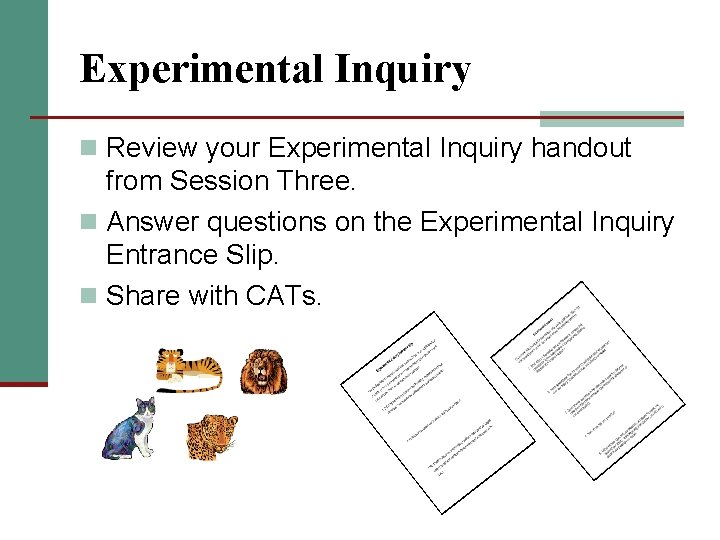
Experimental Inquiry n Review your Experimental Inquiry handout from Session Three. n Answer questions on the Experimental Inquiry Entrance Slip. n Share with CATs.
Celebrate Effort n What activity did you use with your students to test your prediction? n Was your prediction correct?
Today’s Agenda n Objectives n Participant Activity Outline n What did you learn? n For next time… n Also for next time…
Objectives After completing Session Four and its fieldwork, teacher participants will be able to… n utilize the online modules. n describe the specific strategies, research generalizations, and resulting classroom implications for the reinforcing effort and providing recognition strategies.
Objectives (Continued) n recognize the ways in which they currently use the reinforcing effort and providing recognition strategies as part of their practice. n recognize when these instructional strategies are used appropriately and meaningfully at their grade level range. n assess their own use of the instructional strategies in their classrooms.
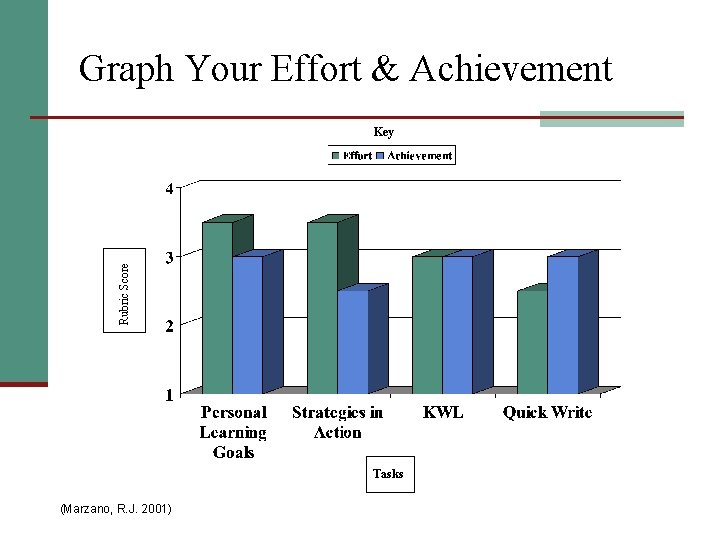
Graph Your Effort & Achievement Rubric Score Key Tasks (Marzano, R. J. 2001)
Question to Ponder n What do you notice about the relationship between the effort you put into a task and your achievement?
Question to Ponder n How could you use the Effort and Achievement Rubric and/or chart with your students?
Effort & Achievement Rubric Creation n Decide on appropriate activities for your unit of study. n Create an Effort and Achievement Rubric. n Refer to page 52 for an example.
Objectives After completing Session Four and its fieldwork, teacher participants will be able to… n utilize the online modules. n describe the specific strategies, research generalizations, and resulting classroom implications for the reinforcing effort and providing recognition strategies.
Objectives (Continued) n recognize the ways in which they currently use the reinforcing effort and providing recognition strategies as part of their practice. n recognize when these instructional strategies are used appropriately and meaningfully at their grade level range. n assess their own use of the instructional strategies in their classrooms.
What did you learn? n Did we achieve our learning objectives today?
For next time… n Are you ready to try the Reinforcing Effort and Providing Recognition strategies in your classroom? Use an effort and achievement rubric in your classroom. n Be prepared to discuss your experiences. n n n What went well? What would you do differently next time?
Also for next time… n Be sure to participate in the online discussion. n Our focus will be on the “Cooperative Learning” strategy. n To prepare, please read Chapter 7 of Classroom Instruction that Works.
Any Questions?
References Marzano, R. J. [et al. ] (2001). A Handbook for Classroom Instruction that Works. Alexandria, VA: Association for Supervision and Curriculum Development. Marzano, R. J. , Pickering, D. J. , and Pollock, J. E. (2005). Classroom Instruction that Works: Researchbased Strategies for Increasing Student Achievement. Upper Saddle River, NJ: Pearson Education, Inc.