
Reinforcement Punishment R What is an S Lesson
- Slides: 23
Reinforcement & Punishment: R What is an S ? Lesson 11
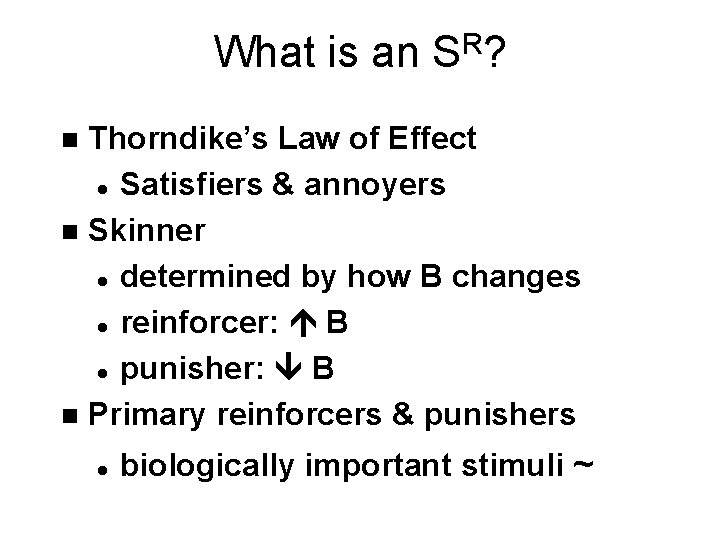
What is an SR? Thorndike’s Law of Effect l Satisfiers & annoyers n Skinner l determined by how B changes l reinforcer: B l punisher: B n Primary reinforcers & punishers n l biologically important stimuli ~
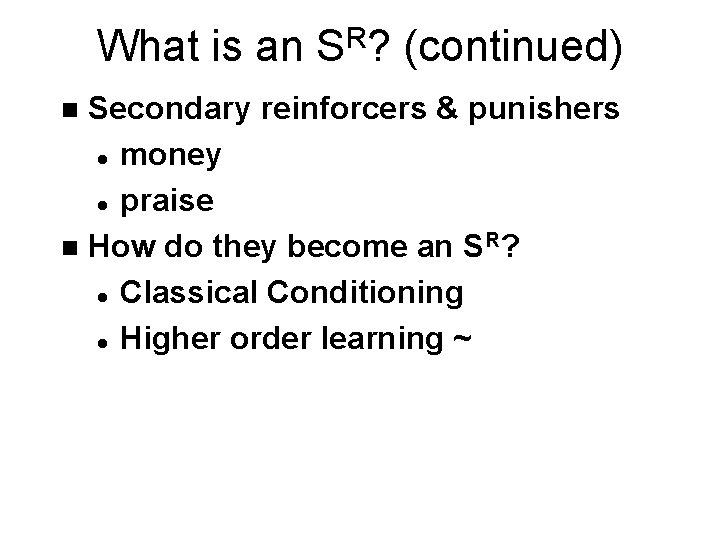
What is an SR? (continued) Secondary reinforcers & punishers l money l praise n How do they become an SR? l Classical Conditioning l Higher order learning ~ n
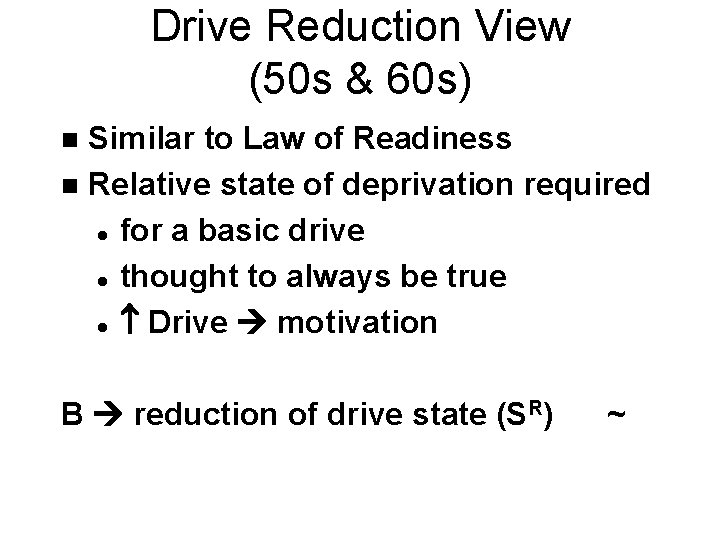
Drive Reduction View (50 s & 60 s) Similar to Law of Readiness n Relative state of deprivation required l for a basic drive l thought to always be true l Drive motivation n B reduction of drive state (SR) ~
Sensory reinforcement Sensory stimulus unrelated to biological drive n monkeys learn response l reward is watching toy train n rats learn to bar press l reward = turning on a light l or turning off light ~ n
Premack Principle Commonly used in educational setting l impractical or unethical to use food n Thought of reinforcers as responses l press bar eating response l wider application of I/O conditioning n Differential probability principle l High probability responses reinforce low probability responses ~ n
Premack Principle Homme et al (1963) l Unruly 3 year olds n High probability behaviors l ignored teacher l screaming l pushing furniture n Low probability behavior l sitting quietly ~ n
Premack Principle: Homme et al Rewarded sitting quietly with. . . l 3 min of running around screaming n Results: sitting quietly increased n Particular behaviors observed by different kids l different responses effective reinforcers for different kids ~ n
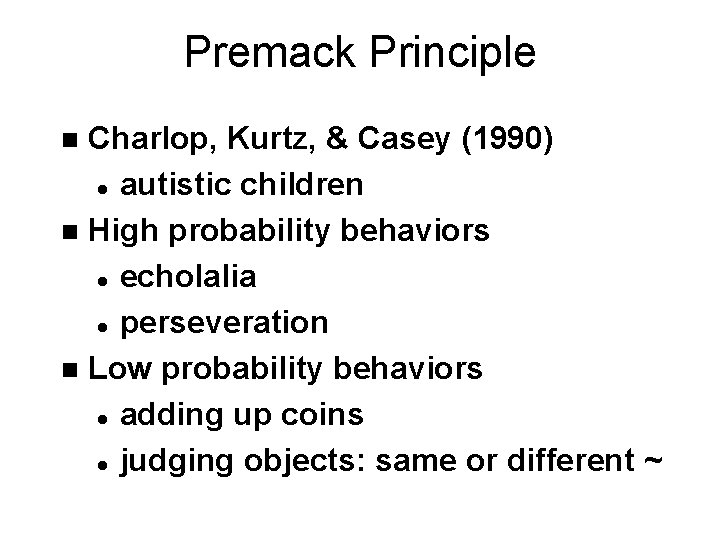
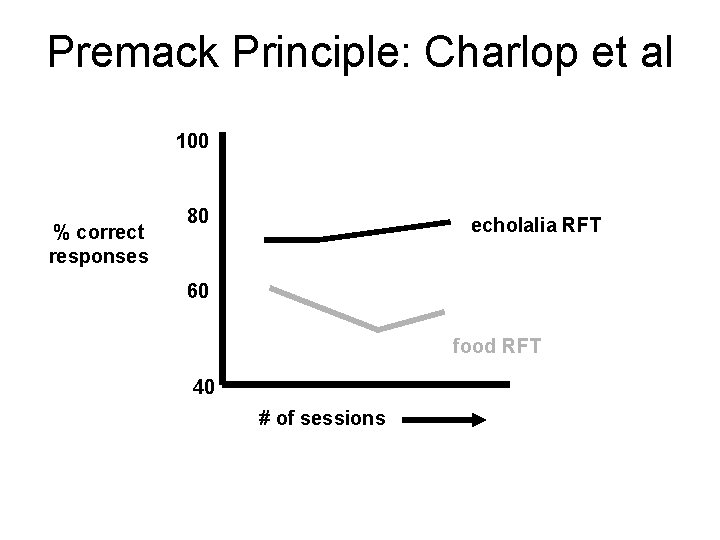
Premack Principle Charlop, Kurtz, & Casey (1990) l autistic children n High probability behaviors l echolalia l perseveration n Low probability behaviors l adding up coins l judging objects: same or different ~ n
Premack Principle: Charlop et al 100 % correct responses 80 echolalia RFT 60 food RFT 40 # of sessions
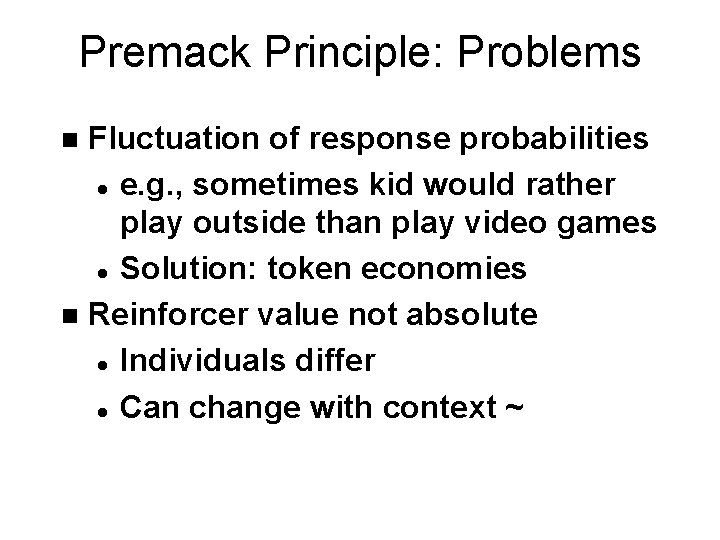
Premack Principle: Problems Fluctuation of response probabilities l e. g. , sometimes kid would rather play outside than play video games l Solution: token economies n Reinforcer value not absolute l Individuals differ l Can change with context ~ n
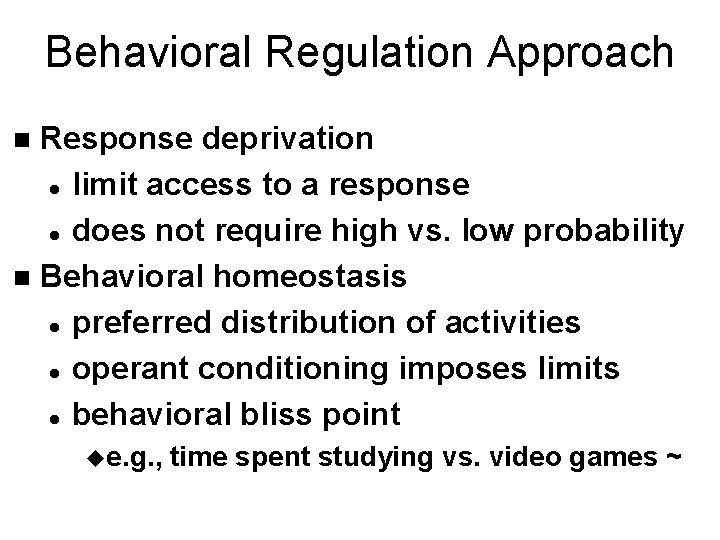
Behavioral Regulation Approach Response deprivation l limit access to a response l does not require high vs. low probability n Behavioral homeostasis l preferred distribution of activities l operant conditioning imposes limits l behavioral bliss point n ue. g. , time spent studying vs. video games ~
Behavioral Regulation Approach n A behavior is limited below bliss point l disturbance of behavioral homeostasis uanalogous n to increased biological drive Contingency set during I/O procedure l establish relationship between responses l B move toward bliss point (baseline) ~
Behavioral Regulation Approach Low probability behaviors as reinforcers l observe baseline rate of behavior l limit activity below baseline n Require a response to engage in deprived behavior n ucontingency l Increase toward bliss point ucost vs. benefits determines how much ~
What Becomes Connected? Skinner? l refused to consider associations n Thorndike: S-R view (SD-B) l association b/n stimulus context and response R l NOT the outcome (S ) l no representation of reinforcer ~ n
S-R-O (SD-B-SR) view: Tinkelpaugh (1928) Goal-oriented responding l respond with idea of getting reward n The monkey and the hidden banana l 2 cups, put banana under 1 l task: choose cup with banana n Secretly substituted rotten lettuce l monkey became agitated l Expected banana reward (outcome) ~ n
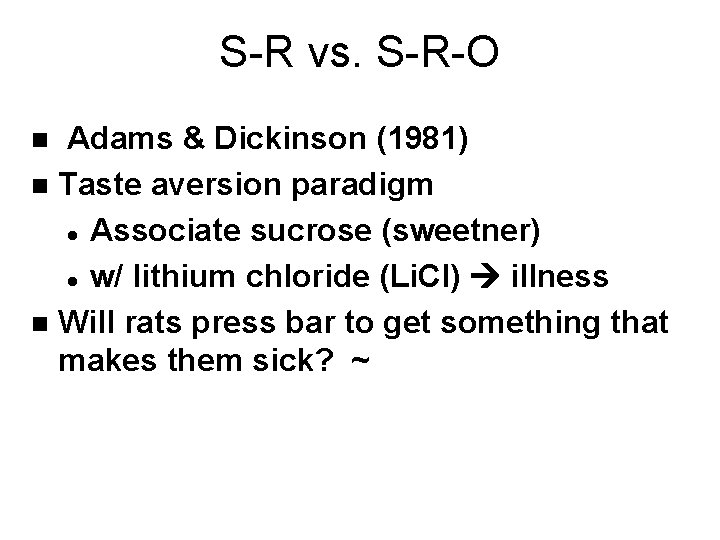
S-R vs. S-R-O Adams & Dickinson (1981) n Taste aversion paradigm l Associate sucrose (sweetner) l w/ lithium chloride (Li. Cl) illness n Will rats press bar to get something that makes them sick? ~ n
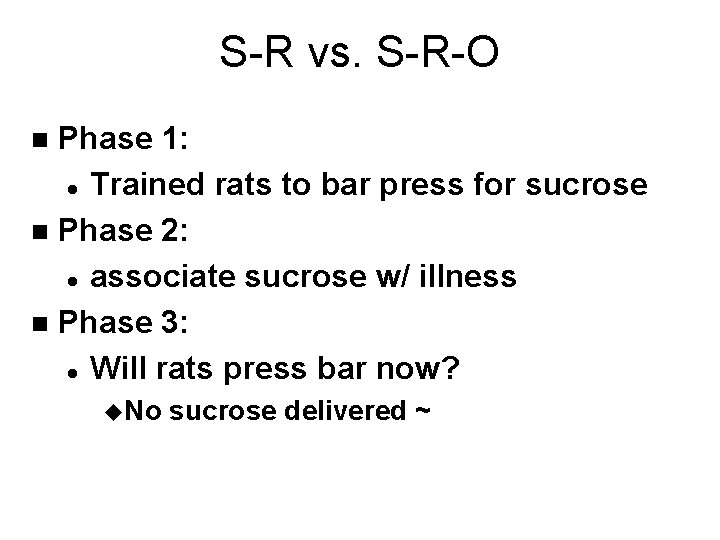
S-R vs. S-R-O Phase 1: l Trained rats to bar press for sucrose n Phase 2: l associate sucrose w/ illness n Phase 3: l Will rats press bar now? n u. No sucrose delivered ~
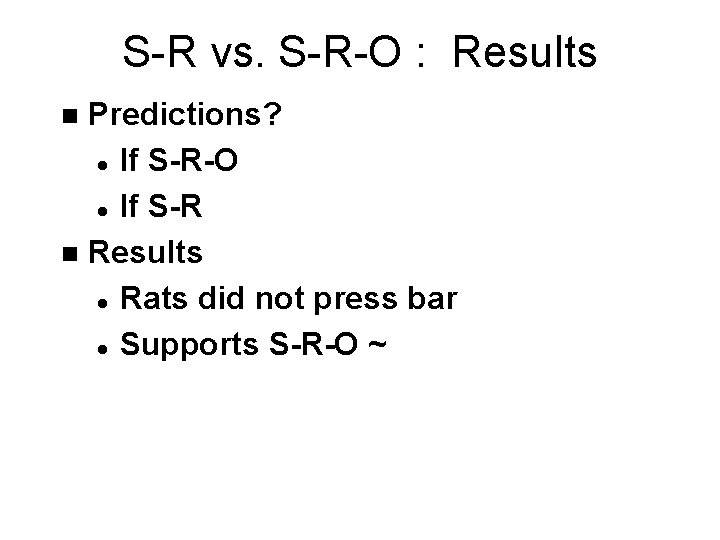
S-R vs. S-R-O : Results Predictions? l If S-R-O l If S-R n Results l Rats did not press bar l Supports S-R-O ~ n
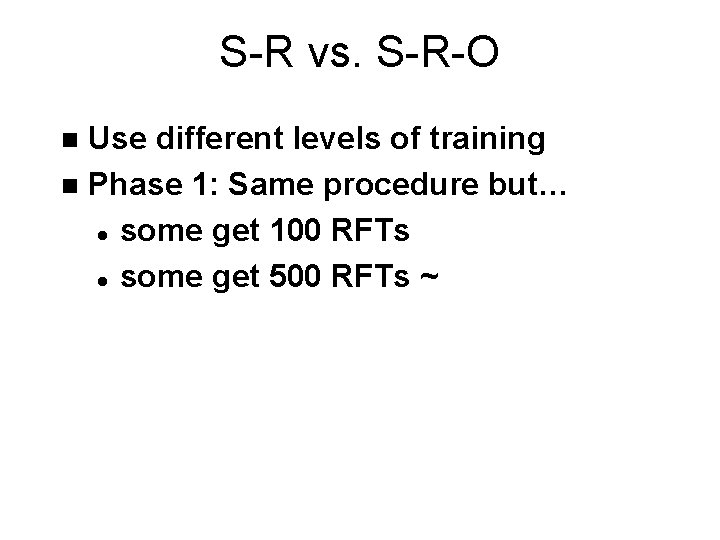
S-R vs. S-R-O Use different levels of training n Phase 1: Same procedure but… l some get 100 RFTs l some get 500 RFTs ~ n
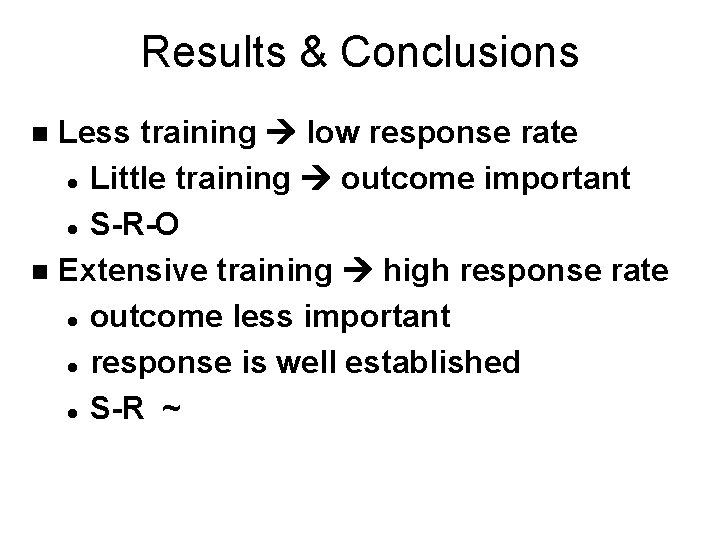
Results & Conclusions Less training low response rate l Little training outcome important l S-R-O n Extensive training high response rate l outcome less important l response is well established l S-R ~ n
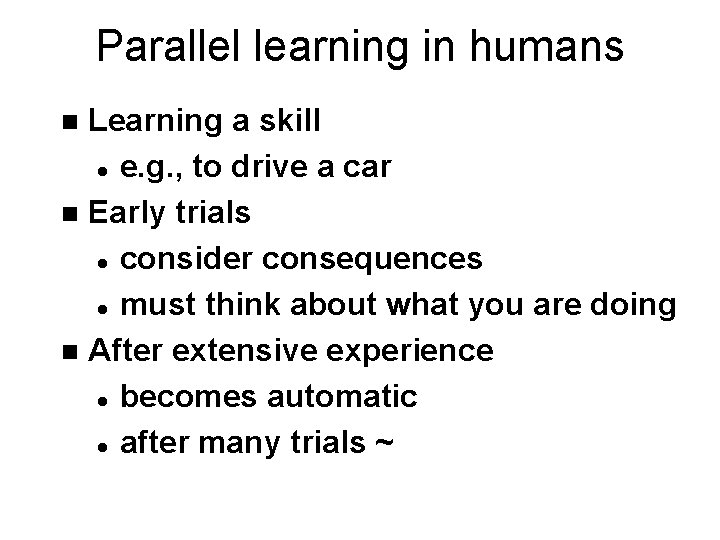
Parallel learning in humans Learning a skill l e. g. , to drive a car n Early trials l consider consequences l must think about what you are doing n After extensive experience l becomes automatic l after many trials ~ n
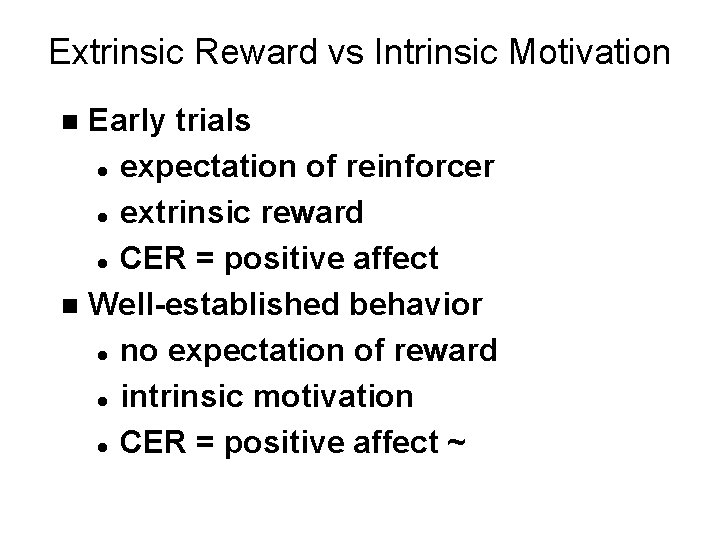
Extrinsic Reward vs Intrinsic Motivation Early trials l expectation of reinforcer l extrinsic reward l CER = positive affect n Well-established behavior l no expectation of reward l intrinsic motivation l CER = positive affect ~ n