
Reinforcement Learning in Quadrotor Helicopters Learning Objectives Understand
Reinforcement Learning in Quadrotor Helicopters
Learning Objectives �Understand the fundamentals of quadcopters �Quadcopter control using reinforcement learning
Why Quadcopters? �It can be used in various applications. �It can accurately and efficiently perform tasks that would be of high risk for a human pilot to perform. �It is inexpensive and expandable.
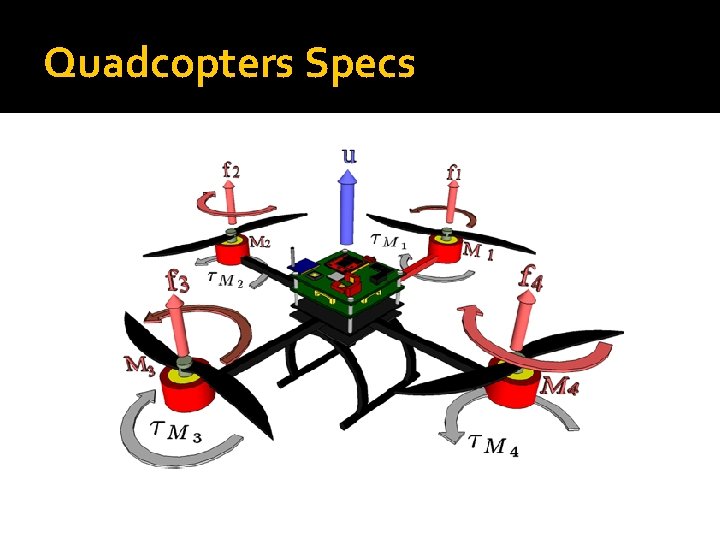
Quadcopters Specs

Quadcopter as an Agent �What are possible actions of a quadcopter? �What are possible states of a quadcopter?
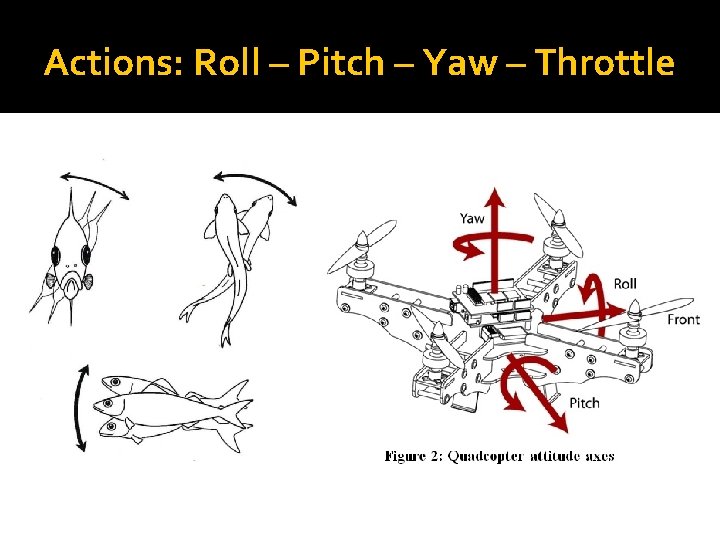
Actions: Roll – Pitch – Yaw – Throttle
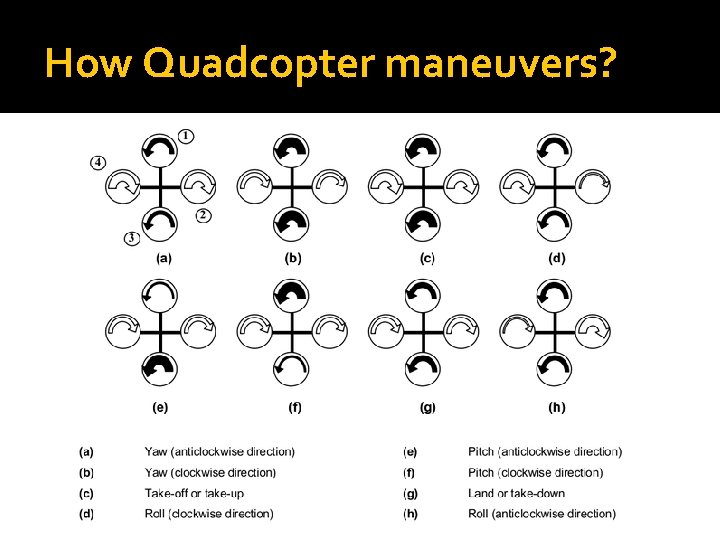
How Quadcopter maneuvers?
States �Position of the quadcopter in the environment. �Current sensor reading Inertial measurement unit (IMU) ▪ Accelerometers, gyroscopes, magnetometers Barometer (altitude) GPS (location) Ultrasonic sensors Cameras
Multi-Agent Quadrotor Testbed Control Design: Integral Sliding Mode vs. Reinforcement Learning Problem with altitude control Highly nonlinear and destabilizing effect of 4 rotor downwashes interacting Noticeable loss in thrust upon descent through the highly turbulent flow field Other factors that introduce disturbances, blade flex, ground effect and battery discharge dynamics Additional complication arise from the limited choice in low cost, high resolution altitude sensors.
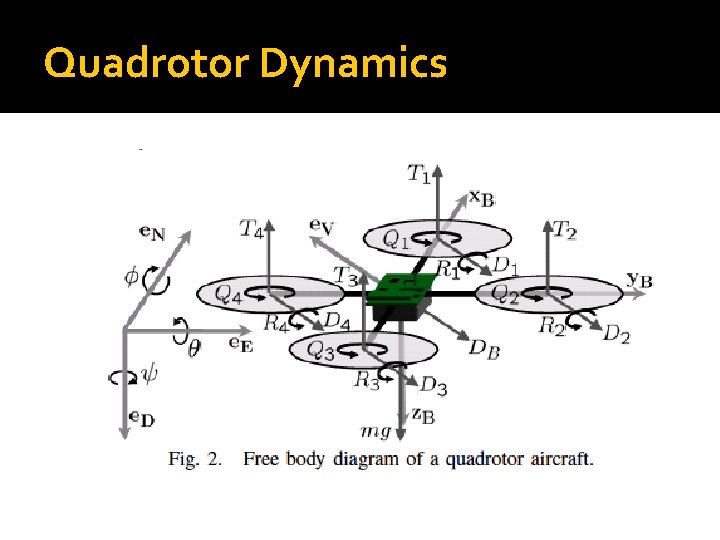
Quadrotor Dynamics
Reinforcement Learning Control �A nonlinear, nonparametric model of the system is constructed using flight data, approximating the system as a stochastic Markov process �A model-based RL algorithm uses the model in policy-iteration to search for an optimal control policy
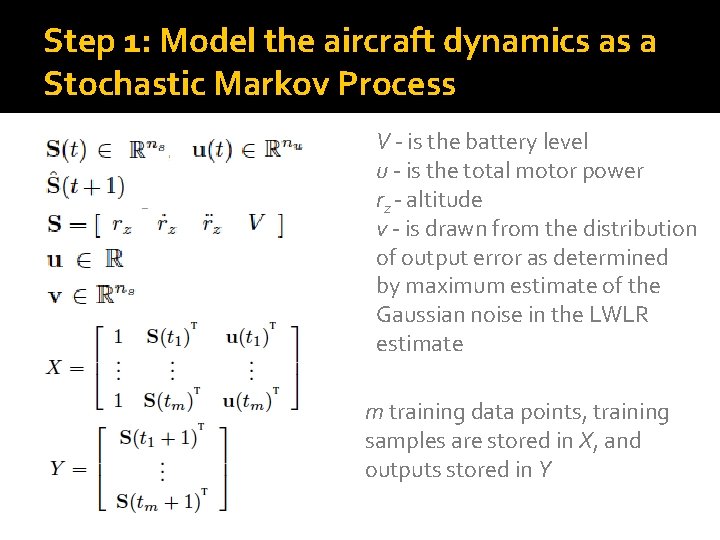
Step 1: Model the aircraft dynamics as a Stochastic Markov Process V - is the battery level u - is the total motor power rz - altitude v - is drawn from the distribution of output error as determined by maximum estimate of the Gaussian noise in the LWLR estimate m training data points, training samples are stored in X, and outputs stored in Y
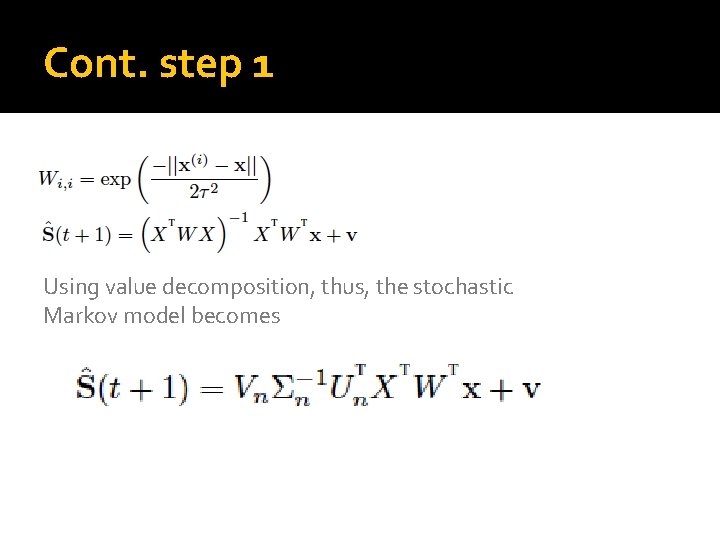
Cont. step 1 Using value decomposition, thus, the stochastic Markov model becomes
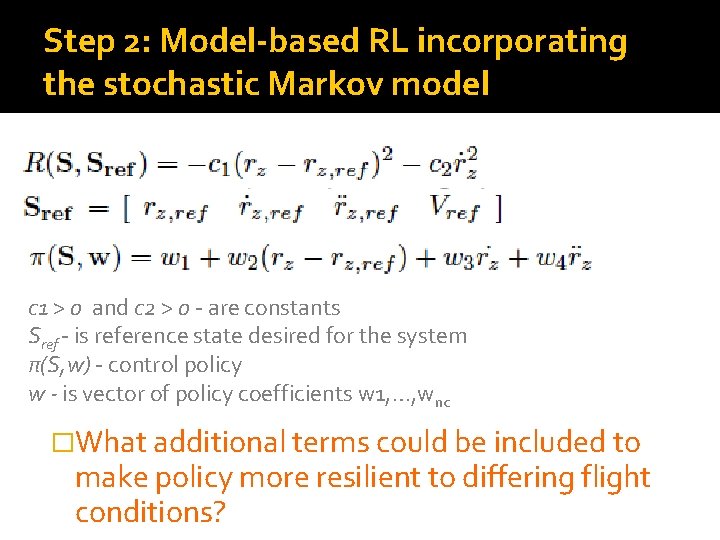
Step 2: Model-based RL incorporating the stochastic Markov model c 1 > 0 and c 2 > 0 - are constants Sref - is reference state desired for the system π(S, w) - control policy w - is vector of policy coefficients w 1, …, wnc �What additional terms could be included to make policy more resilient to differing flight conditions?
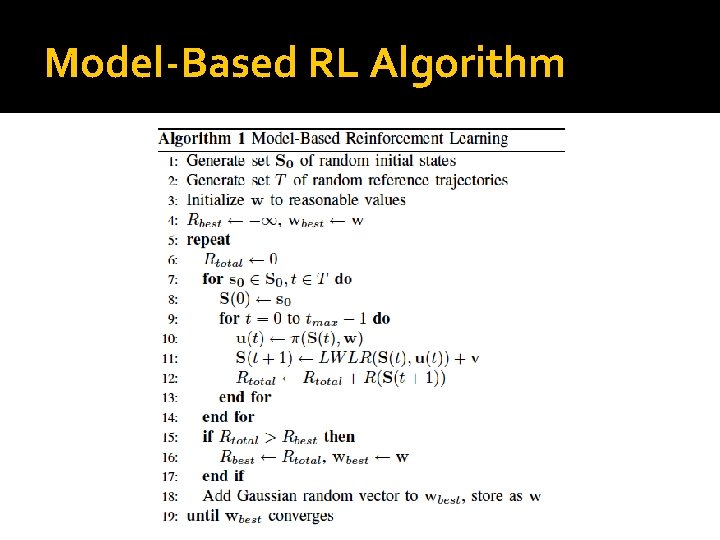
Model-Based RL Algorithm
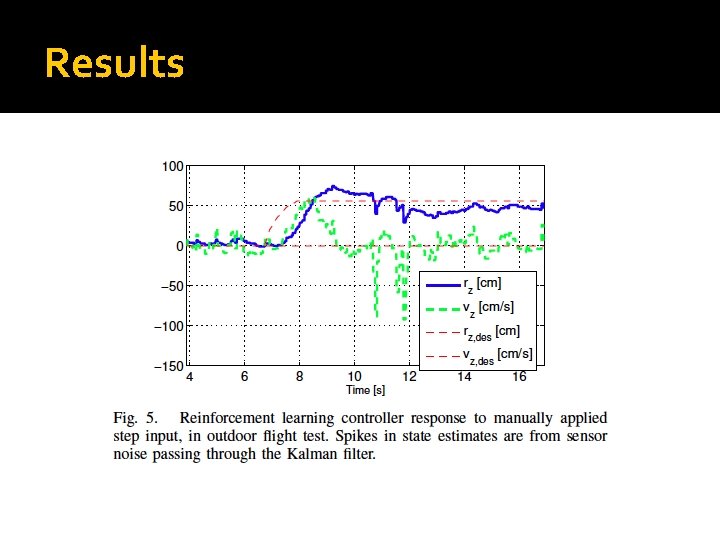
Results
Other Examples �Balancing a Flying Inverted Pendulum https: //www. youtube. com/watch? v=o. Yu. Qr 6 F r. KJE&noredirect=1 �Automated Aerial Suspended Cargo Delivery through Reinforcement Learning https: //www. youtube. com/watch? v=s 2 p. Wxg AHw 5 E&noredirect=1
References �S. Gupte, P. I. T. Mohandas, and J. M. Conrad. A Survey of Quadrotor Unmanned Aerial Vehicles. �S. L. Waslander, G. M. Hoffmann, J. S. Jang, and C. J. Tomlin. Multi-Agent Quadrotor Testbed Control Design: Integral Sliding mode vs. Reinforcement Learning
- Slides: 18