
REIMAGINING THE LIBRARYS CONNECTION TO STUDENT SUCCESS An
REIMAGINING THE LIBRARY’S CONNECTION TO STUDENT SUCCESS: An Assessment Revelation COMO 2016 - Athens, Georgia
Presenters from Columbus State University v Alison Cook, Business Liaison & Government Documents Coordinator v Dr. Florence Wakoko, Assistant Director, Library Assessment v Paul Luft, Science Liaison v Paula Adams, Head of Reference Services & Student Outreach

COLUMBUS STATE UNIVERSITY LIBRARIES
Who Are We? v CSU founded in 1958, library first built in 1959 v Regional State University v Student Enrollment (Fall 2015) = 8, 400 v 1, 503 are graduate students (Fall 2015) v 11 Post graduate degree programs v CSU Library current building built in 1975 v Currently houses over 400, 000 volumes

Two CSU Libraries Music Library (River. Park Campus) & Main Campus Library
So, What’s There to Prove? v The major question is………. . v Why do we care? v The good news: The literature also suggests there may well be some correlation between library use (Soria et al, 2013) and more importantly, library instruction (Cook, 2014) and student academic success. v Assessment and the CSU Libraries past efforts.
What’s the Point of it All? v Academic libraries and methodologies used for such assessment. Institutional data and library related data (Stone, Ramsden, 2013) (Cook, 2014) v CSU Libraries and a multi-modal approach. v Our next presenter will provide more details concerning how we came to this question……
CONCEPTUAL MODEL Visualizing How and Where to Begin
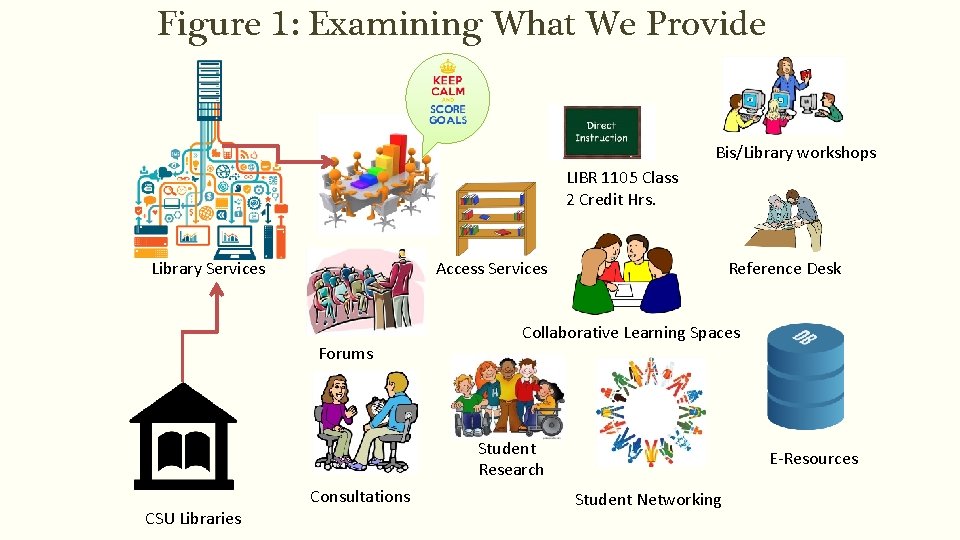
Figure 1: Examining What We Provide Bis/Library workshops LIBR 1105 Class 2 Credit Hrs. Library Services Reference Desk Access Services Forums Collaborative Learning Spaces Student Research CSU Libraries Consultations E-Resources Student Networking
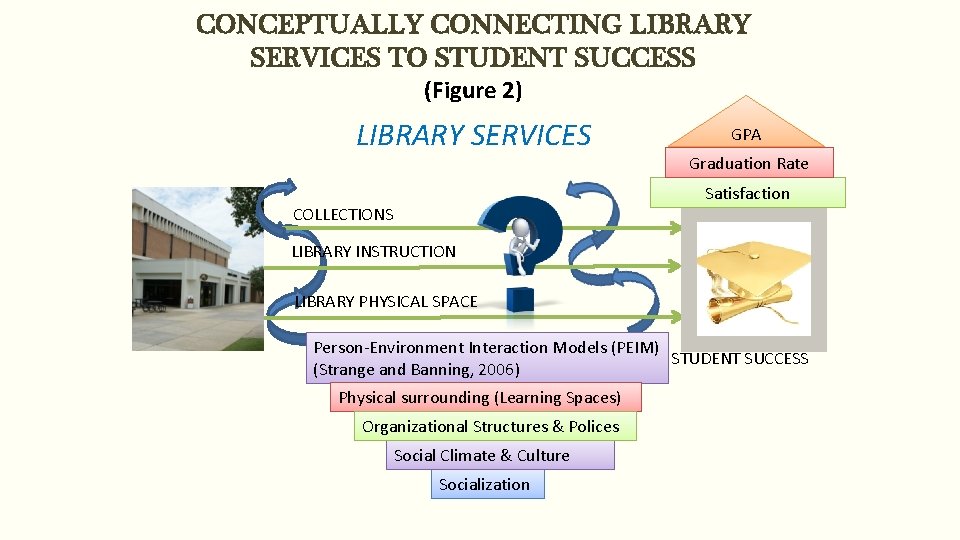
CONCEPTUALLY CONNECTING LIBRARY SERVICES TO STUDENT SUCCESS (Figure 2) LIBRARY SERVICES GPA Graduation Rate Satisfaction COLLECTIONS LIBRARY INSTRUCTION LIBRARY PHYSICAL SPACE Person-Environment Interaction Models (PEIM) STUDENT SUCCESS (Strange and Banning, 2006) Physical surrounding (Learning Spaces) Organizational Structures & Polices Social Climate & Culture Socialization
REVIEWING THE LITERATURE How are others defining student success and measuring the value of libraries?
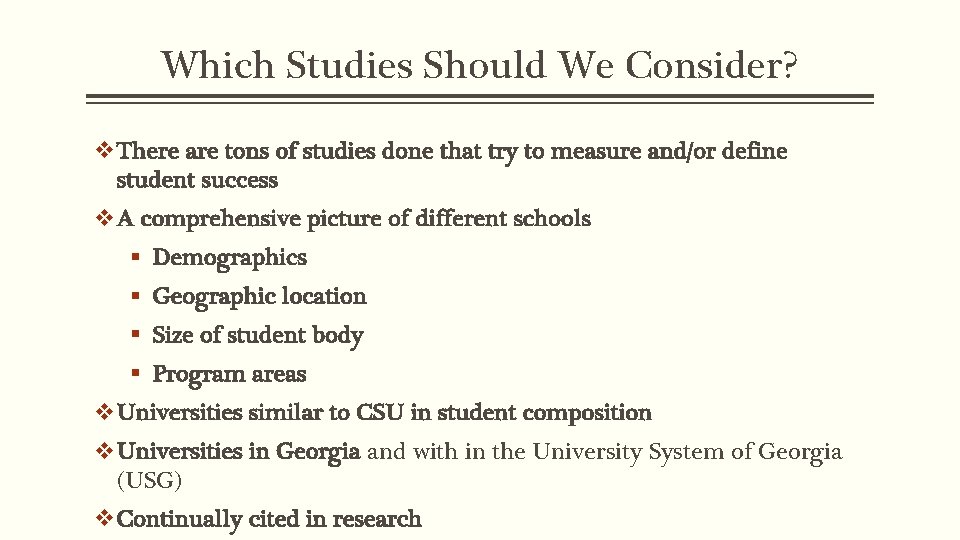
Which Studies Should We Consider? v. There are tons of studies done that try to measure and/or define student success v. A comprehensive picture of different schools § Demographics § Geographic location § Size of student body § Program areas v. Universities similar to CSU in student composition v. Universities in Georgia and with in the University System of Georgia (USG) v. Continually cited in research
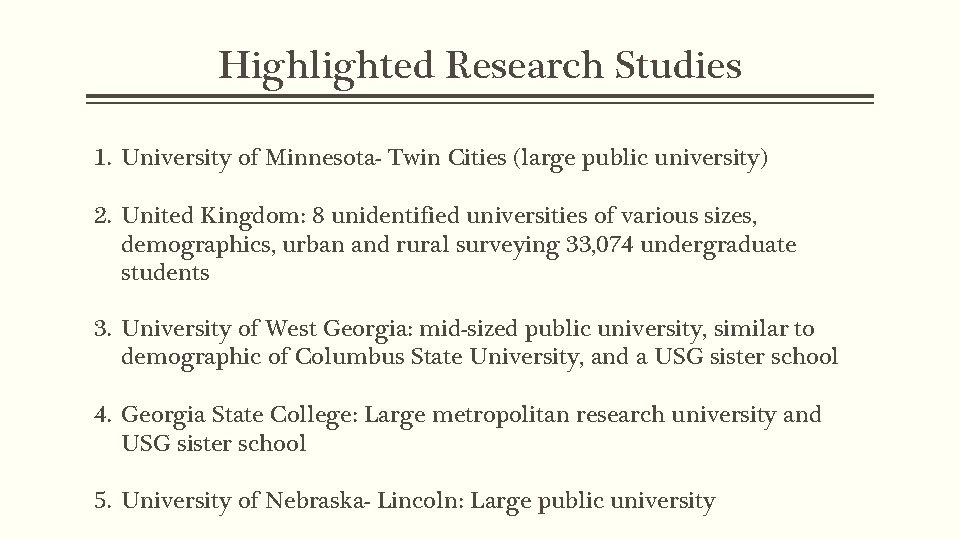
Highlighted Research Studies 1. University of Minnesota- Twin Cities (large public university) 2. United Kingdom: 8 unidentified universities of various sizes, demographics, urban and rural surveying 33, 074 undergraduate students 3. University of West Georgia: mid-sized public university, similar to demographic of Columbus State University, and a USG sister school 4. Georgia State College: Large metropolitan research university and USG sister school 5. University of Nebraska- Lincoln: Large public university
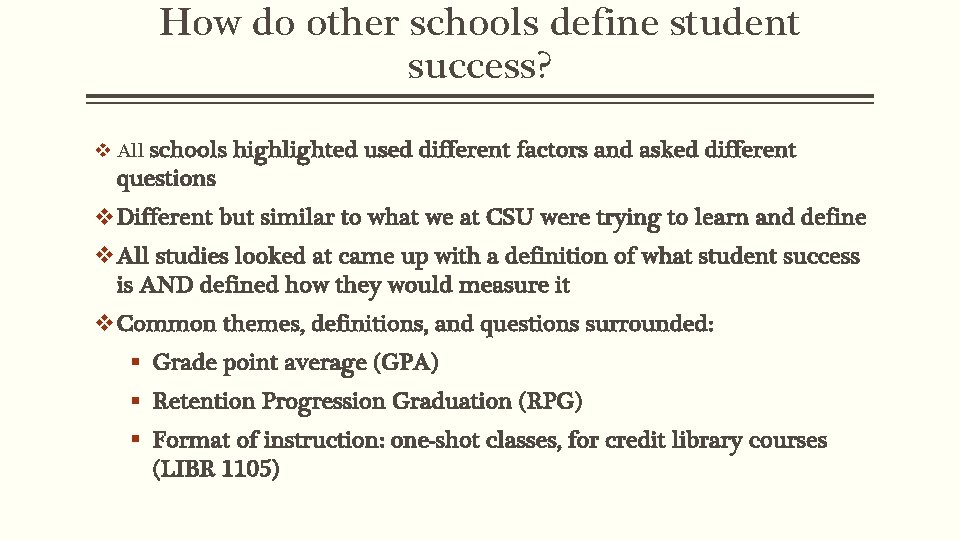
How do other schools define student success? v All schools highlighted used different factors and asked different questions v. Different but similar to what we at CSU were trying to learn and define v. All studies looked at came up with a definition of what student success is AND defined how they would measure it v. Common themes, definitions, and questions surrounded: § Grade point average (GPA) § Retention Progression Graduation (RPG) § Format of instruction: one-shot classes, for credit library courses (LIBR 1105)
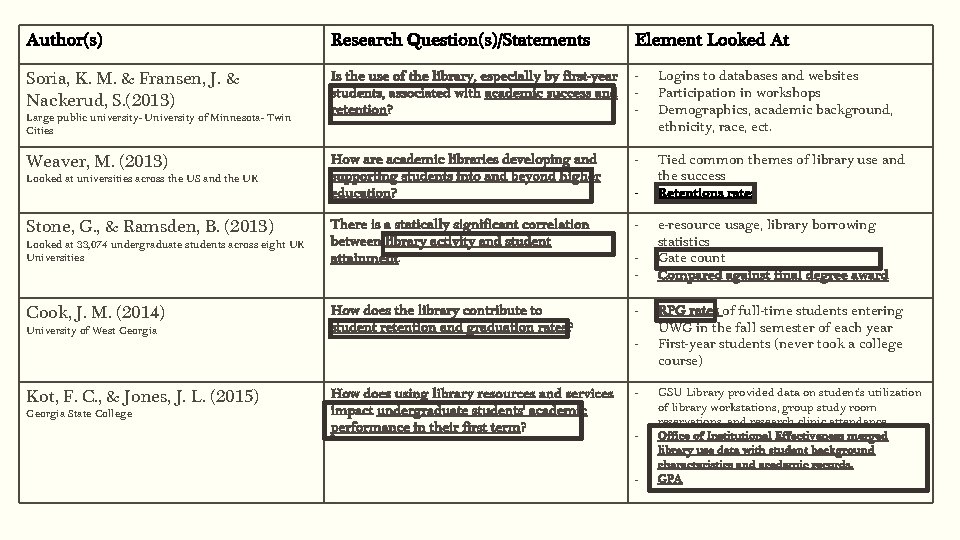
Author(s) Research Question(s)/Statements Element Looked At Soria, K. M. & Fransen, J. & Nackerud, S. (2013) Is the use of the library, especially by first-year students, associated with academic success and retention? - Logins to databases and websites Participation in workshops Demographics, academic background, ethnicity, race, ect. Weaver, M. (2013) How are academic libraries developing and supporting students into and beyond higher education? - Tied common themes of library use and the success Retentions rates There is a statically significant correlation between library activity and student attainment. - How does the library contribute to student retention and graduation rates? - How does using library resources and services impact undergraduate students' academic performance in their first term? - Large public university- University of Minnesota- Twin Cities Looked at universities across the US and the UK Stone, G. , & Ramsden, B. (2013) Looked at 33, 074 undergraduate students across eight UK Universities Cook, J. M. (2014) University of West Georgia Kot, F. C. , & Jones, J. L. (2015) Georgia State College - - e-resource usage, library borrowing statistics Gate count Compared against final degree award RPG rates of full-time students entering UWG in the fall semester of each year First-year students (never took a college course) GSU Library provided data on student's utilization of library workstations, group study room reservations, and research clinic attendance. Office of Institutional Effectiveness merged library use data with student background characteristics and academic records. GPA
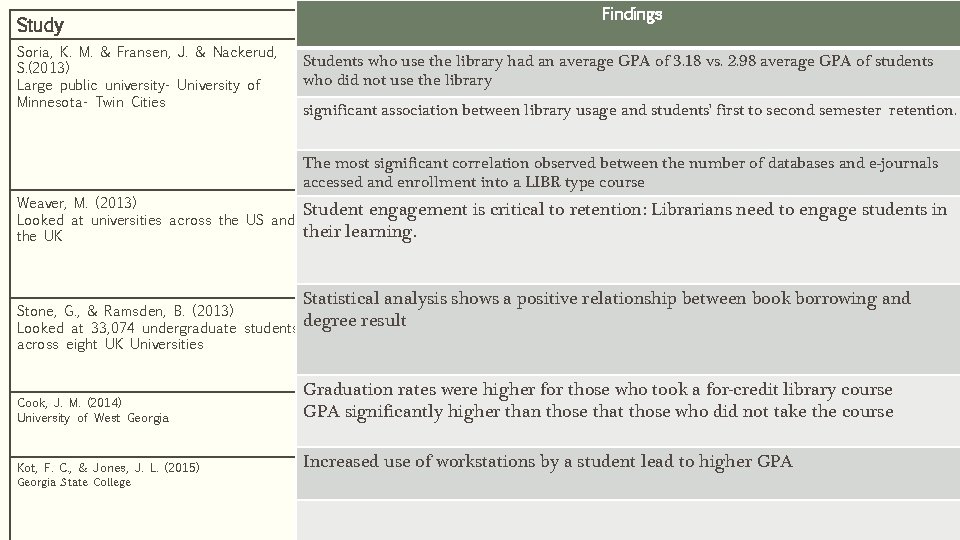
Study Soria, K. M. & Fransen, J. & Nackerud, S. (2013) Large public university- University of Minnesota- Twin Cities Findings Research Question(s)/Statements Findings Is the use of the library, especially by first- - Students who use the library had an average GPA of 3. 18 vs. 2. 98 average. GPA of of students year students, associated with academic who did not use the library whosuccess did not and use the library retention? significant first association between library usage and significant association between library usage and- students' to second semester retention. students' first to second semester retention. - The most significant correlation observed between the number of databases andand e-journals the number of databases e-journals accessed and enrollment into a LIBR type course Weaver, M. (2013) Looked at universities across the US and the UK - Retention is increased if the library is used within How are academic libraries developing and Student engagement is critical to retention: Librarians need to engage students in the first few weeks. supporting students into and beyond higher - Student engagement is critical to retention: their learning. education? Librarians need to engage students in their learning. - The more resources used = more likely student will attain a degree Statistical analysis shows a positive relationship between book borrowing and Stone, G. , & Ramsden, B. (2013) There is a statically significant correlation degree result Looked at 33, 074 undergraduate students between library activity and student across eight UK Universities attainment. - Statistical analysis shows a positive relationship between book borrowing and degree result - No correlation between library entries and degree attainment - The library is important to students regardless of what they could find on the internet Cook, J. M. (2014) University of West Georgia Graduation rates were higher for those who took a for-credit library course - Graduation rates were higher for those who How does the library contribute to student GPA significantly higher than those that those who did notcourse take the course a for-credit library Kot, F. C. , & Jones, J. L. (2015) Increased use of workstations by a student lead to higher GPA - Student credit load appeared How does using library resources and Georgia State College retention and graduation rates? services impact undergraduate students' academic performance in their first term? took - GPA significantly higher than those that those who did not take the course to be positively related to the likelihood of using library workstations - Increased use of workstations by a student lead to higher GPA
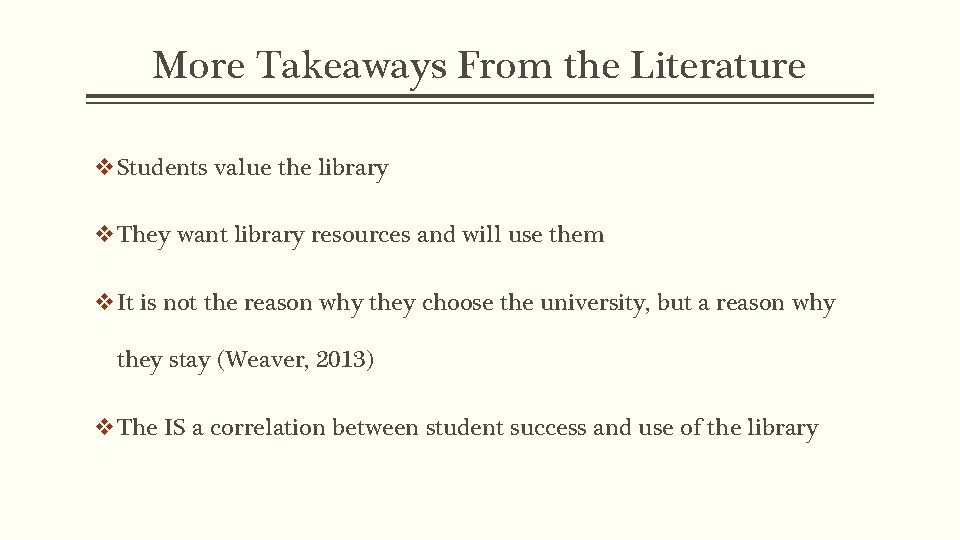
More Takeaways From the Literature v. Students value the library v. They want library resources and will use them v. It is not the reason why they choose the university, but a reason why they stay (Weaver, 2013) v. The IS a correlation between student success and use of the library
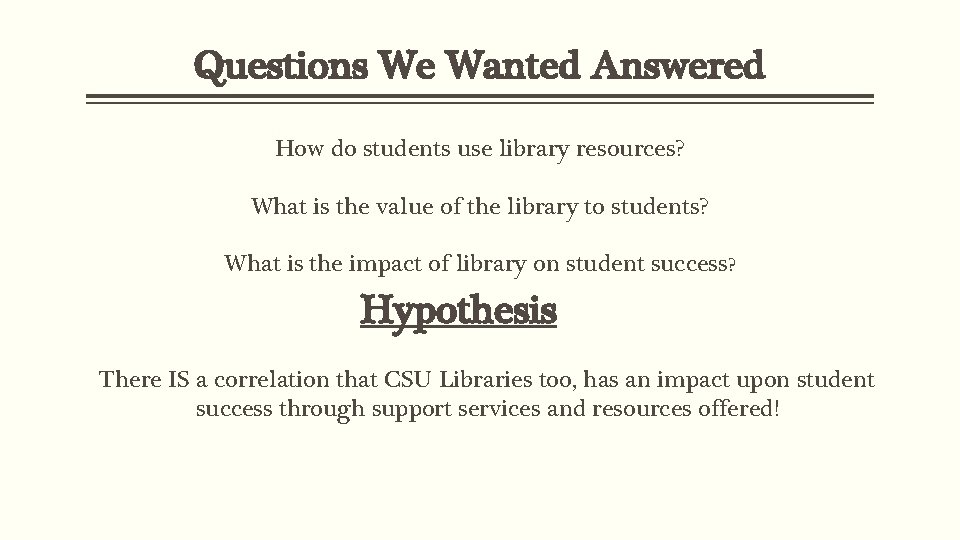
Questions We Wanted Answered How do students use library resources? What is the value of the library to students? What is the impact of library on student success? Hypothesis There IS a correlation that CSU Libraries too, has an impact upon student success through support services and resources offered!
THE METHOD The Rationale For the Narrative
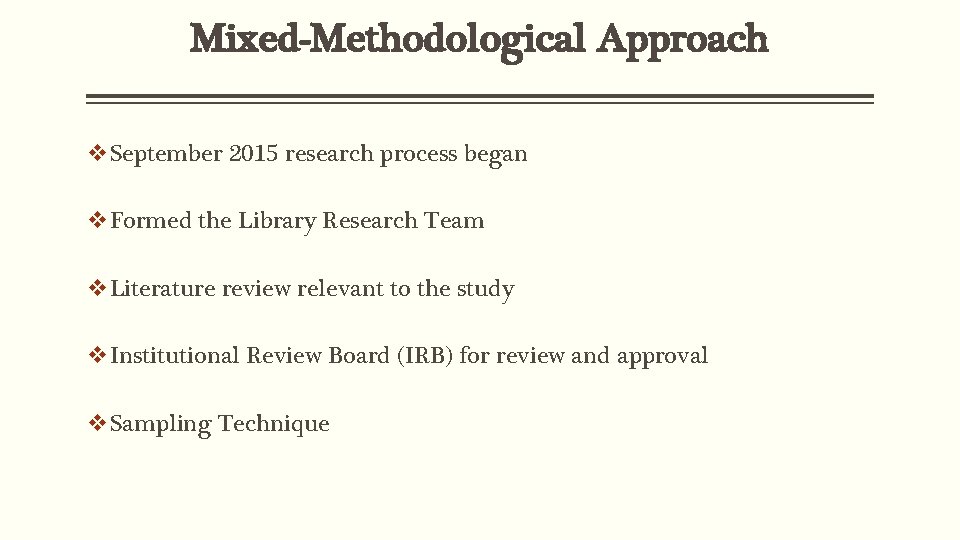
Mixed-Methodological Approach v. September 2015 research process began v. Formed the Library Research Team v. Literature review relevant to the study v. Institutional Review Board (IRB) for review and approval v. Sampling Technique
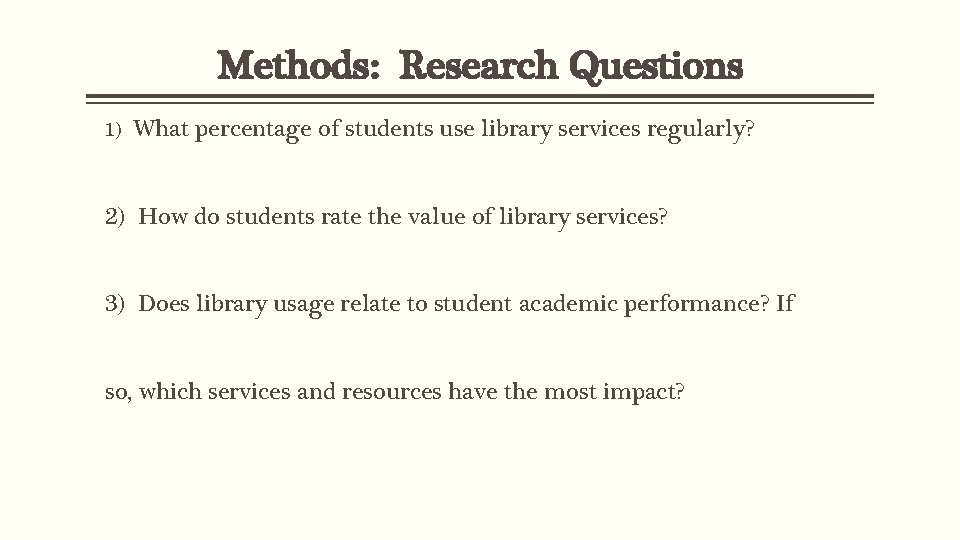
Methods: Research Questions 1) What percentage of students use library services regularly? 2) How do students rate the value of library services? 3) Does library usage relate to student academic performance? If so, which services and resources have the most impact?
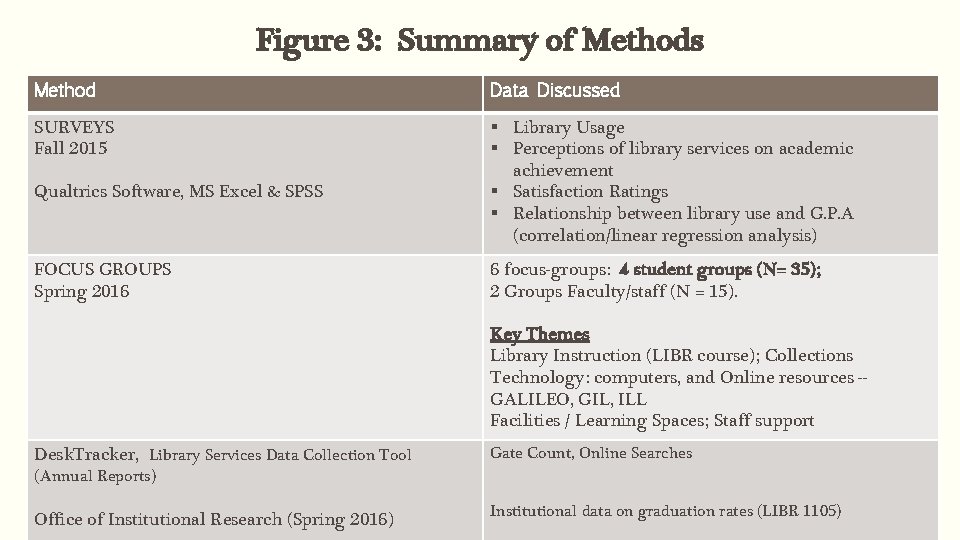
Figure 3: Summary of Methods Method Data Discussed SURVEYS Fall 2015 § Library Usage § Perceptions of library services on academic achievement § Satisfaction Ratings § Relationship between library use and G. P. A (correlation/linear regression analysis) Qualtrics Software, MS Excel & SPSS FOCUS GROUPS Spring 2016 6 focus-groups: 4 student groups (N= 35); 2 Groups Faculty/staff (N = 15). Key Themes Library Instruction (LIBR course); Collections Technology: computers, and Online resources -GALILEO, GIL, ILL Facilities / Learning Spaces; Staff support Desk. Tracker, Library Services Data Collection Tool Gate Count, Online Searches (Annual Reports) Office of Institutional Research (Spring 2016) Institutional data on graduation rates (LIBR 1105)
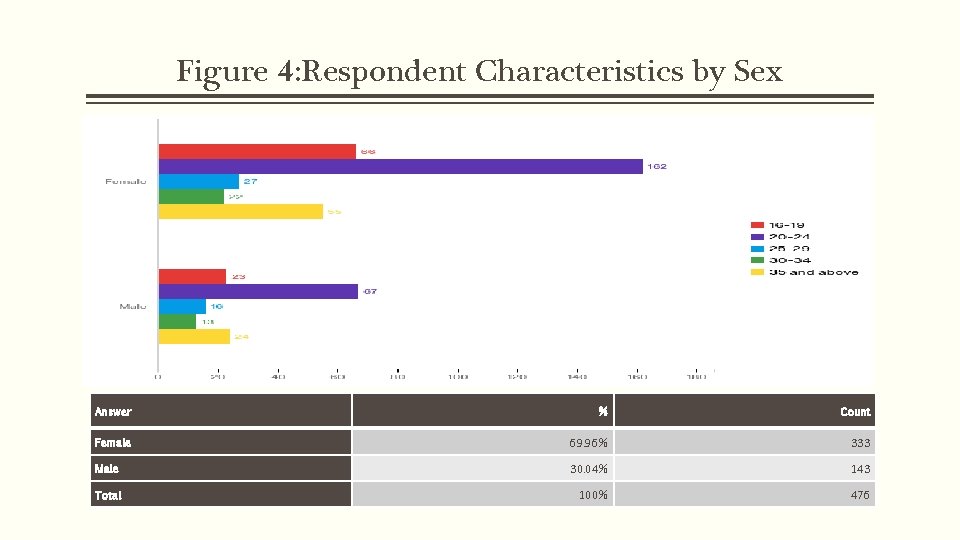
Figure 4: Respondent Characteristics by Sex Answer % Count Female 69. 96% 333 Male 30. 04% 143 Total 100% 476
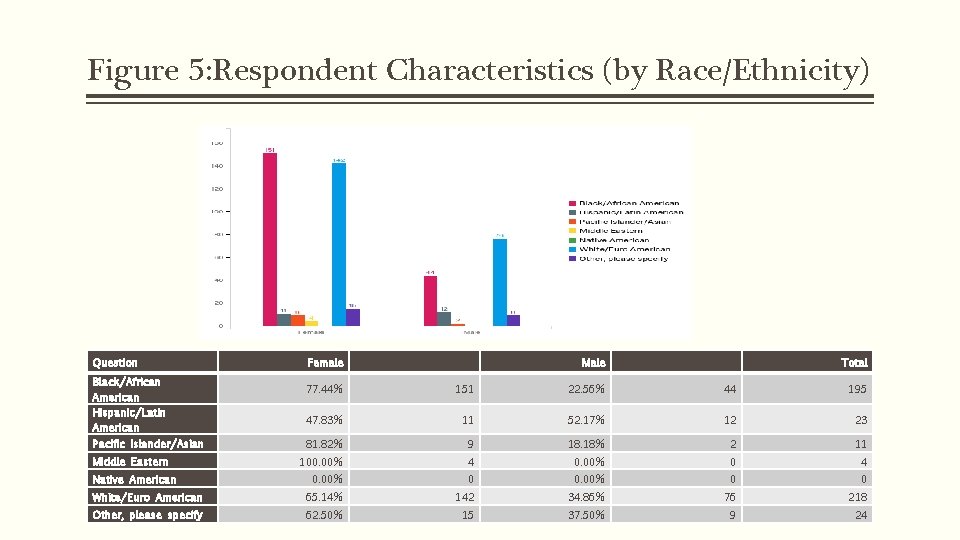
Figure 5: Respondent Characteristics (by Race/Ethnicity) Question Black/African American Hispanic/Latin American Pacific Islander/Asian Female Male Total 77. 44% 151 22. 56% 44 195 47. 83% 11 52. 17% 12 23 81. 82% 9 18. 18% 2 11 100. 00% 4 0. 00% 0 0 White/Euro American 65. 14% 142 34. 86% 76 218 Other, please specify 62. 50% 15 37. 50% 9 24 Middle Eastern Native American
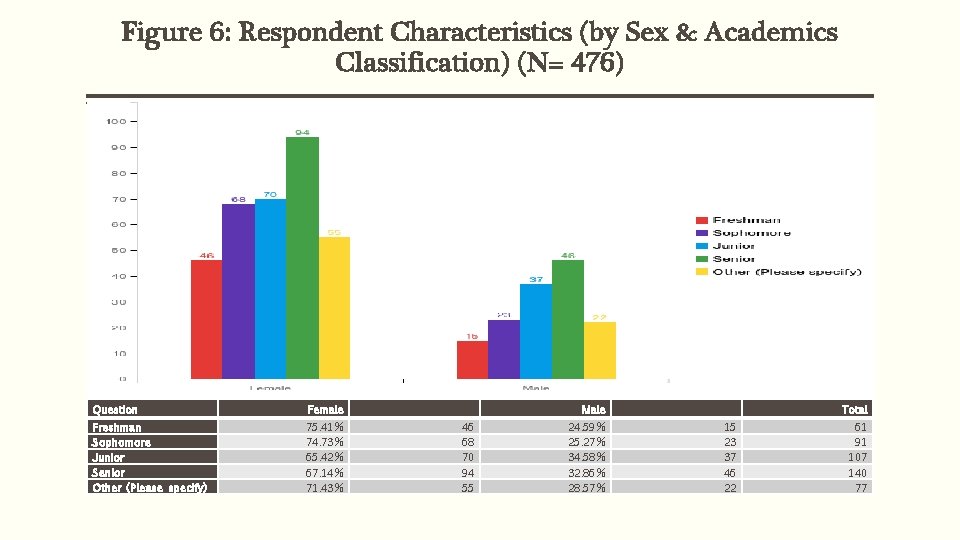
Figure 6: Respondent Characteristics (by Sex & Academics Classification) (N= 476) Question Female Freshman Sophomore Junior Senior Other (Please specify) 75. 41% 74. 73% 65. 42% 67. 14% 71. 43% Male 46 68 70 94 55 24. 59% 25. 27% 34. 58% 32. 86% 28. 57% Total 15 23 37 46 22 61 91 107 140 77
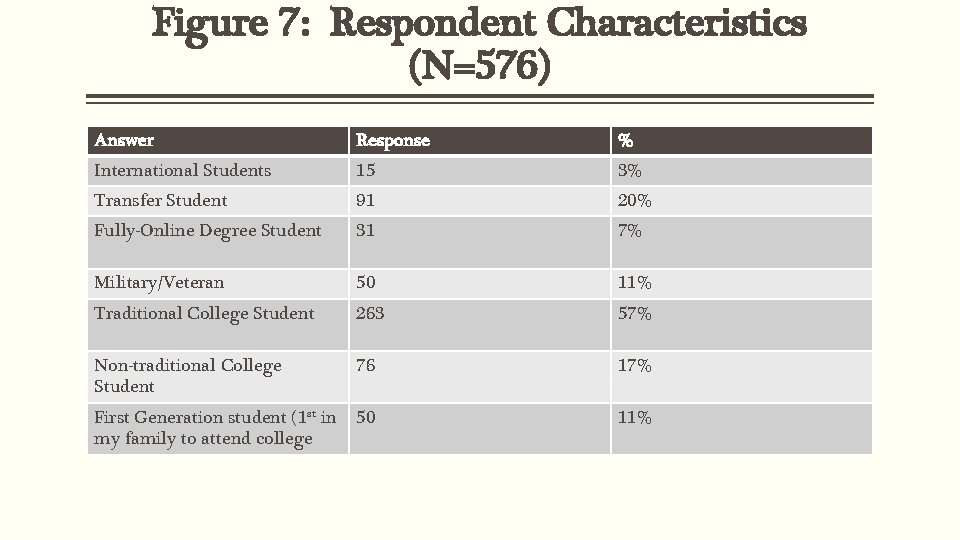
Figure 7: Respondent Characteristics (N=576) Answer Response % International Students 15 3% Transfer Student 91 20% Fully-Online Degree Student 31 7% Military/Veteran 50 11% Traditional College Student 263 57% Non-traditional College Student 76 17% First Generation student (1 st in my family to attend college 50 11%
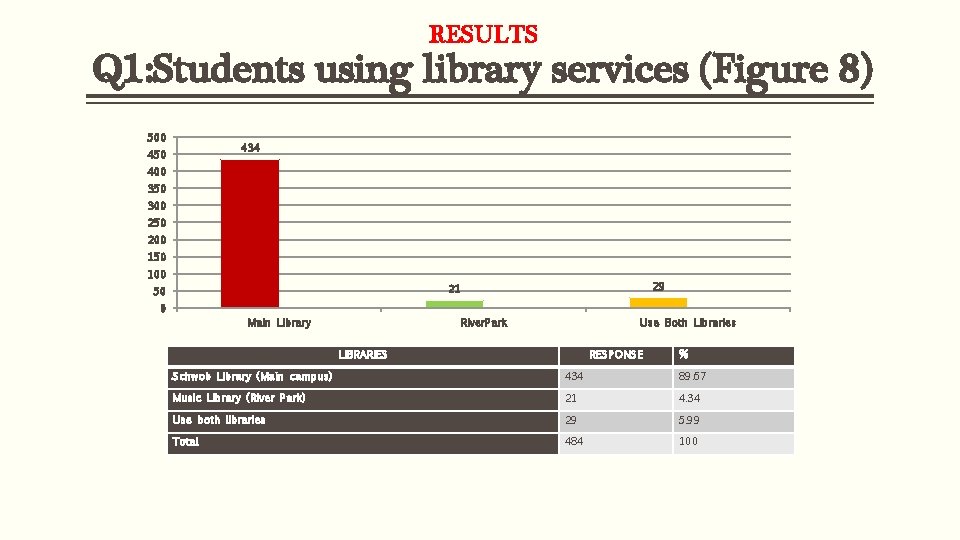
RESULTS Q 1: Students using library services (Figure 8) 500 434 450 400 350 300 250 200 150 100 29 21 50 0 Main Library River. Park Use Both Libraries LIBRARIES RESPONSE % Schwob Library (Main campus) 434 89. 67 Music Library (River Park) 21 4. 34 Use both libraries 29 5. 99 Total 484 100
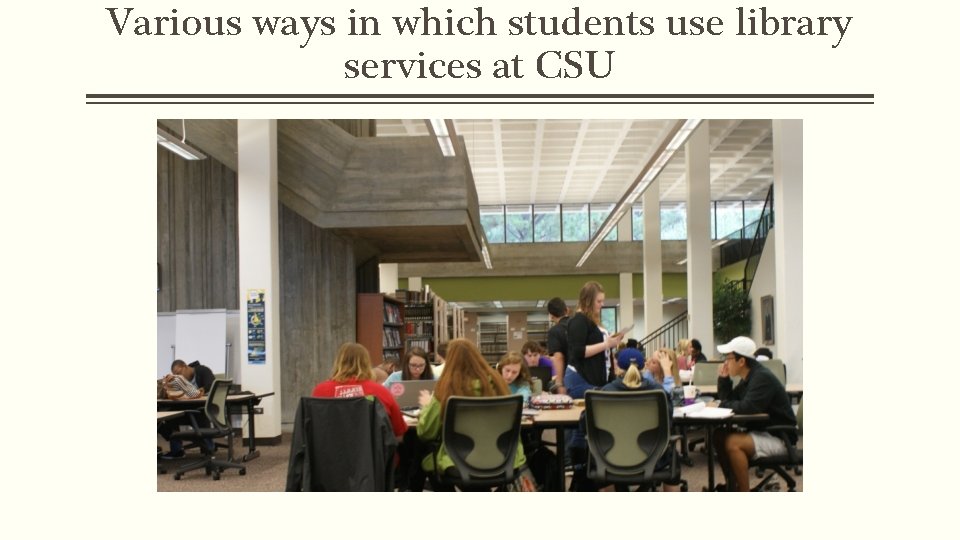
Various ways in which students use library services at CSU
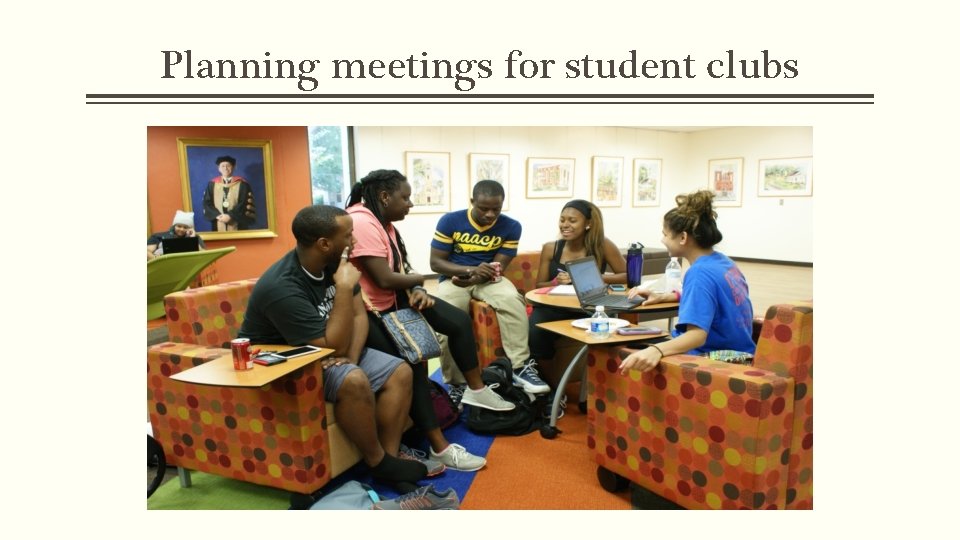
Planning meetings for student clubs
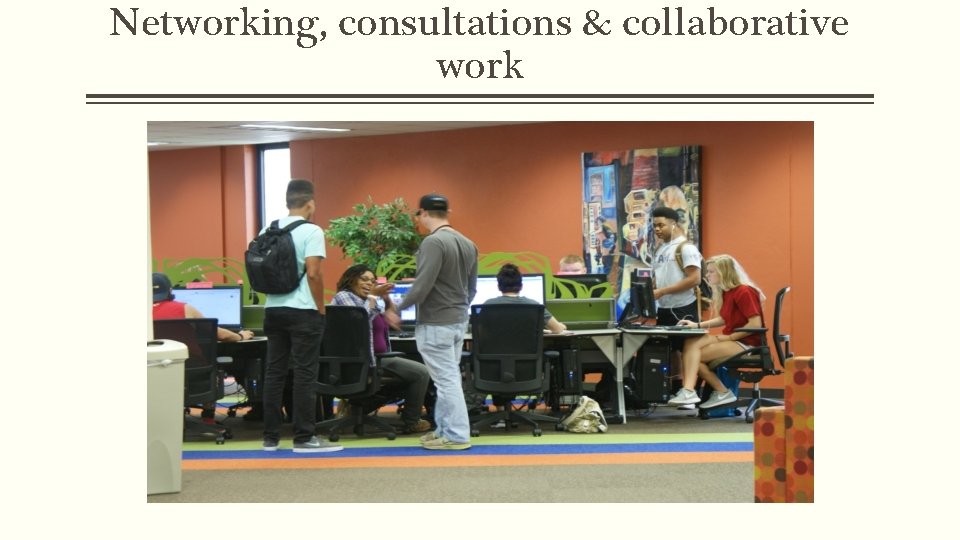
Networking, consultations & collaborative work
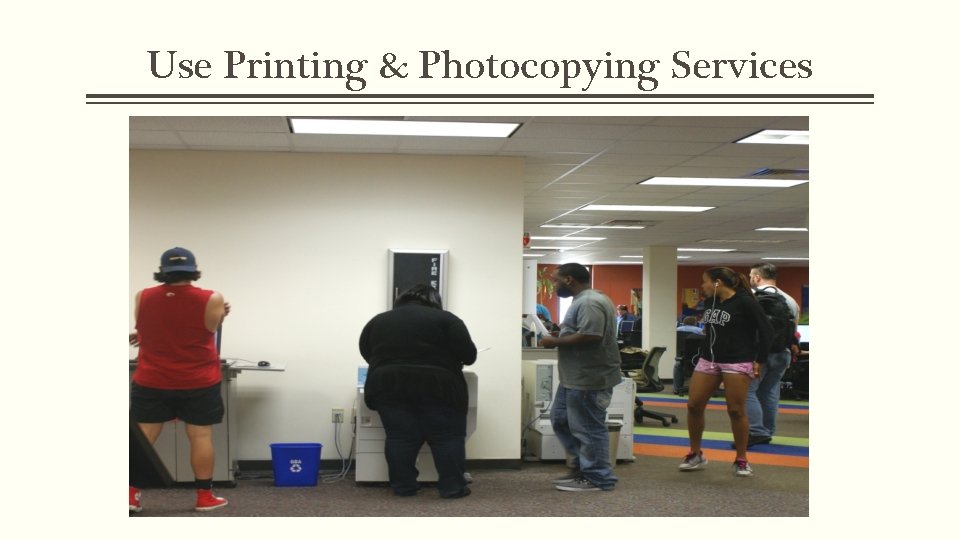
Use Printing & Photocopying Services
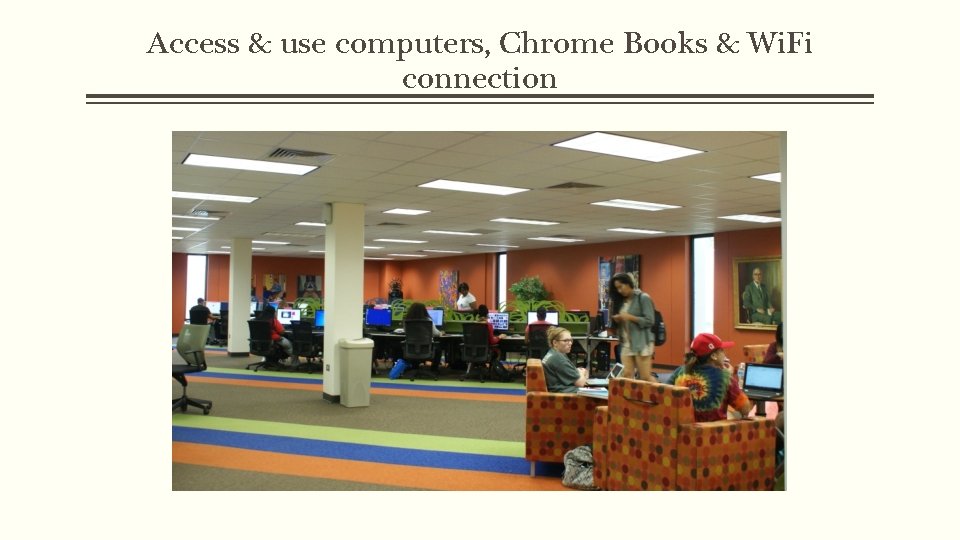
Access & use computers, Chrome Books & Wi. Fi connection
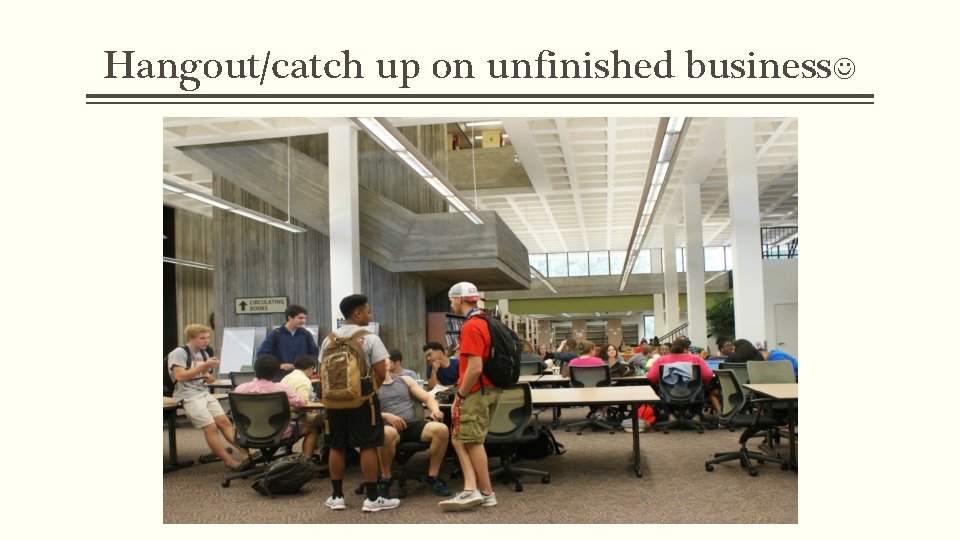
Hangout/catch up on unfinished business
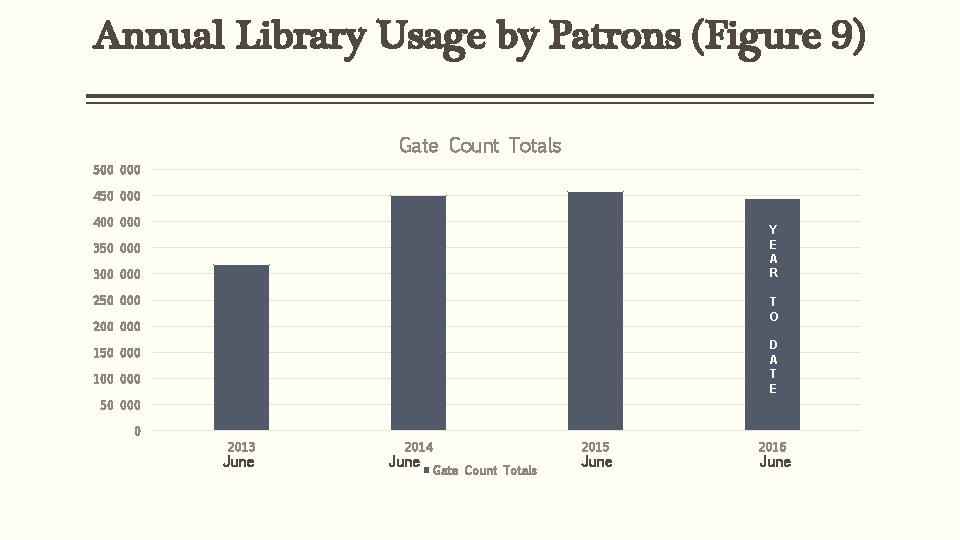
Annual Library Usage by Patrons (Figure 9) Gate Count Totals 500 000 450 000 400 000 Y E A R 350 000 300 000 250 000 T O 200 000 D A T E 150 000 100 000 50 000 0 2013 June 2014 June 2015 Gate Count Totals June 2016 June
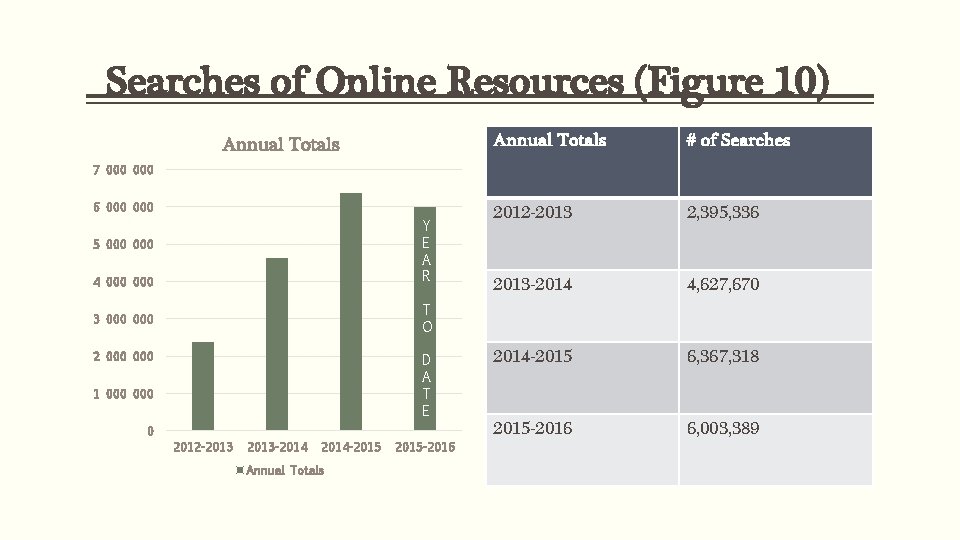
Searches of Online Resources (Figure 10) Annual Totals # of Searches 2012 -2013 2, 395, 336 2013 -2014 4, 627, 670 2014 -2015 6, 367, 318 2015 -2016 6, 003, 389 7 000 6 000 Y E A R 5 000 4 000 T O 3 000 2 000 D A T E 1 000 0 2012 -2013 -2014 -2015 Annual Totals 2015 -2016
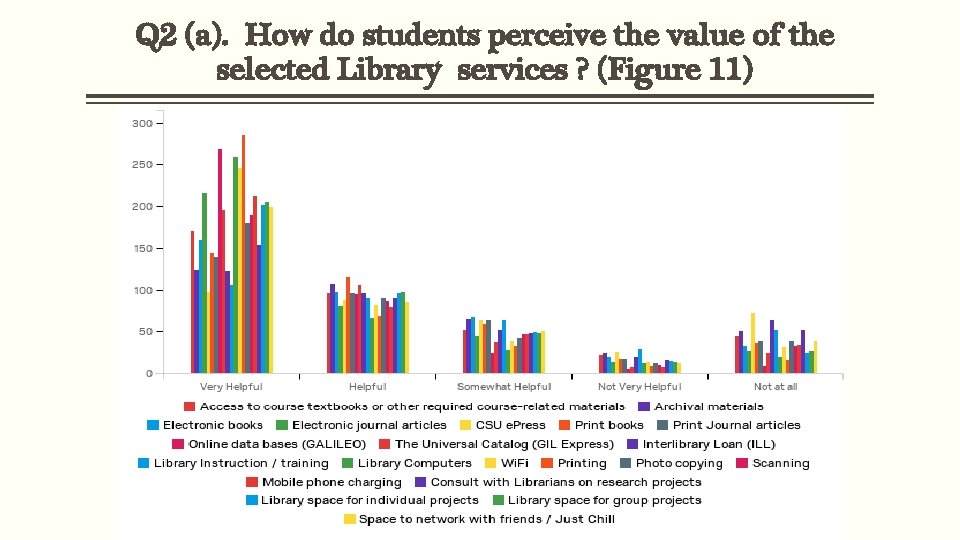
Q 2 (a). How do students perceive the value of the selected Library services ? (Figure 11)
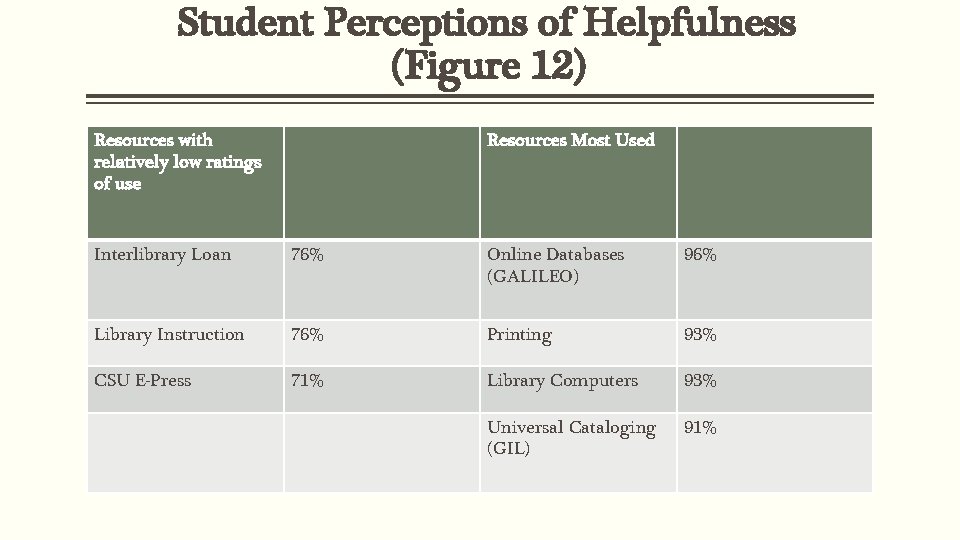
Student Perceptions of Helpfulness (Figure 12) Resources with relatively low ratings of use Resources Most Used Interlibrary Loan 76% Online Databases (GALILEO) 96% Library Instruction 76% Printing 93% CSU E-Press 71% Library Computers 93% Universal Cataloging (GIL) 91%
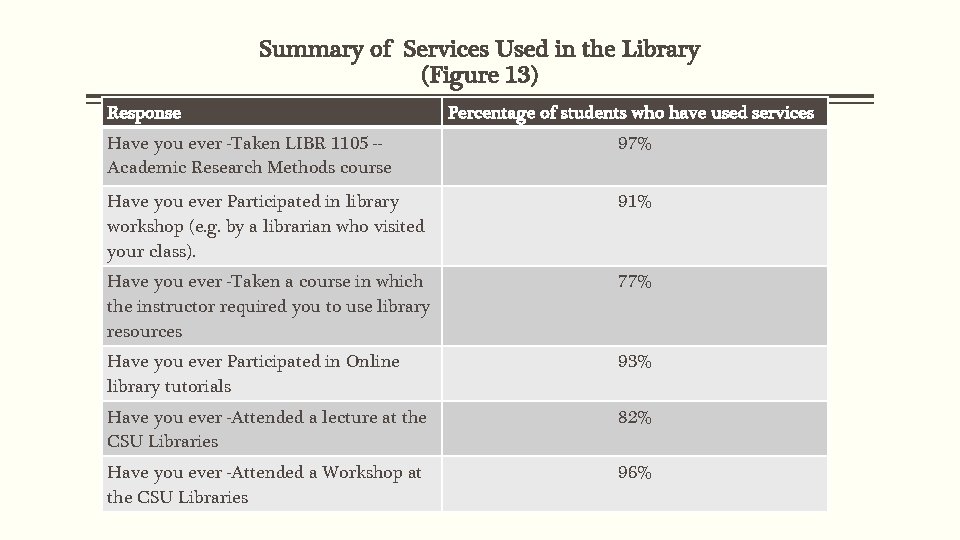
Summary of Services Used in the Library (Figure 13) Response Percentage of students who have used services Have you ever -Taken LIBR 1105 -Academic Research Methods course 97% Have you ever Participated in library workshop (e. g. by a librarian who visited your class). 91% Have you ever -Taken a course in which the instructor required you to use library resources 77% Have you ever Participated in Online library tutorials 93% Have you ever -Attended a lecture at the CSU Libraries 82% Have you ever -Attended a Workshop at the CSU Libraries 96%
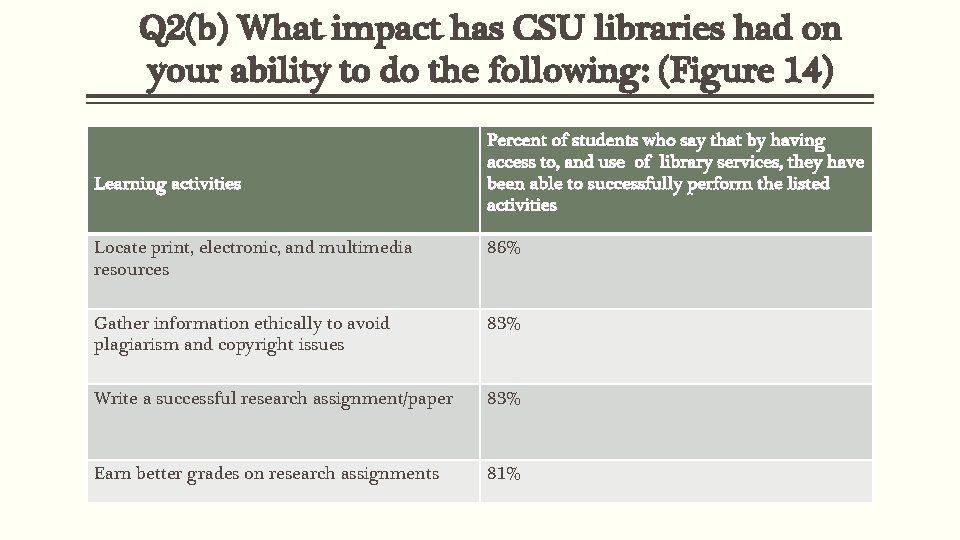
Q 2(b) What impact has CSU libraries had on your ability to do the following: (Figure 14) Learning activities Percent of students who say that by having access to, and use of library services, they have been able to successfully perform the listed activities Locate print, electronic, and multimedia resources 86% Gather information ethically to avoid plagiarism and copyright issues 83% Write a successful research assignment/paper 83% Earn better grades on research assignments 81%
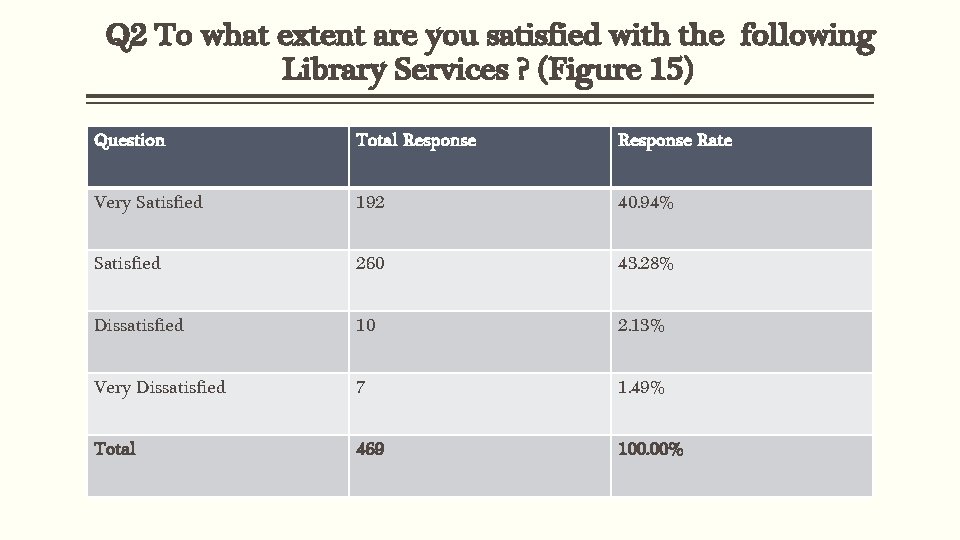
Q 2 To what extent are you satisfied with the following Library Services ? (Figure 15) Question Total Response Rate Very Satisfied 192 40. 94% Satisfied 260 43. 28% Dissatisfied 10 2. 13% Very Dissatisfied 7 1. 49% Total 469 100. 00%
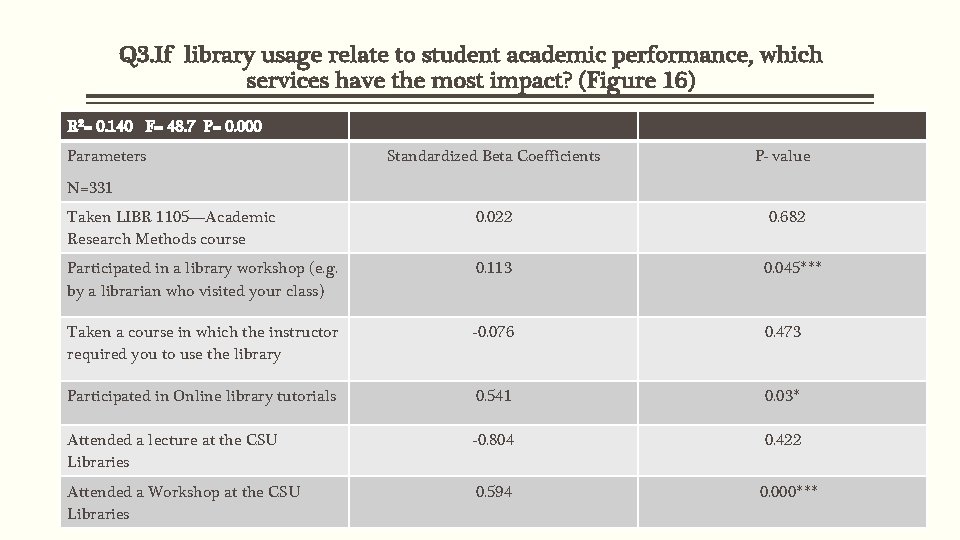
Q 3. If library usage relate to student academic performance, which services have the most impact? (Figure 16) R 2= 0. 140 F= 48. 7 P= 0. 000 Parameters Standardized Beta Coefficients P- value Taken LIBR 1105—Academic Research Methods course 0. 022 0. 682 Participated in a library workshop (e. g. by a librarian who visited your class) 0. 113 0. 045*** Taken a course in which the instructor required you to use the library -0. 076 0. 473 Participated in Online library tutorials 0. 541 0. 03* Attended a lecture at the CSU Libraries -0. 804 0. 422 Attended a Workshop at the CSU Libraries 0. 594 N=331 0. 000***
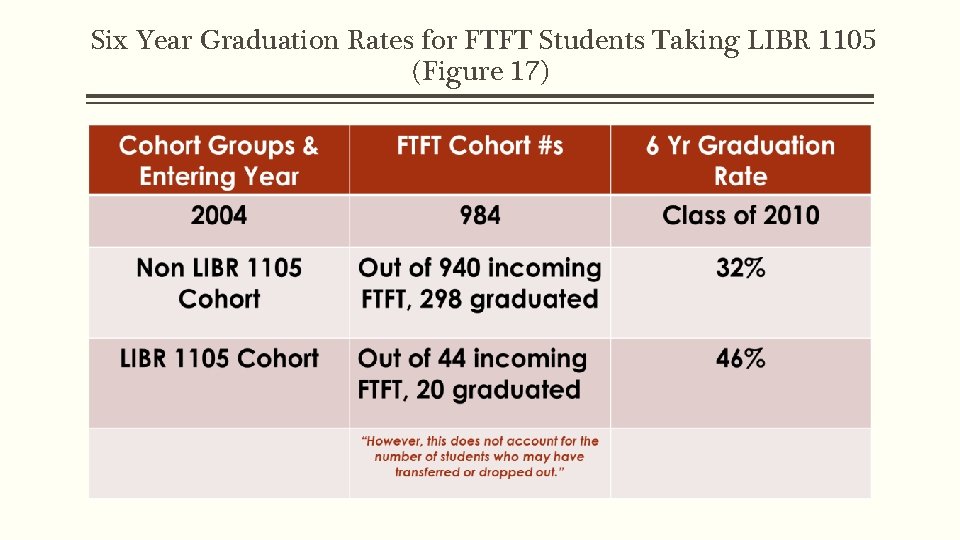
Six Year Graduation Rates for FTFT Students Taking LIBR 1105 (Figure 17)
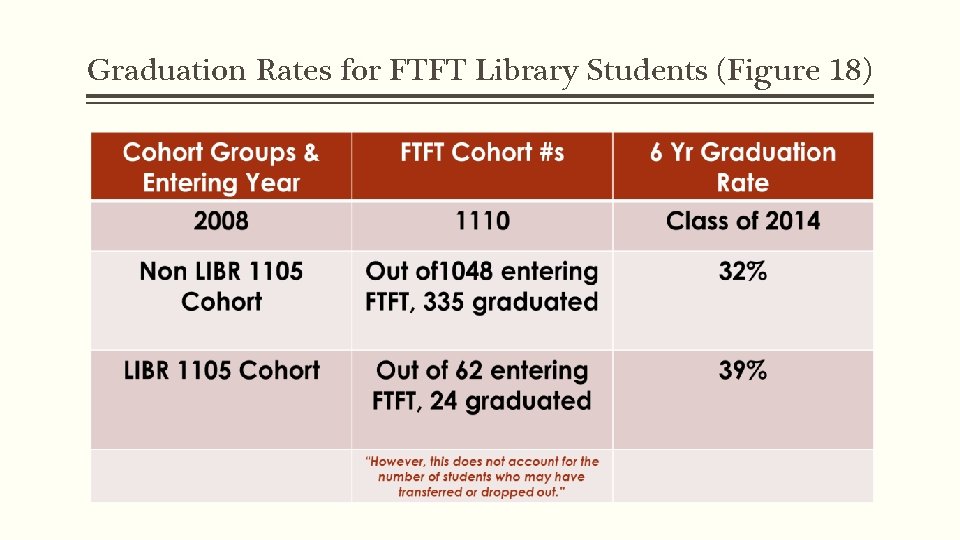
Graduation Rates for FTFT Library Students (Figure 18)
FOCUS GROUPS RESULTS River. Park Campus & International Students
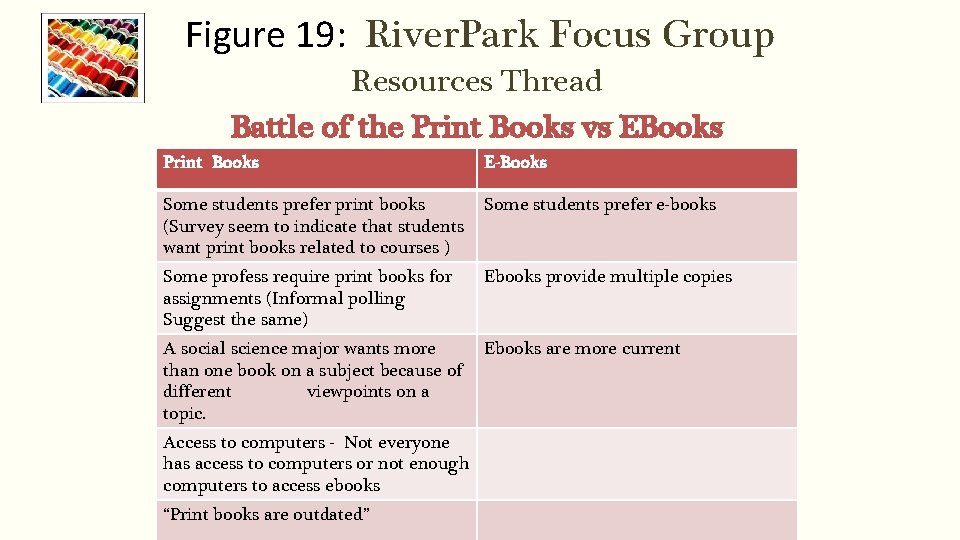
Figure 19: River. Park Focus Group Resources Thread Battle of the Print Books vs EBooks Print Books E-Books Some students prefer print books (Survey seem to indicate that students want print books related to courses ) Some students prefer e-books Some profess require print books for assignments (Informal polling Suggest the same) Ebooks provide multiple copies A social science major wants more than one book on a subject because of different viewpoints on a topic. Ebooks are more current Access to computers - Not everyone has access to computers or not enough computers to access ebooks “Print books are outdated”
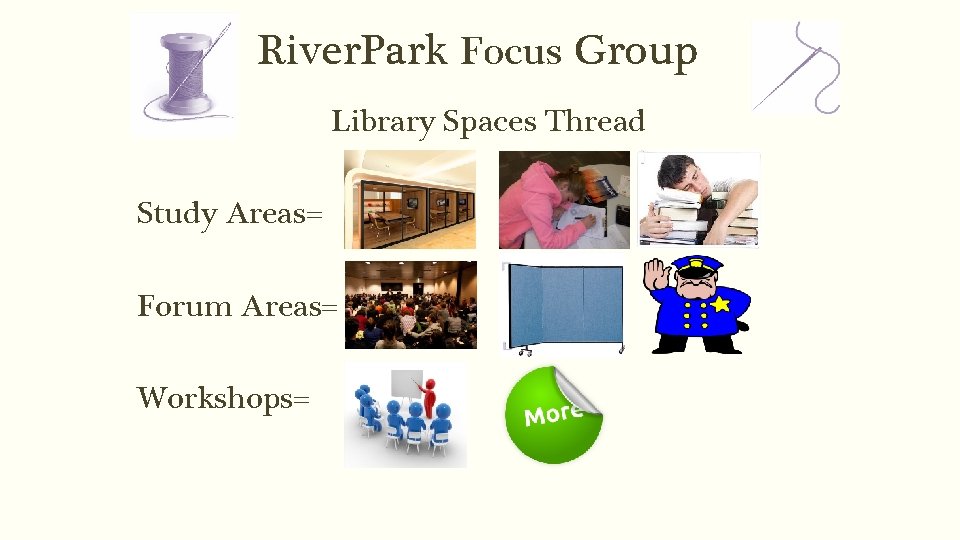
River. Park Focus Group Library Spaces Thread Study Areas= Forum Areas= Workshops=
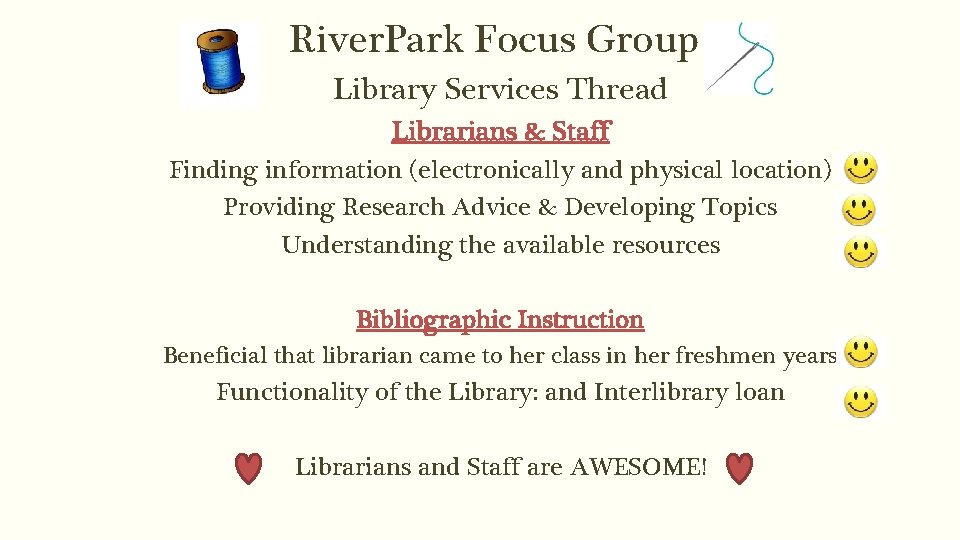
River. Park Focus Group Library Services Thread Librarians & Staff Finding information (electronically and physical location) Providing Research Advice & Developing Topics Understanding the available resources Bibliographic Instruction Beneficial that librarian came to her class in her freshmen years Functionality of the Library: and Interlibrary loan Librarians and Staff are AWESOME!
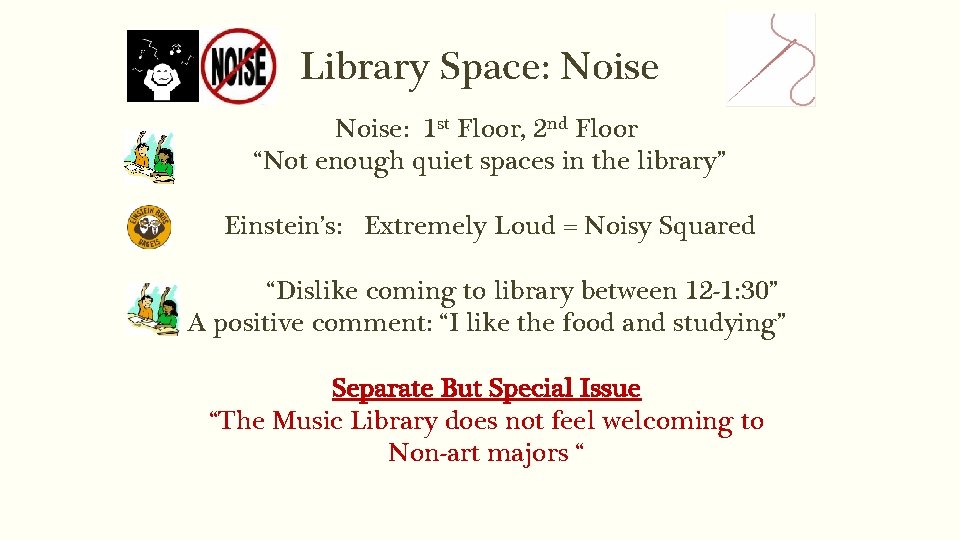
Library Space: Noise: 1 st Floor, 2 nd Floor “Not enough quiet spaces in the library” Einstein’s: Extremely Loud = Noisy Squared “Dislike coming to library between 12 -1: 30” A positive comment: “I like the food and studying” Separate But Special Issue “The Music Library does not feel welcoming to Non-art majors “
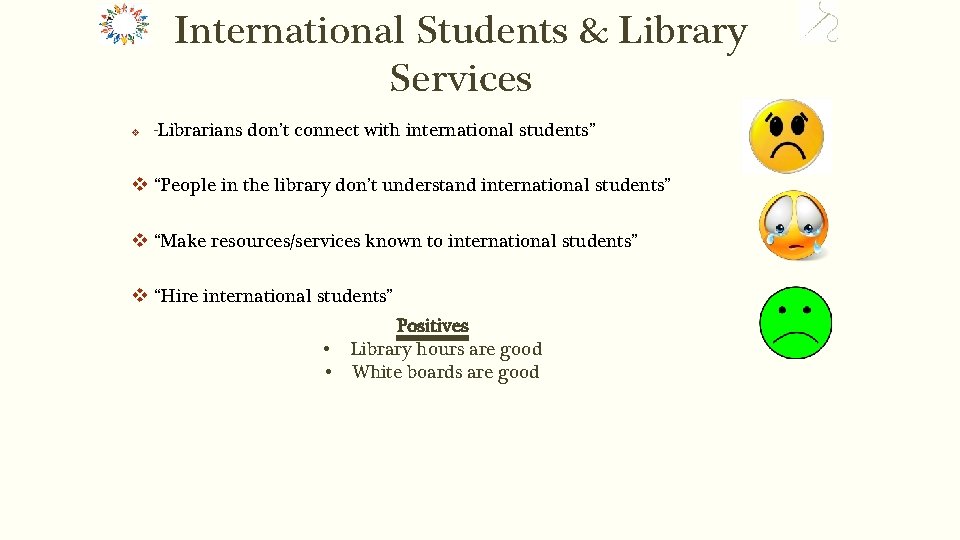
International Students & Library Services v Librarians don’t connect with international students” “ v “People in the library don’t understand international students” v “Make resources/services known to international students” v “Hire international students” Positives • Library hours are good • White boards are good
International Students &Library Spaces v “More quiet spaces” v “(MC) Paint Color and Carpet color needs to change” v “Library need to focus on more study rooms” v “Einstein's is convenient” /“Designated spaces for eating” v “Designated social spaces in the library” *MC= Multiple Comments*
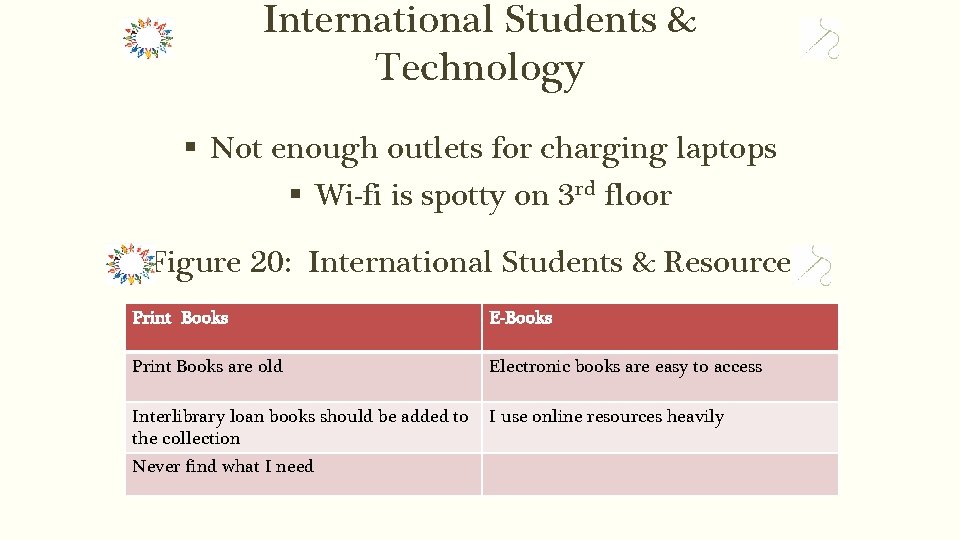
International Students & Technology § Not enough outlets for charging laptops § Wi-fi is spotty on 3 rd floor Figure 20: International Students & Resources Print Books E-Books Print Books are old Electronic books are easy to access Interlibrary loan books should be added to the collection I use online resources heavily Never find what I need
FOCUS GROUPS RESULTS Graduate and LIBR 1105 Students
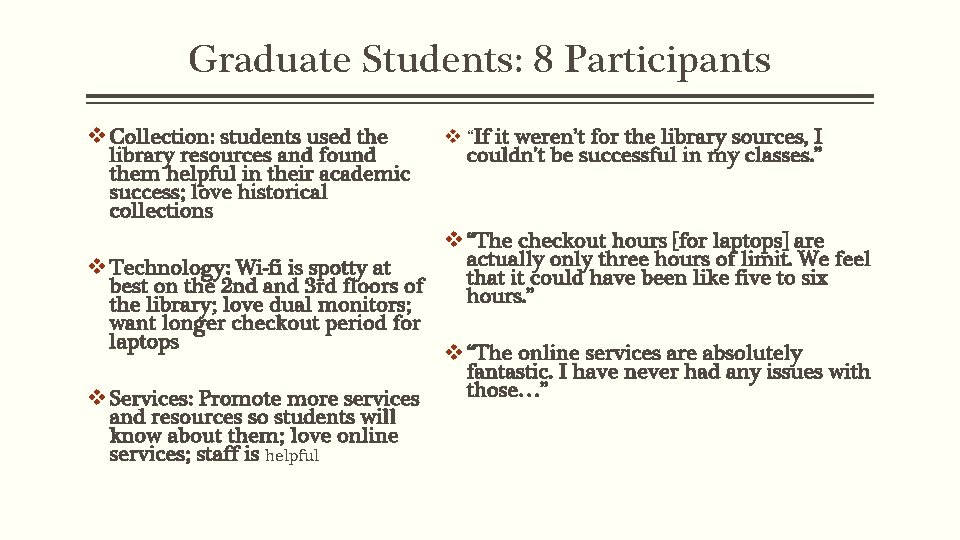
Graduate Students: 8 Participants v Collection: students used the library resources and found them helpful in their academic success; love historical collections v “If it weren’t for the library sources, I couldn’t be successful in my classes. ” v “The checkout hours [for laptops] are actually only three hours of limit. We feel v Technology: Wi-fi is spotty at that it could have been like five to six best on the 2 nd and 3 rd floors of hours. ” the library; love dual monitors; want longer checkout period for laptops v “The online services are absolutely fantastic. I have never had any issues with those…” v Services: Promote more services and resources so students will know about them; love online services; staff is helpful
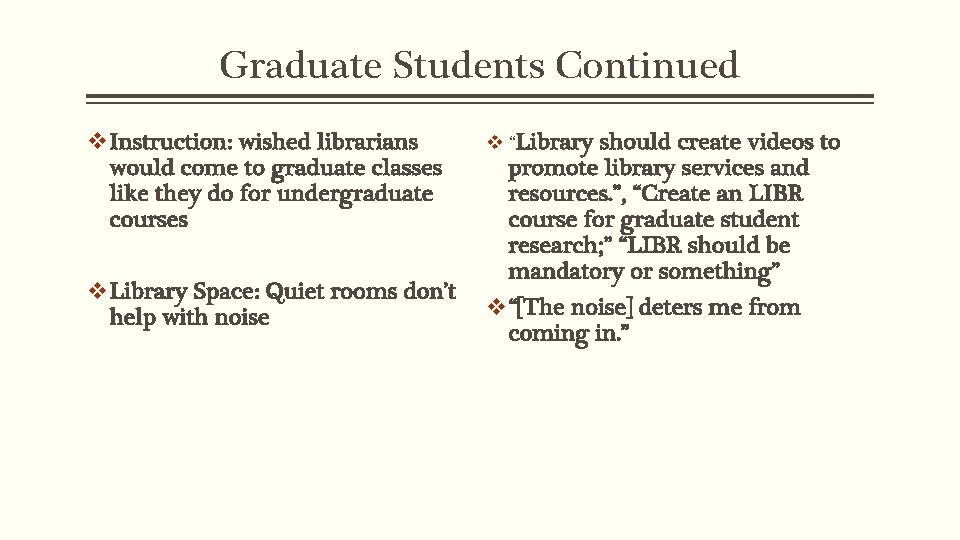
Graduate Students Continued v. Instruction: wished librarians would come to graduate classes like they do for undergraduate courses v. Library Space: Quiet rooms don’t help with noise v “Library should create videos to promote library services and resources. ”, “Create an LIBR course for graduate student research; ” “LIBR should be mandatory or something” v“[The noise] deters me from coming in. ”
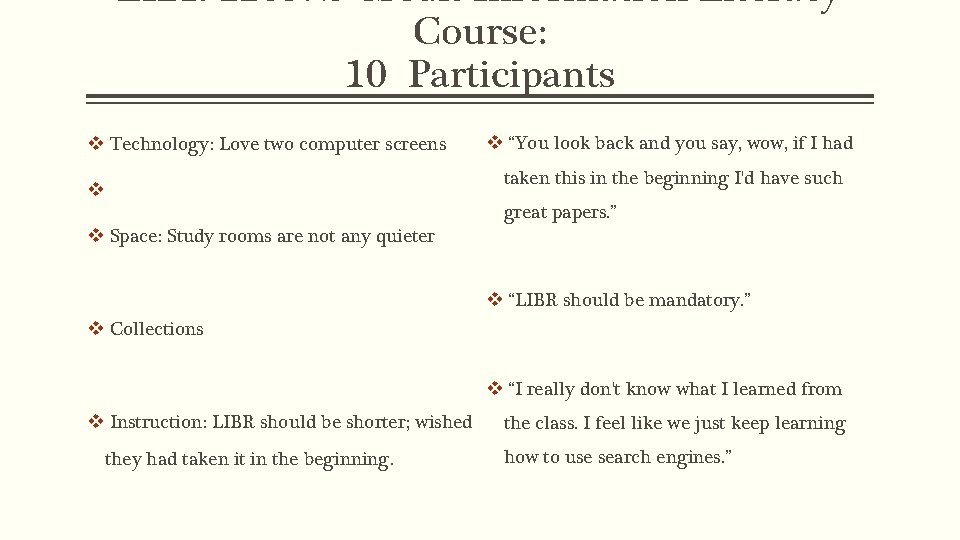
LIBR 1105: 2 Credit Information Literacy Course: 10 Participants v Technology: Love two computer screens v “You look back and you say, wow, if I had taken this in the beginning I'd have such v great papers. ” v Space: Study rooms are not any quieter v “LIBR should be mandatory. ” v Collections v “I really don't know what I learned from v Instruction: LIBR should be shorter; wished they had taken it in the beginning. the class. I feel like we just keep learning how to use search engines. ”
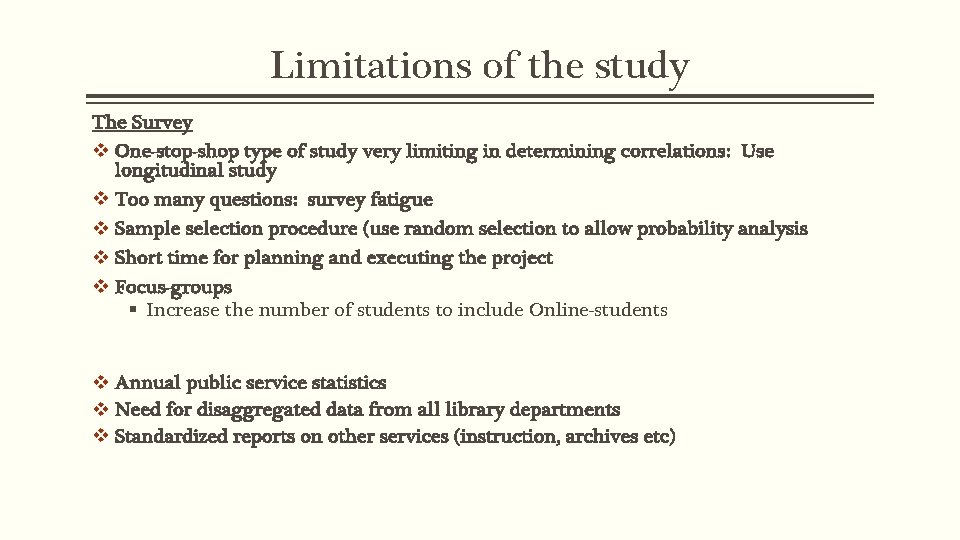
Limitations of the study The Survey v One-stop-shop type of study very limiting in determining correlations: Use longitudinal study v Too many questions: survey fatigue v Sample selection procedure (use random selection to allow probability analysis v Short time for planning and executing the project v Focus-groups § Increase the number of students to include Online-students v Annual public service statistics v Need for disaggregated data from all library departments v Standardized reports on other services (instruction, archives etc)
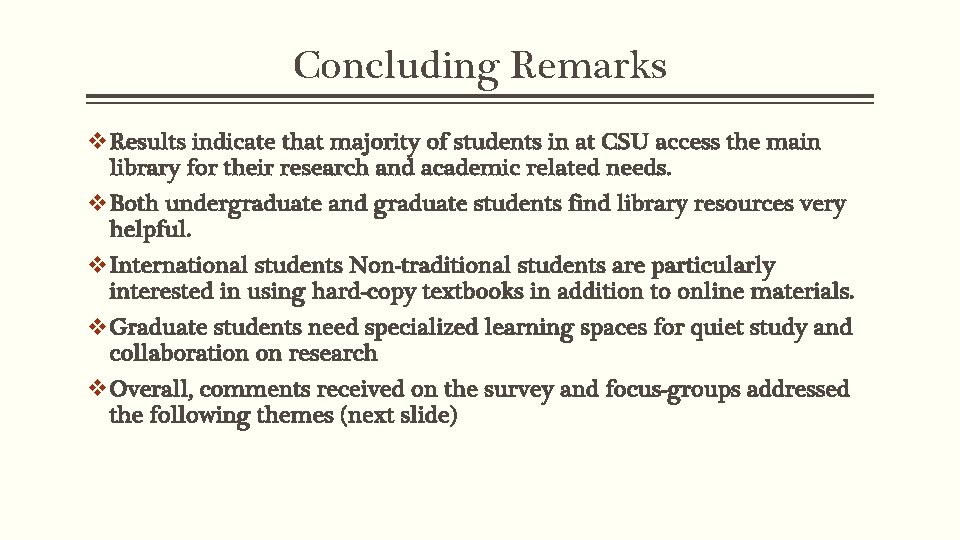
Concluding Remarks v. Results indicate that majority of students in at CSU access the main library for their research and academic related needs. v. Both undergraduate and graduate students find library resources very helpful. v. International students Non-traditional students are particularly interested in using hard-copy textbooks in addition to online materials. v. Graduate students need specialized learning spaces for quiet study and collaboration on research v. Overall, comments received on the survey and focus-groups addressed the following themes (next slide)
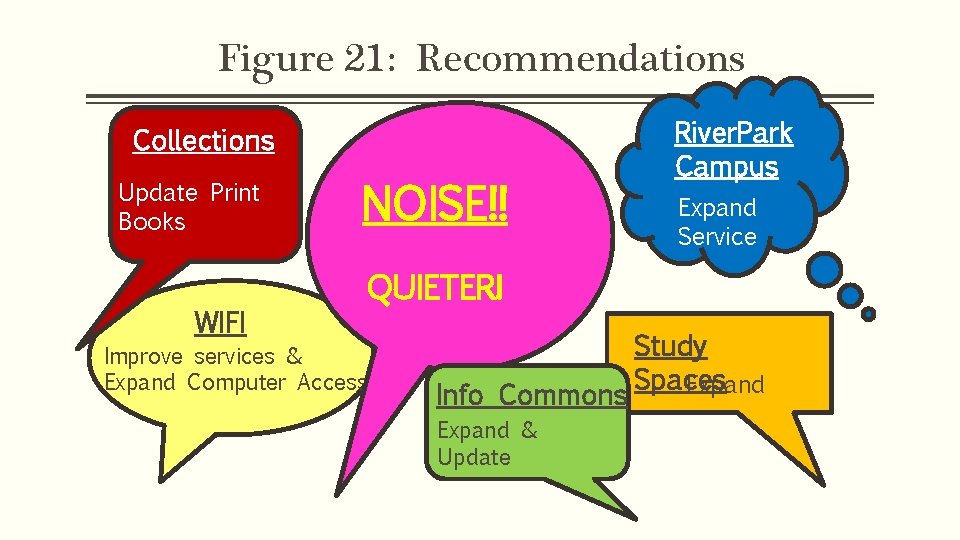
Figure 21: Recommendations Collections Update Print Books WIFI NOISE!! River. Park Campus Expand Service QUIETER! Improve services & Expand Computer Access Info Commons Expand & Update Study Spaces Expand
ACKNOWLEDGEMENT § Mark Flynn, Dean of Libraries § Thomas Ganzevoort, Associate Professor, Library Science § Dr. Katherine White, Associate Professor, Psychology § Sridhar, Sitharaman, Director of Institutional Research § Julie Caulder, Administrative Assistant to Dean of Libraries
BIBLIOGRAPHICAL SOURCES Cook, J. M. (2014). A Library Credit Course and Student Success Rates: A Longitudinal Study. College & Research Libraries, 75(3), 272 -283. Kot, F. C. , & Jones, J. L. (2015). The Impact of Library Resource Utilization on Undergraduate Students' Academic Performance: A Propensity Score Matching Design. College & Research Libraries, 76(5), 566 -586. Krueger R. 2015. A Practical Guide for Applied Research, 5 th Edition. Sage Publishers. Stone, G. , & Ramsden, B. (2013). Library Impact Data Project: Looking for the Link between Library Usage and Student Attainment. College & Research Libraries, 74(6), 546 -559. Soria, K. M. & Fransen, J. & Nackerud, S. (2013). Library Use and Undergraduate Student Outcomes: New Evidence for Students’ Retention and Academic Success. portal: Libraries and the Academy 13(2), 147 -164. The Johns Hopkins University Press. Retrieved February 21, 2016, from Project MUSE database. Weaver, M. (2013). Student Journey Work: A Review of Academic Library Contributions to Student Transition and Success. New Review Of Academic Librarianship, 19(2), 101 -124. CSU statistical data obtained through the Office of Institutional Research
Questions? Comments?
Thank You!
- Slides: 62