
Reimagining the First Year at UW Whitewater What

- Slides: 17
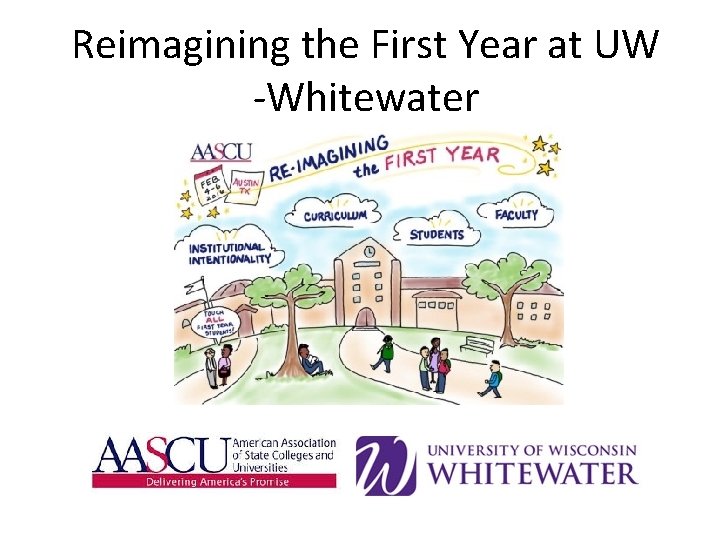
Reimagining the First Year at UW -Whitewater
What is It? Re-Imagining the First Year (RFY) is a new project aimed at ensuring success for all students, particularly those who have historically been underserved by higher education: low income, first generation, and students of color. Support from: Bill & Melinda Gates Foundation and USA Funds
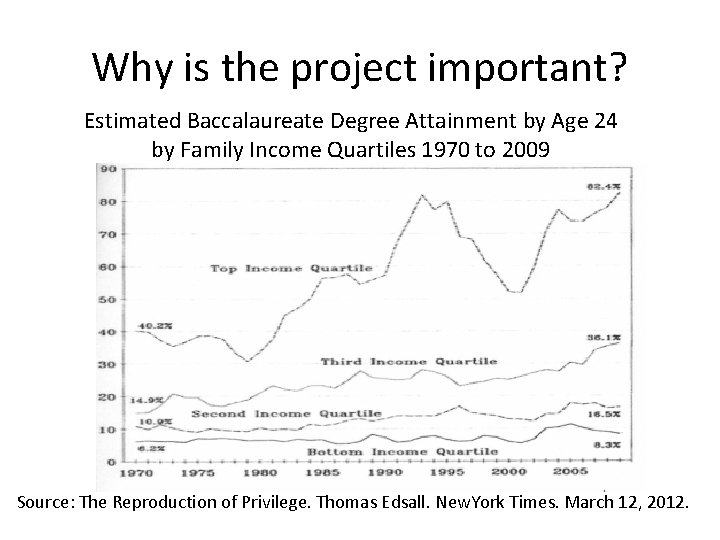
Why is the project important? Estimated Baccalaureate Degree Attainment by Age 24 by Family Income Quartiles 1970 to 2009 Source: The Reproduction of Privilege. Thomas Edsall. New. York Times. March 12, 2012.
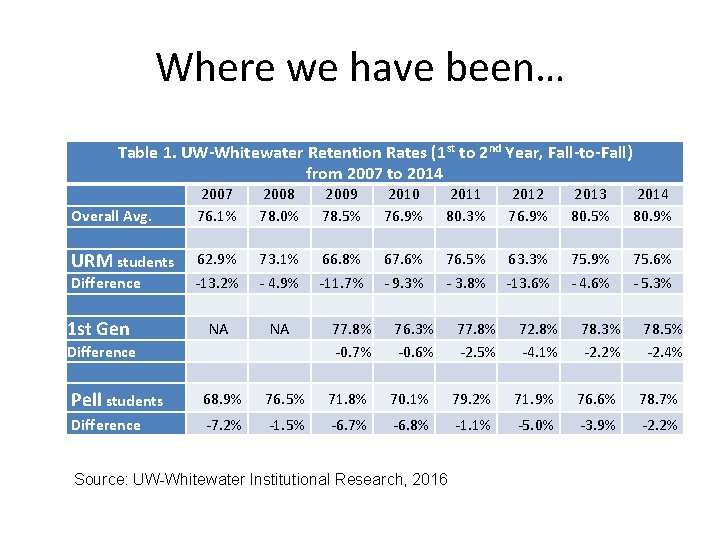
Where we have been… Table 1. UW-Whitewater Retention Rates (1 st to 2 nd Year, Fall-to-Fall) from 2007 to 2014 Overall Avg. 2007 76. 1% 2008 78. 0% 2009 78. 5% 2010 76. 9% 2011 80. 3% 2012 76. 9% 2013 80. 5% 2014 80. 9% URM students 62. 9% -13. 2% 73. 1% - 4. 9% 66. 8% -11. 7% 67. 6% - 9. 3% 76. 5% - 3. 8% 63. 3% -13. 6% 75. 9% - 4. 6% 75. 6% - 5. 3% NA NA 77. 8% -0. 7% 76. 3% -0. 6% 77. 8% -2. 5% 72. 8% -4. 1% 78. 3% -2. 2% 78. 5% -2. 4% Difference 1 st Gen Difference Pell students 68. 9% 76. 5% 71. 8% 70. 1% 79. 2% 71. 9% 76. 6% 78. 7% Difference -7. 2% -1. 5% -6. 7% -6. 8% -1. 1% -5. 0% -3. 9% -2. 2% Source: UW-Whitewater Institutional Research, 2016
Basics • Goal is to develop comprehensive, institutional transformation that redesigns the first year of college and creates sustainable change for student success • Coalition of 44 member institutions • Three calendar years, 2016 -2018 – First year to plan (January – December 2016) – Two years to implement
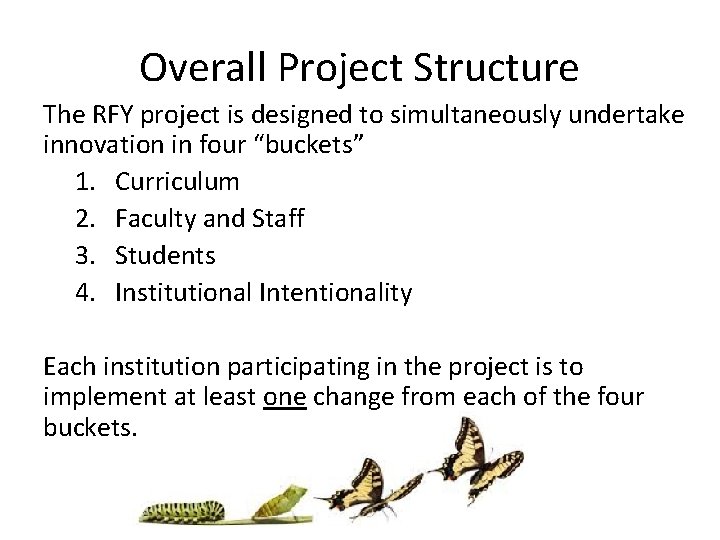
Overall Project Structure The RFY project is designed to simultaneously undertake innovation in four “buckets” 1. Curriculum 2. Faculty and Staff 3. Students 4. Institutional Intentionality Each institution participating in the project is to implement at least one change from each of the four buckets.
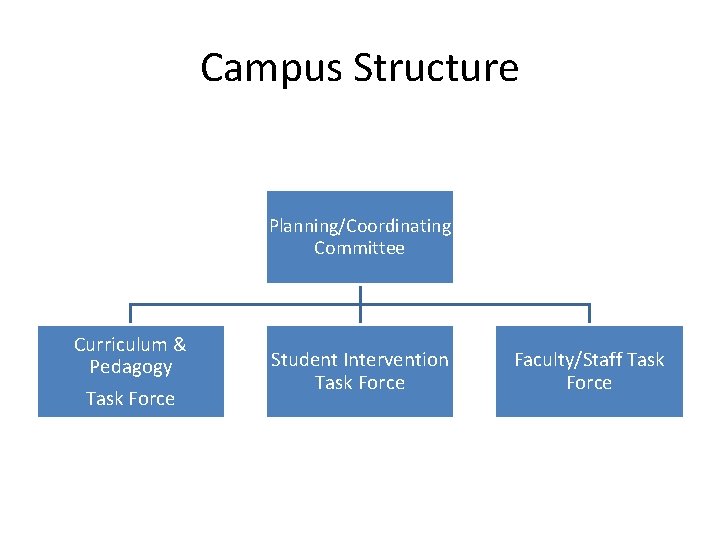
Campus Structure Planning/Coordinating Committee Curriculum & Pedagogy Task Force Student Intervention Task Force Faculty/Staff Task Force
What we need from you … • Good ideas! Input on goals and priorities for task force work over the next two years • Involvement in the project • Support for the work we will do on campus
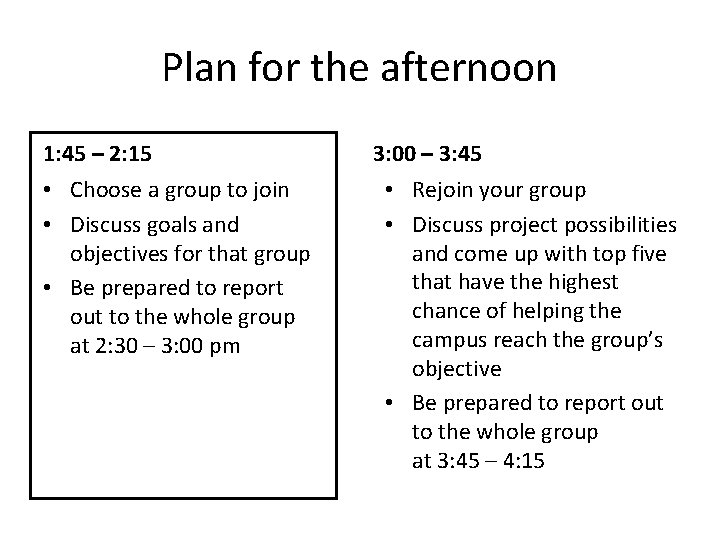
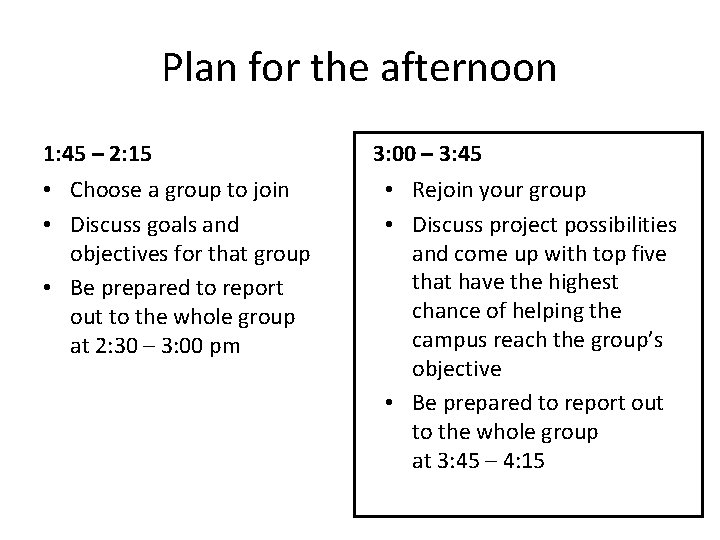
Plan for the afternoon 1: 45 – 2: 15 • Choose a group to join • Discuss goals and objectives for that group • Be prepared to report out to the whole group at 2: 30 – 3: 00 pm 3: 00 – 3: 45 • Rejoin your group • Discuss project possibilities and come up with top five that have the highest chance of helping the campus reach the group’s objective • Be prepared to report out to the whole group at 3: 45 – 4: 15
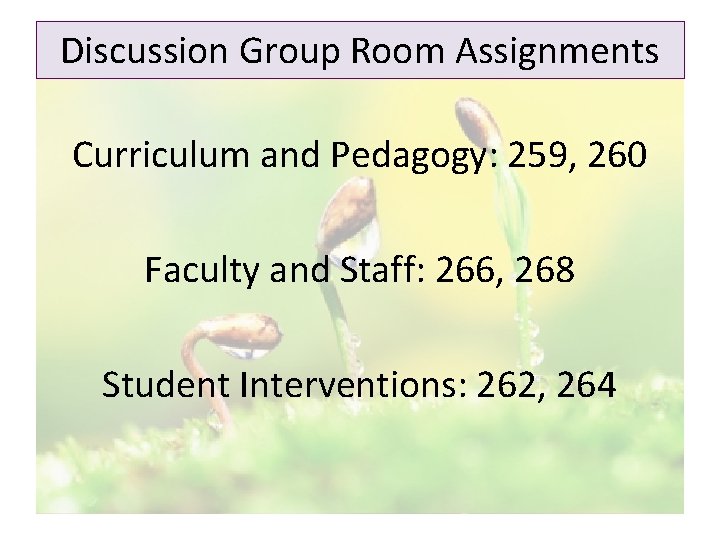
Curriculum and Pedagogy Co-leaders: Carolyn Morgan and Liz Hachten • Goal: Enable more students – including low income, underrepresented minority and first gen students – to experience academic success in their first year courses • Objectives: Reduced course repeats, higher GPAs, accelerated progress in their chosen major, higher retention & graduation, narrowing of the achievement gap. • Focus: The first year curriculum, including general education courses and key gateway courses in the majors, especially those with high DWFI rates. Breakout Rooms: 259, 260
Faculty and Staff Co-leaders: Barbara Beaver, Jodie Parys, Tom Rios • Goal: To help faculty and staff contribute to increased student success, retention, and achievement for all students, and especially first generation, under-represented minority, and/or other students who may be at greater risk of not persisting beyond the First Year. • Objectives: Better define faculty/staff mentorship and support roles, build awareness among faculty/staff, develop ways to empower faculty/staff to support student success initiatives. • Focus: Belonging mindset approach, positive deviance student -driven success strategies, alternative grading strategies, development of faculty/staff mentorship roles. Breakout Rooms: 266, 268
Student Interventions Co-leaders: Matt Aschenbrener, Brent Bilodeau, Susan Johnson, Beth John • Goal: Provide students with a strong start to their educational experience at UWW • Objectives: Create clearly marked pathways, increase student engagement in high impact practices, provide seamless integration of support, set high expectations for students, build a strong foundation for sophomore year success • Focus: Advising, degree audit, early alert, mentoring, degree mapping/meta majors, summer bridge, and mindset development. Breakout Rooms: 262, 264
Plan for the afternoon 1: 45 – 2: 15 • Choose a group to join • Discuss goals and objectives for that group • Be prepared to report out to the whole group at 2: 30 – 3: 00 pm 3: 00 – 3: 45 • Rejoin your group • Discuss project possibilities and come up with top five that have the highest chance of helping the campus reach the group’s objective • Be prepared to report out to the whole group at 3: 45 – 4: 15
Discussion Group Room Assignments Curriculum and Pedagogy: 259, 260 Faculty and Staff: 266, 268 Student Interventions: 262, 264
Plan for the afternoon 1: 45 – 2: 15 • Choose a group to join • Discuss goals and objectives for that group • Be prepared to report out to the whole group at 2: 30 – 3: 00 pm 3: 00 – 3: 45 • Rejoin your group • Discuss project possibilities and come up with top five that have the highest chance of helping the campus reach the group’s objective • Be prepared to report out to the whole group at 3: 45 – 4: 15
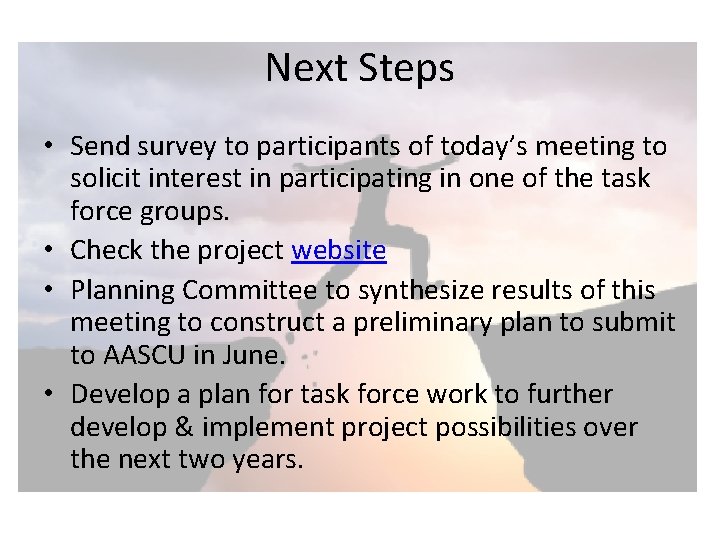
Next Steps • Send survey to participants of today’s meeting to solicit interest in participating in one of the task force groups. • Check the project website • Planning Committee to synthesize results of this meeting to construct a preliminary plan to submit to AASCU in June. • Develop a plan for task force work to further develop & implement project possibilities over the next two years.