
Reheating of the Universe after Inflation with f
- Slides: 22
Reheating of the Universe after Inflation with f( )R Gravity: Spontaneous Decay of Inflatons to Bosons, Fermions, and Gauge Bosons Eiichiro Komatsu & Yuki Watanabe University of Texas at Austin Caltech High Energy Physics Seminar, March 28, 2007 Reference: Phys. Rev. D 75, 061301(R) (2007)
Why Study Reheating? • The universe was left cold and empty after inflation. • But, we need a hot Big Bang cosmology. • The universe must reheat after inflation. Successful inflation must transfer energy in inflaton to radiation, and heat the universe to at least ~1 Me. V for successful nucleosynthesis. …however, little is known about this important epoch…. Outstanding Questions • Can one reheat universe successfully/naturally? • How much do we know about reheating? • What can we learn from observations (if possible at all)? • Can we use reheating to constrain inflationary models? • Can we use inflation to constrain reheating mechanism? 2/22
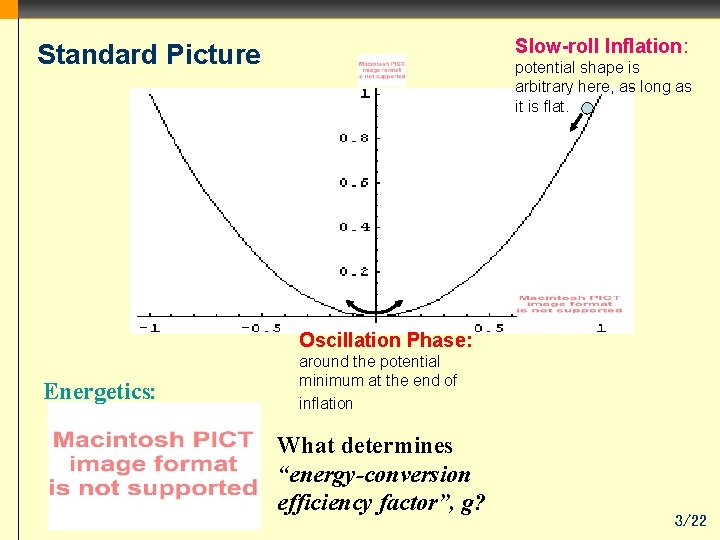
Slow-roll Inflation: Standard Picture potential shape is arbitrary here, as long as it is flat. Oscillation Phase: Energetics: around the potential minimum at the end of inflation What determines “energy-conversion efficiency factor”, g? 3/22
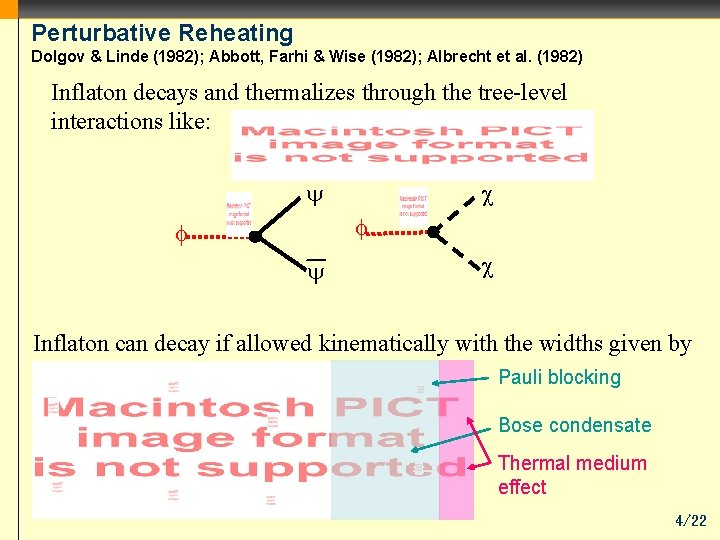
Perturbative Reheating Dolgov & Linde (1982); Abbott, Farhi & Wise (1982); Albrecht et al. (1982) Inflaton decays and thermalizes through the tree-level interactions like: c y y c Inflaton can decay if allowed kinematically with the widths given by Pauli blocking Bose condensate Thermal medium effect 4/22
Reheating Temperature from Energetics Coupling constants determine the decay width, But, what determines coupling constants? 5/22
Fine-tuning Problem? To relax fine-tuning, one needs: (a)High reheat temperature -> unwanted relics (e. g. , gravitinos), (b)Very low-scale inflation (H~10 -18 Mpl~10 Ge. V) -> worse fine-tuning, or (c)Natural explanation for the smallness of g. 6/22
What are coupling constants? Problem: arbitrariness of the nature of inflaton fields • Inflation works very well as a concept, but we do not understand the nature (including interaction properties) of inflaton. e. g. Higgs-like scalar fields, Axion-like fields, Flat directions, RH sneutrino, Moduli fields, Distances between branes, and many more… • Arbitrariness of inflaton = Arbitrariness of couplings • Can we say anything generic about reheating? Universal coupling? Gravitational coupling is universal -> however, too weak to cause reheating with GR. In the early universe, however, GR would be modified. What happens to “gravitational decay channel”, when GR is modified? 7/22
Conventional Einstein gravity during inflation Einstein-Hilbert term generates GR. Inflaton minimally couples to gravity. Conventionally one had to introduce explicit couplings between inflaton and matter fields by hand. 8/22
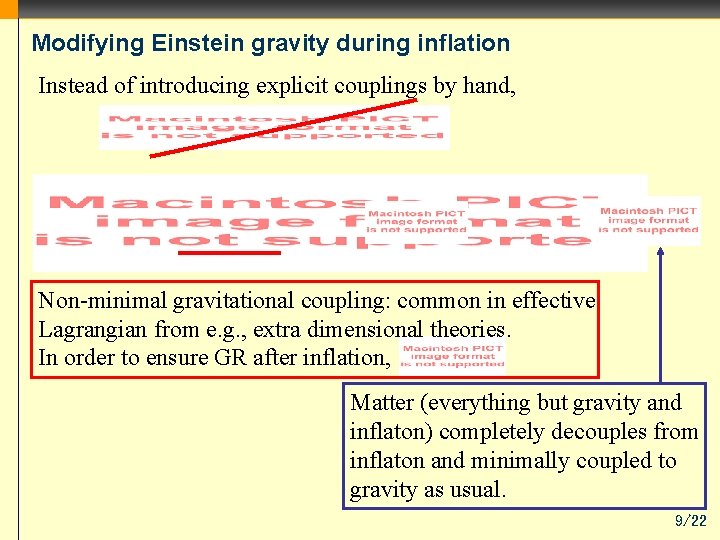
Modifying Einstein gravity during inflation Instead of introducing explicit couplings by hand, Non-minimal gravitational coupling: common in effective Lagrangian from e. g. , extra dimensional theories. In order to ensure GR after inflation, Matter (everything but gravity and inflaton) completely decouples from inflaton and minimally coupled to gravity as usual. 9/22
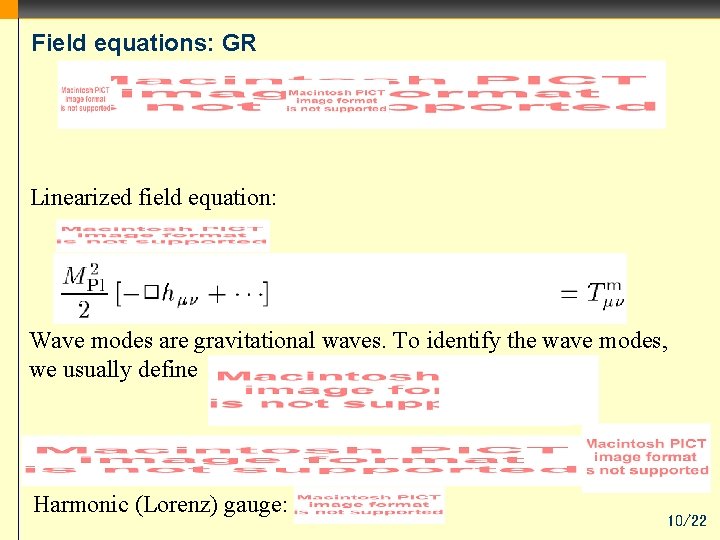
Field equations: GR Linearized field equation: Wave modes are gravitational waves. To identify the wave modes, we usually define Harmonic (Lorenz) gauge: 10/22
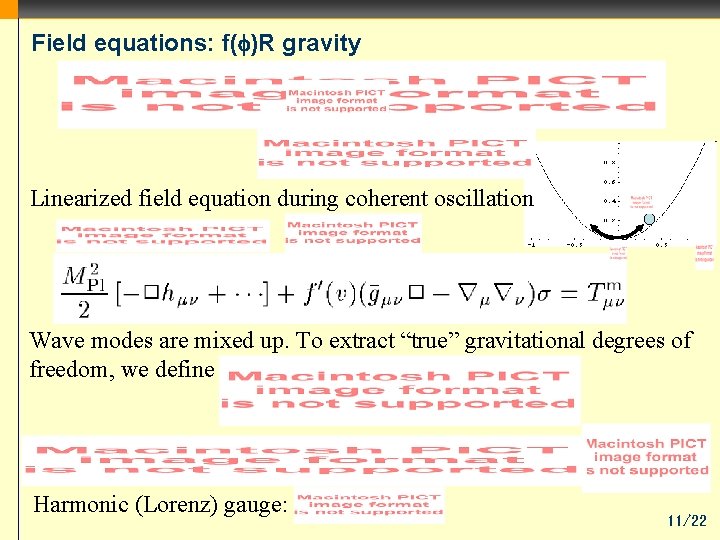
Field equations: f( )R gravity Linearized field equation during coherent oscillation Wave modes are mixed up. To extract “true” gravitational degrees of freedom, we define Harmonic (Lorenz) gauge: 11/22
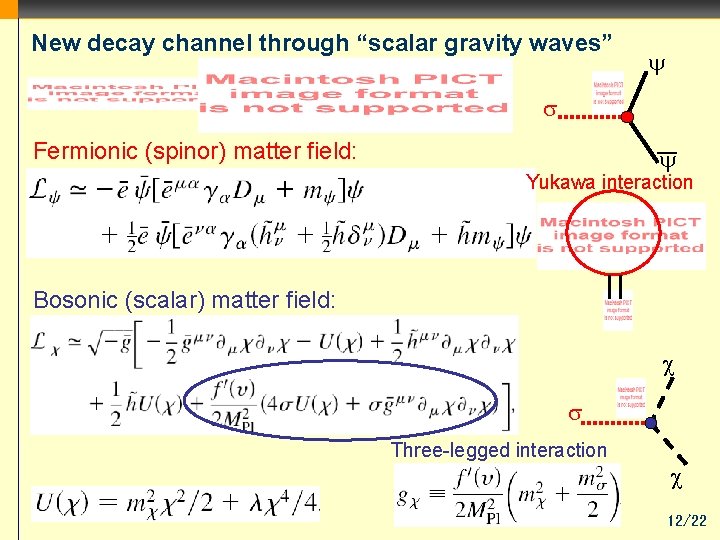
New decay channel through “scalar gravity waves” y s Fermionic (spinor) matter field: y Yukawa interaction Bosonic (scalar) matter field: c s Three-legged interaction c 12/22
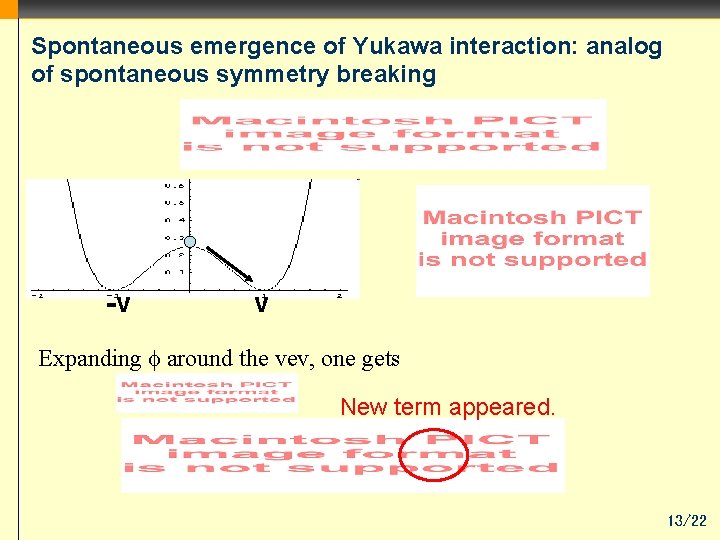
Spontaneous emergence of Yukawa interaction: analog of spontaneous symmetry breaking -v v Expanding around the vev, one gets New term appeared. 13/22
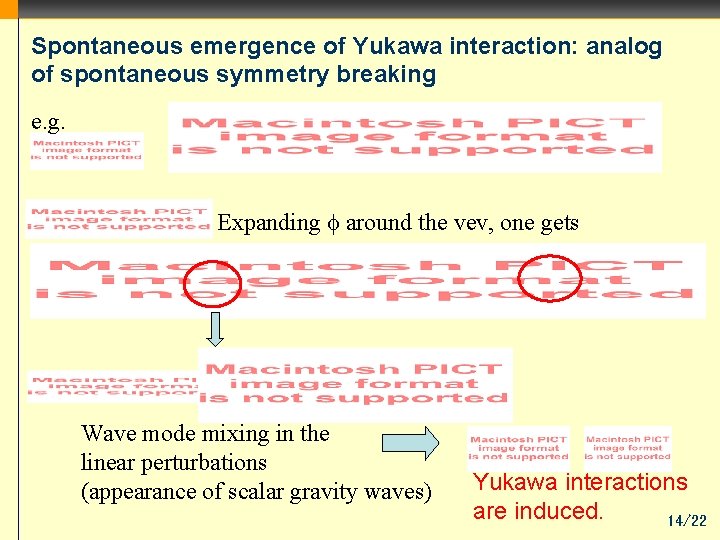
Spontaneous emergence of Yukawa interaction: analog of spontaneous symmetry breaking e. g. Expanding around the vev, one gets Wave mode mixing in the linear perturbations (appearance of scalar gravity waves) Yukawa interactions are induced. 14/22
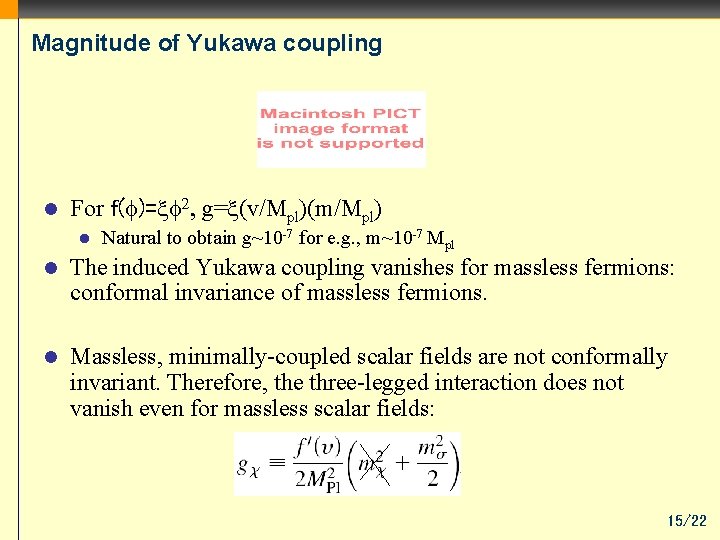
Magnitude of Yukawa coupling l For f( )= g= (v/Mpl)(m/Mpl) l Natural to obtain g~10 -7 for e. g. , m~10 -7 Mpl l The induced Yukawa coupling vanishes for massless fermions: conformal invariance of massless fermions. l Massless, minimally-coupled scalar fields are not conformally invariant. Therefore, the three-legged interaction does not vanish even for massless scalar fields: 15/22
The Results So Far… l Phys. Rev. D 75, 061301(R) (2007) After inflation with f( )R gravity, inflatons decay spontaneously into: Massive fermions, l Massive scalar bosons, or l Massless scalar bosons with non-conformal coupling. l The smallness of coupling can be explained naturally. l Inflaton decay is “built-in” and the coupling constrants can be calculated explicitly from a single function, f( ). l l l Rates of decay to fermions and bosons are related. This mechanism allows inflatons to decay into any fields that are not conformally coupled. l Other possibilities? 16/22
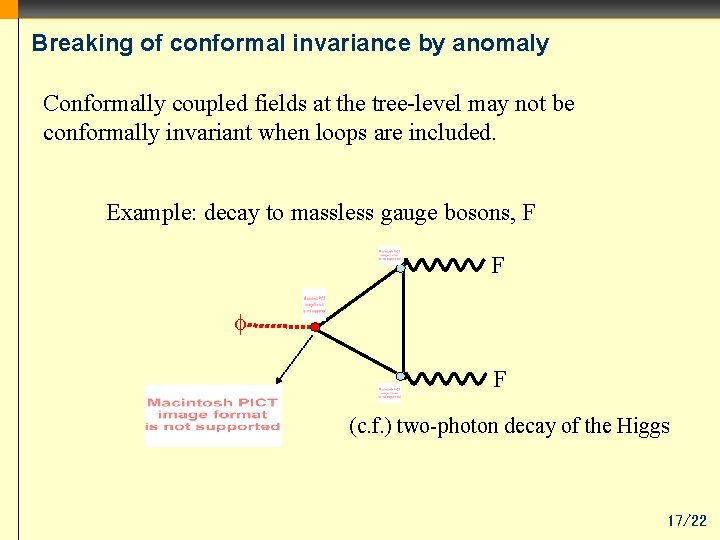
Breaking of conformal invariance by anomaly Conformally coupled fields at the tree-level may not be conformally invariant when loops are included. Example: decay to massless gauge bosons, F F F (c. f. ) two-photon decay of the Higgs 17/22
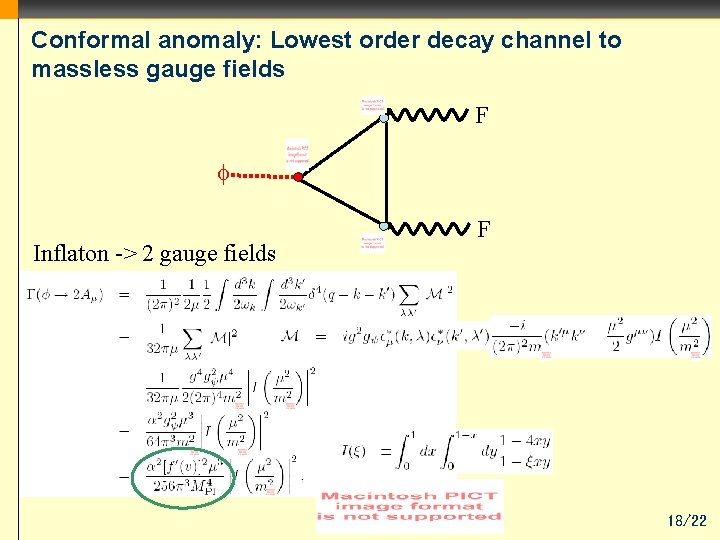
Conformal anomaly: Lowest order decay channel to massless gauge fields F Inflaton -> 2 gauge fields F 18/22
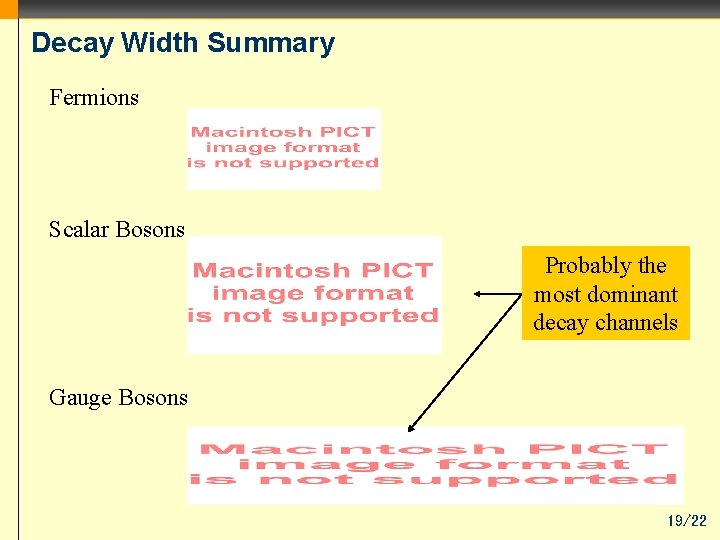
Decay Width Summary Fermions Scalar Bosons Probably the most dominant decay channels Gauge Bosons 19/22
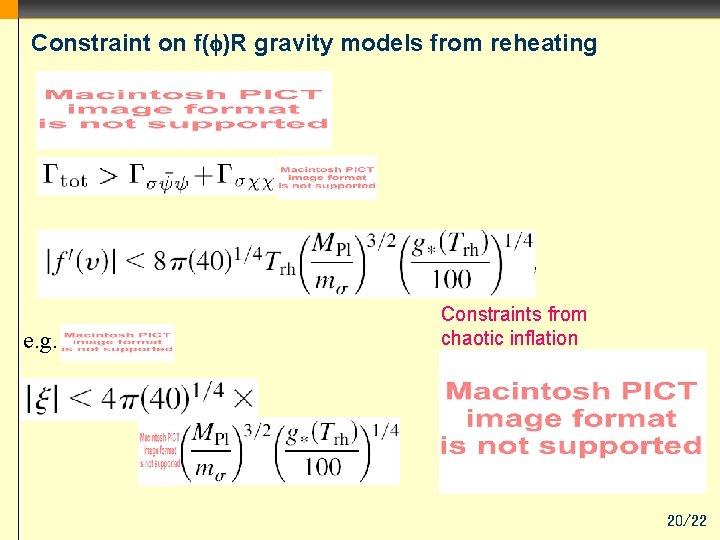
Constraint on f( )R gravity models from reheating e. g. Constraints from chaotic inflation 20/22
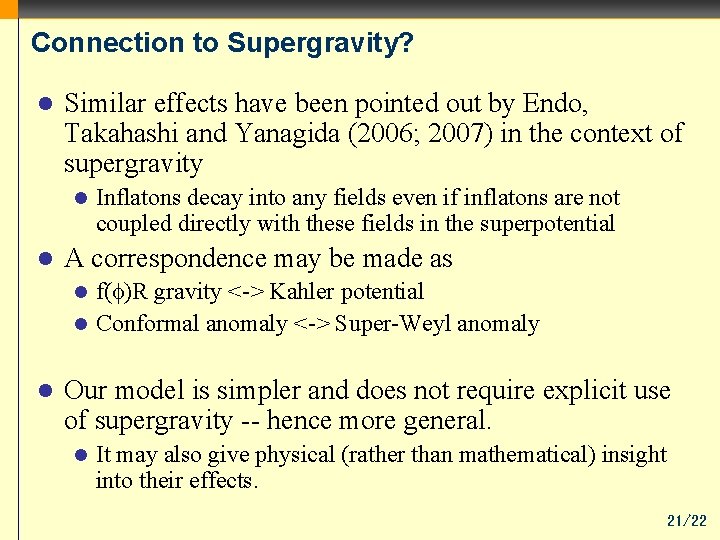
Connection to Supergravity? l Similar effects have been pointed out by Endo, Takahashi and Yanagida (2006; 2007) in the context of supergravity l l Inflatons decay into any fields even if inflatons are not coupled directly with these fields in the superpotential A correspondence may be made as f( )R gravity <-> Kahler potential l Conformal anomaly <-> Super-Weyl anomaly l l Our model is simpler and does not require explicit use of supergravity -- hence more general. l It may also give physical (rather than mathematical) insight into their effects. 21/22
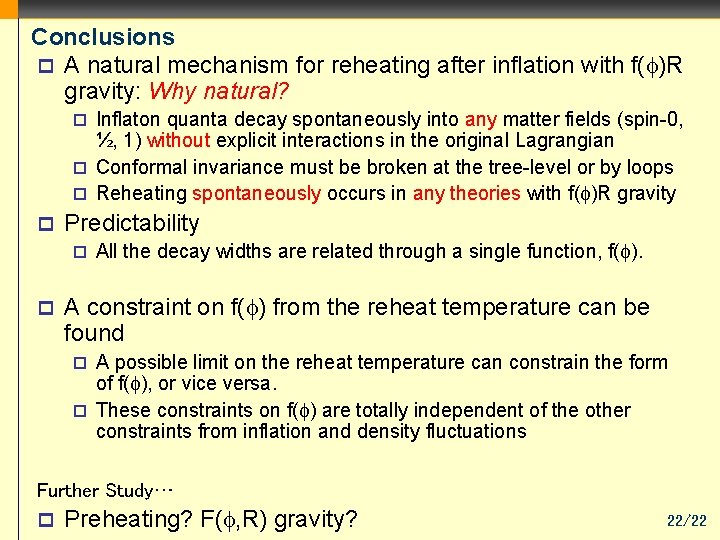
Conclusions p A natural mechanism for reheating after inflation with f( )R gravity: Why natural? Inflaton quanta decay spontaneously into any matter fields (spin-0, ½, 1) without explicit interactions in the original Lagrangian p Conformal invariance must be broken at the tree-level or by loops p Reheating spontaneously occurs in any theories with f( )R gravity p p Predictability p p All the decay widths are related through a single function, f( ). A constraint on f( ) from the reheat temperature can be found A possible limit on the reheat temperature can constrain the form of f( ), or vice versa. p These constraints on f( ) are totally independent of the other constraints from inflation and density fluctuations p Further Study… p Preheating? F( , R) gravity? 22/22