
Rehabilitation Sabino Sports Medicine I Developing a rehab
Rehabilitation Sabino Sports Medicine I
Developing a rehab program Assess the injury n Establish goals n Long term—return athlete to full activity n Short term n Execute program n Reassess as athlete progresses through program n
Format for rehab program n Phase I—time period immediately following injury/surgery during which movement in the affected part is either involuntarily limited because of pain, swelling, muscle spasm, etc, or purposely restricted by immobilization in casts, splints, slings, etc.
Phase I-therapeutic objectives Teach proper ambulation techniques n Assist the healing process using appropriate modalities n Minimize loss of muscular strength and slow muscle atrophy n Maintain overall level of physical fitness n
Criteria for progression to phase II Remove cast, splint, sling, etc. n Sufficient reduction of pain, swelling, inflammation to allow for use of safe and effective therapeutic exercise n Acceptable degree of tissue healing to allow use of therapeutic exercise without aggravating injury n
Phase II Period of time when more vigorous therapeutic exercise, including joint ROM, is started. n Using appropriate therapeutic modalities during the time will enhance the healing process and assist in facilitating the use of therapeutic exercise. n
Therapeutic Objectives Phase II n n n Establish weight bearing and restore normal gait patterns Restore joint ROM equal to the unaffected part Restore flexibility equal to or exceeding unaffected part Restore muscular strength & endurance equal to unaffected part and consistent with demands of sport involved Maintain acceptable level of physical fitness
Criteria to progress to Phase III n n n Acceptable reduction of local symptoms Acceptable level of healing of “wound” Adequate restoration of gait, ROM, flexibility, strength, endurance, power, & CV fitness to resume at least part of regular practice/conditioning Satisfactory assurance of adequate protection from reinjury Great level of motivation and confidence of athlete
Phase III n Period of time during which participation (in part or completely) of the normal practice and conditioning is resumed
Therapeutic Objectives Phase III n n Continue restoration of joint ROM, flexibility, muscular strength and endurance to safely resume full participation Continue to work on overall physical fitness Re-establish nornal pattern of motor activity—gait patterns, coordination agility, balance, proprioception—as they relate to the sport specific skills Restore athlete’s confidence in resuming full participation
Criteria to progress to Phase IV n n Restoration of all components of physical fitness Resuming full---complete and unrestricted--- participation
Phase IV n That period of time after which “complete” rehabilitation” is achieved and full activity is resumed.
Therapeutic Objectives Phase IV n n n Maintain muscular strength, endurance, power, and flexibility Maintain optimal CV fitness Maintain overall rehabilitated state
Assessing the injury n Use SOAP notes (systematic means of documenting the assessment and recording progress of rehab program
SOAP notes n S = Subjective n Patient history, symptoms, chief complaint n O = Objective n Signs, information from observation, palpation, stress tests n A = Assessment n Type and severity of injury, any associated problems n P = Plan n What will you do? Long & short term goals, what is working, how the athlete is progressing
Establish Goals n Short term goals n Control swelling using proper immediate first aid n PRICE n Reduce/minimize pain n PRICE, use of modalities such as ice, heat, e-stim n Restore full ROM n Dynamic, static, PNF stretching activities n Restore/increase muscular strength, endurance, power n Isometrics, isotonics, isokinetics, plyometrics through full, pain-free ROM
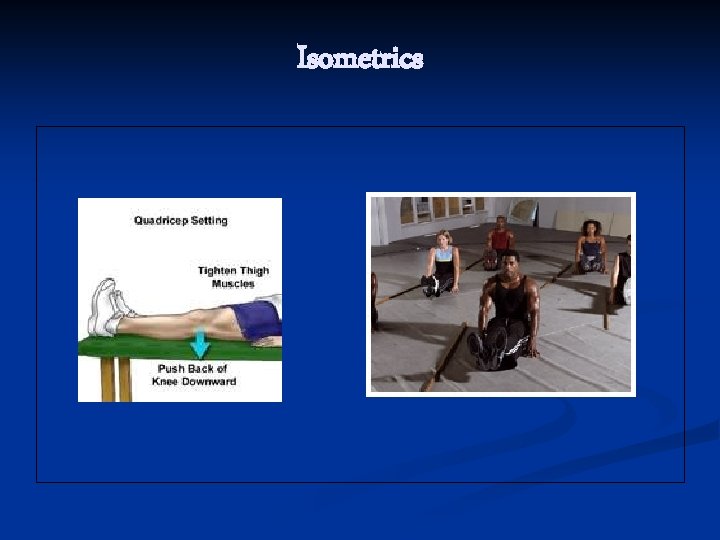
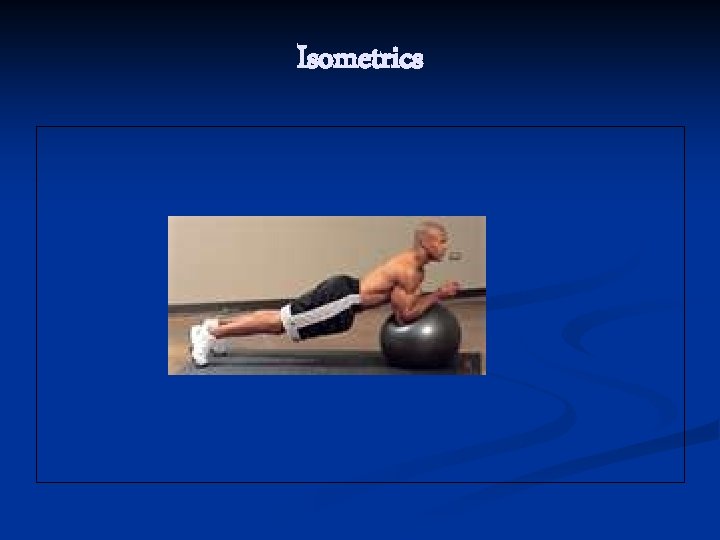
n Isometrics Performed early in rehab when joint is immobilized n Used when performing exercises through full ROM may be detrimental n Increase static strength n Assist in decreasing amount of atrophy n Lessen swelling by causing muscle pumping action n
Isometrics
Isometrics
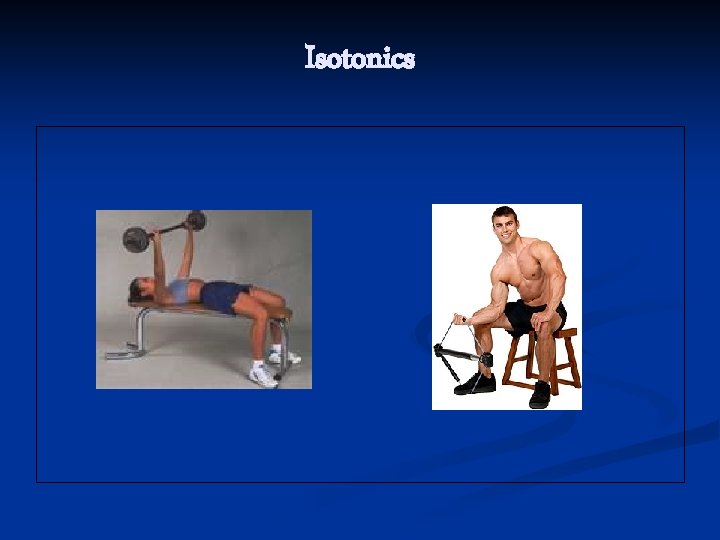
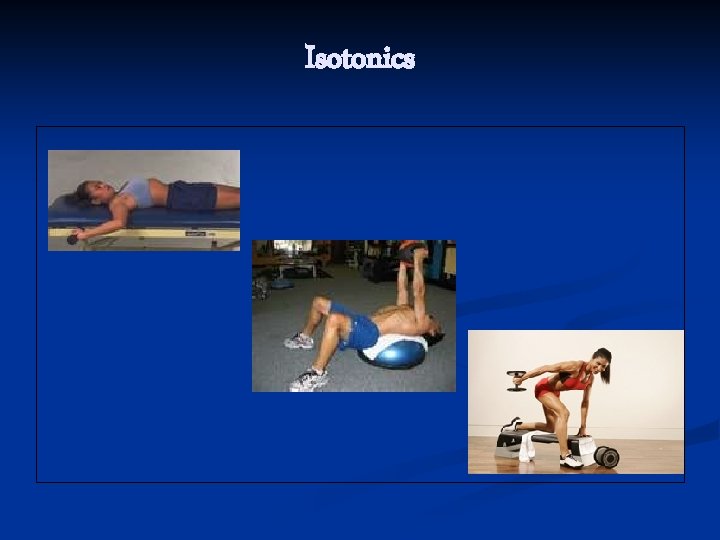
n Isotonics (progressive resistance exercises or PRE’s) Most commonly used strengthening technique n Use free weights, exercise machines, tubing, bands, etc. , with fixed weight through ROM n Use isotonic muscle contractions n n Force is generated while the muscle is changing length n Use eccentric (lengthening) and concentric (shortening) muscle contractions
Isotonics
Isotonics
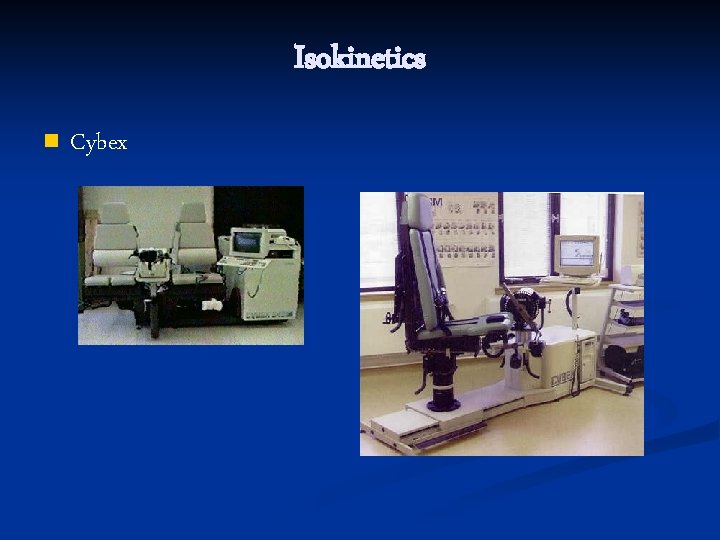
n Isokinetics Occasionally used in rehab n Incorporated in later phases of rehab n Used primarily for diagnostic purposes n Uses a fixed speed with accommodating resistance to provide maximal resistance throughout ROM n Measures commonly used as criteria for return to functional activity n
Isokinetics n Cybex
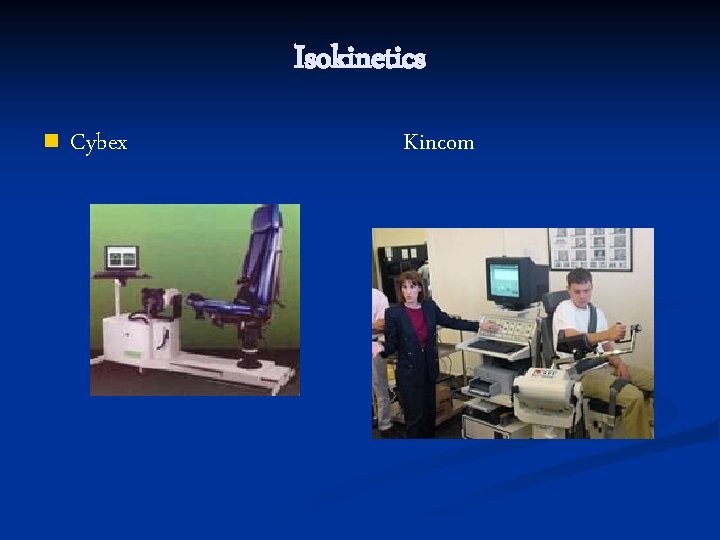
Isokinetics n Cybex Kincom
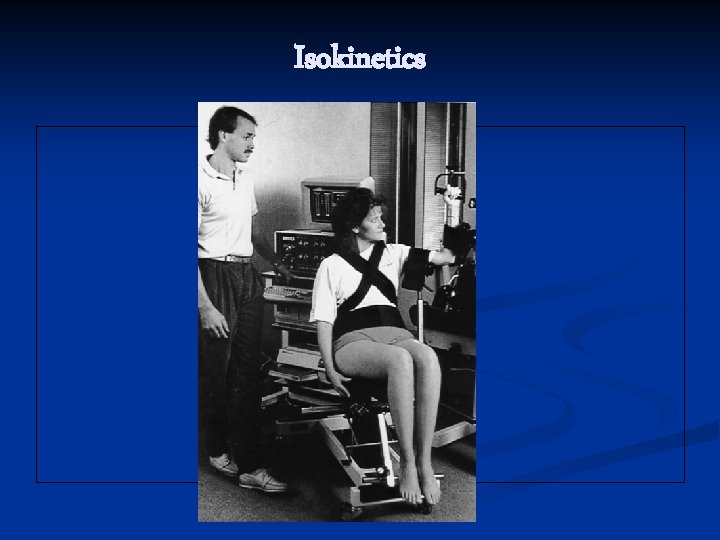
Isokinetics
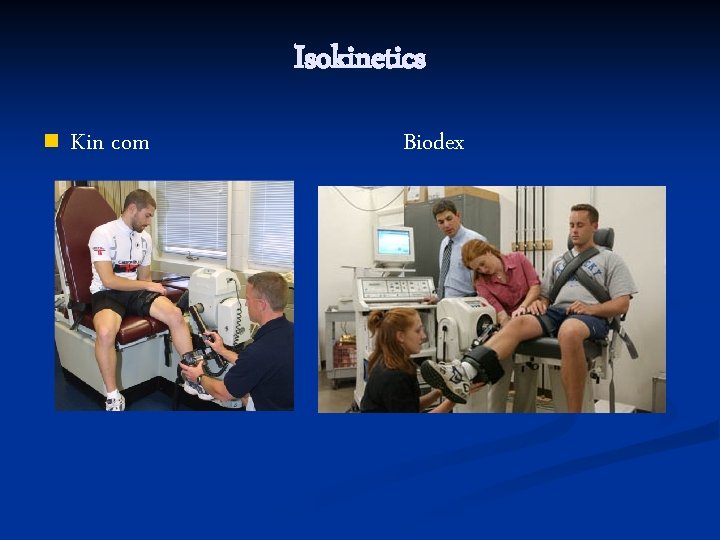
Isokinetics n Kin com Biodex
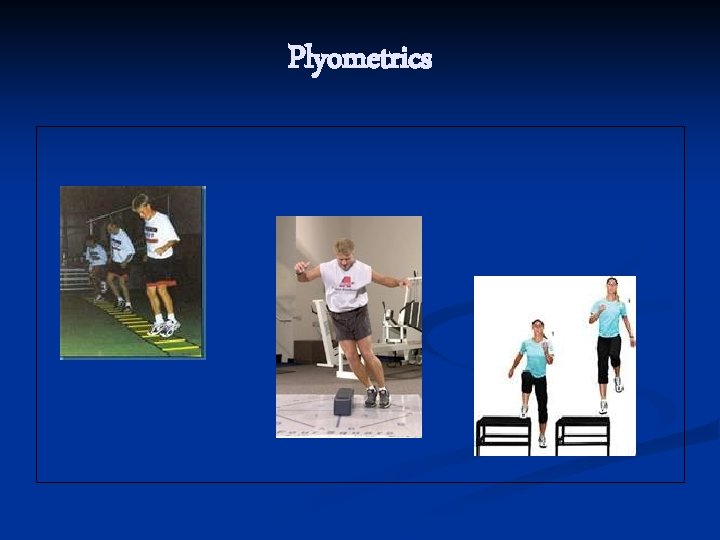
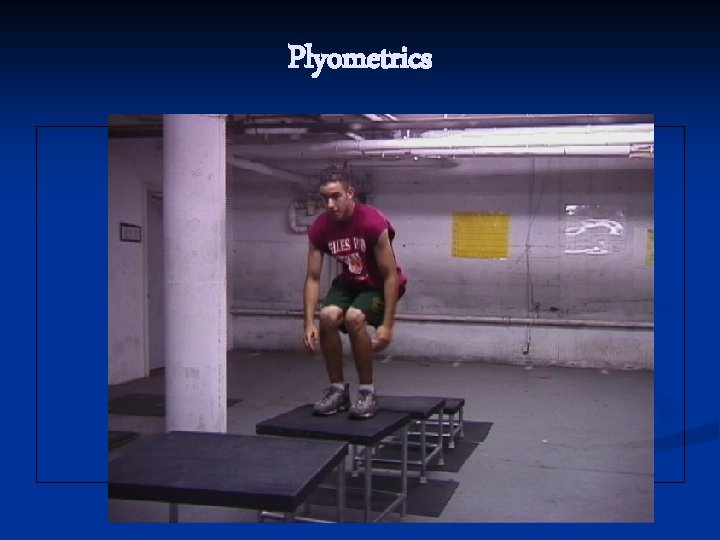
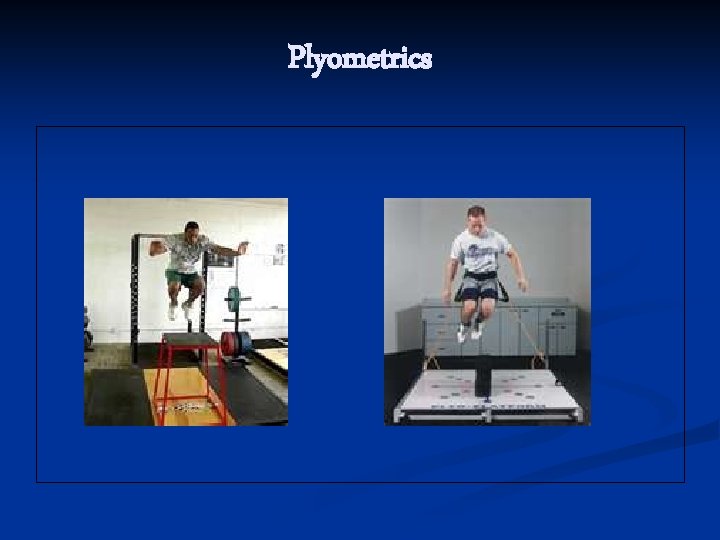
n Plyometrics Incorporated in later stages of rehab n Use a quick stretch of muscle to facilitate a subsequent concentric muscle contraction n Useful in restoring/developing athlete's ability to produce dynamic movements associated with muscular power n Ability to generate force rapidly is key to successful performance in many sports n
Plyometrics
Plyometrics
Plyometrics
Short term goals n Reestablish neuromuscular control n Mind’s attempt to teach the body conscious control of specific movements— using strengthening exercises that are more functional n Improve balance n Balance training and postural n stability Maintain cardiorespiratory fitness n Single most neglected component, use pool, bike, upper body ergometer, stairclimber, elliptical trainer, etc.
n Incorporate appropriate functional progressions n n Involve series of gradually progressive activities designed to prepare athlete for return to participation Monitor activity to determine athlete’s ability to perform and physical tolerance Advance the activity as long as there is not any swelling or additional pain Use position specific drills and activities n Walking, jogging on track-walk curves, jogging full track, running on track—jog curves, running full track, running 2 -3 miles 3 x week, lunges— 90 degree pivot, 180 degree pivot, sprints—”W”, Triangle, 20 yd, 40 yd, 120 yd, acceleration/deceleration runs, shuffle runs, carioca
Modalities Those things you can use to assist/enhance the healing of injuries 3 categories Thermal-used to move heat into or out of the body-----heat & cold Mechanical---ultrasound, massage, traction, intermittent compression Electrical—muscle stimulation
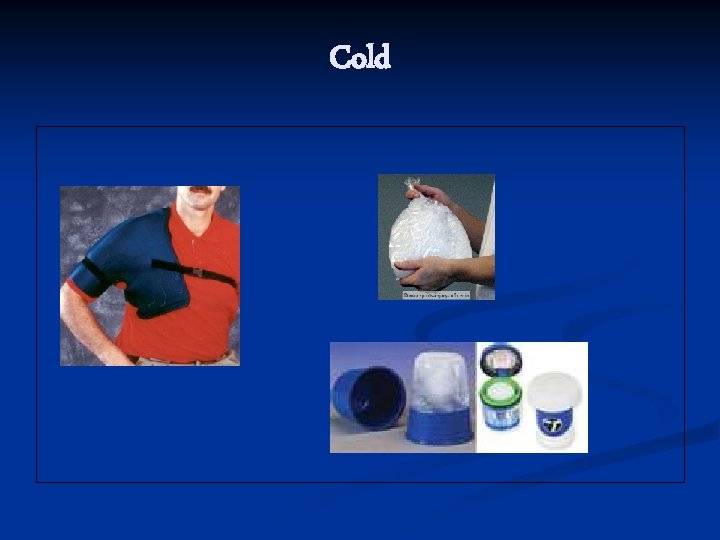
Cold n Types of cold use Ice pack (15 -20 minutes) n Ice massage (5 -15 minutes) n Cold whirlpool (15 -20 minutes) n Slush bucket (15 -20 minutes) n Cryokinetics (10 -15 minutes) n Chemical cold packs (15 minutes? ? ? Watch for chemical burns) n
Cold
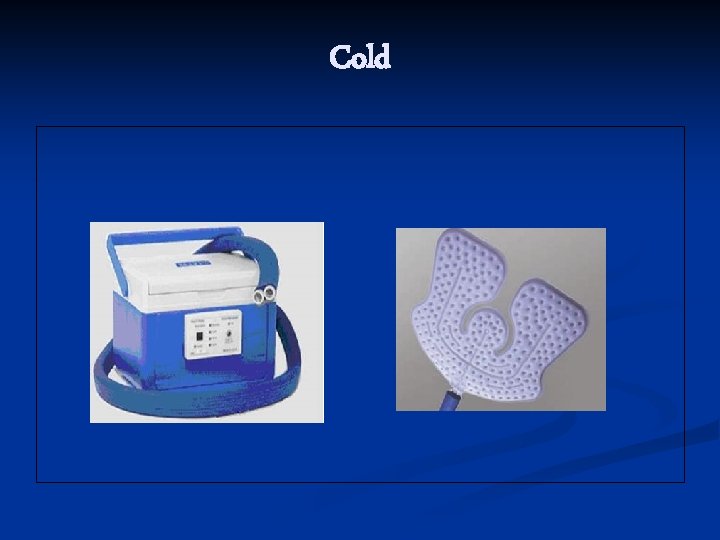
Cold
Cold n Physiological effects Decrease tissue temperature n Decrease blood flow n Decrease inflammation n Decrease pain---analgesic n Decrease muscle spasm n Increase muscle tone n
Cold n Indications for use Acute injuries n Pain n Swelling n Inflammation n Preparing for exercise n
Cold n Contraindications for use Open wounds n Cold related allergy n Areas with sensory or circulatory deficits n
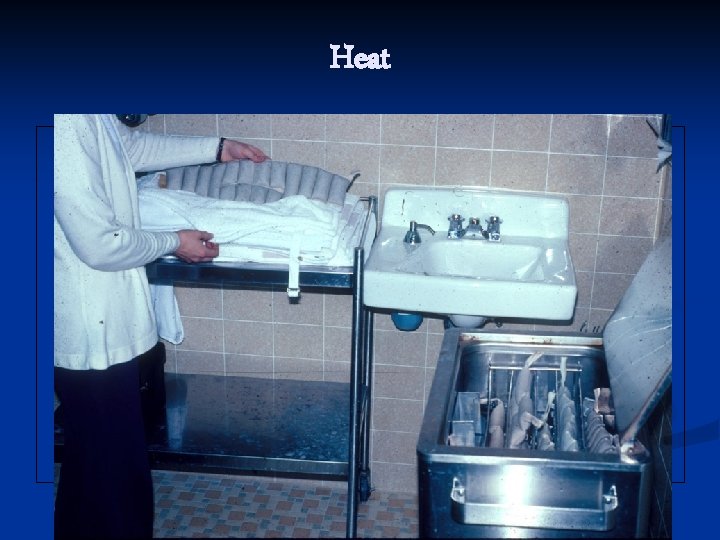
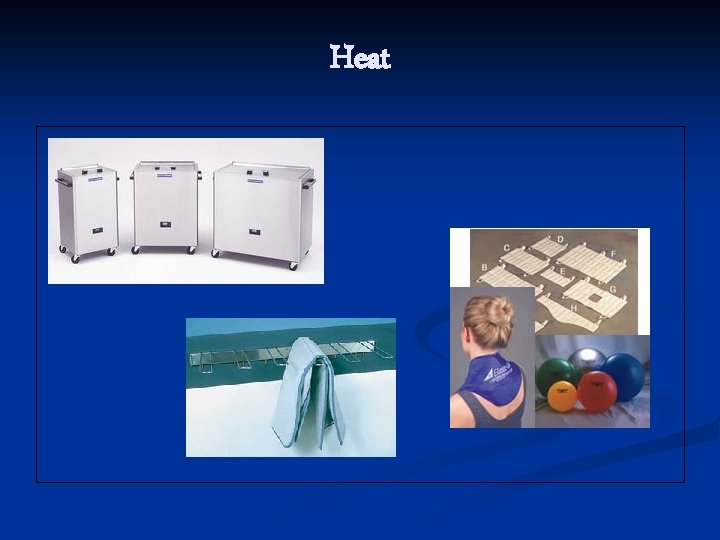
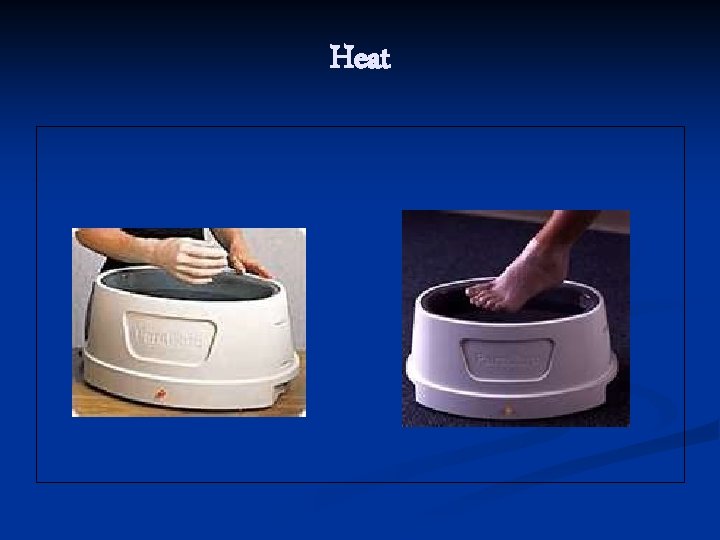
Heat n Types of heat modalities Hydrocollator pack (moist heat) (10 -15 minutes) n Electrical heat pack (15 -20 minutes) n Warm whirl pool (10 -15 minutes) n Paraffin bath (dip several times--10 -15 minutes) n
Heat
Heat
Heat
Heat n Physiological effects Increase tissue temperature n Increase blood flow n Increase tissue extensibility n Increase ROM n Decrease swelling n Decrease muscle tone n
Heat n Indications for use Chronic inflammatory conditions n Tight tissue—connective, muscle, tendon , ligament n Chronic pain n Chronic muscle spasm n
Heat n Contraindications for use Acute injuries n Areas with sensory deficits n
Ultrasound n Thermal or non-thermal modality that stimulates blood flow n n Continuous or pulsed Sound waves pass through pizoelectric crystal in sound head to create mechanical energy Mechanical energy cause vibration of tissue cells which create heat Heat can reach depth of 3 -5 centimeters
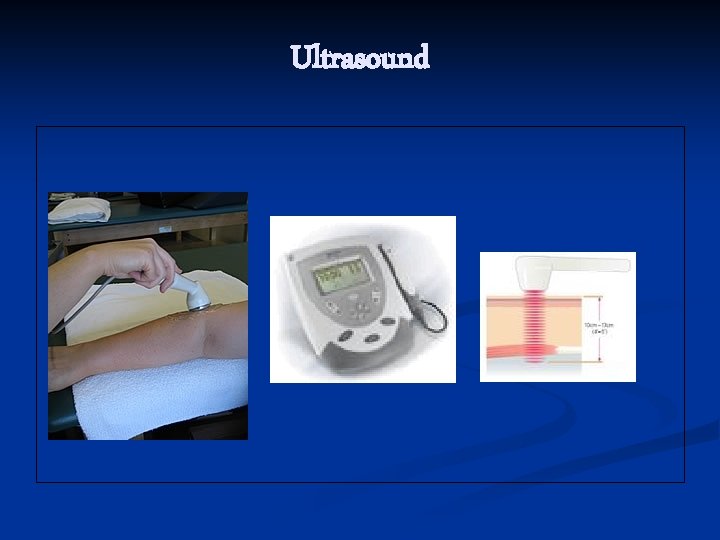
Ultrasound
Ultrasound n Application n Must use a coupling agent n Conductive gel, lotion, water Keep sound head moving with even pressure over the area being treated n Area shouldn’t be larger than 3 -4 inches n Treatment time 3 -8 minutes n
Ultrasound n Indications for use Chronic injuries n Acute injuries (non-thermal setting) n Strains n Sprains n Tendonitis n Contusions n Tight tissue n
ultrasound n Contraindications for use Heart, eyes, ears, brain, spinal cord, genitals n Epiphyseal plates n Acute injuries n Areas with poor circulation n Stress fractures n Open wounds n Infected areas n Tumors n
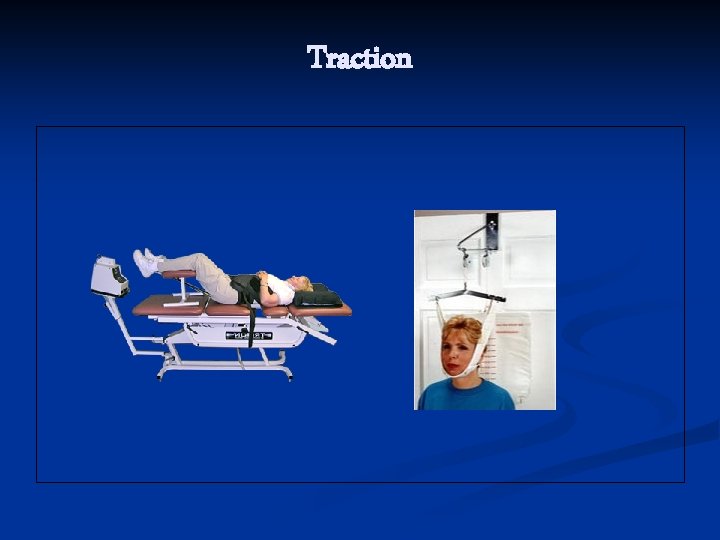
Traction Pulling force that deliberately separates joints of the body that have been compressed together or are stiff n Commonly used at cervical or lumbar area n Can be done mechanically or manually n Separates bones n Puts gentle stretch on area n
Traction
Traction n Indications for use Disc herniation/protrusion n Degenerative disc disease n Degenerative joint disease n Soft tissue compression n Nerve root compression n Muscle spasm n
Traction n Contraindications for use Osteoporosis n Fractured vertebrae n Spinal hypermobility n Infections of spine n
Massage Intentional & methodical kneading and stroking of soft tissue n Increases circulation n Decreases muscle spasm n Relieves swelling (move towards heart) n
n Strokes n Massage Effleurage n Stroke w/ palm of hand n Petrissage n Kneading tissue by squeezing between hands/fingers n Tapotment (percussion) n Light chopping motion with hands n Vibration n Tissue shakes vigorously n Friction n Deep pressure/movement of hand or fingers used to break up scar tissue or relieve spasm/tight tissue
Massage n Indications for use Promotes relaxation n Muscle spasm n Pain n Soft tissue stiffness n
Massage n Contraindications for use Non-union fracture n Open wounds n Acute injuries n Dermatological conditions n
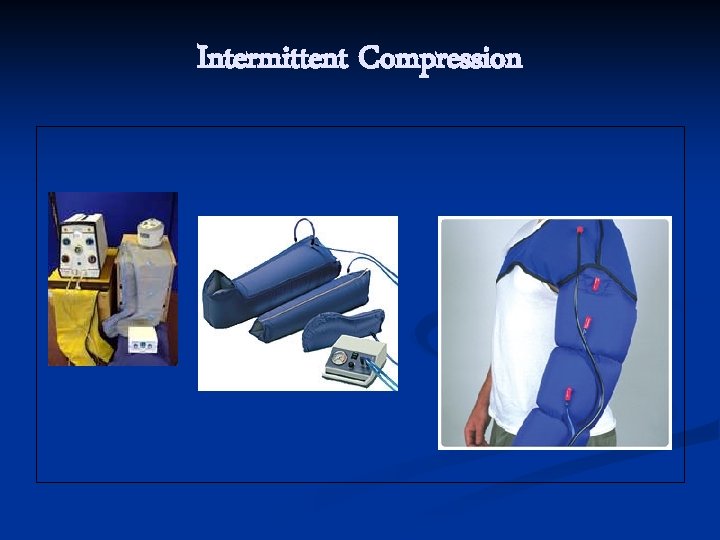
Intermittent compression Compression that is on and off—usually about 30 -45 seconds on and 15 seconds off n Treatment time is 15 minutes – 1 hour n Helps venous blood flow from extremity n
Intermittent Compression
Intermittent compression n Indications Post acute edema n Lymphedema n Chronic swelling/edema n
Intermittent Compression n Contraindications for use Acute injuries n Possible fracture n Compartment syndromes n
Electrical Muscle Stimulation The application of electrical current to the surface of the skin n Types n Galvanic stimulation n TENS n Interferential n Combo (US & e-stim) n
Galvanic Stim n Used for treatment of Contusions n Sprains n Strains n Acute edema n Muscle re-education n
Galvanic stim Physiological response of body depends on the polarity of the current n Negative current: vasoconstriction, hardens tissues, local analgesic, decreases nerve excitability n Positive current: vasodilatation, softens tissue, increases nerve excitability, increases venous and lymphatic return n
Galvanic stim Place electrodes so pain is “between” the pads n Place electrodes at either end of the muscle being treated n Can be used in conjunction with heat or cold n Treatment time is 10 -20 minutes n
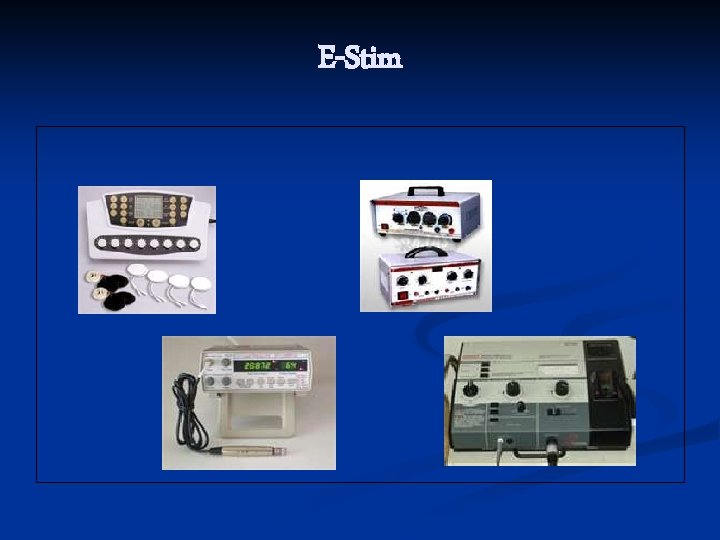
E-Stim
Interferential Stimulation Uses interfering electrical currents to regulate blood flow, reduce pain, decrease edema, relieve muscle spasm, strengthen muscle tissue n Used to treat: contusions, sprains, strains, etc. n Should feel slight vibration n
Inferential Uses 4 electrodes set at a diagonal pattern n Covers “larger” area n Electrical currents “interfere” with each other to create a bigger surface areas n Can be used with heat or cold n Treatment time is 10 -20 minutes n
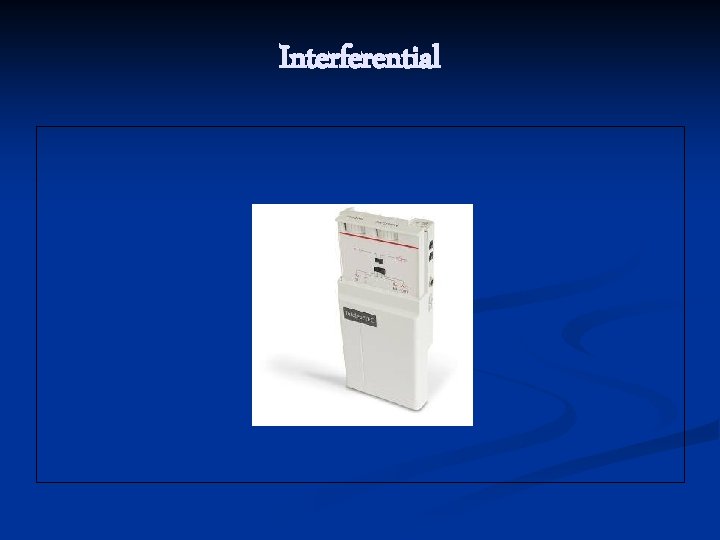
Interferential
TENS (transcutaneous electrical muscle stimulation) Used primarily for pain control n Electrodes are placed on skin over painful area to “block” the sensation of chronic or acute pain n Cause a muscle contraction n Used for 30 minutes to 1 hour treatment time n Can be used so patient can exercise without pain n
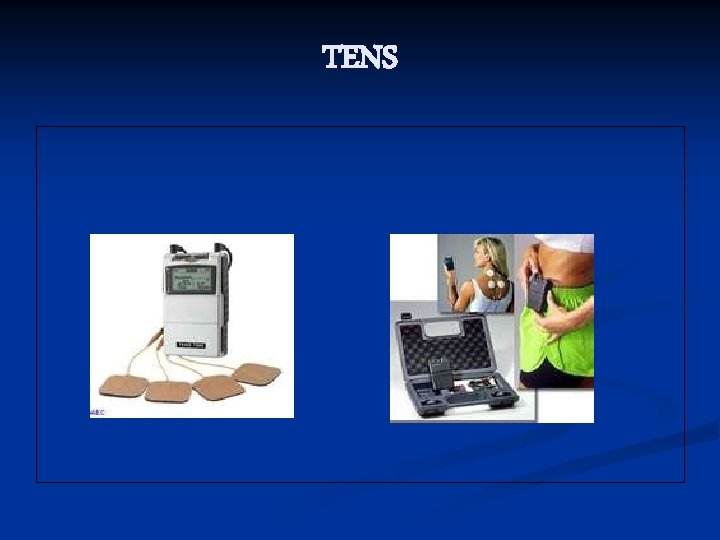
TENS
Ultrasound/muscle stim combo US combined with muscle stim n Electricity comes through the US head n Combine deep heating with benefits of muscle contraction n Used for treating strains, muscle spasms, trigger points, tight muscles n Treatment time is 5 -15 minutes n
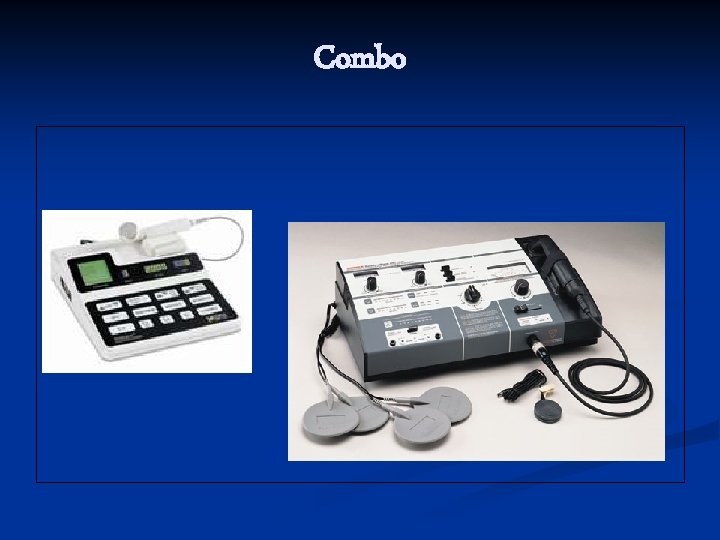
Combo
- Slides: 76