
Rehabilitation Research at the NSF Wendy Nilsen Ph
Rehabilitation Research at the NSF Wendy Nilsen, Ph. D Program Director, Smart and Connected Health
Background NSF • Rehabilitation research can be found in many areas in NSF and within the mission of several cross-directorate initiatives • It is a case of use-inspired basic research. The scientific advances in basic science can be in computing, information science, engineering or social or behavioral science. The benefit to rehabilitation research is important, but second to the advances in basic science. • Three major homes for this research: • Smart and Connected Health • Cyber-physical Systems • National Robotics Initiative
Smart & Connected Health (SCH) Inter-Agency Program National Science Foundation National Institutes of Health NSF Solicitation NSF 13 -543 Wendy Nilsen, Ph. D Program Director, Smart and Connected Health Computer and Information Sciences and Engineering, NSF 3
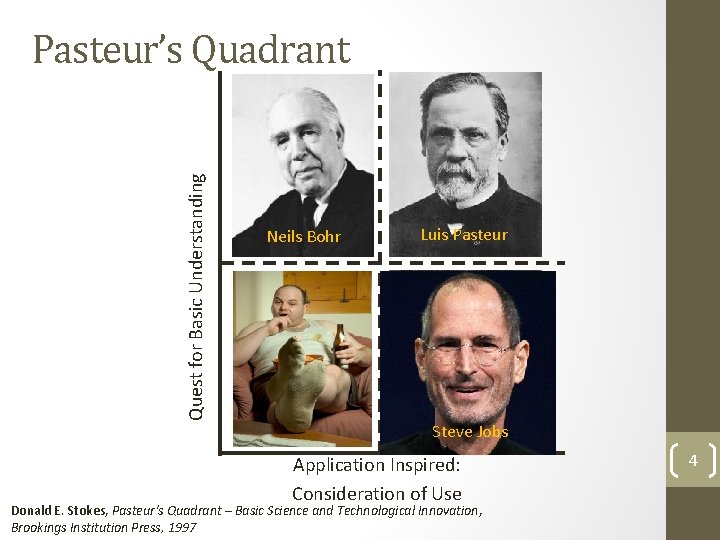
Quest for Basic Understanding Pasteur’s Quadrant Neils Bohr Luis Pasteur Steve. Edison Jobs Thomas Application Inspired: Consideration of Use Donald E. Stokes, Pasteur's Quadrant – Basic Science and Technological Innovation, Brookings Institution Press, 1997 4
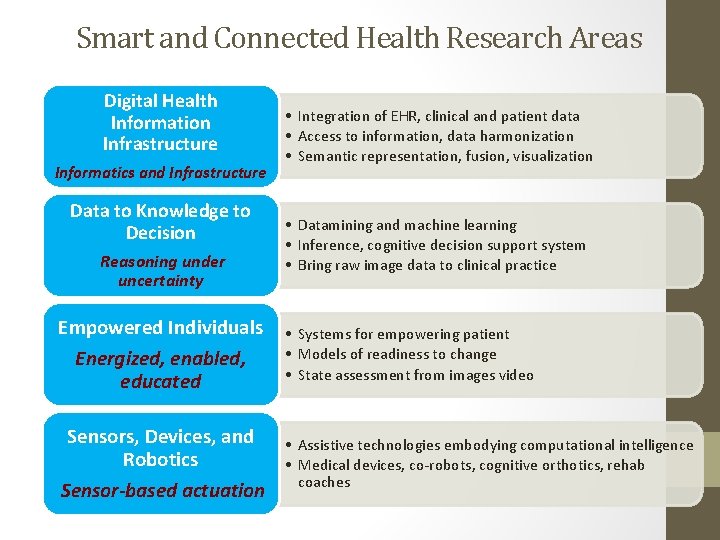
Smart and Connected Health Research Areas Digital Health Information Infrastructure Informatics and Infrastructure Data to Knowledge to Decision Reasoning under uncertainty • Integration of EHR, clinical and patient data • Access to information, data harmonization • Semantic representation, fusion, visualization • Datamining and machine learning • Inference, cognitive decision support system • Bring raw image data to clinical practice Empowered Individuals Energized, enabled, educated • Systems for empowering patient • Models of readiness to change • State assessment from images video Sensors, Devices, and Robotics Sensor-based actuation • Assistive technologies embodying computational intelligence • Medical devices, co-robots, cognitive orthotics, rehab coaches
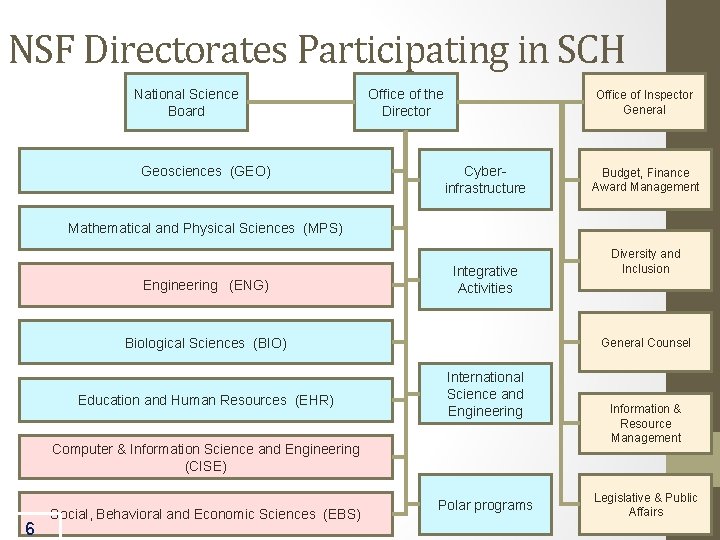
NSF Directorates Participating in SCH National Science Board Geosciences (GEO) Office of the Director Office of Inspector General Cyberinfrastructure Budget, Finance Award Management Mathematical and Physical Sciences (MPS) Engineering (ENG) Integrative Activities Biological Sciences (BIO) Education and Human Resources (EHR) General Counsel International Science and Engineering Computer & Information Science and Engineering (CISE) 6 Social, Behavioral and Economic Sciences (EBS) Diversity and Inclusion Polar programs Information & Resource Management Legislative & Public Affairs
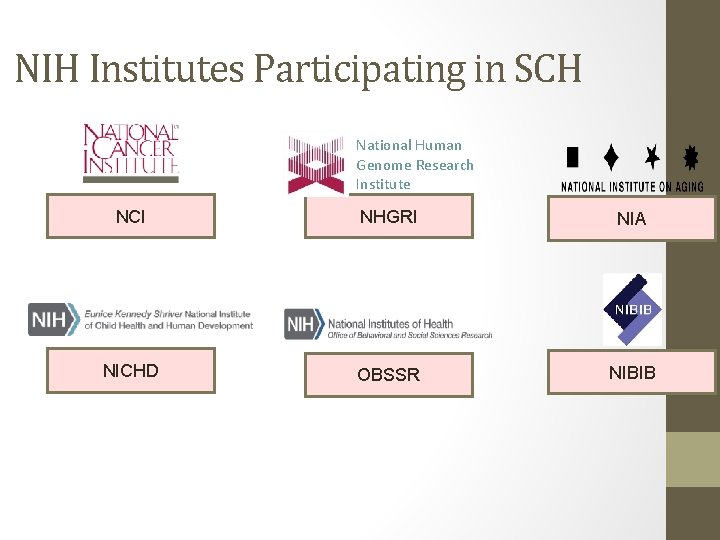
NIH Institutes Participating in SCH National Human Genome Research Institute NCI NHGRI NIA NICHD OBSSR NIBIB
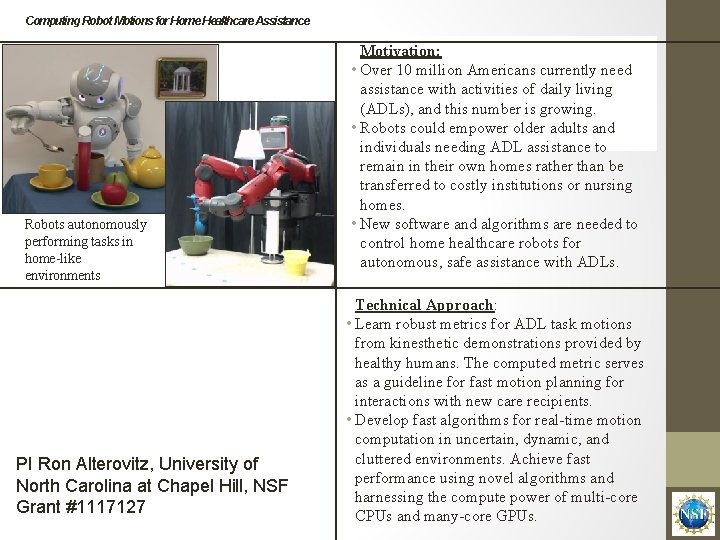
Computing Robot Motions for Home Healthcare Assistance Robots autonomously performing tasks in home like environments PI Ron Alterovitz, University of North Carolina at Chapel Hill, NSF Grant #1117127 Motivation: • Over 10 million Americans currently need assistance with activities of daily living (ADLs), and this number is growing. • Robots could empower older adults and individuals needing ADL assistance to remain in their own homes rather than be transferred to costly institutions or nursing homes. • New software and algorithms are needed to control home healthcare robots for autonomous, safe assistance with ADLs. Technical Approach: • Learn robust metrics for ADL task motions from kinesthetic demonstrations provided by healthy humans. The computed metric serves as a guideline for fast motion planning for interactions with new care recipients. • Develop fast algorithms for real time motion computation in uncertain, dynamic, and cluttered environments. Achieve fast performance using novel algorithms and harnessing the compute power of multi core CPUs and many core GPUs.
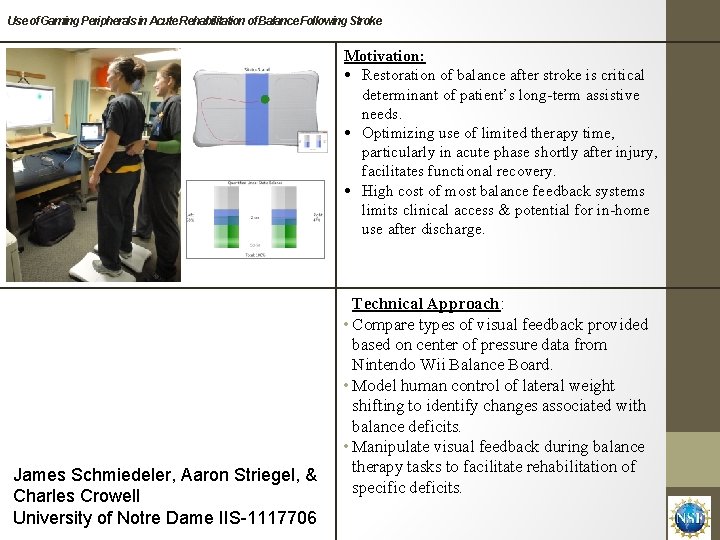
Use of Gaming Peripherals in Acute Rehabilitation of Balance Following Stroke Motivation: Restoration of balance after stroke is critical determinant of patient’s long term assistive needs. Optimizing use of limited therapy time, particularly in acute phase shortly after injury, facilitates functional recovery. High cost of most balance feedback systems limits clinical access & potential for in home use after discharge. James Schmiedeler, Aaron Striegel, & Charles Crowell University of Notre Dame IIS-1117706 Technical Approach: • Compare types of visual feedback provided based on center of pressure data from Nintendo Wii Balance Board. • Model human control of lateral weight shifting to identify changes associated with balance deficits. • Manipulate visual feedback during balance therapy tasks to facilitate rehabilitation of specific deficits.
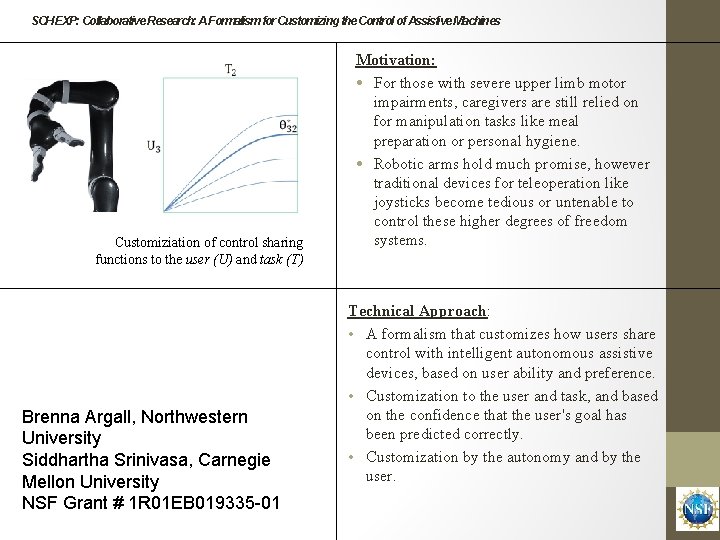
SCH EXP: Collaborative Research: A Formalism for Customizing the Control of Assistive Machines Customiziation of control sharing functions to the user (U) and task (T) Brenna Argall, Northwestern University Siddhartha Srinivasa, Carnegie Mellon University NSF Grant # 1 R 01 EB 019335 -01 Motivation: For those with severe upper limb motor impairments, caregivers are still relied on for manipulation tasks like meal preparation or personal hygiene. Robotic arms hold much promise, however traditional devices for teleoperation like joysticks become tedious or untenable to control these higher degrees of freedom systems. Technical Approach: • A formalism that customizes how users share control with intelligent autonomous assistive devices, based on user ability and preference. • Customization to the user and task, and based on the confidence that the user's goal has been predicted correctly. • Customization by the autonomy and by the user.
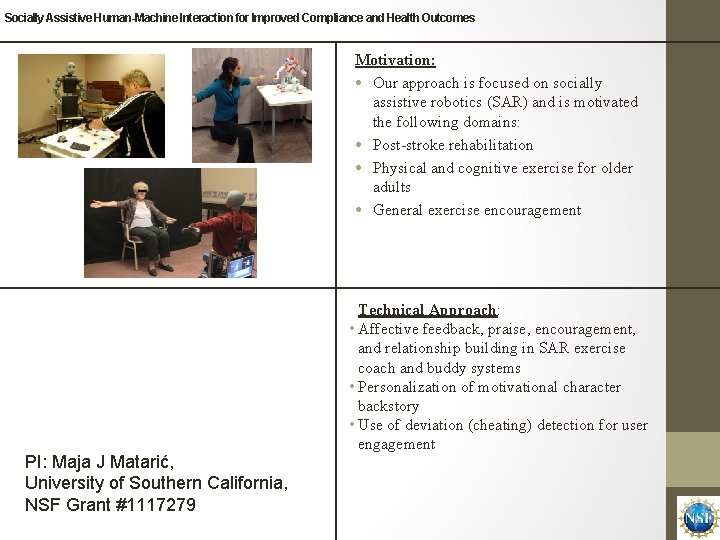
Socially Assistive Human-Machine Interaction for Improved Compliance and Health Outcomes Motivation: Our approach is focused on socially assistive robotics (SAR) and is motivated the following domains: Post stroke rehabilitation Physical and cognitive exercise for older adults General exercise encouragement PI: Maja J Matarić, University of Southern California, NSF Grant #1117279 Technical Approach: • Affective feedback, praise, encouragement, and relationship building in SAR exercise coach and buddy systems • Personalization of motivational character backstory • Use of deviation (cheating) detection for user engagement
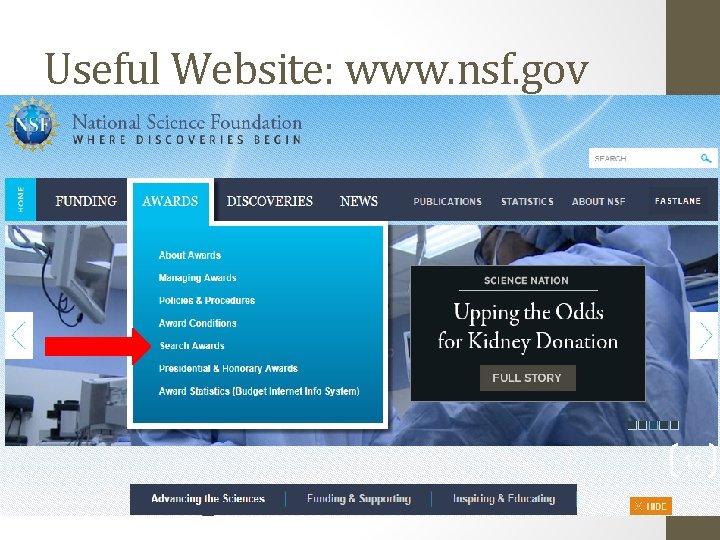
Useful Website: www. nsf. gov 12
“You miss 100% of the shots you never take. ” Wayne Gretzky
Thank you! • Wendy Nilsen • wnilsen@nsf. gov
- Slides: 14