
Rehabilitation Following an Adult Posterior Radial Subluxation with
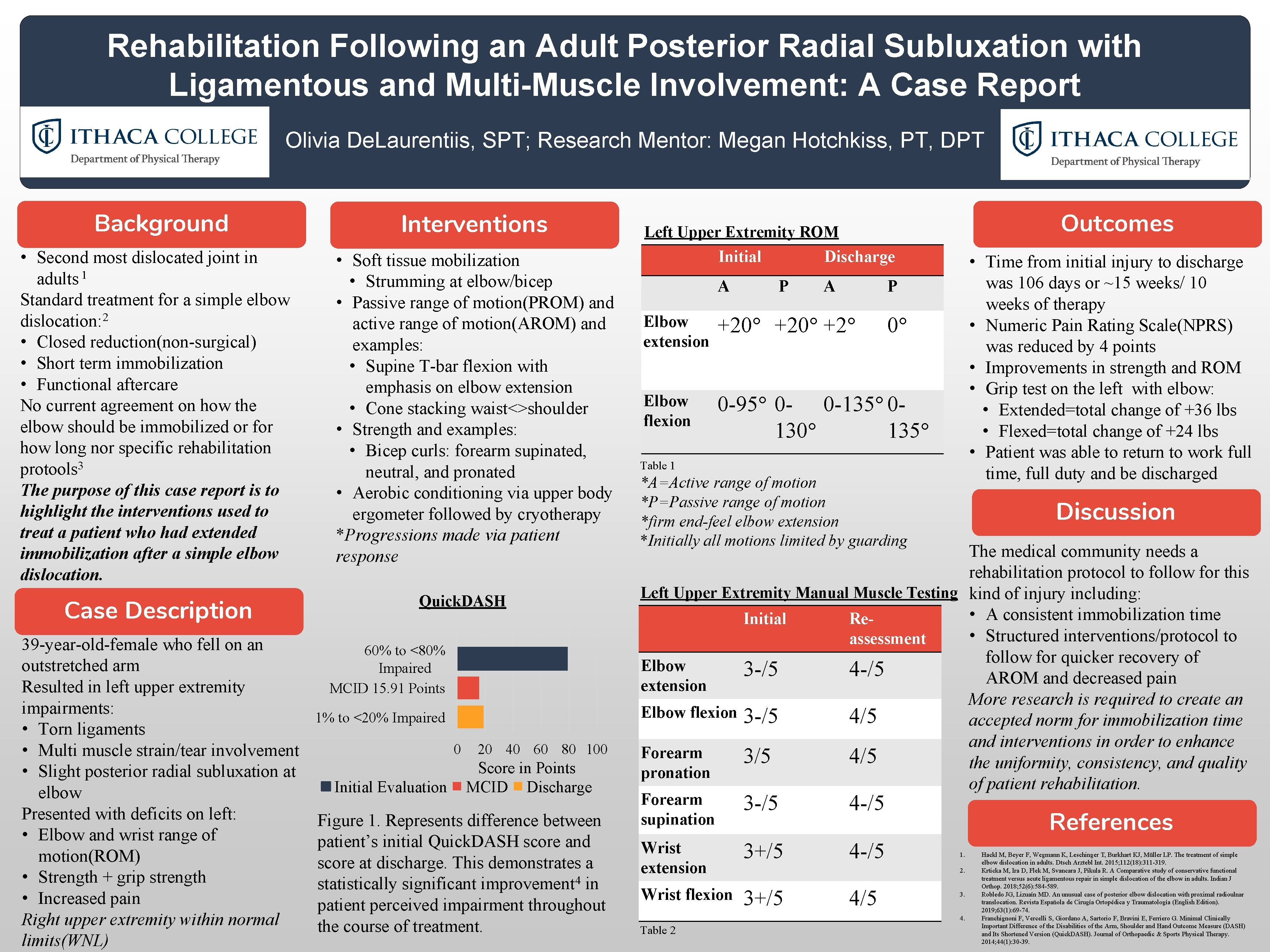
Rehabilitation Following an Adult Posterior Radial Subluxation with Ligamentous and Multi-Muscle 3 Involvement: A Case Report Olivia De. Laurentiis, SPT; Research Mentor: Megan Hotchkiss, PT, DPT Background • Second most dislocated joint in 1 adults Standard treatment for a simple elbow 2 dislocation: • Closed reduction(non-surgical) • Short term immobilization • Functional aftercare No current agreement on how the elbow should be immobilized or for how long nor specific rehabilitation 3 protools The purpose of this case report is to highlight the interventions used to treat a patient who had extended immobilization after a simple elbow dislocation. Case Description Interventions • Soft tissue mobilization • Strumming at elbow/bicep • Passive range of motion(PROM) and active range of motion(AROM) and examples: • Supine T-bar flexion with emphasis on elbow extension • Cone stacking waist<>shoulder • Strength and examples: • Bicep curls: forearm supinated, neutral, and pronated • Aerobic conditioning via upper body ergometer followed by cryotherapy *Progressions made via patient response Quick. DASH 39 -year-old-female who fell on an 60% to <80% outstretched arm Impaired Resulted in left upper extremity MCID 15. 91 Points impairments: 1% to <20% Impaired • Torn ligaments 0 20 40 60 80 100 • Multi muscle strain/tear involvement Score in Points • Slight posterior radial subluxation at Initial Evaluation MCID Discharge elbow Presented with deficits on left: Figure 1. Represents difference between • Elbow and wrist range of patient’s initial Quick. DASH score and motion(ROM) score at discharge. This demonstrates a • Strength + grip strength 4 statistically significant improvement in • Increased pain patient perceived impairment throughout Right upper extremity within normal the course of treatment. limits(WNL) Outcomes Left Upper Extremity ROM Initial A Discharge P A • Time from initial injury to discharge was 106 days or ~15 weeks/ 10 weeks of therapy • Numeric Pain Rating Scale(NPRS) was reduced by 4 points • Improvements in strength and ROM • Grip test on the left with elbow: • Extended=total change of +36 lbs • Flexed=total change of +24 lbs • Patient was able to return to work full time, full duty and be discharged P Elbow extension +20 +2 Elbow flexion 0 -95 0 - 0 -135 0130 135 0 Table 1 *A=Active range of motion *P=Passive range of motion *firm end-feel elbow extension *Initially all motions limited by guarding Discussion The medical community needs a rehabilitation protocol to follow for this Left Upper Extremity Manual Muscle Testing kind of injury including: • A consistent immobilization time Initial Re • Structured interventions/protocol to assessment follow for quicker recovery of Elbow 3 -/5 4 -/5 AROM and decreased pain extension More research is required to create an Elbow flexion 3 -/5 4/5 accepted norm for immobilization time and interventions in order to enhance Forearm 3/5 4/5 the uniformity, consistency, and quality pronation of patient rehabilitation. Forearm supination 3 -/5 4 -/5 Wrist extension 3+/5 4 -/5 Wrist flexion 3+/5 References 1. 2. 4/5 3. 4. Table 2 Hackl M, Beyer F, Wegmann K, Leschinger T, Burkhart KJ, Müller LP. The treatment of simple elbow dislocation in adults. Dtsch Arztebl Int. 2015; 112(18): 311 -319. Krticka M, Ira D, Flek M, Svancara J, Pikula R. A Comparative study of conservative functional treatment versus acute ligamentous repair in simple dislocation of the elbow in adults. Indian J Orthop. 2018; 52(6): 584 -589. Robledo JG, Lizuaín MD. An unusual case of posterior elbow dislocation with proximal radioulnar translocation. Revista Española de Cirugía Ortopédica y Traumatología (English Edition). 2019; 63(1): 69 -74. Franchignoni F, Vercelli S, Giordano A, Sartorio F, Bravini E, Ferriero G. Minimal Clinically Important Difference of the Disabilities of the Arm, Shoulder and Hand Outcome Measure (DASH) and Its Shortened Version (Quick. DASH). Journal of Orthopaedic & Sports Physical Therapy. 2014; 44(1): 30 -39.
- Slides: 1