
Regulatory Requirements for Drug Eluting Balloons Ashley Boam
Regulatory Requirements for Drug Eluting Balloons Ashley Boam, MSBE for: Andrew Farb, M. D. Interventional Cardiology Devices Branch Division of Cardiovascular Devices U. S. FDA/CDRH THE DRUG ELUTING BALLOON SYMPOSIUM CRT 2010 Washington, DC February 22, 2010 DHHS/FDA
DISCLOSURES Ashley Boam I have no real or apparent conflicts of interest to report.

Components of a Drug-Eluting Balloon (DEB) Combination Product PTCA Balloon Coating Delivery System Therapeutic Agent
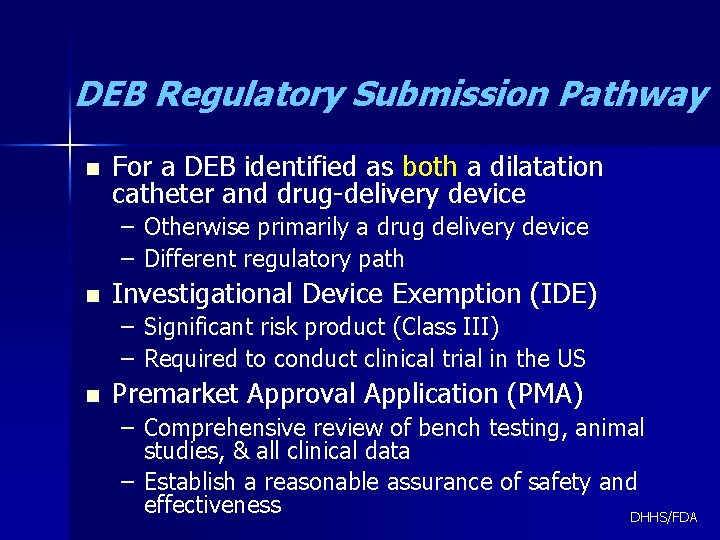
DEB Regulatory Submission Pathway n For a DEB identified as both a dilatation catheter and drug-delivery device – Otherwise primarily a drug delivery device – Different regulatory path n Investigational Device Exemption (IDE) – – n Significant risk product (Class III) Required to conduct clinical trial in the US Premarket Approval Application (PMA) – Comprehensive review of bench testing, animal studies, & all clinical data – Establish a reasonable assurance of safety and effectiveness DHHS/FDA

DEB Preclinical Testing Objectives n Complete characterization of the finished sterilized product – Coating/drug loading characteristics – drug and coating content, coating integrity & uniformity n Particularly with varying balloon sizes – In vitro/in vivo PK studies n n Serum and tissue levels Adequate early time point sampling – Methods and specifications to allow stability testing n Adequate bench and animal studies to assess safety prior to human studies DHHS/FDA

Bench Testing n n See FDA Guidance documents – For PTCA component: Draft Class II Special Controls Guidance for PTCA Catheters – For Drug component: Draft Coronary DES Guidance Additional specific bench tests to support indication (e. g. , ISR, coronary vs. peripheral arterial beds, small vessels) Testing to evaluate expected worst case clinical use and encompass product matrix Coating integrity and particulate testing are necessary DHHS/FDA

Preclinical testing of PTCA Balloons (Including DEBs) – Biocompatibility Ø Entire device without drug coating Ø Balloon + drug coating material separately Ø If drug retained in tissue>30 days, implant biocompatibility testing needed n n Cytotoxicity Sensitization Hemocompatibility Material-mediated pyrogenicity DHHS/FDA
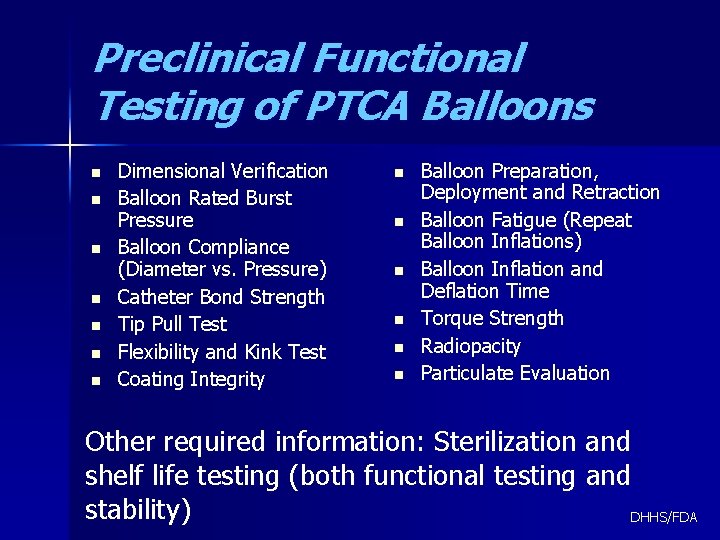
Preclinical Functional Testing of PTCA Balloons n n n n Dimensional Verification Balloon Rated Burst Pressure Balloon Compliance (Diameter vs. Pressure) Catheter Bond Strength Tip Pull Test Flexibility and Kink Test Coating Integrity n n n Balloon Preparation, Deployment and Retraction Balloon Fatigue (Repeat Balloon Inflations) Balloon Inflation and Deflation Time Torque Strength Radiopacity Particulate Evaluation Other required information: Sterilization and shelf life testing (both functional testing and stability) DHHS/FDA

Drug substance on DEB See DES Draft Guidance: http: //www. fda. gov/downloads/Drugs/Guidance. Co mpliance. Regulatory. Information/Guidances/UCM 07 2193. pdf DHHS/FDA
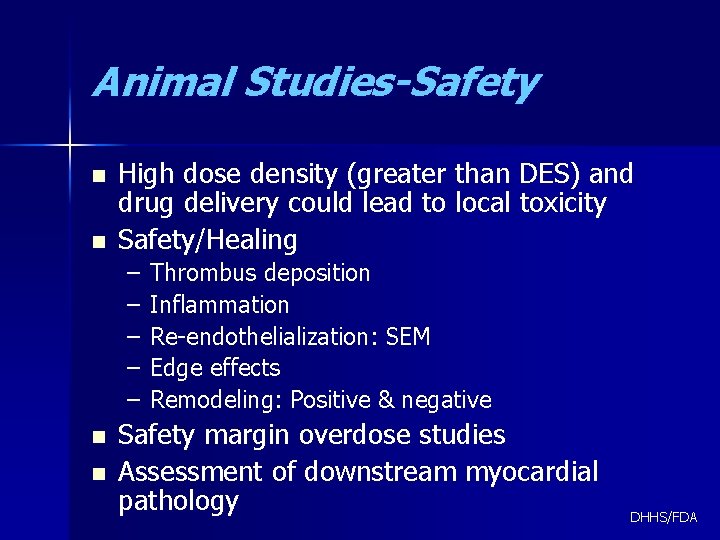
Animal Studies-Safety n n High dose density (greater than DES) and drug delivery could lead to local toxicity Safety/Healing – – – n n Thrombus deposition Inflammation Re-endothelialization: SEM Edge effects Remodeling: Positive & negative Safety margin overdose studies Assessment of downstream myocardial pathology DHHS/FDA
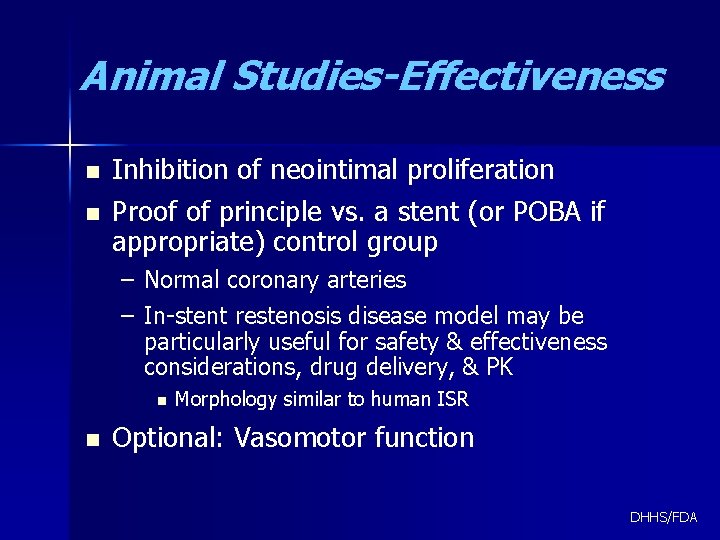
Animal Studies-Effectiveness n n Inhibition of neointimal proliferation Proof of principle vs. a stent (or POBA if appropriate) control group – – Normal coronary arteries In-stent restenosis disease model may be particularly useful for safety & effectiveness considerations, drug delivery, & PK n n Morphology similar to human ISR Optional: Vasomotor function DHHS/FDA
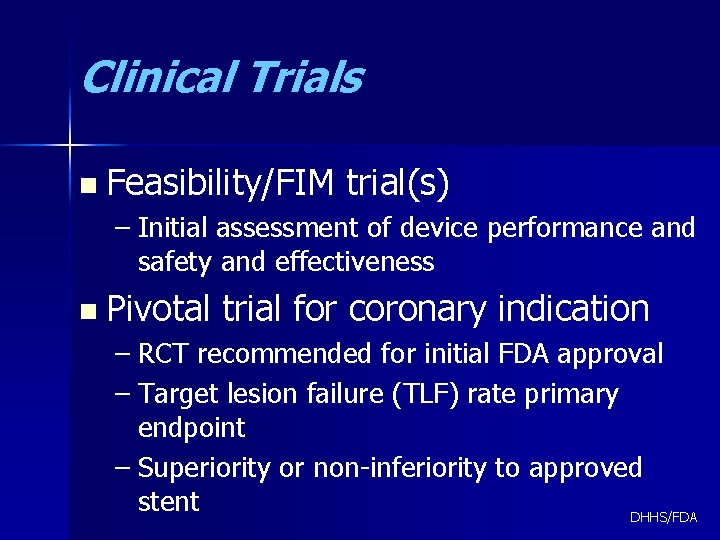
Clinical Trials n Feasibility/FIM trial(s) – Initial assessment of device performance and safety and effectiveness n Pivotal trial for coronary indication – RCT recommended for initial FDA approval – Target lesion failure (TLF) rate primary endpoint – Superiority or non-inferiority to approved stent DHHS/FDA
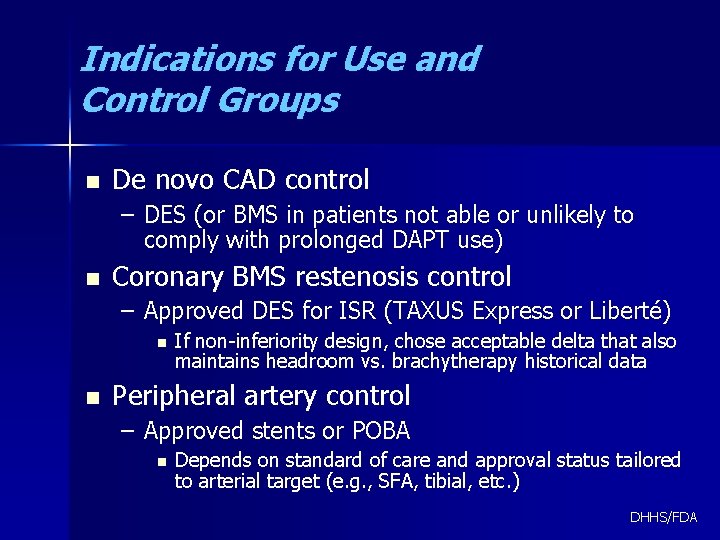
Indications for Use and Control Groups n De novo CAD control – DES (or BMS in patients not able or unlikely to comply with prolonged DAPT use) n Coronary BMS restenosis control – Approved DES for ISR (TAXUS Express or Liberté) n n If non-inferiority design, chose acceptable delta that also maintains headroom vs. brachytherapy historical data Peripheral artery control – Approved stents or POBA n Depends on standard of care and approval status tailored to arterial target (e. g. , SFA, tibial, etc. ) DHHS/FDA
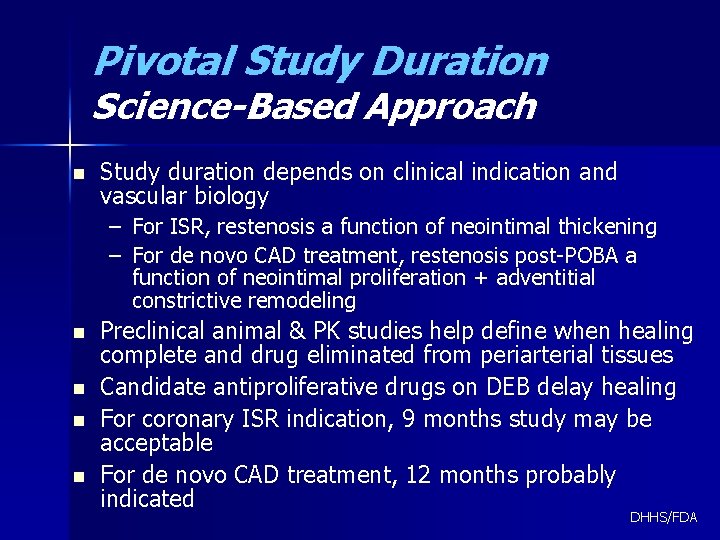
Pivotal Study Duration Science-Based Approach n Study duration depends on clinical indication and vascular biology – For ISR, restenosis a function of neointimal thickening – For de novo CAD treatment, restenosis post-POBA a function of neointimal proliferation + adventitial constrictive remodeling n n Preclinical animal & PK studies help define when healing complete and drug eliminated from periarterial tissues Candidate antiproliferative drugs on DEB delay healing For coronary ISR indication, 9 months study may be acceptable For de novo CAD treatment, 12 months probably indicated DHHS/FDA
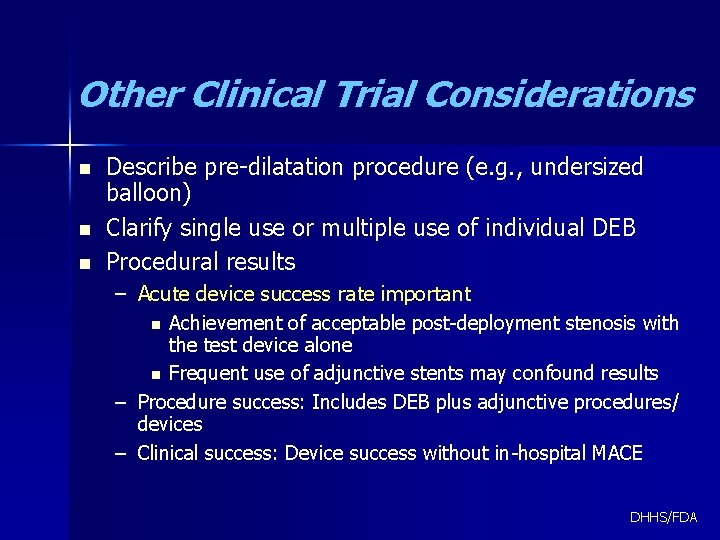
Other Clinical Trial Considerations n n n Describe pre-dilatation procedure (e. g. , undersized balloon) Clarify single use or multiple use of individual DEB Procedural results – Acute device success rate important Achievement of acceptable post-deployment stenosis with the test device alone n Frequent use of adjunctive stents may confound results – Procedure success: Includes DEB plus adjunctive procedures/ devices – Clinical success: Device success without in-hospital MACE n DHHS/FDA
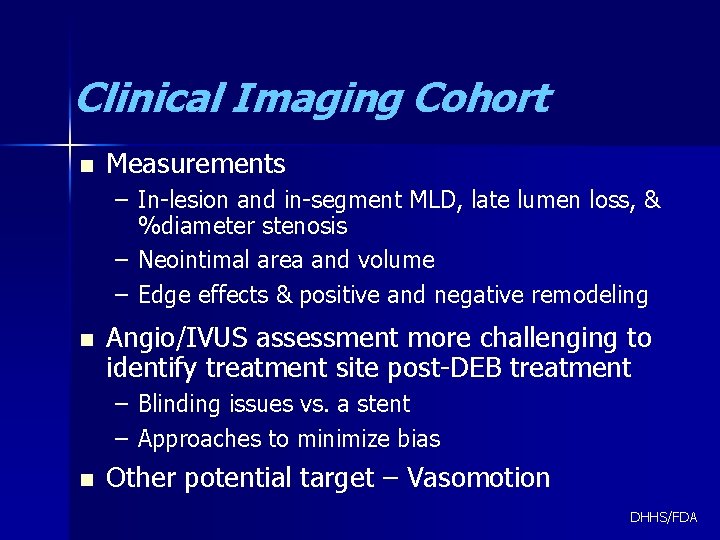
Clinical Imaging Cohort n Measurements – In-lesion and in-segment MLD, late lumen loss, & %diameter stenosis – Neointimal area and volume – Edge effects & positive and negative remodeling n Angio/IVUS assessment more challenging to identify treatment site post-DEB treatment – Blinding issues vs. a stent – Approaches to minimize bias n Other potential target – Vasomotion DHHS/FDA
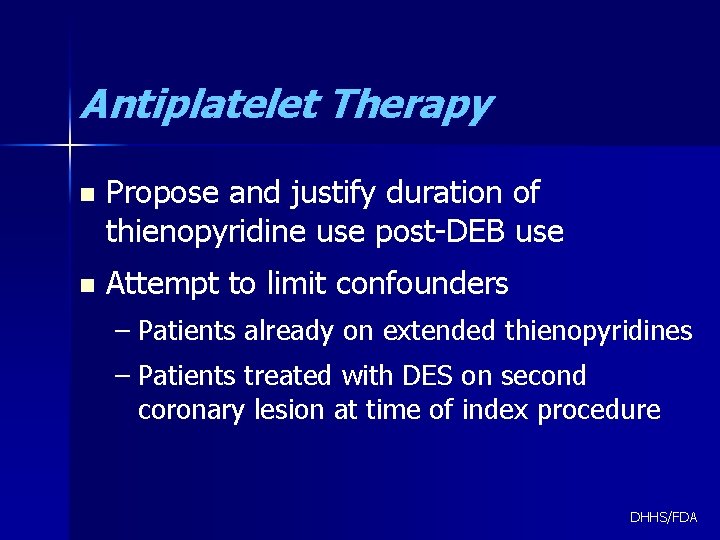
Antiplatelet Therapy n Propose and justify duration of thienopyridine use post-DEB use n Attempt to limit confounders – Patients already on extended thienopyridines – Patients treated with DES on second coronary lesion at time of index procedure DHHS/FDA
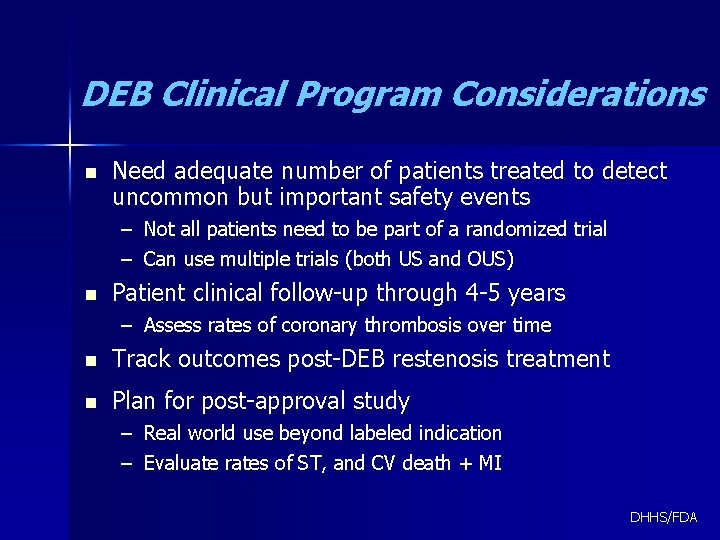
DEB Clinical Program Considerations n Need adequate number of patients treated to detect uncommon but important safety events – Not all patients need to be part of a randomized trial – Can use multiple trials (both US and OUS) n Patient clinical follow-up through 4 -5 years – Assess rates of coronary thrombosis over time n Track outcomes post-DEB restenosis treatment n Plan for post-approval study – Real world use beyond labeled indication – Evaluate rates of ST, and CV death + MI DHHS/FDA
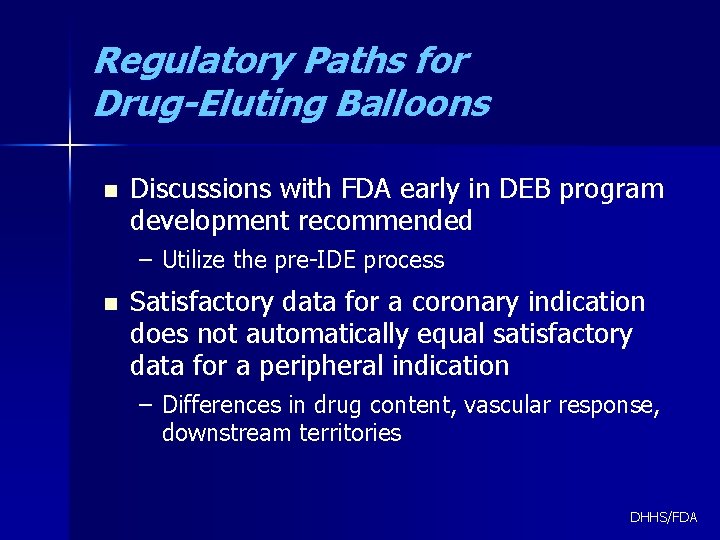
Regulatory Paths for Drug-Eluting Balloons n Discussions with FDA early in DEB program development recommended – Utilize the pre-IDE process n Satisfactory data for a coronary indication does not automatically equal satisfactory data for a peripheral indication – Differences in drug content, vascular response, downstream territories DHHS/FDA
Contact Information Interventional Cardiology Devices Branch 301 -796 -6343 andrew. farb@fda. hhs. gov ashley. boam@fda. hhs. gov DHHS/FDA
- Slides: 20