
REGULATORY REFORM RIA IMPLEMENTATION IN TURKEY By Dr
REGULATORY REFORM & RIA IMPLEMENTATION IN TURKEY By Dr. Recep KIZILCIK Director of Better Regulation Tunis, Tunisia February 15 , 2007 1
Outline PART I Ø 1 -Regulatory Policy Ø 2 -Regulatory Risk Ø 3 -Why is it hard to make good regulatory decisions ? Ø 4 -Methods of making decision Ø 5 - What is RIA? Ø 6 -Two Aspects of RIA System Ø 7 -Consultation 2
Outline PART II 1 -Regulatory Problems of Turkey 2 -Better Regulation for Turkey 3 -Simplification of regulations 4 -Backgroud of RIA in Turkey 5 -RIA Structure of Turkey 6 -RIA Guideline of Turkey 7 -What Results in Turkey 8 -Benefits and challenges of RIA 3
Regulatory Policy Ø Although governments historicaly used traditional instruments such as current spending, tax and investment to achive objectives of improving social development, better living standarts and quality of the life of citizens, especially following 2000 s, OECD and EU Countries started to attach significant importance to regulatory policy. 4
Regulatory Risk Regulatory risk reduces both the quantity of investment and the value of investment. Ø The more uncertain and risky is the regulatory environment in which economic activity occurs, the more likely it is that aggressive rent seeking and shortterm profit taking will replace longer-term investment in a competitive climate. Ø RIA can help reduce regulatory risk. Ø 5
Why is it hard to make good regulatory decisions(2) Failure to define the problem correctly. Ø Failure to understand other forces and incentives acting on the problem. Ø Failure to predict changes in human behaviour. Ø Failure to see the full consequences of government actions. 6
Why is it hard to make good regulatory decisions(2) Failure to understand domestic and international market forces. Ø Failure to update to meet changing needs, technologies, and situations. Ø Failure to understand limits in government capacities. Ø Failure to oppose powerful interest groups and combat regulatory capture. Ø 7
Methods of Making Decision Countries use several methods to make regulatory decisions; Ø Expert, Ø Consensus, Ø Political, Ø Benchmarking, Ø Evidence-based. 8
What is RIA? RIA is an evidence-based process for making regulatory decisions. Ø Structurally, RIA is a process of asking the right questions in a structured format to support a wider and more transparent policy debate. Ø Systematically and consistently examining selected potential impacts arising from government action or non-action, Ø Communicating the information to decision-makers and stakeholders. Ø 9
Objectives of RIA Ø Ø Ø Calculating the costs and benefits of government action. Opening up decisions to a wider range of interests. Improving regulatory qualities. Changing the culture of the regulators. Changing the views about the role of government. Shifting the role of government from “rowing” to “steering”. 10
RIA should be part of wider regulatory policy Ø RIA should be based on governmentwide principles of good regulation It is essential to explicitly define regulatory quality, especially in a transition country, where understanding of market needs is low. Ø Most governments have issued instructions to regulators about the quality of their regulatory decisions. Ø Ø Regulators must show that their proposed regulations will meet these quality standards BEFORE they adopt them. 11
Critical Questions for RIA To enforce and comply ? Are proposals enforceable? –e. g. resources Ø Who will enforce them? Ø How will consistency and accountability be ensured? Ø What are compliance targets? Ø Do benefits justify compliance costs? Ø 12
Important success factors Ø Ø Ø The highest level political support Support from Prime Minister’s Office Awareness-raising and training Development of RIA network for sharing of experience and leading this process Ongoing liaison with OECD and EU colleagues especially EU Directors of Better Regulation Learning by doing 13
Two Aspects of a RIA System Ø An administrative process. - Conception and Development of Regulation. - Ministry Drafts Regulation & RIA in consultation with stakeholders. - Inter ministerial consultation, & Oversight Regulatory Body. - Final Submission to Cabinet. Ø A substantive decision-making report addressing content issues. 14
Phases of EC Impact Assessment Report Ø Executive summary. Ø Section 1: Procedural issues and consultation. Ø Section 2: Problem definition. Ø Section 3: Objectives. Ø Section 4: Policy options. Ø Section 5: Analysis of impacts. Ø Section 6: Comparing the options. Ø Section 7: Monitoring and evaluation. 15
Consultation To assist the decision-making process. Ø To contribute to evidence-based policymaking. Ø To help identify possible alternatives to regulation. Ø To strengthen focus of policy makers on the needs of the public and end-consumer. Ø 16
Phases of the Consultation Process Ø Ø Planning Execution Analysis & Evaluation Consultation means; l l Structured public engagementwith those whose views are to be sought Providing informationto the key audienceon the purpose and subject of the consultation–e. g. a policy initiative, a regulatory change, a legislative proposal or a service delivery Seeking, receiving, analysing and responding to feedback from the key audience It is important to differentiate between–Ongoing consultative mechanisms(involving standing committees, foraor groups) and Once-off consultationexercises 17
Plan for Consultation Decide what is purpose of consultation Ø What do you want to achieve Ø Who to consult and timetable? Ø How to make stakeholders aware? Ø Are outside experts or consultants required? Ø Compliance with legal obligations Ø 18
Methods of Consultation Written Consultations Ø Questionnaire-based survey Ø Internet and use of IT tools Ø Face-to-Face Interviews Ø Public Hearings Ø 19

Regulatory Problems of Turkey Ø Ø Ø High regulatory risks that reduce investment and competition. High transactions costs due to a complex, multi-layered. often arbitrary rules that are vulnerable to corruption. Regulatory barriers to entry and competition. Too little market regulation, poor enforcement, and under-institutionalization in policy areas such as consumer and environmental protection. Turkey’s civil service needs new tools to move toward norms of good regulation. 20
Better Regulation for Turkey(1) Ø Ø Ø Good regulation, not deregulation, is the answer for Turkey. Creating more private businesses is important. But real aim of reform is to create competitive markets that reward value, re-allocate resources, and adapt to opportunities and risks. Poor and inadequate regulatory structures permit abuses and corruption to flourish in emerging markets, undermine investor and consumer confidence, and destroy rather than create economic value. Private enterprises produce wealth within wellregulated markets. 21
Better Regulation for Turkey(2) Ø Sustainable growth is based on the quality of governance. Ø The focus of development today is on the role of the state and its effectiveness, that is, its quality. Ø Turkey needs smart government. Institutional reforms must improve the capacities of its public administration –skills, structures, transparency, accountability for performance, relation with and understanding of markets and consumer interests, and styles of operation. 22
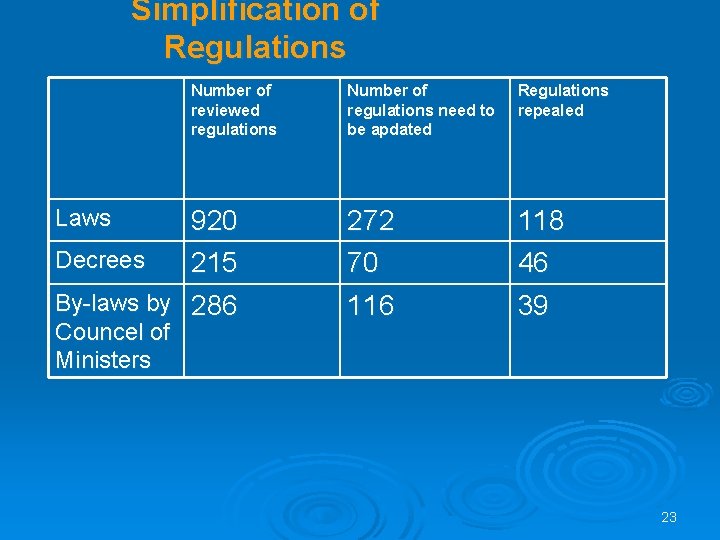
Simplification of Regulations Number of reviewed regulations Number of regulations need to be apdated Regulations repealed 920 215 272 70 118 46 By-laws by 286 Councel of Ministers 116 39 Laws Decrees 23
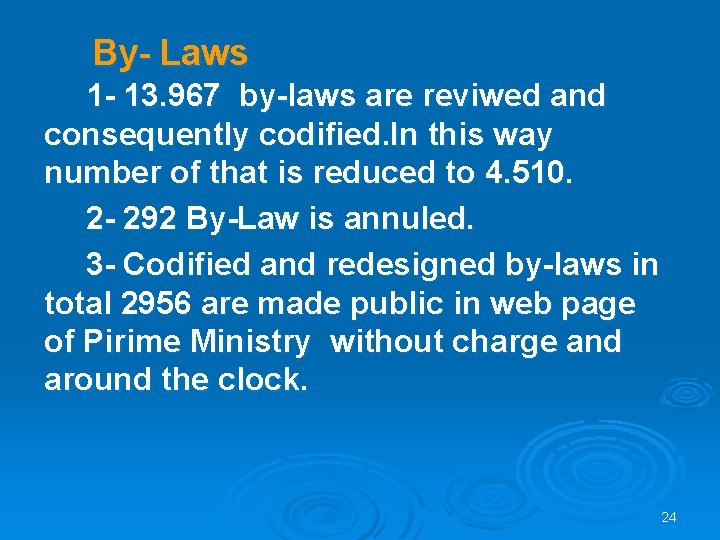
By- Laws 1 - 13. 967 by-laws are reviwed and consequently codified. In this way number of that is reduced to 4. 510. 2 - 292 By-Law is annuled. 3 - Codified and redesigned by-laws in total 2956 are made public in web page of Pirime Ministry without charge and around the clock. 24
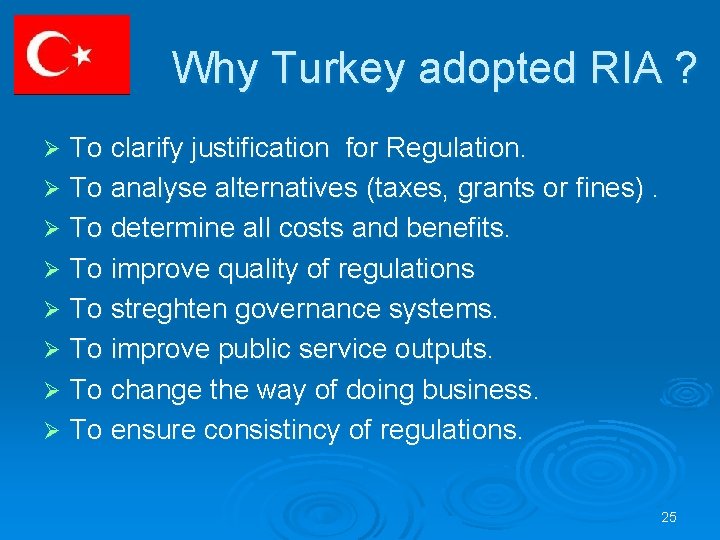
Why Turkey adopted RIA ? To clarify justification for Regulation. Ø To analyse alternatives (taxes, grants or fines). Ø To determine all costs and benefits. Ø To improve quality of regulations Ø To streghten governance systems. Ø To improve public service outputs. Ø To change the way of doing business. Ø To ensure consistincy of regulations. Ø 25
Background of RIA in Turkey Ø Influence of OECD and EU on RIA in Turkey. Ø OECD, Regulatory Reform in Turkey, 2001. Ø Action Plan of the Government. Ø “Setting up Better Regulation Unit in Prime Ministry in 2004’’ Ø By- law on principles of draft laws, decree laws and by laws entered into force on February 17, 2006. Ø By that Regulation Government committed to doing RIA of all draft laws and decree laws whose costs exceed 10 million New Turkish Lira following February 17, 2007. Ø Pilot Project; the one funded by the EU and about to be completed 26
RIA structure of Turkey Ø Oversight body in the Office of Prime Minister. Ø Main functions of this unit is; l l Ø To develop and enhance capacity of public administration on RİA, To help carry out RIA by line ministries, To do reality checks on the quality of RIAs undertaken To train and technical advice. Better Regulation or RIA units at all line ministries and regulatory bodies. 27
How RIA is done in Turkey ? Ø Two phased approach: l l Partial RIA, applied to all primary legislation involving changes to regulatory framework and secondary regulation identified by prime ministry. Full RIA, only conducted where partial RIA suggests significant impacts or significant costs (initial cost of 10 million New Turkish Lira) 28
RIA Guideline of Turkey Problem definition. Ø Objectives. Ø Alternatives. Ø Assessment of alternatives. Ø Consultation. Ø Comparison of alternatives. Ø Implementation , monitoring and evaluation. Ø 29
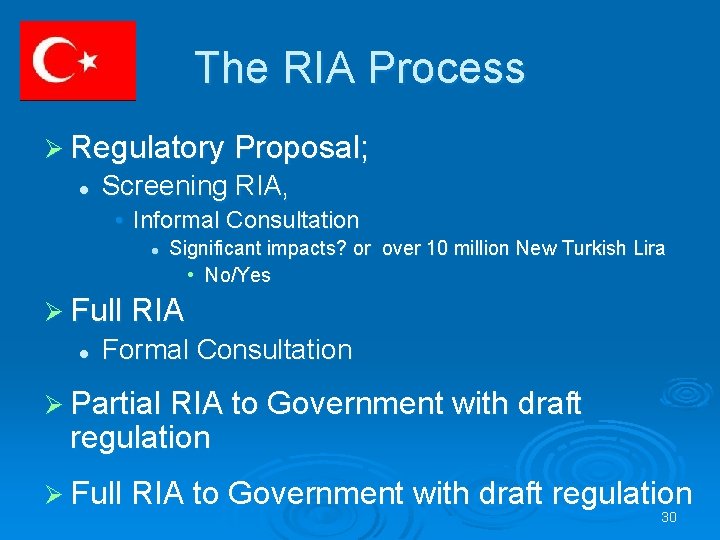
The RIA Process Ø Regulatory Proposal; l Screening RIA, • Informal Consultation l Significant impacts? or over 10 million New Turkish Lira • No/Yes Ø Full RIA l Formal Consultation Ø Partial RIA to Government with regulation Ø Full RIA to Government with draft regulation 30
Scope of Partial RIA Ø Ø Ø Setting of policy context, objectives and policy options Identification of cost, benefits and other impacts of options. Informal consultation including ministries, consumer and other interest groups. Expression of how enforcement and compliance will be achieved. Review–how will performance of regulations be assessed? 31
How to conduct full RIA ? Full RIA only conducted where Screening RIA suggests: –Significant impacts. –Significant costs (initial cost of 10 million New Turkish Lira). Ø International experience suggests Full RIA in 10 -15%of cases. Ø 32
Full RIA covers More detailed analysis of developed options. Ø More in-depth analysis of possible impacts. Ø Monetarization of likely impacts Ø Formal consultation. Ø Summary of pros and cons of each option and determination of a recommended option if deemed appropriate. Ø 33
Results in Turkey Ø This pilot undertaken in cooperation with the EU has given the first results: l l RIA model developed in 2007. Due to execution of pilot RIA a good enough capacity is built up in public administration especialy at participating ministries. Quite large number of personnel are trained in RIA who are to carry out RİAs at their departments after February 17 , 2007. Developed a action plan with the aim of improving the newly established RIA system in coming years. 34
Lessons learned Ø Many RIA lessons are learned: l More structured and explicit focus on the objectives behind regulations–with identification of problems being addressed. l Identification and analysis of alternative options for achieving policy objectives. l l l Recognition of difficulties of assessing and particularly quantifying the costs associated with regulations. Need of changing the way of doing business. Need of continous training. 35
Benefits of RIA Ø Ø Ø With RIA, the Public Sector can; Have a more structured and explicit examination of likely costs and benefits of proposed regulation, Have important consultation with stakeholders, Have an earlier focus on enforcement and compliance issues who will enforce the regulations, what are the compliance targets? , Highlight the introduction of performance indicators for regulations, so that they can show if the regulations are working well. Improve ligitimacy of regulations 36
Challenges of RIA Key players will feel some discomfort. Ø So, traditional ways will be challenged Ø And yet if RIA is well explained there can be real benefits for the main players and in the public interest Ø Institutional resistance to change including bruacracy Ø 37

Thank you for your attention 38
- Slides: 38