
Regulatory Perspective on Trends in Veterinary Biologics Byron
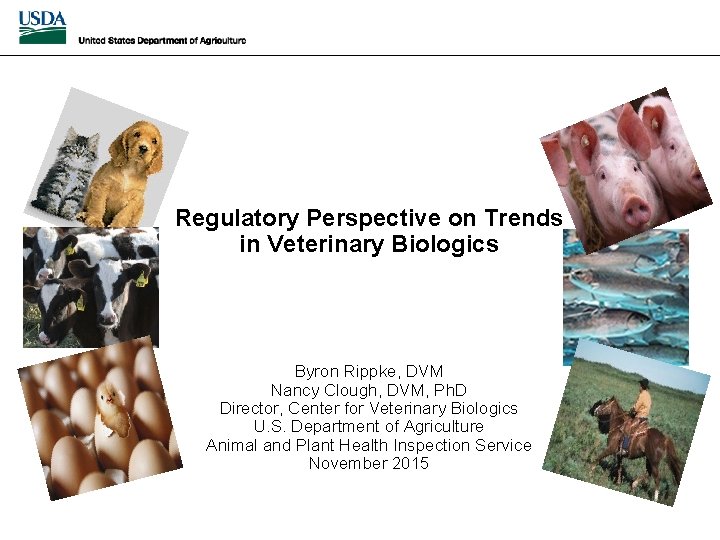
Regulatory Perspective on Trends in Veterinary Biologics Byron Rippke, DVM Nancy Clough, DVM, Ph. D Director, Center for Veterinary Biologics U. S. Department of Agriculture Animal and Plant Health Inspection Service November 2015
Predominating Trends • Increased pressure to bring products to market more quickly • Increased interest in customized biologicals to meet regional or individual needs 2
Regulating at the Speed of Change • Increased pressure to bring products to market as quickly as possible: • Highly mutable agents • Emerging diseases • Novel technologies vs. • USDA’s mission to ensure licensed products are pure, safe, potent, and effective 3
Conditional Licenses This con produ c d pote itiona t licen l. s pro ncy te Effica e is gre s ss. t stud cy and ies in • 9 CFR 102. 6 • To meet emergency conditions, limited market, local or special circumstance • Reduced requirements for proof of efficacy (“reasonable expectation”) but otherwise must meet all licensing requirements for full licensure 4

Conditional Licenses: Limitations This con produ c d pote itiona t licen l s. pro ncy te Effica e is gre s ss. t stud cy and ies in • Special labeling to disclose conditional status, no trade names • Restricted distribution—requires permission from State or importing authorities • Annual or biannual license renewal • Conditionally licensed fractions cannot be mixed with fully licensed fractions • Once a similar product has full license, no additional conditional licenses are issued 5
Influenza virus changes • Veterinary Services Memorandum 800. 111, first published in 2007 • Arose from need to keep vaccine Seeds up to date with rapid, frequent virus shift/drift • Once manufacturer has a full license for killed product, can add, remove, exchange Seeds of same HN type(s) in expedited manner • Requires only similar serological response. No large-scale field safety • Updated product receives full license 6
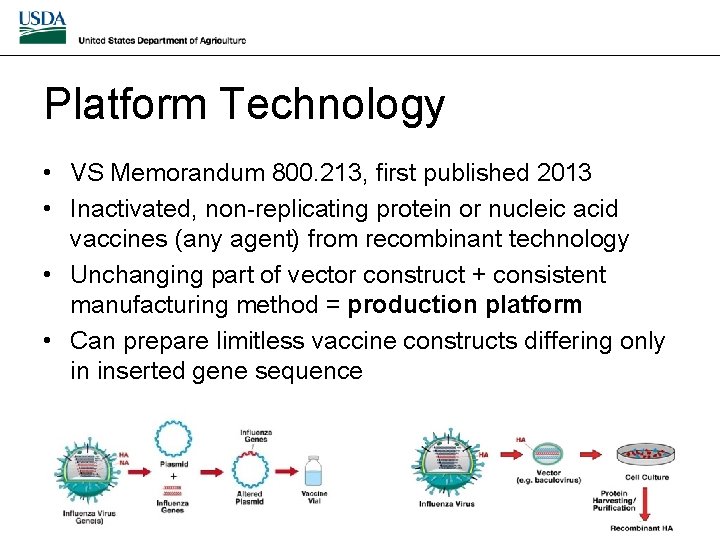
Platform Technology • VS Memorandum 800. 213, first published 2013 • Inactivated, non-replicating protein or nucleic acid vaccines (any agent) from recombinant technology • Unchanging part of vector construct + consistent manufacturing method = production platform • Can prepare limitless vaccine constructs differing only in inserted gene sequence 7
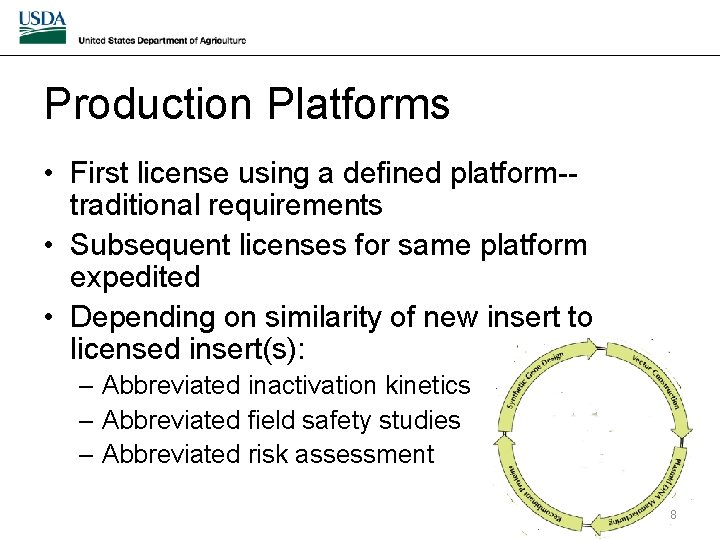
Production Platforms • First license using a defined platform-traditional requirements • Subsequent licenses for same platform expedited • Depending on similarity of new insert to licensed insert(s): – Abbreviated inactivation kinetics – Abbreviated field safety studies – Abbreviated risk assessment 8
Production Platforms • Platform-based Seeds (vector + gene insert) that only have reasonable expectation of efficacy (“conditional” license) may be combined with fully licensed Seeds from same platform • May be eligible for conditional license even if similar full licenses exist 9
Emerging Diseases • Recent examples: Pandemic H 1 N 1 influenza (2009), porcine epidemic diarrhea virus (2013), H 3 N 2 canine influenza viruses (2015) • To expedite product licensure, USDA obtained, tested Master Seeds for direct distribution to biologics manufacturers. Applicants could use these Seeds in product development with minimal or no additional testing. • Provided challenge virus and standardized challenge protocol for PEDV 10
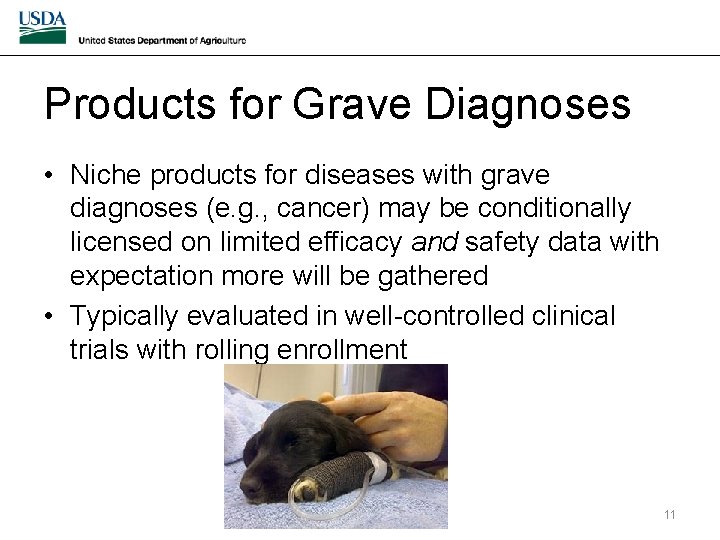
Products for Grave Diagnoses • Niche products for diseases with grave diagnoses (e. g. , cancer) may be conditionally licensed on limited efficacy and safety data with expectation more will be gathered • Typically evaluated in well-controlled clinical trials with rolling enrollment 11
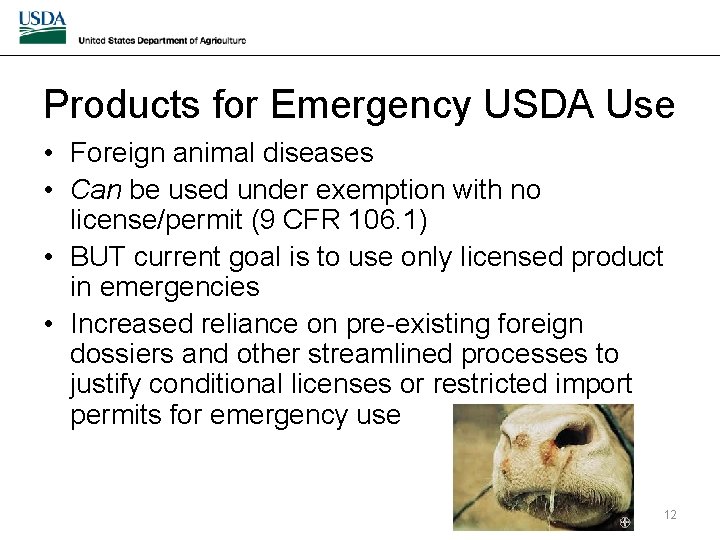
Products for Emergency USDA Use • Foreign animal diseases • Can be used under exemption with no license/permit (9 CFR 106. 1) • BUT current goal is to use only licensed product in emergencies • Increased reliance on pre-existing foreign dossiers and other streamlined processes to justify conditional licenses or restricted import permits for emergency use 12
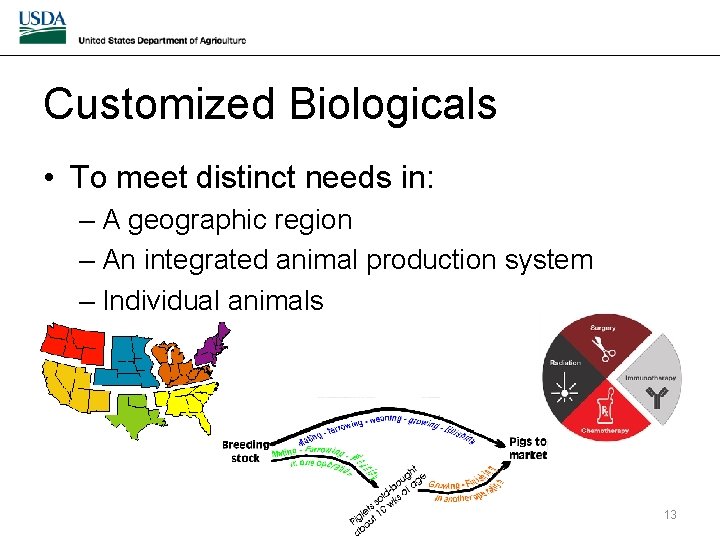
Customized Biologicals • To meet distinct needs in: – A geographic region – An integrated animal production system – Individual animals 13
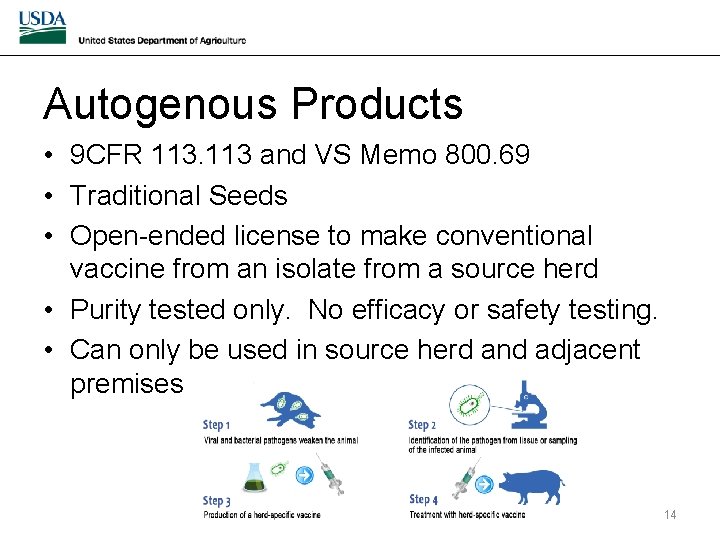
Autogenous Products • 9 CFR 113 and VS Memo 800. 69 • Traditional Seeds • Open-ended license to make conventional vaccine from an isolate from a source herd • Purity tested only. No efficacy or safety testing. • Can only be used in source herd and adjacent premises 14
Prescription Products • VS Memo 800. 213 (added 2015) • Open-ended license to create custom recombinant formulations based on established production platform • Requires prescribing veterinarian • Serials (batches) tested for safety, purity. Vet assumes liability for efficacy. • Gene sequence for platform Seed may be obtained from prescribing veterinarian or other epidemiological data 15
Prescription Products • May be used in geographically distant sites, as veterinarian deems appropriate. • May include gene sequences animals are at risk for exposure but not yet in herd • Prescription fraction may be combined with fractions licensed for non-prescription products 16
Prescription products • Restricted labeling—similar to conditional • Restricted distribution—only by State permission • Individual serial (batch) release by USDA • License issued for 2 years, subject to renewal 17
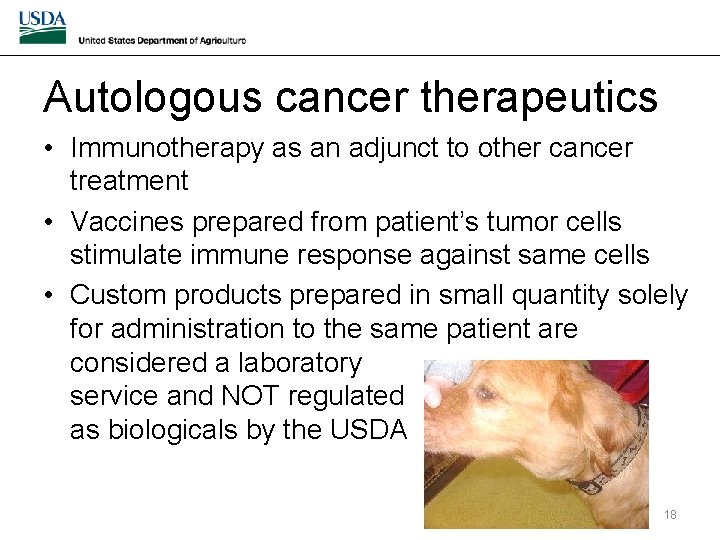
Autologous cancer therapeutics • Immunotherapy as an adjunct to other cancer treatment • Vaccines prepared from patient’s tumor cells stimulate immune response against same cells • Custom products prepared in small quantity solely for administration to the same patient are considered a laboratory service and NOT regulated as biologicals by the USDA 18
Summary • Expediting time to licensure – – – Conditional licenses Streamlined updates of influenza strains Production Platforms USDA provides Seeds for emerging diseases Products for USDA emergency use Products for grave diagnoses • Custom Products – Autogenous products – Prescription products – Autologous cancer therapeutics 19
Questions?
- Slides: 20