
Regulatory Impact Assessment for Better Standards International Best
Regulatory Impact Assessment for Better Standards International Best Practices from OECD Manama, 20 January 2014 Charles-Henri Montin, Senior Regulatory Expert, Ministry of economy and finance, Paris OECD RPC delegate http: //smartregulation. net C. H. Montin, Manama 1
Contents Ø Ø Ø The policy-making cycle and how RIA fits into that cycle Nature, purpose and functions of RIA Typical methodology Challenges for introducing RIA The potential relevance of RIA to GCC standardisation agencies C. H. Montin, Manama 2
3 sources for best practice United Kingdom European Union France Better Regulation Smart Regulation Regulatory Quality Impact assessment RIA Evaluation préalable Regulatory Policy Committee Publication One-in, one-out Impact assessment Board Conseil d’Etat Legistics Constitutional basis for RIA C. H. Montin, Manama 3
C. H. Montin, Manama 4
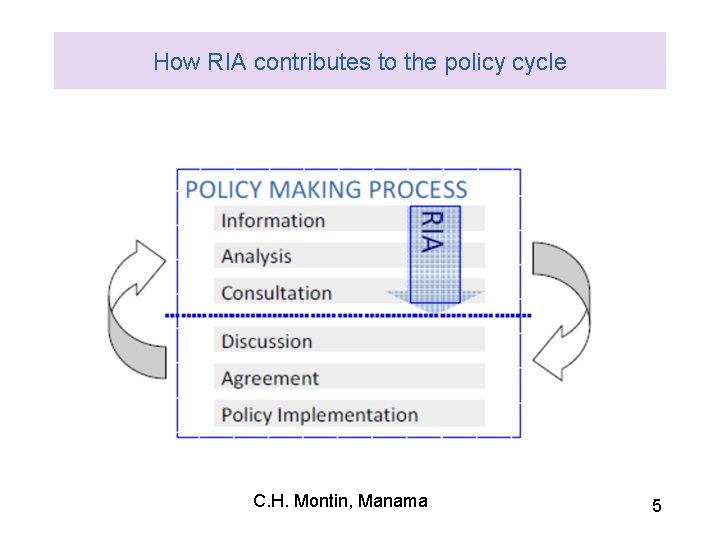
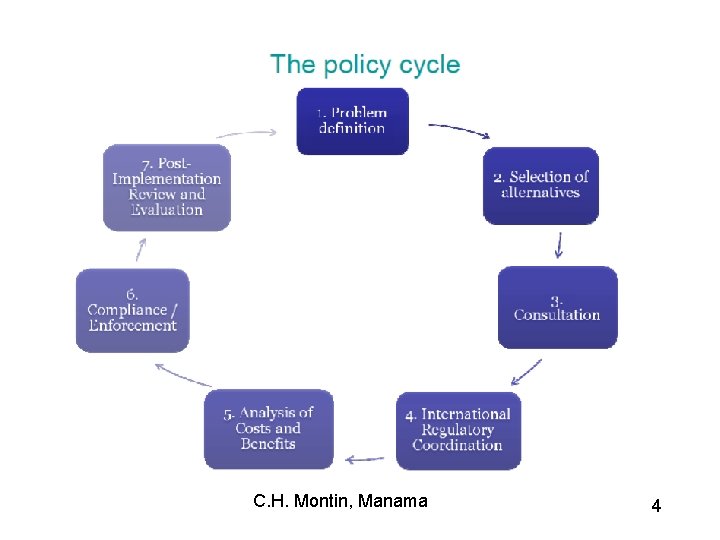
How RIA contributes to the policy cycle C. H. Montin, Manama 5
What is impact assessment? Ø Investigates and measures the likely benefits, costs and effects of new and changed regulation, throughout the regulatory process – A key decision making tool for governments – Underpins regulatory reform – Used in most OECD countries – No single model fits all situations C. H. Montin, Manama 6
Purpose of RIA Ø Ø Ø Identifies all main potential impacts arising from proposed government regulations – Articulates the problem and explains why it needs to be addressed – Broadens the range of options Promotes balanced decisions that trade off problems against wider economic / social goals – Ensures transparency and stakeholder input – Supports informed decision on policy and regulation Informs political debate and supports communication on policy C. H. Montin, Manama 7
Practical functions of RIA Ø Ø Ø Provides factual data to make appropriate regulatory decisions Exposes impacts and linkages among policies and gives decision-makers a capacity to weigh trade offs Provides a public accounting of each regulation Provides a clear explanation of the regulation, its purpose, the analysis substantiating it and expected impacts Enables policy makers to understand take personal responsibility for regulatory decisions C. H. Montin, Manama 8
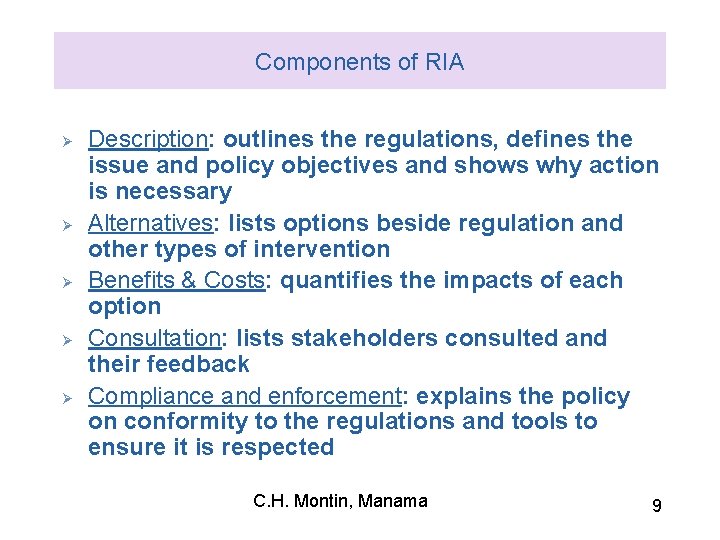
Components of RIA Ø Ø Ø Description: outlines the regulations, defines the issue and policy objectives and shows why action is necessary Alternatives: lists options beside regulation and other types of intervention Benefits & Costs: quantifies the impacts of each option Consultation: lists stakeholders consulted and their feedback Compliance and enforcement: explains the policy on conformity to the regulations and tools to ensure it is respected C. H. Montin, Manama 9

The process of Regulatory Impact Analysis Definition Policy objectives Consultation Involving Stakeholders Identification Regulatory Options Assessment Costs Selection Best Option Design Enforcement, Compliance and monitoring mechanisms Benefits Policy context Other impacts After RIA is prepared: DECISION MAKING C. H. Montin, Manama 10
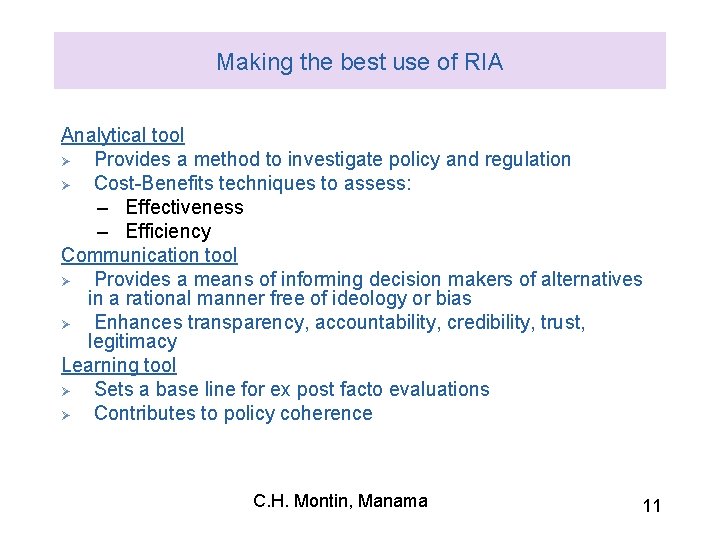
Making the best use of RIA Analytical tool Ø Provides a method to investigate policy and regulation Ø Cost-Benefits techniques to assess: – Effectiveness – Efficiency Communication tool Ø Provides a means of informing decision makers of alternatives in a rational manner free of ideology or bias Ø Enhances transparency, accountability, credibility, trust, legitimacy Learning tool Ø Sets a base line for ex post facto evaluations Ø Contributes to policy coherence C. H. Montin, Manama 11
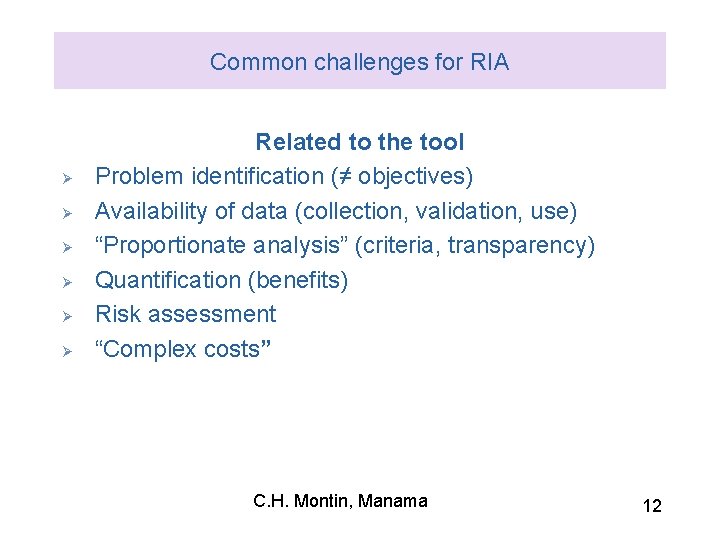
Common challenges for RIA Ø Ø Ø Related to the tool Problem identification (≠ objectives) Availability of data (collection, validation, use) “Proportionate analysis” (criteria, transparency) Quantification (benefits) Risk assessment “Complex costs” C. H. Montin, Manama 12
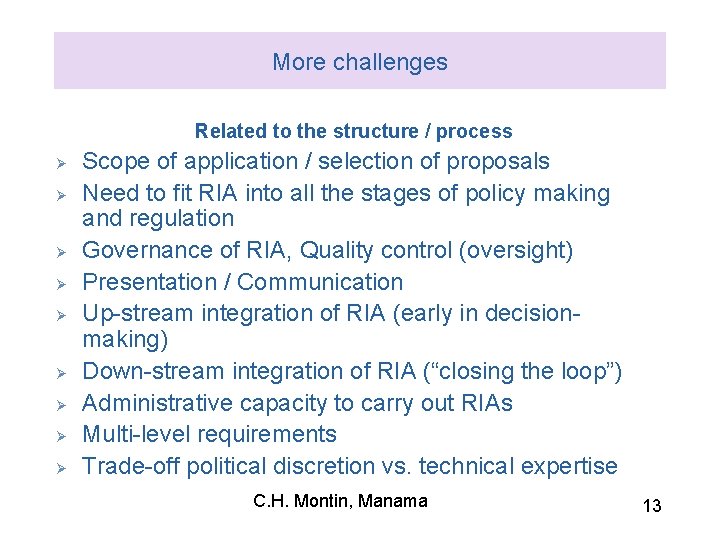
More challenges Related to the structure / process Ø Ø Ø Ø Ø Scope of application / selection of proposals Need to fit RIA into all the stages of policy making and regulation Governance of RIA, Quality control (oversight) Presentation / Communication Up-stream integration of RIA (early in decisionmaking) Down-stream integration of RIA (“closing the loop”) Administrative capacity to carry out RIAs Multi-level requirements Trade-off political discretion vs. technical expertise C. H. Montin, Manama 13
OECD good practices (1) Ø 1. Political commitment and endorsement at the highest levels – Legal basis for RIA – Clear ministerial accountability Ø 2. Allocate responsibilities for the RIA programme – Operational responsibilities with the services – Inter-service coordination – Central quality oversight C. H. Montin, Manama 14
OECD good practices (2) Ø 3. Target and prioritise RIA efforts – Scope of application / thresholds for when to do RIAs – Sectoral impacts Ø 4. Develop comprehensive guidelines – Mandatory – Both on process and on technical aspects Ø 5. Carry out sound analysis – Strategies for data collection – Consistent but flexible methodologies C. H. Montin, Manama 15
OECD good practices (3) Ø Ø Ø 6. Consultation / Transparency / Communication 7. Training, training 8. Apply RIA to both new and existing regulation C. H. Montin, Manama 16
Relevance to GCC standardisation Ø Better Regulation principles apply to standards: – Standards are an acknowledged “alternative” to regulation with specific advantages for certain types of issues – BR tools support more evidence based decisions in the production of standards (especially RIA) – Effective consultation of stakeholders, including coproduction – Feed-back from enforcement and implementation (compliance assessment) – Can be developed internationally (IRC) C. H. Montin, Manama 17
Developing RIA practice in GCC/Bahrain Ø The main steps for developing RIA practice: – Define national/regional methodology – Build capacities in regulating/standards agencies – Set up quality control mechanisms or structures – Create training programme for RIA drafters – Launch pilot studies – Monitor for continuous improvement with practice. C. H. Montin, Manama 18
Conclusions Ø Ø Impact assessment has developed over the last 20 years and is now a widely used tool; UK and EU currently have best practice models It presents challenges to operate it meaningfully (influence on decision making) but also a lot of knowledge has been shared. Policy-makers naturally address the costs and benefits of political choices. RIA offers rigour Good potential for supporting the development of better standards in cooperation with regional partners C. H. Montin, Manama 19
To learn more about RIA… Ø Ø RIA methodology (UK) – BR framework – UK Government RIA site ; RIA template RIA guidelines (EU) – European Commission RIA site – Guidelines France: Guide de Légistique About applying RIA to standards: – a Strategic vision for European standards (2011) – RIA on standards (academic article) C. H. Montin, Manama 20
- Slides: 20