
REGULATORY IMPACT ASSESSMENT A TOOL FOR EVIDENCEBASED POLICY
REGULATORY IMPACT ASSESSMENT – A TOOL FOR EVIDENCEBASED POLICY MAKING Daniel Trnka Deputy Head Regulatory Policy Division OECD
What is Regulatory Impact Assessment (RIA)? • Formal and systematic “policy tool” and “decision process” to examine and measure the likely benefits, costs and effects of new or existing regulation • In the OECD, used most often when developing new laws/regulations (US, Canada, UK, Germany, EU, Australia etc. )
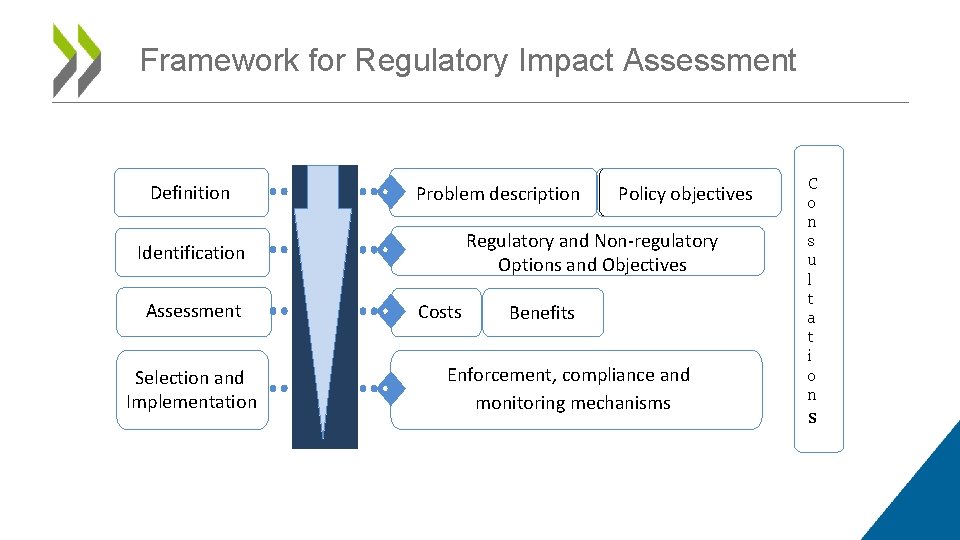
Framework for Regulatory Impact Assessment Definition Problem description Regulatory and Non-regulatory Options and Objectives Identification Assessment Selection and Implementation Policy objectives Costs Benefits Enforcement, compliance and monitoring mechanisms C o n s u l t a t i o n s
Why is RIA important? • Control the quality of regulation – a step in improving competitiveness • Evidence-based policy making: Is regulation the best available means to address the policy objective? • Improves transparency – both within government and civil society • Simple language can make it understandable for everyone and easily accessible

Consequences of no RIA What happens when a regulation is developed based on wishful thinking? • Regulation is not effective. The problem is not identified properly. • The government tackles the problem in the wrong way. • The regulation is contrary to other government objectives. • Adverse and unexpected consequences. • The regulation must be changed often as a result of poor design. • Too many overlapping regulations and burdens on businesses and citizens. • Etc….

Minimum requirements for RIA • Always start at the inception of the regulation-making process; • Clearly identify the problem and desired goals of the proposal; • Identify and evaluate all potential alternative solutions; • Always attempt to assess all potential costs and benefits, both direct and indirect; • Be based on all available evidence and scientific expertise; • Be elaborated in consultations with stakeholders and well communicated; • Be proportionate to the significance of the regulation; • Oversight is crucial
RIA and SMEs • Costs of regulations usually disproportionately bigger for SMEs • RIA helps to identify these costs…and potentially less costly solutions (SME Tests) • RIA also helps to identify potential mitigating measures, exemptions, etc. • RIA helps to bring SMEs to the table
One-In, X-Out • • • Requirement for regulators to offset regulatory costs Transparency about regulatory costs But what about benefits? Resource demanding, potential gaming Conceptual issues: – – What type of costs is measured; BAU, sunk costs; Future costs of existing regulation difficult to predict, subject to major change; What type of regulations is included
Regulatory sandboxes • Regulations more and more behind technological developments • Sandboxes create a “safe space” where companies can “play” with innovative products • Differences in implementation • Focus on collaboration between administration and stakeholders • Businesses’ satisfaction questionable
How can OECD help? • Regulatory Policy Review • Focused scans/mini reviews • Technical assistance in implementing regulatory management tools (e. g. RIA) – – – Analysis of the current situation Suggesting institutional set up Action plan for implementation Developing a methodology Communication with stakeholders • Training • Awareness raising

THANK YOU FOR YOUR ATTENTION! Daniel. Trnka@oecd. org oe. cd/ria
- Slides: 11