
REGULATORY FRAMEWORKS AND LEGISLATION IN PUBLIC TRANSPORT TEACHING
REGULATORY FRAMEWORKS AND LEGISLATION IN PUBLIC TRANSPORT TEACHING MATERIAL Transparencies 2003 EU-funded Urban Transport Research Project Results www. eu-portal. net
REGULATORY FRAMEWORKS AND LEGISLATION IN PUBLIC TRANSPORT MODULE 1 DEFINITION INTRODUCTION TO LEARNING MATERIALS KT Regulatory framework of public transport contains: • legal and • organisational aspects Transparency, efficiency and quality are the keys for a friendly and efficient PT. • The co-existence of authorities and operators, the necessary allocation of responsibilities sharing of risks as well as co-ordinated ”pull” and ”push” measures are other crucial issues

REGULATORY FRAMEWORKS AND LEGISLATION IN PUBLIC TRANSPORT SOURCES The following EU-objects served as key sources for this KT: • ISOTOPE (improved structure and organisation for transport operations of passengers in Europe) • MARETOPE (managing and assessing regulatory evolution in local public transport operations in Europe) • QUATTRO (quality approach in tendering urban public transport operations)
REGULATORY FRAMEWORKS AND LEGISLATION IN PUBLIC TRANSPORT NATIONAL DIFFERENCES Short description of the national differences in the following parts of Europe. The following categories of financing can be distinguished: • UK • Western Europe • Central Europe Capital cities regions are often approached in a different manner than rest of the country.
REGULATORY FRAMEWORKS AND LEGISLATION IN PUBLIC TRANSPORT MODULE 2 Structure of presentation • Definition • Sources • Right of initiative • Levels of planning and control in PT • Contractual relationships between actors • Quality assurance in PT • Financing and subsiding • Differences and Examples
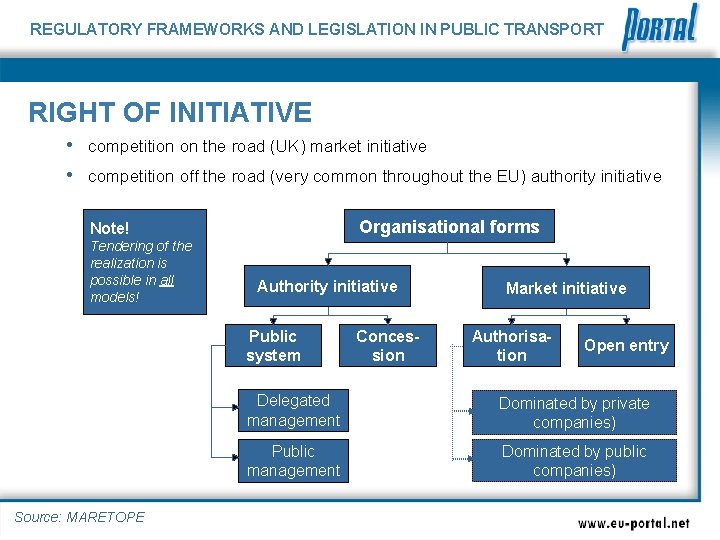
REGULATORY FRAMEWORKS AND LEGISLATION IN PUBLIC TRANSPORT RIGHT OF INITIATIVE • competition on the road (UK) market initiative • competition off the road (very common throughout the EU) authority initiative Organisational forms Note! Tendering of the realization is possible in all models! Authority initiative Public system Source: MARETOPE Concession Market initiative Authorisation Open entry Delegated management Dominated by private companies) Public management Dominated by public companies)
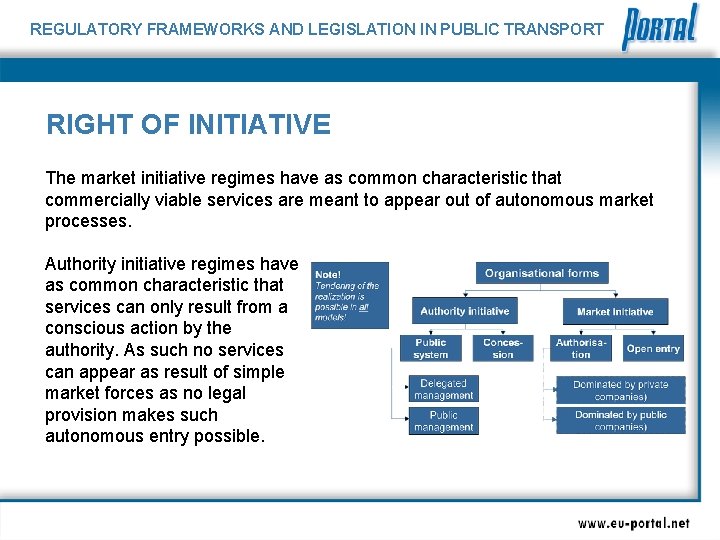
REGULATORY FRAMEWORKS AND LEGISLATION IN PUBLIC TRANSPORT RIGHT OF INITIATIVE The market initiative regimes have as common characteristic that commercially viable services are meant to appear out of autonomous market processes. Authority initiative regimes have as common characteristic that services can only result from a conscious action by the authority. As such no services can appear as result of simple market forces as no legal provision makes such autonomous entry possible.
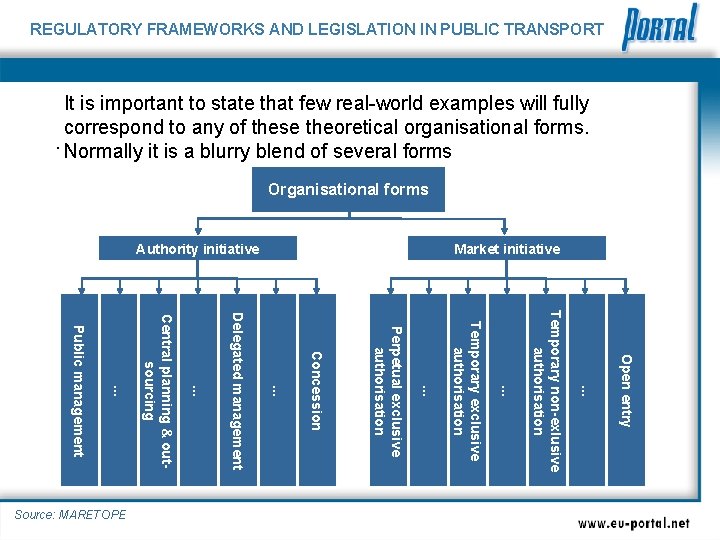
REGULATORY FRAMEWORKS AND LEGISLATION IN PUBLIC TRANSPORT It is important to state that few real-world examples will fully correspond to any of these theoretical organisational forms. . Normally it is a blurry blend of several forms Organisational forms Authority initiative Open entry . . . Temporary non-exlusive authorisation . . . Temporary exclusive authorisation . . . Perpetual exclusive authorisation Concession . . . Delegated management . . . Central planning & outsourcing . . . Public management Source: MARETOPE Market initiative
REGULATORY FRAMEWORKS AND LEGISLATION IN PUBLIC TRANSPORT MODULE 3 Source: MARETOPE
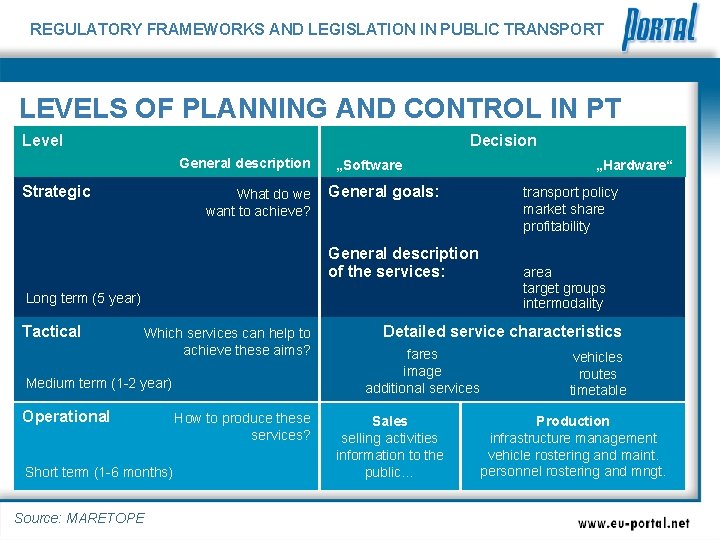
REGULATORY FRAMEWORKS AND LEGISLATION IN PUBLIC TRANSPORT LEVELS OF PLANNING AND CONTROL IN PT Level Decision General description Strategic What do we want to achieve? „Software General goals: General description of the services: Long term (5 year) Tactical Which services can help to achieve these aims? Medium term (1 -2 year) Operational Short term (1 -6 months) Source: MARETOPE How to produce these services? „Hardware“ transport policy market share profitability area target groups intermodality Detailed service characteristics fares image additional services Sales selling activities information to the public… vehicles routes timetable Production infrastructure management vehicle rostering and maint. personnel rostering and mngt.
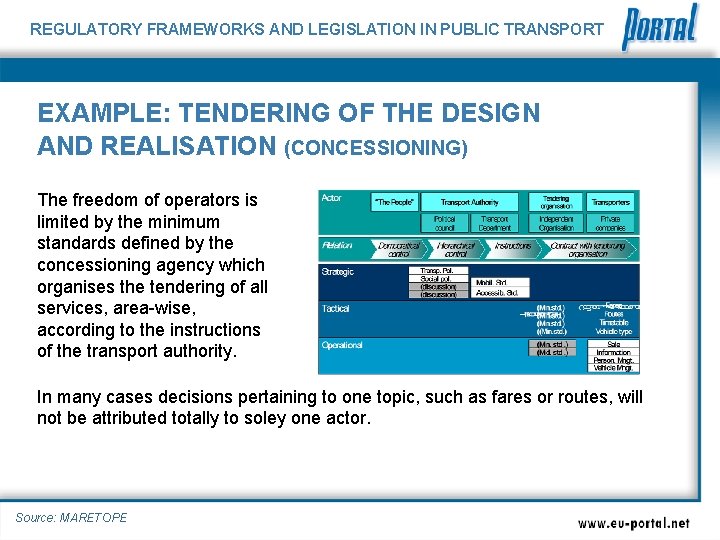
REGULATORY FRAMEWORKS AND LEGISLATION IN PUBLIC TRANSPORT EXAMPLE: TENDERING OF THE DESIGN AND REALISATION (CONCESSIONING) The freedom of operators is limited by the minimum standards defined by the concessioning agency which organises the tendering of all services, area-wise, according to the instructions of the transport authority. In many cases decisions pertaining to one topic, such as fares or routes, will not be attributed totally to soley one actor. Source: MARETOPE
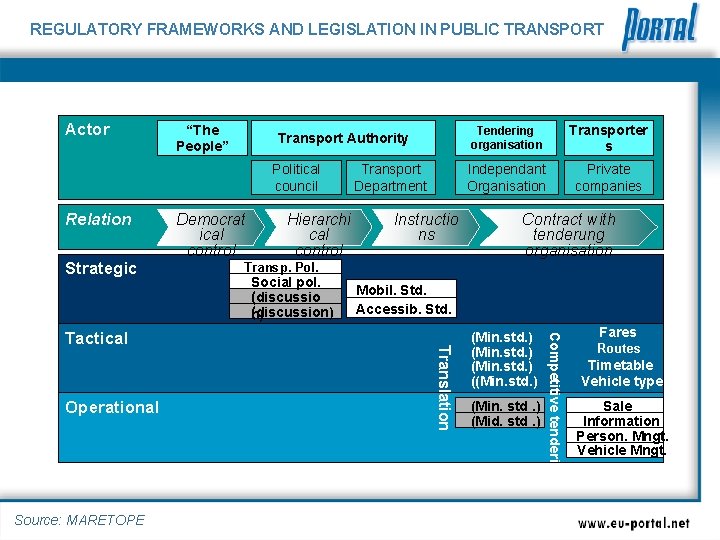
REGULATORY FRAMEWORKS AND LEGISLATION IN PUBLIC TRANSPORT Actor “The People” Transport Authority Political council Relation Strategic Source: MARETOPE Instructio ns Transporter s Independant Organisation Private companies Contract with tenderung organisation Transp. Pol. Social pol. (discussio (ndiscussion) ) Mobil. Std. Accessib. Std. (Min. std. ) (Mid. std. ) Competitive tendering Operational Hierarchi cal control Translation Tactical Democrat ical control Transport Department Tendering organisation Fares Routes Timetable Vehicle type Sale Information Person. Mngt. Vehicle Mngt.
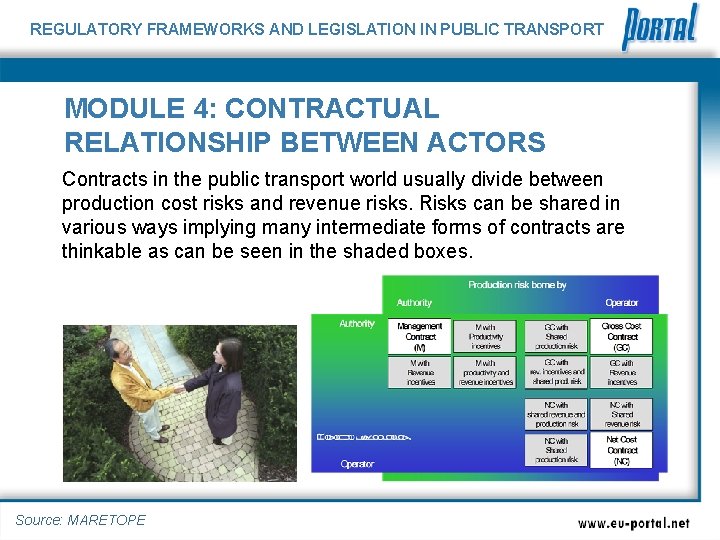
REGULATORY FRAMEWORKS AND LEGISLATION IN PUBLIC TRANSPORT MODULE 4: CONTRACTUAL RELATIONSHIP BETWEEN ACTORS Contracts in the public transport world usually divide between production cost risks and revenue risks. Risks can be shared in various ways implying many intermediate forms of contracts are thinkable as can be seen in the shaded boxes. Source: MARETOPE
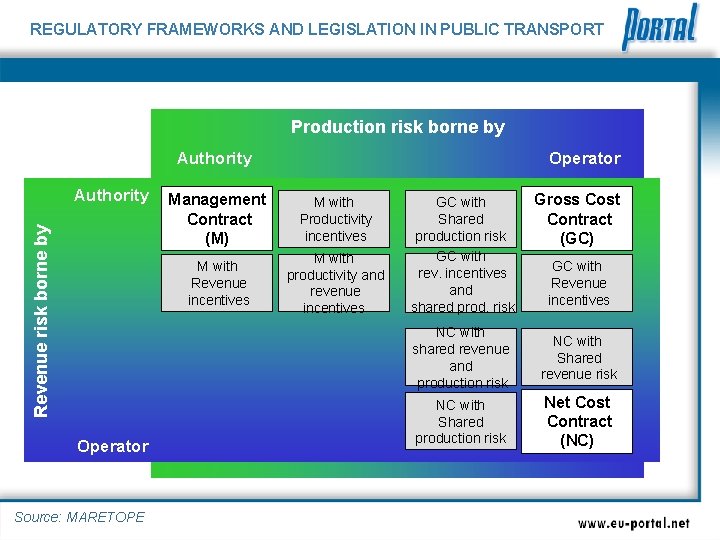
REGULATORY FRAMEWORKS AND LEGISLATION IN PUBLIC TRANSPORT Production risk borne by Authority Revenue risk borne by Authority Operator Source: MARETOPE Operator Management Contract (M) M with Productivity incentives M with Revenue incentives M with productivity and revenue incentives GC with Shared production risk GC with rev. incentives and shared prod. risk Gross Cost Contract (GC) GC with Revenue incentives NC with shared revenue and production risk NC with Shared revenue risk NC with Shared production risk Net Cost Contract (NC)
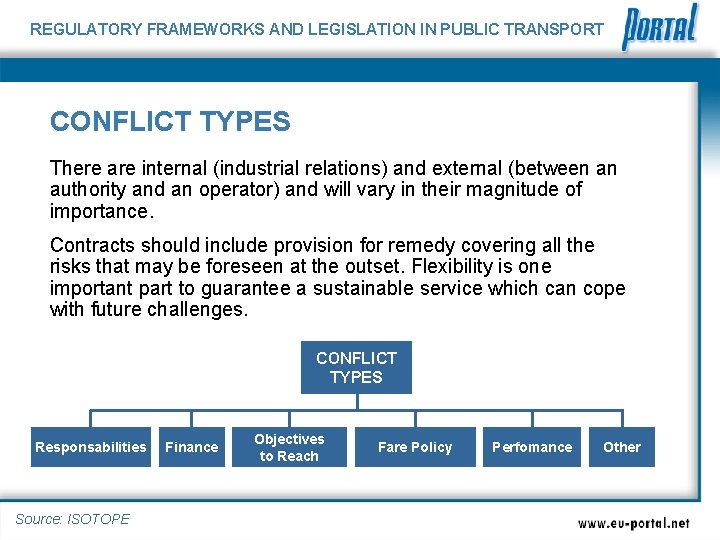
REGULATORY FRAMEWORKS AND LEGISLATION IN PUBLIC TRANSPORT CONFLICT TYPES There are internal (industrial relations) and external (between an authority and an operator) and will vary in their magnitude of importance. Contracts should include provision for remedy covering all the risks that may be foreseen at the outset. Flexibility is one important part to guarantee a sustainable service which can cope with future challenges. CONFLICT TYPES Responsabilities Source: ISOTOPE Finance Objectives to Reach Fare Policy Perfomance Other
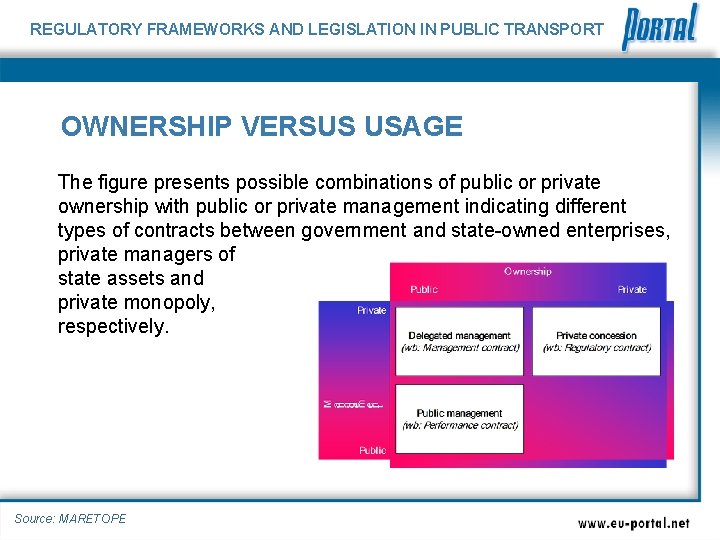
REGULATORY FRAMEWORKS AND LEGISLATION IN PUBLIC TRANSPORT OWNERSHIP VERSUS USAGE The figure presents possible combinations of public or private ownership with public or private management indicating different types of contracts between government and state-owned enterprises, private managers of state assets and private monopoly, respectively. Source: MARETOPE
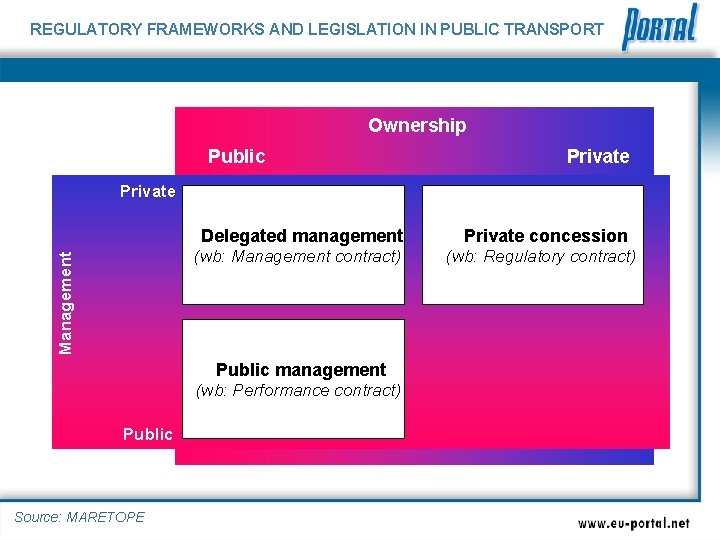
REGULATORY FRAMEWORKS AND LEGISLATION IN PUBLIC TRANSPORT Ownership Public Private Management Private Delegated management Private concession (wb: Management contract) (wb: Regulatory contract) Public management (wb: Performance contract) Public Source: MARETOPE
REGULATORY FRAMEWORKS AND LEGISLATION IN PUBLIC TRANSPORT FIXED VERSUS FLEXIBLE PLANNING In the context of tendering, decision making at the tactical level can be organised. • prior to the contracting out and operators have no tactical powers (London, Copenhagen) • (prior to the contracting out and operators have some tactical powers (Helsingborg, Sundsvall) • during the contracting out (Netherlands, France) simultaneously with the contracting out of the operational level • during the contracting out not simultaneously with the contractingout of the operational level
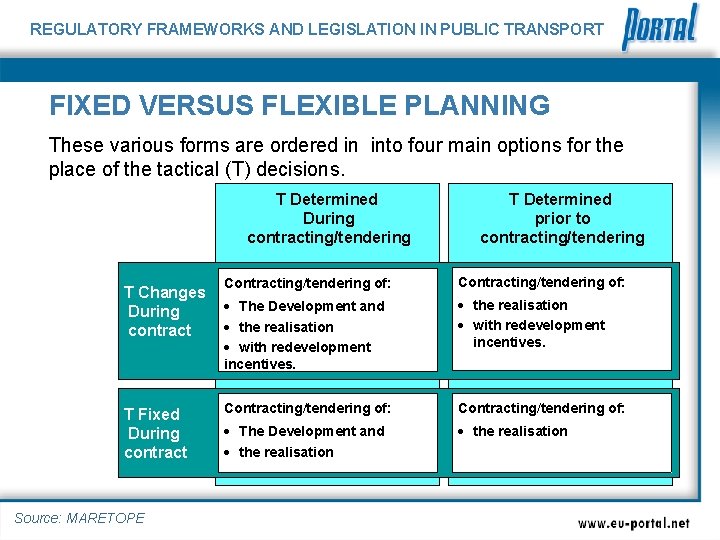
REGULATORY FRAMEWORKS AND LEGISLATION IN PUBLIC TRANSPORT FIXED VERSUS FLEXIBLE PLANNING These various forms are ordered in into four main options for the place of the tactical (T) decisions. T Determined During contracting/tendering T Changes During contract T Fixed During contract Source: MARETOPE T Determined prior to contracting/tendering Contracting/tendering of: · The Development and · the realisation · with redevelopment incentives. Contracting/tendering of: · The Development and · the realisation
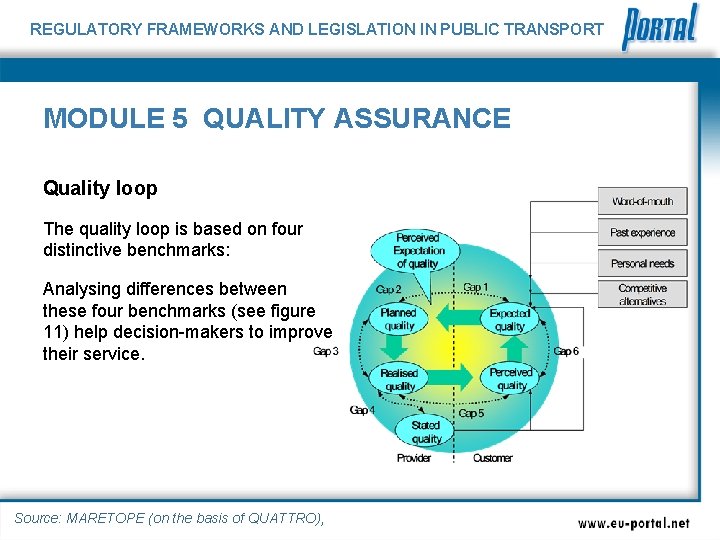
REGULATORY FRAMEWORKS AND LEGISLATION IN PUBLIC TRANSPORT MODULE 5 QUALITY ASSURANCE Quality loop The quality loop is based on four distinctive benchmarks: Analysing differences between these four benchmarks (see figure 11) help decision-makers to improve their service. Source: MARETOPE (on the basis of QUATTRO),
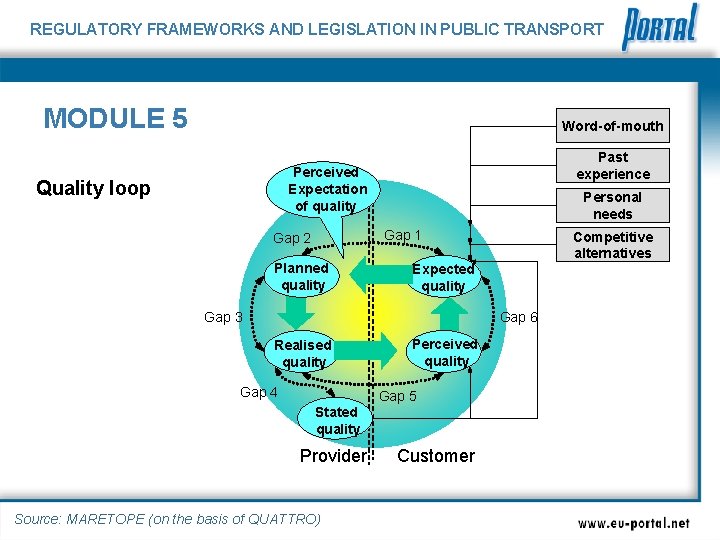
REGULATORY FRAMEWORKS AND LEGISLATION IN PUBLIC TRANSPORT MODULE 5 Word-of-mouth Past experience Perceived Expectation of quality Quality loop Personal needs Gap 1 Gap 2 Planned quality Competitive alternatives Expected quality Gap 3 Gap 6 Realised quality Gap 4 Perceived quality Gap 5 Stated quality Provider Source: MARETOPE (on the basis of QUATTRO) Customer
REGULATORY FRAMEWORKS AND LEGISLATION IN PUBLIC TRANSPORT CONTRACT DESIGN The contract should specify: • objectives of continuous improvement • tools and responsibilities, including measurement and/or monitoring programs • consequences of the measures, including financial incentives and/or penalties • control of these results • recourse procedure in the case of non application of the contract
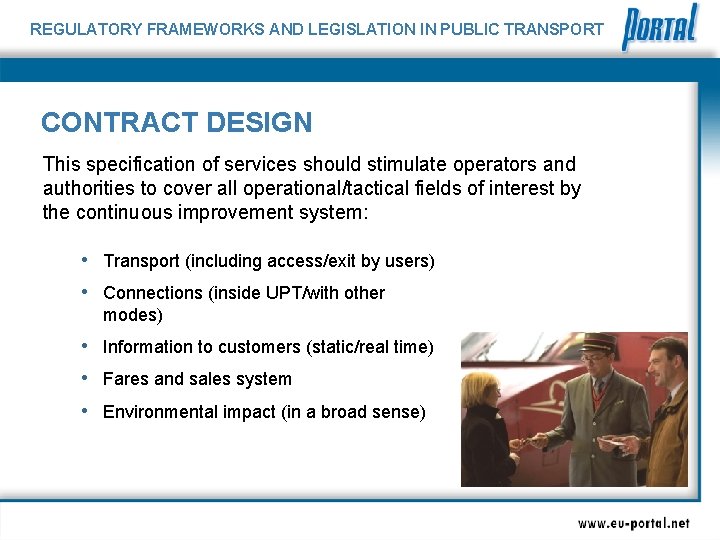
REGULATORY FRAMEWORKS AND LEGISLATION IN PUBLIC TRANSPORT CONTRACT DESIGN This specification of services should stimulate operators and authorities to cover all operational/tactical fields of interest by the continuous improvement system: • Transport (including access/exit by users) • Connections (inside UPT/with other modes) • Information to customers (static/real time) • Fares and sales system • Environmental impact (in a broad sense)
REGULATORY FRAMEWORKS AND LEGISLATION IN PUBLIC TRANSPORT MODUL 6 INTEGRATION The contract should specify: • Logical integration • Physical integration • Traffic integration Continuous improvement By ”continuous improvement” of urban public transport, we consider the need for continuous adjustment of the service design and of the organisation in charge of providing the service, in order to maintain or increase its value. Innovation in service and management is generated by continuous improvement systems.
REGULATORY FRAMEWORKS AND LEGISLATION IN PUBLIC TRANSPORT FINANCING AND SUBSIDING Pricing and financing in Urban Transport are closely related concepts since the level of prices determines the self-financing capacity, and consequently the need for subsidies. The following categories of financing can be distinguished: • • Transport users contributions Contributions from public sources and public companies Contributions from other beneficiaries Private sources
- Slides: 25